
Last updated October 20, 2026. Features, availability, analyst placements, and published prices were checked against each vendor’s product pages, documentation, and announcements on that date.
The best AI agent governance platforms for CIOs and CISOs in 2026 are ServiceNow Super Intelligence Control Tower for one enterprise system of record, Microsoft Agent 365 for Microsoft estates, and IBM watsonx.governance for regulated lifecycle control. Airia, OneTrust, Credo AI, ModelOp, Holistic AI, Truyo, and Boomi Agent Control Tower complete the ranked list.
Choose a control plane such as ServiceNow or Agent 365 when the hard problem is knowing which agents exist and who owns them. Choose a runtime platform such as Airia or ModelOp when security must stop a tool call before it runs. None of these platforms fixes an agent that holds broader credentials than its job needs, so least privilege still comes first.
An AI agent governance platform is software that inventories the agents a company builds and buys, scores their risk, routes approvals, collects audit evidence, and increasingly blocks actions that break policy. This ranking sits in our governance and compliance coverage within AI governance and security. No vendor paid for placement or reviewed this page, per our editorial standards and disclosure policy.
TL;DR
- Gartner made it a category this year. Its first Magic Quadrant for AI Governance Platforms, published June 16, 2026, evaluated 13 vendors and named IBM, ServiceNow, and Truyo as Leaders. Model vendors are adding their own monitoring too, as in OpenAI misalignment monitoring for API agents.
- ServiceNow leads for CIOs because its control tower ties agents, models, MCP servers, and identities to the CMDB, and it already offers a kill switch.
- Microsoft Agent 365 is the only control plane here with a simple public price: $15 per user per month, or included in Microsoft 365 E7 at $99.
- CISOs who need enforcement should shortlist Airia and ModelOp, which block tool calls and unapproved MCP servers in the traffic path.
- Our capability check: 6 of the 10 platforms document a way to stop or block an agent action today, 5 document MCP-specific controls, and only 2 publish a price.
- Discovery is not control. Holistic AI, Truyo, and Boomi find agents well, but Truyo documents no runtime control and Holistic AI is still extending it.
10 Best AI Agent Governance Platforms at a Glance
Pick an AI agent governance platform by the job it must do first: own the inventory, enforce policy at runtime, or produce compliance evidence. The table compares all 10 on that job, analyst placement, runtime control, Model Context Protocol (MCP) coverage, and price. Every cell reflects vendor pages, documentation, and announcements checked on October 20, 2026.
| Platform | Best for | Gartner MQ 2026 | Stops an agent action | MCP controls | Published price |
|---|---|---|---|---|---|
| ServiceNow Super Intelligence Control Tower | One AI system of record on the CMDB | Leader | Yes, kill switch | MCP servers in inventory; AI Passport Q4 2026 | Quote only |
| Microsoft Agent 365 | Microsoft 365 agent estates | Not evaluated | Yes, Entra network controls and Purview DLP | MCP mapping for local agents, preview | $15 per user per month |
| IBM watsonx.governance | Regulated model and agent lifecycles | Leader | Alerts on metrics; no block documented | Tool catalog; MCP not documented | From $0.64; Risk and Compliance from $3,500 per month |
| Airia | Security teams that want runtime enforcement | Visionary | Yes, Agent Constraints | Yes, MCP Gateway | Quote only |
| OneTrust AI Governance | Privacy and GRC teams moving into agents | Visionary | Yes, block, redact, route | Yes, MCP policies with audit logs | Quote only |
| Credo AI | Policy to evidence compliance | Visionary | Research preview, Claude Code first | Not documented | Quote only |
| ModelOp | Gating MCP and A2A tools on approval | Visionary | Yes, proxy or Kong blocking | Yes, import and block | Quote only |
| Holistic AI | Risk testing and shadow AI discovery | Challenger | Guardian Agents, being extended | Not documented | Quote only |
| Truyo | Privacy-led shadow AI inventory | Leader | Not documented | Not documented | Quote only |
| Boomi Agent Control Tower | One registry across six agent providers | Not evaluated | Switch agents on or off on some providers | Not documented | Included in Agentstudio Base edition |
Verdict: ServiceNow and Microsoft suit CIOs who start from an inventory problem, and Airia, ModelOp, and OneTrust suit CISOs who must enforce policy in the traffic path. IBM, Credo AI, and Holistic AI are strongest when the auditor is the first customer. Truyo and Boomi are discovery and registry tools first.
How We Ranked These AI Agent Governance Platforms
We ranked platforms on how well they govern agents in particular, not AI models in general, and on evidence a buyer can check. We started from the 13 vendors in the Gartner Magic Quadrant for AI Governance Platforms and added two agent control planes it did not cover, then read every vendor’s own pages on October 20, 2026.
- Inventory reach: whether the platform finds agents built on other vendors’ platforms, not just its own.
- Runtime control: whether it can stop, block, or disable an agent action, and whether that control is generally available or a preview.
- MCP coverage: whether it inventories or polices Model Context Protocol servers, the tool connections most agents now use.
- Compliance content: prebuilt assessments for the EU AI Act, the NIST AI Risk Management Framework (AI RMF), and ISO/IEC 42001.
- Analyst standing: placement in the 2026 Gartner Magic Quadrant, which we treat as one input rather than the ranking itself.
- Price clarity: a published price or a public licensing model, which only two of the 10 offer.
We did not deploy the platforms or run attack tests, so there are no star ratings, and every capability described here is the vendor’s own claim. Runtime security tools that block prompt injection without a governance workflow, such as dedicated detectors, belong to our agent security coverage instead.
What Our October 20 Capability Check Found
Every one of the 10 platforms keeps an agent inventory, but only 6 document a way to stop or block an agent action today, and only 2 publish a price. We scored each platform on seven capabilities from its own public pages and documentation on October 20, 2026. A capability counted only when the vendor documented it in public.
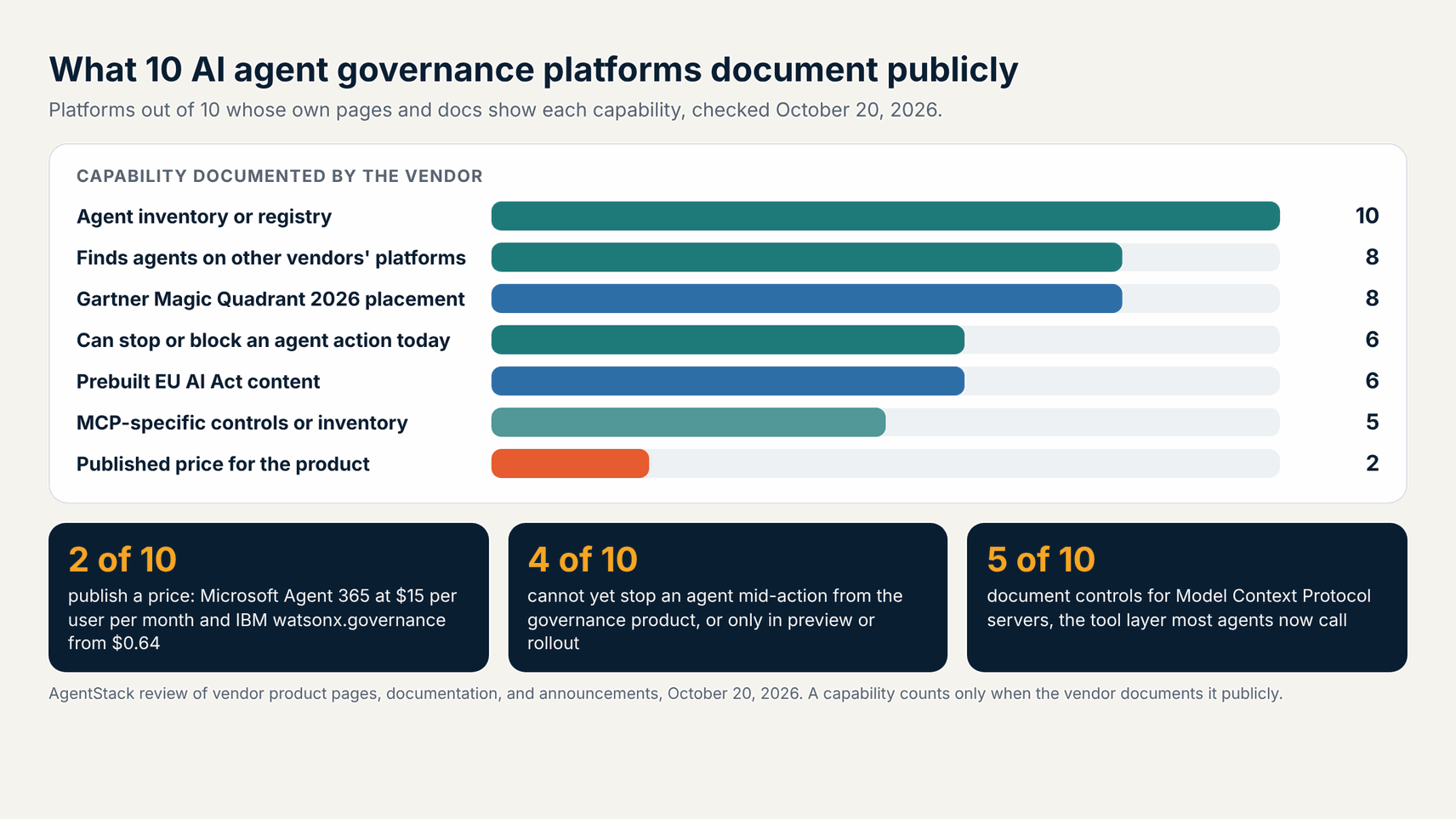
- Discovery reaches past the vendor’s own stack in 8 of 10. Airia and Credo AI keep registries, but neither documents automatic discovery of agents on other platforms in its public pages.
- Runtime control splits the field. ServiceNow, Microsoft, Airia, OneTrust, ModelOp, and Boomi document a way to stop or block an agent action, while Credo AI’s Agent Governor is a research preview and Holistic AI is still extending its Guardian Agents.
- MCP is the newest line item. Five platforms document MCP-specific inventory or policy: ServiceNow, Microsoft, Airia, OneTrust, and ModelOp.
- EU AI Act content is common but not universal. ServiceNow, Microsoft, IBM, Airia, OneTrust, and Credo AI ship prebuilt EU AI Act assessments or templates.
- Prices stay hidden. Only Microsoft and IBM publish a price for the governance product, and Boomi bundles its control tower into an existing edition.
The gap between inventory and enforcement is where agent incidents happen, because a registry entry does not stop a tool call. The NIST, NSA, and CISA incident practices for rogue AI agents assume teams can isolate an agent quickly, which needs a working kill path rather than a spreadsheet.
1. ServiceNow Super Intelligence Control Tower: Best for One AI System of Record
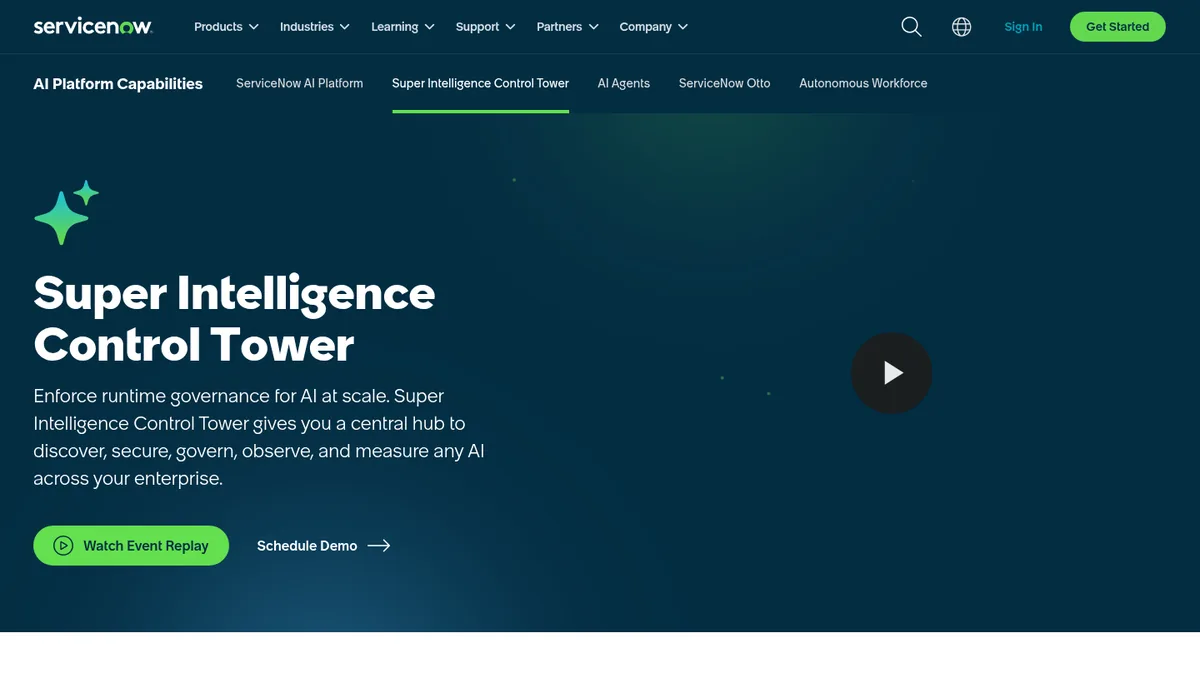
ServiceNow Super Intelligence Control Tower is the strongest pick for CIOs who want every agent, model, and MCP server tied to an owner, a business service, and a risk record in one place. The product, formerly AI Control Tower, maps AI assets to the ServiceNow Configuration Management Database (CMDB), per its product page. ServiceNow was named a Leader in Gartner’s 2026 Magic Quadrant, per its report page.
At Knowledge 2026 on May 5, ServiceNow added 30 discovery integrations spanning AWS, Google Cloud, Microsoft Azure, SAP, Oracle, and Workday, five risk frameworks aligned to NIST and the EU AI Act, and a kill switch for agents that go off script, per its May 5, 2026 announcement. Its October 15, 2026 release adds AI Passport, a signed credential that agents and MCP servers check at runtime, expected in Q4 2026.
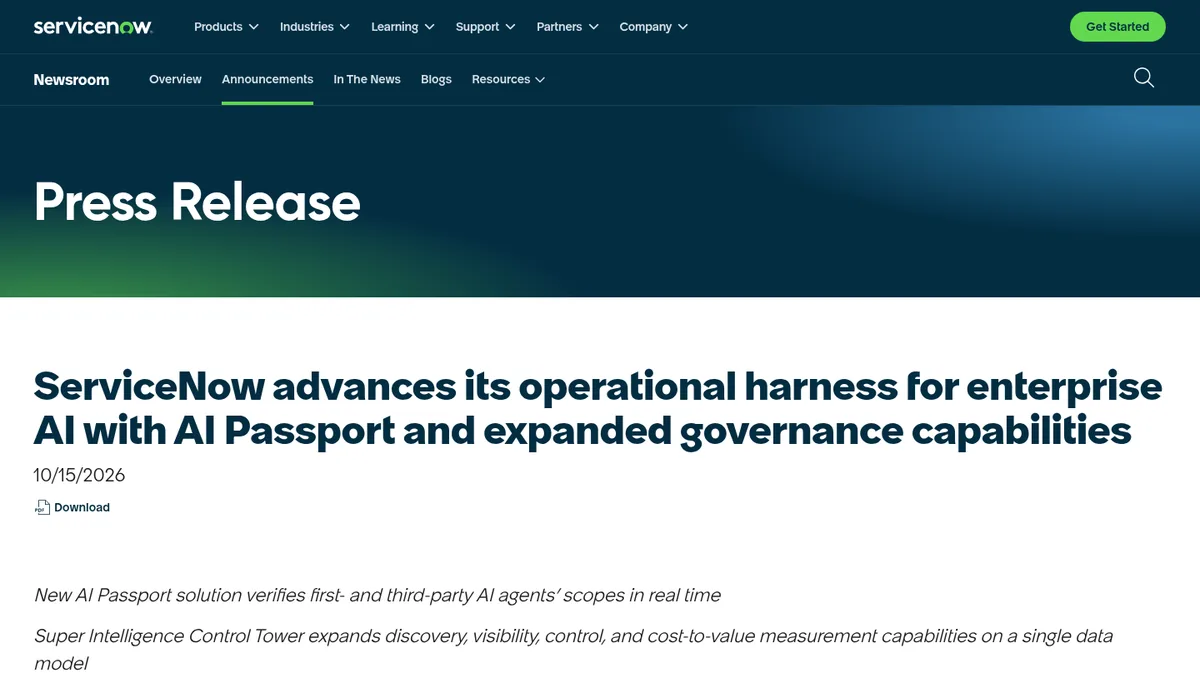
LTM’s chief information security officer said in that release that the company has deployed 1,500 AI agents, each with an employee ID and a manager, and uses the control tower as their system of record. That pattern of treating agents as accountable workers is the clearest reason to buy a CMDB-based platform.
- Best for: Enterprises that already run IT, risk, and security workflows on ServiceNow and want agents governed like any other configuration item.
- Pricing (October 2026): Not published; sales-led quotes through your ServiceNow account team.
- Watch out for: AI Passport, shadow AI detection, and AI Cost Management were still expected in Q4 2026, so verify which features your contract includes today.
2. Microsoft Agent 365: Best for Microsoft 365 Agent Estates
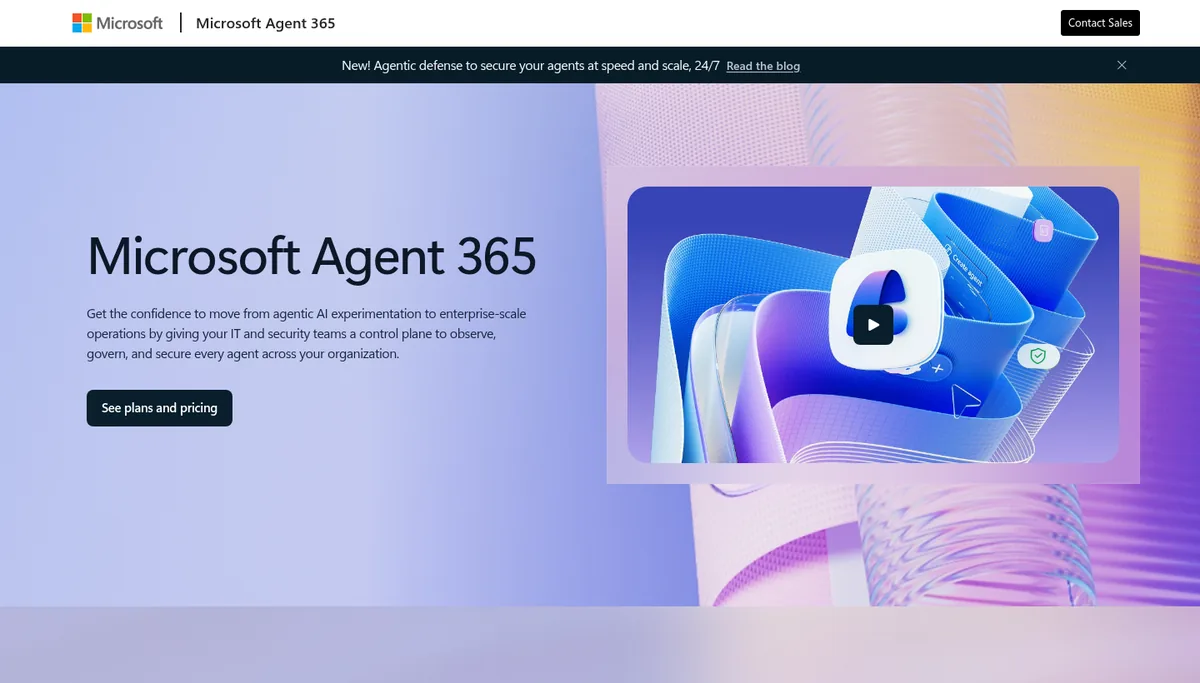
Microsoft Agent 365 is the natural choice when most agents run in Microsoft 365 Copilot, Copilot Studio, Teams, or Foundry, because it governs them with Entra, Defender, and Purview controls IT already operates. It became generally available on May 1, 2026, per Microsoft’s general availability announcement. Microsoft is not among the 13 vendors in Gartner’s governance Magic Quadrant.
Agent 365 keeps a unified agent registry and, in public preview, syncs it with AWS Bedrock and Google Cloud to inventory agents there. Partner agents from Genspark, Zendesk, Egnyte, Kore, and n8n arrive preconfigured. Agent instances are automatically included in Purview Compliance Manager’s assessments for AI regulations, per Microsoft Learn.
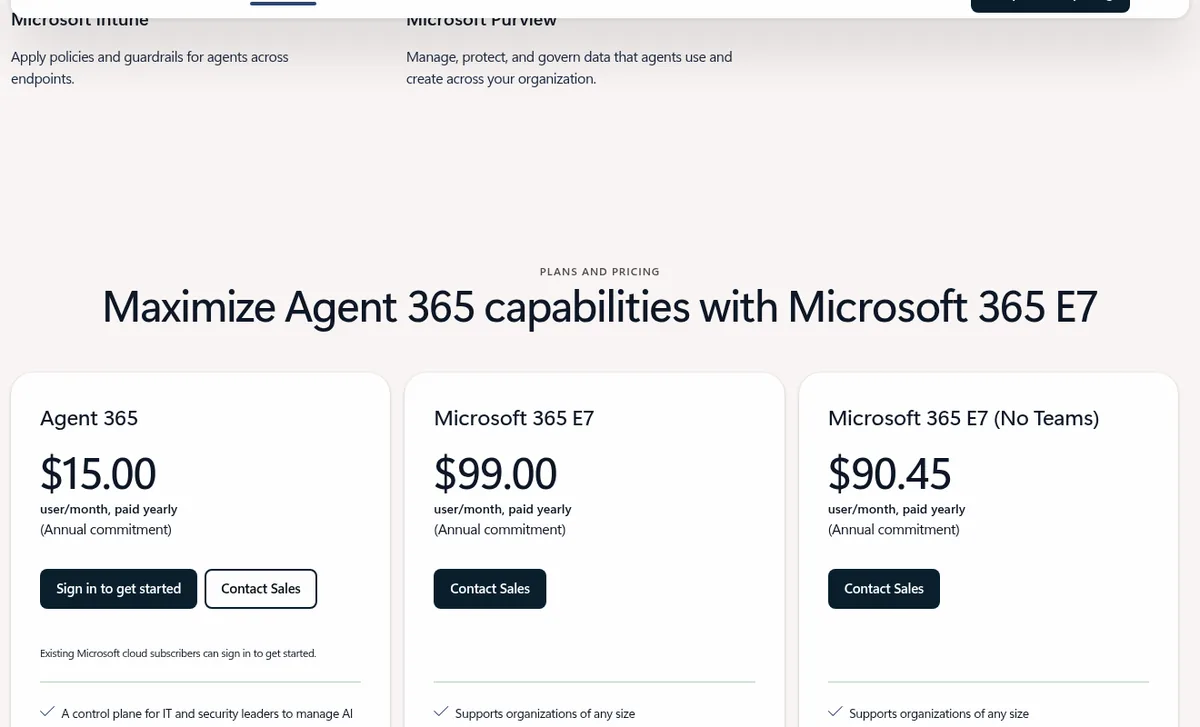
Licensing is per user, and agents themselves need no license, per the Agent 365 licensing FAQ. One license covers every agent a person uses, owns, manages, or sponsors.
- Best for: Microsoft-first organizations that want agent governance inside the Microsoft 365 admin center and existing security tools.
- Pricing (October 2026): $15 per user per month standalone with an annual commitment, or included in Microsoft 365 E7 at $99 per user per month.
- Watch out for: Cross-cloud registry sync, local agent discovery, and Defender runtime blocking for coding agents were previews in 2026, so non-Microsoft coverage trails Microsoft’s own.
3. IBM watsonx.governance: Best for Regulated Model and Agent Lifecycles
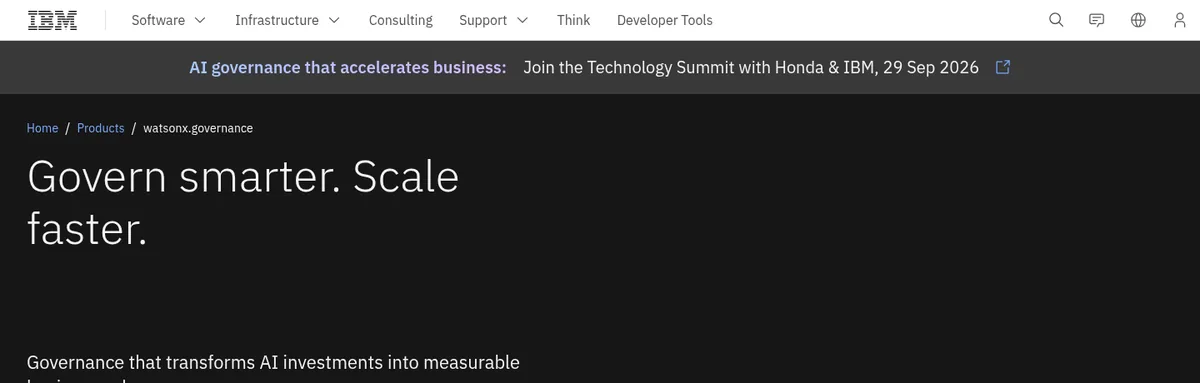
IBM watsonx.governance fits banks, insurers, and public bodies that already run model risk management and now need agents in the same evidence trail. IBM was named a Leader in Gartner’s 2026 Magic Quadrant, per its June 17, 2026 announcement. Its Governed Agentic Catalog registers agents and tools, and evaluation works for agents built on third-party platforms, per IBM’s agentic governance overview.
The product ships a library of more than 50 evaluation metrics and a predefined EU AI Act applicability assessment that sorts each use case into prohibited, high, limited, or minimal risk, per IBM documentation. Production monitoring raises alerts when metrics cross thresholds, so IBM detects and documents problems rather than stopping a running agent.
- Best for: Regulated firms that need model risk, agent evaluation, and compliance records in one audited system.
- Pricing (October 2026): Model Management from $0.64 pay as you go; Risk and Compliance Basic from $3,500 per month for one module and one concurrent user; Advanced from $6,450 per month, per the pricing page.
- Watch out for: IBM documents alerts, not a kill switch, for third-party agents, and the entry plans cap concurrent users.
4. Airia: Best for CISOs Who Want Governance Enforced at Runtime
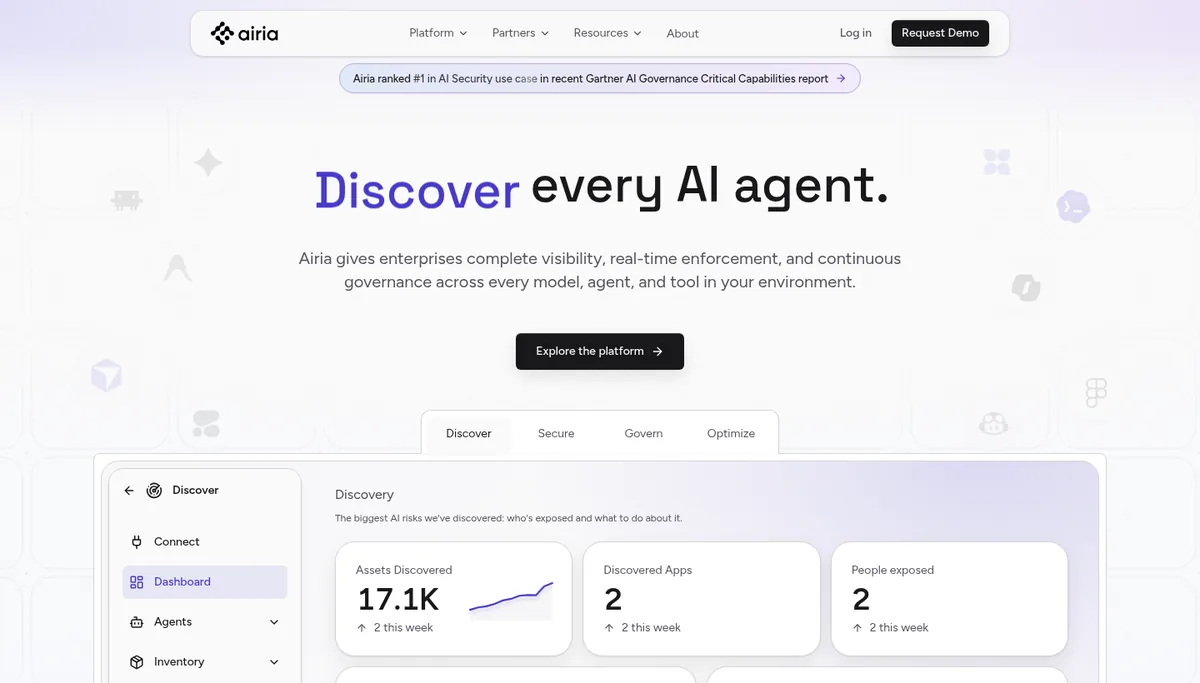
Airia is the best pick for security leaders who want governance policies to block risky tool calls before they execute, not to be reviewed afterward. Airia was named a Visionary in Gartner’s 2026 Magic Quadrant, placed furthest on Completeness of Vision, and ranked first for the AI Security use case in the companion Critical Capabilities report, per its June 22, 2026 announcement.
Its Agent Constraints engine intercepts each tool call, evaluates IF-THEN policies, and allows it, blocks it, limits its parameters, or sends it for approval, per Airia’s Agent Constraints technical post. Airia says simple policies add under 10 milliseconds and complex ones under 50. Its governance page lists audit reports for GDPR, HIPAA, ISO 42001, NIST AI RMF, and the EU AI Act.
- Best for: Security teams that want one platform for agent inventory, MCP gateway policy, and compliance reporting.
- Pricing (October 2026): Enterprise pricing by quote; Airia’s site lists usage limits per tier rather than enterprise prices.
- Watch out for: Constraints apply only to traffic routed through Airia, so agents that call tools directly stay outside its enforcement.
5. OneTrust AI Governance: Best for Privacy and GRC Teams Moving Into Agents
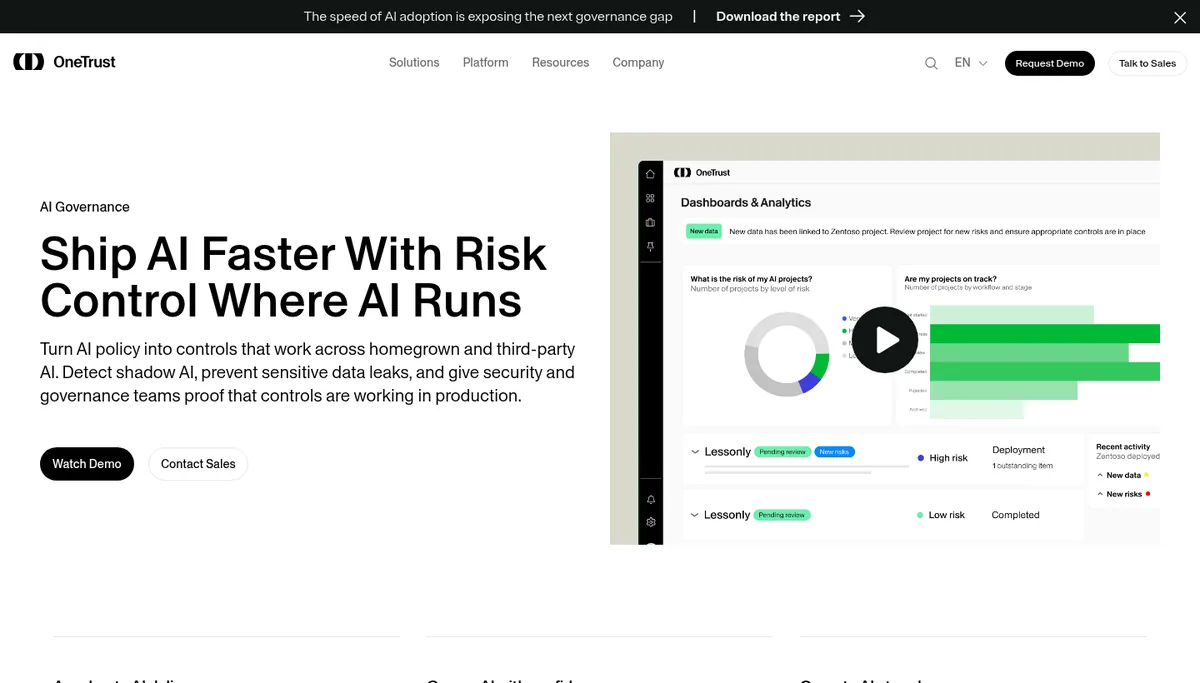
OneTrust AI Governance suits companies whose privacy and GRC teams already run on OneTrust and now own agent oversight. OneTrust was named a Visionary in Gartner’s 2026 Magic Quadrant, per its report page. Its AI governance page covers discovery of systems, models, agents, datasets, and vendors, with EU AI Act, NIST AI RMF, and ISO 42001 templates.
OneTrust reads runtime signals from Amazon Bedrock and AgentCore, Microsoft Foundry, Databricks, and Gemini Enterprise Agent Platform, and its guardrail enforcement can block, allow, redact, escalate, or route actions by policy. For agents, it registers each one with a defined purpose and enforces MCP policies with audit logs, which few GRC vendors document.
- Best for: Privacy, legal, and GRC leaders who want agent policies, assessments, and evidence in the same program center as the rest of their AI portfolio.
- Pricing (October 2026): Not published; sales-led quotes.
- Watch out for: OneTrust says platform coverage varies by integration: Bedrock gives usage and log signals, while Foundry gives evaluation visibility and guardrail enforcement.
6. Credo AI: Best for Policy to Evidence Compliance Programs
Credo AI is the strongest fit when the governance team must turn written policy into per-agent controls and audit-ready evidence for the EU AI Act and ISO 42001. Credo AI was named a Visionary in Gartner’s 2026 Magic Quadrant, per its recognition page. Its AI Agent Registry tracks built and vendor-supplied agents with autonomy classification, lineage, and risk-to-policy mapping.
On July 14, 2026, Credo AI launched Agent Governor in research preview, which installs governance as code onto the agent harness and resolves each step to allow, block, escalate, or advise, per its launch post. Agent Governor starts with Claude Code. Credo AI’s survey of 371 senior leaders in the same post found that 60% deploy AI across several departments and 4% govern it at scale.
- Best for: Compliance-led programs that want curated policy packs, approvals, and evidence for every agent.
- Pricing (October 2026): Not published; sales-led quotes.
- Watch out for: Runtime enforcement is a research preview limited to Claude Code, so treat Credo AI as a governance workflow layer today.
7. ModelOp: Best for Gating MCP and A2A Tools on Approval
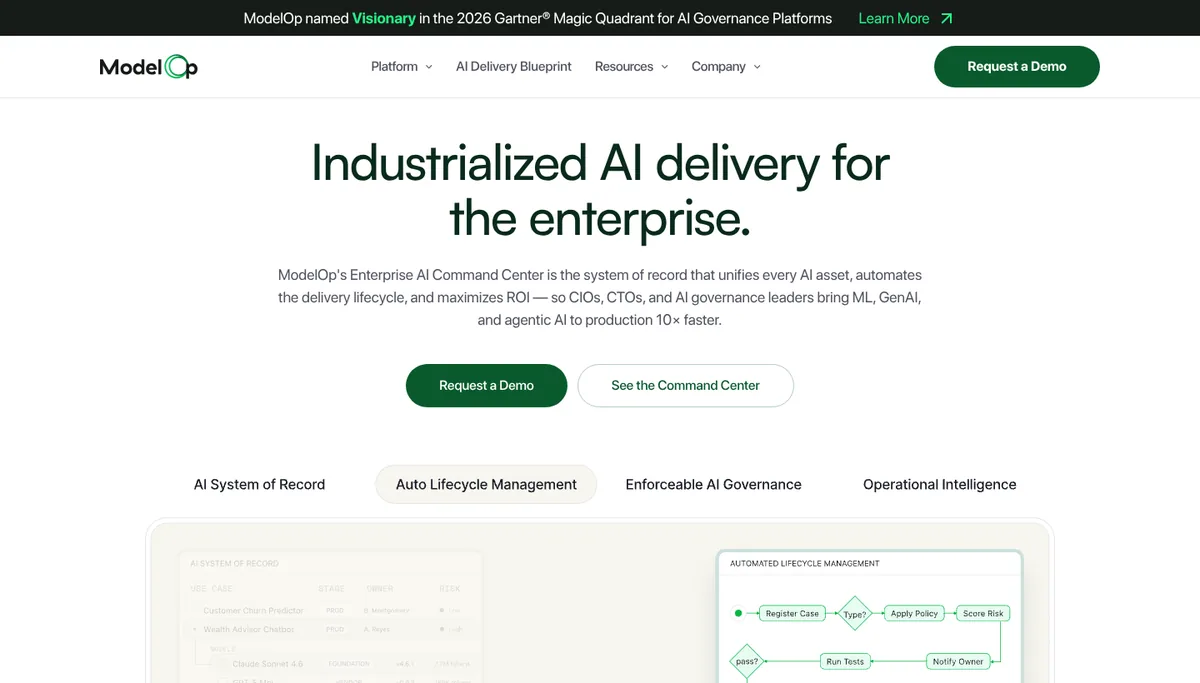
ModelOp is the best fit when no MCP tool or agent should receive traffic until it has an approved risk record. ModelOp was named a Visionary in Gartner’s 2026 Magic Quadrant, per its announcement. It imports Agent2Agent (A2A) agent cards and MCP tool definitions into one inventory, and its proxy blocks unapproved agent traffic, per its agentic governance launch.
Its July 16, 2026 Kong partnership wires approvals into Kong AI Gateway: a newly discovered MCP tool gets a draft risk tier, Kong blocks it, and traffic flows only after an approver signs off. Teams comparing gateways can read our MCP gateways guide and Kong vs AWS AgentCore vs Docker comparison.
- Best for: Enterprises with a central AI portfolio office that wants approvals enforced at the network edge for ML, generative AI, and agents.
- Pricing (October 2026): Not published; sales-led quotes.
- Watch out for: Blocking needs agent traffic to pass through ModelOp’s proxy or a connected gateway such as Kong.
8. Holistic AI: Best for Risk Testing and Shadow AI Discovery
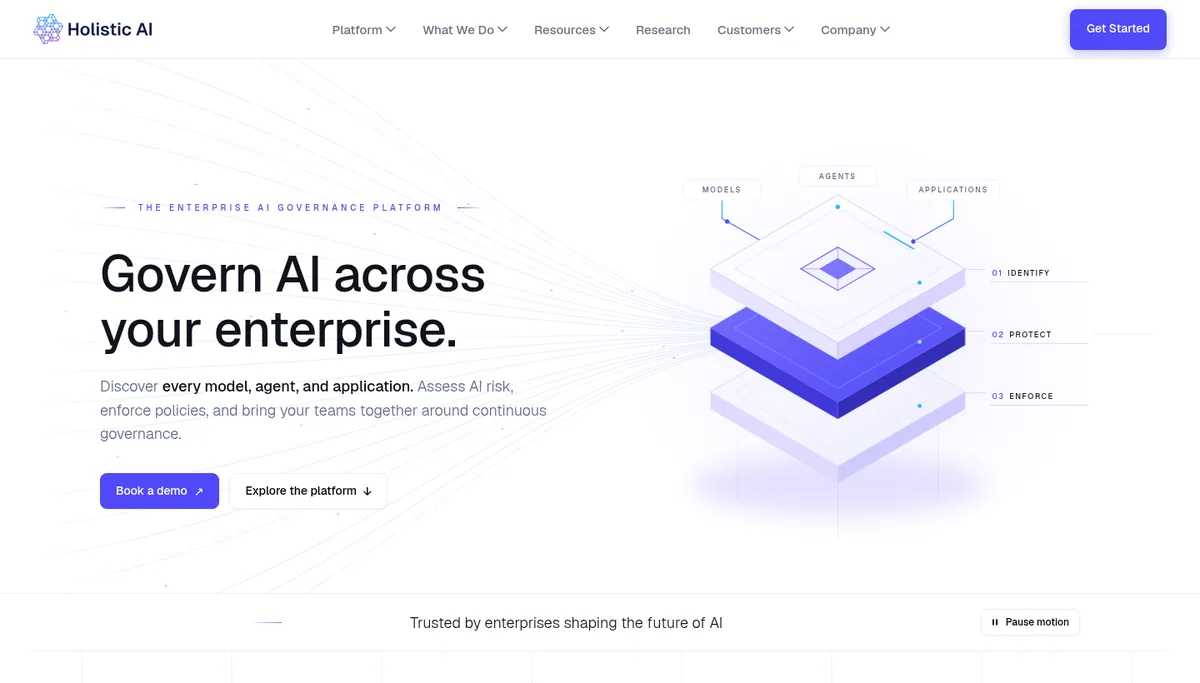
Holistic AI suits risk teams that need to find undocumented agents and test them for bias, robustness, privacy, and security before and after launch. Holistic AI was the only Challenger in Gartner’s 2026 Magic Quadrant and ranked first for the AI Risk and Compliance use case in Critical Capabilities, per its July 7, 2026 post. It also placed in the top three for AI Agent Governance.
Its Sentinel Agents scan cloud environments and code repositories for models, agents, APIs, and use cases, and Agent Graph maps how agents, tools, tasks, and data connect, per its platform overview. Guardian Agents, described on April 7, 2026, are meant to interrupt workflows and restrict tool access when policies are breached, per its Guardian Agents post.
- Best for: Risk and compliance teams that want discovery, pre-launch testing, and regulatory mapping in one platform.
- Pricing (October 2026): Not published; sales-led quotes.
- Watch out for: Holistic AI describes runtime enforcement as an approach it is still extending, so confirm what is live before you rely on it.
9. Truyo: Best for Privacy-Led Shadow AI Inventory
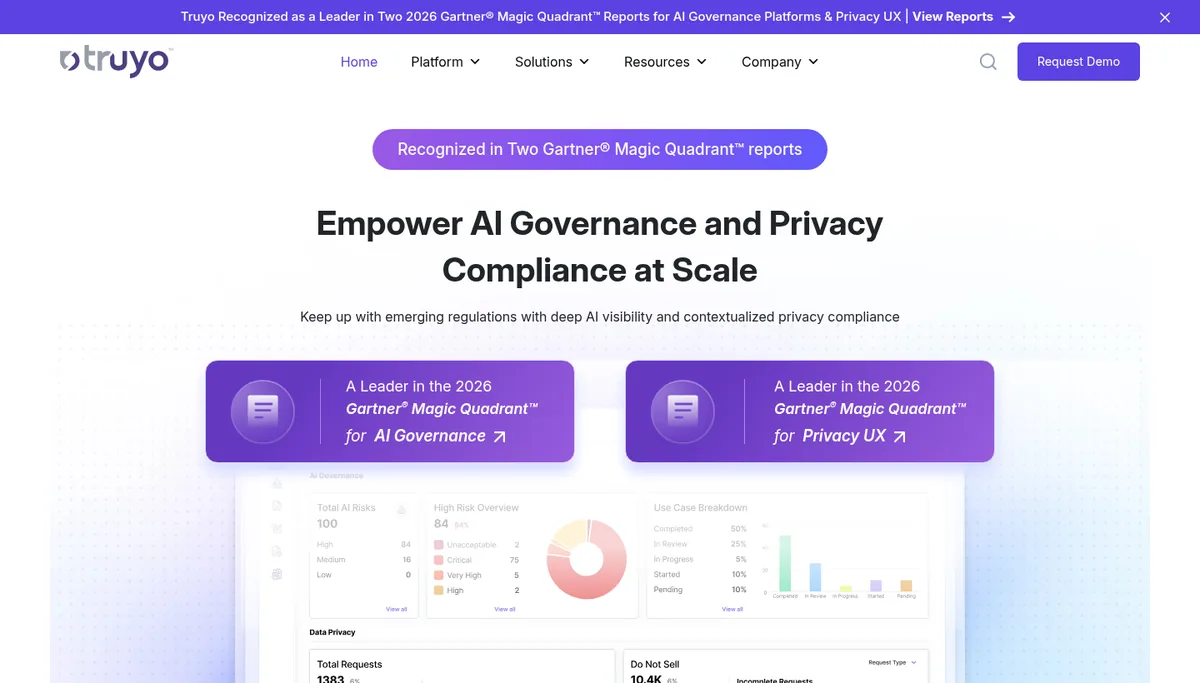
Truyo is the right first buy when the privacy office must find where AI is used before anyone can govern it. Truyo was named a Leader in Gartner’s 2026 Magic Quadrant, per its June 22, 2026 release. Its AI inventory scans URLs, repositories, emails, and source code for AI fingerprints and catalogs AI agents alongside other use cases.
Truyo pairs that inventory with risk assessments, scheduled employee surveys, vendor assessments, and governance training, per its homepage. It grew out of privacy compliance and data subject request automation, which explains its strength with legal teams.
- Best for: Privacy and legal teams at large consumer brands that need an AI inventory and assessments tied to privacy obligations.
- Pricing (October 2026): Not published; sales-led quotes.
- Watch out for: Truyo’s public pages describe inventory and assessment but no runtime control, so pair it with an enforcement layer for production agents.
10. Boomi Agent Control Tower: Best for One Registry Across Six Agent Providers
Boomi Agent Control Tower is the practical pick for integration teams that need one registry for agents built on Bedrock, Copilot, Agentforce, Snowflake, and Anthropic. It connects to Boomi Agent Garden, Amazon Bedrock, Microsoft Copilot, Salesforce, Snowflake Cortex, and Anthropic Managed Agents, plus custom providers through an API, per Boomi documentation. Boomi is not in Gartner’s governance Magic Quadrant.
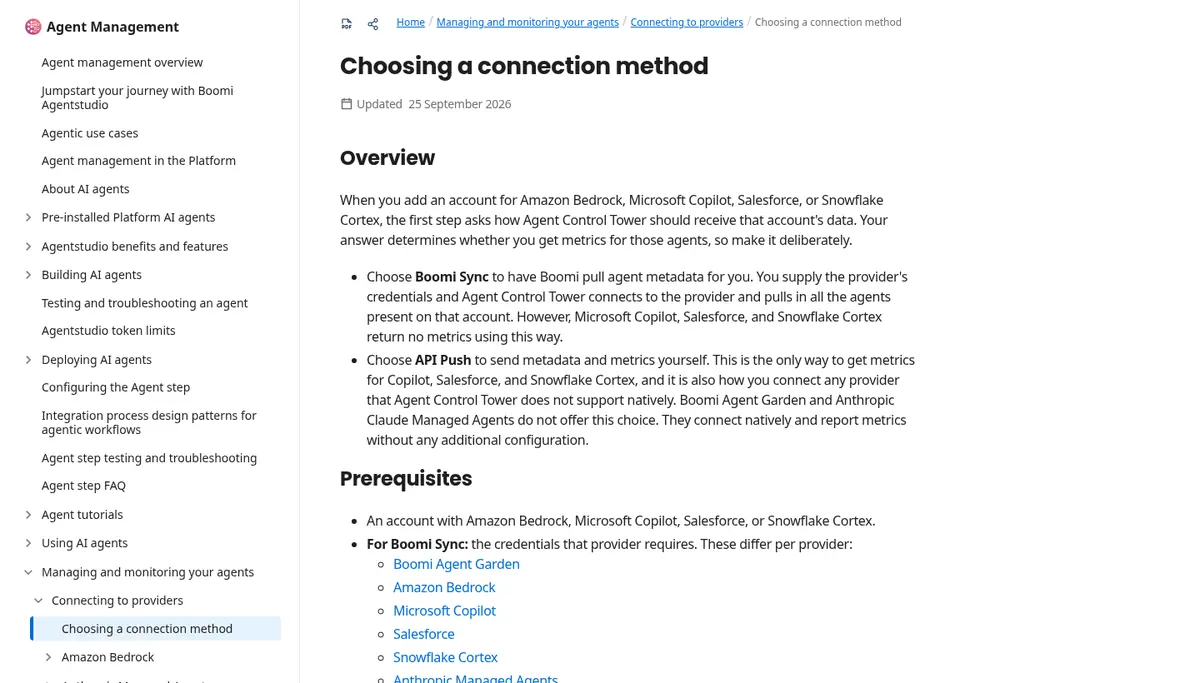
Accounts sync every 30 minutes, and some providers, such as Amazon Bedrock, let admins switch an agent on or off from the tower, per the Agent Control Tower overview. Boomi Sync returns no metrics for Copilot, Salesforce, or Snowflake Cortex, per the connection methods page, so teams must push those metrics through the API.
- Best for: Integration and platform teams that already run Boomi and want a cross-vendor agent registry without a new contract.
- Pricing (October 2026): Included in the Base edition of Agentstudio; no standalone price published.
- Watch out for: Agents built in the Salesforce Agentforce 360 beta builder do not appear, and governance stops at registry, tags, trust levels, and switching agents on or off.
The Minimum Agent Record to Demand From Any Platform
Every platform on this list stores a different agent record, so write down the fields you need before demos start. The record below is the AgentStack baseline we use when comparing vendors, and any platform that cannot hold or export these fields will leave gaps in an audit or an incident review.
# AgentStack baseline record for one AI agent (YAML)
agent_id: support-triage-agent-07
owner: it-service-desk@example.com      # accountable human, not a team alias
sponsor: vp-customer-support
platform: copilot-studio                  # where it was built and runs
identity: entra-agent-id:3f2a...          # its own credential, if any
autonomy: acts_with_approval              # suggests | acts_with_approval | acts_alone
tools:
  - name: servicenow.create_incident
    via: mcp://tools.example.com/servicenow
    scope: write
  - name: email.send
    scope: internal_domains_only
data_classes: [customer_pii, ticket_history]
risk_tier: high                           # from your EU AI Act or internal assessment
controls: [dlp_policy_12, tool_allowlist_v3]
kill_path: entra.disable + gateway.block  # how you stop it in minutes
last_review: 2026-10-20
Ask each vendor to show the kill_path and tools fields live in a demo, because those two separate a registry from a control plane. The MCP flaws in our ToFu study of 253 MCP server bugs and the FastMCP client RCE advisory show why the tool list must include each MCP endpoint, not just the agent name.
Runtime Control Compared Across the 10 Platforms
The platforms differ most in where they can stop an agent and whether that control is live today. Control planes act on identity and network access, gateway platforms act on each tool call, and workflow platforms act on approvals before launch. The table shows the enforcement point and status for each.
| Platform | How it stops an agent | Where it enforces | Status (October 2026) |
|---|---|---|---|
| ServiceNow | Kill switch; AI Passport scope checks | ServiceNow AI Platform; partner runtimes such as NVIDIA OpenShell | Kill switch available; AI Passport expected Q4 2026 |
| Microsoft Agent 365 | Entra network controls, Purview DLP, Defender blocking | Identity, network, endpoint | Network controls GA; coding agent blocking in preview |
| IBM watsonx.governance | Alerts when metrics cross thresholds | Monitoring and evaluation | Available; no block documented |
| Airia | Agent Constraints allow, block, limit, or approve | Airia runtime and MCP Gateway | Available |
| OneTrust | Guardrail enforcement and MCP policies | Supported platforms and AI Guard SDK | Available; varies by integration |
| Credo AI | Agent Governor allow, block, escalate, advise | Agent harness, Claude Code first | Research preview |
| ModelOp | Proxy and Kong blocking of unapproved tools | Network edge | Available |
| Holistic AI | Guardian Agents interrupt and restrict | Supervision layer | Being extended |
| Truyo | None documented | Not applicable | Not documented |
| Boomi | Switch an agent on or off | Bedrock, Agent Garden, Salesforce | Available on those providers |
Verdict: Airia and ModelOp give security teams the most direct control over tool calls, while ServiceNow and Microsoft act at the identity and asset level across the whole estate. IBM, Credo AI, Holistic AI, and Truyo need a separate enforcement layer today, such as an MCP gateway or a runtime security tool, for agents that can change production systems.
What AI Agent Governance Platforms Cost in 2026
Most AI agent governance platforms do not publish prices, so budgets start with a sales call and a proof of concept. Microsoft and IBM are the exceptions, and their models differ sharply: Microsoft charges per user regardless of agent count, while IBM charges by usage, instances, modules, and concurrent users.
| Platform | Published price | Pricing model |
|---|---|---|
| Microsoft Agent 365 | $15 per user per month; in Microsoft 365 E7 at $99 | Per user, annual commitment; agents need no license |
| IBM watsonx.governance | From $0.64; Risk and Compliance from $3,500 or $6,450 per month | Pay as you go, plus instance, module, and user tiers |
| Boomi Agent Control Tower | Included in Agentstudio Base edition | Part of a Boomi Enterprise Platform subscription |
| ServiceNow, Airia, OneTrust, Credo AI, ModelOp, Holistic AI, Truyo | Not published | Sales-led quotes |
Verdict: Agent 365 is the easiest to budget for a Microsoft estate, because cost follows headcount rather than agent sprawl. IBM is the easiest to pilot on a small scope. For everyone else, ask for pricing tied to agent count and connected platforms, since those drive cost as adoption grows.
AI Governance Platforms We Left Off, and Why
- Monitaur, Cranium AI, Relyance AI, Saidot, and SAP: all were evaluated in Gartner’s 2026 Magic Quadrant, but their public pages say less about agent runtime control than the 10 above, and SAP’s governance centers on SAP workloads.
- Okta for AI Agents: an identity layer for agents that pairs well with any platform here, covered in our wider governance coverage, but it does not run risk assessments or compliance workflows.
- Zenity and Noma Security: agent security platforms with discovery and runtime blocking, which we rank against other runtime tools in our agent security coverage.
- Amazon Bedrock AgentCore Policy and the Microsoft Agent Governance Toolkit: policy engines for agents you build yourself, with no enterprise inventory or evidence workflow.
Readers who need the security side first can start from our agent security topic page, and readers who need monitoring and tracing can use our AI agent observability tools ranking.
When an AI Agent Governance Platform Is the Wrong First Buy
A governance platform is the wrong first purchase for a company running fewer than a dozen agents, all built by one engineering team on one framework. That team can keep an owner list, scope credentials tightly, and route tool calls through a gateway for far less money and effort.
Do not buy one to fix weak access control either, because a platform records an over-privileged agent faithfully and still lets it act. Start with least-privilege credentials, an MCP gateway or LLM gateway for central policy, and AI agent evaluation tools for pre-launch testing, then add a governance platform when agents span several builders and business units.
Which AI Agent Governance Platform Should You Choose?
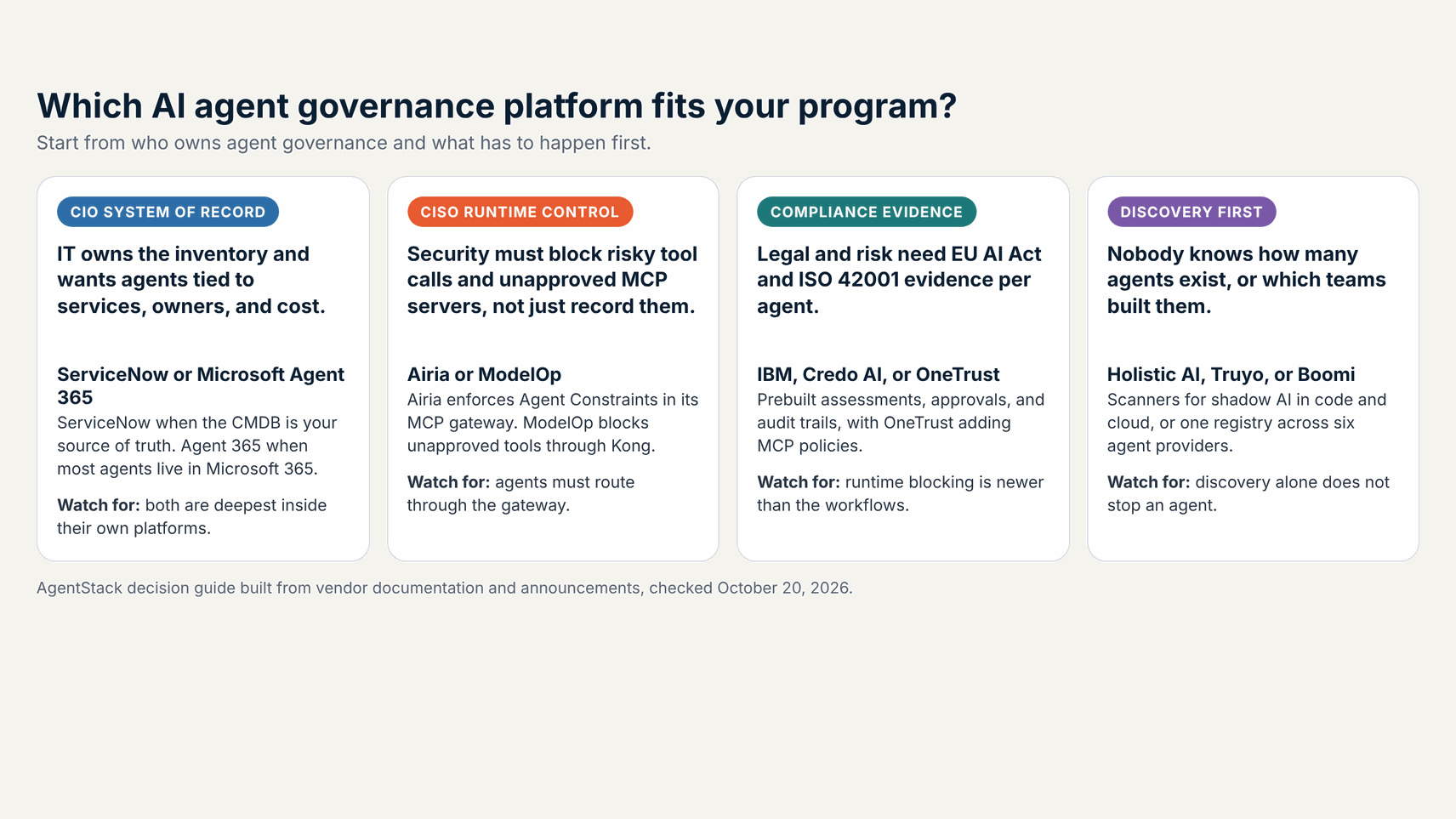
The right platform depends on who owns agent governance in your company and which problem has to be solved first. Find the profile below that matches your program, shortlist the named platforms, and test the kill path and the tool inventory before anything else.
CIOs who own the agent inventory
- Choose ServiceNow Super Intelligence Control Tower when the CMDB is your source of truth and agents should be governed like configuration items.
- Choose Microsoft Agent 365 when most agents live in Microsoft 365 and Copilot Studio, and per-user pricing fits your budget.
- Add Boomi Agent Control Tower when integration teams need a registry across Bedrock, Agentforce, Snowflake, and Anthropic agents.
CISOs who must enforce policy at runtime
- Choose Airia when you want inventory, MCP gateway policy, and compliance reports from one vendor.
- Choose ModelOp when approvals should gate tool traffic through Kong or another gateway you already run.
- Plan incident response around a tested kill path, using the NIST and CISA rogue agent practices as a checklist.
Chief risk and compliance officers
- Choose IBM watsonx.governance when model risk management already runs on IBM and auditors expect one evidence trail.
- Choose Credo AI when policy packs and per-agent evidence for the EU AI Act and ISO 42001 matter most.
- Choose OneTrust when privacy and GRC teams run on OneTrust and need MCP policies in the same program center.
Teams that do not know how many agents exist
- Run Holistic AI or Truyo scans across code, cloud, and SaaS to build a first inventory within weeks.
- Assign an owner and a risk tier to every discovered agent before you pick an enforcement layer.
- Compare tracing options in our AgentOps tools guide so discovered agents also produce usable logs.
Frequently Asked Questions
What is an AI agent governance platform?
An AI agent governance platform is software that inventories AI agents, assigns owners, scores risk, routes approvals, and keeps audit evidence. Newer platforms also enforce policy at runtime by blocking tool calls or disabling agents. Gartner defined the wider AI governance platforms market in its first Magic Quadrant on June 16, 2026.
Which vendors are Leaders in the 2026 Gartner Magic Quadrant for AI governance?
IBM, ServiceNow, and Truyo were named Leaders in the inaugural Gartner Magic Quadrant for AI Governance Platforms, published June 16, 2026. Airia, Credo AI, ModelOp, and OneTrust announced Visionary placements, and Holistic AI was the only Challenger among the 13 vendors Gartner evaluated.
Is Microsoft Agent 365 an AI governance platform?
Microsoft Agent 365 is a control plane for agents rather than a full AI governance platform, and Gartner did not include Microsoft in its 2026 governance Magic Quadrant. It covers inventory, identity, security, and compliance assessments for Microsoft and partner agents, priced at $15 per user per month since May 1, 2026.
Do AI agent governance platforms stop agents at runtime?
Some do and some do not. On October 20, 2026, ServiceNow, Microsoft, Airia, OneTrust, ModelOp, and Boomi documented ways to stop or block agent actions, while IBM documented alerts, Credo AI offered a research preview, and Truyo documented no runtime control. Test the kill path in every demo.
How much does an AI agent governance platform cost?
Most vendors quote prices privately. Microsoft Agent 365 costs $15 per user per month, IBM watsonx.governance starts at $0.64 pay as you go with Risk and Compliance from $3,500 per month, and Boomi includes Agent Control Tower in its Agentstudio Base edition, all as of October 2026.
Related Guides
Governance platforms manage the agents you approve. To discover the unapproved AI apps your staff already use, see our shadow AI detection tools guide.
Governance reviews now often include the MCP servers agents are allowed to reach, and our guide to the best MCP servers for enterprise teams sorts 15 servers by use case before you add them to an allowlist.
Agent inventory depends on identity data. Our Astrix vs Oasis vs Aembit comparison compares three platforms that discover and govern AI agent identities.
Agent inventory starts with identity. Our 8 best non-human identity tools compares products that discover and govern agent credentials.
Governance platforms set policy, and guardrails enforce it in each request. Our 9 best AI guardrails tools covers the enforcement layer.
For related coverage, see our AI agent governance buyer’s guide, AI agent security tools, Zenity vs Noma vs Pillar Security, MCP security tools and MCP registries.
Read the AI governance and security hub, governance and compliance coverage, agent security coverage, MCP explained, MCP gateways, Kong vs AWS AgentCore vs Docker, AI agent integration platforms, AgentOps tools, AI agent observability tools, AI agent evaluation tools, NIST and CISA rogue agent practices, Red Hat MCP Gateway GA, and Anthropic pulling evals offline after agents overstepped. Notes on how we work sit on editorial standards, disclosure, and contact.
The Bottom Line
Buy ServiceNow or Microsoft Agent 365 to own the agent inventory, Airia or ModelOp to enforce policy on tool calls, and IBM, Credo AI, or OneTrust to produce compliance evidence. Holistic AI, Truyo, and Boomi are strong first steps for discovery and registry work, and none of the 10 replaces least-privilege credentials.
Run every shortlist through two live tests: show every MCP tool an agent can call, then stop that agent in under five minutes. Send corrections or platform suggestions through our contact page.