

Last updated October 15, 2026. Product claims, security features, and pricing cues were checked against each vendor’s docs and marketing pages on that date.
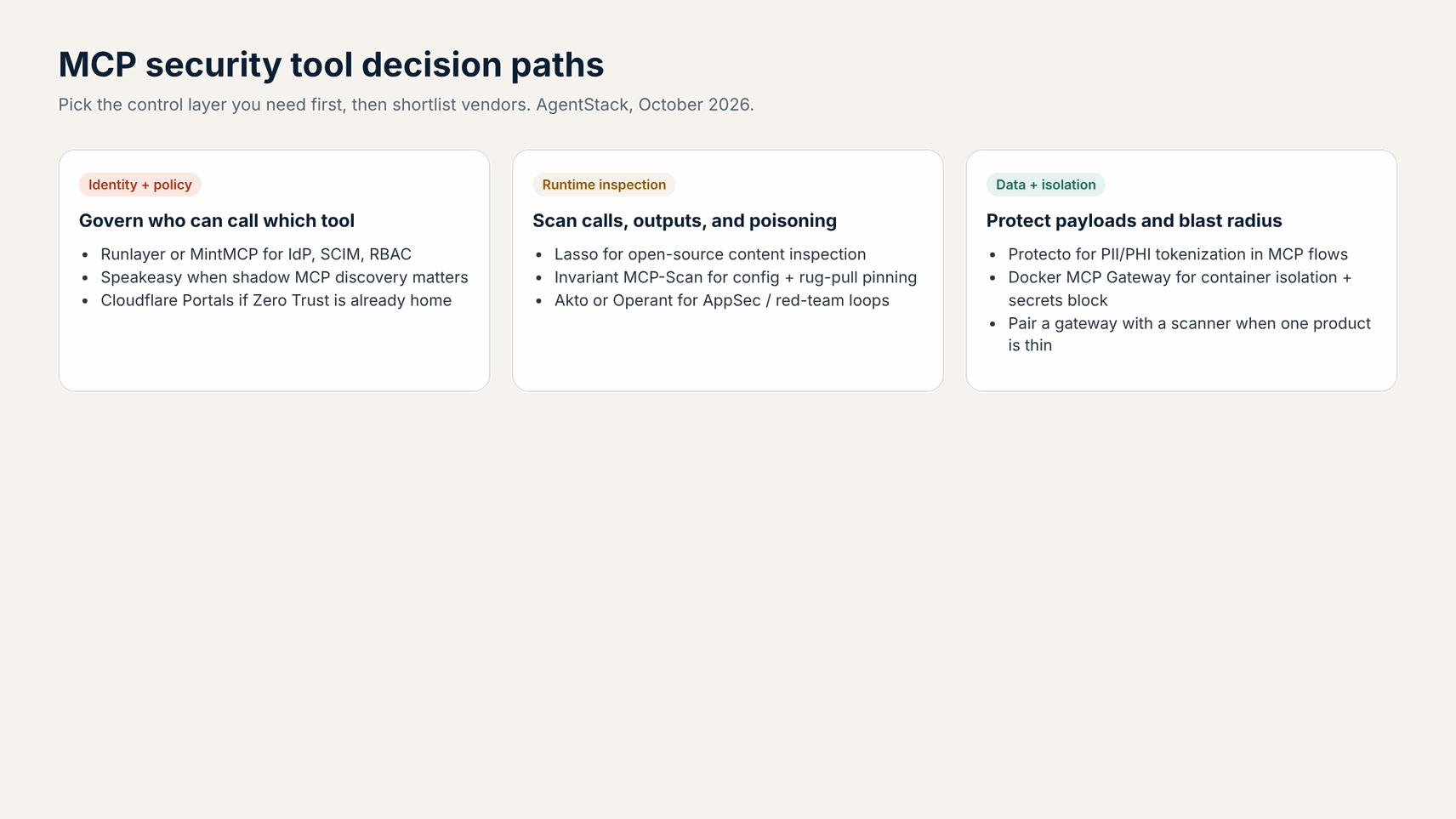
The best MCP security tools in 2026 for controlling agent tool access are Runlayer and MintMCP for identity-backed policy, Lasso and Invariant for inspection and tool-poisoning defense, and Speakeasy, Operant, Akto, Cloudflare, Protecto, or Docker MCP Gateway when discovery, AppSec, Zero Trust, data masking, or container isolation is the harder problem. The shortlist below is ranked for teams that already let agents call Model Context Protocol (MCP) tools and need enforceable authz, scanning, and audit, not another catalog of servers.
This guide sits next to our MCP gateways roundup and the ToFu MCP tool security findings piece. Gateways route and govern. Security tools decide which tool calls are allowed, inspected, or blocked before damage spreads.
We compared ten products on policy depth, runtime inspection, identity, deployment, and fit for AppSec vs platform teams. No vendor paid for placement or reviewed this page, per our editorial standards and disclosure policy.
Use this list when Cursor, Claude, ChatGPT, or internal agents already reach MCP servers and you need a control plane for tool access. For broader AgentOps context, start with the AgentOps tools map. For LLM request routing rather than MCP tool policy, see LLM gateways.
TL;DR
- Identity + policy first: Runlayer or MintMCP when SSO, SCIM, RBAC, and attributable audit must sit on every tool call.
- Shadow MCP discovery: Speakeasy when employees already wired unsanctioned servers into coding agents.
- Content inspection: Lasso (open source) for prompt injection, PII, and reputation checks on tool I/O; Invariant MCP-Scan for config scans, rug-pull pinning, and local proxy guardrails.
- AppSec / red team: Akto or Operant when continuous attack simulation and runtime blocking matter as much as a catalog.
- Zero Trust or data path: Cloudflare MCP Portals with Gateway DLP if Cloudflare One is already home; Protecto when PII/PHI tokenization in MCP payloads is the primary risk.
- Isolation baseline: Docker MCP Gateway for per-server containers, network limits, and default
--block-secrets. - Left off: Pure LLM firewalls without an MCP surface, generic API gateways with no tool semantics, and enablement-only catalogs that cannot deny a call.
10 Best MCP Security Tools at a Glance
Pick an MCP security tool by the control you need first: identity-backed allowlists, runtime inspection of tool I/O, data masking, or container isolation. Rank fits companies that already expose MCP to agents and need enforceable deny paths. The table uses each vendor’s own claims as of October 15, 2026.
| Tool | Best for | Primary control | Deploy shape | Entry path |
|---|---|---|---|---|
| Runlayer | Enablement + security together | Identity, ToolGuard, real-time detection | Hosted or self-host | Demo / sales |
| MintMCP | Enterprise MCP governance | RBAC, Mint Guard, virtual MCPs | SaaS (VPC on request) | Sales / trial |
| Lasso Security | Open-source inspection gateway | Prompt injection, PII, reputation | Self-host (MIT) | Open source |
| Speakeasy | Shadow MCP + IdP registry | Tool-level RBAC, discovery, audit | In your infra / Tailscale | Sales |
| Operant AI | Runtime + endpoint MCP defense | Threat detect, trust zones, RBAC | Cloud + endpoint agent | Sales |
| Akto | AppSec MCP gateway + red team | Allowlists, attack matrix, policy | Gateway / platform | Demo |
| Cloudflare | Zero Trust MCP portals | Access, Gateway DLP, MCP detect | Cloudflare One | Plan-dependent |
| Invariant | Scan + pin MCP configs | Poisoning, rug-pull, proxy guardrails | CLI / local proxy | Open source + cloud |
| Protecto | PII/PHI in MCP payloads | Detect, tokenize, context access | SaaS or on-prem | Sales |
| Docker MCP Gateway | Container isolation baseline | Per-server containers, secrets block | Local / Docker | Open source |
Verdict: Start with Runlayer or MintMCP when platform and security share one golden path. Add Lasso or Invariant when inspection depth is thin. Choose Speakeasy for shadow MCP cleanup, Cloudflare when Zero Trust is already the perimeter, Protecto for data-field policy, and Docker when isolation is the first hard requirement.
How We Chose These MCP Security Tools
We kept tools that can deny or reshape an MCP tool call at runtime, govern which servers agents may use, or scan tool definitions for poisoning before those tools enter an agent context. We started from vendor MCP security pages and tools named in our MCP gateways research, then reviewed product docs on October 15, 2026.
- Tool-access control: allowlists, RBAC, or policy that can stop a call instead of only logging it.
- Runtime inspection: scanning of tool descriptions, arguments, or responses for injection, secrets, or PII.
- Identity binding: SSO, SCIM, or non-human agent identities that attribute every call.
- MCP-native surface: explicit MCP clients, servers, portals, or proxies rather than generic LLM firewalls alone.
- Deploy clarity: documented SaaS, VPC, self-host, or local path a security team can evaluate.
- Evidence date: public claims checked October 15, 2026; prices and feature names move fast.
We ranked for control of agent tool access, not for the largest server marketplace. A product can appear in both this list and the gateways guide when its security controls are strong enough to stand alone.
1. Runlayer
Runlayer is the strongest fit when you want MCP enablement, identity, and real-time threat detection in one control plane instead of bolting a scanner onto a thin gateway. The platform catalogs thousands of MCP servers, ties actions to SSO and SCIM identities, and runs ToolGuard-style checks on tool definitions, inputs, and outputs for injection, credentials, and PII.
Security teams get attributable audit and OTEL-friendly tracing. Platform teams get a governed golden path so every Claude, Cursor, or ChatGPT client does not invent its own MCP wiring. Self-host and hosted single-tenant options matter when data egress is a blocker.
Best for: enterprises standardizing MCP across many AI clients with one security and enablement owner.
Watch for: sales-led packaging; confirm ToolGuard policies and self-host topology against your VPC requirements.
2. MintMCP (Mintive)
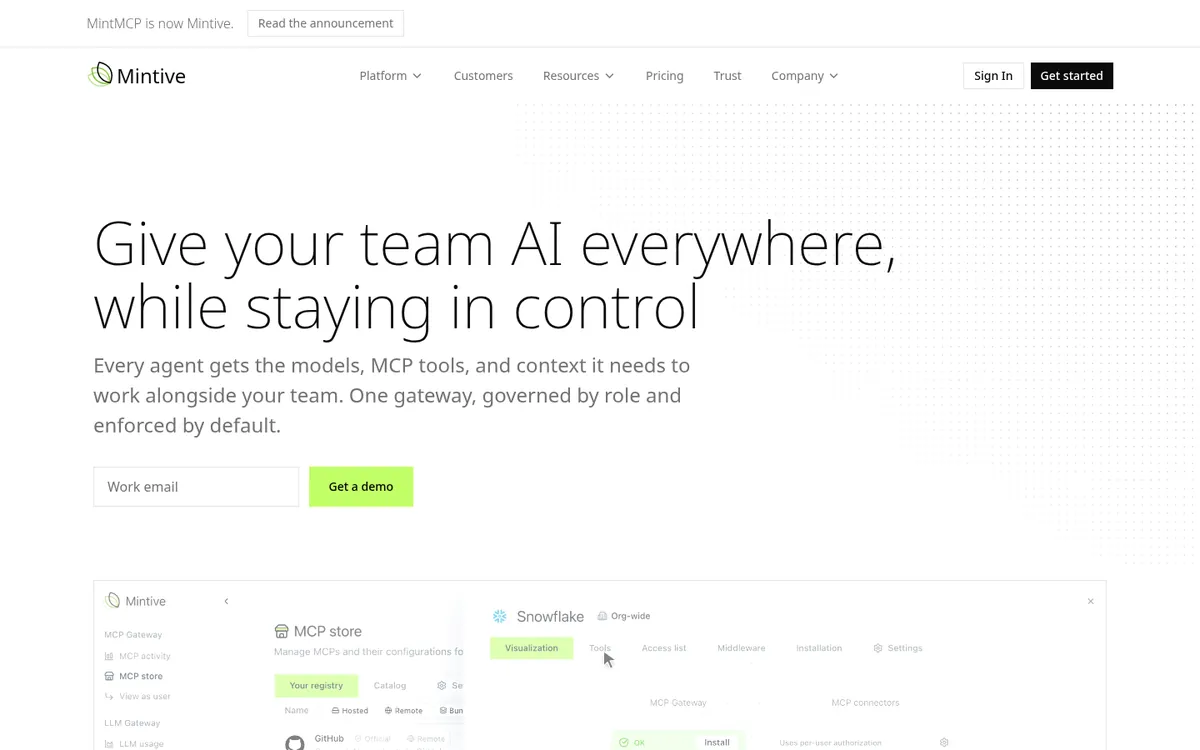
MintMCP is the enterprise MCP governance layer when virtual MCPs, agent identities, Mint Guard policies, and tool-update approvals matter more than a pure open-source scanner. The gateway centralizes connectors, credentials, curated tools, and audit. Agent Gateway treats autonomous agents as first-class non-human identities with scoped permissions.
Mint Guard covers managed detection for prompt injection, secrets, PII, and harmful content. Declarative Rules and Gateway Middleware (JS sandbox) let you flag, block, mask, or notify, including custom DLP hooks. Tool-update policy can require approval before upstream tool changes reach agents, which addresses rug-pull style drifts.
Best for: SaaS-first enterprises that want MCP adoption to feel like governed procurement.
Watch for: VPC or self-host may be request-gated; compare detection depth with Runlayer if real-time threat tiers are the buying criterion.
3. Lasso Security MCP Gateway
Lasso Security’s open-source MCP gateway leads when content inspection, reputation scoring, and PII masking must run under your license terms without a SaaS control plane. It sits in the request path to scan tool descriptions and traffic for prompt injection and sensitive data, with a plugin model for guardrails.
Teams that already operate Envoy-style infrastructure often pair Lasso with a separate IdP or registry product. Public comparisons note strong inspection depth and lighter per-tool authorization than full enterprise gateways, so plan an identity layer beside it.
Best for: security engineering teams that self-host and want MIT-licensed inspection first.
Watch for: you will still need SSO, SCIM, and catalog UX from another product if those are hard requirements.
4. Speakeasy MCP Gateway
Speakeasy is the pick when shadow MCP is already real: employees connected servers inside coding agents, and you need discovery, an official registry, and IdP-driven tool RBAC in your own network. The gateway provisions access from Okta, Entra, or other SAML/OIDC providers, normalizes auth, and logs every tool call.
Agent hooks and a device agent surface unsanctioned servers so admins can promote approved ones into the registry with tool-level allowlists. Tailscale and private-hostname patterns keep the path off the public internet. Guardrails can scan requests and responses for secrets, personal data, and prompt injection.
Best for: platform teams cleaning up shadow MCP while keeping Claude Code, Cursor, and peers usable.
Watch for: discovery covers instrumented clients; tune judge-based detectors in log-only mode before blocking.
5. Operant AI
Operant AI targets runtime MCP defense across cloud gateways and endpoints, including trust zones, prompt-injection detection, and least-privilege tool execution. The MCP Gateway inspects client and server traffic for poisoning, jailbreaks, and sensitive data leakage. Endpoint Protector extends registry and RBAC to local coding agents and plugins.
Security graphs and OWASP-aligned mappings help AppSec teams explain MCP risk in familiar language. Rate limits, redaction, and blocking of untrusted servers shrink blast radius when an agent drifts.
Best for: AppSec and SOC teams that need runtime block actions beyond passive catalogs.
Watch for: evaluate endpoint agent coverage for the exact MCP clients your developers use.
6. Akto
Akto’s MCP Gateway and Agentic Security Platform fit AppSec teams that want zero-code routing, allowlists, and continuous red teaming against a growing agent attack matrix. Point MCP clients at one Akto endpoint without changing existing servers, then apply visibility, rate limits, and policy in one place.
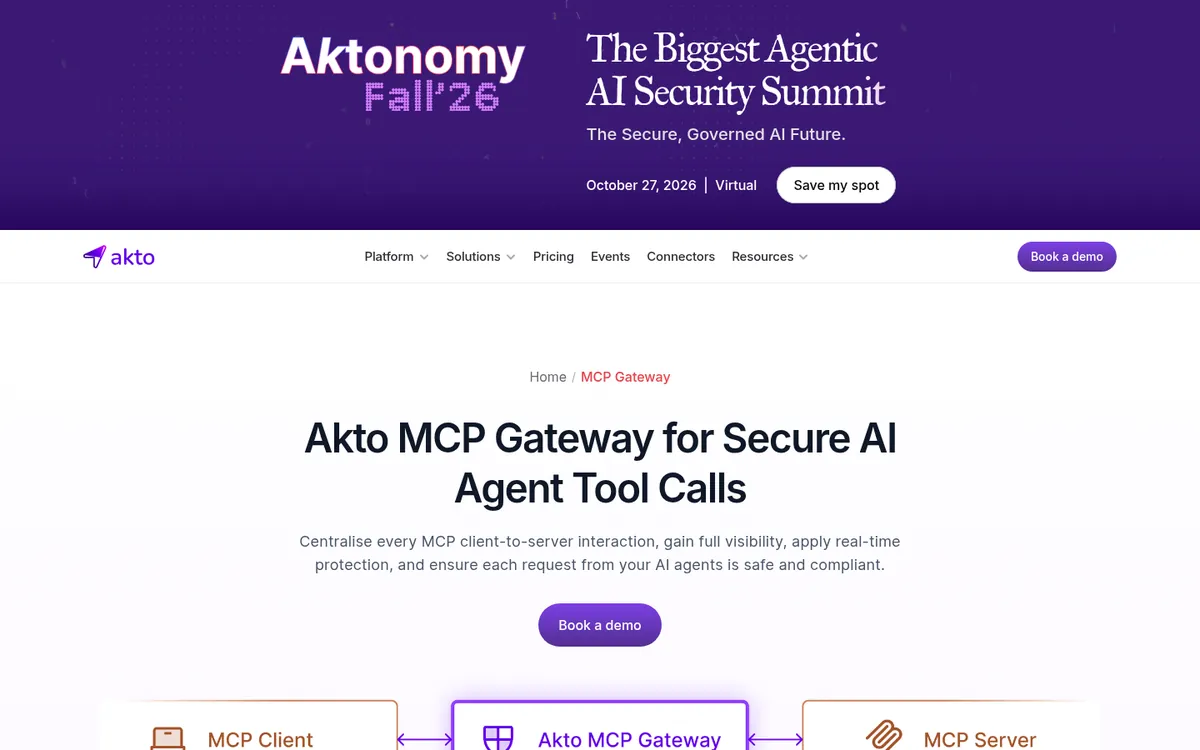
Red-team modules simulate prompt injection, tool poisoning, and cascading failures. Governance features such as skills inventory and blocking help DevSecOps keep pace with agent frameworks. Treat Akto as the security proxy when your primary buyer is AppSec rather than AI platform.
Best for: DevSecOps programs that already think in API security and want MCP in the same workflow.
Watch for: confirm how deep per-tool RBAC goes versus marketplace enablement suites.
7. Cloudflare MCP Server Portals
Cloudflare MCP Server Portals are the natural control point when Cloudflare One already owns Access identity, Gateway HTTP policy, and DLP for the company. Portals give employees one managed endpoint with curated tools and Access logs. Enabling Gateway routing sends upstream MCP calls through Secure Web Gateway for HTTP logs and DLP profiles.
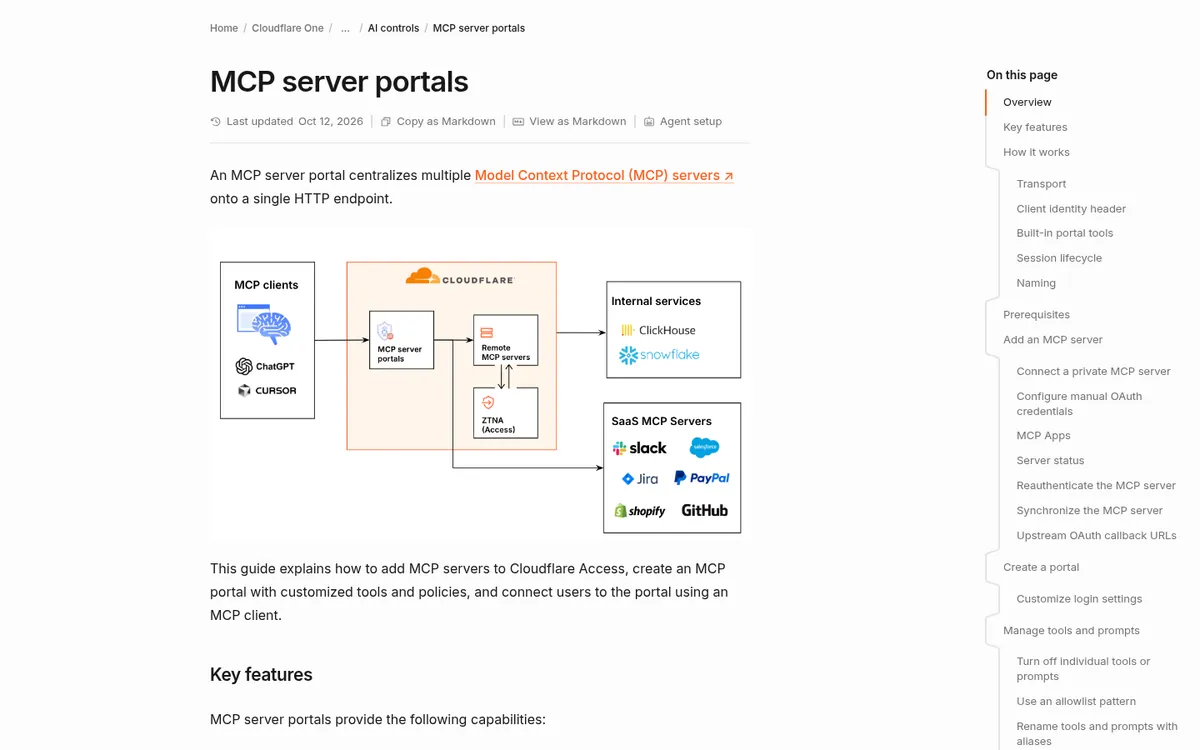
Gateway can classify MCP traffic and distinguish portal-proxied calls from direct bypasses, which lets you block unsanctioned paths. Streamable HTTP is the supported transport for Gateway-routed portals; SSE-only servers need a different plan.
Best for: enterprises standardized on Cloudflare Zero Trust that want MCP behind the same DLP stack.
Watch for: DLP AI prompt profiles may not apply to portal traffic; target upstream hostnames in HTTP policies.
8. Invariant Labs (MCP-Scan / Agent Scan)
Invariant coined much of the public vocabulary for MCP tool poisoning and rug pulls, and MCP-Scan (Agent Scan) remains the practical scanner for local client configs plus optional proxy guardrails. Run a static scan against Cursor, Claude, Windsurf, and peers to catch poisoned tool descriptions, tool shadowing, and toxic flows before a session starts.
Tool pinning hashes definitions so rug-pull changes surface on the next load. The proxy mode monitors live traffic and can block or log secrets, PII, and custom policies. Use Invariant beside a gateway when you need research-grade detection without waiting for a full enterprise SKU.
# Example: scan local MCP client configs (consent required to start servers)
mcp-scan scan
# Optional runtime guardrails on tool calls and responses
mcp-scan proxy --guardrails default
Best for: security researchers and platform engineers validating developer MCP installs.
Watch for: scanning executes configured MCP commands; only use --dangerously-run-mcp-servers in trusted CI.
9. Protecto
Protecto is the data-plane pick when the risk is sensitive fields flowing through MCP tools rather than only which server is allowed. It detects PII, PHI, and business-confidential data in prompts, tool payloads, and outputs, then masks or tokenizes while preserving enough semantics for the agent to keep working.
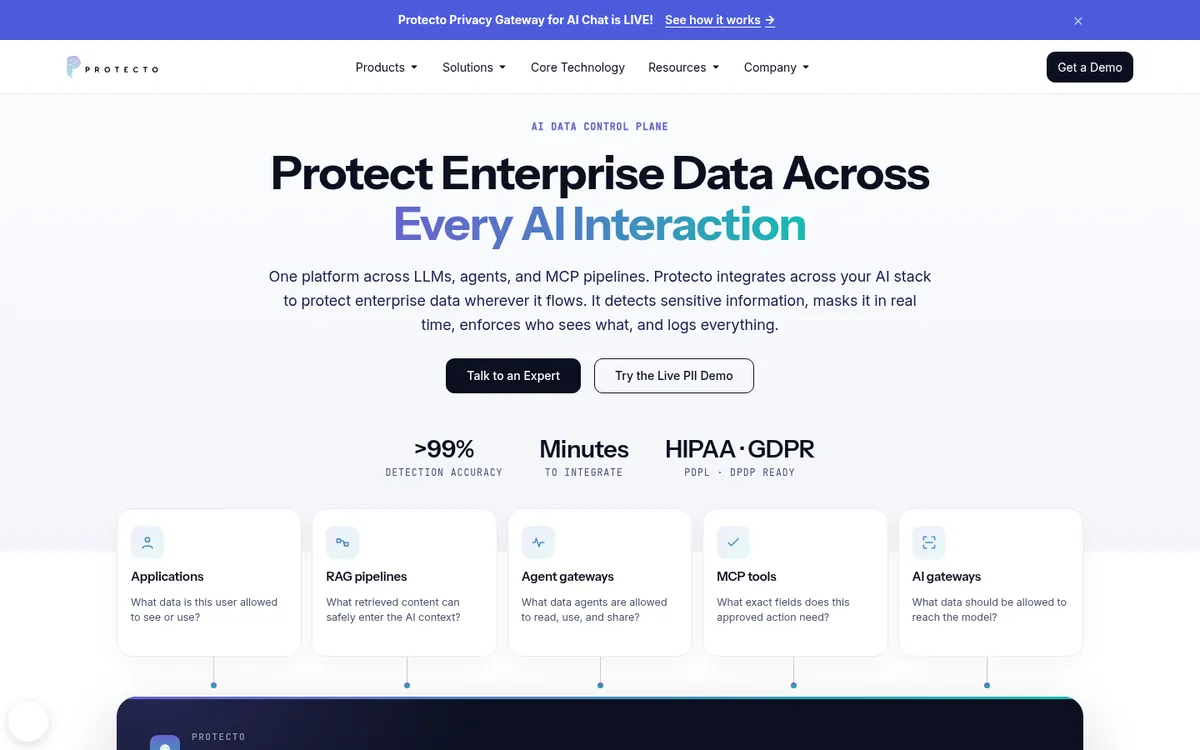
Context-based access aims to decide who may see which fields for which task at runtime. SaaS and on-prem or air-gapped deployments matter for regulated healthcare and BFSI stacks. Pair Protecto with a gateway that still owns server allowlists and identity.
Best for: privacy and compliance owners focused on MCP and RAG data exposure.
Watch for: MCP-specific GPTGuard capabilities may still be rolling out; confirm GA status for your use case.
10. Docker MCP Gateway
Docker MCP Gateway is the isolation baseline: each MCP server runs in a container with resource limits, network controls, and default secrets blocking on tool arguments and text responses. It will not replace IdP-backed enterprise governance, but it shrinks blast radius for local and CI agent work.
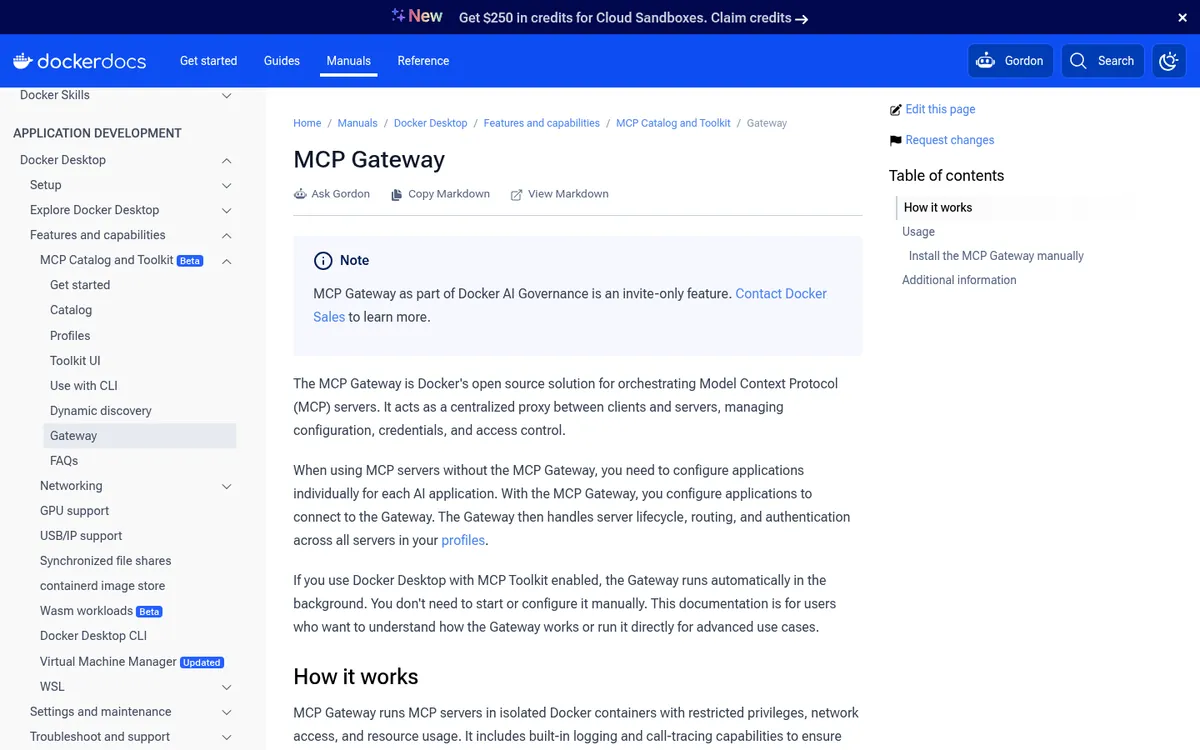
Flags such as --block-secrets, read-only binds by default, and optional host allowlists give platform teams a concrete starting policy. Many teams run Docker locally for developers and put Runlayer, MintMCP, or Cloudflare in front for company-wide identity.
Best for: engineering orgs standardizing on Docker Desktop or Engine for MCP sandboxes.
Watch for: pair with a scanner or enterprise gateway when you need SSO, SCIM, or central audit.
Persona Picks: Who Should Use Which MCP Security Tool
Match the buyer to the failure mode: platform wants one golden path, AppSec wants attacks blocked, privacy wants fields masked, and developers want containers that cannot leak keys. Use the picks below as starting shortlists, then prove deny rules in a staging agent.
| Persona | Primary pick | Strong alternatives | Why |
|---|---|---|---|
| AI platform / IT | Runlayer or MintMCP | Speakeasy, Cloudflare | Identity, catalog, audit across clients |
| AppSec / DevSecOps | Akto or Operant | Lasso, Invariant | Red team, runtime block, inspection |
| Privacy / compliance | Protecto | Cloudflare DLP, Lasso PII | Field-level masking in MCP payloads |
| Developer productivity | Docker MCP Gateway | Invariant MCP-Scan | Local isolation + config hygiene |
| Zero Trust owner | Cloudflare Portals | Speakeasy + Tailscale | Same Access and Gateway stack |
Verdict: Do not buy a second catalog if your gap is data masking or red teaming. Buy the control layer that fails closed for your highest-risk tool calls.
Capability Comparison: Policy, Inspection, and Audit
Enterprise buyers should score MCP security tools on whether they can refuse a tool call, inspect I/O, bind identity, and export audit that survives an incident review. The matrix below is directional from public docs as of October 15, 2026, not a lab benchmark.
| Tool | Deny / allow tools | I/O inspection | IdP / SCIM | Shadow discovery | Self-host path |
|---|---|---|---|---|---|
| Runlayer | Strong | Strong | Strong | Strong | Yes |
| MintMCP | Strong | Strong (Guard/Rules) | Strong | Partial | On request |
| Lasso | Moderate | Strong | Bring your own | Limited | Yes (OSS) |
| Speakeasy | Strong | Yes | Strong | Strong | Yes |
| Operant | Strong | Strong | Yes | Endpoint registry | Hybrid |
| Akto | Strong | Yes | Yes | Via gateway traffic | Gateway |
| Cloudflare | Via Access/Gateway | DLP on routed traffic | Access | MCP traffic detect | Cloudflare edge |
| Invariant | Proxy guardrails | Strong | N/A local | Config scan | Local / CLI |
| Protecto | Data-field policy | Data-focused | Integrations | N/A | On-prem option |
| Docker | Network + secrets | Secrets patterns | N/A | N/A | Yes |
Verdict: Runlayer, MintMCP, and Speakeasy cover the most identity-plus-deny ground. Lasso and Invariant deepen inspection. Protecto and Docker close data and isolation gaps the others leave open.
Example: Tool-Call Policy Sketch
Whatever vendor you choose, write the deny rule before the allow list grows, then map it into that product’s policy language. The sketch below is illustrative pseudo-policy for a billing agent that may read invoices but must never call a wire-transfer tool.
# Illustrative MCP tool policy (pseudo)
allow:
  - server: billing-mcp
    tools: [list_invoices, get_invoice_pdf]
deny:
  - server: payments-mcp
    tools: [create_wire, update_beneficiary]
inspect:
  - on: tools/call
    block_if: contains_secret | contains_pci
audit:
  - export: otel
    fields: [actor, agent_id, server, tool, decision]
Translate the same intent into Runlayer ToolGuard, MintMCP Rules, Speakeasy allowlists, Cloudflare Gateway DLP, or Lasso plugins. If the product cannot express this deny, it is not your tool-access control plane.
What These MCP Security Tools Cost
Most enterprise MCP security platforms are sales-led; open-source options shift spend into engineering time and hosting instead of license line items. Treat published OSS licenses as the floor, then budget for IdP seats, DLP packs, and incident-response logging.
| Tool | Published entry cue | What usually drives cost | Notes |
|---|---|---|---|
| Runlayer | Demo / sales | Seats, MCP volume, deploy | Hosted vs self-host |
| MintMCP | Trial / sales | Agents, connectors, guardrails | VPC may be add-on |
| Lasso | Open source (MIT) | Ops + infra | Pair with IdP product |
| Speakeasy | Sales | Gateway + IdP scope | In-infra deployment |
| Operant | Sales | Runtime + endpoint coverage | Platform SKUs |
| Akto | Demo | API/MCP traffic tier | AppSec packaging |
| Cloudflare | Zero Trust plan | Gateway, DLP, seats | Often already licensed |
| Invariant | OSS + cloud | Cloud features if used | CLI free to start |
| Protecto | Sales | Volume + on-prem | Regulated deployments |
| Docker | OSS / Docker sub | Engine capacity | Baseline isolation |
Verdict: If Cloudflare One or Docker is already paid for, start there for portal or isolation controls, then add a dedicated MCP security gateway when deny policies outgrow generic DLP.
MCP Security Tools We Left Off, and Why
We left out several adjacent products that still appear in MCP security SERPs because they lack tool-level MCP controls, overlap other guides, or stay too early for a production shortlist. Each note says why it is out of scope for this ranking.
- Generic LLM firewalls without MCP semantics: useful on the model path; they do not inventory MCP servers or pin tool schemas. Cover them with gateway and observability buys instead.
- Pure API gateways (Kong, Envoy alone): excellent routers; without MCP-aware policy packs they under-serve tool poisoning and schema rug pulls. See comparisons in our MCP gateways guide when those vendors ship MCP SKUs.
- Pipelock and niche scanning proxies: promising as sidecar inspectors; evidence and packaging were thinner than Lasso or Invariant for a top-ten enterprise shortlist on our review date.
- agentgateway (Linux Foundation / Solo.io): strong infrastructure routing with OAuth and RBAC roots; we treat it as an infra gateway candidate more than a dedicated MCP security product here.
- Enablement catalogs without deny: marketplaces that only list servers without enforceable policy are out of scope for tool-access control.
Which MCP Security Tool Should You Choose?
Choose Runlayer or MintMCP for a company-wide golden path, Speakeasy when shadow MCP cleanup is urgent, Lasso or Invariant when inspection must be self-hosted, and Cloudflare, Protecto, or Docker when Zero Trust, data fields, or containers are the binding constraint. Prove a deny rule on your riskiest tool before rolling out catalogs.
- Many AI clients, one security owner: Runlayer or MintMCP first.
- Developers already bypassing IT: Speakeasy discovery, or Cloudflare MCP traffic detect plus portals.
- Need open-source inspection now: Lasso gateway plus Invariant scans on laptops.
- AppSec owns the buy: Akto or Operant with red-team loops.
- Regulated data in tool responses: Protecto beside your gateway.
- Local agent sandboxes: Docker MCP Gateway as the default developer path.
Decision kernel: if the product cannot refuse a tool call and show who asked, it is not your MCP security control plane. Catalogs without deny are enablement, not security.
Frequently Asked Questions
What are MCP security tools?
MCP security tools control which Model Context Protocol servers and tools agents may call, and they inspect or block risky tool traffic. They add identity, policy, scanning, and audit on top of raw MCP connections so tool poisoning, rug pulls, and data leaks are harder to execute unnoticed.
How is an MCP security tool different from an MCP gateway?
An MCP gateway centralizes routing, auth, and often a catalog of servers. An MCP security tool emphasizes deny policies, inspection of tool descriptions and I/O, threat detection, or data masking. Many products combine both. Buy for the control you lack: routing, inspection, or identity.
What is MCP tool poisoning?
Tool poisoning hides malicious instructions inside MCP tool descriptions that models trust as context. Agents may then exfiltrate secrets or misuse other tools. Mitigations include scanning descriptions, pinning tool hashes, approving schema changes, and runtime guardrails on arguments and outputs.
Do I need MCP security if I already use an LLM gateway?
Yes, if agents call tools over MCP. LLM gateways govern model requests, cost, and failover. They do not replace per-tool MCP allowlists, schema pinning, or MCP-aware DLP. Teams often run an LLM gateway beside an MCP security gateway or portal.
What is the best open-source MCP security option?
Lasso Security’s MCP gateway and Invariant’s MCP-Scan are the strongest open-source leaning options on this list today. Lasso emphasizes traffic inspection depth. Invariant emphasizes config scanning, rug-pull pinning, and local proxy guardrails. Docker MCP Gateway adds container isolation plus secrets blocking for local sandboxes.
Related Guides
Security tools work best when every approved server is listed in one place. Our enterprise MCP registries guide compares eight private and managed registries that hold that list for enterprise teams.
MCP security tools cover tool access, and agent security platforms cover the agents themselves. Our Zenity vs Noma vs Pillar Security comparison shows how the three leading agent security platforms approach that wider job.
MCP security tools control tool access, one layer of a wider program. Our AI agent governance buyer’s guide shows how that layer fits with identity, policy, monitoring, and audit.
MCP gateways control tool access, while runtime platforms inspect what agents do with that access. Our AI agent security tools guide compares 12 runtime protection platforms, including Zenity, Prisma AIRS, and Google Model Armor.
Where a server runs shapes its attack surface too. Our MCP hosting platforms guide compares how Cloudflare Workers, AgentCore Runtime, Cloud Run, Azure Functions, and other hosts handle authentication and isolation for remote MCP servers.
Security tooling often arrives inside a gateway contract, so check our MCP gateway pricing comparison to see which gateway tiers include identity, audit logs, and policy controls.
If your shortlist is already down to three platforms, our MintMCP vs Runlayer vs Lasso comparison goes deeper on identity, shadow MCP discovery, self-hosting, and pricing shape for the three tools security teams compare most often.
- 10 Best MCP Gateways in 2026 for Enterprise Security and Scale
- ToFu Finds 253 Bugs in 118 MCP Servers and a Repeat-After-Me Agent Bypass
- 9 Best LLM Gateways for Enterprise AI Teams in 2026
- AgentOps in 2026: The Complete Map of Observability and Eval Tools
- 12 Best AI Agent Observability Tools in 2026
- 12 Best AI Agent Frameworks in 2026, Compared for Production
- MCP hub · AgentOps hub
- Editorial standards · Disclosure · Contact