

Last updated October 14, 2026. Endpoints, auth methods, release dates, and limits were checked against each vendor’s docs, changelogs, and repositories on that date.
The best MCP servers for enterprise teams in 2026 are the vendor-hosted ones that sit on systems you already govern: GitHub, Atlassian Rovo, Slack, Salesforce, and the AWS MCP Server lead their categories. Sentry, Playwright, Linear, Notion, HubSpot, Stripe, MCP Toolbox for Databases, Snowflake, Brave Search, and the Filesystem reference server each win a narrower job.
An MCP server is a program that exposes tools, data, or prompts to AI agents through the Model Context Protocol, so one client such as Claude, Cursor, or ChatGPT can call many systems through the same interface. This guide groups 15 MCP servers by use case and sits in the MCP and Agent Protocols hub under the MCP topic. Placement is unpaid, per our editorial standards and disclosure policy.
Choosing is harder than it looks. A third-party crawl counted 38,212 servers in the official MCP Registry on October 1, 2026, and most enterprise risk comes from picking an unofficial wrapper when the vendor already ships a hosted server with OAuth and admin controls.
TL;DR
- Default rule: prefer the vendor’s own hosted server. 11 of the 15 picks run as hosted endpoints and 10 of those use OAuth, so there is no local token to leak and access can be revoked centrally.
- Code and delivery: GitHub for repos and CI, Sentry for production errors, Playwright for browser automation, and Linear for issue tracking. GitHub and Linear both offer
/readonlyendpoints. - Knowledge and collaboration: Atlassian Rovo (GA February 4, 2026), Notion, and Slack (GA February 17, 2026). Slack only allows Marketplace-published and internal apps to use MCP.
- Revenue and payments: Salesforce Hosted MCP Servers (GA April 29, 2026), HubSpot (GA April 13, 2026), and Stripe, which stops accepting non-Agent API keys on October 31, 2026.
- Data and cloud: MCP Toolbox for Databases (v1.0 April 10, 2026) covers 20+ engines, Snowflake caps each server at 50 tools, and the AWS MCP Server exposes 15,000+ API operations at no extra charge.
- Web and local: Brave Search for fresh web results at $5 per 1,000 requests, and the Filesystem reference server for sandboxed local file work.
15 Best MCP Servers at a Glance
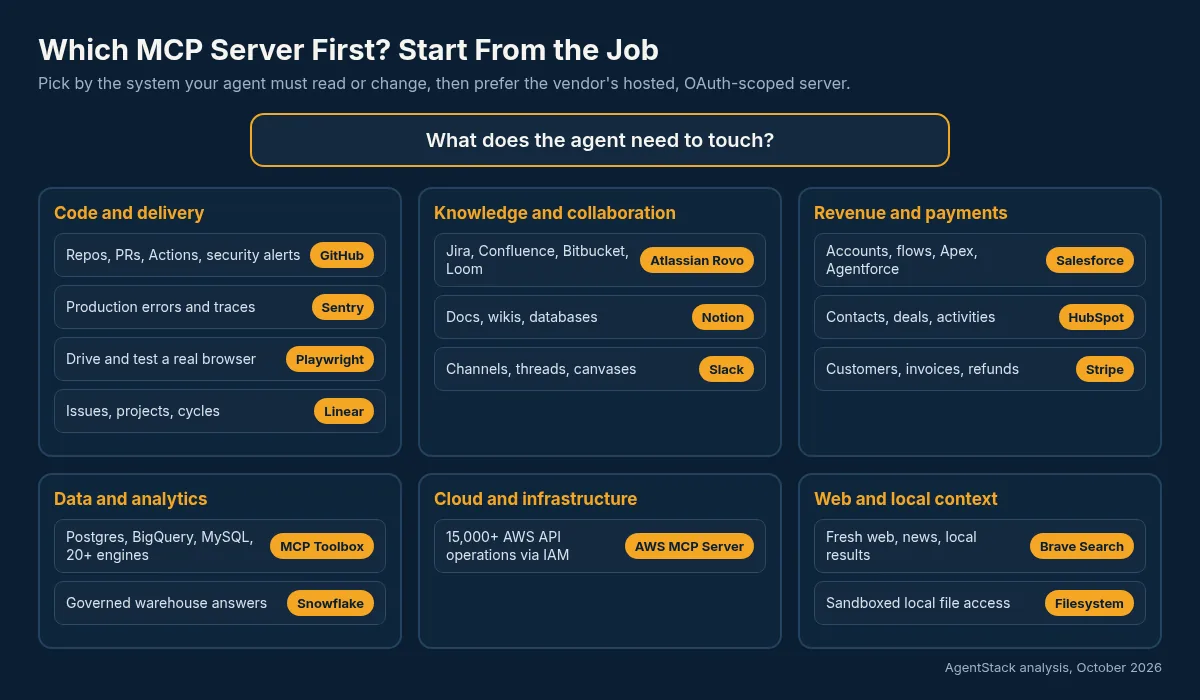
Match each MCP server to the system your agent must read or change, then check how it authenticates and whether it can run read-only. The table groups the 15 picks by use case. Hosted servers trade local control for zero infrastructure, while local servers keep traffic on your machine but need tokens or credentials on disk.
| MCP server | Use case | Hosting | Auth | Least-privilege control |
|---|---|---|---|---|
| GitHub MCP Server | Repos, PRs, Actions, security alerts | Hosted or local | OAuth or PAT | Toolsets, /readonly, lockdown mode |
| Sentry MCP | Errors, traces, issue triage | Hosted or local | OAuth | Org and project scoped URLs |
| Playwright MCP | Browser automation and testing | Local or Docker | None (local) | Capability flags such as --caps |
| Linear MCP | Issues, projects, cycles | Hosted | OAuth 2.1 or API key | /mcp/readonly or read scope |
| Atlassian Rovo MCP | Jira, Confluence, Bitbucket, Loom | Hosted | OAuth 2.1 or API token | Domain allowlists, audit logs |
| Notion MCP | Docs, wikis, databases | Hosted | OAuth only | Workspace permissions |
| Slack MCP | Channels, threads, canvases | Hosted | OAuth via approved apps | Granular search:read.* scopes |
| Salesforce Hosted MCP | CRM data, flows, Apex, Agentforce | Hosted | OAuth | Org permissions, per-server tools |
| HubSpot MCP | CRM records and activities | Hosted | OAuth 2.1 with PKCE | User permissions, sensitive-data block |
| Stripe MCP | Payments, billing, refunds | Hosted | OAuth or Agent API key | Human confirmation on refunds |
| MCP Toolbox for Databases | SQL and NoSQL databases | Local or self-hosted | DB credentials or IAM | Custom tools in tools.yaml |
| Snowflake-managed MCP | Governed warehouse answers | Hosted in Snowflake | Snowflake or External OAuth | RBAC per tool, read-only SQL default |
| AWS MCP Server | AWS APIs and docs | Hosted (8 Regions) | IAM SigV4 via proxy | IAM context keys, SCPs |
| Brave Search MCP | Web, news, local search | Local | Brave API key | Tool selection |
| Filesystem (reference) | Local file read and write | Local | None (local) | Allowed directories only |
How We Picked These 15 MCP Servers
We kept servers that a security team can approve: official or vendor-maintained code, a documented auth model, and a public changelog or release history. Community wrappers around the same APIs were left out when the vendor ships its own server. Every pick had a docs page or repository we could capture on October 14, 2026.
- Ownership: built and maintained by the system’s vendor, or by the MCP project itself for reference servers.
- Authentication: OAuth 2.1, scoped tokens, or cloud IAM, with a clear way to revoke access.
- Least privilege: read-only modes, toolset filters, scoped URLs, or per-tool permissions.
- Auditability: admin approval, audit logs, or cloud-native trails such as CloudTrail.
- Transport: Streamable HTTP for hosted servers, with deprecated SSE endpoints flagged.
- Use-case coverage: one strong pick per job, so the list maps to real enterprise workflows.
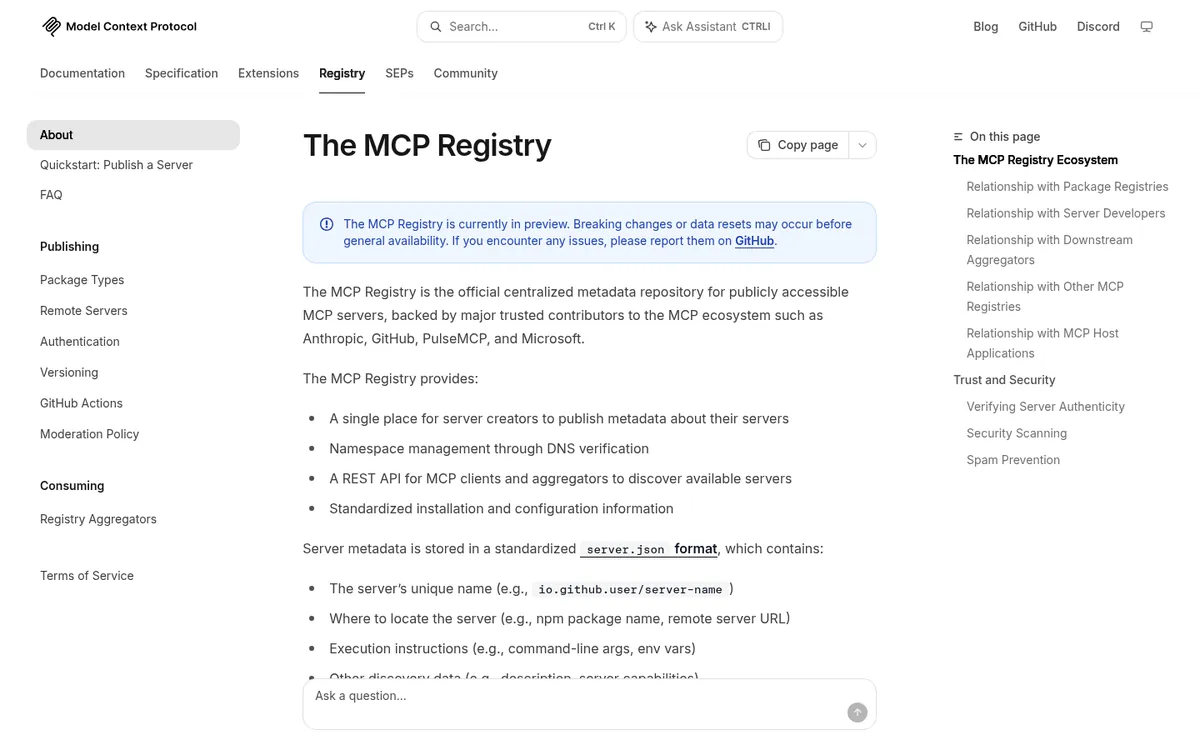
We did not run paid load tests, so there are no star ratings. Discovery started in the official MCP Registry, which is still in preview, verifies publisher namespaces through GitHub or DNS, and delegates code scanning to npm, PyPI, and downstream aggregators.
Code and Delivery MCP Servers
Engineering teams get the fastest return from MCP servers that sit on the code, error, and issue systems their agents already touch every day. These four servers cover repositories, production errors, browser automation, and planning. GitHub, Sentry, and Linear all run hosted endpoints, so a coding agent can connect with OAuth instead of a long-lived token in a config file.
1. GitHub MCP Server: Repos, Pull Requests, and CI
The GitHub MCP Server is the official server for repositories, issues, pull requests, Actions, and security alerts, and the first MCP server most engineering teams should approve. It is MIT-licensed, written in Go, and runs either locally or as a hosted endpoint at https://api.githubcopilot.com/mcp/ with OAuth, per the GitHub MCP Server repository.
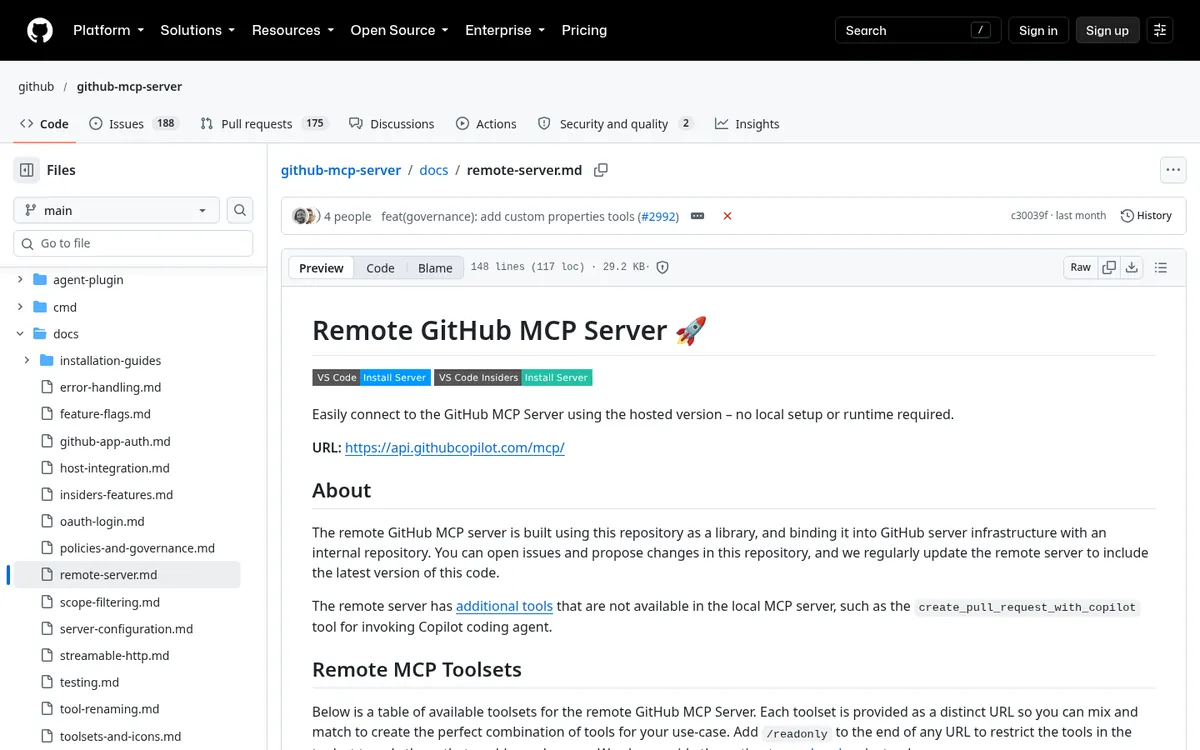
Control comes from toolsets. The default set is context, issues, pull_requests, repos, and users, and the remote server docs let you pick others with the X-MCP-Toolsets header or a /x/{toolset} path. Adding /readonly strips write tools, and the configuration guide documents a lockdown mode through X-MCP-Lockdown.
- Best for: platform and developer-experience teams that want agents to triage issues, review pull requests, and read CI logs.
- Setup and auth: OAuth on the hosted server; GitHub Enterprise Cloud with data residency uses a
copilot-api.SUBDOMAIN.ghe.com/mcpURL. - Watch out for: GitHub Enterprise Server does not support the hosted endpoint, so GHES shops must run the local server with
GITHUB_HOSTset.
2. Sentry MCP: Production Errors in the Agent Loop
Sentry MCP lets a coding agent search errors, inspect traces, and triage issues in the same session where it writes the fix. The hosted endpoint is https://mcp.sentry.dev/mcp, every connection uses OAuth, and you can scope the URL to one organization or one project, per the Sentry MCP docs.
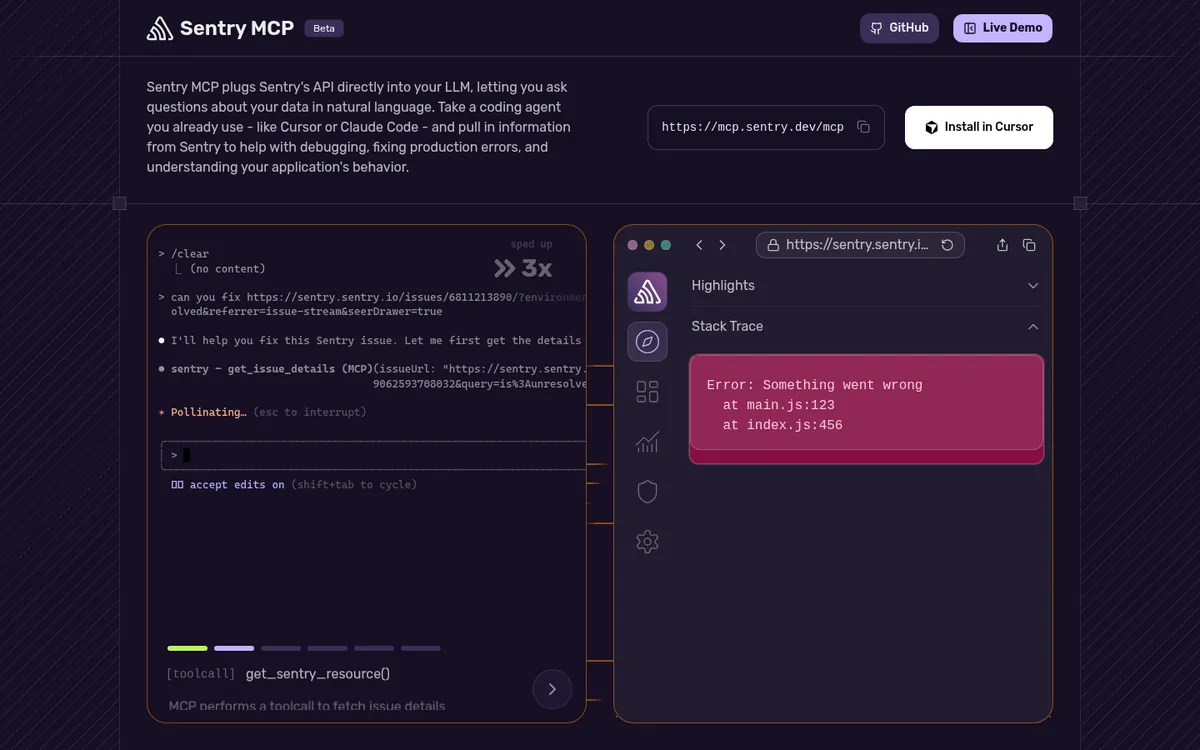
Scoping is the least-privilege lever. A project-scoped URL defaults every tool to that project and hides discovery tools the agent does not need. The open-source repository also ships a stdio mode for self-hosted Sentry, though Seer analysis is left out there because Seer is not part of self-hosted Sentry.
- Best for: teams that already route errors to Sentry and want agents to move from stack trace to patch faster.
- Setup and auth: OAuth on the hosted server; stdio mode with a User Auth Token for self-hosted installs.
- Watch out for: the AI-powered search tools need an LLM provider key such as OpenAI, Azure OpenAI, Anthropic, or OpenRouter, and the npm package ships under the FSL-1.1-ALv2 license.
3. Playwright MCP: Browser Automation Without Vision Models
Playwright MCP gives agents a real browser through structured accessibility snapshots, so they click and type by element reference instead of guessing from screenshots. Microsoft maintains it under Apache 2.0, it needs Node.js 18 or newer, and version 0.0.83 shipped on September 28, 2026, per the Playwright MCP repository and releases.
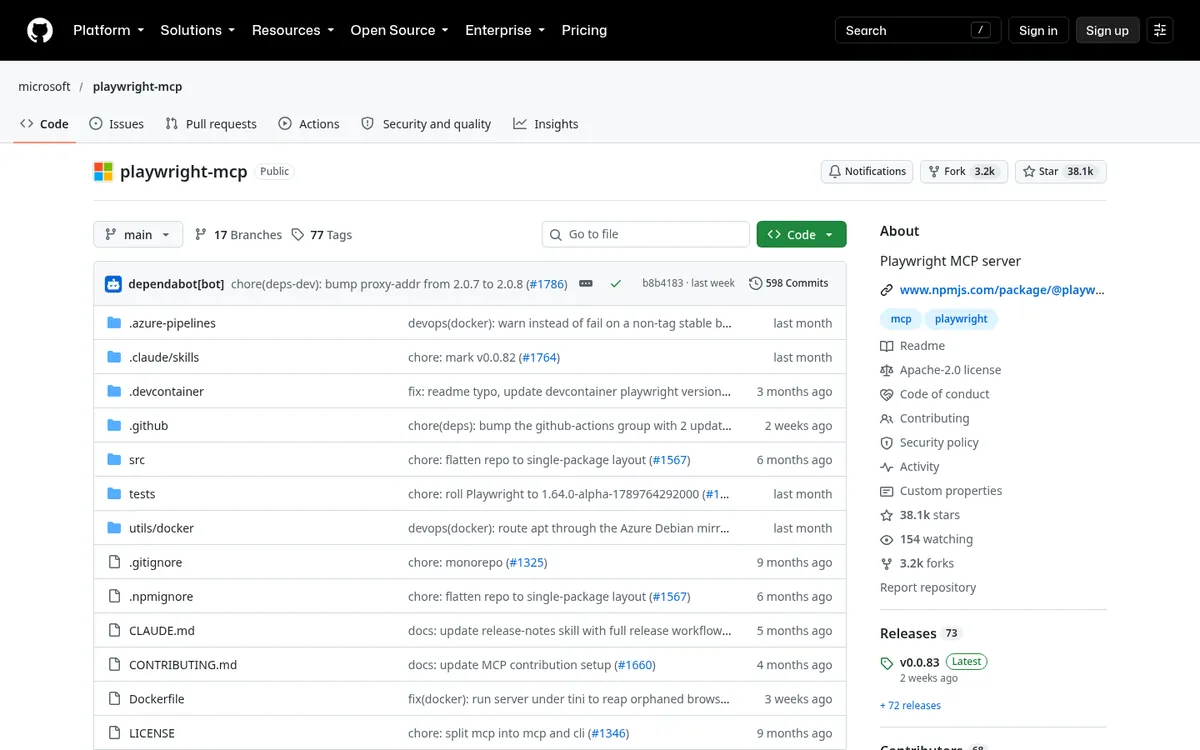
Optional capabilities such as vision, pdf, and devtools are off until you pass them with --caps, which keeps the default tool list short. The README is candid about token cost: it recommends the Playwright CLI with Skills for high-throughput coding agents, and keeps MCP for long-running, exploratory, or self-healing test loops.
- Best for: QA and automation teams that need agents to test web apps, fill forms, or reproduce UI bugs.
- Setup and auth: local
npx @playwright/mcp@latestor a Docker image, which supports headless Chromium only. - Watch out for: browser sessions can reach anything the host can reach, so run it in an isolated container for untrusted sites.
4. Linear MCP: Planning and Issue Tracking
Linear MCP is a hosted server that lets agents find, create, and update issues, projects, and comments, with a dedicated read-only endpoint for safer rollouts. It runs on Streamable HTTP at https://mcp.linear.app/mcp and uses OAuth 2.1 with dynamic client registration, or a bearer token or API key, per the Linear MCP docs.
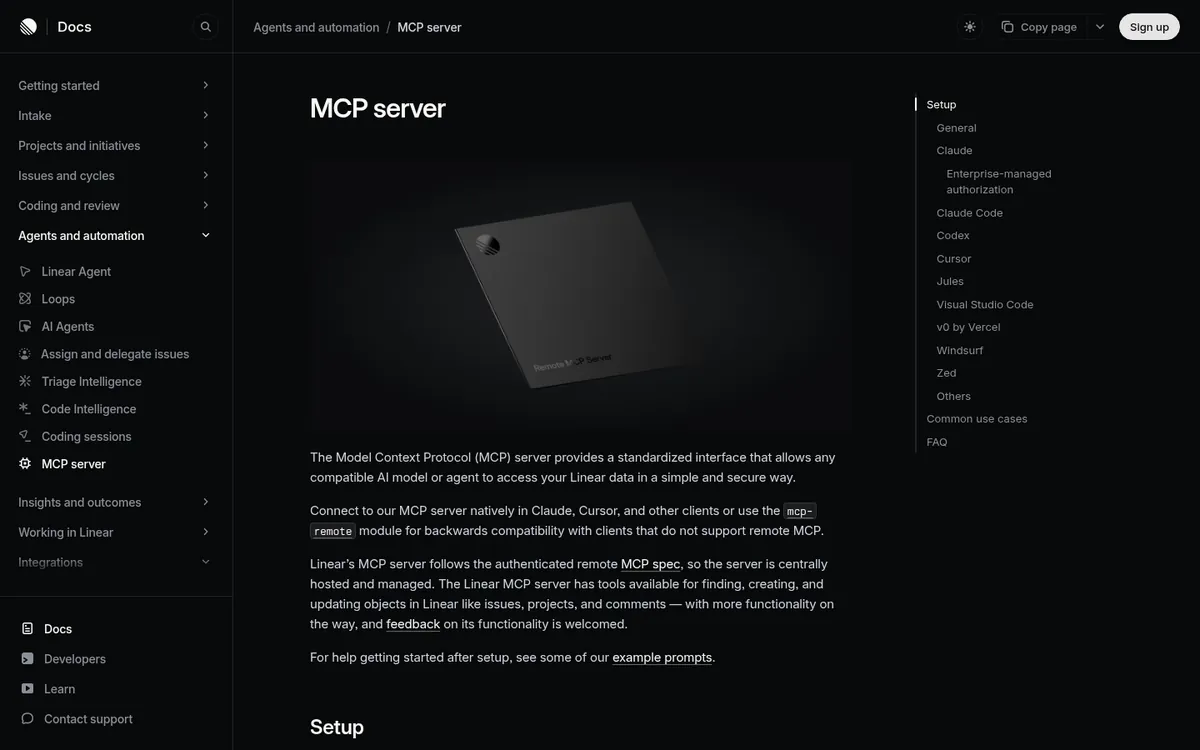
Read-only access has two paths: connect to /mcp/readonly, or request only the read OAuth scope so the token cannot reach write APIs. A February 2026 update added initiatives, project milestones, and project updates, and Okta customers can turn on enterprise-managed authorization so clients sign users in under existing access policies.
- Best for: product and engineering teams that want agents to turn specs or standup notes into tracked work.
- Setup and auth: OAuth 2.1 for interactive clients; API keys with only the Read permission for read-only automation.
- Watch out for: each Linear workspace needs its own auth context, and the SSE endpoint is deprecated.
Knowledge and Collaboration MCP Servers
Knowledge servers decide whether an agent answers from your real specs and conversations or from stale training data. Atlassian, Notion, and Slack all run hosted MCP servers that respect existing permissions, so an agent sees only what the signed-in user can already see. The trade-off is admin work: each one has its own approval model and scope list.
5. Atlassian Rovo MCP Server: Jira, Confluence, and More
The Atlassian Rovo MCP Server is the broadest knowledge server on this list, exposing Jira, Confluence, Jira Service Management, Bitbucket, Compass, Loom, and Teamwork Graph data to outside AI clients. Atlassian took it to general availability on February 4, 2026, per its GA announcement, and new setups should use https://mcp.atlassian.com/v2/mcp.
Authentication uses OAuth 2.1 or API tokens, and every action follows the user’s existing access, per the Atlassian MCP Server repository. GA added audit logs for tool calls, admin choices to allow or block AI client domains, and respect for IP allowlists. The changelog notes a ?tools=all flag that returns a flat tool list in pages of 50 for teams that front servers with an MCP gateway.
- Best for: enterprises standardized on Jira and Confluence that want agents to draft pages and create linked epics.
- Setup and auth: OAuth 2.1 sign-in with scope consent, or API tokens for service use.
- Watch out for: the legacy
/v1/sseendpoint lost support after June 30, 2026, and v1 connections move to v2 tools on March 1, 2027.
6. Notion MCP: Docs, Wikis, and Databases
Notion MCP is the hosted, actively maintained server for reading and updating pages, databases, and comments in a Notion workspace. It runs at https://mcp.notion.com/mcp on Streamable HTTP with an SSE fallback, and it works with Claude Code, Cursor, Codex, VS Code, and Devin, per the Notion MCP setup guide.
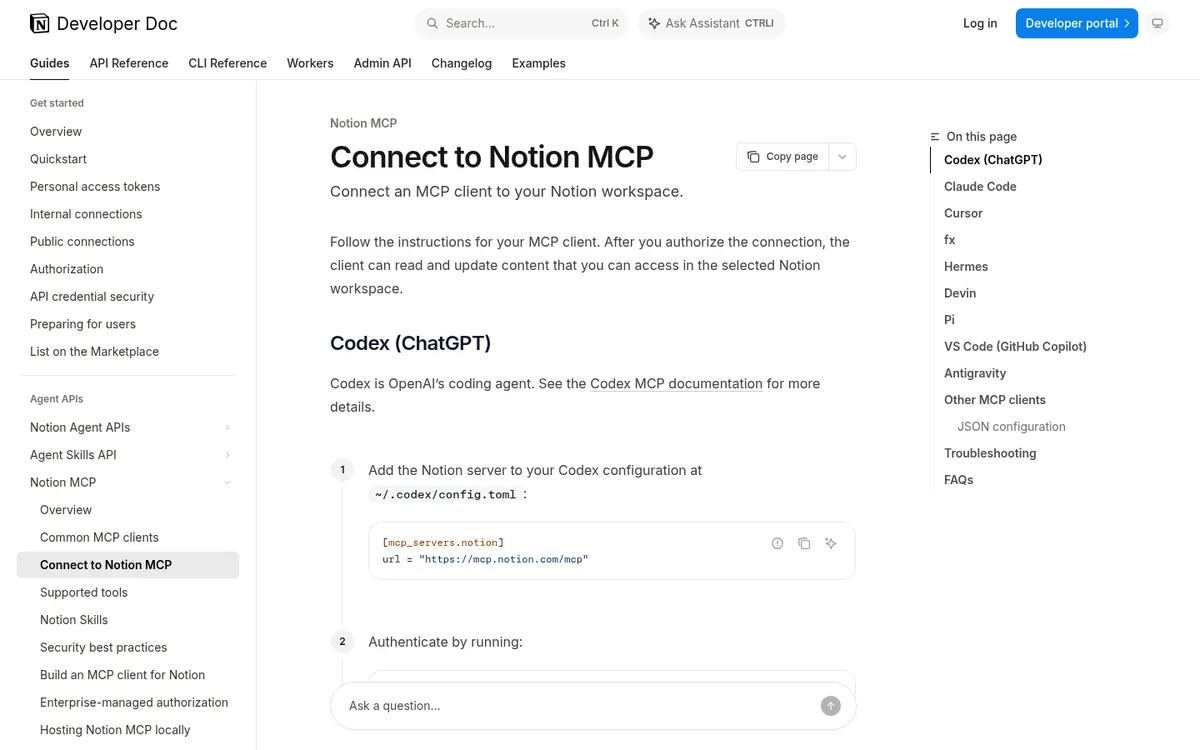
Notion says its older open-source notion-mcp-server package is no longer actively maintained, so new rollouts should use the hosted server. A notion-create-file-upload tool handles images and files up to 20 MiB, and Devin can share one organization-level connection backed by a Notion service account.
- Best for: teams whose specs, runbooks, and meeting notes live in Notion.
- Setup and auth: OAuth only; each user authorizes the workspace they want to expose.
- Watch out for: Notion MCP does not yet support non-interactive authorization, so fully headless pipelines still need the API.
7. Slack MCP Server: Conversations as Agent Context
The Slack MCP server lets approved AI clients search channels, read threads, send messages, and create canvases with the signed-in user permissions. Slack made it generally available on February 17, 2026, alongside the Real-time Search API, per the Slack developer changelog.
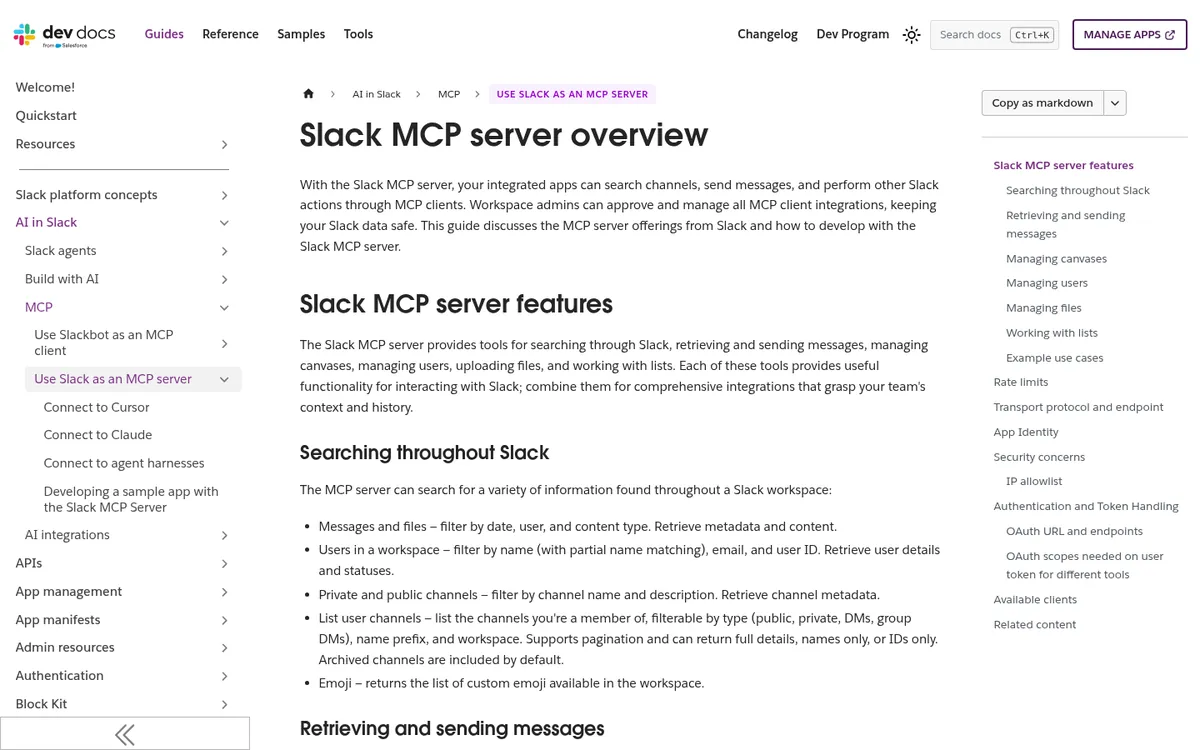
Governance is stricter than most servers. Only apps published in the Slack Marketplace and internal apps can use MCP, unlisted apps are prohibited, and workspace admins approve every MCP client integration, per the Slack MCP server overview. Search access splits into search:read.public, plus private channel, DM, and group DM scopes that each need user consent.
- Best for: companies where decisions and incident history live in Slack threads.
- Setup and auth: JSON-RPC 2.0 over Streamable HTTP through an approved app or a partner client such as Claude, Cursor, or Perplexity.
- Watch out for: the archived reference Slack server is now community-maintained by Zencoder, so do not confuse it with Slack’s own server.
Revenue and Payments MCP Servers
Revenue systems carry the highest blast radius, so the best MCP servers here are the vendor-hosted ones with permission enforcement and human checkpoints built in. Salesforce, HubSpot, and Stripe all host their servers and require OAuth or scoped keys. Each also limits what agents can write, which matters more here than in any other category.
8. Salesforce Hosted MCP Servers: CRM Logic for Any Client
Salesforce Hosted MCP Servers expose org data, flows, Apex actions, and queries to any MCP client while Salesforce handles hosting, authentication, and permission checks. They became generally available on April 29, 2026 for Enterprise Edition orgs and above, per the Salesforce Developers blog.
Prebuilt standard servers cover the Agentforce 360 Platform, Tableau Next, and Data 360 SQL. Custom servers publish your own flows, Apex actions, and Named Query APIs, and a May 2026 guide shows production URLs following https://api.salesforce.com/platform/mcp/v1/custom/NAME. Agentforce agents can also be exposed as tools, though only agents built with the new Agent Script Builder qualify, per the Agentforce docs.
- Best for: Salesforce-centric enterprises that want Claude, ChatGPT, or Slackbot to act on CRM records without custom APIs.
- Setup and auth: OAuth with a client ID and the server URL, turned on in Setup.
- Watch out for: Enterprise Edition or higher is required, and legacy Agentforce agents must be upgraded before they can be MCP tools.
9. HubSpot MCP Server: CRM Reads and Writes
The remote HubSpot MCP server gives AI clients read and write access to CRM records and activities through a HubSpot-hosted connection. It left beta and became available to all HubSpot accounts on April 13, 2026, at https://mcp.hubspot.com, per the HubSpot developer changelog.
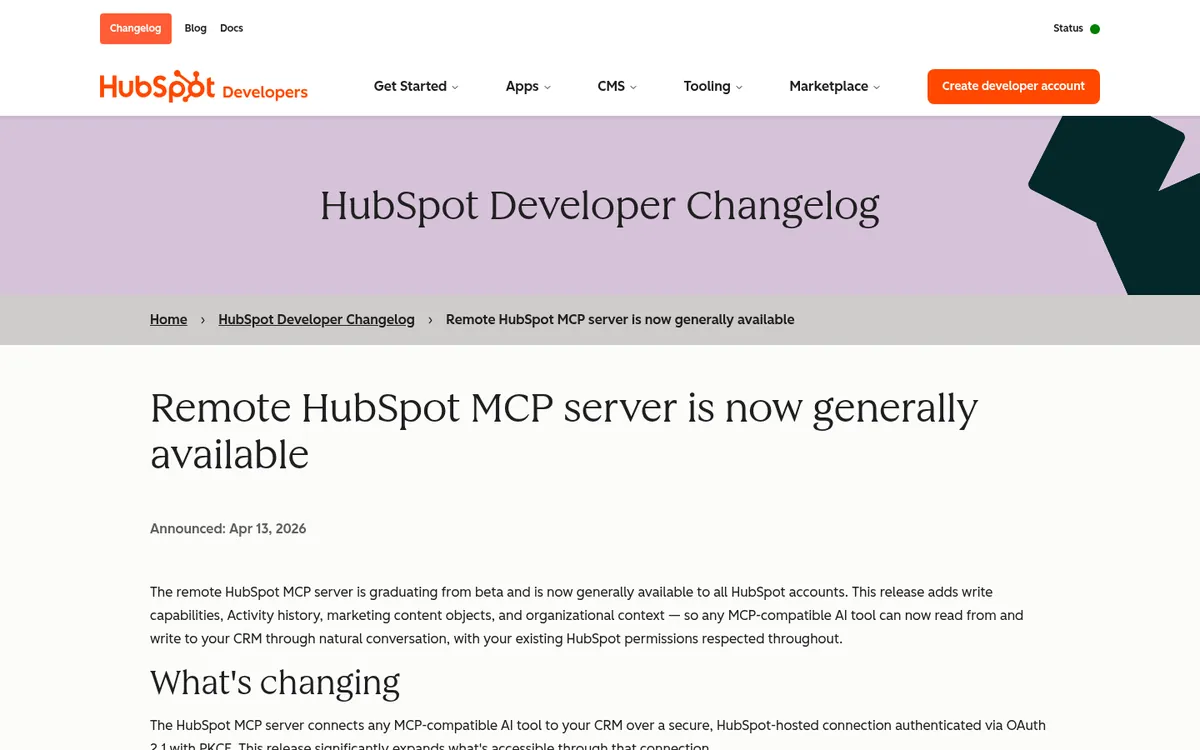
Reads cover contacts, companies, deals, tickets, quotes, invoices, campaigns, landing pages, blog posts, and activity history. Writes cover contacts, companies, deals, tickets, line items, products, and activities such as calls, notes, tasks, and meetings. Setup starts with an MCP Auth App under Development, and every action follows the user’s existing HubSpot permissions.
- Best for: sales and RevOps teams that want agents to log activities and update deals from a conversation.
- Setup and auth: OAuth 2.1 with PKCE is mandatory for every connection.
- Watch out for: accounts with sensitive data turned on lose access to activity objects through MCP, even though the standard CRM APIs still reach them.
10. Stripe MCP Server: Payments With Human Checkpoints
Stripe MCP lets agents query and change Stripe data through a hosted server at mcp.stripe.com, with human confirmation required before sensitive writes such as refunds. It keeps the tool list small by routing most of the API through stripe_api_read and stripe_api_write, per the Stripe MCP docs.
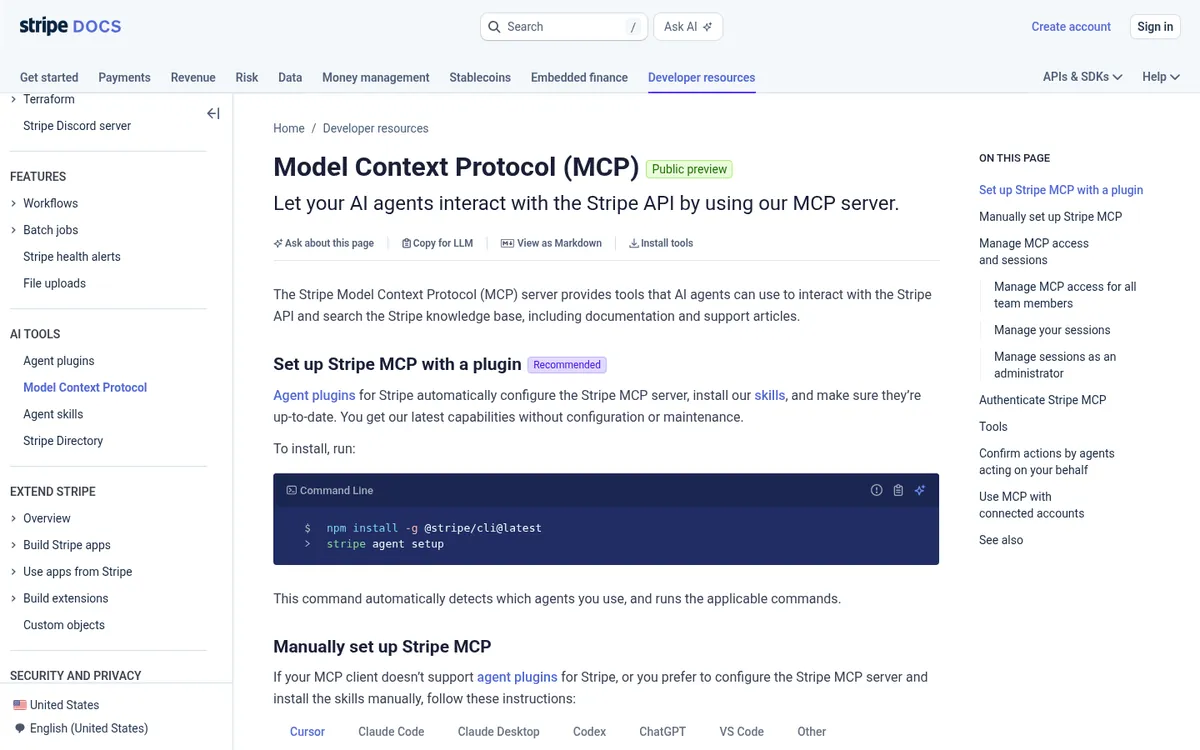
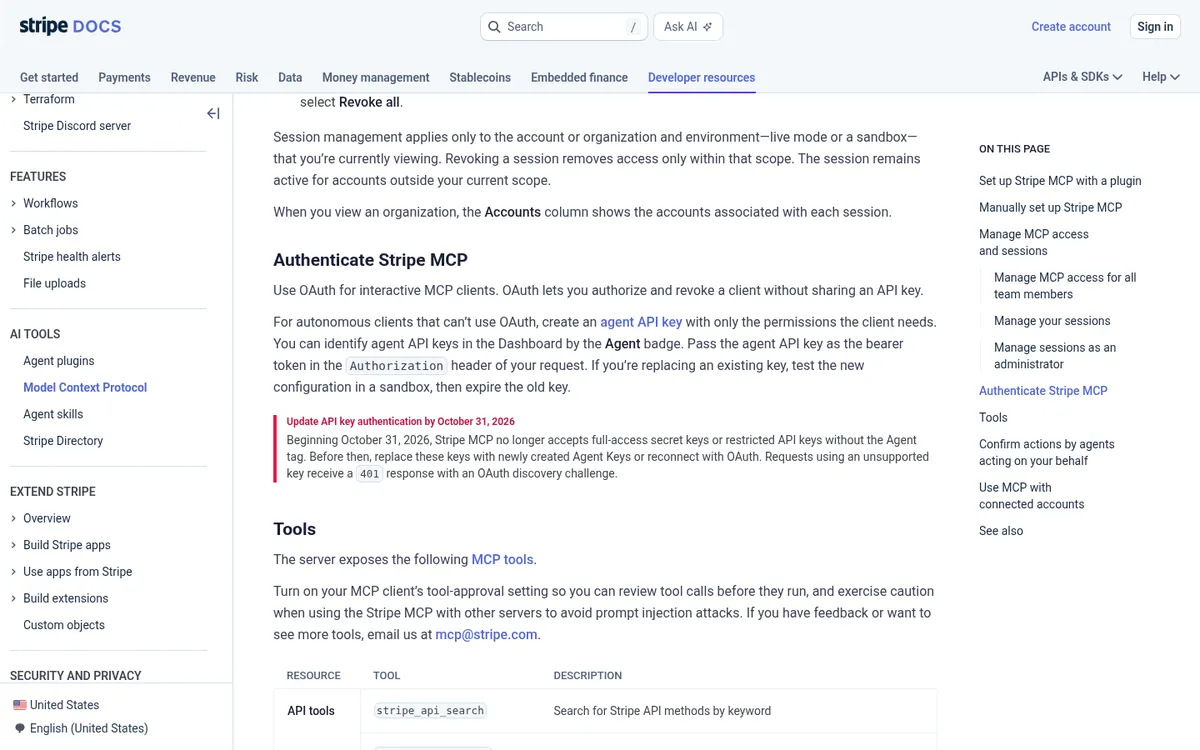
Interactive clients should use OAuth, which lets you grant access per live account or sandbox and revoke sessions from the Dashboard. Autonomous clients need an Agent API key, and the deadline is close: from October 31, 2026, Stripe MCP rejects full-access secret keys and restricted keys without the Agent tag with a 401 response.
- Best for: finance, support, and billing teams that want agents to look up customers, invoices, and disputes.
- Setup and auth: OAuth for people; Agent API keys for headless agents; a
Stripe-Accountheader for Connect platforms. - Watch out for: refund and outbound payment approvals expire after 24 hours, and connected-account calls cannot use OAuth.
Data and Analytics MCP Servers
Data servers split into two jobs: direct database access for builders, and governed answers for business users. MCP Toolbox for Databases covers the first job across 20+ engines. Snowflake’s managed server covers the second by putting Cortex Agents, semantic views, and RBAC between the agent and raw tables, which is the safer default for analytics.
11. MCP Toolbox for Databases: One Server for 20+ Engines
MCP Toolbox for Databases is Google’s open-source MCP server and tools framework for connecting agents to PostgreSQL, BigQuery, MySQL, MongoDB, Snowflake, and more than a dozen other databases. It reached its first stable release, v1.0.0, on April 10, 2026, per the release notes, and the docs reference v1.14.0 in October 2026.
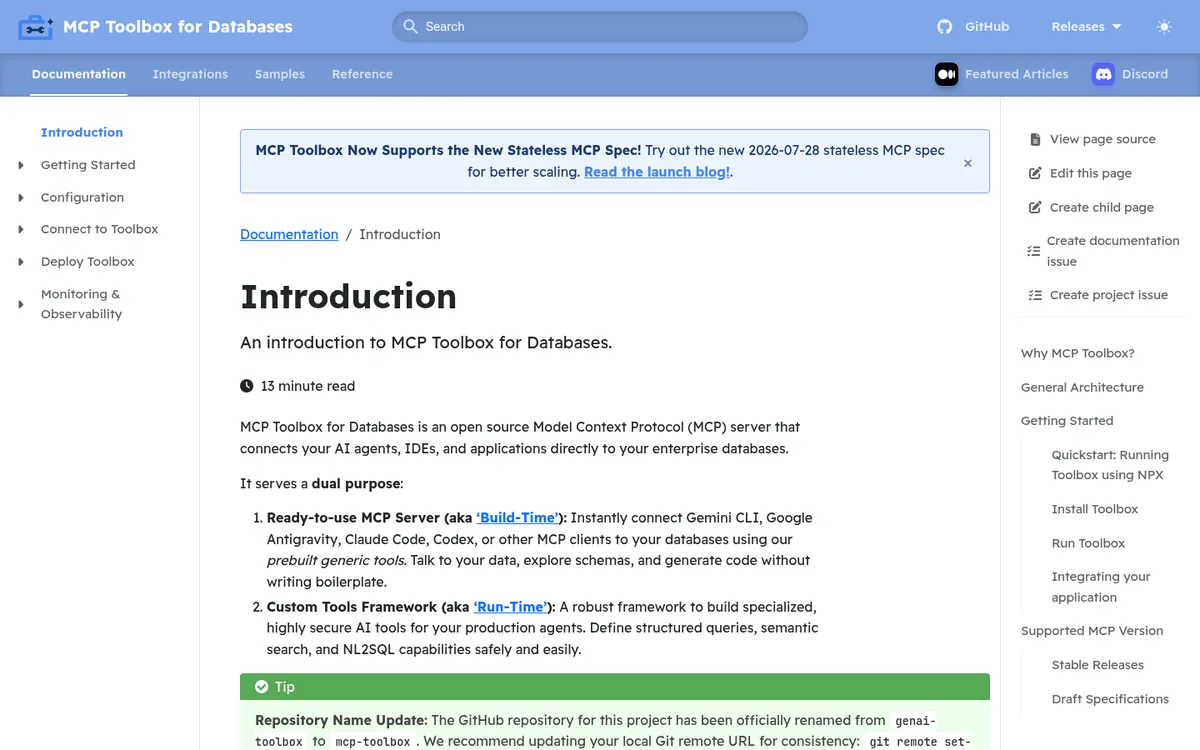
Run it with a flag such as --prebuilt=postgres for generic tools like list_tables and execute_sql, or define narrow, parameterized tools in tools.yaml for production agents. The Toolbox docs list connection pooling, IAM auth, OpenTelemetry metrics and traces, and support for MCP spec versions from 2024-11-05 to 2026-07-28.
- Best for: data and platform teams that need one governed path from agents to many databases.
- Setup and auth: local binary, container, or Homebrew; credentials or IAM per data source.
- Watch out for: the prebuilt
execute_sqltool is broad, so production agents should get custom tools instead. The old reference PostgreSQL server is archived.
12. Snowflake-Managed MCP Server: Governed Warehouse Answers
The Snowflake-managed MCP server exposes Cortex Agents, Cortex Analyst, Cortex Search, SQL, and custom functions as MCP tools without any extra infrastructure. It has been generally available since November 4, 2025, per the release note, and it is created with a CREATE MCP SERVER statement.
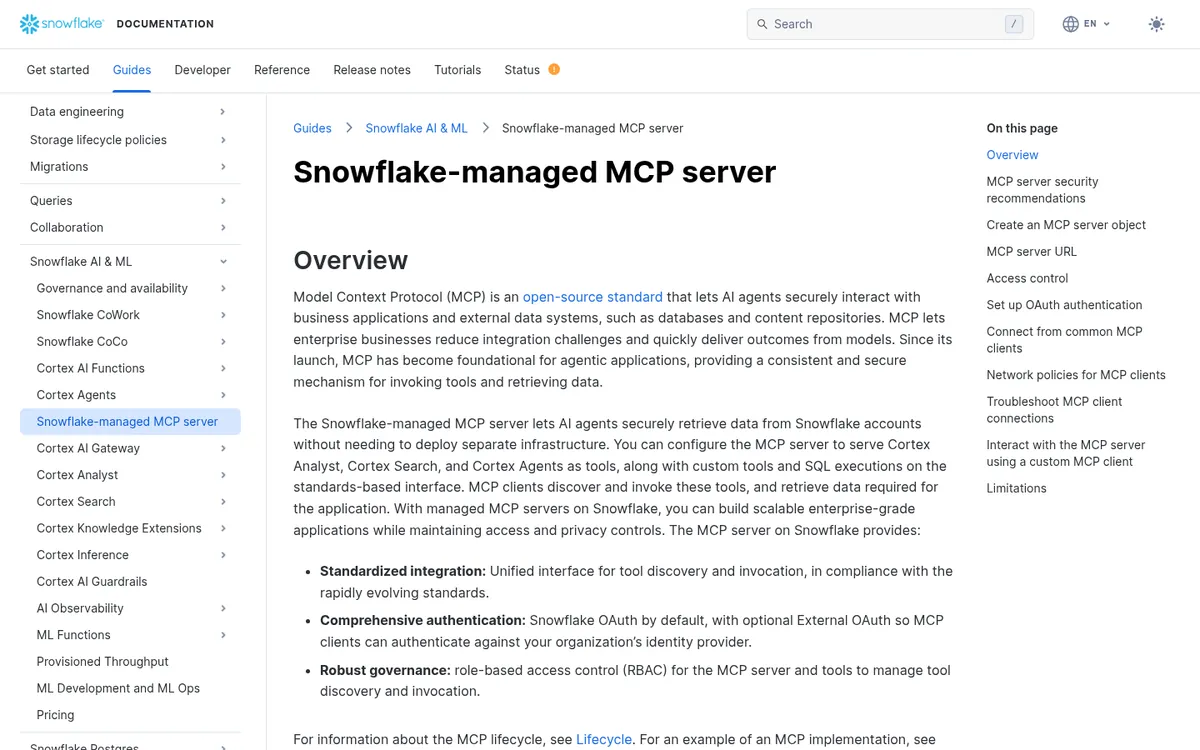
Snowflake’s own docs recommend exposing one Cortex Agent as the client-facing tool, so semantic views and verified queries cannot be bypassed. The SQL execution tool defaults to read_only: true, each tool needs its own grant, and External OAuth can bind servers to Okta or Microsoft Entra ID.
- Best for: analytics teams that want business users in Claude or ChatGPT to query governed data.
- Setup and auth: Snowflake OAuth by default, or External OAuth; no dynamic client registration.
- Watch out for: each server holds at most 50 tools, generic and SQL responses truncate at 250 KB, and only tool capabilities are supported.
Cloud, Web, and Local MCP Servers
The last three picks give agents reach beyond business apps: cloud APIs, the live web, and the local file system. The AWS MCP Server is hosted and IAM-governed. Brave Search and the Filesystem reference server run locally, which keeps them simple but moves credential and sandbox duty to your team.
13. AWS MCP Server: Every AWS API Behind IAM
The AWS MCP Server is a managed remote server that gives agents authenticated access to more than 15,000 AWS API operations through a small, fixed tool set. AWS announced general availability on May 6, 2026, with no extra charge for the server itself, per the AWS News Blog.
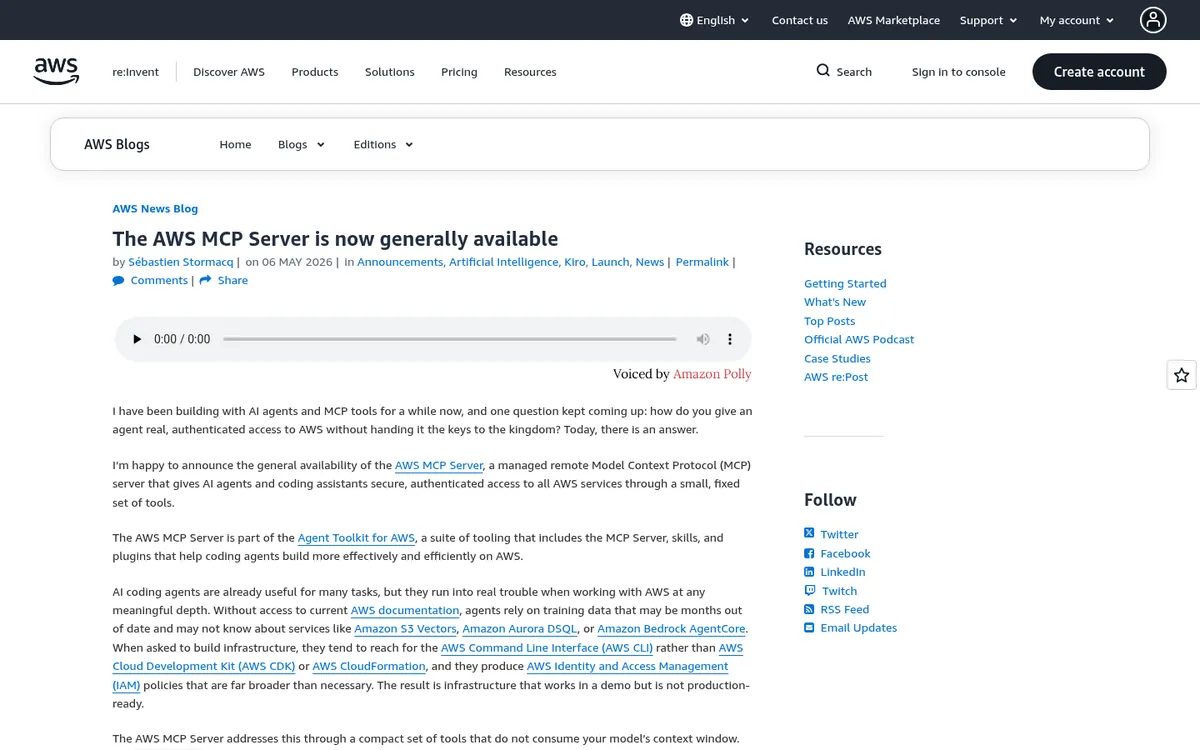
The core tools are call_aws, search_documentation, read_documentation, and run_script, which runs short Python in a sandbox with your IAM permissions and no network access. IAM context keys and Service Control Policies can keep the agent read-only while humans keep write access, and CloudWatch metrics under the AWS-MCP namespace separate agent calls from human ones.
- Best for: cloud platform teams that want coding agents to inspect, provision, and debug AWS resources under existing IAM.
- Setup and auth: SigV4 through the open-source MCP Proxy for AWS; endpoints run in 8 Regions after an October 2, 2026 expansion.
- Watch out for: the agent inherits whatever the IAM role allows, so scope the role first and log every call in CloudTrail.
14. Brave Search MCP Server: Fresh Web Results
The Brave Search MCP server is the official way to give agents current web, news, image, video, and local results from an independent index. Brave maintains it under the MIT license, the npm release was v2.1.4 in October 2026, and it replaced the archived reference Brave server, per the Brave Search MCP repository.
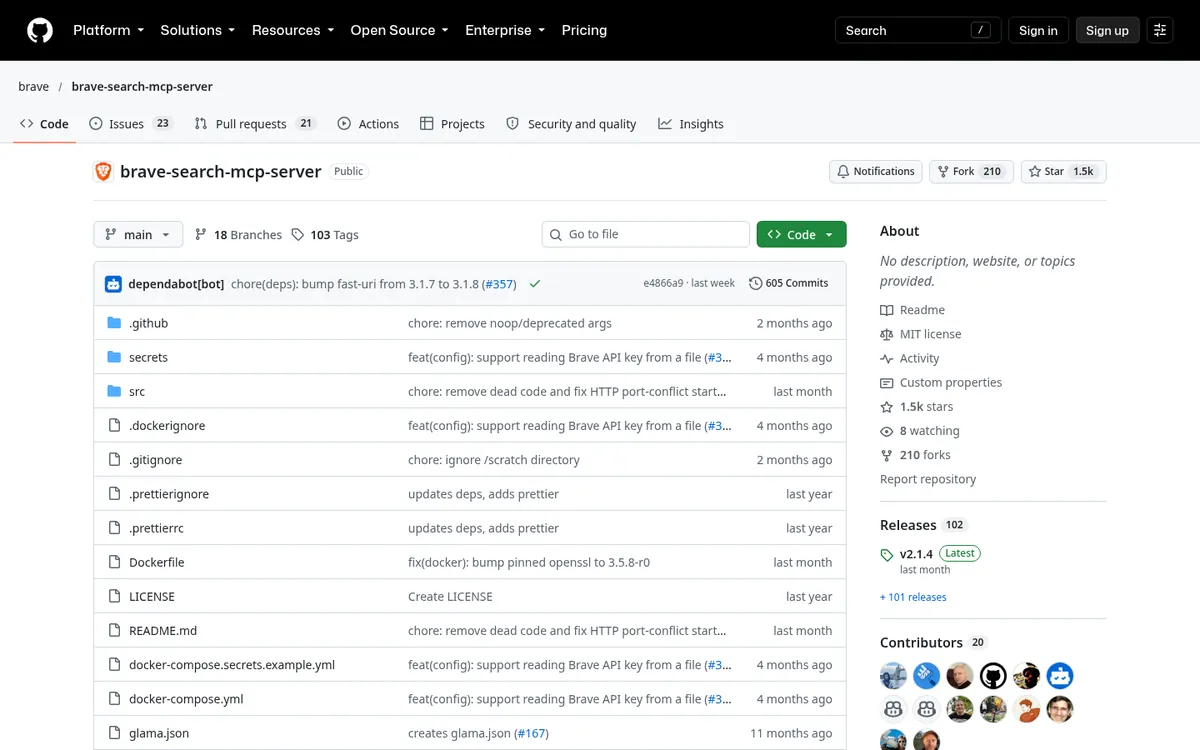
Version 2 defaults to the stdio transport, with HTTP available through BRAVE_MCP_TRANSPORT, and it dropped base64 image data from image search to save context. The Brave Search API prices Search at $5 per 1,000 requests with up to 50 queries per second, and free plans require a credit card for identity checks.
- Best for: research, support, and sales agents that need cited, current web context.
- Setup and auth: local server with a Brave API key in the environment.
- Watch out for: full local business search needs a Pro plan, and the server falls back to web search without it.
15. Filesystem Reference Server: Sandboxed Local Files
The Filesystem server from the MCP project is the baseline for letting an agent read, write, move, and search files inside directories you explicitly allow. It ships as @modelcontextprotocol/server-filesystem and refuses to touch paths outside its allowed list, per the Filesystem server README.
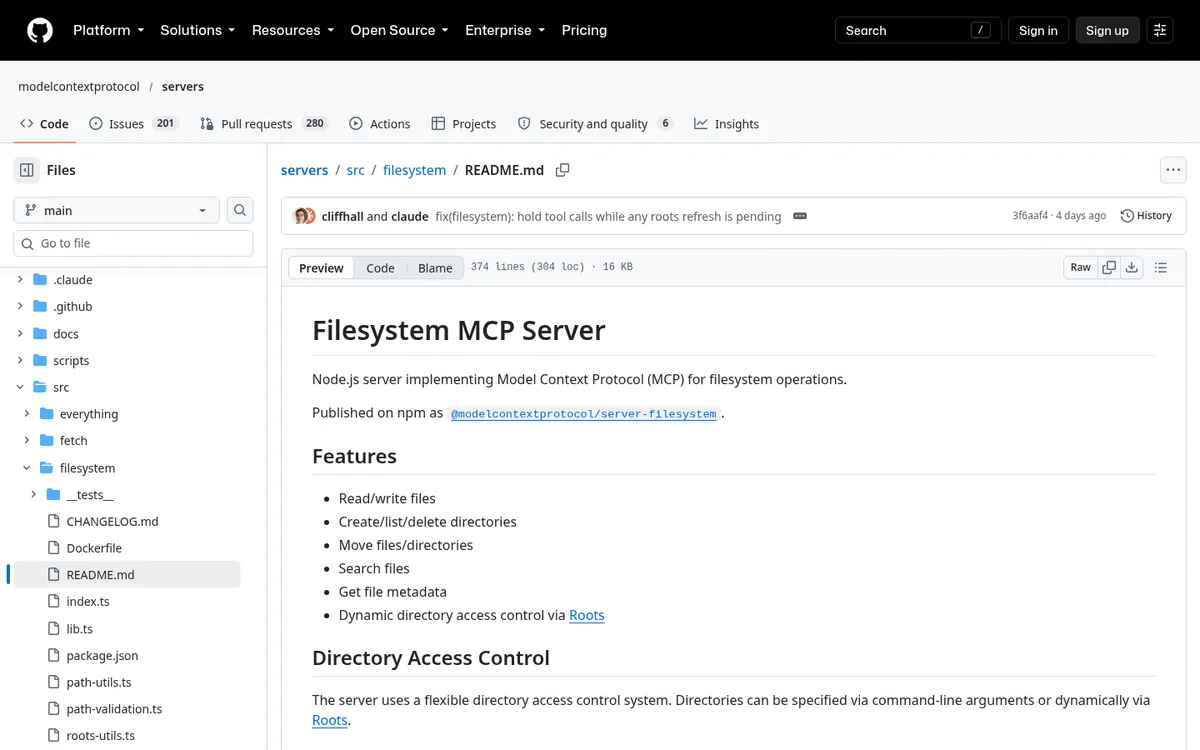
Treat it as a reference implementation. The MCP servers repository warns that its servers are educational examples, not production-ready solutions. Pass allowed directories as startup arguments: Roots, the dynamic alternative, was deprecated by SEP-2577 and keeps working only through a migration window.
- Best for: developer laptops and CI sandboxes where an agent edits local project files.
- Setup and auth:
npx -y @modelcontextprotocol/server-filesystem /path/to/projectwith no network auth. - Watch out for: write and delete tools are included, so mount only a project directory and run it in a container for shared machines.
Governance Controls Compared
The safest MCP rollout starts read-only, scoped to one project or workspace, and logged centrally. The table shows which control each server gives you before an agent can write. Where the docs do not describe an MCP call log, put a gateway or proxy in front if compliance requires a full tool-call record.
| MCP server | Read-only path | Admin control | Audit trail |
|---|---|---|---|
| GitHub | /readonly or header | Toolsets, lockdown mode | Not documented for MCP calls |
| Sentry | Skill filters such as ?skills= | Org and project URLs | Not documented for MCP calls |
| Linear | /mcp/readonly | Okta-managed auth | Not documented for MCP calls |
| Atlassian Rovo | Scope consent | AI domain allowlists, IP allowlists | Tool-call audit logs |
| Slack | Granular search scopes | Admin approves every client | Not documented for MCP calls |
| Salesforce | Per-server tool choice | Setup enablement, org permissions | Not documented for MCP calls |
| Stripe | Restricted Agent keys | Team MCP toggle per environment | Workbench MCP call logs |
| Snowflake | read_only: true SQL | RBAC per tool | Snowflake query history |
| AWS | IAM context keys, SCPs | IAM roles | CloudTrail, CloudWatch AWS-MCP |
A read-only starter config
Most clients accept a JSON block like the one below. It connects three hosted servers in their narrowest modes, so a pilot team can test value before anyone grants write access.
{
  "mcpServers": {
    "github": {
      "type": "http",
      "url": "https://api.githubcopilot.com/mcp/readonly",
      "headers": { "X-MCP-Toolsets": "repos,issues,pull_requests" }
    },
    "linear": {
      "type": "http",
      "url": "https://mcp.linear.app/mcp/readonly"
    },
    "sentry": {
      "type": "http",
      "url": "https://mcp.sentry.dev/mcp/my-org/my-project"
    }
  }
}
Security Risks to Check Before You Connect
Every MCP server widens what an agent can do, so the main risks are over-broad permissions, poisoned tool descriptions, and prompt injection from content the agent reads. Snowflake’s docs warn that mixing unverified servers can lead to tool poisoning or tool shadowing, and Stripe tells users to keep tool approval on when combining servers.
Research backs the caution. Our coverage of the ToFu MCP fuzzing study found 253 verified bugs across 118 MCP servers, plus a repeat-after-me bypass that worked across 6 agent frameworks. Broader agent risks sit in our Agent Security topic.
- Prefer hosted vendor servers: OAuth tokens can be revoked centrally, unlike a personal token pasted into a config file.
- Start read-only: use
/readonlyendpoints, read scopes, or read-only SQL until the pilot proves value. - Scope tightly: one repo, project, workspace, or IAM role per agent, never an org-wide admin token.
- Keep a human on writes: mirror Stripe’s model and require approval for refunds, deletions, and outbound messages.
- Pin local servers: pin package versions for stdio servers and run them in containers with minimal mounts.
When to Build or Proxy Instead
Build your own MCP server only when no vendor server exists for an internal system, or when you need a narrow, audited tool that the vendor server cannot offer. Salesforce custom servers, Snowflake generic tools, and MCP Toolbox custom tools all let you publish narrow tools without writing protocol code.
Put an MCP gateway or proxy in front when you run more than a handful of servers, need one audit log, or must filter tools by team. Model traffic is a separate layer, covered in our LLM gateways guide, and teams wiring MCP into agents should compare runtimes in AI agent frameworks.
What We Left Out and Why
- Archived reference servers: the old PostgreSQL, GitHub, Slack, Sentry, Brave, and Google Drive reference servers now live in a separate archive, and vendor servers replace most of them.
- Unofficial wrappers: community servers for GitHub, Jira, or Salesforce were skipped when the vendor ships its own hosted server.
- Marketplaces and catalogs: the MCP Registry, Smithery, PulseMCP, and Glama are discovery layers. One September 2026 count found 21,869 servers on PulseMCP and 89,255 on Glama.
- MCP gateways: gateways route and govern traffic to servers, so they belong in a separate comparison.
Our Recommendation for Enterprise MCP Rollouts
Start with three hosted servers on systems you already govern, in read-only mode, for one pilot team: GitHub, Atlassian Rovo or Notion, and Slack cover most engineering workflows. Add Salesforce, HubSpot, or Stripe only after a human-approval step exists for writes.
Data teams should start with Snowflake’s managed server or custom MCP Toolbox tools, never raw execute_sql. Cloud teams can trial the AWS MCP Server behind a read-only IAM role this week. For tracing what agents do with these tools, see AI agent observability tools and the AgentOps tools map.
Spotted a server we missed or a detail that changed? Send it through our contact page.
Related Guides
- MCP and Agent Protocols hub
- MCP topic
- Agent Security topic
- ToFu finds 253 bugs in 118 MCP servers
- Claude Managed Agents dynamic workflows
- AI agent frameworks compared
- Best LLM gateways for enterprise AI teams
- AgentOps hub
- AgentOps tools map
- Best AI agent observability tools
- Open source LLM observability
- AI agent evaluation tools
- Editorial standards · Disclosure · Contact
Frequently Asked Questions
What is an MCP server?
An MCP server is a program that exposes tools, data, or prompts to AI agents through the Model Context Protocol. A client such as Claude, Cursor, or ChatGPT connects to it and calls those tools through one standard interface, so teams do not need a custom integration for every agent and every business system.
Are hosted or local MCP servers safer for enterprises?
Hosted vendor servers are usually safer for business apps because they use OAuth, respect existing permissions, and can be revoked centrally by an admin. Local servers suit developer tools such as Playwright or Filesystem, but they keep credentials on the machine and need containers, pinned versions, and tight directory limits.
Which MCP servers support read-only mode?
GitHub offers a /readonly URL and header, Linear offers /mcp/readonly or a read-only OAuth scope, and Snowflake’s SQL tool defaults to read-only. Sentry limits reach through project-scoped URLs, and AWS can be held read-only with IAM context keys or Service Control Policies while humans keep their write access.
How many MCP servers exist in 2026?
A third-party crawl counted 38,212 servers in the official MCP Registry on October 1, 2026, with 37,744 marked active. Directories differ widely: a September 2026 count found 21,869 servers on PulseMCP and 89,255 on Glama, so most enterprises should start from vendor servers rather than raw directory listings.
Do I need an MCP gateway for these servers?
Not for a small pilot. Two or three hosted servers with OAuth and read-only modes are manageable on their own. A gateway or proxy becomes worthwhile when you run many servers, need one central audit log, want to filter tools by team, or must block unapproved servers across the company.