
Last updated October 20, 2026. Features, release dates, licenses, and published prices were checked against each vendor’s product pages, documentation, GitHub repositories, and model cards on that date.
The best AI guardrails tools in 2026 are Check Point AI Guardrails (built on Lakera Guard) for full agent tool traffic, Amazon Bedrock Guardrails for AWS teams, and Google Model Armor for the lowest metered price. Azure AI Content Safety, NVIDIA NeMo Guardrails, OpenAI Guardrails, Guardrails AI, IBM Granite Guardian, and Meta Llama Guard 4 complete the list.
Pick a managed API when you want a detector someone else trains and updates. Pick an open-source framework or open-weight model when prompts cannot leave your network or you need checks written as code. No guardrail fixes an agent that holds a credential it should never have had, so scope tool permissions before you add detectors.
An AI guardrail is a check that inspects what goes into a model, what comes out, or what an agent is about to do with a tool, then blocks, edits, or flags it. This ranking sits in our agent security coverage within AI governance and security. No vendor paid for placement or reviewed this page, per our editorial standards and disclosure policy.
TL;DR
- Tool controls are the dividing line. Our check found 5 of the 9 tools document a way to inspect a tool call before it runs, while 4 still screen only prompts and replies. Guardrails do not manage the credentials an agent uses, which is the job of the non-human identity tools we cover separately.
- Check Point AI Guardrails covers the most ground: prompts, outputs, tool calls, tool responses, tool descriptions, and a tool allow and deny list, as SaaS or self-hosted. Our Lakera vs HiddenLayer vs Mindgard comparison sets Lakera against two broader AI security platforms.
- Model Armor is the cheapest metered option: about $75 a month to screen 1 million agent steps of 3,000 characters, against $450 on Bedrock and $1,125 per Azure API.
- Bedrock added an agent-loop API in June 2026. InvokeGuardrailChecks scores any step, including tool results, with no guardrail resource to manage.
- Open source is strong but uneven. NeMo Guardrails validates tool calls locally, Granite Guardian 4.1 judges function calls, and Meta has not updated Llama Guard 4 since April 2025.
- Ownership changed in 2026. Harvey acquired Guardrails AI in September, and Check Point now sells Lakera Guard as AI Guardrails.
9 Best AI Guardrails Tools at a Glance
Choose an AI guardrails tool by the control you need most: screening prompts, checking outputs, or stopping a tool call that does not match what the user asked. The table compares all nine on that job, tool coverage, deployment, license, and published price. Every cell reflects vendor pages, documentation, GitHub, and model cards checked on October 20, 2026.
| Tool | Best for | Tool call checks | Runs in your environment | License or model | Published price |
|---|---|---|---|---|---|
| Check Point AI Guardrails (Lakera Guard) | Dedicated guardrail API for agent tool traffic | Yes, allow and deny list plus deviation detector | Yes, self-hosted option | Commercial | $74,000 a year for 10M requests (AWS Marketplace) |
| Amazon Bedrock Guardrails | AWS teams guarding any model | Content checks on tool inputs and results | No, AWS service | Commercial | $0.15 per 1,000 text units for content filters |
| Google Model Armor | Cheapest metered screening, Google Cloud and MCP | Screens agent interactions, single turn | No, Google Cloud | Commercial | 2M tokens free, then $0.10 per 1M |
| Azure AI Content Safety | Foundry agents and Azure apps | Yes, Task Adherence (preview) | Containers for text and image analysis | Commercial | $0.375 per 1,000 text records |
| NVIDIA NeMo Guardrails | Programmable rails in Python | Yes, IORails schema and allowlist | Yes | Apache 2.0 | Free |
| OpenAI Guardrails | OpenAI Agents SDK builders | Yes, per tool call and output | Library only; checks call a model | MIT | Free library; model tokens |
| Guardrails AI | Validating and fixing structured outputs | Not documented | Yes | Apache 2.0 | Free |
| IBM Granite Guardian 4.1 | Open-weight judge with custom criteria | Yes, function calling hallucination | Yes | Apache 2.0 | Free weights |
| Meta Llama Guard 4 and Prompt Guard 2 | Free content safety classifiers | Code interpreter abuse category only | Yes | Llama 4 Community License | Free weights |
Verdict: Check Point, Azure, NeMo Guardrails, OpenAI Guardrails, and Granite Guardian can judge a tool call before it executes, which is the control agents need most. Bedrock and Model Armor are the strongest managed screens for prompts and responses. Guardrails AI and Llama Guard 4 are best kept for output validation and content safety.
How We Ranked These AI Guardrails Tools
We ranked tools on how well they guard agents that call tools, not just chatbots, and on evidence a buyer can check. We started from managed cloud guardrails, dedicated guardrail APIs, open-source frameworks, and open-weight safety models, then read each vendor’s own pages, release notes, and model cards on October 20, 2026.
- Input controls: detection of jailbreaks and prompt injection in user messages, the top risk in the OWASP Top 10 for LLM applications.
- Output controls: checks for harmful content, personally identifiable information (PII), and ungrounded answers before a reply reaches a user.
- Tool controls: whether the tool inspects a proposed tool call, its arguments, or the tool’s result before the agent acts on it.
- Deployment: whether it runs inside your own network, which matters for regulated data and air-gapped systems.
- Maintenance: the date of the latest release or model update, read from GitHub and Hugging Face.
- Price clarity: a published usage price, which four of the nine offer.
We did not run attack benchmarks, so there are no star ratings, and detection rates quoted below are the vendor’s own figures. Runtime security platforms that discover agents across a company, such as Zenity or Noma, belong in our agent security coverage rather than this developer-level list.
What Our October 20 Coverage Check Found
All nine tools screen prompts and outputs, but only five document a check on a tool call before it runs, and only four publish a usage price. We scored each tool on six controls from its public documentation, GitHub repository, or model card on October 20, 2026. A control counted only when the vendor or maintainer documented it in public.
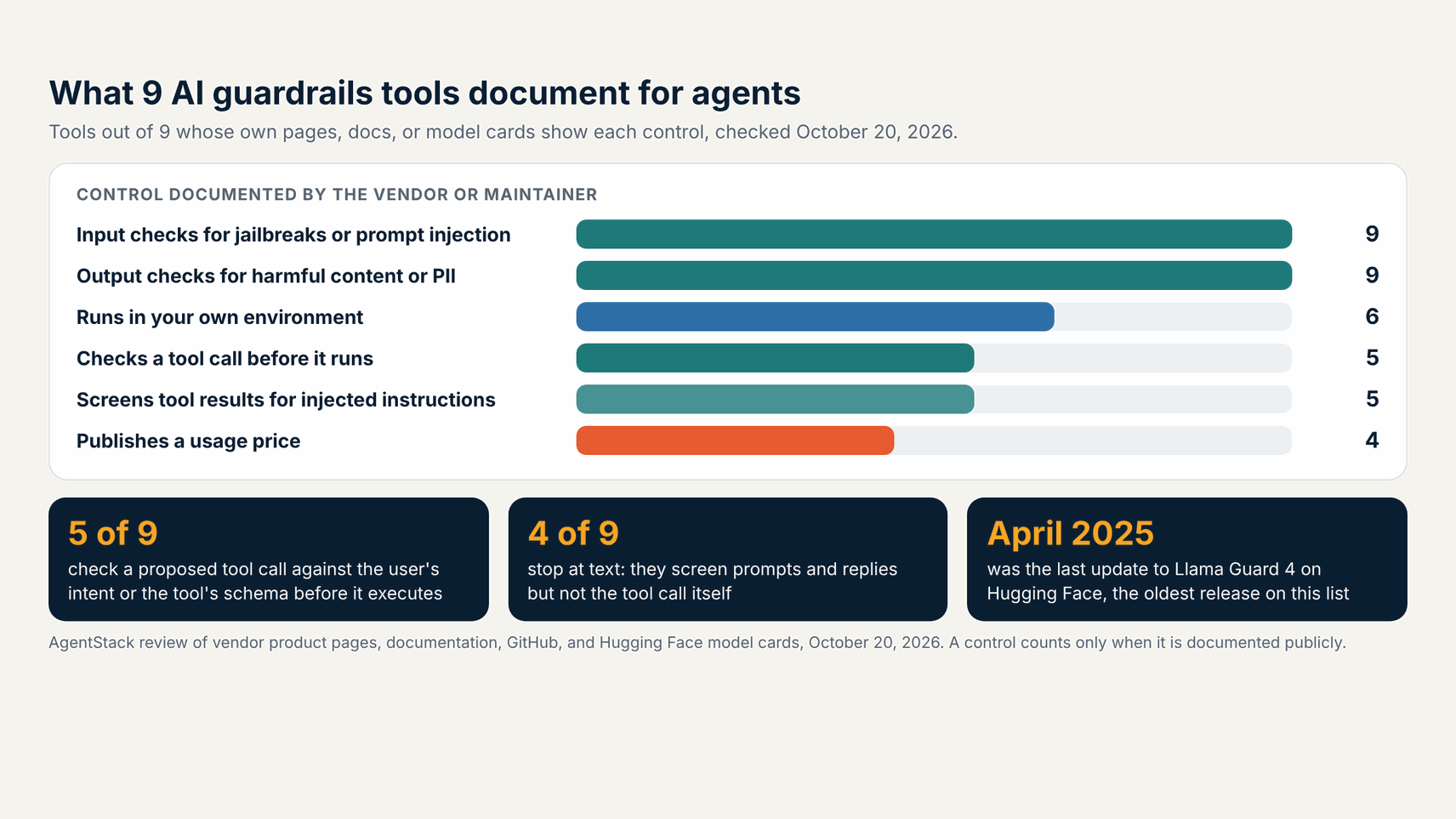
- Tool call checks appear in 5 of 9. Check Point, Azure, NeMo Guardrails, OpenAI Guardrails, and Granite Guardian judge a proposed call; Bedrock, Model Armor, Guardrails AI, and Llama Guard 4 screen text only.
- Tool result screening appears in 5 of 9. Check Point, Bedrock, Model Armor, Azure, and OpenAI Guardrails document checks on what a tool sends back, which is where indirect prompt injection arrives.
- Six of nine can run in your own environment. The four open projects run anywhere, Check Point offers a self-hosted build, and Azure sells disconnected containers for text and image analysis.
- Maintenance varies widely. NeMo Guardrails shipped v0.24.1 on September 16, 2026, Granite Guardian 4.1 arrived in April 2026, and Llama Guard 4 has not changed since April 29, 2025.
- Only four publish a usage price. Google, AWS, Microsoft, and Check Point list rates; the open projects are free but cost compute or model tokens.
A guardrail that reads only the chat transcript cannot see an agent quietly calling the wrong tool, which is why tool checks matter more than another prompt filter. The ToFu study of 253 MCP server bugs and the FastMCP client RCE advisory show how much damage starts at the tool layer.
1. Check Point AI Guardrails (Lakera Guard): Best Dedicated API for Agent Tool Traffic
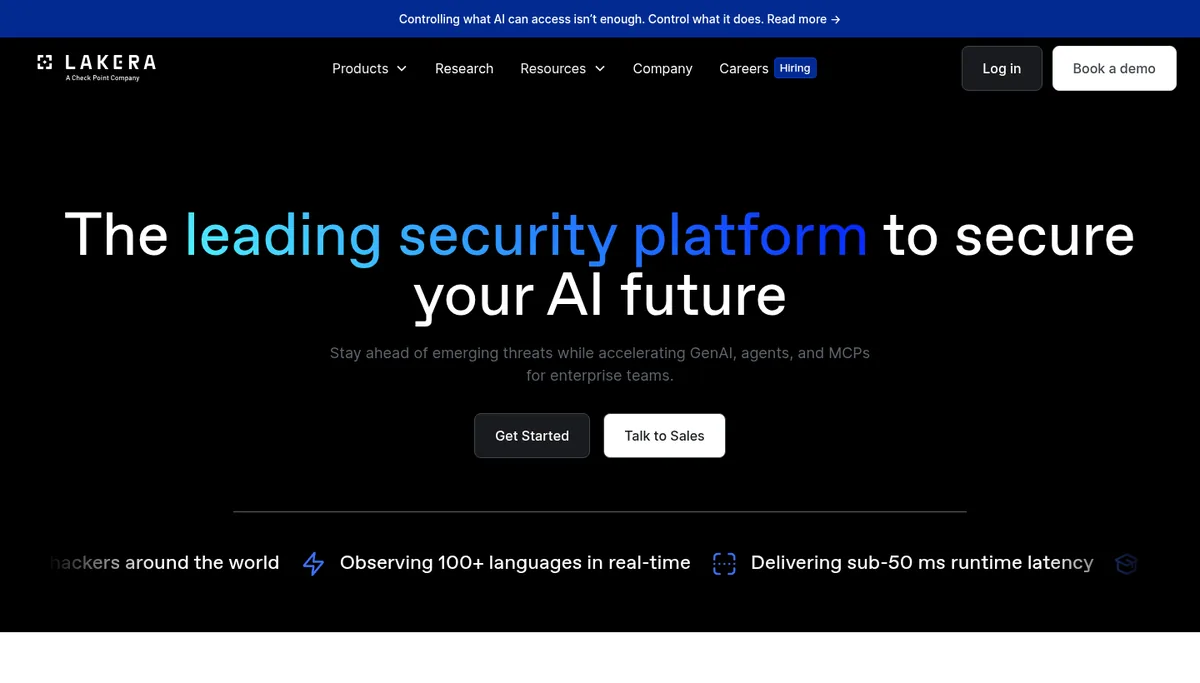
Check Point AI Guardrails is the strongest pick for teams that want one guardrail API covering prompts, outputs, tool calls, tool responses, and tool descriptions. Check Point acquired Lakera and now sells Lakera Guard as the AI Guardrails tier of Check Point AI Agent Security, per its documentation. The API is model agnostic and detects threats in more than 100 languages.
Its defenses cover prompt attacks, data leakage, content violations, malicious links, and custom policies. For agents, a Dangerous Deviation detector flags actions outside an agent’s mandate, and a Tool Allow and Deny List controls which tools an agent may call. Check Point says its threat database grows by about 100,000 entries a day.
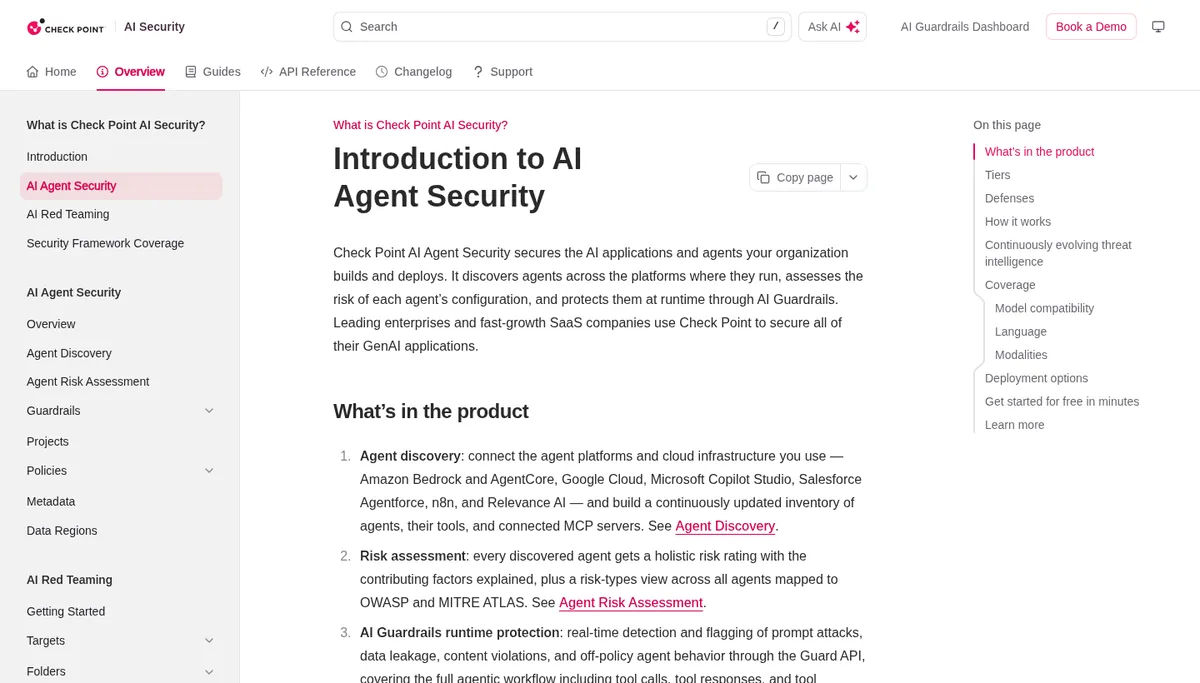
- Best for: Engineering teams that call a guardrail API on every agent step and want SaaS or self-hosted deployment.
- Pricing (October 2026): $74,000 a year for 10 million guardrail requests on AWS Marketplace; other plans by quote.
- Watch out for: Detectors flag only when a project runs in Enforce mode, and your application still has to block, so test the integration path before launch.
2. Amazon Bedrock Guardrails: Best for AWS Teams Guarding Any Model
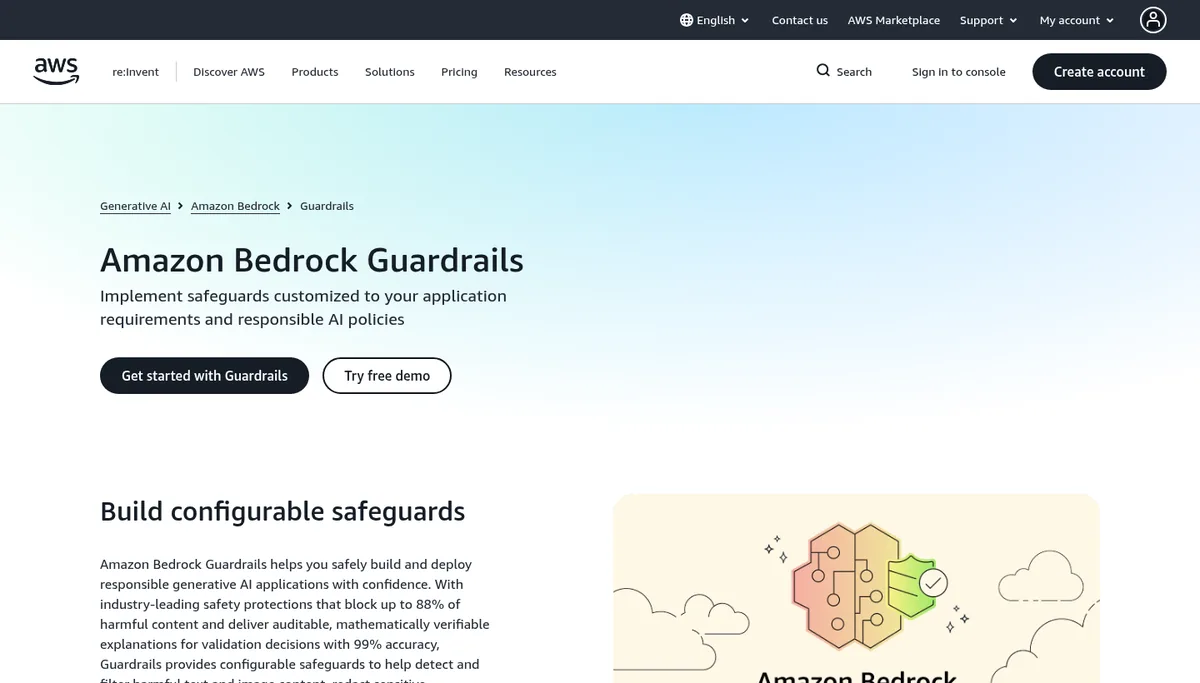
Amazon Bedrock Guardrails is the natural choice for AWS teams, because one policy can screen prompts and responses for any model, including models hosted outside Bedrock. Its safeguards cover content and word filters, prompt attack detection, denied topics, sensitive information filters, contextual grounding, and Automated Reasoning checks, per its product page. The ApplyGuardrail API runs them without invoking a model.
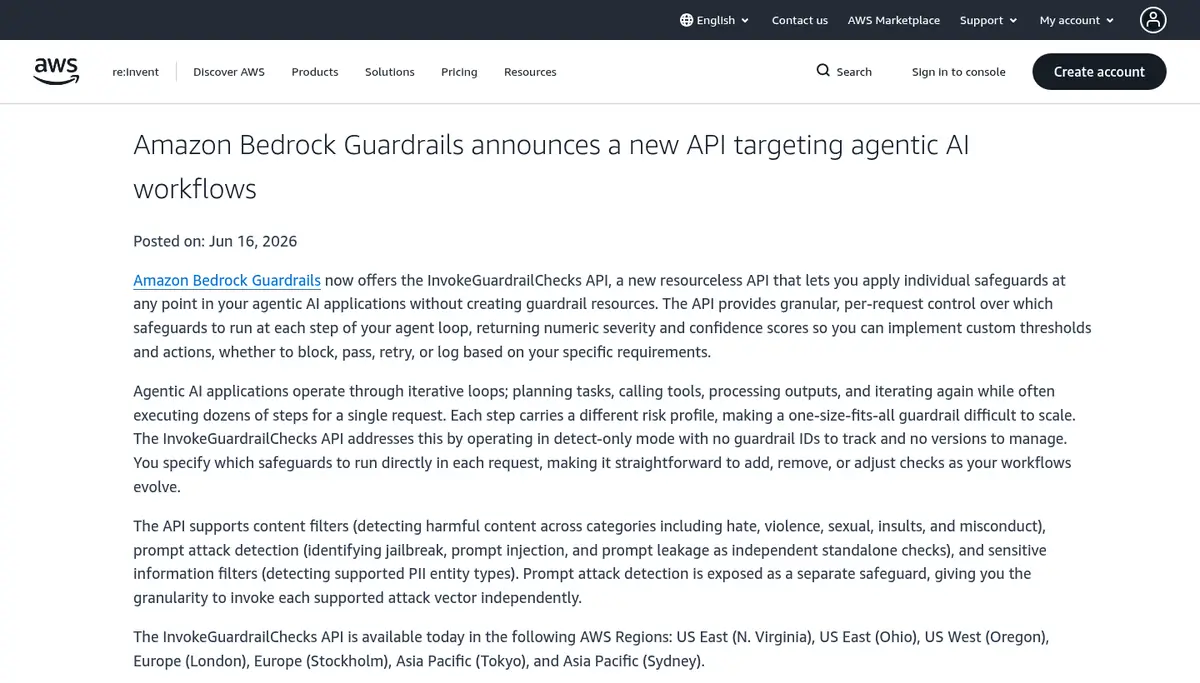
On June 16, 2026, AWS added InvokeGuardrailChecks, a detect-only API that scores jailbreak, prompt injection, prompt leakage, harmful content, and PII at any step, per its announcement. AWS documents calling it before a tool runs or after a tool returns a result, with no guardrail resource to create, per the developer guide. Automated Reasoning checks use formal logic to validate answers in regulated domains.
- Best for: AWS teams that want one managed policy across Bedrock, self-hosted, and third-party models, including agents built with Strands Agents.
- Pricing (October 2026): Content filters and denied topics $0.15 per 1,000 text units, PII filters $0.10, word and regex filters free; InvokeGuardrailChecks content filters $0.07 and prompt attack $0.08, per Bedrock pricing.
- Watch out for: InvokeGuardrailChecks returns scores only and launched in seven Regions, and no Bedrock safeguard checks whether a tool call matches what the user asked.
3. Google Model Armor: Best Metered Price for Prompt and Response Screening
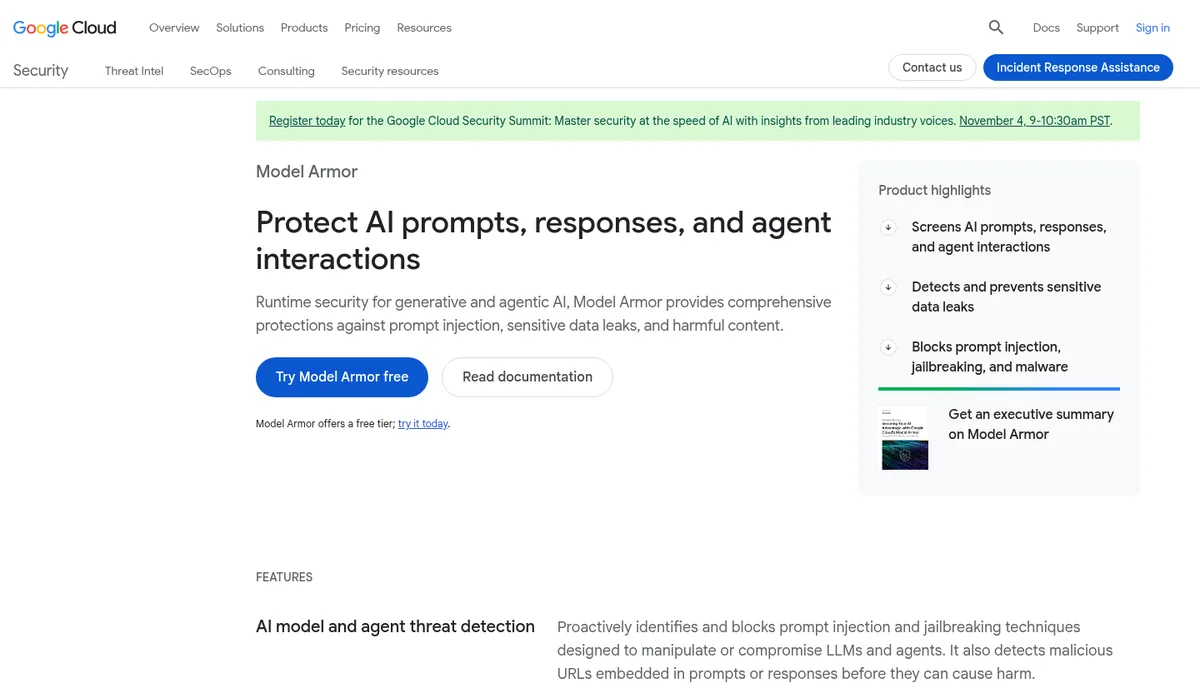
Google Model Armor is the cheapest published way to screen agent prompts and responses for injection, jailbreaks, sensitive data, malicious URLs, and harmful content. It works with any model through a REST API, and inline with Gemini, Google MCP servers, Apigee, Agent Gateway, and LangChain, per its product page. Templates set confidence thresholds per filter, with Inspect only or Inspect and block modes.
The Model Armor documentation states that it treats each request as a single turn with no conversation history. It also does not decode Base64, hexadecimal, URL encoding, or ciphertext, so encoded payloads pass through unless another layer decodes them first.
- Best for: Teams on Google Cloud, and anyone who wants a low per-token price for screening prompts and outputs on any cloud.
- Pricing (October 2026): Free for 2 million tokens a month, then $0.10 per million tokens; Security Command Center subscriptions include 3 billion tokens a month, per the pricing table.
- Watch out for: Single-turn inspection misses attacks spread across turns, and Model Armor does not judge whether a tool call fits the user’s request.
4. Azure AI Content Safety: Best for Foundry Agents That Need Tool Call Checks
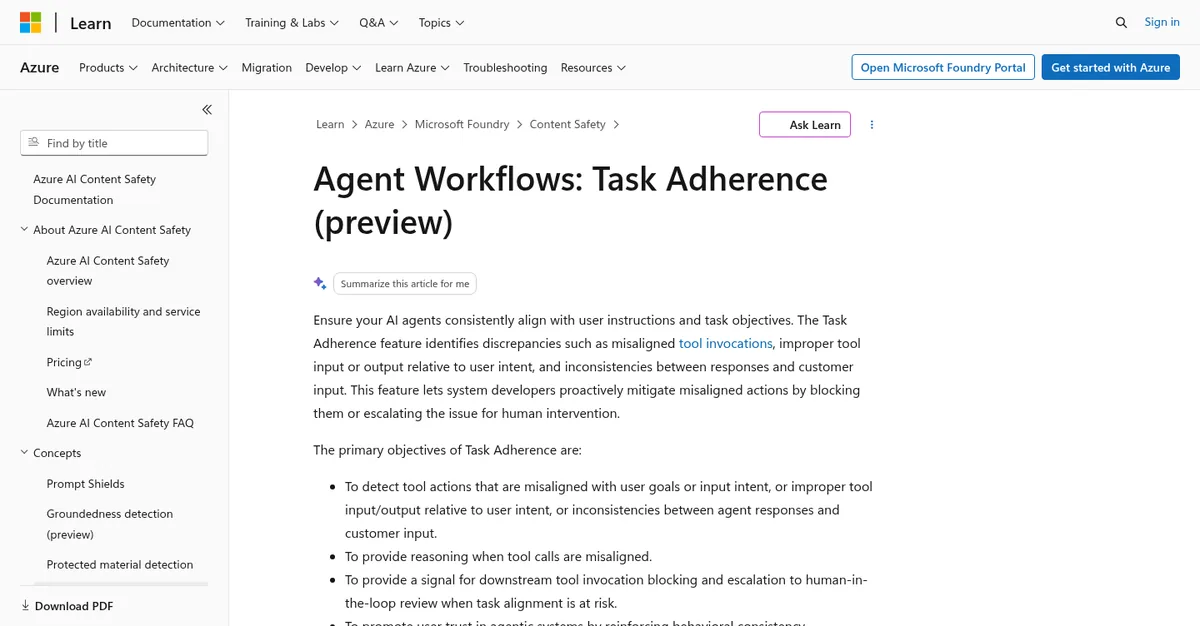
Azure AI Content Safety is the best managed option for agents that need a check on tool use itself, because its Task Adherence API flags tool calls that do not match the user request. Task Adherence, in preview, detects misaligned, unintended, or premature tool invocations, per Microsoft Learn. A request to read leave balances that triggers apply_leave() is Microsoft’s own example.
Prompt Shields detect user prompt attacks and document attacks, and for Foundry agents they can scan tool responses for supported tools in preview, per the Prompt Shields documentation. The service overview also lists groundedness detection, protected material detection, and harm categories with severity levels.
- Best for: Teams building on Microsoft Foundry or Azure OpenAI that want prompt, document, and tool call checks from one service.
- Pricing (October 2026): $0.375 per 1,000 text records of up to 1,000 characters on the Standard tier, with 5,000 free records a month on the Free tier, per the pricing page and the Azure Retail Prices API.
- Watch out for: Task Adherence and tool response scanning are previews, each API bills separately, and Task Adherence data may be processed in US and EU regions.
5. NVIDIA NeMo Guardrails: Best Open-Source Framework for Programmable Rails
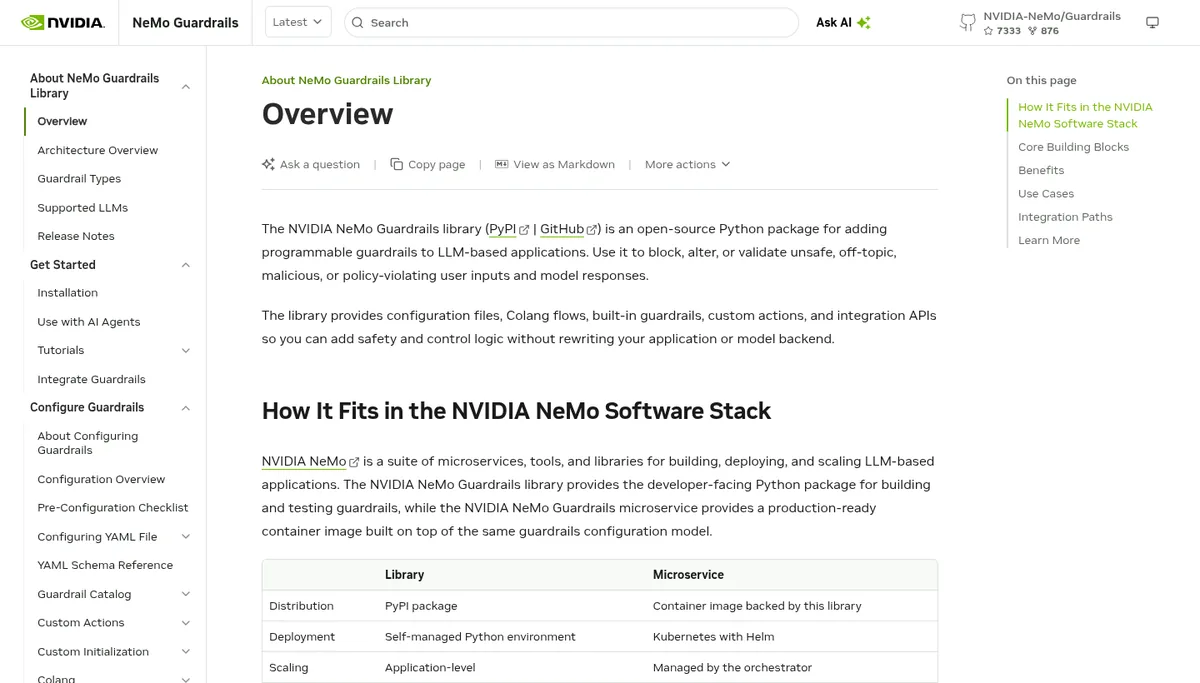
NVIDIA NeMo Guardrails is the best open-source framework for teams that want input, output, dialog, and tool rails defined in configuration and run inside their own stack. It is Apache 2.0, has about 7,300 GitHub stars, and shipped v0.24.1 on September 16, 2026, per its GitHub releases. Rails can call NVIDIA safety models or other detectors, per the library documentation.
Its IORails engine validates each tool call against an allowlist and JSON Schema, checks tool results, fails closed, and adds no extra model calls, per the tool calling guide. Tool rails arrived in v0.23.0 on July 1, 2026. Result checks cover structure and call linkage, so pair them with a content detector for poisoned tool output.
- Best for: Python teams that want guardrails as versioned configuration, with no data leaving their environment.
- Pricing (October 2026): Free and open source; you pay for compute and any models the rails call.
- Watch out for: IORails is experimental and supports only the OpenAI Chat Completions format, and Colang dialog rails take time to learn.
6. OpenAI Guardrails: Best for OpenAI Agents SDK Builders
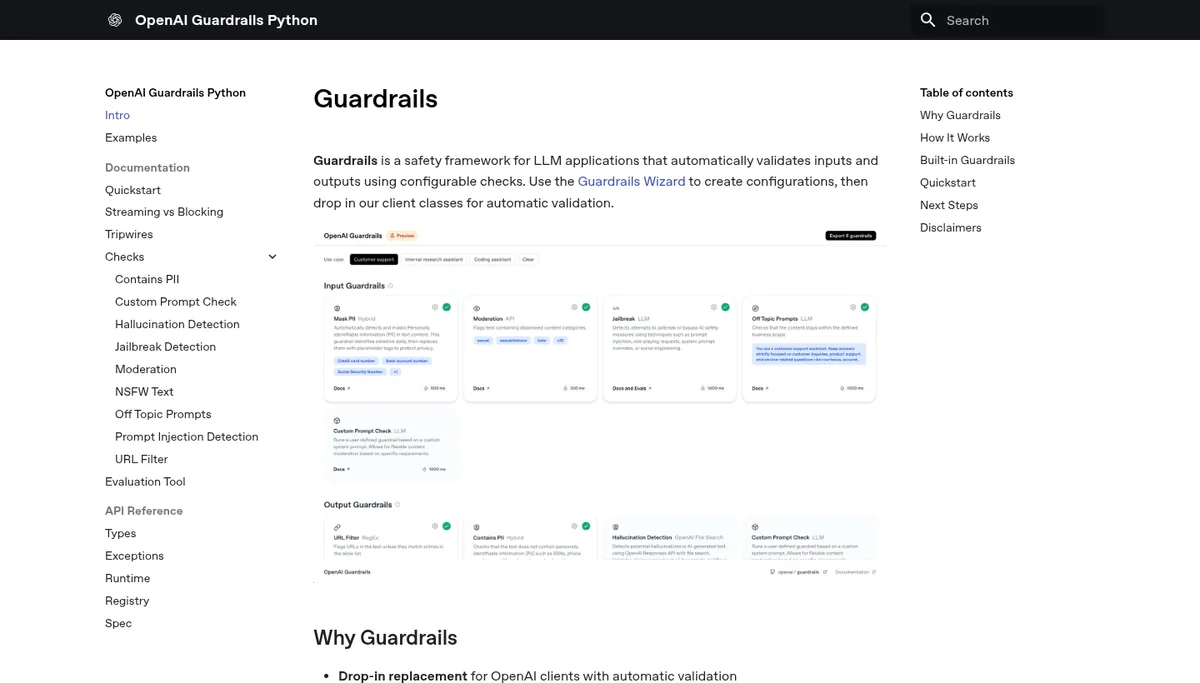
OpenAI Guardrails is the fastest way to add input, output, and per-tool checks to an agent built on the OpenAI Agents SDK. The MIT-licensed library wraps the OpenAI client, and GuardrailAgent drops in for the SDK’s Agent class, per its Agents SDK guide. The Python package reached v0.3.3 on September 10, 2026, per GitHub, and is still labeled a preview.
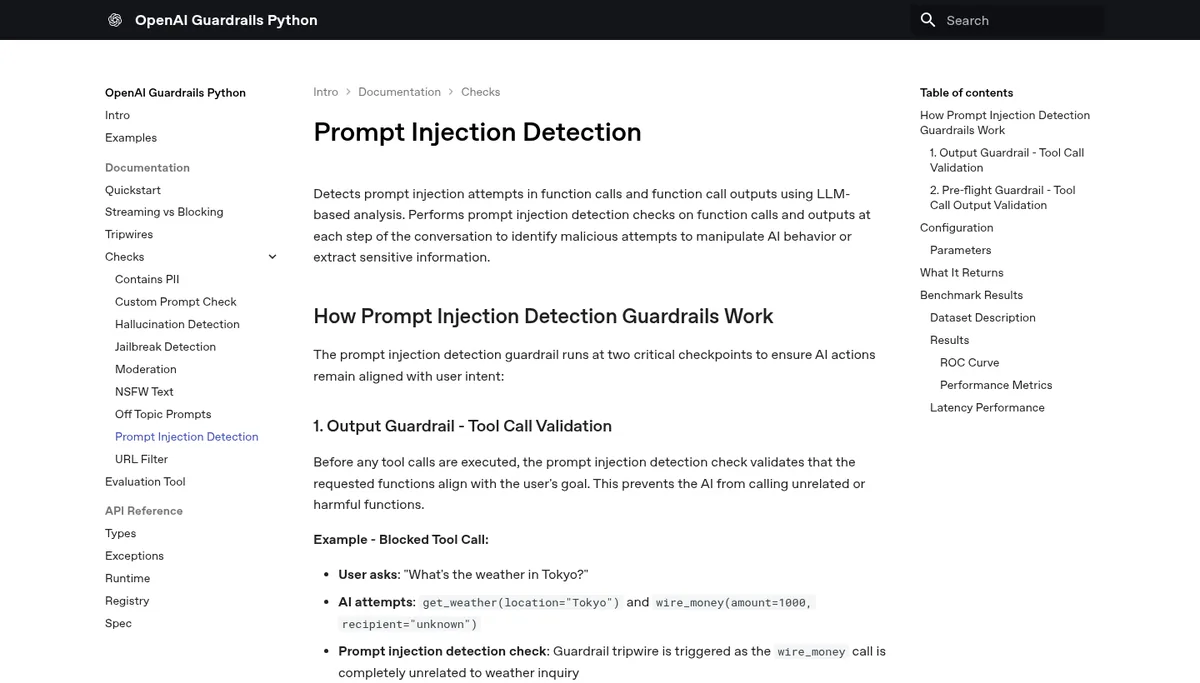
Its Prompt Injection Detection check runs on every tool call and tool output, and trips when a call does not serve the user’s goal, per the check documentation. OpenAI reports a ROC AUC of 0.987 for the default gpt-4.1-mini on a benchmark built from AgentDojo traces and internal data, with a median latency of 1,481 milliseconds per check.
- Best for: Teams on the OpenAI Agents SDK or Responses API that want guardrails configured in a no-code wizard and exported as JSON.
- Pricing (October 2026): Free library; LLM-based checks bill tokens on the model you select, and the library reports guardrail token usage.
- Watch out for: LLM-based checks add about 1.5 seconds per call at the median with the default model, and the library is still labeled a preview.
7. Guardrails AI: Best for Validating and Correcting Structured Outputs
Guardrails AI is the best open-source choice when outputs must match a schema or business rule, because its validators can reask, fix, filter, or raise on failure. Its validator hub lists 65 validators, including a jailbreak detector, PII checks, and competitor mentions. The Apache 2.0 framework has about 7,500 GitHub stars.
Harvey acquired Guardrails AI in September 2026, and its founders joined Harvey’s product team, per the announcement. Harvey said the framework is downloaded more than 250,000 times a month. Version 0.11.0, released August 14, 2026, deprecated the hub command line tool and moved validators to public PyPI, per its release notes.
- Best for: Teams that need structured, policy-checked outputs from any model, with corrective actions instead of a plain block.
- Pricing (October 2026): Free and open source under Apache 2.0.
- Watch out for: No release has shipped since the acquisition, Harvey has not said how the project will be governed, and tool call checks are not documented.
8. IBM Granite Guardian 4.1: Best Open-Weight Judge for Custom Criteria
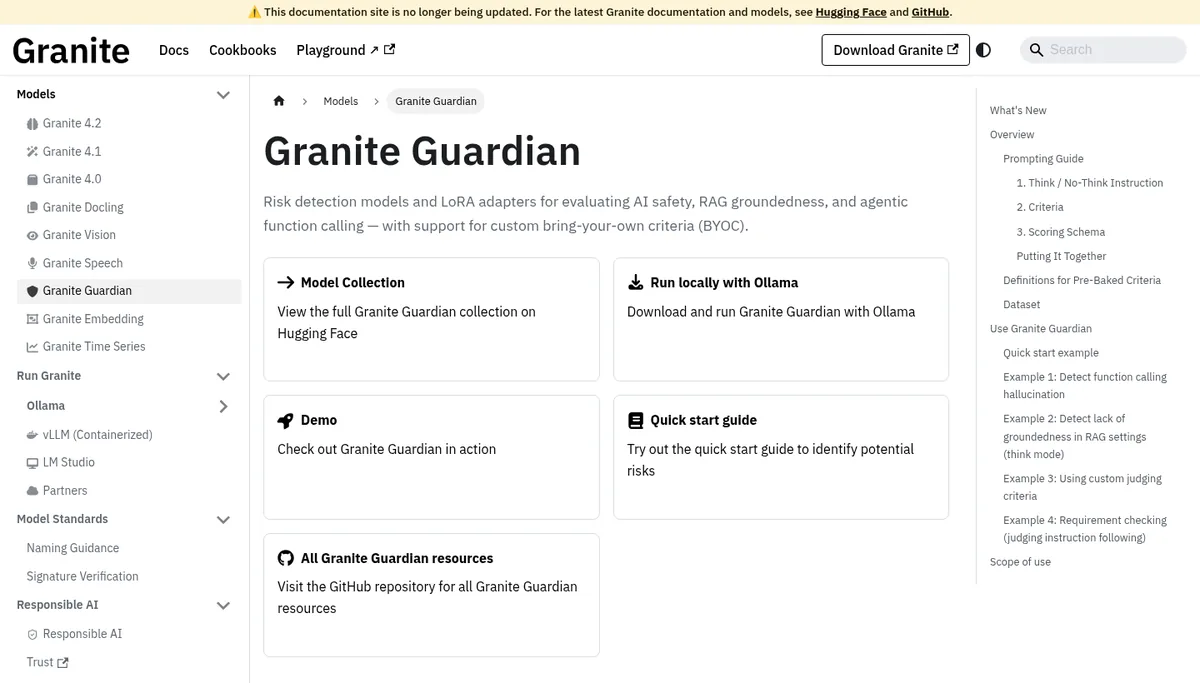
IBM Granite Guardian 4.1 is the best open-weight model for teams that want one judge for jailbreaks, harm, groundedness, function call errors, and their own written criteria. The 8 billion parameter model, released in April 2026 under Apache 2.0, improves bring your own criteria judging and adds thinking and non-thinking modes, per its model card. Granite Guardian 4.1 recorded about 55,000 Hugging Face downloads in the past month.
Its function calling hallucination check flags calls with wrong argument names, values, or types, or calls that do not fit the query, and IBM reports balanced accuracy rising from 0.74 to 0.79 over version 3.3. IBM’s Granite Guardian docs include recipes for local and Ollama deployment.
- Best for: Teams that self-host models and want a single judge model they can prompt with custom rules.
- Pricing (October 2026): Free weights; you pay for GPU or CPU inference.
- Watch out for: It returns yes or no judgments, so you build the blocking logic and thresholds yourself, and thinking mode adds latency.
9. Meta Llama Guard 4 and Prompt Guard 2: Best Free Content Safety Classifiers
Meta Llama Guard 4 is the best free classifier for content safety on text and images, and Prompt Guard 2 adds a small, fast jailbreak detector in front of it. Llama Guard 4 is a 12 billion parameter multimodal model that labels prompts and responses against 14 hazard categories, including code interpreter abuse, per its model card. Prompt Guard 2 ships in 86 million and 22 million parameter sizes.
Meta reports 69% recall and an 11% false positive rate for Llama Guard 4 on English output filtering in its own test set. Both models sit under Llama Protections and run on a single GPU or smaller hardware.
- Best for: Teams that want free, self-hosted content moderation for chat inputs and outputs, including images.
- Pricing (October 2026): Free weights under the Llama 4 Community License, which requires a separate license above 700 million monthly active users.
- Watch out for: Neither model has been updated on Hugging Face since April 2025, and neither judges whether a tool call matches user intent.
Where Each Guardrail Sits in an Agent Loop
An agent loop has four places to put a guardrail: the user’s message, the tool call the model proposes, the result the tool returns, and the final reply. Most incidents start at the middle two, so the sketch below shows the AgentStack baseline for wiring all four checks into one loop.
# AgentStack baseline: four guardrail checkpoints in one agent loop (Python sketch)
def run_step(user_msg, history):
    check_input(user_msg)                 # Prompt Guard 2, Model Armor, Prompt Shields, Bedrock prompt attack
    plan = llm.propose(history + [user_msg])
    for call in plan.tool_calls:
        check_tool_call(call, user_msg)   # Task Adherence, OpenAI Prompt Injection Detection,
                                          # NeMo IORails schema check, Granite Guardian function calling
        if call.name not in ALLOWED_TOOLS[agent_id]:
            raise Blocked("tool not on allowlist")
        result = tools.run(call, creds=scoped_creds(agent_id, call.name))
        check_tool_result(result)         # Check Point tool responses, Bedrock InvokeGuardrailChecks
        history.append(result)
    reply = llm.answer(history)
    check_output(reply)                   # Llama Guard 4, Guardrails AI validators, Bedrock PII filter
    return reply
Log every verdict with the agent ID and tool name so blocked calls show up in traces. Our AI agent observability tools ranking covers where to send those events, and AI agent testing tools help replay attacks against the loop before launch.
Tool Controls Compared Across the 9 Tools
The nine tools differ most in what they can see of a tool call and whether the check is live today. Intent checks compare the call with the user’s request, schema checks compare it with the tool definition, and content checks scan the text going in or out. The table shows each tool’s method and status.
| Tool | Tool call check | Tool result check | Status (October 2026) |
|---|---|---|---|
| Check Point AI Guardrails | Allow and deny list; Dangerous Deviation detector | Prompt attacks in tool responses and descriptions | Available |
| Amazon Bedrock Guardrails | Content and PII scores on tool inputs | Prompt injection scores on tool results | Available; InvokeGuardrailChecks since June 2026 |
| Google Model Armor | None documented | Malicious URLs, files, and injection in content | Available; single turn |
| Azure AI Content Safety | Task Adherence intent check | Prompt Shields document attacks on tool responses | Preview |
| NVIDIA NeMo Guardrails | Allowlist and JSON Schema | Structure and call linkage | Experimental |
| OpenAI Guardrails | Intent check on every tool call | Intent check on every tool output | Preview library |
| Guardrails AI | Not documented | Not documented | Available for outputs |
| IBM Granite Guardian 4.1 | Function calling hallucination | Custom criteria you write | Available |
| Meta Llama Guard 4 | Code interpreter abuse category | Not documented | No update since April 2025 |
Verdict: Azure Task Adherence and OpenAI Guardrails are the only intent checks here, and both are previews, so pair either one with an allowlist such as NeMo IORails or Check Point. Bedrock and Model Armor work best as content screens at each step, and Granite Guardian is the open-weight route to judging calls without a cloud dependency.
What AI Guardrails Tools Cost in 2026
Four of the nine tools publish usage prices, and they meter differently: Bedrock and Azure charge per 1,000 characters, Model Armor charges per token, and Check Point lists annual request bundles. To compare them, we priced one workload of 1 million agent steps a month, each screened once at 3,000 characters, or about 750 tokens.
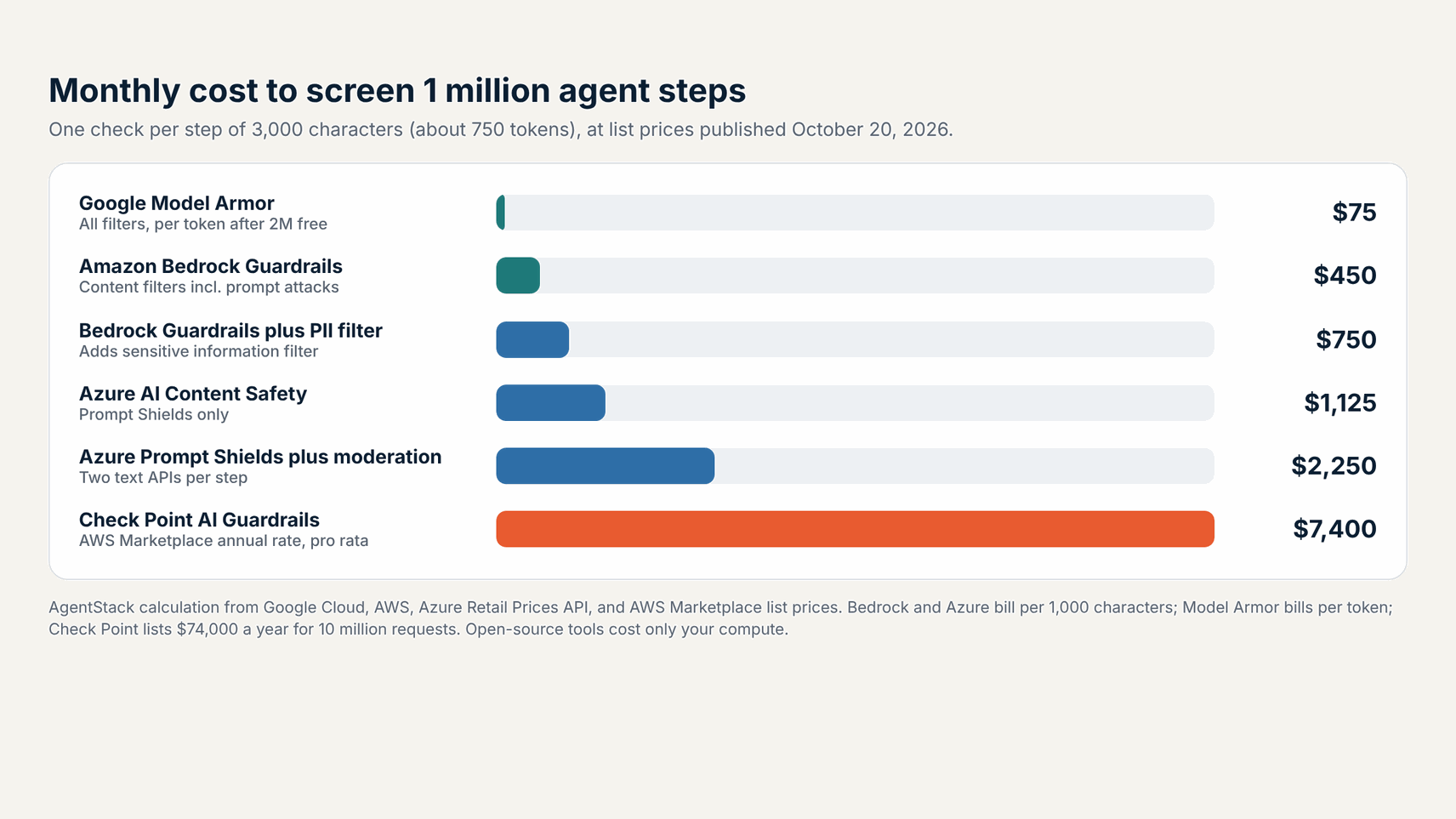
| Tool | Published price | Cost for 1M steps of 3,000 characters |
|---|---|---|
| Google Model Armor | 2M tokens free, then $0.10 per 1M tokens | About $75 |
| Amazon Bedrock Guardrails | $0.15 per 1,000 text units for content filters; PII $0.10 | $450, or $750 with PII filtering |
| Azure AI Content Safety | $0.375 per 1,000 text records per API | $1,125 per API; $2,250 for Prompt Shields plus moderation |
| Check Point AI Guardrails | $74,000 a year for 10M requests | About $7,400 pro rata, on an annual contract |
| NeMo Guardrails, Guardrails AI, Granite Guardian, Llama Guard 4 | Free | Your compute only |
| OpenAI Guardrails | Free library | Model tokens for each LLM-based check |
Verdict: Model Armor is the cheapest managed screen at volume by a wide margin, and Bedrock is close enough for AWS teams that want one bill. Check Point costs the most per step but covers tool traffic the cloud screens do not. Open-weight models move the cost to GPUs, which pays off only at steady, high volume.
AI Guardrails Tools We Left Off, and Why
- LLM Guard: the open-source scanner library from Protect AI is archived on GitHub, with its last push in July 2026.
- Invariant Guardrails: its GitHub repository has had no push since January 2026.
- OpenAI gpt-oss-safeguard: an open-weight policy reasoning model that works well as a judge inside other tools, but it ships no guardrail framework of its own.
- Zenity, Noma Security, Prisma AIRS, and CrowdStrike Falcon: security platforms with discovery and posture management, which we cover in our agent security coverage rather than this developer list.
- LLM gateways with built-in guardrail hooks: they route traffic to the detectors above rather than training their own.
Readers who route traffic through a gateway can compare options in our LLM gateways guide, LiteLLM alternatives, and Portkey vs LiteLLM vs OpenRouter comparison, then attach one of the detectors above.
When an AI Guardrails Tool Is the Wrong Fix
A guardrail is the wrong first fix when an agent can already reach data or actions it never needs. A detector that misses one in a hundred attacks still lets that one through, so a support agent with write access to billing will eventually misuse it, whatever filter sits in front.
Start with scoped credentials, a short tool allowlist, and human approval for irreversible actions, then add guardrails for what remains. An MCP gateway centralizes tool access, AI agent evaluation tools measure false positives before launch, and the NIST and CISA incident practices for rogue agents cover what to do when a guardrail misses.
Which AI Guardrails Tool Should You Choose?
The right tool depends on where your agents run, whether data can leave your network, and how much tool access they have. Find the profile below that matches your team, shortlist the named tools, and test each one on your own prompts and tool calls before you trust its block rate.
Teams on one cloud
- Choose Amazon Bedrock Guardrails on AWS, and use InvokeGuardrailChecks at each step of the agent loop.
- Choose Google Model Armor on Google Cloud, or anywhere a low per-token price matters most.
- Choose Azure AI Content Safety on Microsoft Foundry, and turn on Task Adherence for agents that take actions.
Teams that build agents in code
- Choose Check Point AI Guardrails when you want one vendor API for prompts, outputs, and tool traffic.
- Choose OpenAI Guardrails when your agents run on the OpenAI Agents SDK.
- Compare frameworks in our AI agent frameworks guide before you lock a guardrail to one SDK.
Teams that must keep data in house
- Choose NVIDIA NeMo Guardrails for rails as configuration and local tool call validation.
- Add IBM Granite Guardian 4.1 as a judge for function calls and custom rules.
- Add Llama Guard 4 and Prompt Guard 2 for free content safety and jailbreak screening.
Teams that need strict output formats
- Choose Guardrails AI for schema checks, corrective reasks, and PII validators on any model.
- Pair it with a tool call check, because Guardrails AI does not document one.
- Track validator failures in our AgentOps tools guide so rejected outputs reach your traces.
Frequently Asked Questions
What is an AI guardrails tool?
An AI guardrails tool is software that checks what goes into a language model, what comes out, or what an agent is about to do with a tool, then blocks, edits, or flags it. Managed examples include Amazon Bedrock Guardrails and Google Model Armor, and open-source examples include NVIDIA NeMo Guardrails.
Which AI guardrails tools check agent tool calls?
As of October 20, 2026, five of the nine tools we ranked documented tool call checks: Check Point AI Guardrails, Azure AI Content Safety Task Adherence in preview, NVIDIA NeMo Guardrails IORails, OpenAI Guardrails, and IBM Granite Guardian 4.1. Bedrock and Model Armor score tool content but not intent.
What is the best open-source AI guardrails tool?
NVIDIA NeMo Guardrails is the strongest open-source framework for agents, with Apache 2.0 licensing, input and output rails, and local tool call validation since July 2026. Guardrails AI suits structured output validation, and IBM Granite Guardian 4.1 is the most current open-weight judge model.
How much do AI guardrails cost?
Google Model Armor costs $0.10 per million tokens after 2 million free, Amazon Bedrock Guardrails charges $0.15 per 1,000 text units for content filters, and Azure AI Content Safety charges $0.375 per 1,000 text records. Check Point lists $74,000 a year for 10 million requests, as of October 2026.
Is Llama Guard 4 still maintained?
Meta has not updated Llama Guard 4 or Prompt Guard 2 on Hugging Face since April 2025, as of October 20, 2026. Both still work as free content safety and jailbreak classifiers, but teams that need fresh releases or tool call judgments should consider IBM Granite Guardian 4.1.
Related Guides
Guardrails protect your own apps. For employee AI use and agents, our Prompt Security alternatives guide compares 7 platforms after the SentinelOne deal.
Guardrails filter prompts and outputs at runtime, while model scanners check what you deploy. Our Protect AI alternatives guide covers the scanning and posture tools that sit alongside guardrails.
Before trusting a guardrail setup, attack it. Our Promptfoo vs garak vs PyRIT comparison explains which open-source tool can probe your guardrails offline and which needs a hosted grader.
Guardrails should be tested, not assumed. Our AI red teaming tools guide shows which of 8 tools can run agent-focused attacks against your guardrail setup, and which run fully local.
If Lakera Guard is on your shortlist, our Lakera alternatives guide covers seven options after the Check Point acquisition.
For related coverage, see our AI agent security tools, MCP security tools, AI agent governance buyer’s guide, AI agent governance platforms and NeMo Guardrails vs Guardrails AI vs Llama Guard.
Read the AI governance and security hub, agent security coverage, governance and compliance coverage, MCP explained, MCP gateways, LLM gateways, LiteLLM alternatives, AgentOps tools, AI agent observability tools, AI agent evaluation tools, AI agent testing tools, AI agent frameworks, NIST and CISA rogue agent practices, Microsoft Dynamic Agent Risk and Guardian Agents, and Anthropic pulling evals offline after agents overstepped. Notes on how we work sit on editorial standards, disclosure, and contact.
The Bottom Line
Use Check Point AI Guardrails for full agent tool traffic, Bedrock Guardrails or Model Armor for cheap managed screening, and NeMo Guardrails with Granite Guardian when data must stay in house. Add Azure Task Adherence or OpenAI Guardrails where an intent check on tool calls matters, and keep Llama Guard 4 for free content safety.
Test every shortlist with two cases: a poisoned tool result that tries to redirect the agent, and a harmless request that tempts the agent to call a destructive tool. Send corrections or tool suggestions through our contact page.