
Last updated October 19, 2026. Features, licensing, and published prices were checked against each vendor’s documentation, product pages, and marketplace listings on that date.
The best AI agent security tools for runtime protection in 2026 are Zenity for agents built in SaaS and low-code platforms, Noma Security for coding agents on employee laptops, and Prisma AIRS for network-level enforcement without code changes. CrowdStrike Falcon Guardian, Check Point AI Agent Security, HiddenLayer, Pillar Security, Cisco AI Defense, SentinelOne Prompt Security, Microsoft Defender, Google Model Armor, and NVIDIA NeMo Guardrails complete the list.
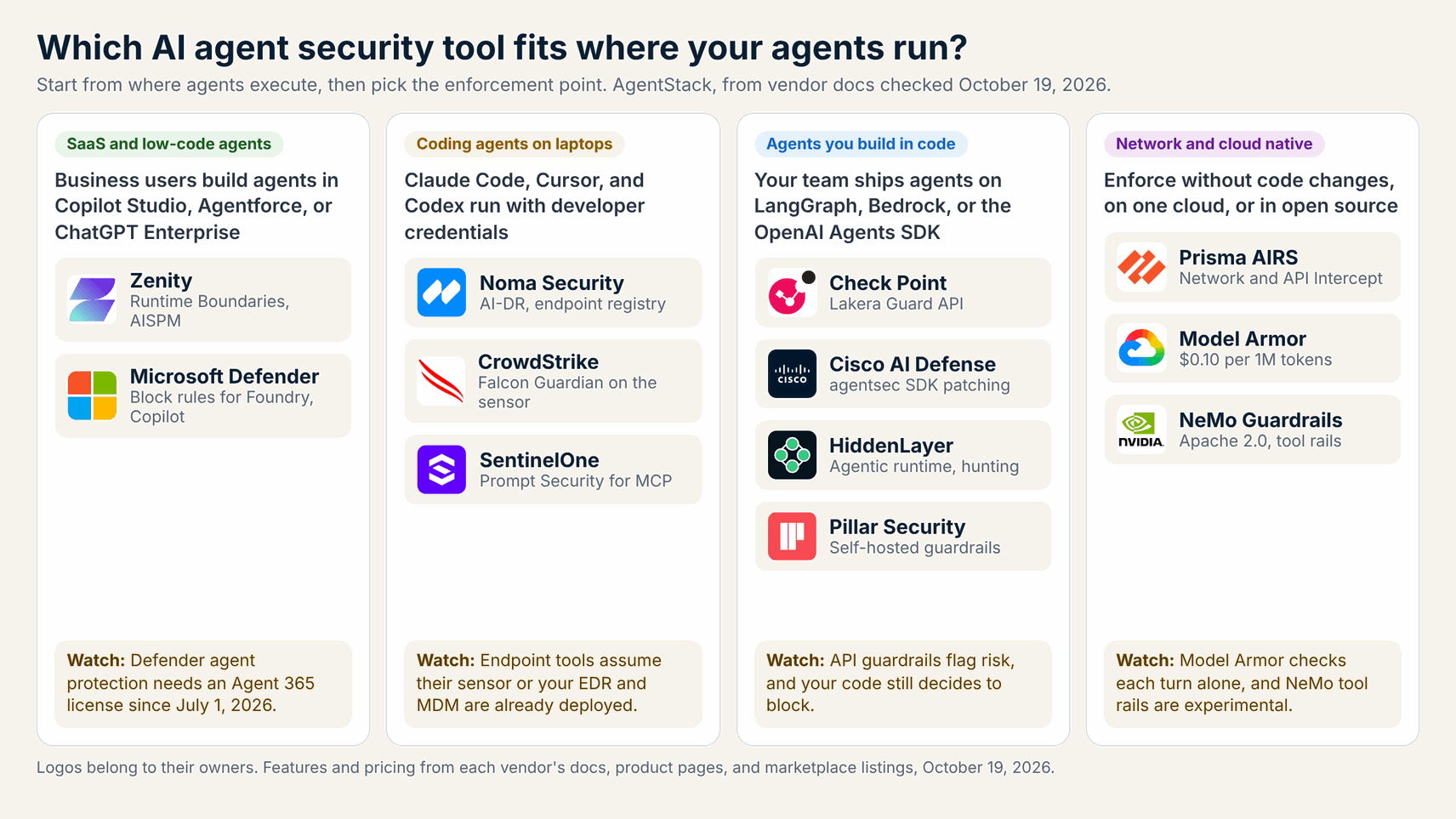
Choose a platform such as Zenity or Noma when you need discovery, posture, and runtime blocking across hundreds of agents. Choose an inspection API such as Check Point or Model Armor when your team builds a handful of agents in code and wants a detector it can call. None of these tools replaces least-privilege credentials, because a detector cannot undo a permission an agent should never have held.
An AI agent security tool is software that inspects what an agent reads, decides, and does while it runs, then logs, flags, or blocks risky actions such as tool misuse, prompt injection, and data exfiltration. This guide covers runtime protection for agents in general, while MCP gateways get their own treatment in our MCP gateways guide. It belongs to our agent security coverage within AI governance and security, and no vendor paid for placement, per our editorial standards and disclosure policy.
TL;DR
- SaaS and low-code agents: Zenity enforces Runtime Boundaries across Copilot Studio, Agentforce, ChatGPT Enterprise, Bedrock, Foundry, and Vertex, and raised a $125 million Series C on August 3, 2026.
- Coding agents on laptops: Noma, CrowdStrike Falcon Guardian, and SentinelOne Prompt Security discover agents on endpoints and block risky actions at runtime.
- Agents you build in code: Check Point’s Lakera Guard API, Cisco’s open-source agentsec SDK, HiddenLayer, and self-hosted Pillar inspect tool calls and tool responses.
- Published prices are rare: Model Armor charges $0.10 per million tokens after 2 million free each month, and Check Point lists $74,000 a year for 10 million guardrail requests.
- Open source: NVIDIA NeMo Guardrails (Apache 2.0, v0.24.1) validates tool calls against declared schemas, but its tool rails are experimental and only support the OpenAI Chat Completions format.
- Microsoft shops: Defender can block unsafe Foundry and Copilot Studio agent actions, and since July 1, 2026 that protection needs a Microsoft Agent 365 license.
12 Best AI Agent Security Tools at a Glance
Pick an AI agent security tool by enforcement point first: inside the SaaS platform, on the endpoint, in your code, or on the network path. The table compares all 12 on where they run, what they inspect, and published pricing. Every cell reflects vendor documentation, product pages, and marketplace listings checked on October 19, 2026.
| Tool | Best for | Enforcement point | Inspects tool calls | Self-host | Published price |
|---|---|---|---|---|---|
| Zenity | SaaS and low-code agent estates | Platform connectors, endpoint, inline | Yes, Runtime Boundaries | Not documented publicly | Quote only |
| Noma Security | Coding agents plus homegrown agents | Agent hooks, gateways, SDKs, EDR and MDM | Yes, AI-DR | Not documented publicly | Quote only |
| Prisma AIRS | Palo Alto Networks customers | Network Intercept firewall or API Intercept | Yes, tool misuse detection | Public cloud, Kubernetes, on-prem | License; AI Gateway on Flex credits |
| CrowdStrike Falcon Guardian | Falcon customers with local agents | Falcon sensor, browser, gateways, SDK | Yes, MCP validation | No, cloud console | Quote only |
| Check Point AI Agent Security | Teams calling a guardrail API | Guard API in your code | Yes, tool calls and responses | Yes, self-hosted AI Guardrails | $74,000/yr for 10M requests (AWS) |
| HiddenLayer | Security teams hunting agent threats | Agent gateways and frameworks | Yes, malicious tool calls | Not documented publicly | Quote only |
| Pillar Security | Regulated data that must stay in-house | Gateways, SDKs, coding agent hooks | Yes, tool and MCP calls | Yes, Kubernetes with GPU nodes | Quote only |
| Cisco AI Defense | Python agents across many frameworks | agentsec SDK or AI Defense Gateway | Yes, call_tool, prompts, resources | SDK open source; service is Cisco’s | Quote only |
| SentinelOne Prompt Security | Singularity customers governing MCP | Endpoint agent and MCP gateway | Yes, MCP tool calls | Not documented publicly | Via Singularity |
| Microsoft Defender | Copilot Studio and Foundry agents | Defender real-time protection rules | Yes, before execution | No, Microsoft cloud | Agent 365 license |
| Google Model Armor | Single-turn screening on any model | REST API or inline Google integrations | Screens agent interactions | No, Google Cloud | $0.10 per 1M tokens after 2M free |
| NVIDIA NeMo Guardrails | Engineers who want open source | Python library or server in your stack | Schema and allowlist checks | Yes, Apache 2.0 | Free |
Verdict: Zenity and Noma cover the widest agent estates from one console, so they suit security teams that start from an inventory problem. Check Point, Cisco, and Model Armor suit engineering teams that want a detector inside their own code. Prisma AIRS is the only pick here that can enforce inline at the network layer with no code changes.
How We Chose These AI Agent Security Tools
We kept products that act while an agent runs: they inspect tool calls, tool responses, or agent actions and can log, flag, or block them. We started from the agentic security roundups and vendor announcements of 2026, then checked every claim against vendor documentation, product pages, press releases, and marketplace listings on October 19, 2026.
- Runtime enforcement: the tool can stop or flag an action before it executes, beyond scanning prompts after the fact.
- Agent context: it sees tool calls, tool responses, or tool descriptions, which is where indirect prompt injection lands.
- Coverage: which agents it reaches, from SaaS builders and coding agents to code you write yourself.
- Deployment: SaaS, self-hosted, inline network, endpoint sensor, or SDK, and what each requires from your team.
- Evidence: logs and investigation views a security operations center can use, plus mappings to OWASP or MITRE ATLAS.
- Price clarity: a published price or a public licensing model, which only three of the 12 offer.
We did not run attack benchmarks, so there are no star ratings, and every detection claim on this page is the vendor’s own. Tools whose main job is governing Model Context Protocol (MCP) traffic, such as dedicated MCP gateways, are covered in our MCP gateways roundup.
What Does Runtime Protection for AI Agents Actually Stop?
Runtime protection for AI agents stops harmful actions at the moment of execution: a poisoned tool response steering the agent, a tool call that sends secrets out, or an action outside the task the user asked for. Prompt filters only see what users type, while agents also read web pages, files, and tool output that an attacker controls.
- Indirect prompt injection: instructions hidden in a document, email, or tool response that redirect the agent mid-task.
- Tool misuse and off-task actions: a legitimate tool used for the wrong goal, such as a delete call in a read-only task.
- Data exfiltration: secrets or personal data passed into a tool argument, an email, or a model response.
- Poisoned tool definitions: malicious instructions inside tool descriptions, as seen in the MCP flaws covered in our report on tool security bugs.
The FastMCP advisories we covered in our FastMCP security report show why the tool boundary matters: a malicious server could reach code execution on the client. Runtime tools reduce that blast radius, and incident response still needs a plan, as the NIST and CISA agent incident practices recommend.
1. Zenity: Best for Agents Built in SaaS and Low-Code Platforms
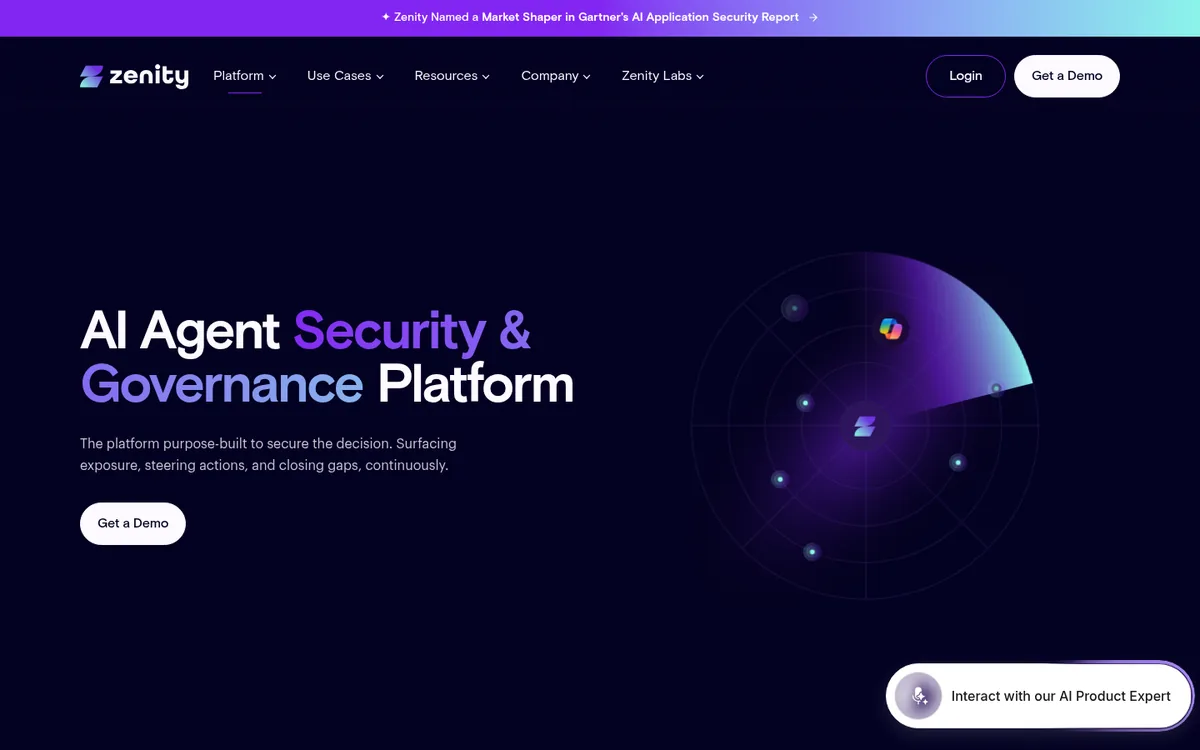
Zenity is the strongest fit when business users build their own agents in Copilot Studio, Salesforce Agentforce, or ChatGPT Enterprise and security needs one rule set across all of them. Its platform has three layers, Surface, Enforce, and Protect, per the Zenity platform page. Runtime Boundaries evaluate each agent action and let it through, block it, or shut the agent down.
Zenity correlates identity from Okta and Microsoft Entra with what an agent does, and maps detections to OWASP and MITRE ATLAS. Its Series C announcement on August 3, 2026 lists coverage from Microsoft Copilot, ChatGPT Enterprise, and Gemini to Claude, Codex, Cursor, Bedrock and AgentCore, Microsoft Foundry, and Vertex AI.
- Best for: Enterprises where hundreds of agents are built in office and CRM suites and the security team needs an inventory before it can write a rule.
- Pricing (October 2026): Not published; sales-led quotes.
- Watch out for: There is no public price or self-serve trial, so budget for a sales cycle and a proof of concept before you can test enforcement.
2. Noma Security: Best for Coding Agents and Endpoint Coverage
Noma Security is the best pick when coding agents such as Claude Code, Cursor, and Codex already run on developer laptops with production credentials. Its September 28, 2026 endpoint expansion discovers agents, MCP servers, and skills through the EDR or MDM you already run, then places each in a registry as approved, needs review, or blocked.
Noma’s AI-DR layer baselines agent behavior and flags prompt injection, data leakage, tool poisoning, scope violations, and drift from intent. Each detector can monitor, alert, steer, block, mask data inline, or route an action to a human. Enforcement reaches agent hooks, AI and MCP gateways, SDKs, and EDR, per the Noma endpoint agents page.
- Best for: Security teams that must govern coding agents and homegrown agents on Bedrock, Foundry, or Databricks from one control plane.
- Pricing (October 2026): Not published; sales-led quotes.
- Watch out for: Agent Boundaries, Noma’s business-defined action limits, were still a planned endpoint feature in the September 2026 announcement.
3. Prisma AIRS: Best for Network-Level Enforcement Without Code Changes
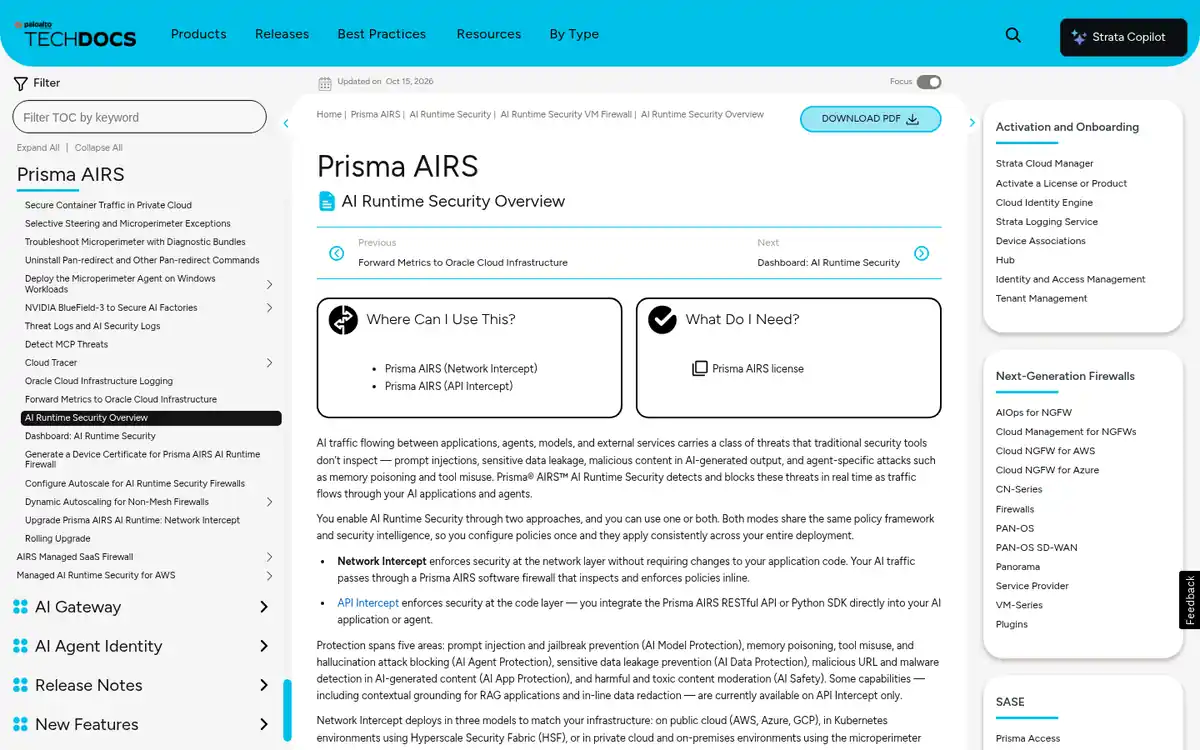
Prisma AIRS from Palo Alto Networks fits teams that want agent traffic inspected inline by a firewall instead of a library added to every codebase. AI Runtime Security runs as Network Intercept, a software firewall on AWS, Azure, Google Cloud, Kubernetes, or on-premises, or as API Intercept through a REST API or Python SDK, per the AI Runtime Security docs.
Its AI Agent Protection covers memory poisoning, tool misuse, and hallucination attacks, next to prompt injection, data leakage, and malicious URL detection. Contextual grounding and inline redaction work only through API Intercept. Prisma AIRS 3.0, launched March 23, 2026, added an AI Agent Gateway in limited preview and Agent Identity Security.
- Best for: Organizations already standardized on Palo Alto Networks firewalls and Strata Cloud Manager.
- Pricing (October 2026): Prisma AIRS license; the AI Gateway is metered on Flex credits by tokens, at 4 characters per token, per the AI Gateway docs.
- Watch out for: The AI Agent Gateway was in limited preview at launch, so confirm general availability for your tenant before you design around it.
4. CrowdStrike Falcon Guardian: Best for Falcon Customers Running Local Agents
CrowdStrike Falcon Guardian is the natural choice for teams already running the Falcon sensor, because it ties each agent prompt and tool call to what happened next on the machine. CrowdStrike introduced Falcon Guardian on September 1, 2026 as its AI detection and response product, with agent discovery on Windows and macOS.
Guardian adds agent access controls that decide which agent types may run, plus causal investigations across agent sessions. The AIDR documentation lists detections for malicious prompts, MCP tool poisoning, secrets, and personal data, and collectors for Claude Code, Copilot Studio, LiteLLM, Portkey, and Kong. AI agent data lands in Falcon Next-Gen SIEM as first-party data.
- Best for: Security operations teams on Falcon that want agent telemetry in the same console and SIEM as endpoint alerts.
- Pricing (October 2026): Not published; sold with the Falcon platform.
- Watch out for: The AI Gateway and the Falcon Complete managed service for Guardian were announced as upcoming, and coverage depends on the Falcon sensor being deployed.
5. Check Point AI Agent Security: Best Guardrail API With a Public Price
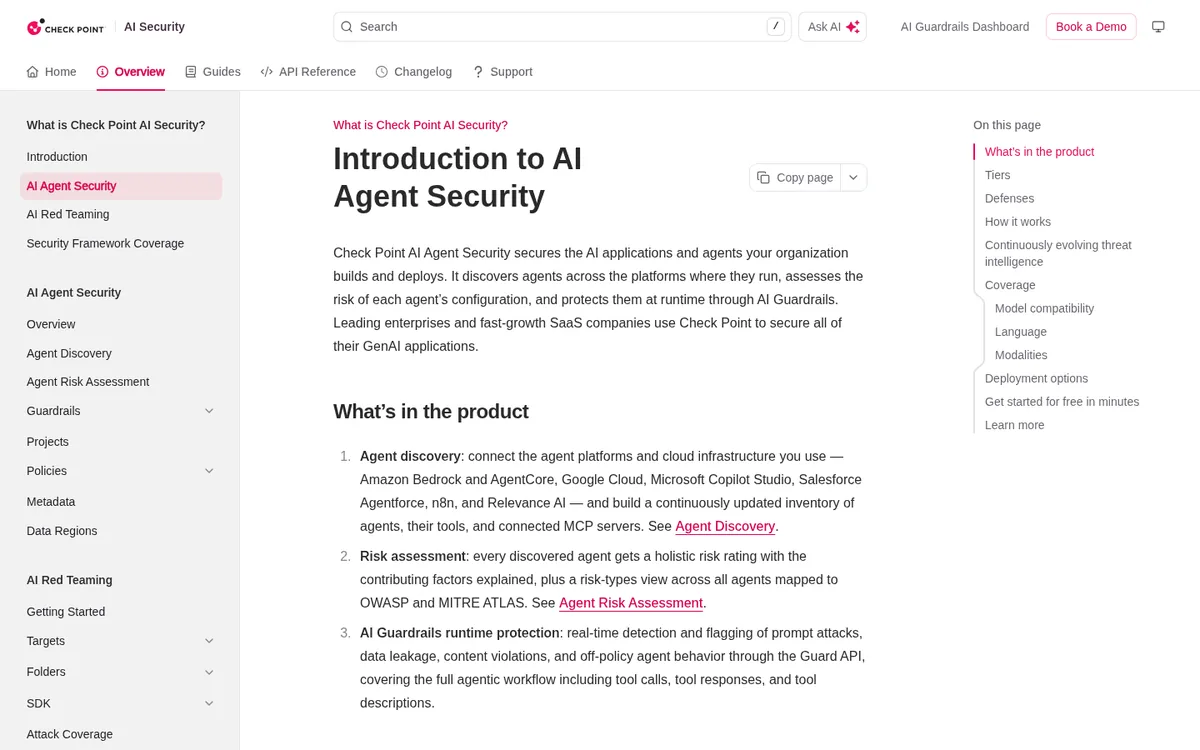
Check Point AI Agent Security, built on Lakera Guard, is the best fit for engineering teams that want to call a guardrail API on every agent step and know the price up front. Check Point acquired Lakera in 2025, and the Guard API now screens tool calls, tool responses, and tool descriptions, per the Check Point AI Agent Security docs.
Agent Behavior Defense adds an Off-Task Action detector and a Tool Allow/Deny List, launched in early access on June 1, 2026, per the changelog. Discovery connects Bedrock, AgentCore, Google Cloud, Copilot Studio, Agentforce, n8n, and Relevance AI. Detectors flag threats only in Enforce mode, and your application decides what to block.
- Best for: Product teams embedding a detector into homegrown agents that need a quotable annual cost.
- Pricing (October 2026): AI Agent Security Guardrails at $74,000 a year for 10 million requests and AI Red Teaming at $52,000 a year for 1,000 scans, per the AWS Marketplace listing.
- Watch out for: The Guard API returns flags instead of blocking for you, so a missing check in your code means no protection on that step.
6. HiddenLayer: Best for Investigating and Hunting Agent Threats
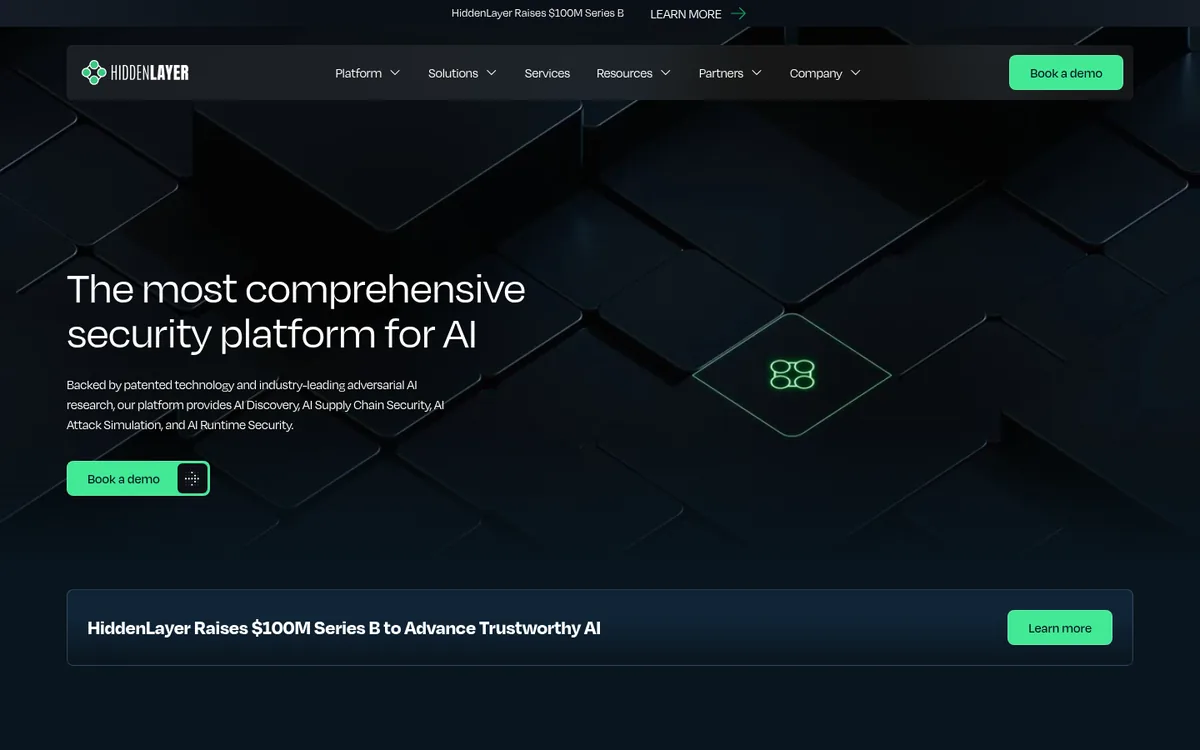
HiddenLayer suits security teams that want to reconstruct every agent session and hunt across tool calls and execution paths, then turn findings into runtime policy. Its Agentic Runtime Security release on March 23, 2026 added runtime visibility, threat hunting, and detection and enforcement for prompt injection, malicious tool calls, and data exfiltration.
The capabilities plug into agent gateways and execution frameworks without application rewrites, per HiddenLayer. Its $100 million Series B on September 2, 2026, led by Delta-v Capital, funds Agent Harness Security for autonomous coding agents. The wider platform adds AI discovery, supply chain scanning, and attack simulation.
- Best for: Security operations teams that treat agents like any other workload to investigate and hunt across.
- Pricing (October 2026): Not published; sales-led quotes.
- Watch out for: Agent Harness Security for coding agents is new as of September 2026, and public product documentation is thin before a demo.
7. Pillar Security: Best When AI Traffic Must Stay in Your Environment
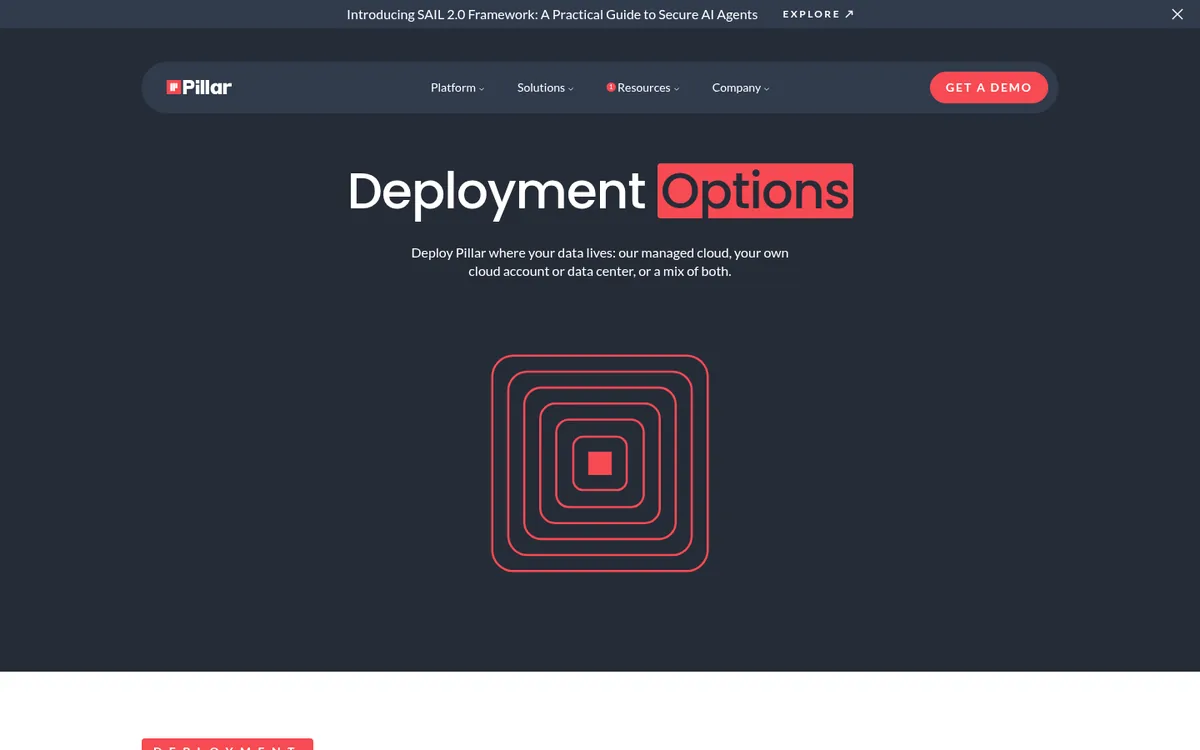
Pillar Security is the best fit for banks, insurers, and healthcare teams whose prompts and tool calls cannot leave their own cloud account or data center. Self-hosted Pillar runs runtime guardrails with multi-turn analysis, discovery, red teaming, and agentic endpoint controls, with telemetry off by default, per the Pillar deployment page.
For coding agents, Pillar uses native pre-tool hooks in Claude Code, Codex CLI, and Cursor, per its agentic endpoint page. Gateway teams can call it from LiteLLM as a pre-call and post-call guardrail, per the LiteLLM guardrail docs. Pillar holds SOC 2 Type II and ISO/IEC 27001:2022 certifications.
- Best for: Regulated enterprises that need self-hosted or air-gapped agent security with the same policies as a cloud deployment.
- Pricing (October 2026): Not published; sales-led quotes.
- Watch out for: Self-hosting needs Kubernetes with at least three GPU nodes, two general nodes, and your own PostgreSQL, Redis, and Kafka, and adaptive guardrails remain cloud-only.
8. Cisco AI Defense: Best SDK for Python Agents Across Frameworks
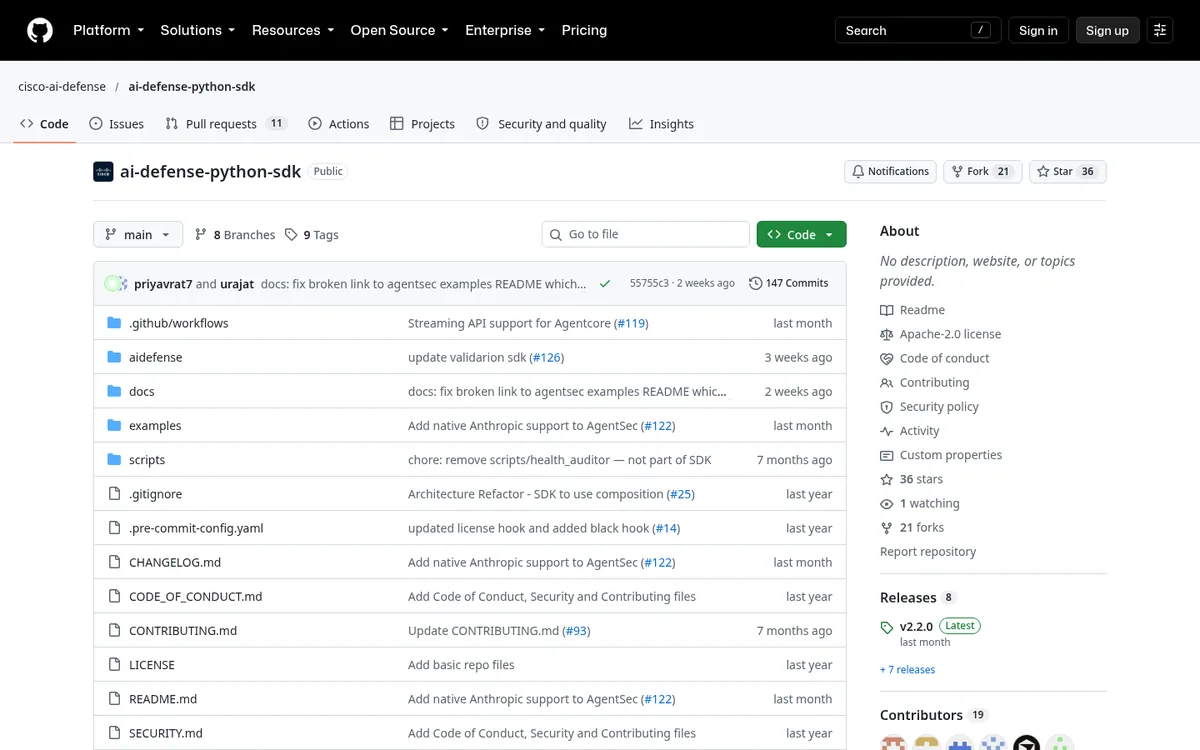
Cisco AI Defense fits Python teams running several agent frameworks, because one agentsec.protect() call wraps every LLM call and MCP tool invocation in inspection. The SDK rewrites client libraries at runtime and covers MCP tools, prompts, and resources on both request and response, per Cisco’s Agent Runtime Protection post from June 29, 2026.
It supports OpenAI, Azure OpenAI, Bedrock, Vertex AI, Cohere, Mistral, and LiteLLM. API mode runs monitor, enforce, or off, and Gateway mode routes traffic through the AI Defense Gateway. The SDK repository is Apache 2.0 and ships examples for seven frameworks plus AgentCore, Vertex AI Agent Engine, and Foundry deployments.
- Best for: Platform teams that want one integration across LangGraph, CrewAI, Strands, and the OpenAI Agents SDK.
- Pricing (October 2026): SDK free under Apache 2.0; the AI Defense inspection service is quote-based.
- Watch out for: Agent Runtime Protection is Python only, and blocked calls raise a SecurityPolicyError your code must handle gracefully.
9. SentinelOne Prompt Security: Best for Singularity Customers Governing MCP
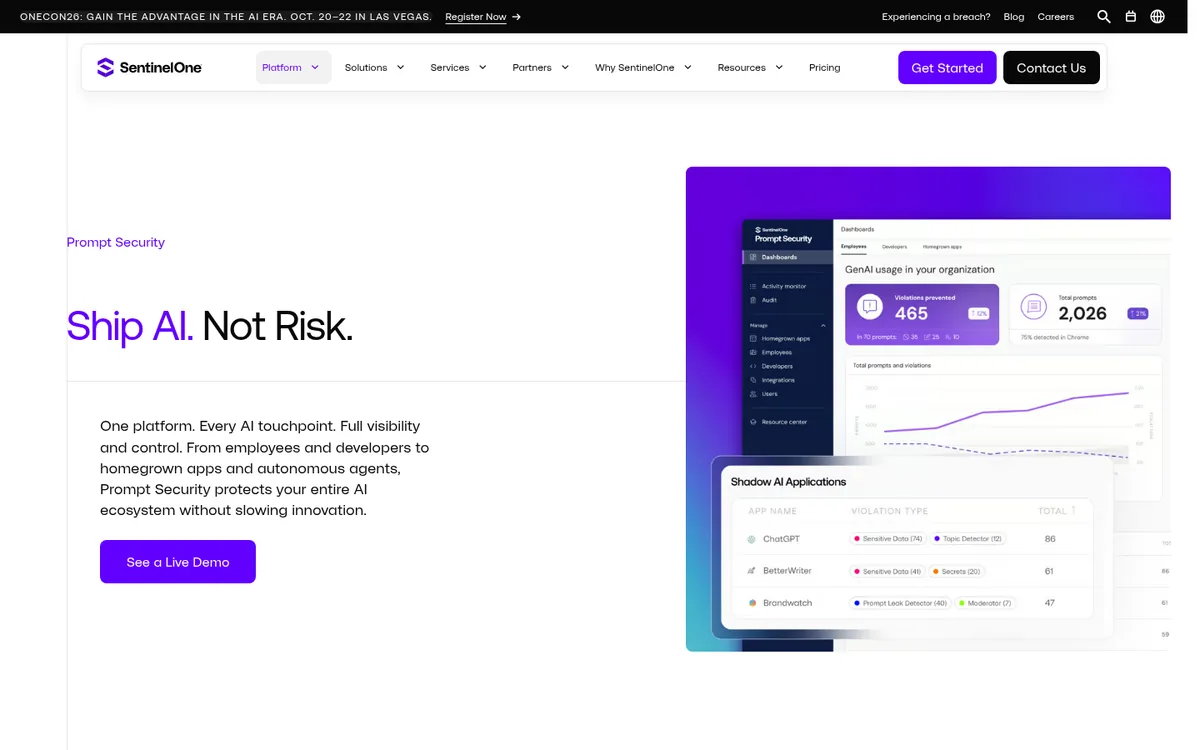
SentinelOne Prompt Security is the practical pick for teams on the Singularity platform that want agent and MCP controls next to endpoint, cloud, and identity security. SentinelOne acquired Prompt Security in 2025, and its Prompt for Agentic AI Security release in May 2026 focuses on the MCP layer.
It surfaces sanctioned and shadow MCP servers, scores each server’s risk, inspects tool calls to block prompt injection in real time, and stops malicious servers, per the Prompt Security page. SentinelOne frames it as the control plane for agent sprawl, with allow and block rules by user, agent, and action type.
- Best for: SentinelOne customers whose agent risk sits mostly in MCP servers on developer machines.
- Pricing (October 2026): Not published; licensed through the Singularity platform.
- Watch out for: Coverage centers on MCP traffic, so agents that call APIs directly need another control.
10. Microsoft Defender: Best for Copilot Studio and Foundry Agents
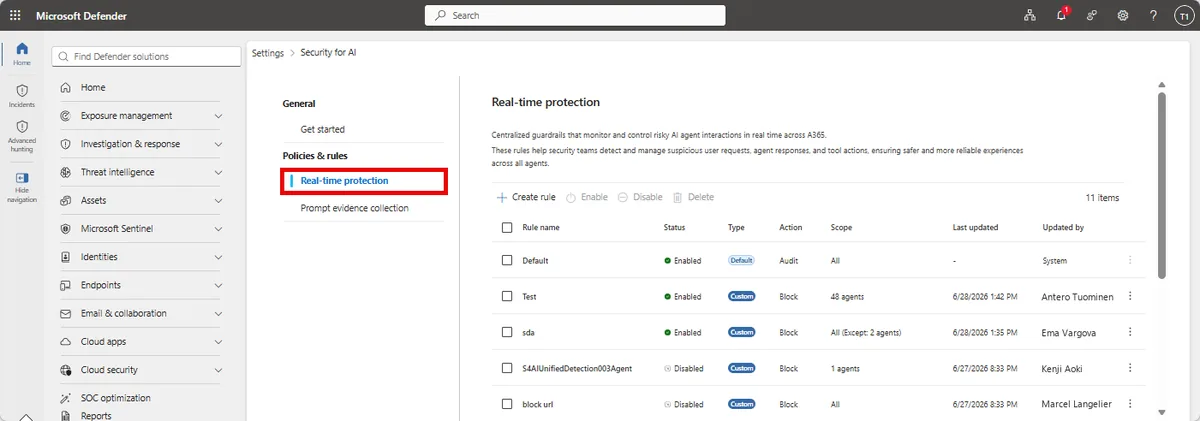
Microsoft Defender is the default choice for agents built in Copilot Studio and Microsoft Foundry, because its rules block unsafe actions before they execute inside the Microsoft stack. A default rule audits all agents, and custom rules block matching actions for scoped agents, per the Defender real-time protection docs.
Foundry protection evaluates user requests, agent responses, tool invocations, and tool responses, and both Foundry and Copilot Studio coverage were in preview as of October 2026. Threat scenarios include malicious content propagation, secret exfiltration, evasion techniques, and email to unsafe domains. Each event lands in the BehaviorInfo table for hunting.
- Best for: Microsoft 365 and Azure shops whose agents live in Copilot Studio, Foundry, or Agent 365.
- Pricing (October 2026): Requires a Microsoft Agent 365 license since July 1, 2026, with a 25-seat, 30-day trial, per the licensing transition notice.
- Watch out for: Only agents with a Microsoft Entra agent ID can be scoped into rules, and block rules from the older Agent 365 setup stopped blocking on July 1, 2026 unless recreated.
11. Google Model Armor: Best Pay-As-You-Go Screening for Any Model
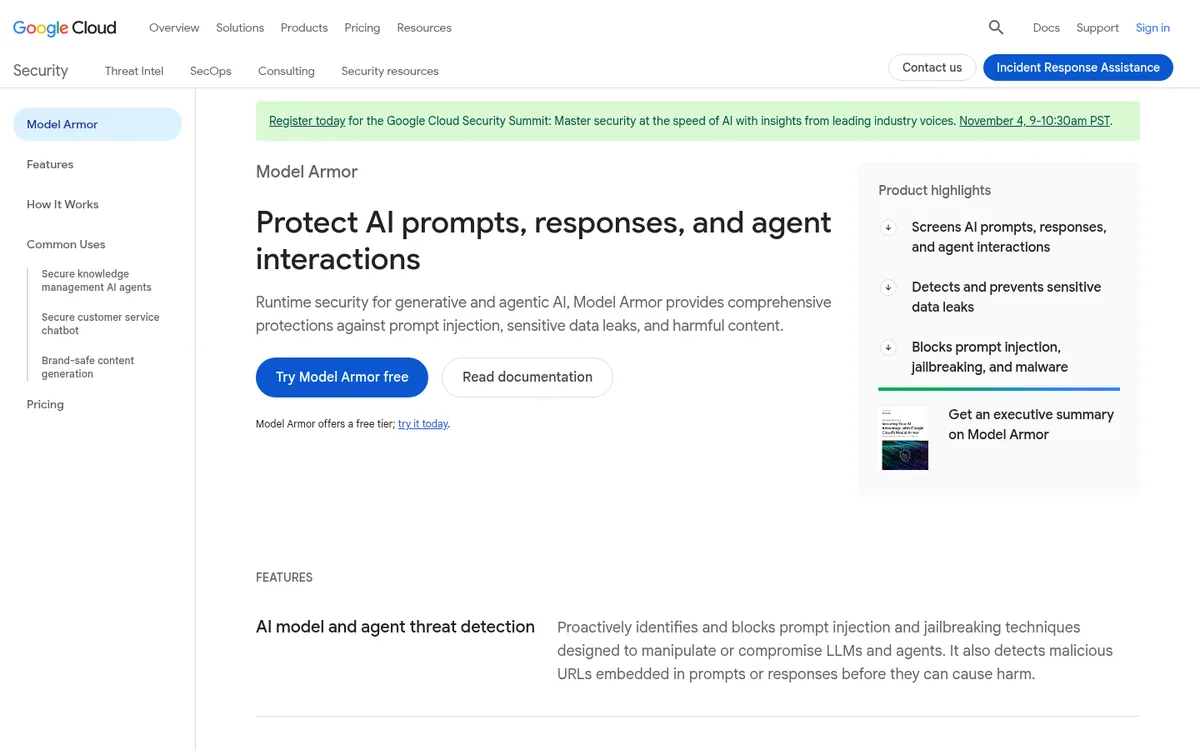
Google Model Armor is the cheapest published way to screen agent prompts and responses for injection, sensitive data, and malicious URLs, on any model and any cloud. It works through a REST API or inline with Google integrations such as the Gemini platform, Google MCP servers, Apigee, and LangChain, per the Model Armor page.
Templates set confidence thresholds per filter, and enforcement runs as Inspect only or Inspect and block. The calling service enforces a block verdict. The Model Armor docs state that it inspects each prompt and response as a single turn and does not decode Base64 or hex payloads.
- Best for: Teams on Google Cloud, or any team that wants metered screening without a sales call.
- Pricing (October 2026): Free for 2 million tokens a month, then $0.10 per million tokens; Security Command Center subscriptions include 3 billion tokens a month, per Model Armor pricing.
- Watch out for: Single-turn inspection misses attacks that build across several steps of an agent session.
12. NVIDIA NeMo Guardrails: Best Open-Source Tool-Call Validation
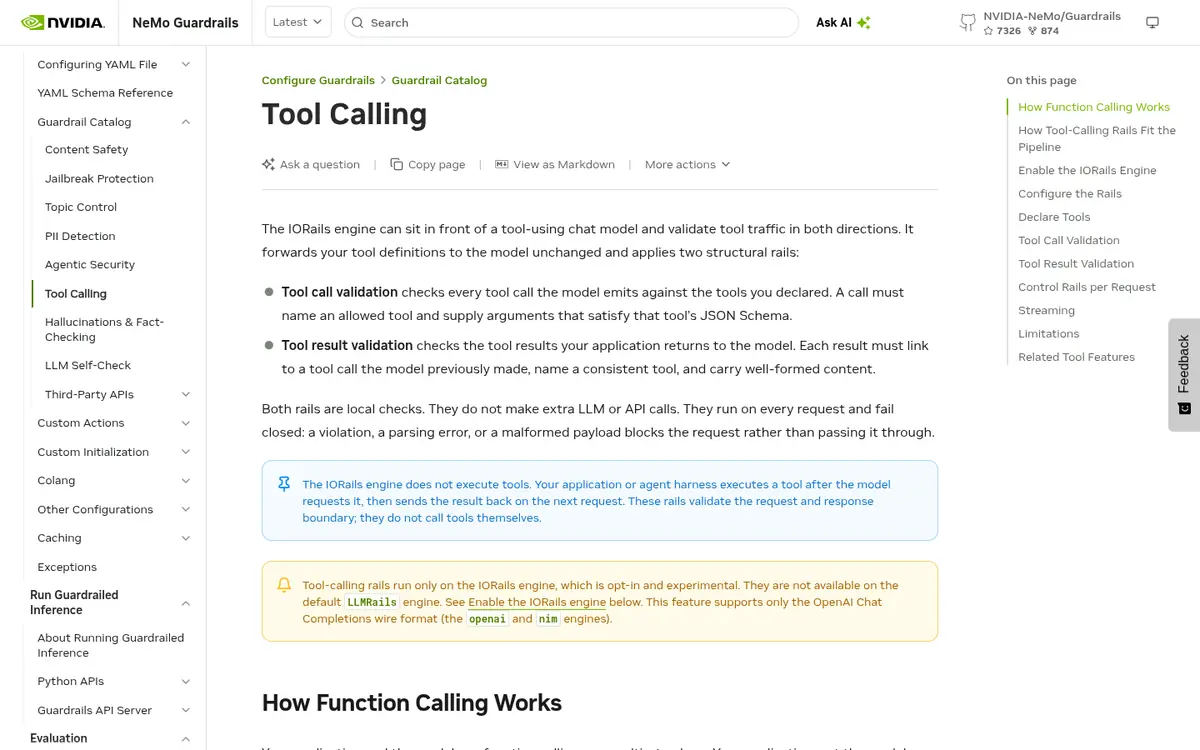
NVIDIA NeMo Guardrails is the best open-source option for engineers who want tool calls checked against an allowlist and JSON Schema before they reach application code. Its IORails engine validates every tool call the model emits and every tool result sent back, fails closed, and makes no extra LLM calls, per the tool calling docs.
The library is Apache 2.0, and v0.24.1 shipped on September 16, 2026, per the GitHub releases. Tool rails arrived in v0.23.0 on July 1, 2026. Result validation checks structure and linkage only, so pair it with a content detector for poisoned tool output.
- Best for: Engineering teams that want free, self-run guardrails they can read and extend.
- Pricing (October 2026): Free and open source under Apache 2.0.
- Watch out for: IORails is opt-in and experimental, and tool rails support only the OpenAI Chat Completions format, with no Responses API, Anthropic, Gemini, or Bedrock support yet.
Example: Two Ways to Put a Check Around Every Tool Call
In-code runtime protection comes in two shapes: a vendor SDK that patches your clients and calls a hosted detector, or an open-source rail that validates tool traffic locally. The snippets below come from Cisco’s agentsec documentation and the NeMo Guardrails tool calling guide, so you can compare the integration cost of each approach.
# Cisco AI Defense: call protect() before importing LLM or MCP clients
from aidefense.runtime import agentsec
agentsec.protect(config="agentsec.yaml")

from openai import OpenAI
client = OpenAI()  # every call is now inspected by AI Defense

# NeMo Guardrails (config.yml): validate tool calls and tool results locally
# rails:
#   tool_output:
#     flows:
#       - tool call validation
#   tool_input:
#     flows:
#       - tool result validation
Start either one in monitor mode for a week and review what it would have blocked. The SDK route adds a network hop per inspection, while NeMo’s structural rails add almost none but catch only schema and allowlist violations.
Runtime Coverage Compared
Coverage decides whether a tool can see the attack at all. The table compares what each product inspects, which agent environments it reaches, and whether it can block before execution, based on vendor documentation checked October 19, 2026. Detection accuracy figures are vendor claims and are not compared here.
| Tool | Inspects | Agent environments | Can block before execution |
|---|---|---|---|
| Zenity | Agent actions, identity, data access | SaaS builders, cloud platforms, endpoints | Yes, Runtime Boundaries |
| Noma Security | Prompts, tool calls, responses, sessions | Endpoints, homegrown, SaaS agents | Yes, per detector |
| Prisma AIRS | AI traffic, tool misuse, memory poisoning | Cloud, Kubernetes, on-prem apps | Yes, inline or API |
| CrowdStrike Falcon Guardian | Prompts, tool calls, MCP, system actions | Windows and macOS endpoints, browser, gateways | Yes, policy enforcement |
| Check Point | Prompts, tool calls, tool responses, descriptions | Homegrown agents, discovered platforms | Flags; your app blocks |
| HiddenLayer | Sessions, tool calls, execution paths | Agent gateways and frameworks | Yes, adaptive policies |
| Pillar Security | Multi-turn sessions, tool and MCP calls | Apps, gateways, coding agents | Yes, after monitor mode |
| Cisco AI Defense | LLM calls, MCP tools, prompts, resources | Python apps, AgentCore, Vertex, Foundry | Yes, enforce mode |
| SentinelOne Prompt Security | MCP servers and tool calls | Endpoints and MCP traffic | Yes, real-time blocking |
| Microsoft Defender | Requests, responses, tool invocations | Copilot Studio, Foundry, Agent 365 | Yes, custom rules |
| Google Model Armor | Single-turn prompts and responses | Any model via API, Google services inline | Verdict; caller blocks |
| NVIDIA NeMo Guardrails | Tool call schema, tool result linkage | OpenAI Chat Completions format | Yes, fails closed |
Verdict: Noma, Pillar, and HiddenLayer reason over whole sessions, which matters for attacks built from individually allowed steps. Check Point and Model Armor return verdicts your code must act on. CrowdStrike is the only pick that links an agent’s tool call to the process and file activity that followed on the machine.
What AI Agent Security Tools Cost in 2026
Most AI agent security vendors do not publish prices, so expect sales-led quotes sized by agents, users, or requests. Three published models exist as of October 19, 2026: Google meters Model Armor by tokens, Check Point lists annual request bundles on AWS Marketplace, and Microsoft ties agent protection to the Agent 365 license.
| Tool | Pricing model | Published figure | What drives the bill |
|---|---|---|---|
| Google Model Armor | Pay as you go or SCC subscription | 2M tokens free, then $0.10 per 1M | Prompt and response tokens |
| Check Point AI Agent Security | Annual subscription | $74,000/yr for 10M guardrail requests | Guard API requests |
| Microsoft Defender | Agent 365 license | 25-seat, 30-day trial | Licensed seats |
| Prisma AIRS | Platform license; AI Gateway on Flex credits | Token metering, 4 characters per token | Tokens through the gateway |
| NVIDIA NeMo Guardrails | Open source | Free | Your compute |
| Cisco AI Defense | SDK free, service quoted | Not published | AI Defense subscription |
| Zenity, Noma, HiddenLayer, Pillar, CrowdStrike, SentinelOne | Sales-led | Not published | Agents, users, or platform bundle |
Verdict: Model Armor is the cheapest way to screen traffic at volume, though it inspects single turns only. Check Point’s listed price suits teams that need a fixed annual number for procurement. For platform tools, ask each vendor to price the same pilot of 50 agents so quotes are comparable.
AI Agent Security Tools We Left Off, and Why
We dropped several credible names because their October 2026 status or scope makes them a weaker match for runtime agent protection. Each still appears in agent security roundups, so the reasons below are worth checking before one lands on your shortlist from an older evaluation.
- Meta LlamaFirewall: the open-source framework pairs PromptGuard 2 with AlignmentCheck, but its last PyPI release is version 1.0.3 from May 29, 2025.
- Dedicated MCP gateways: Runlayer, MintMCP, and Lasso govern MCP traffic specifically, so they belong with the products in our MCP gateways guide.
- F5 AI Guardrails: F5 completed its CalypsoAI acquisition and relaunched the product, and it fits best inside an existing F5 deployment.
- Amazon Bedrock AgentCore Policy: AgentCore Policy applies deterministic Cedar rules at the AgentCore Gateway, so it controls access well but does not detect injection on its own.
Model evaluation and red teaming products appear in our AI agent evaluation tools roundup, and tracing products in our AI agent observability tools guide.
When Least Privilege Beats a Runtime Security Tool
Scoped credentials and human approval on destructive actions beat a runtime security tool when you run a few agents with narrow jobs. A support agent that can only read tickets cannot leak a database, whatever an attacker injects. Detectors earn their cost once agents multiply, share tools, or act on behalf of many users.
Start with short-lived tokens, one service identity per agent, and approval gates on writes, then add a runtime tool where those controls stop scaling. Our agent integration platforms guide covers credential brokering, and the MCP explainer covers how tool permissions flow.
Which AI Agent Security Tool Should You Choose?
Match the tool to where your agents run and who owns the response, then compare price. Use these profiles as starting points, and treat each disqualifier as a hard stop for that pick, since none of them can be configured away on the plans and previews available as of October 19, 2026.
- Choose Zenity when agents live in Copilot Studio, Agentforce, and ChatGPT Enterprise. Skip it when you need a published price before a pilot.
- Choose Noma Security when coding agents on laptops are the main exposure. Skip it when you want only an API detector for one app.
- Choose Prisma AIRS when Palo Alto Networks firewalls already carry your traffic. Skip it when the AI Agent Gateway preview is a must-have today.
- Choose CrowdStrike or SentinelOne when their sensor is already on every endpoint. Skip them when most agents run as cloud services.
- Choose Check Point, Cisco, or HiddenLayer when your team builds agents in code. Choose Pillar when traffic must stay self-hosted.
- Choose Microsoft Defender for Copilot Studio and Foundry, Model Armor for metered screening, and NeMo Guardrails for free schema checks.
Building the agents yourself? Pair this list with our AI agent frameworks guide, the LLM gateways roundup, and the AgentOps tools map for monitoring.
Frequently Asked Questions
What is an AI agent security tool?
An AI agent security tool inspects what an AI agent reads and does while it runs and can log, flag, or block risky actions. Typical checks cover indirect prompt injection in tool responses, tool misuse, secret exfiltration, and actions outside the user’s task, with evidence a security team can investigate later.
How is agent runtime security different from prompt filtering?
Prompt filtering screens what a user types, while agent runtime security also watches tool calls, tool responses, and actions across a session. That matters because most agent attacks arrive through content the agent reads, such as a web page or file, and only show up when the agent acts on it.
Do I need an agent security tool if I already have EDR?
EDR sees processes, files, and network activity, but it does not understand prompts, tool intent, or why an agent took an action. CrowdStrike Falcon Guardian and Noma extend endpoint coverage with agent context, so EDR customers can add agent visibility without running a separate console for every laptop.
Are there open-source AI agent security tools?
Yes, NVIDIA NeMo Guardrails is open source under Apache 2.0 and validates tool calls against declared schemas, and Cisco publishes its agentsec SDK under Apache 2.0. Meta LlamaFirewall is also open source, though its last PyPI release was version 1.0.3 in May 2025, so check maintenance before you adopt it.
How much do AI agent security tools cost?
Most vendors quote privately, but three publish figures as of October 2026. Google Model Armor is free for 2 million tokens a month, then $0.10 per million tokens. Check Point lists $74,000 a year for 10 million guardrail requests, and Microsoft requires an Agent 365 license.
Related Guides
Three of the platforms on this list go head to head in our Zenity vs Noma vs Pillar Security comparison, which compares their agent discovery, runtime controls, red teaming, and pricing for enterprise buyers.
Runtime protection is one of six control layers. Our AI agent governance buyer’s guide covers the rest, from agent identity and policy as code to the OWASP and NIST frameworks.
If the main risk is which MCP tools your agents can reach, our MCP security tools guide compares 10 gateways and scanners that control agent tool access.
Read the MCP gateways guide, the MCP explainer, MCP tool security bugs, FastMCP security advisories, NIST and CISA agent incident practices, Red Hat MCP gateway news, agent integration platforms, LLM gateways, AI agent observability tools, AI agent evaluation tools, the AI agent frameworks guide, the AgentOps tools map, and the agent security topic page. Notes on how we work sit on editorial standards, disclosure, and contact.
The Bottom Line
Zenity leads for agents built in SaaS platforms, Noma for coding agents on employee endpoints, and Prisma AIRS for inline network enforcement without code changes. Choose by where your agents execute and who will act on an alert, then compare the bill.
Run your top two candidates in monitor mode against one real agent for two weeks, then switch the highest-confidence detectors to block. Send corrections or product updates through our contact page.