


Last updated October 20, 2026. Counts, features, and dates were checked against each directory’s own pages, documentation, and public API on that date, and the Smithery and official registry figures come from our own API reads the same morning.
In the Smithery vs Glama decision for October 2026, the Official MCP Registry is the source of record, Glama is the better research layer, and Smithery is a directory to migrate away from. Smithery’s hosted server URLs, API, and CLI stop working on October 31, 2026. Teams that only browse Smithery can keep using it to look up each vendor’s own MCP URL.
All three are public directories for Model Context Protocol (MCP) servers, the programs that give AI agents tools. Smithery is a directory and hosting proxy that Arcade.dev acquired on August 5, 2026. Glama is an independent directory that builds, scans, and scores servers, and the Official MCP Registry is the metadata registry run by the MCP project.
New to the protocol? Our MCP explained guide separates servers, gateways, registries, and security layers, and the MCP topic page collects the rest of our coverage. No directory paid for placement or reviewed this comparison, per our editorial standards and disclosure policy.
TL;DR
- Use the Official MCP Registry as the source of record. It listed 45,863 active servers on October 20, 2026, offers a free unauthenticated read API, and is still in preview with no private servers and no uptime promise.
- Use Glama to vet a public server before you install it. It listed 106,279 servers and 33,925 remote connectors, builds open source servers in Firecracker sandboxes, and scores every tool definition.
- Plan your exit from Smithery URLs now. Server URLs on run.tools and server.smithery.ai, the Smithery API, accounts, and the CLI stop working on October 31, 2026, while smithery.ai stays up as a directory run by Arcade.dev.
- Our data: 74.2% of Smithery’s 20,784 listings ran on Smithery hosting, and all 100 servers at the top of its default API ranking used run.tools URLs.
- The breakage spreads: 221 active entries in the Official MCP Registry point at Smithery-hosted URLs, and 218 of them list no package to fall back on.
- None of the three is an enterprise catalog. For internal servers and approval workflows, pair a private registry with an MCP gateway.
How We Compared Smithery, Glama, and the Official MCP Registry
We compared the three directories on who runs them, how servers get listed, what each one checks, what it costs, and what changes after October 31, 2026. Every count comes from the directory’s own API or filter pages read October 20, 2026, and every feature claim comes from its documentation checked that day.
- Coverage: how many servers each lists, and how many are remote, local, or hosted by the directory itself.
- Listing rules: how a publisher proves ownership, and whether anyone checks the code or the live endpoint.
- Trust signals: security scans, health checks, quality scores, and change history a buyer can read.
- Access and cost: API keys, licensing terms for the data, hosting fees, and free tiers.
- Durability: ownership, preview status, and announced shutdowns.
We read Smithery through its public servers API, the Official MCP Registry through its aggregator API, and Glama through its public directory pages, since its own API requires a key and an attribution license. We did not run load tests, so there are no star ratings.
Smithery vs Glama vs Official MCP Registry at a Glance
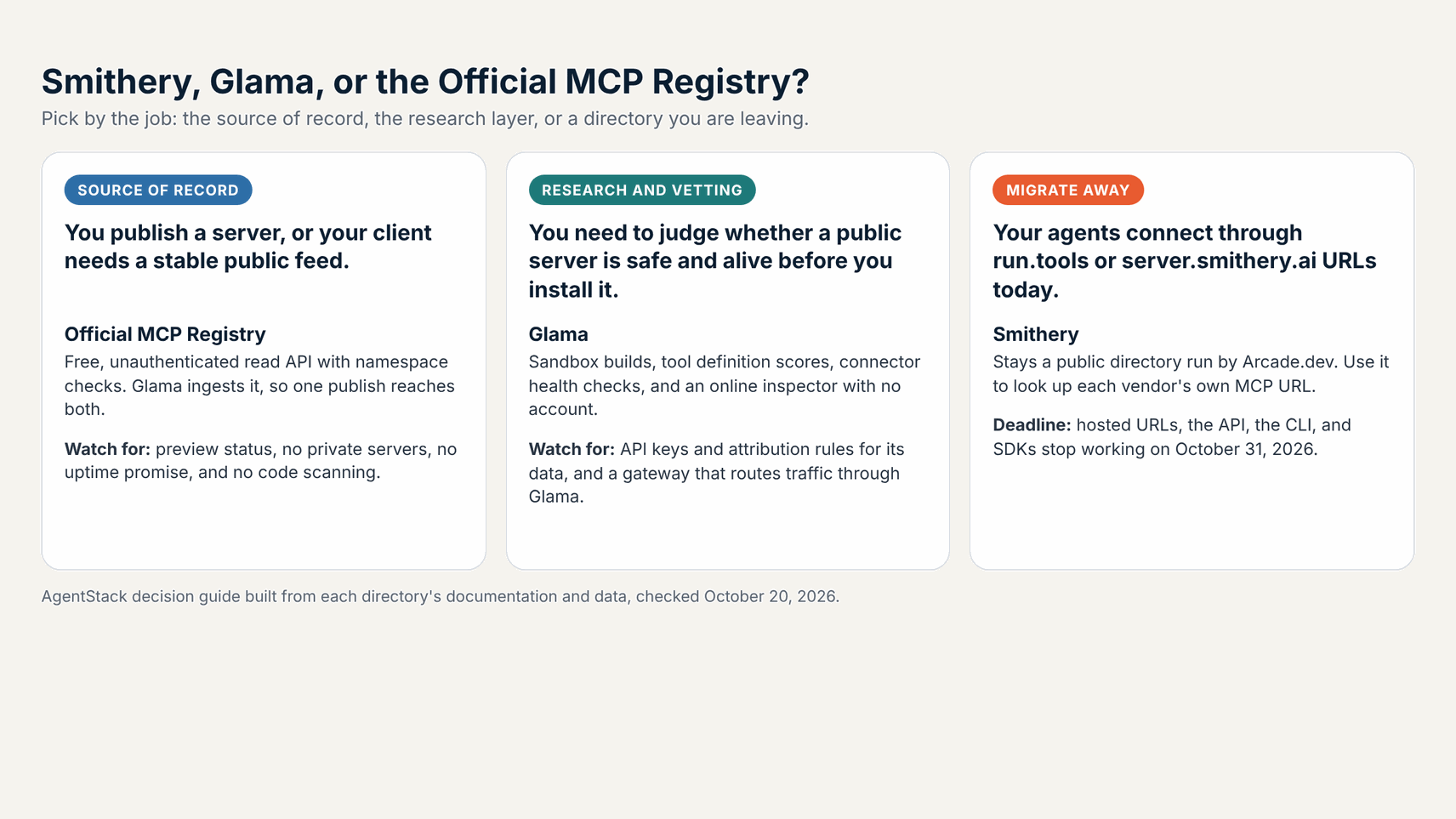
Decision kernel: Choose the Official MCP Registry when you publish a server or need a stable public feed. Choose Glama when you must judge whether a public server is safe, healthy, and well documented. Choose Smithery only to look up vendor URLs before its hosted connections end October 31, 2026, and choose none of them for private servers.
| Attribute | Smithery | Glama | Official MCP Registry |
|---|---|---|---|
| What it is | Public directory; hosting proxy until October 31, 2026 | Directory, scanner, gateway, and hosting | Metadata registry for public servers |
| Who runs it | Arcade.dev, after the August 5, 2026 acquisition | Glama LLC | The MCP project, with contributors such as Anthropic, GitHub, PulseMCP, and Microsoft |
| Listings (October 20, 2026) | 20,784 | 106,279 servers plus 33,925 remote connectors | 45,863 active entries |
| How servers get listed | Publisher submits a URL or an MCPB bundle | Maintainer GitHub sign-in, plus everything in the official registry | Publisher proves a namespace through GitHub, DNS, or HTTP |
| Checks on the server | Scans tools, prompts, and resources for the listing page | Sandbox build, behavior analysis, tool scores, connector health | None by design; scanning is left to package registries and aggregators |
| Hosting | Ends October 31, 2026 | Private by default, metered by machine hours and egress | None |
| API access | Public read API, ending October 31, 2026 | API key plus attribution license | Unauthenticated read API, v0.1 frozen since October 24, 2025 |
| Private servers | Not after accounts close on October 31, 2026 | Private hosted deployments | Not supported |
Verdict: The Official MCP Registry wins on neutrality and openness, Glama wins on depth of checks, and Smithery now wins only as a lookup tool for vendor URLs. Teams that used Smithery for hosting need a new home for those connections before October 31, 2026. Readers who only browse can treat Glama and the official registry as a pair.
What Our October 20 Data Shows
Smithery listed 20,784 servers on October 20, 2026, and 74.2% of them ran as remote servers on Smithery hosting that its owner says stops working on October 31. Glama listed more than twice the official registry, and its own health checks flagged 38.1% of remote connectors as unhealthy.
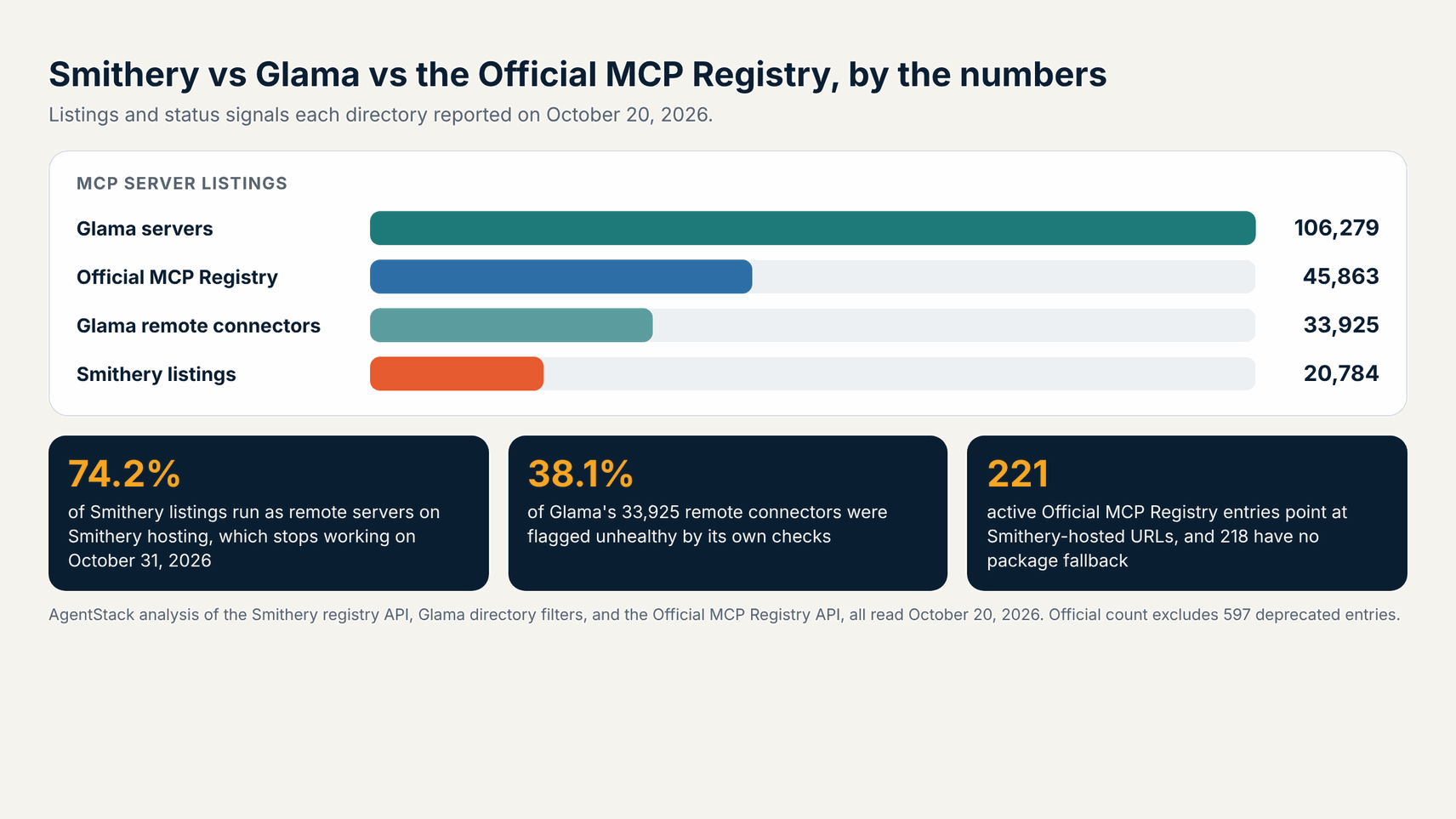
- Smithery depends on its own hosting: 15,425 listings were remote servers deployed on Smithery, 1,530 were local MCPB bundles, and 3,829, or 18.4%, had no deployed release at all.
- Few Smithery pages will keep a direct URL: Smithery says a curated set of verified servers will show vendor MCP URLs after October 31, and its API flagged only 192 servers, or 0.9%, as verified.
- The top of Smithery is all hosted: all 100 servers at the top of Smithery’s default API ranking connected through run.tools deployment URLs, and the API’s security field was empty for every one of them.
- The official registry inherits the problem: 221 of its 45,863 active entries point at Smithery-hosted URLs, 213 sit under the
ai.smitherynamespace, and 211 of those were published in September or October 2025. - Glama’s connectors are uneven: of 33,925 remote connectors, 18,894 were marked healthy, 12,911 unhealthy, and 1,363 untested, while 24,745, or 72.9%, required no authentication.
- Most Glama listings are unclaimed: 7,999 of 106,279 servers, or 7.5%, carried the Claimed label, which suggests most entries were indexed without a maintainer stepping forward.
A metadata registry keeps listing a server after its hosting disappears, because nothing in the registry checks that a remote URL still answers. The official aggregator guide says entries are generally immutable except for a status field, so 218 Smithery-hosted entries with no package fallback will keep appearing until their publishers deprecate them. Re-run the check below against your own client configs and the registry.
# 1. Find Smithery-hosted MCP URLs in common client configs
grep -rnE "run\.tools|server\.smithery\.ai" ~/.cursor/mcp.json ~/.claude.json .mcp.json .vscode/mcp.json 2>/dev/null

# 2. Look up the vendor's own entry in the Official MCP Registry
curl -s "https://registry.modelcontextprotocol.io/v0.1/servers?search=linear&version=latest" \
  | jq '.servers[].server | {name, remotes}'
Smithery, Glama, and the Official MCP Registry Up Close
Each profile below covers what the directory is, who it fits, how listings and checks work, what it costs as of October 20, 2026, and one honest limitation. Each heading carries a homepage screenshot captured from the directory’s own site that morning, followed by the page that best explains its current position.
Smithery: a public directory moving to read only after October 31
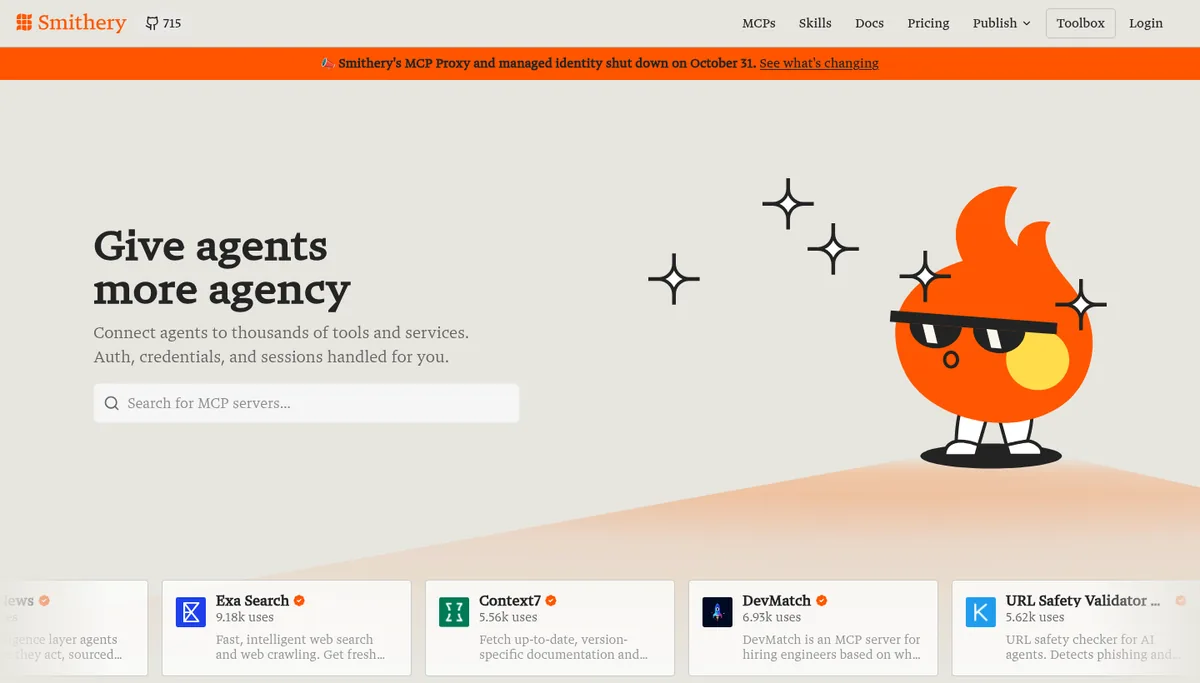
Verdict: Smithery made finding and running an MCP server a one click job, and after October 31, 2026 it becomes a lookup directory only. Arcade.dev announced the acquisition on August 5, 2026, and Smithery cofounder Anirudh Kamath joined Arcade.
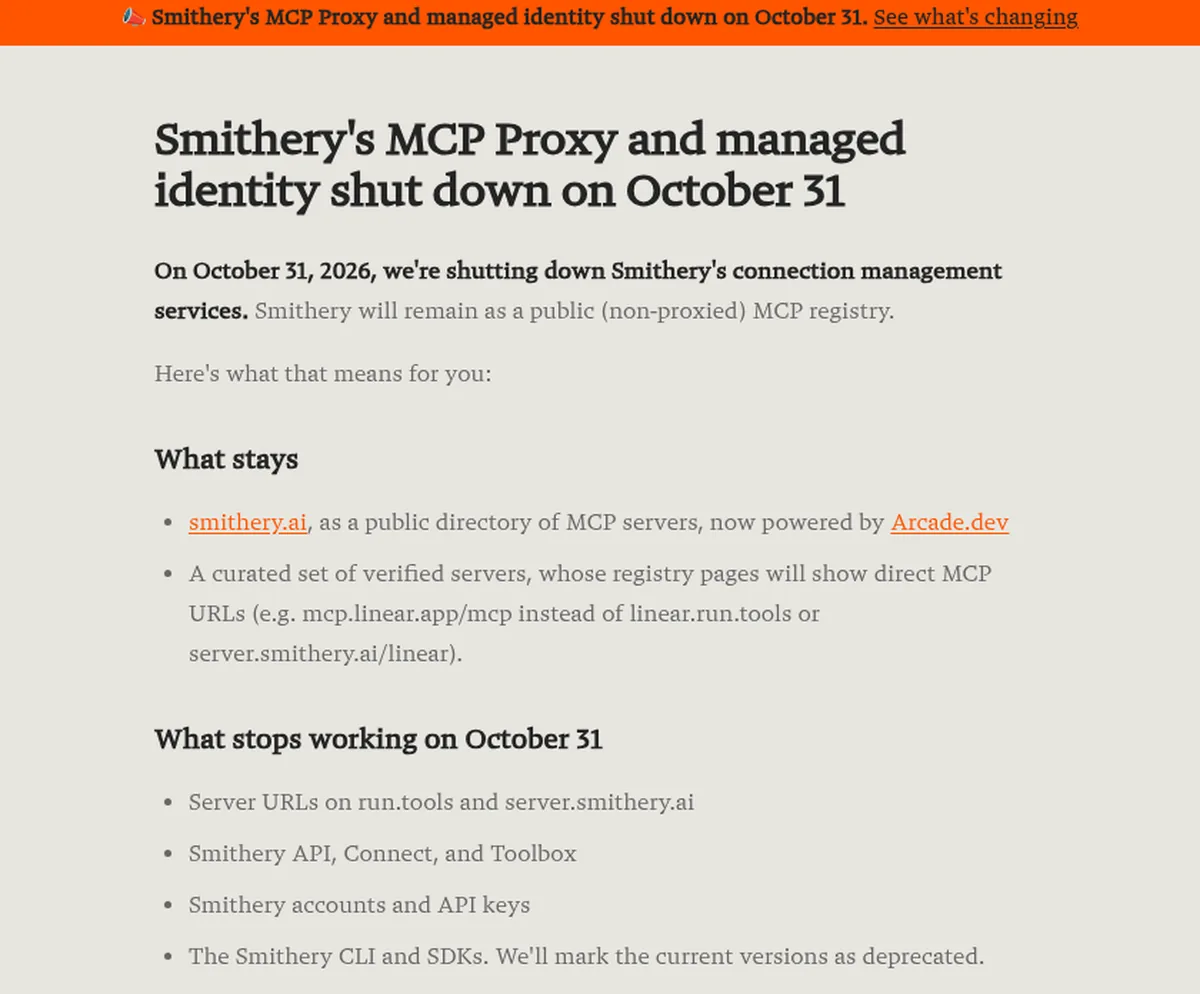
What changes: per the Smithery shutdown notice, server URLs on run.tools and server.smithery.ai, the Smithery API, Connect, Toolbox, accounts, API keys, the CLI, and the SDKs all stop working on October 31, 2026. The smithery.ai site stays up as a public directory powered by Arcade.dev, and Smithery is refunding every paid charge since August 5, 2026.
Best for: developers who need the vendor’s own endpoint for a server they found on Smithery. Its publishing docs describe URL listings that Smithery proxied and MCPB bundles for local servers, and the Context7 listing below shows the repository, tools, and license fields a listing page carries.
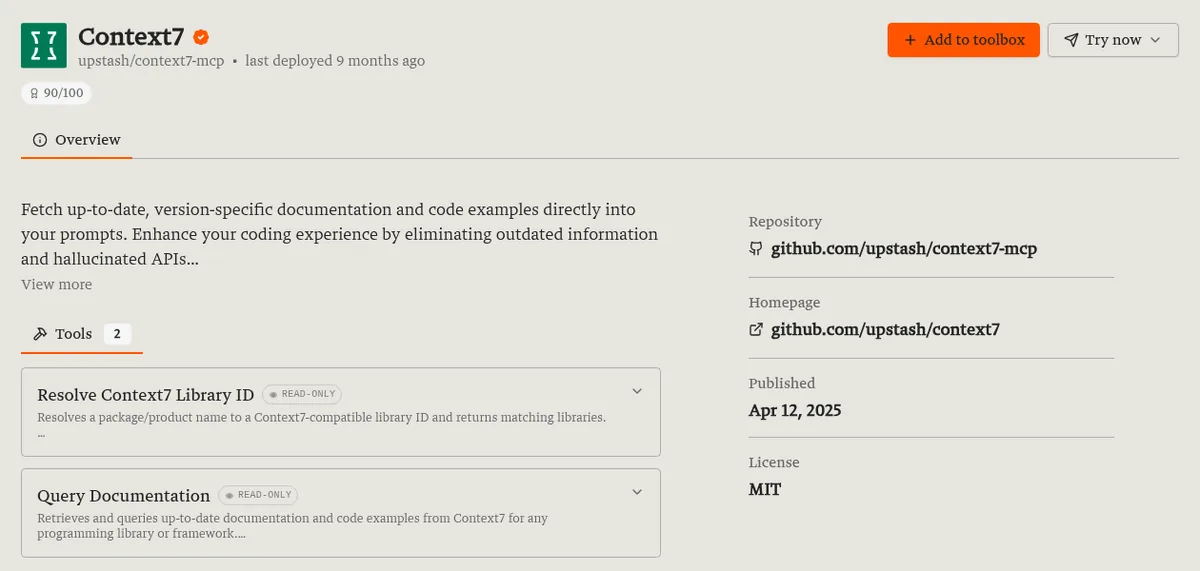
Pricing: browsing is free, and paid plans are cancelled. Limitation: Smithery only promises direct vendor URLs for a curated set of verified servers, so most of its 20,784 listings will point at endpoints that no longer answer. Arcade now owns the directory and sells its own agent tool runtime, so read Smithery rankings with that in mind, and see our Composio vs Arcade vs Nango comparison for how that runtime compares.
Glama: the largest index of the three, with sandbox scans and health checks
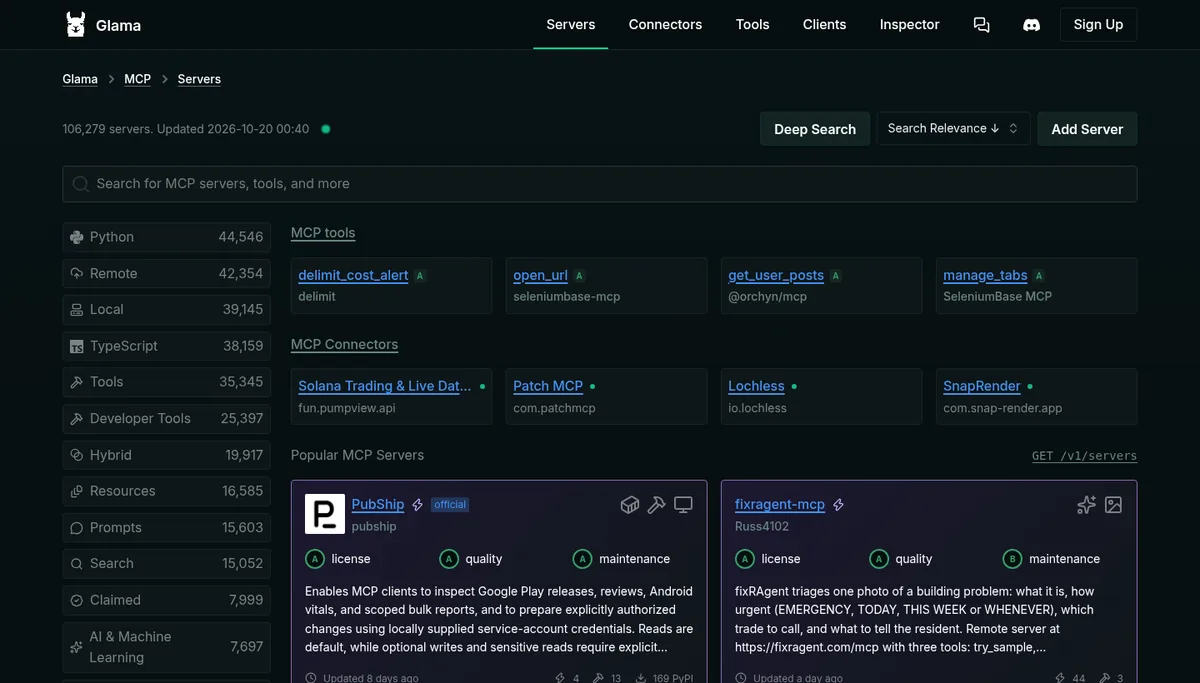
Verdict: Glama is the strongest of the three for deciding whether a server deserves a place on your laptop or in your agent. Its indexing methodology describes a pipeline that builds, runs, introspects, audits, and scores every server, with more than 1 million scans in the 12 months before the page was written.
What it checks: maintainers prove write access to the GitHub repository through OAuth, and each server is built and run in a Firecracker microVM while Glama watches syscalls and network traffic for credential access, unexpected hosts, and exfiltration. Findings are labeled Malicious or Risky, and every tool gets a Tool Definition Quality Score across six dimensions on a 1 to 5 scale.
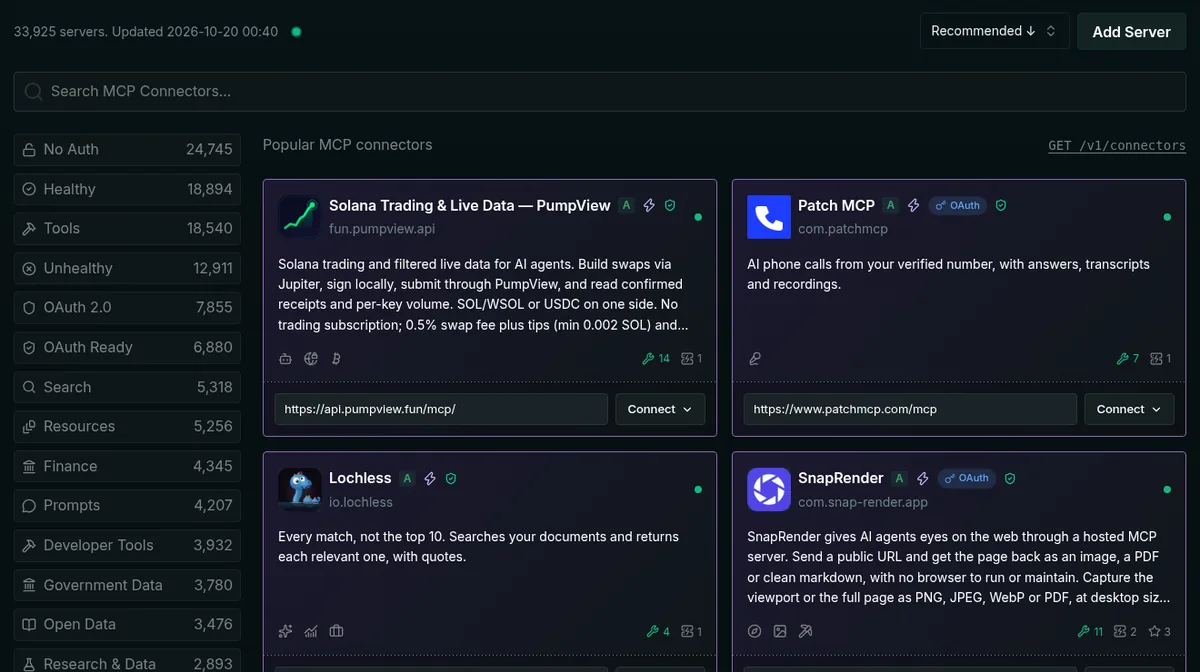
Connectors: Glama’s connector directory tracks remote MCP services on a schedule, diffs each tool schema against the last sweep, and flags prompt injection patterns that appear in changed descriptions. The free online MCP Inspector tests remote Streamable HTTP and SSE endpoints in a browser with no Glama account.
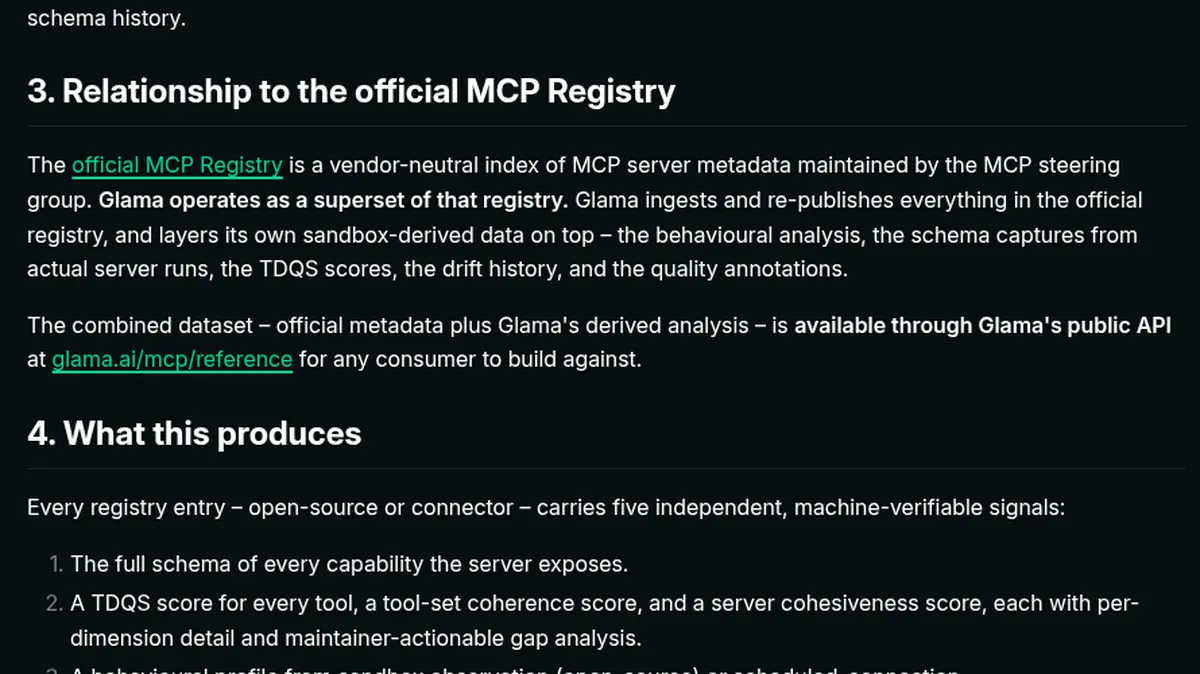
Pricing: browsing and the inspector are free, and the hosting page bills deployments by machine hours and egress, with the rate card shown only inside a workspace. Limitation: the directory API requires a key, and its data license requires a visible Glama credit and a link to each listing on every page that displays the data.
Official MCP Registry: the source of record for server metadata
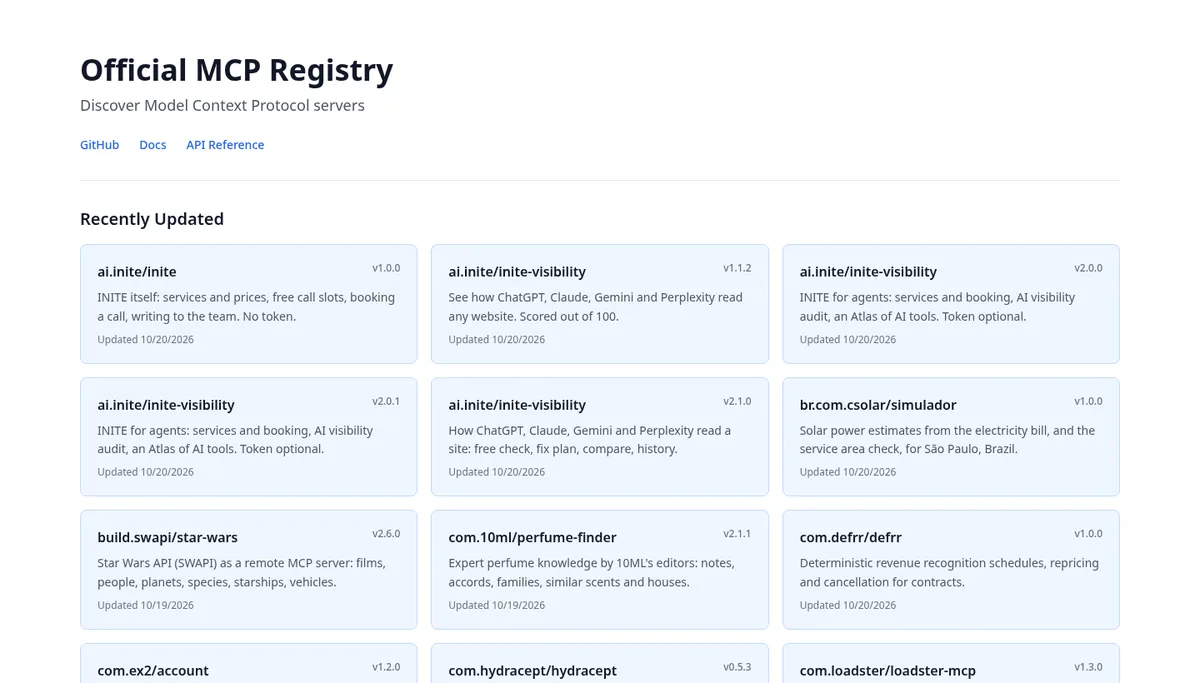
Verdict: the Official MCP Registry is the neutral feed that Glama and other aggregators ingest, and it is where a server publisher should list first. It launched in preview on September 8, 2025, and its v0.1 API has been frozen since October 24, 2025, per the registry repository.
How listing works: publishers run mcp-publisher init, sign in with mcp-publisher login github or prove a domain through DNS or HTTP, and publish a server.json, per the publishing quickstart. Clients and aggregators read the result through an unauthenticated REST API, and the aggregator guide suggests scraping about once an hour.
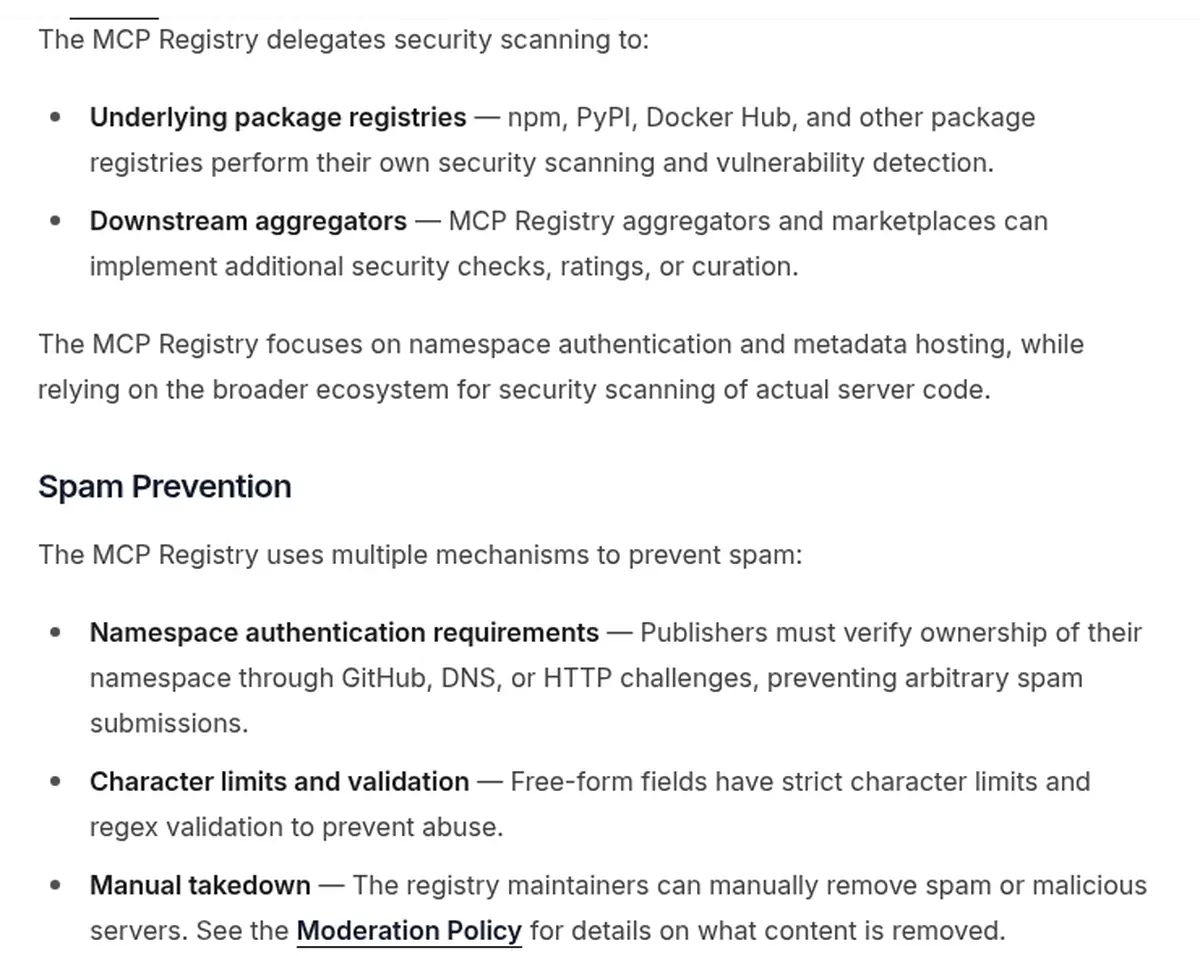
What it does not do: per the about page, the registry focuses on namespace authentication and metadata hosting, and it leaves security scanning to npm, PyPI, Docker Hub, and downstream aggregators. The official registry proves who published an entry, and it says nothing about whether the server is safe or still running.
Pricing: the API and listings are free. Limitation: the registry is still in preview, does not accept private servers, and the aggregator guide states it offers no uptime or data durability guarantees, so production clients should cache a copy instead of calling it on every request.
How to Move Off Smithery URLs Before October 31, 2026
Moving off Smithery means replacing every run.tools or server.smithery.ai URL with the vendor’s own MCP endpoint, then moving any credentials Smithery held for you. For servers whose vendor runs its own endpoint, the work is one config change per server. Servers with no vendor endpoint need a new host.
- Inventory your configs. Run the grep command above across developer machines, CI jobs, and agent deployments, and list every Smithery URL you find.
- Find each vendor endpoint. Open the server’s Smithery page or search the Official MCP Registry, and prefer an entry under the vendor’s own domain namespace, such as
app.linear/linearwithhttps://mcp.linear.app/mcp. - Reconnect auth. Smithery’s managed OAuth and stored API keys end with its accounts, so sign in to each vendor directly or move the connection behind your own gateway.
- Re-host community servers. For servers with no vendor endpoint, run the package locally, deploy it on a platform you control, or use a hosting option from our MCP gateways guide.
- Clean up your listings. If you published to Smithery, republish to the Official MCP Registry with your own URL and deprecate any
ai.smitheryentry that pointed at Smithery hosting.
Teams that relied on Smithery Connect to manage OAuth for their own users need a replacement product, not a config change. Arcade sells that layer, and our AI agent integration platforms roundup and Composio alternatives guide compare the other options on hosted tools, auth, and pricing.
How Trust Signals Differ Across the Three Directories
The three directories differ most in what they verify after a server is listed. The Official MCP Registry verifies only the publisher’s namespace, Smithery scanned listings for their metadata, and Glama builds, runs, and scores servers and checks connectors on a schedule. Read the signals together, because none of them alone proves a server is safe.
| Signal | Smithery | Glama | Official MCP Registry |
|---|---|---|---|
| Publisher check | Smithery account and namespace; 192 verified listings | GitHub write access for open source; sandbox credentials for connectors | GitHub OAuth, DNS, or HTTP namespace proof |
| Code or behavior check | Metadata scan of tools, prompts, and resources | Firecracker build with syscall and network monitoring | None; left to package registries |
| Live health | Not exposed in the API for the top 100 listings we read | Healthy, Unhealthy, or Untested flag per connector | None; status is active, deprecated, or deleted |
| Tool quality | Not documented | Tool Definition Quality Score, six dimensions | None |
| Change history | Release history through the API until October 31, 2026 | Git history plus schema drift history | Versions are kept; only the status field changes |
Verdict: Glama gives the most evidence about a server, and the official registry gives the most reliable evidence about who published it. Use both before you approve a public server, and watch for advisories like the FastMCP client RCE disclosure and the ToFu study of 253 MCP server bugs, which show why a directory score is a starting point and not a security review.
What Each Directory Costs in 2026
Browsing all three directories costs nothing, and the differences show up only when you use their APIs or hosting. The official registry is free with no key, Glama’s API needs a key and an attribution license, and Smithery’s paid plans are being refunded and cancelled ahead of its October 31, 2026 shutdown.
| Directory | Browsing | API | Hosting |
|---|---|---|---|
| Smithery | Free | Free until October 31, 2026, then gone | Ends October 31, 2026; charges since August 5, 2026 refunded |
| Glama | Free, plus a free online inspector | API key required; 100 requests per second per IP; attribution required | Metered by machine hours and egress; rates shown inside a workspace |
| Official MCP Registry | Free | Free and unauthenticated | None offered |
Verdict: the official registry is the only option with no key, no license terms, and no vendor attached to its data. Glama’s attribution rule matters if you plan to show its scores inside your own product, and Smithery’s costs drop to zero because the paid service ends.
Which Directory Should You Use?
The right directory depends on whether you are installing, migrating, publishing, or governing MCP servers. Find the profile below that matches your work, use the named directory for that job, and keep the official registry as the shared source of truth. Each profile lists the first steps to take this week.
Developers picking a server to install today
- Search Glama, open the listing, and read its license, quality, and maintenance grades plus any Risky findings.
- Confirm the publisher in the Official MCP Registry, and prefer a vendor domain namespace over an
io.githubone. - Compare the options in our MCP servers for enterprise teams roundup before you install a second server for the same job.
Teams with agents on Smithery URLs
- Run the config inventory this week and set a cutover date before October 31, 2026.
- Swap in vendor endpoints, then re-authenticate each connection directly with the vendor.
- Pick a home for hosted community servers, using our Kong vs AWS AgentCore vs Docker comparison if you want a gateway in front of them.
MCP server publishers
- Publish to the Official MCP Registry under your own domain namespace, since Glama ingests everything listed there.
- Claim your Glama listing and fix the tool descriptions its quality score flags.
- Update your Smithery listing to point at your own endpoint if it is verified, and deprecate any Smithery-hosted official entries.
Platform teams building an approved catalog
- Treat all three directories as upstream sources, never as the catalog your employees install from.
- Mirror reviewed servers into a private registry and enforce the list through an MCP gateway, as covered in our MCP gateways guide.
- Track gateway products such as the Red Hat MCP Gateway that add tool discovery and audit logs on top of a catalog.
When None of the Three Is the Right Tool
None of these public directories fits a company that must list internal servers, approve them before employees install them, or control who calls which tool. The official registry rejects private servers, Glama’s private deployments run on Glama’s infrastructure, and Smithery is closing its accounts.
A public directory tells you a server exists, while a private registry plus a gateway decides whether your agents may use it. For that job, read our MCP explained guide for how registries, gateways, and clients fit together, then pick an enforcement layer from the MCP gateways guide. Keep the official registry as the upstream feed you filter, since it is the only one of the three with no vendor and no license terms attached.
Frequently Asked Questions
Is Smithery shutting down completely?
No. Smithery is shutting down its MCP Proxy, managed identity, API, accounts, CLI, and SDKs on October 31, 2026, but smithery.ai stays online as a public directory powered by Arcade.dev. Server URLs on run.tools and server.smithery.ai stop working that day, so switch to each vendor’s own MCP endpoint before then.
Does Glama include every server in the Official MCP Registry?
Yes, according to Glama. Its methodology page says Glama ingests and republishes everything in the official registry, then adds sandbox analysis, schema captures, quality scores, and drift history. That is why Glama listed 106,279 servers on October 20, 2026, against 45,863 active official entries.
Is the Official MCP Registry safe to install servers from directly?
Not on its own. The registry verifies who controls a namespace, but it does not scan code or check whether a remote server still answers. Check the server on a scanning directory such as Glama, review its package and permissions, and route it through your own gateway or allowlist before agents use it.
Do I need an API key to use Glama or the official registry?
Glama’s directory API needs an API key, allows 100 requests per second per IP, and requires a visible Glama credit and listing links wherever you display its data. The Official MCP Registry API needs no key at all, which makes it the easier feed for clients and internal mirrors.
What happens to Smithery servers published to the official registry?
They stay listed. On October 20, 2026, 221 active official registry entries pointed at Smithery-hosted URLs, and 218 had no package to fall back on. Registry entries are generally immutable apart from status, so they will remain until publishers deprecate them, even after those URLs stop answering.
Related Guides
For related coverage, see our enterprise MCP registries guide and MCP security tools.
Read MCP explained, MCP gateways, MCP servers for enterprise teams, Kong vs AWS AgentCore vs Docker, AI agent integration platforms, Composio vs Arcade vs Nango, Composio alternatives, Red Hat MCP Gateway GA, the ToFu MCP bug study, the agent protocols hub, and the MCP topic page. Notes on how we work sit on editorial standards, disclosure, and contact.
The Bottom Line
Publish to the Official MCP Registry, vet with Glama, and move every Smithery URL to a vendor endpoint before October 31, 2026. The official registry is the neutral record, Glama adds the evidence the registry leaves out, and Smithery is now a lookup tool owned by a runtime vendor.
Companies that need approval and enforcement should treat all three as upstream feeds and run their own private catalog behind a gateway. Send corrections or directory suggestions through our contact page.