

Last updated October 11, 2026. Licenses, pricing, ownership, and release dates were checked against each vendor’s own pages and repositories on that date.
Shipping an AI agent is the easy part. Keeping it correct, safe, and affordable once real users start talking to it is where most teams stall.
AgentOps tools are the software that closes that gap: they instrument an agent, trace what it did, score whether it was right, route and cap its model calls, and block unsafe actions. This map sorts the 2026 market into five layers and profiles 13 tools across them.
AgentStack is an independent publication for teams that build and run agents, and this pillar anchors our AgentOps hub. No vendor paid for placement, per our editorial standards and disclosure policy.
Most teams need one tool per layer, and OpenTelemetry is the glue that keeps those tools swappable. If you only want the tracing shortlist, go straight to our guide to the 12 best AI agent observability tools. For self-hosted open source picks, see our open source LLM observability guide.
TL;DR
- AgentOps is the operating discipline for agents in production, and it is also the name of one tracing product, AgentOps.ai.
- The stack has five layers: instrument, observe, evaluate, route, and protect.
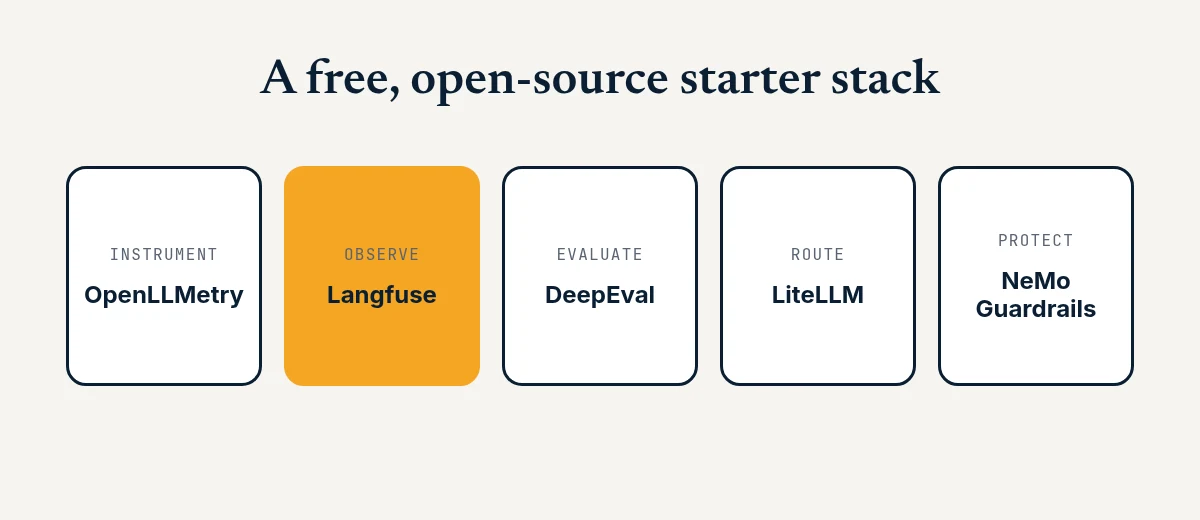
- A free starter stack exists, built from OpenLLMetry, Langfuse, DeepEval, LiteLLM, and NeMo Guardrails, all under MIT or Apache 2.0 licenses.
- Ownership moved fast in 2026, with Langfuse, Traceloop, Galileo, Portkey, and Guardrails AI under new owners and Promptfoo in an announced OpenAI deal.
- OpenTelemetry GenAI conventions now reach guardrails too, since NeMo Guardrails emits GenAI spans from version 0.16.0.
- Pin your gateway versions, because LiteLLM’s March 2026 supply chain incident showed how much a compromised AgentOps dependency can reach.
What Is AgentOps? The Discipline, the Loop, and the Product
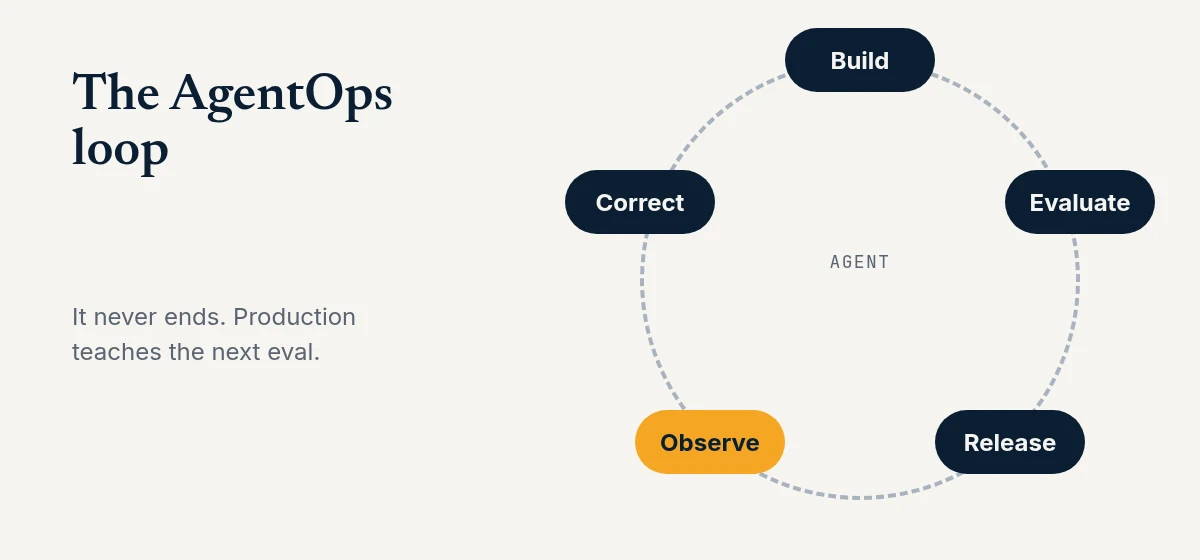
AgentOps is the practice of building, evaluating, releasing, observing, and correcting AI agents as one continuous loop once they run in production. It extends DevOps, MLOps, and LLMOps to software that decides and acts, so it adds tool-call tracing, trajectory evals, spend control, and runtime guardrails to the usual monitoring.
AgentOps vs MLOps vs LLMOps
The three disciplines overlap, but each one operates a different unit of work. The table shows where AgentOps adds new jobs.
| Discipline | What it operates | Main failure it watches for | Typical tools |
|---|---|---|---|
| MLOps | Trained models | Data drift and model decay | Experiment trackers, model registries, feature stores |
| LLMOps | Single prompts and model calls | Bad completions, latency, token cost | Prompt management, LLM tracing, gateways |
| AgentOps | Multi-step agent runs that call tools | Wrong tool calls, loops, unsafe actions, runaway spend | Agent tracing, trajectory evals, gateways, guardrails |
AgentOps the discipline vs AgentOps the product
Search for AgentOps and the top result is AgentOps.ai, a tracing and session replay product with its own SDK. In this guide, AgentOps means the discipline, and AgentOps.ai is one tool inside its observe layer. We profile it below with the rest of that layer.
Key takeaway: an LLM call either answers well or badly, but an agent can take ten reasonable steps and still do the wrong thing. AgentOps tools exist to see, score, and stop those runs.
The AgentOps Stack: Five Layers and the Question Each One Answers
A complete AgentOps stack has five layers: instrumentation emits spans, observability stores and explores them, evals score them, a gateway routes and caps model calls, and guardrails block unsafe inputs and outputs. One product can cover two or three layers, but no tool in this map covers all five well.
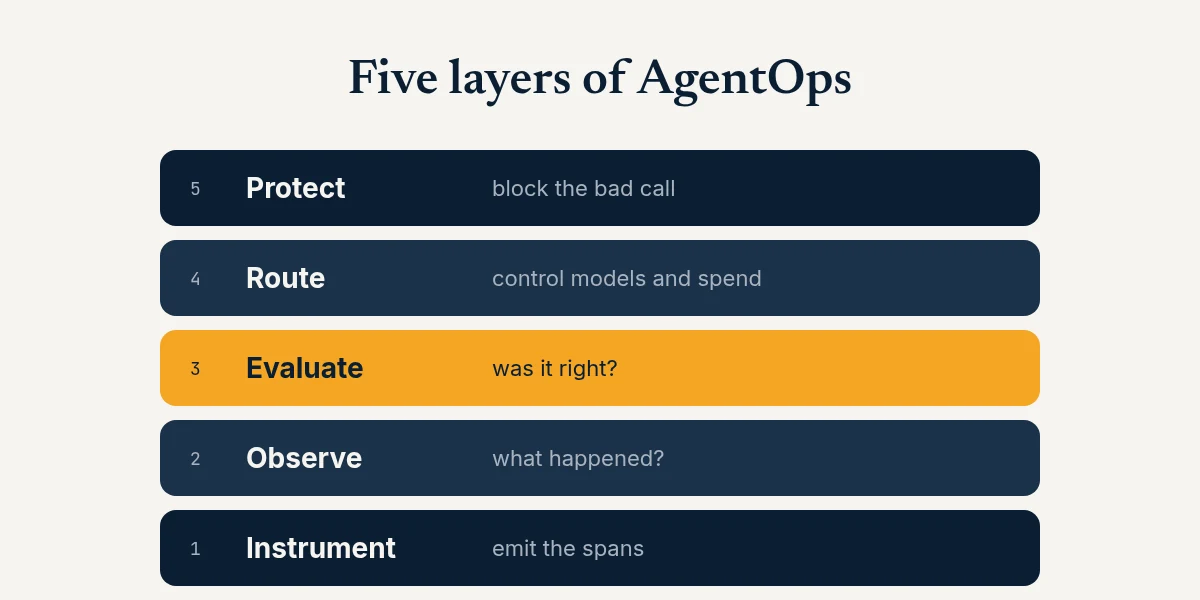
| Layer | Question it answers | Open-source options profiled | Commercial options profiled |
|---|---|---|---|
| 1. Instrument | Did the agent emit usable telemetry? | OpenLLMetry | Traceloop platform |
| 2. Observe | What did the agent do, step by step? | Langfuse, Arize Phoenix, AgentOps SDK | LangSmith, Datadog Agent Observability, AgentOps.ai cloud |
| 3. Evaluate | Was the output or trajectory right? | DeepEval, Promptfoo | Braintrust, Confident AI |
| 4. Route | Which model ran, at what cost, with what limits? | LiteLLM | Cloudflare AI Gateway, LiteLLM Enterprise |
| 5. Protect | Should this input, output, or action be blocked? | NeMo Guardrails | Check Point AI Guardrails (Lakera Guard) |
Observability is the hub of the stack. Every other layer either feeds it spans or reads its traces, which is why our agent observability coverage is the deepest part of this hub.
How We Built This Map
We started from the tools named in top-ranking AgentOps pages, vendor comparisons, and practitioner threads, then kept products that are current, documented, and widely used. Each profile rests on the vendor’s own pricing page, documentation, and repository, plus acquisition announcements, all reviewed on October 11, 2026.
- Layer fit: the tool must answer one layer’s question as its main job.
- Maintenance: we checked the latest release date on PyPI or GitHub for every open-source project.
- License and hosting: what you can self-host, and under which license.
- OpenTelemetry support: whether telemetry stays portable across tools.
- Pricing transparency: public list prices, or a clear note when pricing is quote-only.
- Ownership: who owns the product after the 2025 and 2026 acquisitions.
This is a documentation and pricing review, and we did not run hands-on benchmarks for this edition. Treat performance claims in vendor materials as claims until you test them on your own agent.
Who Owns What: AgentOps Consolidation in 2025 and 2026
At least eight AgentOps vendors changed hands or announced a sale between September 2025 and September 2026, across every layer of the stack. Before you commit, confirm who owns the product, what the license guarantees, and whether the open-source project kept its maintainers.
| Product | Layer | Buyer | Status, per the announcements |
|---|---|---|---|
| Lakera | Protect | Check Point | Announced September 16, 2025; Lakera Guard now ships as Check Point AI Guardrails |
| Langfuse | Observe | ClickHouse | January 16, 2026; MIT license unchanged |
| Helicone | Observe | Mintlify | March 3, 2026; maintenance mode with no new features |
| Promptfoo | Evaluate | OpenAI | Agreement announced March 9, 2026; open source to continue |
| Traceloop | Instrument | ServiceNow | March 2026; OpenLLMetry stays open source |
| Galileo | Evaluate and protect | Cisco (Splunk) | Closed May 22, 2026 |
| Portkey | Route | Palo Alto Networks | Closed May 29, 2026; now inside Prisma AIRS |
| Guardrails AI | Protect | Harvey | September 9, 2026; team joined Harvey’s product and engineering organization |
Buyer’s rule: for every layer, keep an exit path. Instrument with OpenTelemetry, store eval datasets where you can export them, and keep gateway configs in version control.
Layer 1: Instrumentation, the Part That Keeps Everything Swappable
Instrumentation is the code that turns each model call, tool call, and retrieval step into a span another tool can read. Teams that instrument with OpenTelemetry once can send the same spans to any observability backend, so this layer decides how hard it will be to switch tools later.
OpenTelemetry’s GenAI semantic conventions define agent span types such as invoke_agent and execute_tool, and the agent span specification is still marked Development status. Pin the convention version you emit, since attribute names can still change.
OpenLLMetry by Traceloop
Verdict: OpenLLMetry is the default instrumentation layer for teams that want vendor-neutral OpenTelemetry spans.
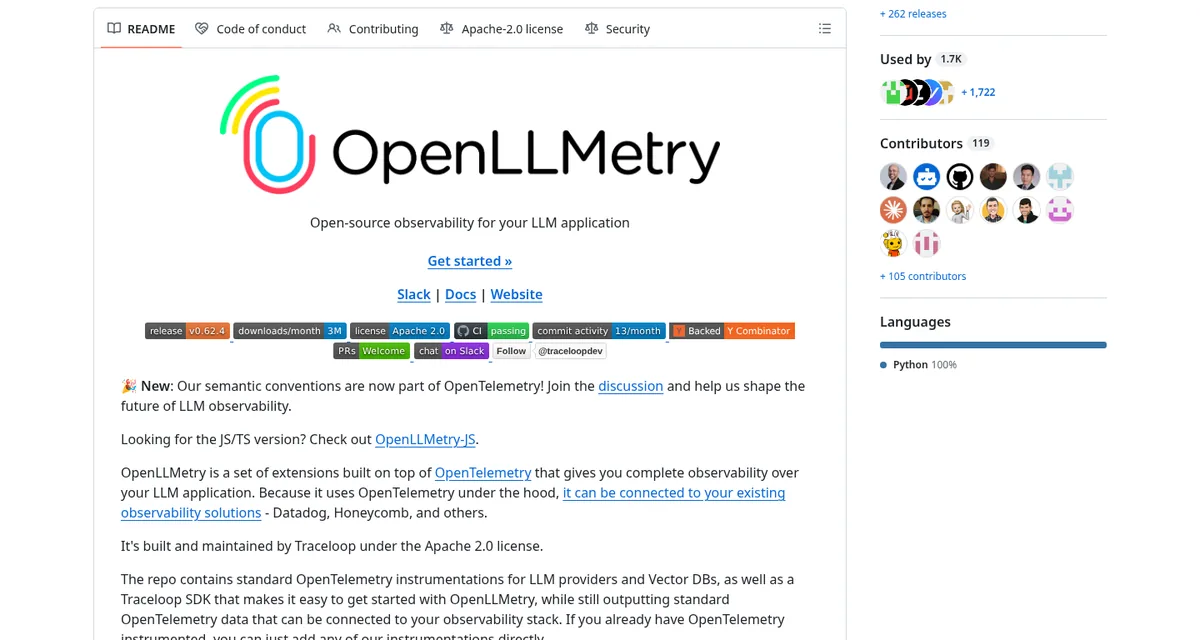
OpenLLMetry is an Apache 2.0 set of OpenTelemetry instrumentations for LLM providers, vector databases, and agent frameworks. Traceloop, its creator, announced in March 2026 that it is joining ServiceNow and that OpenLLMetry will stay open source.
Getting started takes one package and one line, per the project README.
Key features
- Automatic spans for major LLM providers, vector databases, and frameworks.
- Export to more than 25 observability backends, according to Traceloop.
- A Traceloop SDK that wraps setup, plus a commercial Traceloop platform on top.
Pricing
- OpenLLMetry is free and open source.
- Traceloop’s hosted free plan covers 50,000 spans per month, 5 seats, and 24-hour retention.
- Traceloop Enterprise is custom priced, with SOC 2 and on-premises deployment.
Prices come from Traceloop pricing.
Pros and cons
Pros
- Instrument once and change backends without rewriting code.
- A permissive license that many other vendors reuse.
Cons
- The commercial platform’s roadmap now follows ServiceNow.
- The hosted free plan keeps data for only 24 hours.
pip install traceloop-sdkfrom traceloop.sdk import Traceloop
Traceloop.init()Those two snippets come from the OpenLLMetry README. Point the exporter at your chosen backend, and every later layer can read the same spans.
Layer 2: Observability, Where Every Agent Run Becomes a Trace
Observability tools store agent traces and let engineers replay a run step by step, filter by cost or error, and attach scores. This layer has the most choice, so we profile five tools here and cover twelve in depth in our AI agent observability tools guide, including pricing math and a feature matrix.
Langfuse
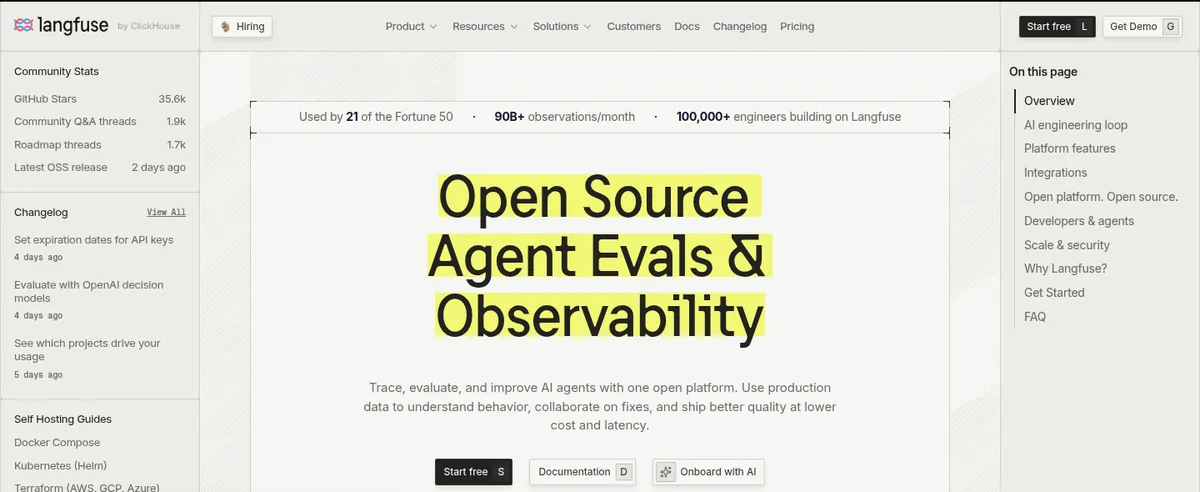
Verdict: Langfuse is the safest open-source default for tracing, evals, prompts, and alerts in one tool.
Langfuse is an LLM engineering platform whose core is MIT licensed, per its license file. ClickHouse acquired it in January 2026, and self-hosting continues.
Key features
- Agent traces with graphs, sessions, and token and cost tracking.
- Datasets, experiments, LLM-as-judge evaluators, and annotation queues.
- Alerts, webhooks, and Slack notifications on every plan.
Pricing
- Hobby is free with 50,000 units per month and 2 users.
- Core costs $29 per month for 100,000 units and unlimited users.
- Pro costs $199 per month, and Enterprise starts at $2,499 per month.
Prices come from Langfuse pricing.
Pros and cons
Pros
- Free self-hosting with the full tracing and eval UI.
- Unlimited users from the $29 plan.
Cons
- Every trace, span, and score counts as a billable unit on cloud plans.
- It observes and scores runs but does not block them.
LangSmith
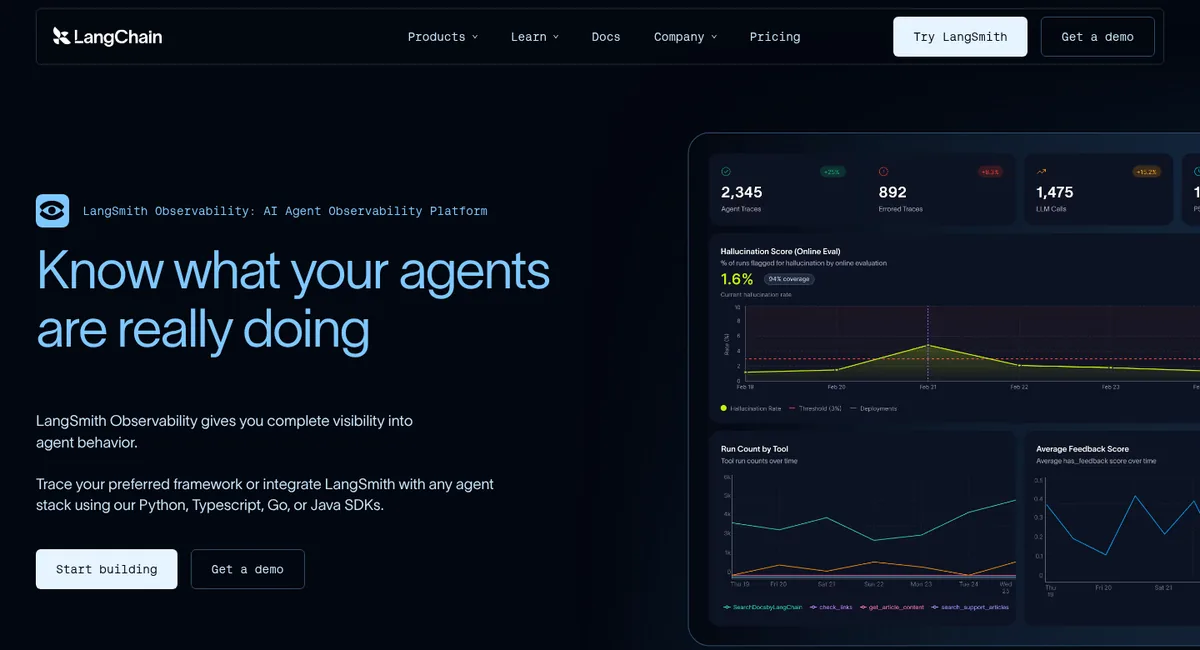
Verdict: LangSmith is the natural pick for agents built on LangChain or LangGraph.
LangSmith is LangChain’s commercial platform for agent observability, evaluation, and deployment, and it accepts traces at an OpenTelemetry endpoint.
Key features
- Agent traces with trajectory and tool monitoring.
- Online and offline evals, including LLM-as-judge.
- Webhook and PagerDuty alerts on latency, errors, cost, and feedback.
Pricing
- Developer is free for 1 seat and 5,000 base traces per month.
- Plus costs $39 per seat per month with 10,000 base traces.
- Enterprise adds self-hosted and hybrid deployment at custom pricing.
Prices come from LangSmith pricing.
Pros and cons
Pros
- The deepest LangGraph-aware tracing on the market.
- Alerts route straight to PagerDuty.
Cons
- Every invited user is a billable seat.
- Self-hosting needs an Enterprise contract.
Weighing the top three? Our Langfuse, LangSmith, and Braintrust comparison prices the same workload on all three.
If LangSmith’s seat pricing or Enterprise-only self-hosting rules it out, see our 8 best LangSmith alternatives, five of which you can self-host for free.
Arize Phoenix
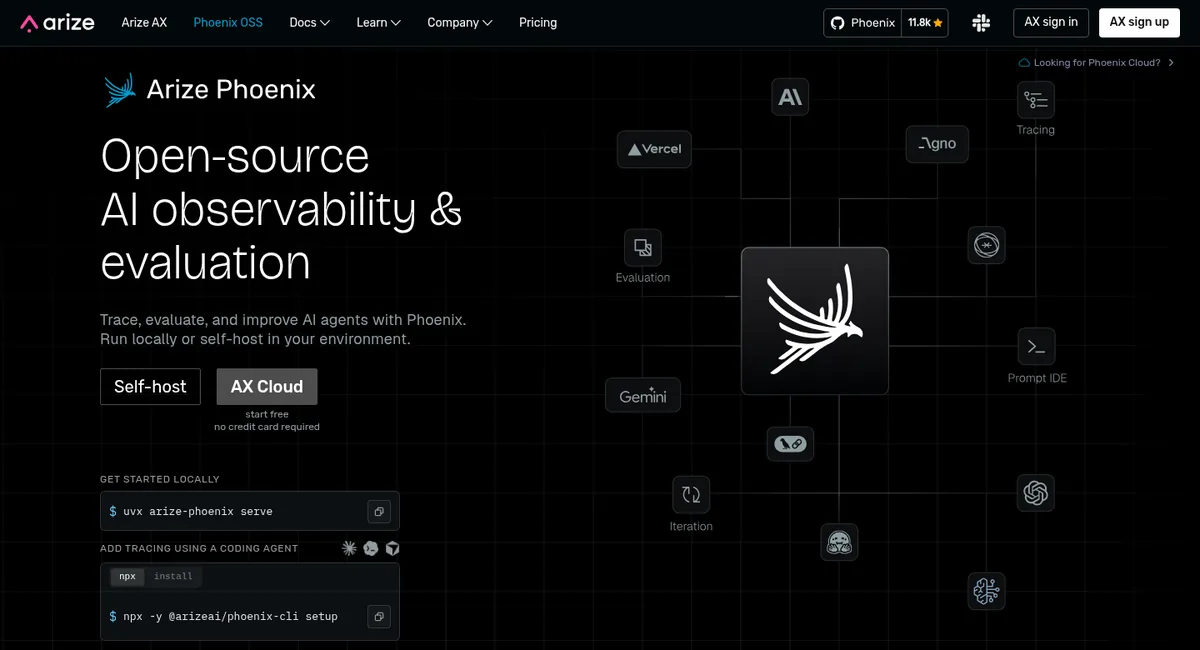
Verdict: Phoenix suits OpenTelemetry-first teams that want free local tracing with a managed upgrade path.
Arize Phoenix is a local-first tracing and evaluation platform under the source-available Elastic License 2.0. It builds on OpenInference, Arize’s Apache 2.0 conventions on top of OpenTelemetry.
Key features
- OpenTelemetry-compliant tracing with agent path and graph views.
- Online and offline evals on traces and datasets.
- Custom dashboards and monitors in the managed Arize AX product.
Pricing
- Phoenix is free to self-host.
- AX Free includes 25,000 spans and 15-day retention.
- AX Pro costs $50 per month for 50,000 spans and 30-day retention.
Prices come from Arize pricing.
Pros and cons
Pros
- No metered events when you run Phoenix yourself.
- Strong retrieval and trajectory evals.
Cons
- The Elastic License bars offering Phoenix as a managed service.
- Monitors live in paid AX, outside self-hosted Phoenix.
Datadog Agent Observability
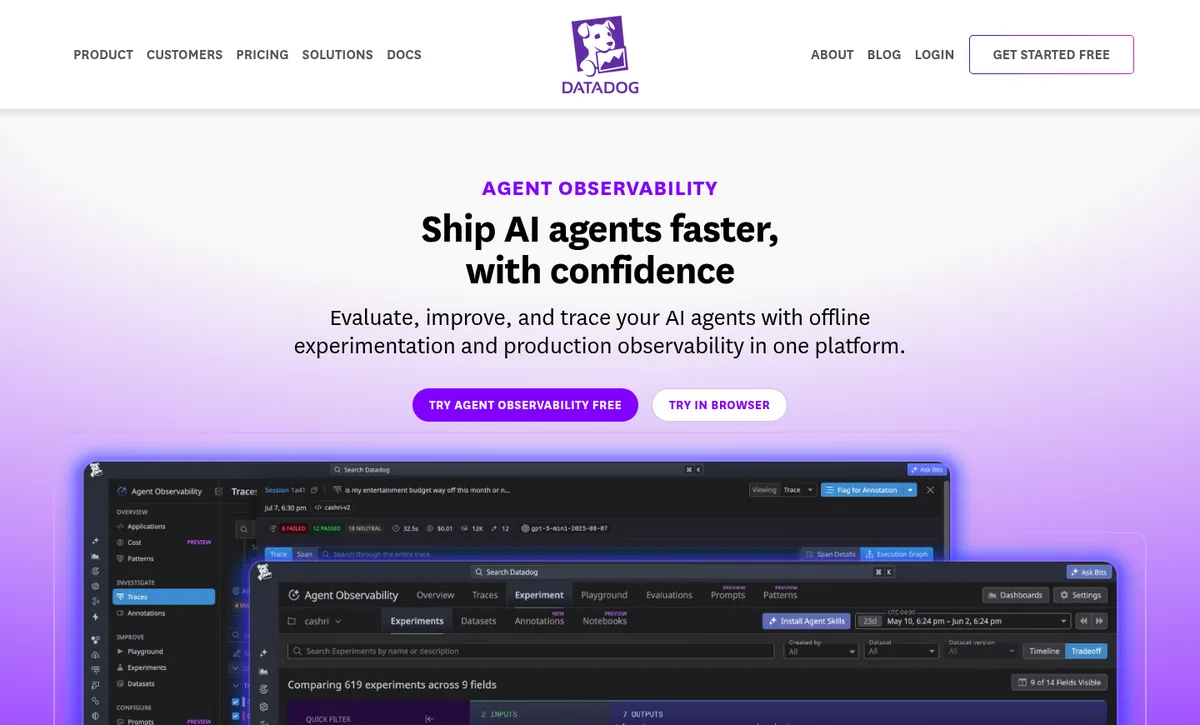
Verdict: Datadog is the practical choice when it already holds your metrics, logs, and APM traces.
Datadog Agent Observability traces agents inside the Datadog platform and natively accepts OpenTelemetry GenAI spans from semantic convention version 1.37.
Key features
- Tracing, evals, datasets, and experiments on every tier.
- Cost, token, latency, and error metrics usable in standard Datadog monitors.
- AI Guard, a separately billed product, for inline protection.
Pricing
- The free tier covers 40,000 LLM spans per month with 15-day retention.
- Pro costs $160 per month on annual billing for 100,000 LLM spans.
- Only LLM spans are billed, so tool and retrieval spans cost nothing extra.
Prices come from Datadog pricing.
Pros and cons
Pros
- One pane for agent, application, and infrastructure telemetry.
- LLM-span billing favors tool-heavy agents.
Cons
- SaaS only, with no self-hosted option.
- Quality alerting follows a different path from cost and latency alerting.
AgentOps.ai
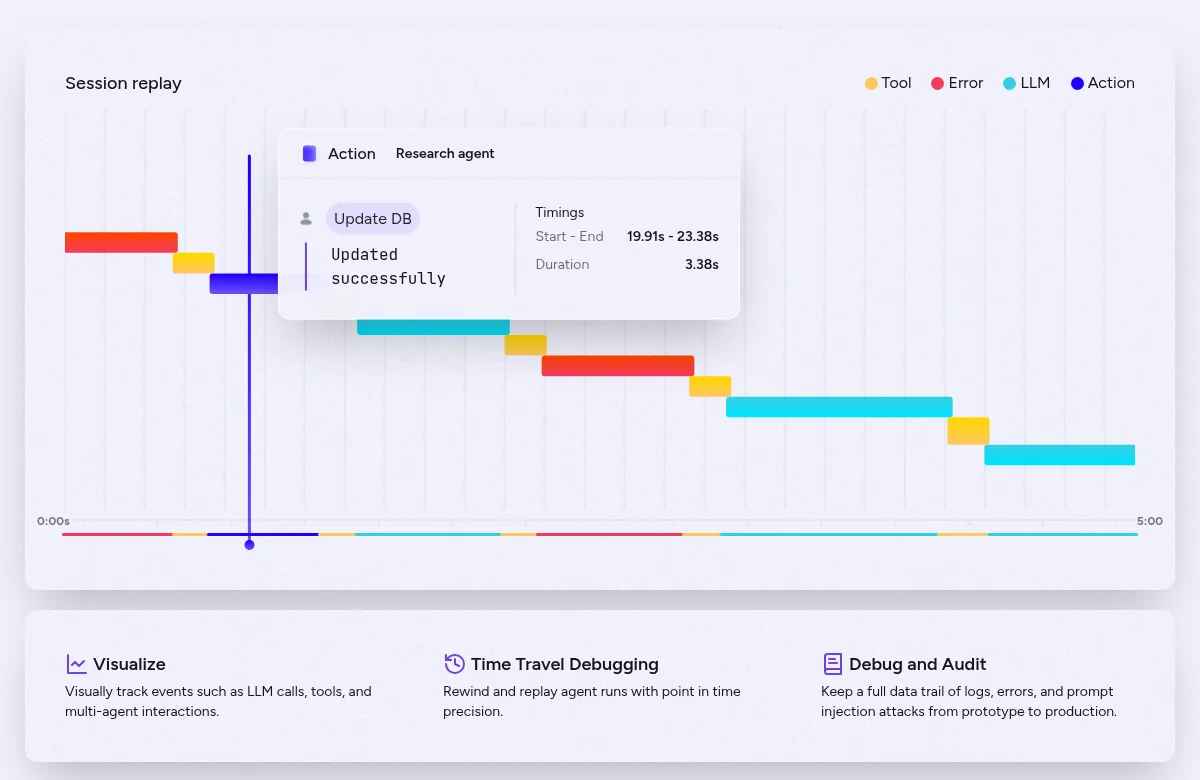
Verdict: AgentOps.ai suits small teams on CrewAI or AutoGen that want session replay with a two-line setup.
AgentOps.ai is a tracing and debugging product built around agent sessions, with a waterfall view of LLM calls, tool calls, and errors. Its SDK repository is MIT licensed, and its docs say the app is open source.
Key features
- Session waterfalls with time travel debugging to replay a run.
- LLM cost tracking that the vendor says covers more than 400 models.
- Integrations with CrewAI, AG2, the OpenAI Agents SDK, and LangChain.
Pricing
- Basic is free up to 5,000 events.
- Pro starts at $40 per month with unlimited events and log retention.
- Enterprise is custom priced and adds SSO, on-premises deployment, and self-hosting.
Prices come from the AgentOps.ai homepage.
Pros and cons
Pros
- The fastest setup in this layer for CrewAI and AutoGen agents.
- Unlimited retention from the $40 Pro plan.
Cons
- The latest Python SDK release on PyPI is 0.4.21, from August 2025. Check recent activity on PyPI before you standardize on it.
- Evals are thinner than in Langfuse or LangSmith.
Layer 3: Evals and Testing, the Layer That Decides What Ships
Eval tools score agent outputs and trajectories against datasets before release and on live traffic after it. Strong teams run three kinds of checks: unit-style evals in CI, red teaming for security, and online scoring of production traces. Our evals and testing coverage goes deeper on each. For a ranked shortlist, see our 10 best AI agent evaluation tools, compared on trajectory scoring, CI gates, and price.
Braintrust
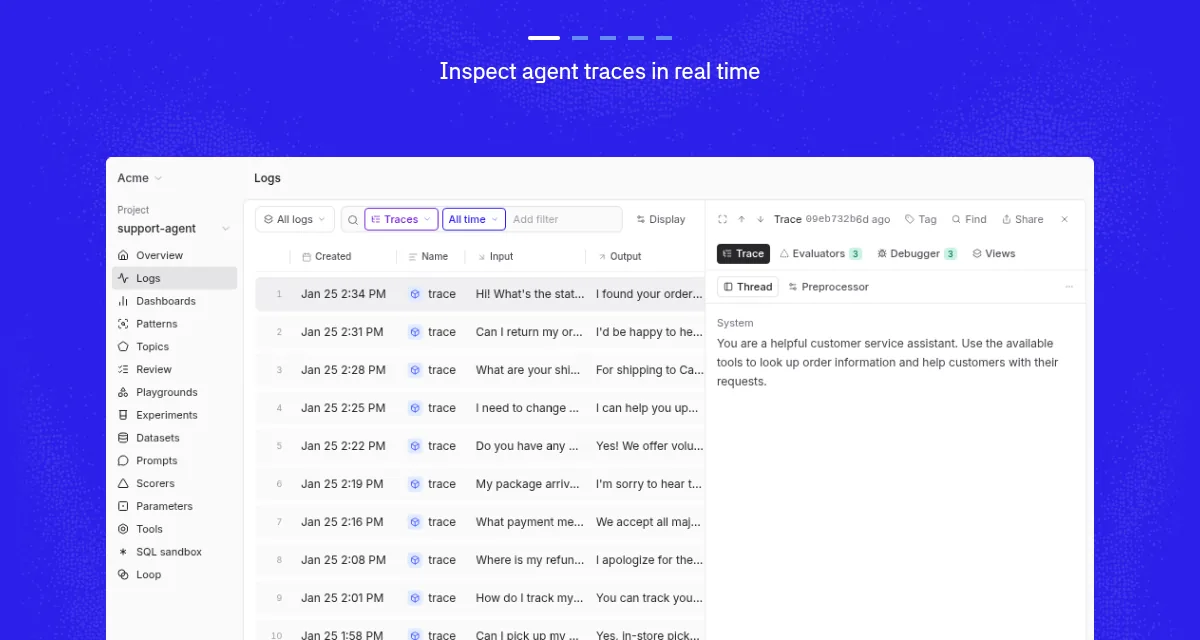
Verdict: Braintrust fits product teams where eval scores decide what ships.
Braintrust is a proprietary evaluation and observability platform built around datasets, experiments, and scorers. It accepts OpenTelemetry traces through an OTLP endpoint.
Key features
- Online scoring of production traces with sampling and filters.
- Alerts written as SQL conditions on eval scores.
- Estimated cost per trace from token counts.
Pricing
- Starter is free with $10 in credits, 1 GB, 10,000 scores, and unlimited users.
- Pro costs $249 per month with $100 in credits, 5 GB, and 50,000 scores.
- Enterprise is custom priced with on-prem or hosted deployment.
Prices come from Braintrust pricing.
Pros and cons
Pros
- Alerts fire directly on quality scores.
- Unlimited users on every plan.
Cons
- Gigabyte plus score billing takes modeling to forecast.
- Closed source, with on-prem only on Enterprise.
DeepEval and Confident AI
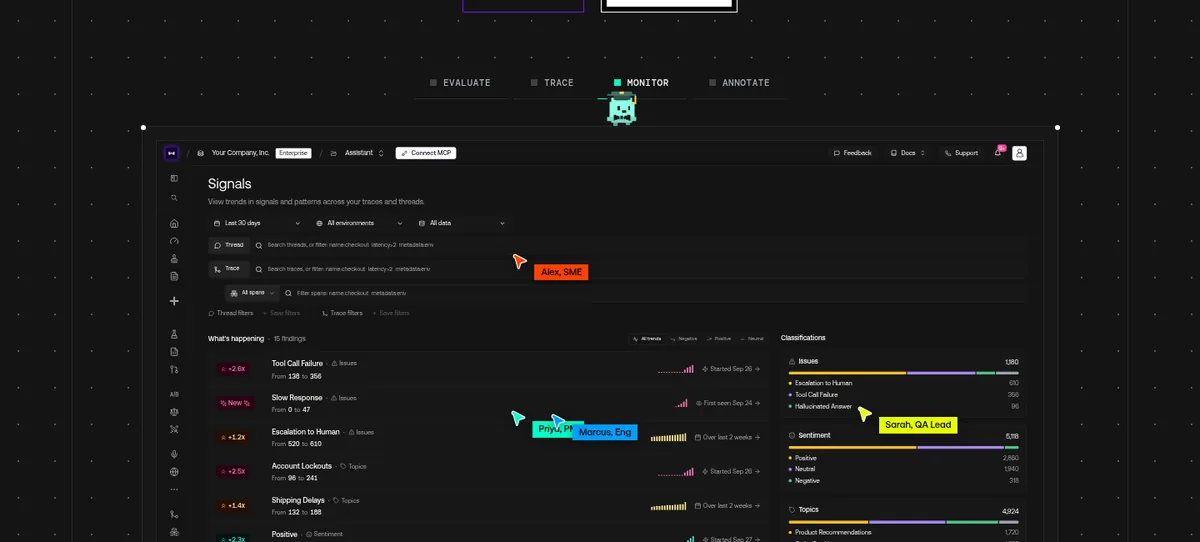
Verdict: DeepEval is the most popular open-source way to write agent evals like unit tests.
DeepEval is an Apache 2.0 evaluation framework that its README describes as similar to Pytest but specialized for LLM apps. It evaluates end-to-end outputs, complete agent trajectories, and individual steps such as tool use and retrieval.
Confident AI, from the same team, is the hosted platform for reports, tracing, and online evals. The repository had about 18,700 GitHub stars in October 2026.
Key features
- More than 30 single-turn and 15 multi-turn metrics, per Confident AI.
- Custom G-Eval metrics written in natural language.
- Online evals, annotation queues, and real-time alerting on paid plans.
Pricing
- DeepEval is free and open source.
- Confident AI Free covers 2 seats, 1 project, and 5 test runs per week.
- Starter costs $200 per month, and Team costs $2,000 per month with SOC 2 and SSO.
Prices come from Confident AI pricing, which bills trace storage at $1 per GB-month above each plan’s allowance.
Pros and cons
Pros
- Evals live in your test suite and CI.
- Unlimited seats from the Starter plan.
Cons
- The jump from free to $200 per month is steep for small teams.
- SOC 2 and SSO start at the $2,000 Team plan.
Promptfoo
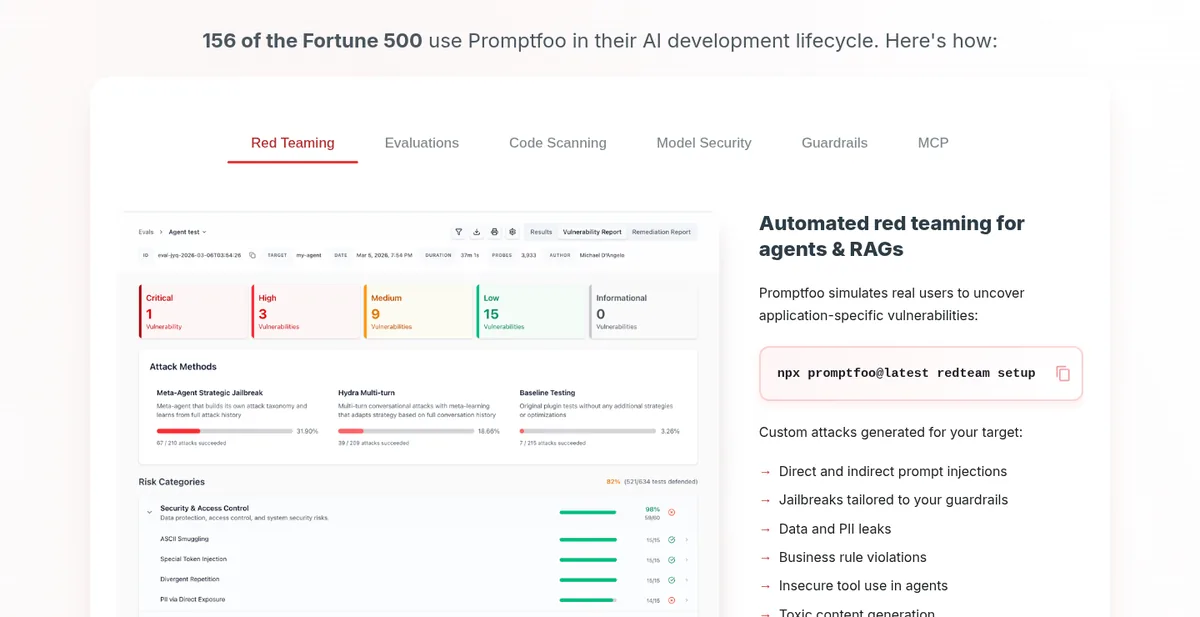
Verdict: Promptfoo is the leading open-source choice for red teaming and security evals of agents.
Promptfoo is an MIT licensed CLI and library for evaluating and red teaming LLM applications, with about 25,900 GitHub stars in October 2026. It agreed to be acquired by OpenAI on March 9, 2026, and says it will remain open source.
Key features
- Automated red teaming for prompt injection, jailbreaks, data leaks, and tool misuse.
- Side-by-side evals of prompts and models in CI.
- Vulnerability scanning in the free Community version.
Pricing
- Community is free, with red teaming up to 10,000 probes per month.
- Enterprise is custom priced and adds continuous monitoring, SSO, and a managed cloud.
- On-Premise is custom priced with full data isolation.
Prices come from Promptfoo pricing.
Pros and cons
Pros
- The broadest free red teaming toolkit in this map.
- Runs locally, so prompts never leave your machine.
Cons
- The roadmap will follow OpenAI’s Frontier platform once the deal closes.
- Production monitoring requires Enterprise.
Layer 4: AI Gateways, Where You Control Models and Spend
An AI gateway sits between your agents and model providers to route requests, apply fallbacks, enforce budgets, and log every call. For AgentOps, the gateway is the cheapest place to measure cost per agent and to stop a looping agent before it burns a budget. See our AI gateways coverage for the wider market.
LiteLLM
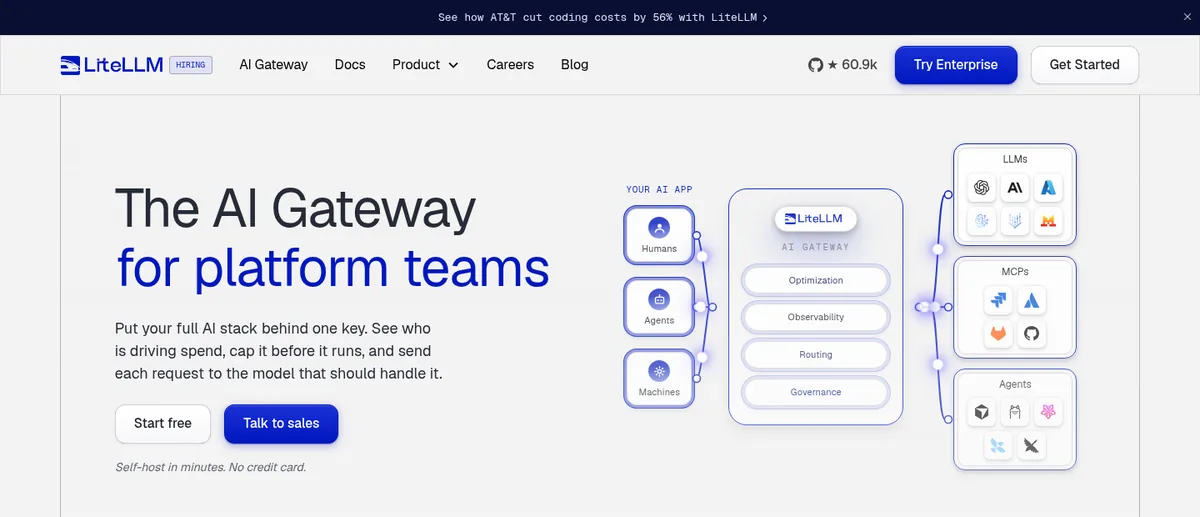
Verdict: LiteLLM is the default self-hosted gateway for platform teams that want one API for every model.
LiteLLM is a Python SDK and self-hosted proxy that calls more than 100 LLMs through the OpenAI format. Its license file puts everything outside the enterprise folder under MIT, and the repository had about 61,000 GitHub stars in October 2026.
Key features
- Virtual keys with budgets and rate limits per key, team, and user.
- Retry, fallback, and load balancing across deployments.
- Callbacks to Langfuse, MLflow, and other tools, plus OpenTelemetry export.
Pricing
- The open-source SDK and proxy are free.
- Enterprise is custom priced and adds SSO, audit logs, and air-gapped deployment.
- A 30-day self-hosted Enterprise trial key is available without a sales call.
Prices and terms come from LiteLLM Enterprise, which lists SOC 2 Type 2 and ISO 27001.
Pros and cons
Pros
- Spend tracking by key, user, team, and tag.
- It runs in your own infrastructure.
Cons
- Two PyPI releases, 1.82.7 and 1.82.8, were backdoored on March 24, 2026. LiteLLM’s advisory says the compromise came through a Trivy dependency in its CI pipeline.
- Enterprise pricing is quote-only.
import litellm

litellm.success_callback = ["langfuse"]
That one line from the LiteLLM docs sends every completion to Langfuse, which ties the route layer to the observe layer.
Cloudflare AI Gateway
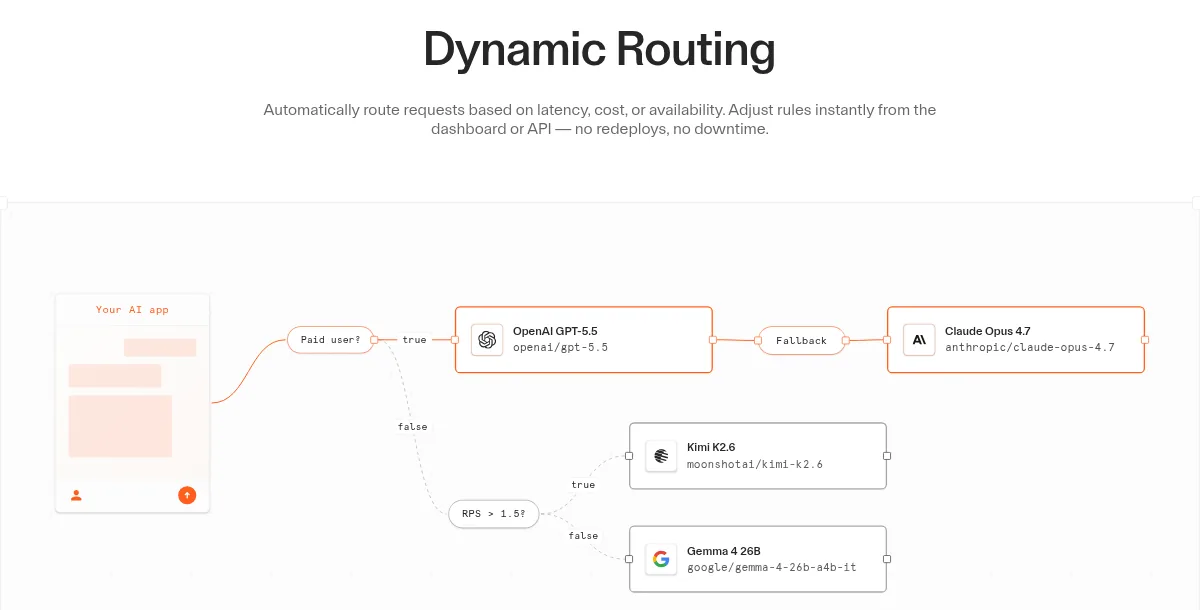
Verdict: Cloudflare AI Gateway is the lowest-effort managed gateway for teams already on Cloudflare.
Cloudflare AI Gateway is a managed proxy that adds analytics, logging, caching, rate limiting, retries, and model fallback with one line of code. It works with Workers AI, OpenAI, Anthropic, Google Gemini, and other providers.
Key features
- Analytics on requests, tokens, and cost.
- Caching and rate limiting at Cloudflare’s edge.
- Dynamic routing, plus guardrails billed as Workers AI inference.
Pricing
- Core features, including analytics, caching, and rate limiting, are free on all plans.
- Gateways created from September 24, 2026 follow Workers Logs pricing for logs.
- Unified Billing adds a 5% fee on purchased credits.
Prices come from Cloudflare AI Gateway pricing.
Pros and cons
Pros
- Free core features with nothing to host.
- DLP scanning is free on all plans.
Cons
- Log pricing changed in September 2026, so check which model applies to your account.
- It is managed only, with no self-hosted option.
Layer 5: Guardrails, the Only Layer That Stops a Bad Action
Guardrails inspect inputs, outputs, and tool calls at runtime and block or rewrite the unsafe ones. Every layer above observes and scores, while this one intervenes, so it belongs on any agent that can touch customer data or take real actions. Our agent security coverage covers threat models in detail.
NeMo Guardrails
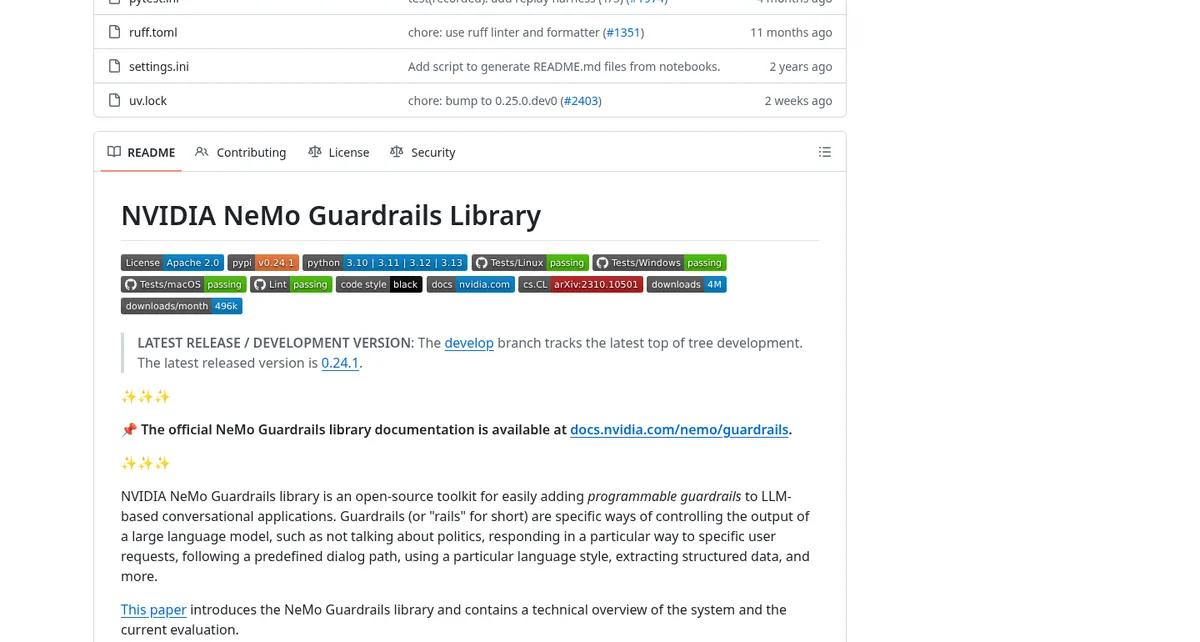
Verdict: NeMo Guardrails is the most complete open-source toolkit for programmable rails around an agent.
NeMo Guardrails is NVIDIA’s Apache 2.0 toolkit for adding programmable guardrails between application code and the LLM. Version 0.24.1 shipped on September 16, 2026.
Key features
- Rails for topic control, jailbreak and prompt injection defense, and fact-checking.
- A Python API or a standalone guardrails server.
- Tracing that uses OpenTelemetry GenAI conventions from version 0.16.0.
Pricing
- NeMo Guardrails is free and open source.
- You pay only for the models and infrastructure that run the rails.
NVIDIA publishes no separate list price for the open-source toolkit.
Pros and cons
Pros
- Guardrail decisions show up as GenAI spans in your existing traces.
- Rails are configured as files you can version and review.
Cons
- Configuration takes real engineering time.
- Each rail can add a model call, so test latency before you ship.
Check Point AI Guardrails (Lakera Guard)
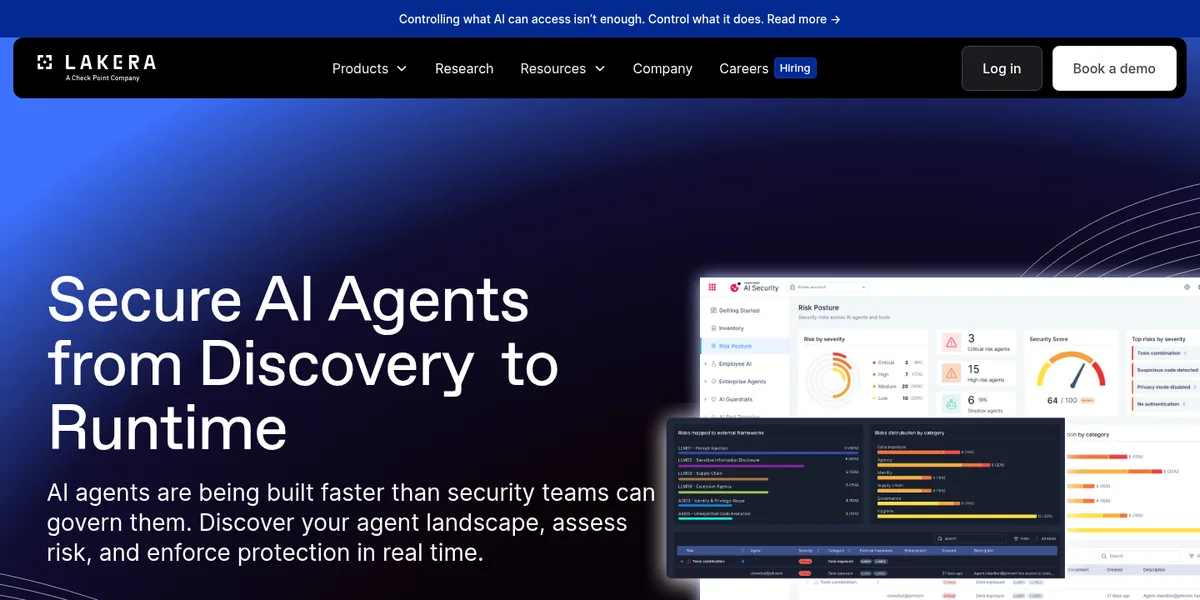
Verdict: Lakera Guard is the simplest managed API for screening agent inputs and outputs in real time.
Lakera built Lakera Guard, and Check Point announced its acquisition of Lakera in September 2025. The current docs call the product Check Point AI Guardrails and describe one API call per interaction.
Key features
- Detection of prompt attacks, PII leakage, content violations, and unknown links.
- Detect mode for monitoring and a blocking mode for enforcement.
- Policies you tune per project.
Pricing
- Community is free with 10,000 requests per month and an 8,000-token prompt limit.
- Enterprise is custom priced and adds self-hosting, SSO, RBAC, and SIEM integration.
- Community data stays in the EU, and Enterprise offers EU or US residency.
Prices come from Lakera Guard pricing.
Pros and cons
Pros
- A single API call protects any model or framework.
- A usable free tier for prototypes.
Cons
- Packaging is moving into Check Point’s product line.
- Self-hosting requires Enterprise.
Two other guardrail options changed status in 2026. Harvey acquired Guardrails AI on September 9, 2026, and the open-source framework remains Apache 2.0 on GitHub, with no public maintenance commitment in the announcement. Datadog AI Guard also offers runtime protection inside a larger observability platform.
The AgentOps Map at a Glance: 13 Tools Compared
The table compares the 13 profiled AgentOps tools on layer, license, self-hosting, OpenTelemetry support, free tier, and paid entry price. Every value comes from the vendor’s pricing page, documentation, or repository as of October 11, 2026, and a cell says not documented when we could not confirm it.
| Tool | Layer | License | Self-host | OpenTelemetry | Free tier | Paid entry | Owner in 2026 |
|---|---|---|---|---|---|---|---|
| OpenLLMetry | Instrument | Apache 2.0 | Yes | Built on it | Yes | Custom (Traceloop Enterprise) | ServiceNow |
| Langfuse | Observe | MIT core | Yes, free | Native ingestion | 50,000 units | $29/mo | ClickHouse |
| LangSmith | Observe | Proprietary | Enterprise only | OTLP endpoint | 5,000 traces | $39/seat/mo | LangChain |
| Arize Phoenix | Observe | Elastic 2.0 | Yes, free | Native, OpenInference | Unlimited self-hosted | $50/mo (AX Pro) | Arize |
| Datadog Agent Observability | Observe | Proprietary | No | Native GenAI conventions | 40,000 LLM spans | $160/mo annual | Datadog |
| AgentOps.ai | Observe | MIT SDK | Enterprise | Not documented | 5,000 events | $40/mo | AgentOps |
| Braintrust | Evaluate | Proprietary | Enterprise | OTLP endpoint | $10 credits | $249/mo | Braintrust |
| DeepEval and Confident AI | Evaluate | Apache 2.0 (DeepEval) | Framework yes; platform Enterprise | Not documented | 2 seats, 5 runs/week | $200/mo | Confident AI |
| Promptfoo | Evaluate | MIT | Yes | Not applicable | 10,000 probes/mo | Custom | OpenAI (announced) |
| LiteLLM | Route | MIT outside enterprise/ | Yes | Export supported | Open source | Custom | BerriAI |
| Cloudflare AI Gateway | Route | Proprietary | No | Not documented | Core features | Usage-based | Cloudflare |
| NeMo Guardrails | Protect | Apache 2.0 | Yes | GenAI spans from 0.16.0 | Open source | None listed | NVIDIA |
| Check Point AI Guardrails | Protect | Proprietary | Enterprise | Not applicable | 10,000 requests/mo | Custom | Check Point |
Only four of the 13 tools publish a self-serve paid entry price of $50 per month or less: Langfuse, LangSmith, Arize AX, and AgentOps.ai. Gateways and guardrails lean on open source or quote-only enterprise contracts.
How to Assemble an AgentOps Stack for Your Team
Pick one tool per layer, starting with instrumentation and observability, then add evals before your first real release and guardrails before any agent touches customer data. Teams that already pay for Datadog or Cloudflare should start there, since an existing contract removes procurement work at two layers.
Startups shipping a first agent
Start with the free stack in the diagram, or swap self-hosted Langfuse for Langfuse Cloud at $29 per month to skip running ClickHouse. Add Promptfoo red teaming before launch, since its Community tier includes 10,000 probes per month.
Platform teams on Datadog
Keep traces in Datadog Agent Observability and route model calls through LiteLLM for per-team budgets. Add DeepEval or Braintrust for dataset evals, because quality alerting in Datadog follows a separate path from cost and latency.
LangGraph teams
LangSmith covers the observe and evaluate layers in one contract. Pair it with a gateway for spend caps and with NeMo Guardrails or Lakera Guard for runtime protection.
Still choosing the framework itself? See our comparison of 12 AI agent frameworks for production.
Regulated enterprises
Favor tools you can self-host or that offer EU and US residency, such as Langfuse, LiteLLM Enterprise, and Check Point AI Guardrails Enterprise. Ask every vendor for its acquisition status and a written data export path before you sign.
Disqualifier: if an agent can send email, move money, or change records, observability alone is not enough. Put a guardrail or a human approval step in front of those tools first.
Routing, budgets, and virtual keys sit one layer below tracing. For that layer, see the 9 best LLM gateways for enterprise AI teams, compared on cost shape and control depth.
If your shortlist is already Portkey, LiteLLM, or OpenRouter, the deeper three-way comparison is Portkey vs LiteLLM vs OpenRouter.
Layer in MCP for tool calling? Our MCP gateways roundup maps enterprise security and scale options next to the AgentOps stack.
MCP is now the default tool interface for many AgentOps stacks. Start with MCP Explained for servers, gateways, and security, then map gateways and observability around it.
For the MCP layer specifically, Kong vs AWS AgentCore vs Docker compares gateway options for teams on Kong Konnect, Amazon Bedrock AgentCore, or local Docker tooling.
On the model-routing side of the stack, LiteLLM alternatives compares eight gateways for teams that need budgets, fallbacks, and provider routing in production.
Frequently Asked Questions About AgentOps Tools
What is AgentOps?
AgentOps is the operating discipline for AI agents in production. It covers instrumenting agents, tracing their runs, evaluating outputs and trajectories, controlling model spend through gateways, and blocking unsafe actions with guardrails. The term also names AgentOps.ai, a tracing product, which this guide treats as one tool in the observe layer.
Is AgentOps the same as LLMOps?
No, AgentOps builds on LLMOps but operates multi-step agents instead of single model calls. An agent plans, calls tools, and takes actions, so AgentOps adds trajectory evals, tool-call tracing, spend caps per agent, and runtime guardrails. LLMOps tools still cover prompts, completions, and token costs inside each step.
What tools do you need for AgentOps?
Most teams need one tool for each of five layers: instrumentation such as OpenLLMetry, observability such as Langfuse or LangSmith, evals such as DeepEval or Braintrust, a gateway such as LiteLLM, and guardrails such as NeMo Guardrails. Some platforms cover two or three layers, which reduces the count.
Is AgentOps.ai open source?
Partly, since the AgentOps.ai Python SDK is MIT licensed on GitHub and its documentation says the app is open source. Hosted plans start free up to 5,000 events, and Pro starts at $40 per month. Its latest SDK release on PyPI was version 0.4.21 from August 2025.
How much does an AgentOps stack cost?
A full stack can cost nothing in licenses when you self-host OpenLLMetry, Langfuse, DeepEval, LiteLLM, and NeMo Guardrails, though you still pay for infrastructure and model calls. Managed options start around $29 per month for Langfuse Core and rise to custom enterprise contracts at the gateway and guardrail layers.
The Bottom Line: Build the Loop One Layer at a Time
Start with OpenTelemetry instrumentation and one observability tool, because every other AgentOps layer reads those traces. Add evals before your first release, a gateway once spend matters, and guardrails before an agent can act on real data. Recheck ownership every quarter, since 2026 moved tools at every layer.
We update this map quarterly, and vendors can send corrections through our contact page. For the deepest comparison in this hub, read our review of the 12 best AI agent observability tools.
Related guides: agent observability, Langfuse vs LangSmith vs Braintrust, Braintrust vs Maxim vs Galileo, 8 Best Open Source LLM Observability Tools You Can Self-Host in 2026, agent evals and testing, AI gateways, AI agent frameworks compared, 8 Best LangSmith Alternatives in 2026, Including Open Source, 10 Best AI Agent Evaluation Tools in 2026, Open Source and Paid, and MCP and agent protocols.
Self-host deep dive: Phoenix vs Langfuse vs Helicone.