

Last updated October 30, 2026. Coverage, agent support, license rules, and list prices were checked against Palo Alto Networks and Cortex docs, Wiz pages, Microsoft Learn, AWS Marketplace, and the Azure Retail Prices API on that date.
In the Prisma AIRS vs Wiz vs Microsoft Defender decision, Wiz is the best default for multicloud AI posture, Microsoft Defender for Cloud is the cheapest fit for Azure-first teams, and Prisma AIRS suits buyers who want posture, red teaming, and runtime blocking from one vendor. All three now discover AI agents, but each one draws the line in a different place.
AI security posture management (AI-SPM) is the practice of finding every model, endpoint, dataset, and agent in your estate and checking each one for risky settings. This comparison sits in our agent security coverage inside the wider AI governance and security hub, and it goes deeper on three platforms that security teams shortlist most often.
We read every vendor page cited here on October 30, 2026, counted the built-in AI checks Microsoft publishes, mapped what each vendor documents across 11 coverage areas, and priced one example estate from public listings. No vendor paid for placement or reviewed this page, per our editorial standards and disclosure policy.
TL;DR
- Wiz documents the widest agent inventory. It names Bedrock, Vertex AI, Azure AI, Copilot Studio, AWS AgentCore, Salesforce Agentforce, and MCP connections, and it fully documented 9 of our 11 coverage areas.
- Microsoft split AI posture across two licenses. Since July 1, 2026, Defender CSPM still finds Foundry projects, but agent discovery and agent posture need Microsoft Agent 365 at $15 per user per month.
- Defender’s AI checks lean on Azure. Its public reference lists 38 AI recommendations: 28 for Azure, 4 for AWS, and 6 for Google Cloud, with all 8 agent checks on Foundry or Bedrock.
- Prisma AIRS joins posture to protection. Posture data comes from a separate Cortex Cloud AI-SPM license, then Prisma AIRS adds red teaming and API Intercept runtime blocking on the same assets.
- List prices differ by a factor of four. Our example estate costs $29,196 a year on Defender plus Agent 365, $72,000 to $114,000 on public Wiz tiers, and a private quote on Prisma AIRS.
Prisma AIRS vs Wiz vs Microsoft Defender: Quick Verdict
Choose Wiz when your AI runs across several clouds and SaaS agent builders, Microsoft Defender when most of it runs on Azure and Microsoft 365, and Prisma AIRS when you want the posture finding and the runtime block in one console. The picks below weigh coverage first, then agent depth, then published cost.
- Wiz AI-SPM: best overall for multicloud teams, with agentless AI-BOM, an Agent Inventory View, MCP connections, and attack paths on one Security Graph.
- Microsoft Defender for Cloud: best value for Azure-first estates, since AI posture rides inside Defender CSPM and agent posture adds a per-user Agent 365 license.
- Prisma AIRS: best for full lifecycle AI security, with Cortex AI-SPM posture data next to model scanning, red teaming, and API Intercept runtime protection.
Prisma AIRS, Wiz, and Microsoft Defender at a Glance
The three platforms reach AI posture from different starting points: Wiz from cloud security, Microsoft from its own cloud and identity stack, and Palo Alto Networks from network and runtime security. That origin still shapes what each finds first and what it charges for. The table sums up each one from vendor pages checked on October 30, 2026.
| Platform | Where posture lives | Agent discovery | Runtime protection | Public list price |
|---|---|---|---|---|
| Prisma AIRS | Cortex Cloud AI-SPM, shown in Prisma AIRS AI Inventory | Bedrock agents with runtime logs, Azure Foundry agents by config | API Intercept and AI gateway | Quote; $4,353 runtime API unit |
| Wiz AI-SPM | Wiz Cloud, part of Google since March 2026 | Agent Inventory View across clouds, AI studios, and custom agents | Wiz Sensor runtime monitoring | $24,000 per 100 workloads a year |
| Microsoft Defender for Cloud | Defender CSPM plan | Agent 365 license since July 1, 2026 | Defender for AI Services plan | $0.007 per resource hour plus $15 per user |
Verdict: Wiz gives the broadest single inventory, Microsoft gives the lowest published entry price, and Prisma AIRS gives the tightest link between a posture finding and a runtime block. Pick the platform whose starting point matches where your team already works.
What Our Documentation Audit Found
Our audit found that Wiz fully documents 9 of 11 AI posture coverage areas, Microsoft documents 8 of 11 when Agent 365 is counted, and Prisma AIRS documents 6 of 11, with several partial entries for SaaS agents, endpoints, and attack paths. Documentation is what a buyer can verify before a pilot, so we scored only what each vendor publishes.
On October 30, 2026 we saved the text of 16 vendor pages, then ran a small script against them. It counted the AI recommendations in Microsoft’s reference table for AI security recommendations, listed the services in the Cortex Cloud AI Security supported services page, and checked which platforms the Wiz posts name.
$ python audit_docs.py   # October 30, 2026, saved vendor page text
defender Azure  recs 28  agent 6  mcp 2  high 5
defender AWS    recs  4  agent 2  mcp 0  high 0
defender GCP    recs  6  agent 0  mcp 0  high 0
defender total 38
cortex ai-spm services 7 + self-managed models + SaaS AI agents
airs agent discovery: bedrock runtime logs True | azure static only True
wiz names Copilot Studio, Agentcore, Agentforce, MCP, Cursor: True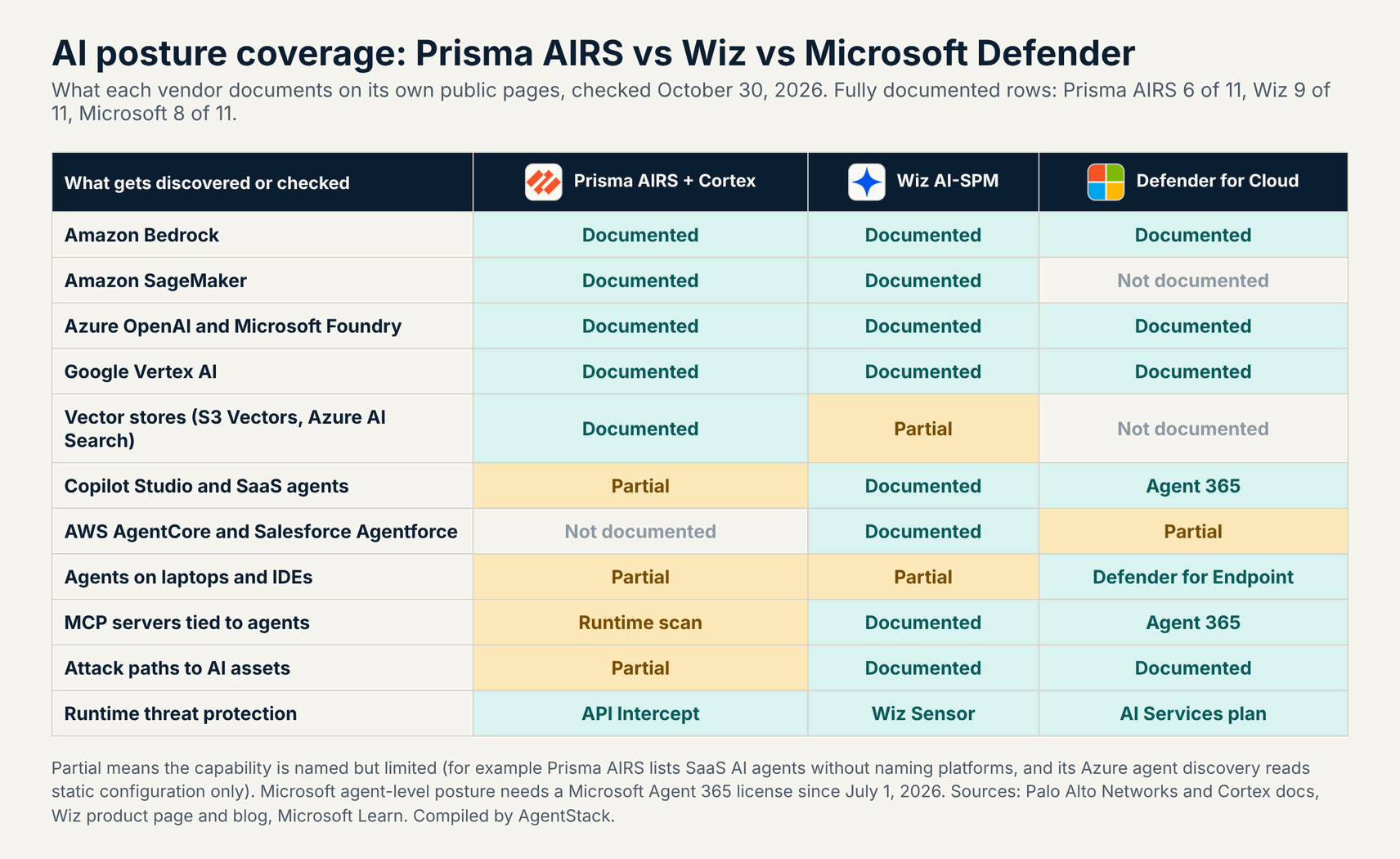
All three cover the big managed services: Amazon Bedrock, Azure OpenAI and Microsoft Foundry, and Google Vertex AI. The gaps show up at the edges. Microsoft’s AI posture overview does not list Amazon SageMaker, Prisma AIRS does not name AWS AgentCore or Salesforce Agentforce, and Wiz is the only one of the three that names both.
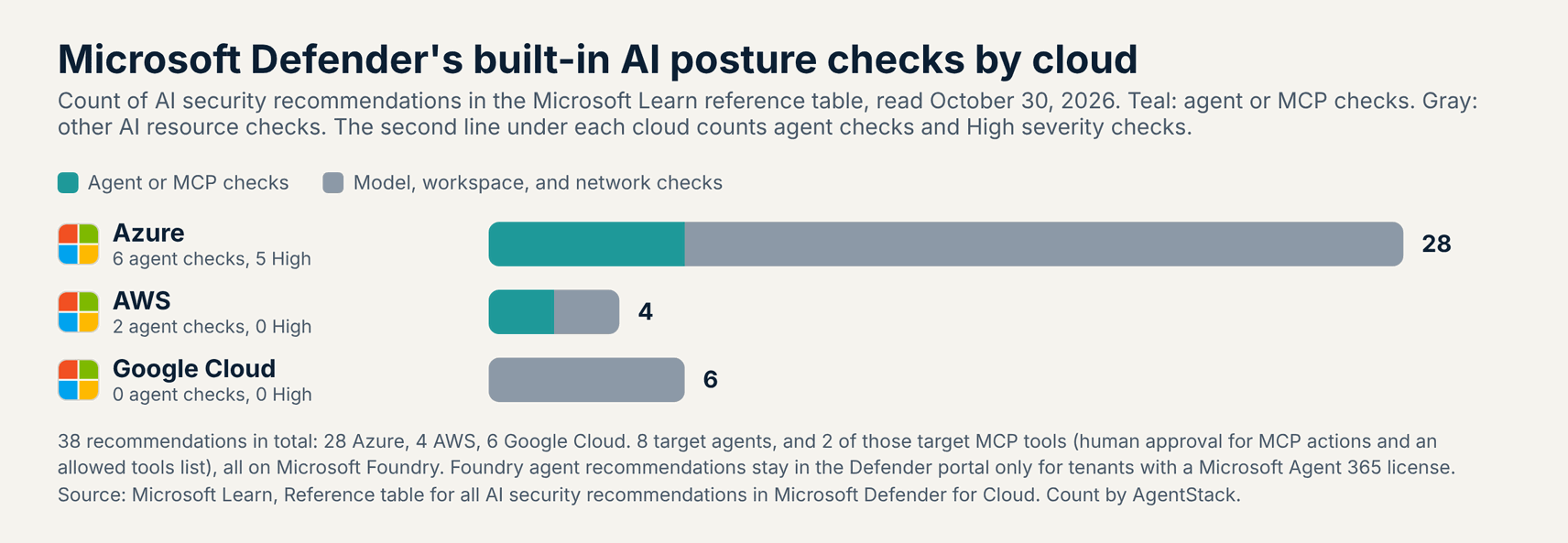
Microsoft’s list shows where its depth sits. Of 38 AI recommendations, 28 cover Azure resources, and 5 of those are rated High; AWS gets 4 and Google Cloud gets 6, none rated High. The 8 agent checks cover Foundry and Bedrock agents only, and the 2 MCP checks ask Foundry agents to require human approval for MCP actions and to set an allowed tools list.
What this means for buyers: ask each vendor for the list of AI rules it runs on your second and third clouds, since that is where coverage thins out. A platform that is deep on one cloud and shallow on the others can still leave most of your AI estate unchecked.
Prisma AIRS: Best for Full Lifecycle AI Security
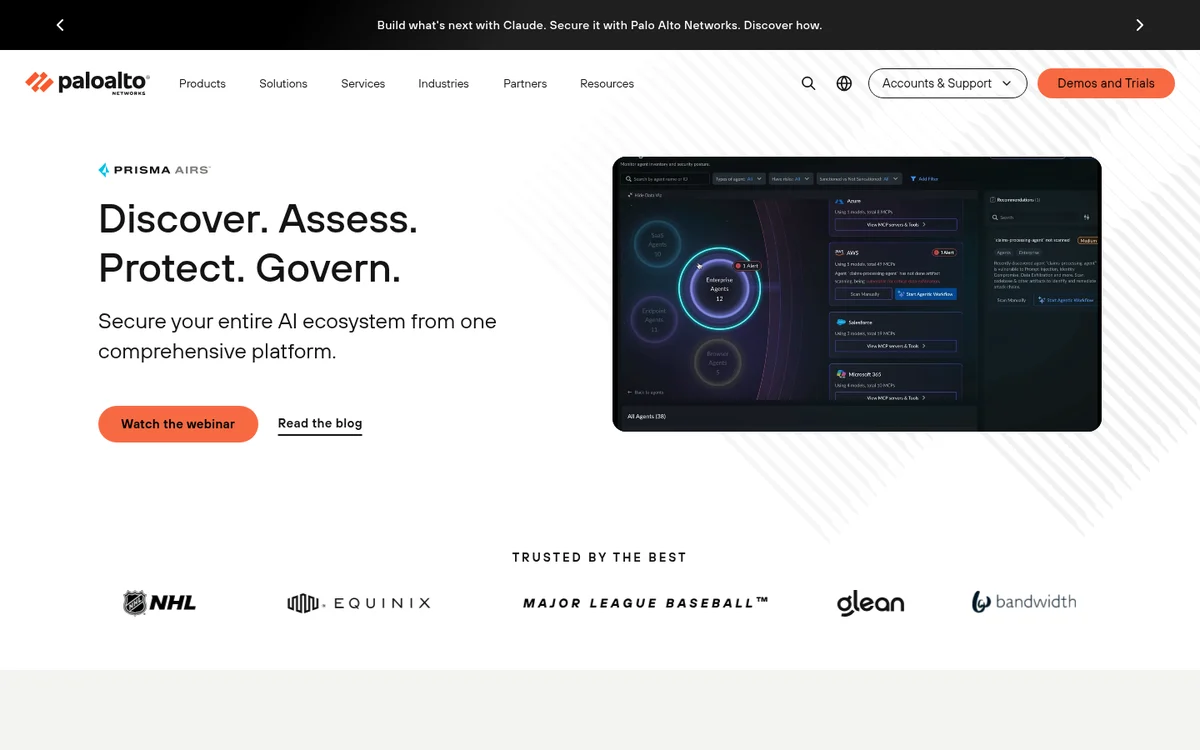
Prisma AIRS is the right pick when you want an AI posture finding and the control that fixes it in the same console, because Palo Alto Networks sells posture, red teaming, model scanning, and runtime blocking under one platform. The Prisma AIRS page groups an AI gateway, supply chain security, red teaming, runtime security, posture management, agent identity, and agentic endpoint security. For a wider model and agent security shortlist, see our Protect AI alternatives guide.
Posture itself comes from Cortex. The Prisma AIRS posture management docs say models, agents, endpoints, and training datasets show issues sourced from Cortex Cloud AI-SPM, rated Critical to Low and mapped to the OWASP Top 10 for LLMs. That data needs an active Cortex Cloud AI-SPM license connected to the Prisma AIRS tenant.
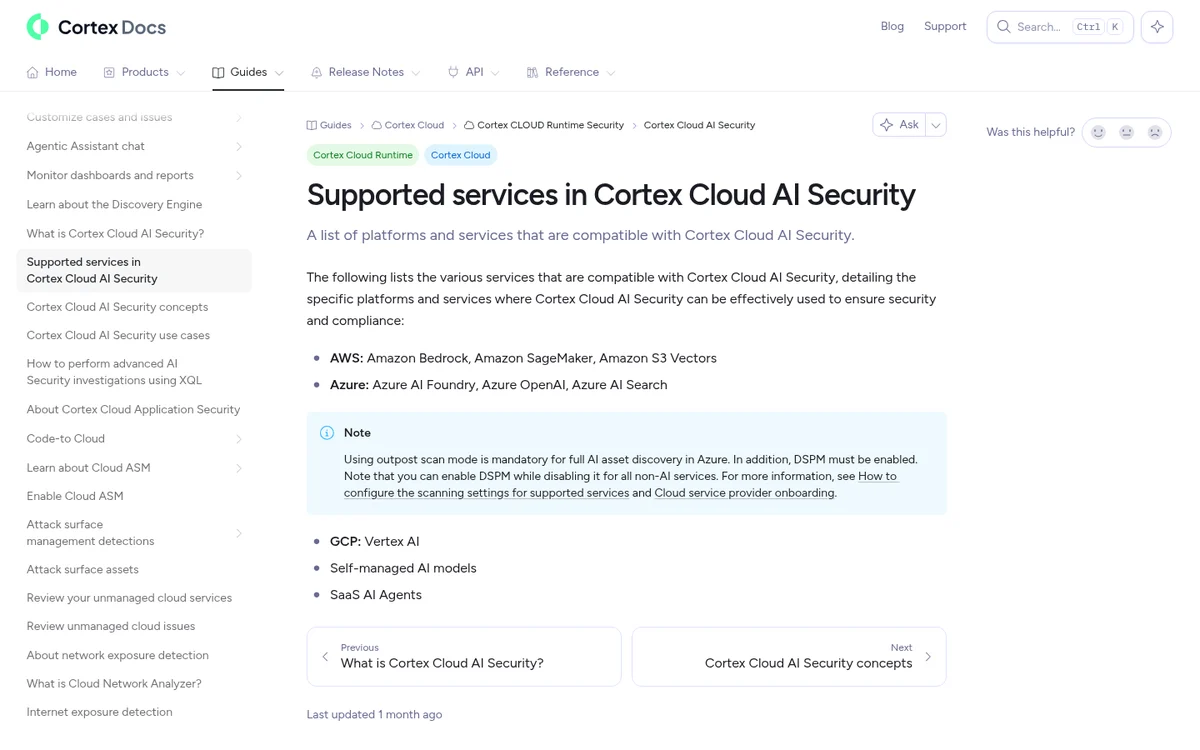
The supported services list names Amazon Bedrock, SageMaker, and S3 Vectors, Azure AI Foundry, Azure OpenAI, and Azure AI Search, and Google Vertex AI, plus self-managed models and SaaS AI agents. Azure needs outpost scan mode and DSPM turned on for full AI asset discovery.
- Best for: Palo Alto Networks customers that want posture findings tied to red teaming and runtime blocking on the same assets.
- Coverage: Bedrock, SageMaker, S3 Vectors, Azure AI Foundry, Azure OpenAI, Azure AI Search, Vertex AI, self-managed models, and SaaS AI agents.
- Pricing (October 2026): Posture is quoted. The Prisma AIRS API listing shows $4,353 for a 12-month unit of runtime API calls, without stating the call volume.
- Watch out for: Posture needs a second Cortex license, and Azure agents are discovered by configuration only, without runtime links.
Wiz AI-SPM: Best for Multicloud and SaaS Agent Inventory
Wiz AI-SPM is the strongest default for teams running AI across several clouds, because its agentless AI-BOM, agent inventory, and attack paths sit on the same Security Graph that already maps the rest of their cloud risk. Google completed its purchase of Wiz on March 11, 2026, and Wiz kept its brand and its multicloud support.
The Wiz post on securing AI agents describes an Agent Inventory View that maps each agent to its models, tools, MCP technology, and training or knowledge base data. It adds guardrail checks such as confirming that Bedrock Guardrails are on for input and output, DSPM for AI pipelines, and built-in OWASP LLM policies.
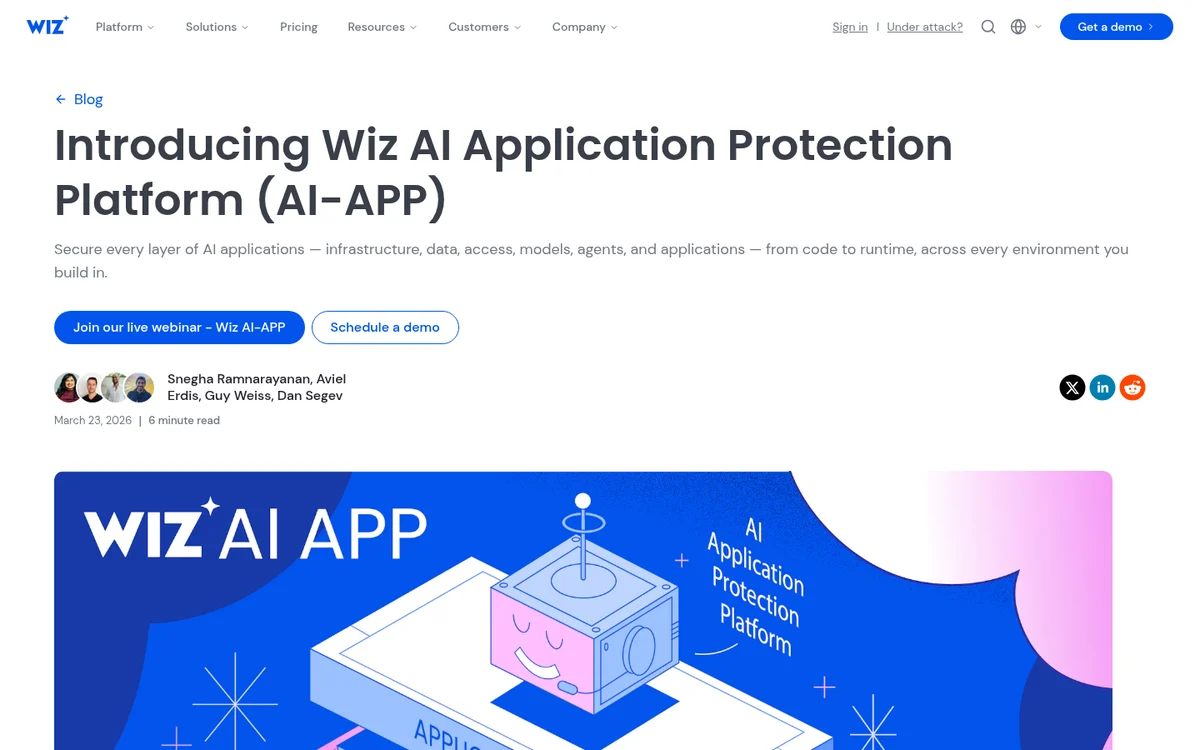
In March 2026 Wiz folded this into its AI Application Protection Platform, which inventories managed platforms, SaaS tools such as Copilot Studio, and custom agents found through code and workload analysis. Its April 2026 update added AWS AgentCore, Gemini Enterprise Agent Platform, Salesforce Agentforce, and IDE extensions such as Cursor and GitHub Copilot to the AI-BOM.
- Best for: Multicloud security teams that already run Wiz and want AI agents, MCP connections, and data paths in the same risk queue.
- Coverage: Bedrock, SageMaker, Vertex AI, Azure AI, OpenAI, Copilot Studio, AWS AgentCore, Agentforce, Databricks, custom agents, and IDE extensions.
- Pricing (October 2026): Quote based. The AWS Marketplace listing shows the Wiz entry tier at $24,000 and Wiz Advanced at $38,000 per 100 cloud workloads a year.
- Watch out for: Laptop agents show up through IDE extension inventory and the Wiz Sensor, which is a paid extension of Wiz Advanced.
Microsoft Defender for Cloud: Best for Azure-First AI Estates
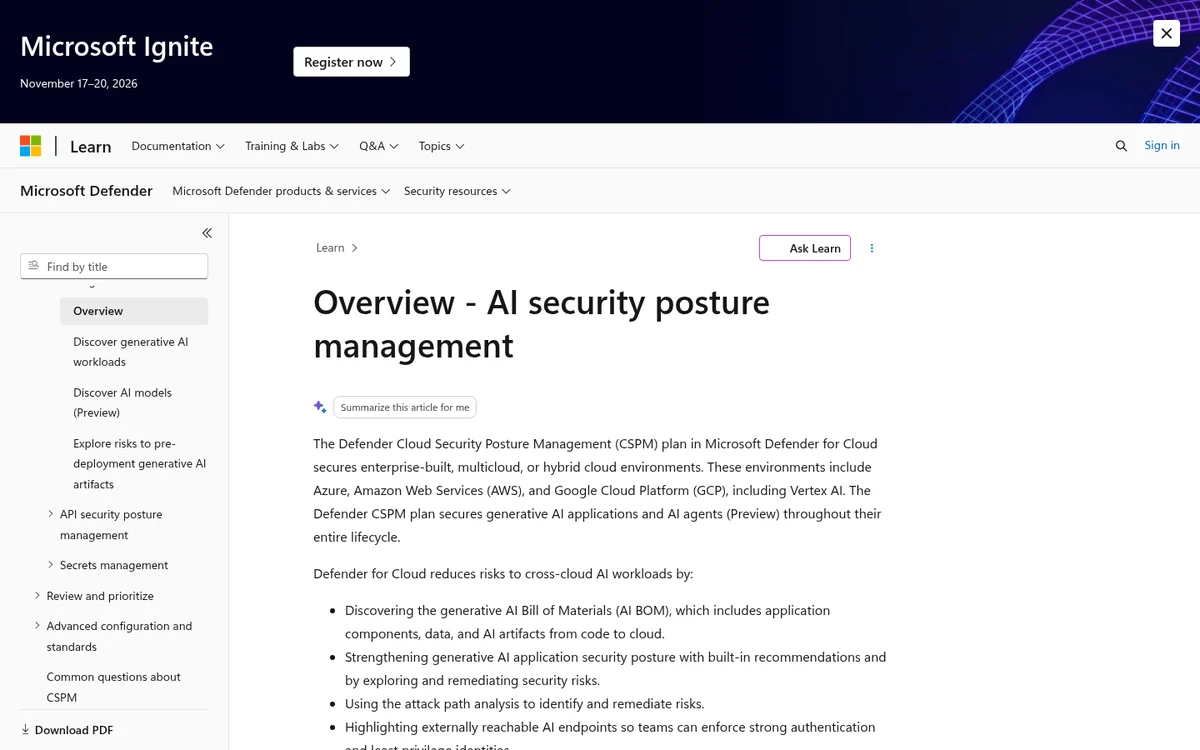
Defender for Cloud is the cheapest way into AI posture for Azure-heavy teams, because AI checks come inside the Defender CSPM plan they may already pay for. The Microsoft Learn overview lists Azure OpenAI, Azure AI Foundry, Azure Machine Learning, Amazon Bedrock, and Google Vertex AI.
Defender runs attack path analysis on AI workloads and issues identity, data, and internet exposure recommendations. Its built-in rules go furthest on Foundry, with checks for content filtering, Entra ID connections, jailbreak guardrails, and MCP tool allow lists.
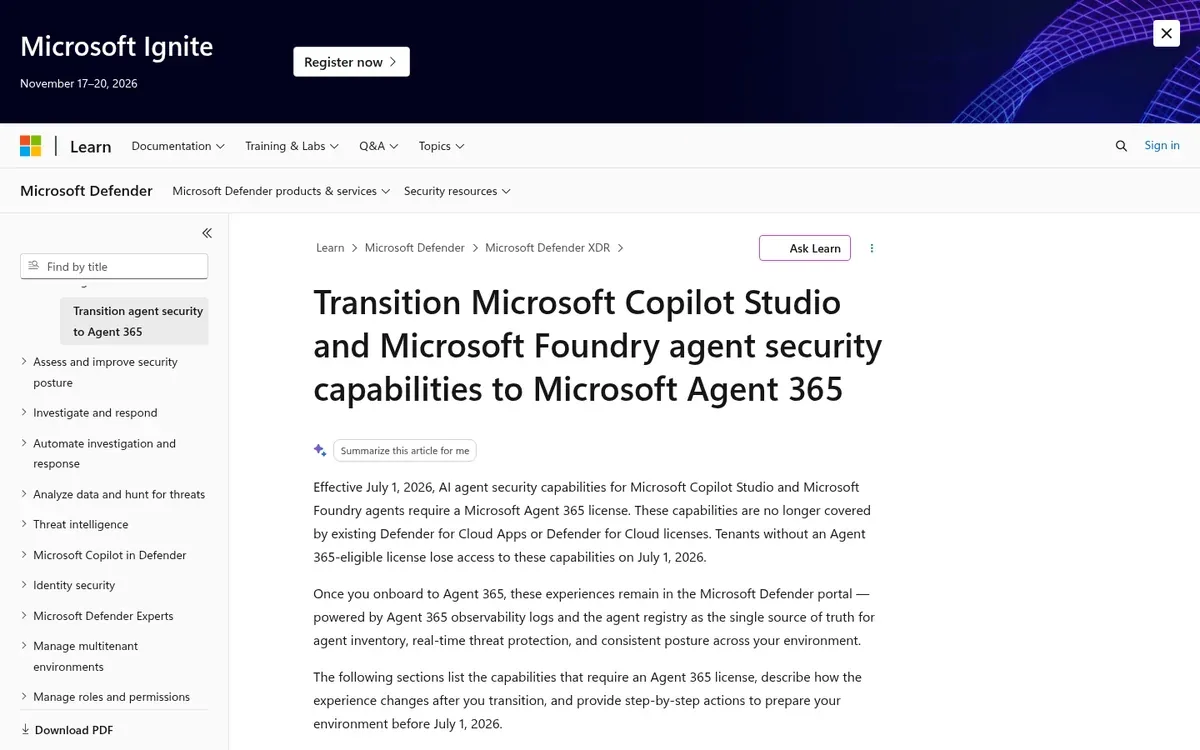
Agent coverage changed this year. Microsoft’s transition notice says that from July 1, 2026, discovery, posture, and threat detection for Foundry agents and Copilot Studio agents need a Microsoft Agent 365 license, and third-party cloud agents moved to Agent 365 registry sync. Defender CSPM still finds Foundry accounts and projects.
- Best for: Azure-first teams already on Defender for Cloud that also run some AI on AWS or Google Cloud.
- Coverage: Azure OpenAI, Azure AI Foundry, Azure Machine Learning, Amazon Bedrock, and Vertex AI, plus Copilot Studio, Foundry, and local agents through Agent 365.
- Pricing (October 2026): Defender CSPM is $0.007 per billable resource per hour in the Azure Retail Prices API, and Agent 365 is $15 per user per month, paid yearly.
- Watch out for: Agent posture now sits behind Agent 365, and AWS and Google Cloud get far fewer built-in AI checks than Azure.
How Each Platform Handles AI Agents and MCP Servers
Wiz and Microsoft both put MCP servers in their agent views, while Prisma AIRS inventories agent configurations on Bedrock and Azure and handles MCP traffic at runtime through its scan API and gateway. Agent support matters more each quarter, as our report on Microsoft Dynamic Agent Risk shows.
Prisma AIRS agent discovery
The Agent Discovery docs cover Bedrock agents, with each version treated as its own asset and runtime links parsed from activity logs, and Azure Foundry agents and OpenAI assistants by static configuration only. Only optimized Bedrock models are supported, and an agent shows as protected about 10 minutes after its first call through API Intercept.
Wiz agent inventory
Wiz builds its agent view without deploying agents, then links each AI agent to the identities, workloads, and data it can reach. Its dynamic scanner validates exposed AI endpoints, and runtime monitoring watches for rogue agents or suspicious DNS traffic from AI workloads.
Microsoft Defender agent inventory
The Defender portal’s AI agents page lists Copilot Studio, Foundry, Microsoft 365, and supported third-party agents, plus local agents found by Defender for Endpoint. Each agent page shows risk level, tools, identities, and MCP servers, and the AgentsInfo table, which replaced AIAgentsInfo, supports Advanced Hunting queries.
What this means for buyers: if your agents call MCP servers, pair any of the three with the controls in our MCP security tools guide, and treat each agent’s credentials as you would any non-human identity.
Prisma AIRS vs Wiz vs Microsoft Defender Pricing
Microsoft is the only one of the three with fully public AI posture pricing, Wiz publishes base tiers on AWS Marketplace, and Prisma AIRS sells posture through private quotes. The units also differ: Defender bills billable resources and users, Wiz bills workloads, and Prisma AIRS bills runtime API calls.
| Platform | Posture price | Agent add-on | Runtime protection price |
|---|---|---|---|
| Prisma AIRS | Cortex Cloud AI-SPM, quote only | Included in Prisma AIRS AI Inventory | $4,353 per 12-month API call unit |
| Wiz AI-SPM | $24,000 entry tier or $38,000 Advanced per 100 workloads | Inside Wiz Cloud tiers | Wiz Sensor $28,000 per 100 sensors |
| Microsoft Defender for Cloud | $0.007 per billable resource hour | Agent 365 at $15 per user per month | $0.0008 per 1,000 tokens |
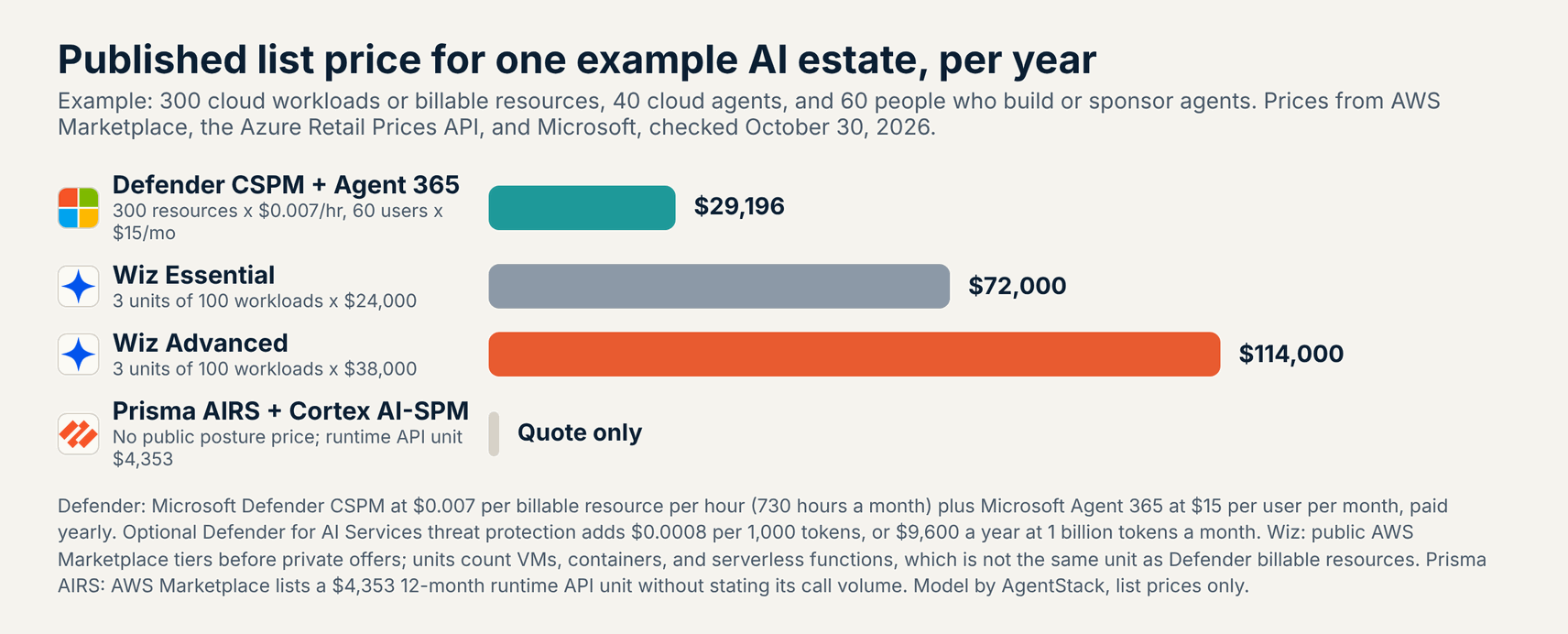
For our example estate of 300 cloud workloads, 40 cloud agents, and 60 people who build or sponsor agents, Defender CSPM costs $18,396 a year and Agent 365 adds $10,800. Three Wiz units cost $72,000 on the entry tier or $114,000 on Advanced before any private offer. Wiz and Defender count different things, so treat the gap as a direction for your quote.
Verdict: Microsoft wins on published price for Azure-first estates, and its cost grows with headcount once Agent 365 enters the bill. Wiz costs more on paper and covers more clouds per unit, while Prisma AIRS needs a quote before you can compare it.
Limits and Prerequisites to Check Before You Buy
Each platform has a prerequisite that changes the real scope of AI posture: a second Cortex license for Prisma AIRS, a higher tier or sensor add-on for Wiz runtime, and Agent 365 for Microsoft agent posture. Ask about these in the first call, before pricing.
| Platform | License prerequisite | Documented limits | Ask the vendor |
|---|---|---|---|
| Prisma AIRS | Active Cortex Cloud AI-SPM license connected to the tenant | Azure agents by config only; optimized Bedrock models only | What the posture license costs on top |
| Wiz AI-SPM | Wiz Cloud tier; Wiz Sensor for runtime extends Advanced | Laptop agents through IDE extension inventory | Which AI rules run on each cloud |
| Microsoft Defender for Cloud | Defender CSPM; Agent 365 for agent posture | 4 AWS and 6 Google Cloud AI checks | How many users need Agent 365 seats |
Verdict: None of the limits rules a platform out, but each one moves the real price or the real coverage. Get the prerequisite in writing with the quote, and test it on your second cloud during the pilot.
Which One Should You Choose?
Match the platform to where your AI runs and which security stack you already pay for, since all three work best when they extend a console your team uses daily. The table maps common situations to a first pick and a fallback.
| Your situation | First pick | Fallback |
|---|---|---|
| AI on AWS, Azure, and Google Cloud | Wiz AI-SPM | Prisma AIRS |
| Mostly Azure and Microsoft 365 agents | Microsoft Defender for Cloud | Wiz AI-SPM |
| Already on Palo Alto Networks firewalls or Cortex | Prisma AIRS | Wiz AI-SPM |
| Agents in Agentforce, AgentCore, or Copilot Studio | Wiz AI-SPM | Microsoft Defender with Agent 365 |
| Need runtime blocking tied to posture | Prisma AIRS | Microsoft Defender for AI Services |
| Tight budget, small Azure footprint | Microsoft Defender for Cloud | Wiz entry tier |
Verdict: Wiz is the safest pick for spread-out estates, Microsoft for Azure shops watching cost, and Prisma AIRS for teams that want one vendor from posture to runtime. Many large teams end up running one of these with a separate agent-focused tool.
You run a multicloud platform team
- Shortlist Wiz first and ask for the AI rule list on each of your clouds.
- Ask Prisma AIRS to show a posture issue and its runtime fix on the same asset.
- Price Wiz Advanced if you need runtime monitoring through the Wiz Sensor.
You run an Azure-first security team
- Turn on Defender CSPM and review the 28 Azure AI recommendations before you buy anything else.
- Count the people who build or sponsor agents to size the Agent 365 bill.
- Add Defender for AI Services if you need prompt-level threat alerts on Foundry models.
You run a Palo Alto Networks shop
- Confirm your Cortex Cloud license includes AI-SPM and is connected to your Prisma AIRS tenant.
- Route agent traffic through API Intercept or the AI gateway so discovered agents move to protected.
- Compare runtime results with our AI guardrails tools roundup and the Lakera vs HiddenLayer vs Mindgard test.
When an AI-SPM Platform Is Not Enough
An AI-SPM platform is not enough on its own when agents run outside your cloud accounts, hold broad credentials, or take high-impact actions, because posture checks settings and cannot stop a live attack. Treat posture as the map, then add controls for the paths it shows.
- SaaS and desktop agents: agent-first tools in our Zenity vs Noma vs Pillar Security comparison reach places a cloud scanner does not.
- Agent credentials: scope tokens and service accounts with the non-human identity tools we reviewed.
- MCP traffic: put an MCP gateway or LLM gateway in front of tools and models so policy applies at runtime.
- High-risk actions: add approvals and incident plans from the NIST, NSA, and CISA practices, and test them with AI agent testing tools.
- Governance programs: map posture findings to policy with our AI agent governance platforms guide and governance and compliance coverage.
Frequently Asked Questions
Is Wiz or Prisma AIRS better for AI security posture management?
Wiz is better for broad multicloud inventory, since it documents agents across Bedrock, Vertex AI, Azure AI, Copilot Studio, AgentCore, and Agentforce on one Security Graph. Prisma AIRS is better when you want posture findings linked to red teaming and runtime blocking, though its posture data needs a separate Cortex Cloud AI-SPM license.
Does Microsoft Defender for Cloud still discover AI agents?
Yes, with a license change. Since July 1, 2026, discovery, posture, and threat detection for Foundry and Copilot Studio agents need a Microsoft Agent 365 license at $15 per user per month. Defender CSPM still discovers Foundry accounts and projects, and third-party cloud agents now come in through Agent 365 registry sync.
Which AI-SPM platform covers MCP servers?
Wiz and Microsoft both list MCP servers in their agent views, and Microsoft adds two Foundry checks for MCP tool approval and allowed tool lists. Prisma AIRS handles MCP at runtime through its scan API and AI gateway. Pair any of them with an MCP gateway if agents call external tools.
How much does Prisma AIRS cost compared with Wiz and Defender?
Prisma AIRS posture is quote only, and its AWS Marketplace runtime API unit lists at $4,353 a year. Wiz lists $24,000 or $38,000 per 100 cloud workloads a year. Defender CSPM costs $0.007 per billable resource per hour, and Agent 365 adds $15 per user per month for agent posture.
Can I run Wiz and Microsoft Defender for Cloud together?
Yes, and many Azure customers do. A common split keeps Defender CSPM and Agent 365 for Foundry and Microsoft 365 agents, then uses Wiz for AWS, Google Cloud, and SaaS AI studios. Agree on one place for tickets and severity first, or the same AI finding can land in two queues.
Related Guides
For related coverage, see our AI firewalls roundup.
For the wider market beyond these three, our AI-SPM tools guide compares 8 AI security posture management platforms, including Noma, Orca and Snyk, with published prices and an open source AI-BOM test.
Keep going with the agent security hub, the AI governance and security hub, our AI agent security tools roundup, the AI agent governance guide, AI agent governance platforms, and Zenity vs Noma vs Pillar Security. Each one goes deeper on a control that sits next to AI posture management, from agent-first scanners to governance programs.
More context sits in MCP security tools, AI guardrails tools, non-human identity tools, the Microsoft Dynamic Agent Risk report, and the NIST and CISA incident response practices.
The Bottom Line
Pick Wiz for multicloud AI posture, Microsoft Defender for Cloud for Azure-first estates on a budget, and Prisma AIRS when you want posture, red teaming, and runtime blocking from one vendor. Prisma AIRS vs Wiz vs Microsoft Defender comes down to where your AI runs today and which console your team already trusts.
License rules and agent coverage changed several times this year, so recheck the linked docs before you sign and run each finalist against your own accounts. Send corrections or your own test results through our contact page.