
Last updated October 25, 2026. Deployment modes, size limits, MCP coverage, and pricing were checked against each vendor’s docs and product pages on that date.
The best AI firewall for most agent teams is one that can inspect tool results as well as user prompts: Prisma AIRS for broad network and API coverage, Check Point AI Agent Security for a scan API that reads tool responses, and Cisco AI Defense for a gateway plus an MCP-aware SDK. Edge products from Cloudflare, Akamai, and Radware still fit public chat apps where the user prompt is the main risk.
An AI firewall is a policy layer that inspects text going into and out of a large language model and blocks, redacts, or logs prompt injection, jailbreaks, and data leaks. This roundup is part of our agent security coverage inside the wider AI governance and security hub, and it ranks eight commercial AI firewalls by where they sit in an agent’s traffic.
We read every vendor doc, product page, and announcement cited here on October 25, 2026, and we ran our own hop test to see which placement can see an injection hidden in a tool result. No vendor paid for placement or reviewed this page, per our editorial standards and disclosure policy.
TL;DR
- Placement decides coverage. In our 12-run hop test, an edge firewall in front of the app saw 0 of 12 poisoned tool results, while an egress proxy and a tool boundary scan saw all 12.
- Egress proxies rescan the same attack. Every tool result is re-sent on later model calls, so one injection showed up in 24 request bodies at the egress hop.
- Prisma AIRS covers the most ground. It offers network intercept, a scan API with a 2 MB sync limit, and documented MCP tool definition, input, and output scanning.
- Check Point and Cisco suit builders. Check Point’s Guard API screens tool responses and tool descriptions, and Cisco’s SDK inspects MCP JSON-RPC messages in API or gateway mode.
- Edge firewalls protect chat endpoints. Cloudflare inspects JSON requests to endpoints labeled cf-llm, so it never sees what your agent pulls from tools after the request.
The Best AI Firewalls in 2026: Quick Verdict
Pick an AI firewall by placement first: tool boundary or egress for agents that read untrusted content, and edge for public chat endpoints where the user prompt carries the risk. The ranking below weighs agent coverage most, then deployment flexibility and documentation depth.
- Prisma AIRS: best overall for enterprises that want network intercept, a scan API, and MCP threat detection under one license.
- Check Point AI Agent Security: best scan API for builders, with tool response and tool description screening and a self-hosted option.
- Cisco AI Defense: best for teams that want gateway or API mode plus an SDK that patches LLM and MCP clients.
- F5 AI Guardrails: best self-hosted inline proxy, on EKS, AKS, GKE, or OpenShift.
- Zscaler AI Guard: best for Zscaler customers that want a proxy for public LLMs and a detection API for private ones.
- Cloudflare AI Security for Apps: best edge firewall for public LLM chat endpoints already on Cloudflare.
- Akamai Firewall for AI: best for Akamai customers that want edge rules plus an API mode.
- Radware LLM Firewall: best add-on for teams already on Radware Cloud Application Protection Services.
AI Firewalls Compared at a Glance
The eight AI firewalls split into three placement groups: edge reverse proxies, LLM egress proxies, and scan APIs you call at the tool boundary. Several vendors offer more than one mode, which matters once your agent starts calling tools. The table summarizes each product from the pages we opened on October 25, 2026.
| AI firewall | Placement | Agent tool coverage | Deployment | Best for |
|---|---|---|---|---|
| Prisma AIRS | Network intercept and scan API | MCP tool definitions, inputs, outputs | VM firewall or API | Palo Alto Networks shops |
| Check Point AI Agent Security | Scan API, called from app or gateway | Tool calls, tool responses, tool descriptions | SaaS or self-hosted | Builders who want an API |
| Cisco AI Defense | Gateway, Multicloud Defense, or Inspection API | MCP JSON-RPC inspection in SDK | SaaS with regional endpoints | Cisco security customers |
| F5 AI Guardrails | Inline proxy or API | Tool calls and MCP tool lists via extractors | SaaS, EKS, AKS, GKE, OpenShift | Self-hosted inline control |
| Zscaler AI Guard | Proxy or detection API | Prompts and responses you send | SaaS | Zscaler customers |
| Cloudflare AI Security for Apps | Edge, in front of your app | Incoming JSON requests only | Cloudflare WAF | Public chat endpoints |
| Akamai Firewall for AI | Edge or API mode | Prompts and responses; MCP not documented | Akamai WAF or API | Akamai customers |
| Radware LLM Firewall | Inline, before the LLM | Prompt level; tools not documented | Cloud WAF add-on | Radware customers |
Verdict: Prisma AIRS, Check Point, Cisco, and F5 document coverage of agent tool traffic. Zscaler covers it if your code sends tool text to its API, and the three edge products protect the request your user sends, not the content your agent fetches.
What Our Firewall Placement Test Found
In our hop test, an AI firewall at the edge saw none of the 12 injections we hid in tool results, an LLM egress proxy saw all 12 across 24 request bodies, and a tool boundary scan saw each one exactly once. Placement, not detection quality, decided whether a firewall had any chance to stop the attack.
We built a small agent loop on October 25, 2026 with three logging proxies: one between the user and the app (edge), one between the app and the model API (egress), and one between the app and an MCP-style tool server (tool boundary). The model was a scripted stand-in that alternated OpenAI Chat Completions and Anthropic Messages wire formats, so we measured visibility, not any vendor’s detection accuracy.
Each of 12 runs made three tool calls that returned real public data fetched that day: GitHub issue lists, PyPI package metadata, Hacker News search results, and encyclopedia text. In one randomly chosen tool result per run, we appended a hidden instruction carrying a distinct canary string, then counted where that string appeared.
$ python hoptest.py && python analyze.py   # October 25, 2026, 12 runs
edge    (user -> app)     12 requests   2,068 bytes    canary seen 0
egress  (app -> model)    48 requests   1,787,949 bytes canary seen 24 (12 of 12 runs)
tool    (app -> MCP)      36 calls      814,718 response bytes, canary seen 12 (once each)
tool response content type: text/event-stream
tool output share of all text: 99.77%
egress bytes / tool bytes: 2.19x | median model request 32,981 B | max 138,305 B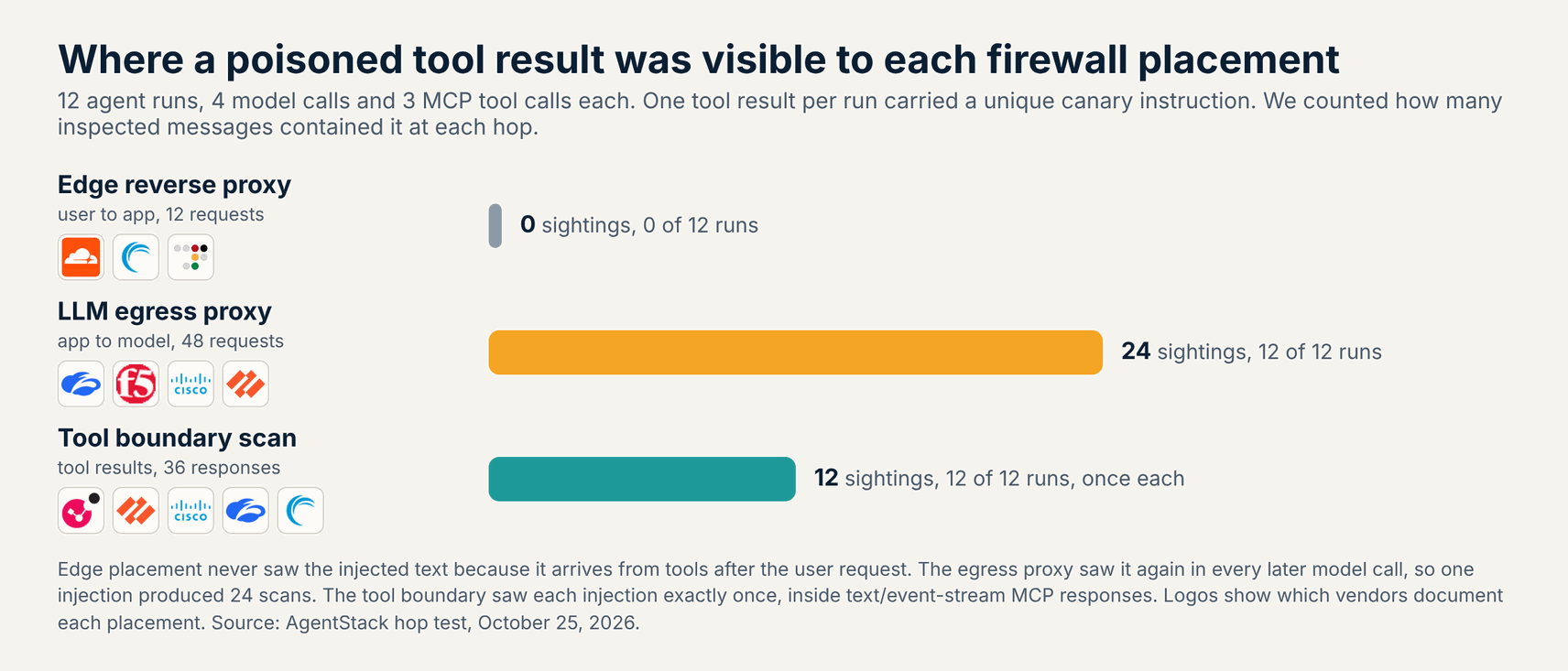
The edge proxy only carried the user’s request, which averaged under 150 characters. The injected text arrived later from tools, so a firewall placed there never saw it, however good its classifier. Cloudflare’s own docs confirm the scope: detection handles incoming requests with a JSON content type to endpoints labeled cf-llm.
The egress proxy saw the canary in the very next model call after the poisoned tool returned, which is early enough to block before the model reads it. It also saw the same text again in every later call, because agent frameworks re-send the whole conversation. Across our runs, the egress hop carried 2.19 times the bytes the tools returned.
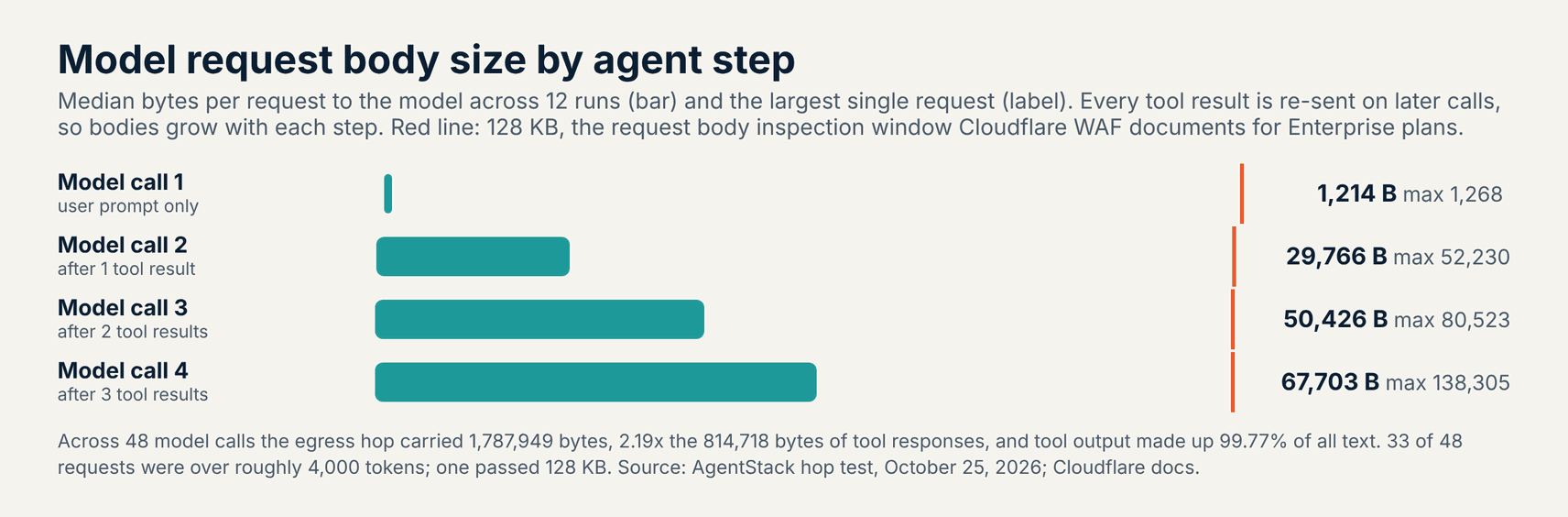
Request bodies grew from a median of 1,214 bytes on the first call to 67,703 bytes on the fourth, and one reached 138,305 bytes. Cloudflare documents that its WAF inspects request bodies up to 128 KB on Enterprise and sets a truncation flag past that point, so any proxy you place on this hop needs to handle large, growing JSON.
What this means for buyers: ask every AI firewall vendor which hop it sits on and whether it parses tool-role messages as well as the latest user turn. If your agent reads web pages, tickets, or MCP output, put a scan at the tool boundary or the egress hop, and treat an edge firewall as protection for the chat front door only.
1. Prisma AIRS: Best Overall for Network and API Coverage
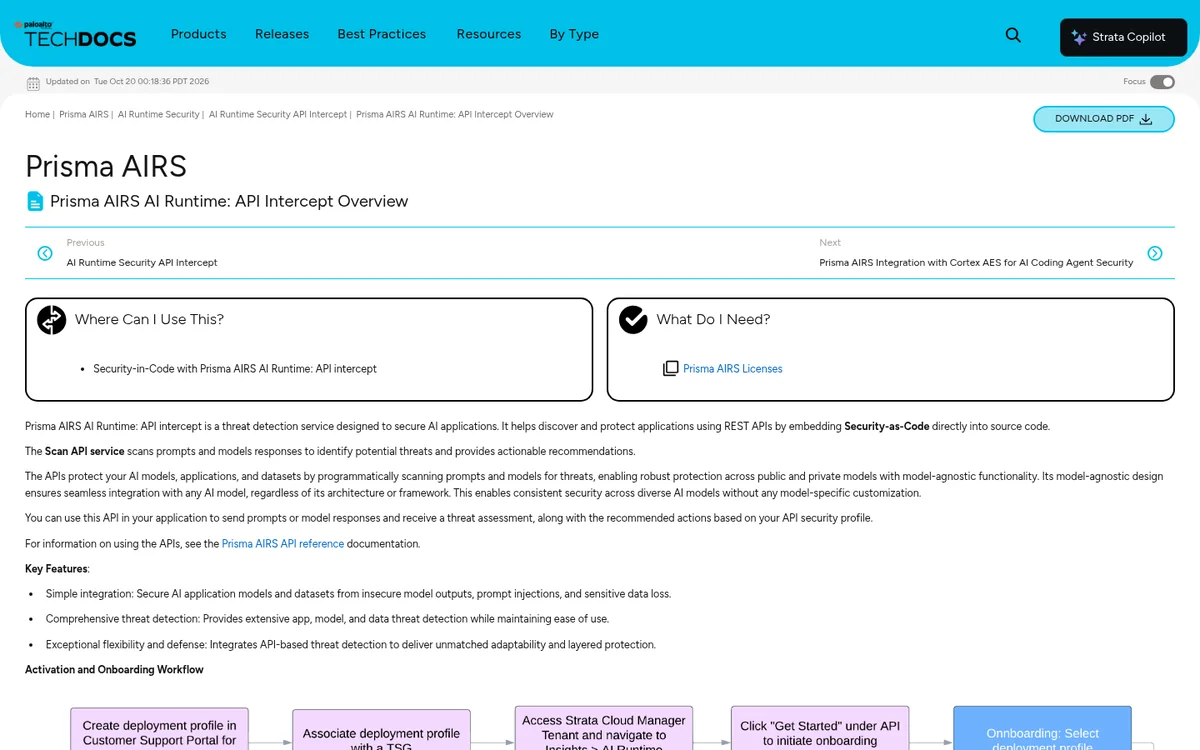
Prisma AIRS is the strongest all-round AI firewall for agents because it offers both a network intercept and a scan API, and Palo Alto Networks documents MCP threat detection on tool definitions, inputs, and outputs. The API intercept overview describes a model-agnostic Scan API for prompts and model responses with recommended actions per security profile.
The same page lists hard limits: 2 MB per synchronous scan, 5 MB per asynchronous scan, 100 URLs per request, and 25 batched async requests. Our largest model request was 138,305 bytes, so these limits leave plenty of room for agent context. The MCP threat detection docs add tool scanning to the sync and async APIs to catch context poisoning through tampered tool descriptions and credential leakage.
For traffic you cannot instrument in code, the AI Runtime Security VM firewall inspects AI traffic on the network path. That combination lets a platform team cover legacy apps at the network layer and new agents through the API, under one policy model in Strata Cloud Manager.
- Best for: Enterprises on Palo Alto Networks that want one vendor for network and code-level AI inspection, including MCP tools.
- Placement: Network intercept on the egress path, plus a Scan API you call at the tool boundary.
- Pricing (October 2026): Sold through Prisma AIRS licenses; we found no public list price on the pages we read.
- Watch out for: One API key per deployment profile, API keys are locked to the region where you create them, and contextual grounding is not supported with MCP detection on AI Model Protection.
2. Check Point AI Agent Security: Best Scan API for Agent Builders
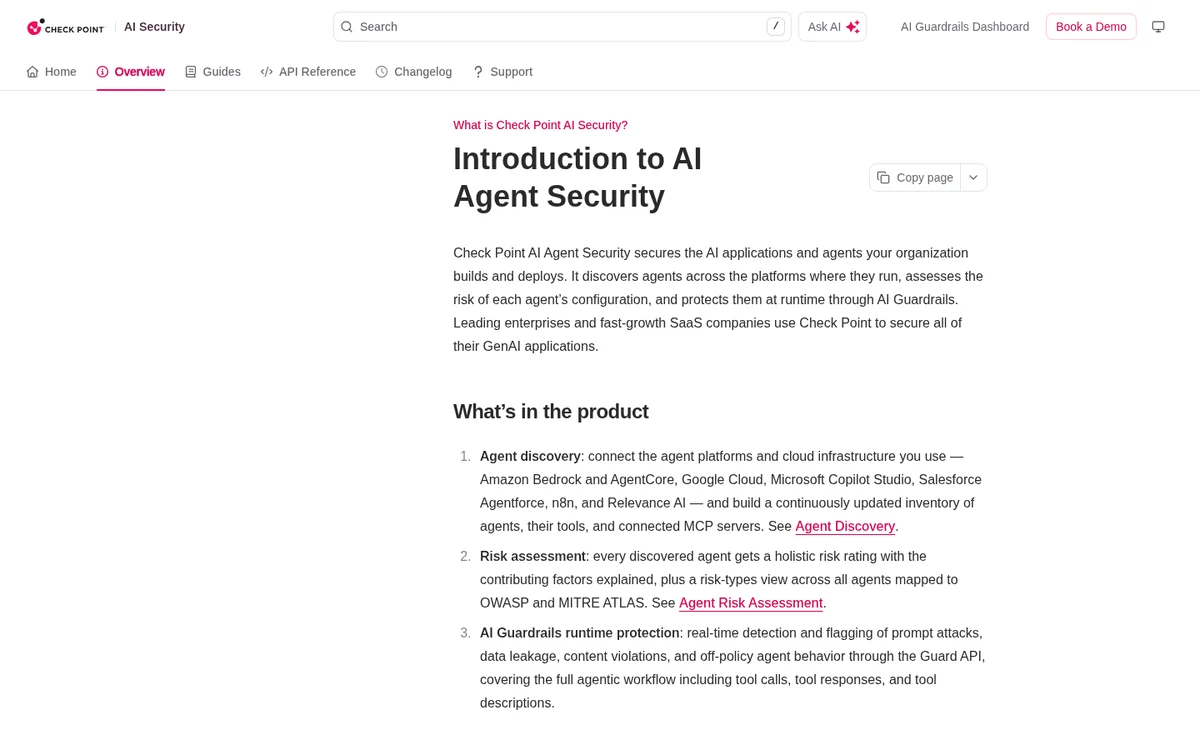
Check Point AI Agent Security, formerly Lakera Guard, is the best scan API for teams building their own agents, because its docs explicitly cover prompt attacks hidden in tool responses and tool descriptions. The product docs describe a Guard API that your AI gateway or app calls on each user interaction or agent step.
Defenses include prompt attacks, data leakage, content violations, malicious links, custom controls, and off-policy agent behavior through a Dangerous Deviation detector and a tool allow or deny list. The docs claim detection in more than 100 languages, a threat database growing by about 100,000 entries a day, and audio screening in early access.
Deployment comes as SaaS or self-hosted. The self-hosted build stores policy as JSON on S3 compatible storage and ships base model updates at least every stable release, which the docs put at every two weeks. Agent discovery and risk scoring cover Bedrock, AgentCore, Copilot Studio, Agentforce, n8n, and more in the full tier.
- Best for: Teams that want to screen every agent step, including tool output and MCP tool descriptions, from their own code or gateway.
- Placement: Scan API at the tool boundary or inside your AI gateway, so placement is your choice.
- Pricing (October 2026): Free account to start; enterprise SaaS and self-hosted plans are quoted by Check Point.
- Watch out for: Detectors only flag in Enforce mode, image inputs are not yet covered, and you must wire the API into every step yourself.
3. Cisco AI Defense: Best Gateway Plus SDK for MCP Traffic
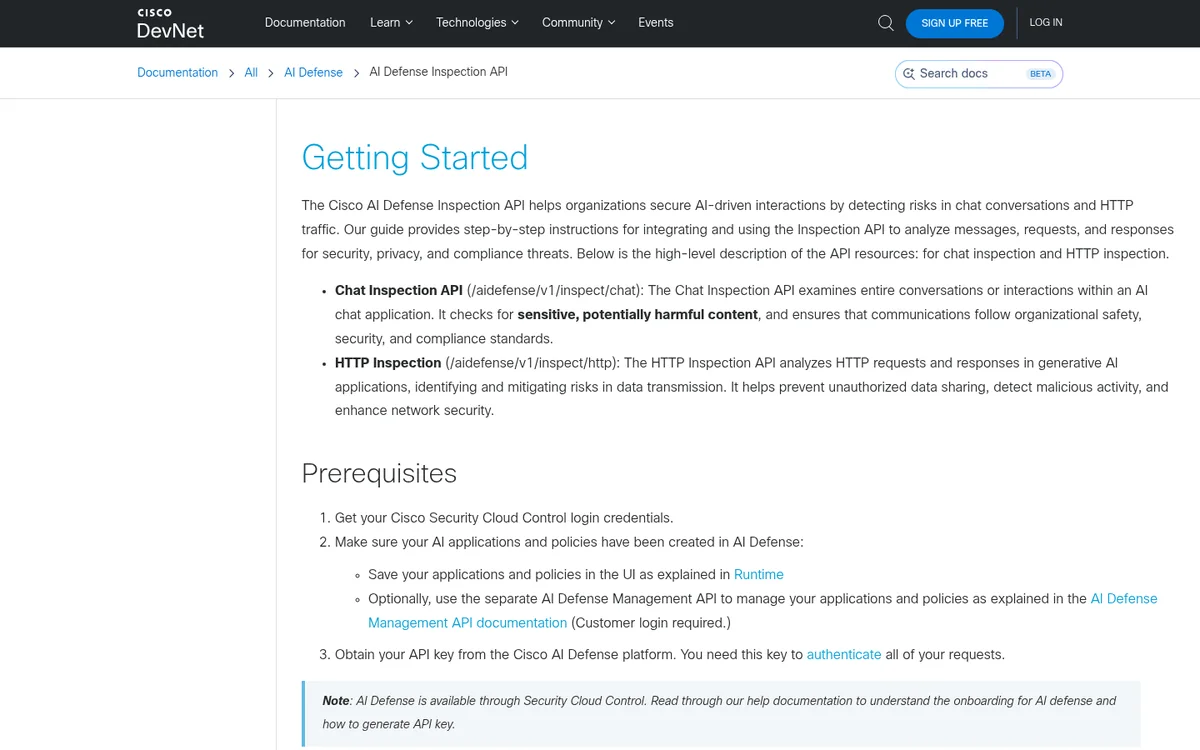
Cisco AI Defense fits teams that want a choice of gateway interception or API inspection, with an open source SDK that inspects MCP JSON-RPC messages as well as model calls. Cisco’s runtime docs list three setups: gateway interception, protection through Multicloud Defense, and the Inspection API.
The Inspection API guide documents a chat inspection endpoint for full conversations and an HTTP inspection endpoint for raw requests and responses, with separate base URLs for US, APAC, and Europe. The Python SDK adds an MCPInspectionClient and an agent runtime module that patches OpenAI, Bedrock, Vertex AI, Anthropic, LiteLLM, and MCP clients in API mode or gateway mode.
In our hop test terms, gateway mode sits on the egress hop and API mode sits wherever your code calls it. Teams with mixed frameworks can start with the SDK patch, then move high-volume apps to the gateway once policy settles.
- Best for: Cisco security customers and Python agent teams that want MCP message inspection without writing a parser.
- Placement: Gateway on the egress hop, Inspection API and SDK at the tool boundary, plus network protection through Multicloud Defense.
- Pricing (October 2026): Quoted by Cisco; we found no public list price on the pages we read.
- Watch out for: Regional endpoints must match where your policies live, and the SDK auto-patching only covers the listed clients.
4. F5 AI Guardrails: Best Self-Hosted Inline Proxy
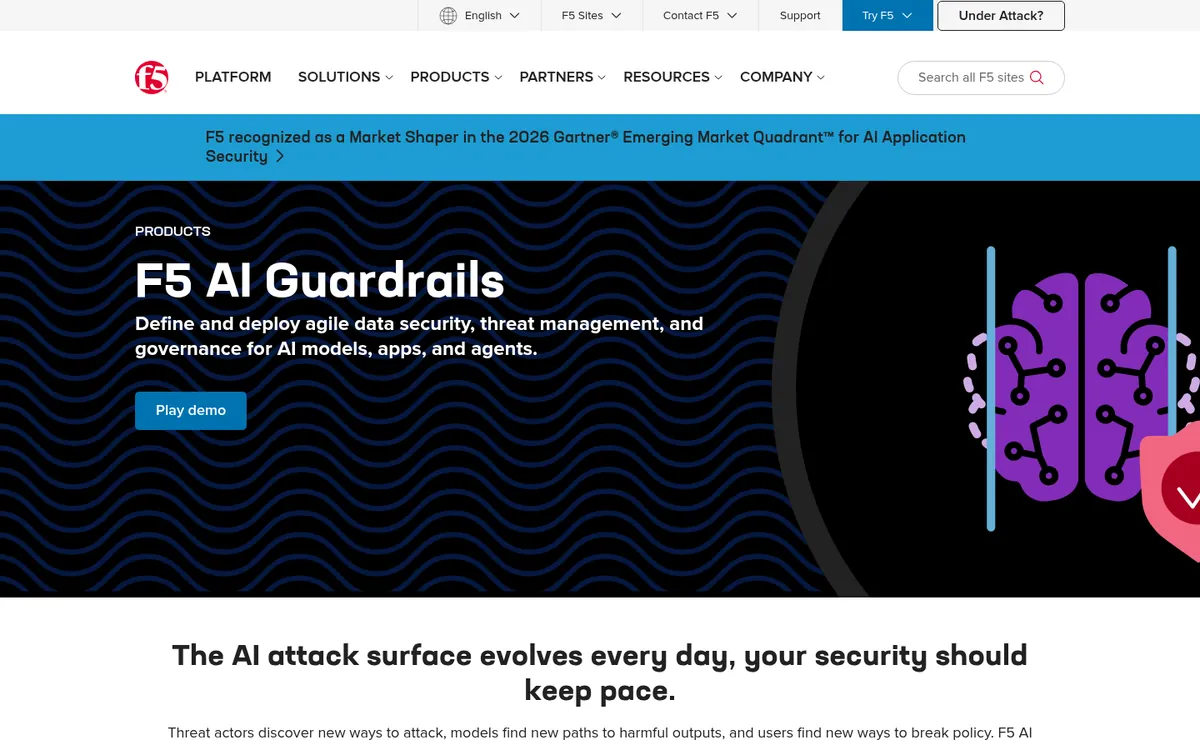
F5 AI Guardrails is the best pick when you want an inline AI firewall you can run in your own Kubernetes clusters, because F5 supports self-hosting on EKS, AKS, GKE, and Red Hat OpenShift. The F5 workshop docs list three options: F5 SaaS, self-hosted in the cloud, and self-hosted on premises, where OpenShift is the main requirement.
The inline implementation lab shows an OpenAI-compatible endpoint: point your client at the Guardrails host with a project token, and clean traffic is forwarded to the model provider. The product page says the same guardrails apply to any OpenAI, Anthropic, or similarly formatted agent and can audit and block unauthorized tool calls.
For agents, F5’s MCP lab adds request and response extractors with JSON paths such as .tools for MCP tool definitions and tool_calls for tool invocations. That means scanners can read tool lists and tool calls, though you configure the extractors per project.
- Best for: Platform teams that need an inline proxy under their own control, including on premises.
- Placement: Inline egress proxy, plus scans through the API; pairs with F5 Distributed Cloud for edge delivery.
- Pricing (October 2026): Quoted by F5; we found no public list price on the pages we read.
- Watch out for: Extractor rules are per project, so tool coverage depends on configuration, and on-premises support requires OpenShift.
5. Zscaler AI Guard: Best for Zscaler Customers With Mixed Models
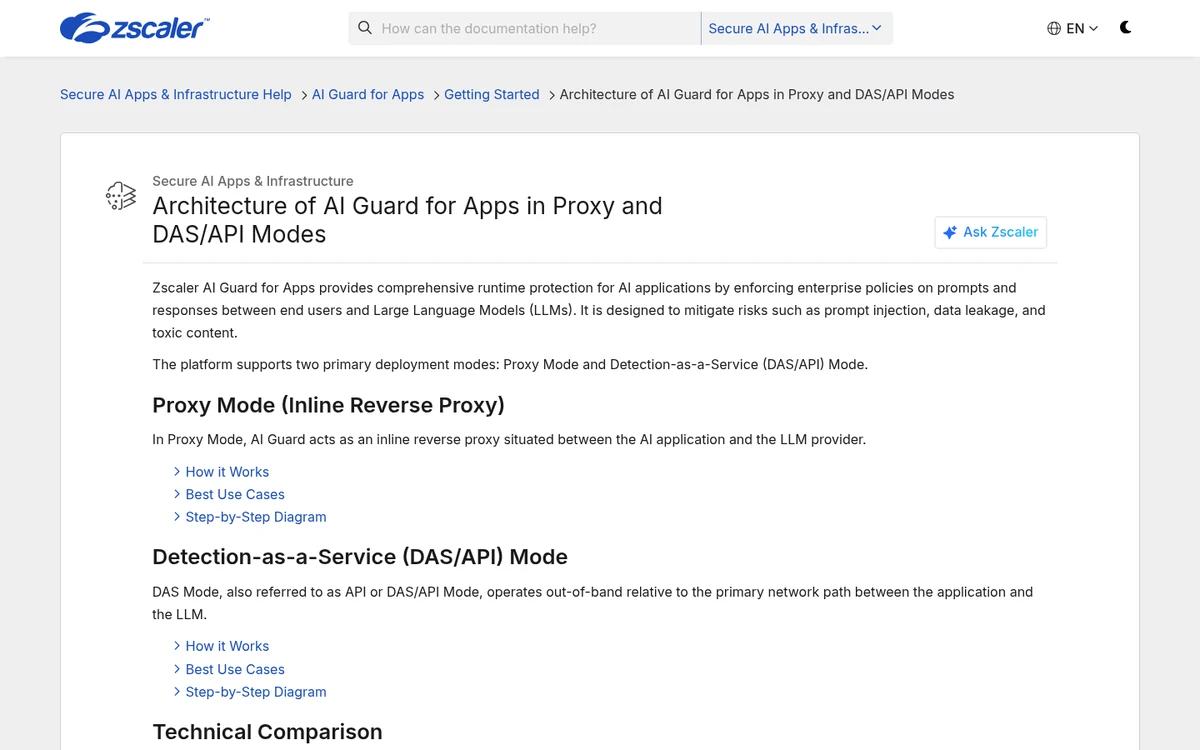
Zscaler AI Guard for Apps works well for Zscaler customers because one tenant can run proxy mode for public LLMs and a detection API for private models side by side. The architecture docs describe proxy mode as an inline reverse proxy between the app and the provider, with the app pointed at the Zscaler proxy URL instead of the provider’s endpoint.
In proxy mode, the app authenticates with a Zscaler key, and AI Guard holds the upstream provider credentials and forwards allowed traffic. Proxy mode supports only internet-reachable providers such as OpenAI, Anthropic, and Gemini. Detection as a Service mode keeps your direct model connection, and your code sends prompts and responses to a separate API that answers block or allow.
The docs call DAS mode suitable for advanced agentic workflows where the app keeps full control over the model connection. In practice, that means your code decides which tool results to send, so tool coverage is as good as your wiring.
- Best for: Zscaler customers that run a mix of public and private models and want one policy tenant.
- Placement: Proxy on the egress hop for public LLMs, or DAS API calls at the tool boundary for any model.
- Pricing (October 2026): Quoted by Zscaler; we found no public list price on the pages we read.
- Watch out for: Proxy mode holds your provider credentials and skips private models, and DAS mode leaves enforcement to your code.
6. Cloudflare AI Security for Apps: Best Edge Firewall for Chat Endpoints
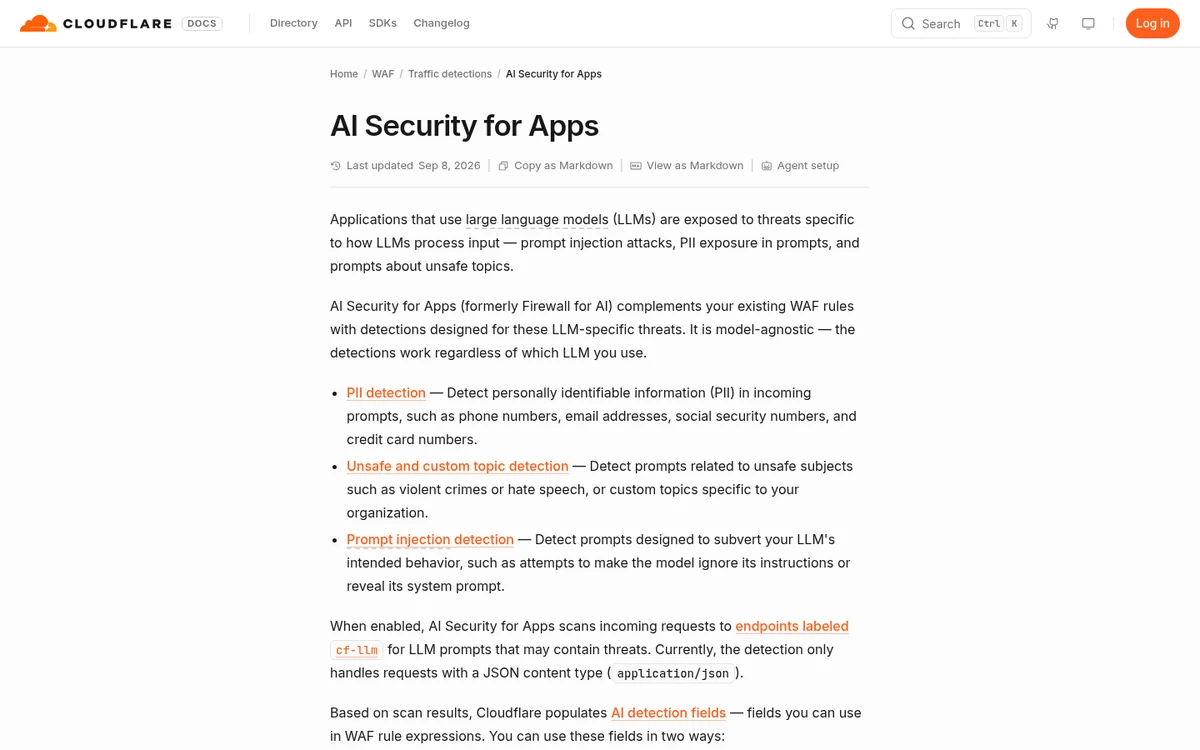
Cloudflare AI Security for Apps is the best edge AI firewall for public chat endpoints already behind Cloudflare, but it inspects incoming requests only, so it cannot see injections that arrive through agent tools. The Cloudflare docs say it scans requests to endpoints labeled cf-llm and handles only the application/json content type.
Detections populate WAF fields for PII, unsafe and custom topics, token count, and a prompt injection score from 1 to 99, where lower means riskier. You then block or challenge with custom rules or rate limiting rules, for example blocking scores under 20 and challenging scores under 40.
LLM endpoint discovery is available on every plan, but the detection fields and the log mode ruleset are a paid add-on for Enterprise. In our hop test, this placement saw the 12 user requests and none of the poisoned tool output.
- Best for: Public chat apps on Cloudflare where abusive user prompts and PII in prompts are the main risks.
- Placement: Edge reverse proxy in front of your app; requests only.
- Pricing (October 2026): Paid add-on for Enterprise plans; endpoint discovery is included on all plans.
- Watch out for: No response or tool output inspection, JSON requests only, and WAF body inspection stops at 128 KB on Enterprise.
7. Akamai Firewall for AI: Best for Akamai Customers Who Need an API Mode
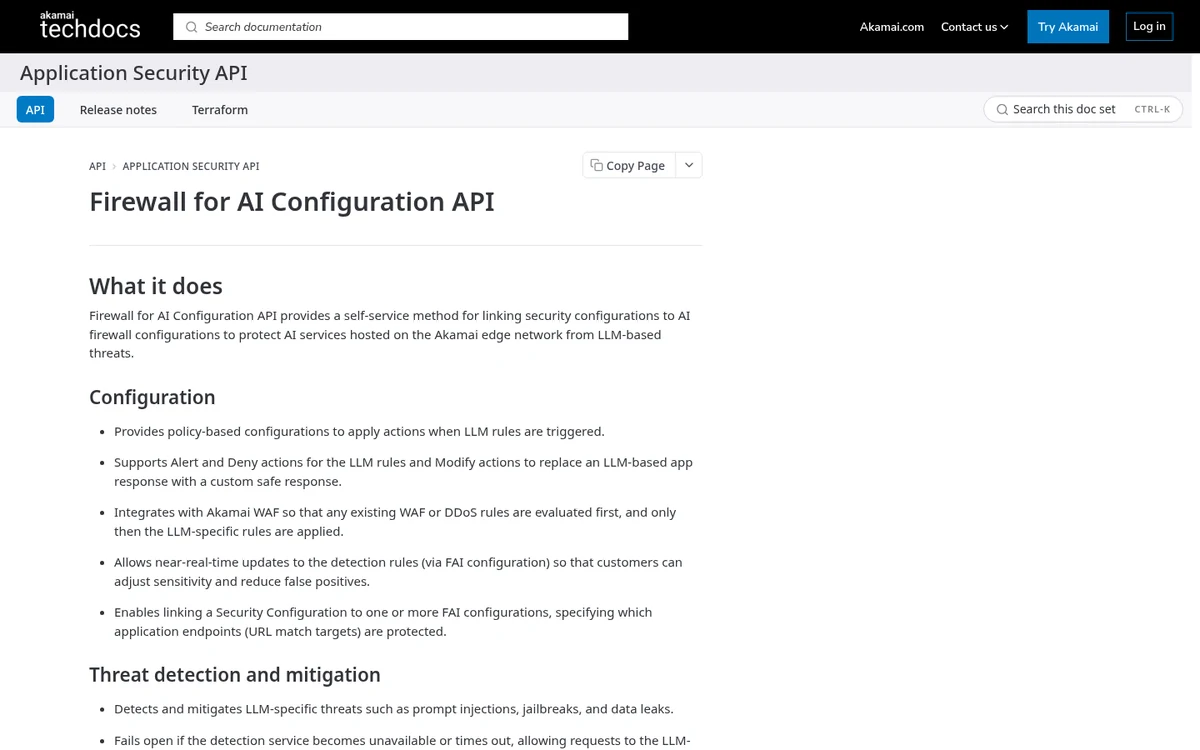
Akamai Firewall for AI suits Akamai customers who want LLM rules at the edge and an API mode for traffic that does not pass through Akamai. The configuration API docs say existing WAF and DDoS rules run first, then LLM rules with Alert, Deny, or Modify actions, where Modify swaps an unsafe response for a safe one.
When you create a configuration, you choose an EDGE type that runs on Akamai’s network or an API type reached through API endpoints. The API type is what lets an agent call Akamai on tool output, since edge deployment only sees traffic routed to your protected app endpoints.
One design choice matters for high-risk agents: the service fails open if detection is unavailable or times out, so requests continue to the LLM rather than being blocked. Event data, including the triggering prompt or response, appears in Web Security Analytics, with an opt-out for payload logging.
- Best for: Akamai App and API Protector customers that want LLM rules next to existing WAF and DDoS policy.
- Placement: Edge reverse proxy, or API mode called from your code at the tool boundary.
- Pricing (October 2026): Quoted by Akamai; we found no public list price on the pages we read.
- Watch out for: Fails open on timeout, and MCP or tool-specific coverage is not documented.
8. Radware LLM Firewall: Best Add-On for Radware Cloud WAF Customers
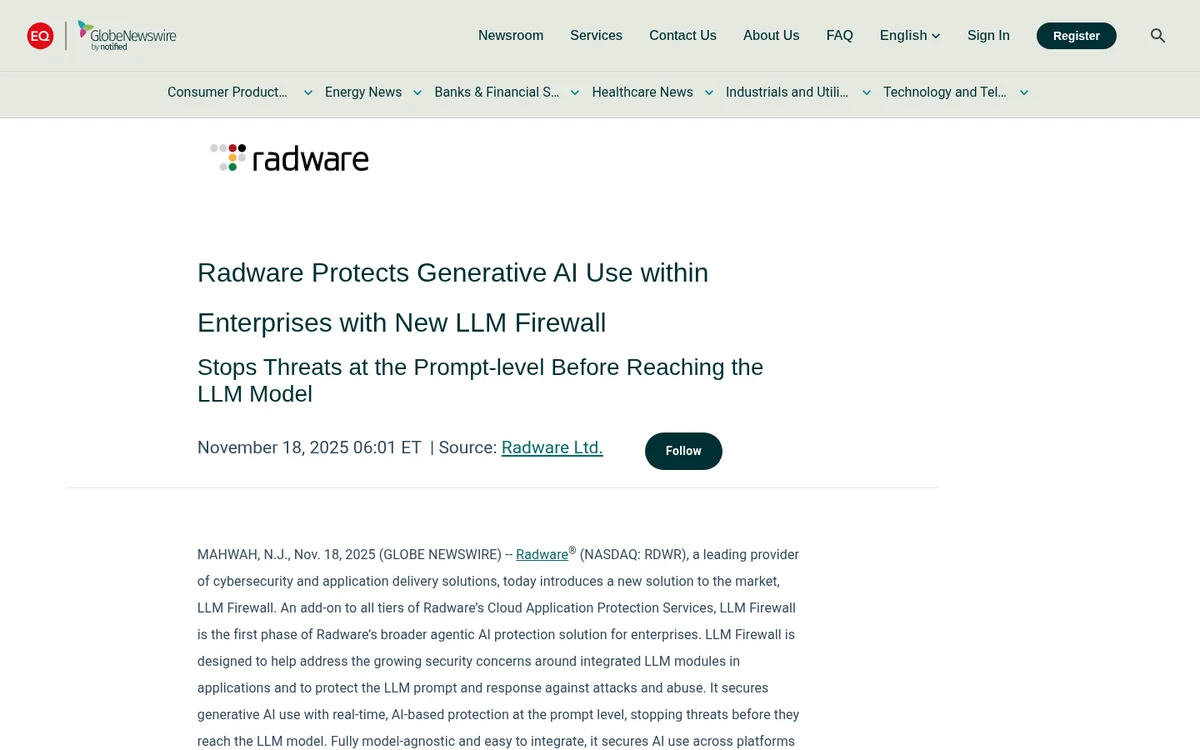
Radware LLM Firewall is a sensible add-on for teams already on Radware Cloud Application Protection Services, since it adds prompt-level inspection to an existing cloud WAF without a new vendor. Radware’s launch announcement from November 18, 2025 calls it an add-on to all tiers of that service and the first phase of a broader agentic AI protection plan.
The product page and announcement focus on prompt injection, jailbreaks, resource abuse, and PII before prompts reach the model, and Radware describes it as model-agnostic. Radware frames it as a WAF for LLMs that handles natural language exploits rather than HTTP exploits.
For agents, the product is prompt-focused, and the pages we read do not describe tool output or MCP inspection. Treat it as front-door protection and pair it with a tool boundary scan if your agents read external content.
- Best for: Radware cloud WAF customers that want LLM prompt protection inside their current contract.
- Placement: Inline, before the LLM, as part of Radware’s cloud application protection.
- Pricing (October 2026): Add-on to all tiers of Radware Cloud Application Protection Services; quoted by Radware.
- Watch out for: Tool output and MCP coverage are not documented, and agentic features are described as later phases.
AI Firewall Coverage by Placement
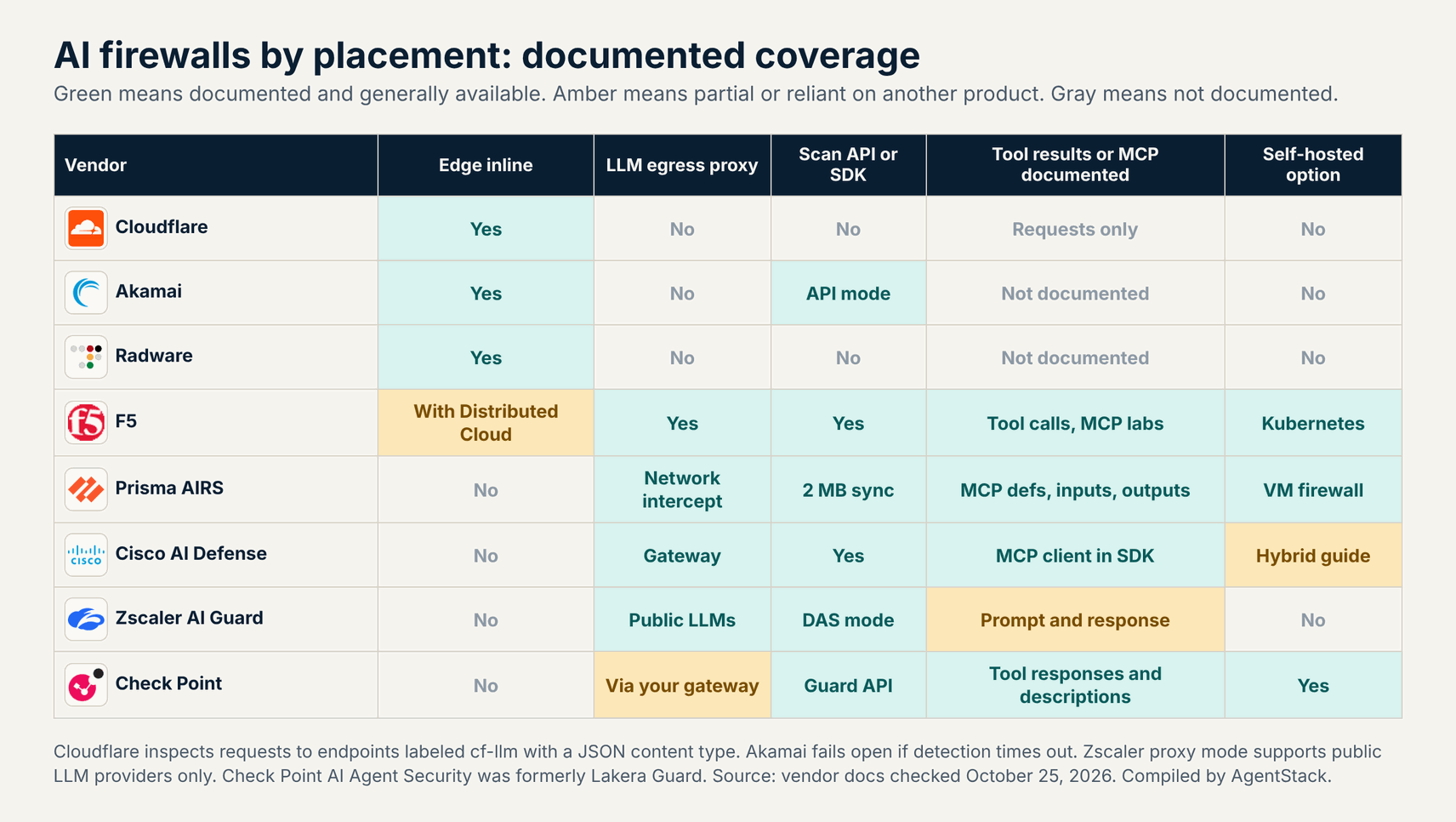
Only four of the eight AI firewalls document coverage of agent tool traffic or MCP messages, and three of the eight are edge products that inspect the user request alone. The matrix below shows which placements each vendor documents, so you can match it to the hop where your risk sits.
| Need | Strongest options | Why |
|---|---|---|
| Scan tool results before the model reads them | Check Point, Prisma AIRS, Cisco | Documented tool response or MCP output scanning through an API or SDK |
| Inline proxy you run yourself | F5 AI Guardrails | Self-hosted on EKS, AKS, GKE, or OpenShift |
| Network-level coverage for apps you cannot change | Prisma AIRS, Cisco | VM firewall or Multicloud Defense on the traffic path |
| Public chat endpoint abuse | Cloudflare, Akamai, Radware | Edge or cloud WAF already in front of the app |
| Mixed public and private models | Zscaler AI Guard | Proxy for public providers and DAS API for private ones |
Verdict: For agents that call tools, start with a scan at the tool boundary from Check Point, Prisma AIRS, or Cisco, or an inline proxy from F5 or Zscaler on the egress hop. Add an edge product only if you also run a public chat endpoint.
How to Choose an AI Firewall
Choose an AI firewall by mapping your agent traffic first: list every hop where untrusted text enters, then buy the product that sits on that hop and parses that format. A firewall on the wrong hop adds latency and cost without reducing the risk you care about.
You run a public chat assistant
- Put an edge firewall such as Cloudflare or Akamai in front of the chat endpoint for prompt abuse and PII.
- Set a strict injection threshold for anonymous traffic and a looser one for signed-in users.
- Log the full request body during a trial period so you can tune false positives.
You run agents that read tools and the web
- Scan every tool result before the next model call, using a scan API or an SDK patch.
- Scan MCP tool descriptions at runtime and again whenever a server is added or updated.
- Pin and review tool metadata, following the patterns in our ToFu MCP tool security bugs study.
You run a central AI platform
- Route model traffic through one egress proxy or LLM gateway so policy lives in one place.
- Budget for rescanning, since agent context grows with every step and egress bytes ran at 2.19 times tool bytes in our test.
- Check payload limits against your largest agent requests before you sign.
When an AI Firewall Is Not Enough
An AI firewall is not enough on its own when agents can take high-impact actions, hold broad credentials, or install tools from public registries, because detection will miss some attacks. In those cases, treat the firewall as one detector and design containment around it.
- High-risk actions: put approvals and least privilege in front of writes, following the NIST, NSA, and CISA practices for rogue agents.
- MCP supply chain: a firewall will not vet servers, so pair it with an MCP gateway and the MCP security tools we tested.
- Compromised dependencies: the LiteLLM supply chain compromise shows why gateways and SDKs need their own patching and pinning.
- Governance programs: map firewall controls to policy in our AI agent governance guide and governance and compliance coverage.
Frequently Asked Questions
What is an AI firewall?
An AI firewall is a security layer that inspects text going into and out of a large language model, then blocks, redacts, or logs prompt injection, jailbreaks, sensitive data, and unsafe content. It can run at the edge, as a proxy between your app and the model, or as an API your code calls.
Can an edge AI firewall stop prompt injection in agent tool results?
No, not on its own. In our October 25, 2026 hop test, an edge proxy in front of the app saw none of 12 injections hidden in tool results, because that text arrives after the user request. Scan tool output at the tool boundary or on the egress hop to the model.
Which AI firewall is best for MCP servers?
Prisma AIRS, Check Point AI Agent Security, and Cisco AI Defense document the deepest MCP coverage. Prisma AIRS scans MCP tool definitions, inputs, and outputs, Check Point screens tool responses and descriptions, and Cisco’s SDK inspects MCP JSON-RPC messages. F5 can read MCP tool lists through configured extractors.
Is an AI firewall the same as an LLM gateway?
Not exactly. An LLM gateway routes, caches, and meters model traffic across providers, while an AI firewall classifies that traffic for attacks and data leaks. Several products combine both, and many teams send gateway traffic to a firewall API, so one policy point covers routing and inspection together.
How much does an AI firewall cost?
Most AI firewalls are quote-based. Cloudflare sells AI Security for Apps as a paid add-on to Enterprise plans, Radware sells its LLM Firewall as an add-on to its cloud WAF tiers, and Check Point offers a free account to start. Budget for rescanning, since agent context grows with each model call.
Related Guides
Prisma AIRS also sells posture management alongside its firewall. Our Prisma AIRS vs Wiz vs Microsoft Defender comparison covers the AI-SPM side in depth.
For related coverage, see our prompt injection detection tools, Bedrock Guardrails vs Azure Prompt Shields vs Model Armor, AI guardrails tools roundup and AI-SPM tools guide.
Keep going with the agent security hub, the AI governance and security hub, our AI agent security tools roundup, Zenity vs Noma vs Pillar, MCP security tools, MCP gateways, MCP explained, and Cloudflare vs Vercel vs AgentCore. Each one is live and covers a layer that sits next to an AI firewall in a production agent stack.
More context sits in the LLM gateways guide, the Red Hat MCP gateway news, Microsoft Dynamic Agent Risk, our AI agent testing tools, the NIST and CISA incident response practices, editorial standards, disclosure, and contact.
The Bottom Line
Buy an AI firewall for the hop where untrusted text enters your agent: Prisma AIRS, Check Point, or Cisco to scan tool output, F5 or Zscaler for an inline proxy, and Cloudflare, Akamai, or Radware for public chat endpoints. Most agent teams need a tool boundary or egress scan first, and an edge product second.
Deployment modes, MCP support, and pricing change quickly, so recheck the linked docs before you sign and rerun a hop test on your own traffic. Send corrections or your own measurements through our contact page. Gateway key leakage is a related failure mode, and our test of ARTEX agents stealing LLM gateway keys shows which LiteLLM builds still accepted a default key.