


Updated November 17, 2026. Based on Amazon Threat Intelligence’s November 13 report, FBI FLASH-20261113-001, LiteLLM’s v1.104.0 release notes, and our own LiteLLM test run on November 17 with versions 1.109.1 and 1.103.11.
ARTEX AI agents spent October 2026 hunting internet-exposed LLM gateways and AI app builders for the provider API keys stored inside them, according to Amazon Threat Intelligence. Amazon’s decoy sensors captured the agents’ own records, which describe a self-funding loop: stolen keys paid for the model inference that ran the next round of key hunting. LiteLLM, One API, New API, Dify, Langflow and Ollama were among the named targets, and the LiteLLM default master key was listed in the agents’ attack playbook.
If you run an LLM gateway on the internet, assume ARTEX-style agents have already probed it: take admin endpoints off the public internet, replace any default or short master key, upgrade LiteLLM to 1.104.0 or later, and rotate every stored provider key at the provider. In our November 17 test, LiteLLM 1.109.1 refused to start with the documented sk-1234 key, while a 1.103.x patch build released on November 10 started with it and spent the stored provider key for any caller who sent it.
TL;DR
- Amazon’s MadPot decoys captured ARTEX agent records from October 3 to November 5, 2026, showing stolen AI provider keys pooled and fed into the framework’s own model gateway.
- Named targets include LLM gateways One API, New API, Veloera, Sub2API and LiteLLM, and AI app builders Dify, FastGPT, Langflow, RAGFlow, Open WebUI, LobeChat and Ollama.
- The FBI’s November 13 FLASH says some ARTEX intrusions reached privileged access in under three hours and counts over 1,600 exposed ARTEX consoles in early November.
- LiteLLM 1.104.0 and later refuse to boot with no master key or the documented
sk-1234, but the check matches one known value, sosk-12345still started in our test. - LiteLLM 1.103.11, uploaded November 10, 2026, booted with
sk-1234and forwarded the stored provider key upstream for a caller using it, although/model/infonever showed the key.
What Amazon Found in the ARTEX Campaigns
ARTEX is an open-source agentic penetration testing framework that splits work among planner, worker, verification and compression agents sharing one knowledge graph. Amazon says its MadPot sensors, posing as LLM chat-completions APIs, received requests from ARTEX agents that carried their full task context, system prompts and tool histories, so each request held a running diary of the campaign.
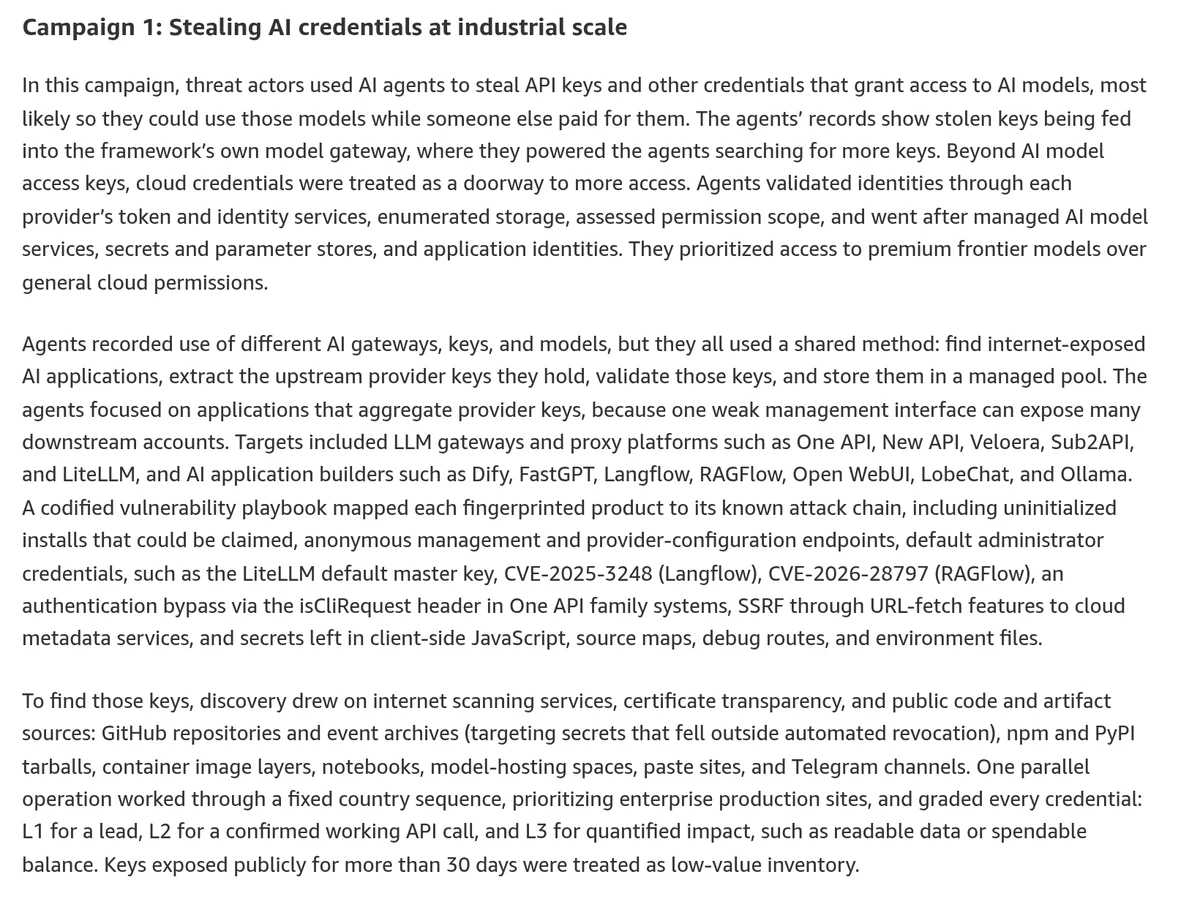
The main campaign was large-scale theft of credentials for AI models. Amazon says the agents found internet-exposed AI applications, extracted the upstream provider keys those apps hold, validated each key, and stored working keys in a managed pool. They preferred apps that aggregate many provider keys, because one weak management interface on a gateway can expose many downstream accounts.
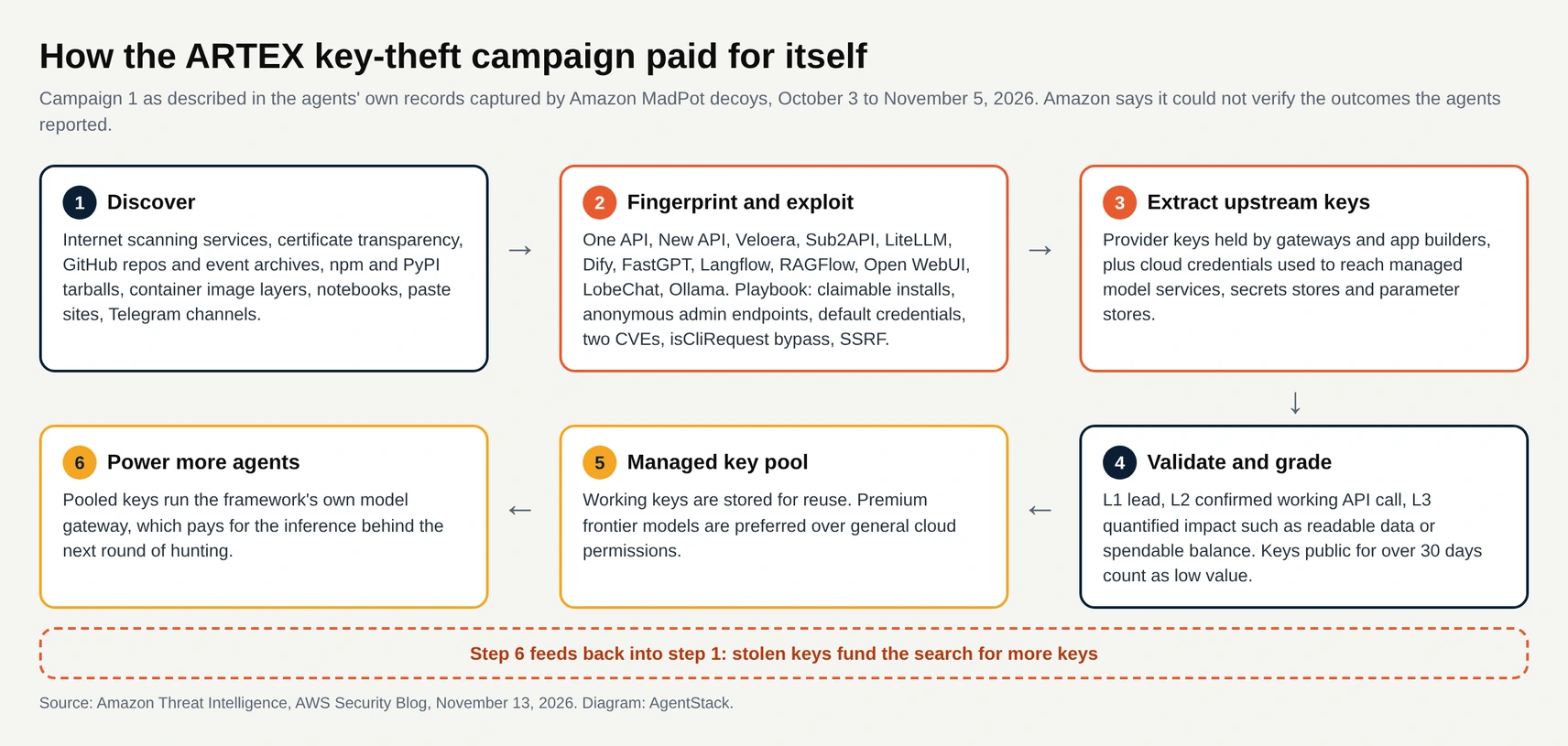
Amazon’s caveats matter for anyone sizing the risk. Amazon assesses with moderate confidence that the activity ran on ARTEX and came from disparate Chinese-nexus groups, and it says it cannot verify the outcomes the agents reported against real victims. A second campaign used ARTEX to attack identity checks at two cryptocurrency exchanges with real-time deepfakes, and the vendor’s server-side verdict rejected every recorded attempt.
What the FBI FLASH Adds
The FBI’s FLASH-20261113-001, published November 13, 2026, describes ARTEX as a Go-based platform that turns natural-language goals into commands and runs on external models such as Claude, GPT, DeepSeek and Kimi. The FBI says DeepSeek Flash family models dominate the attacker-controlled instances it analyzed, citing cost and a lack of observable guardrails when prompts are framed as penetration testing.
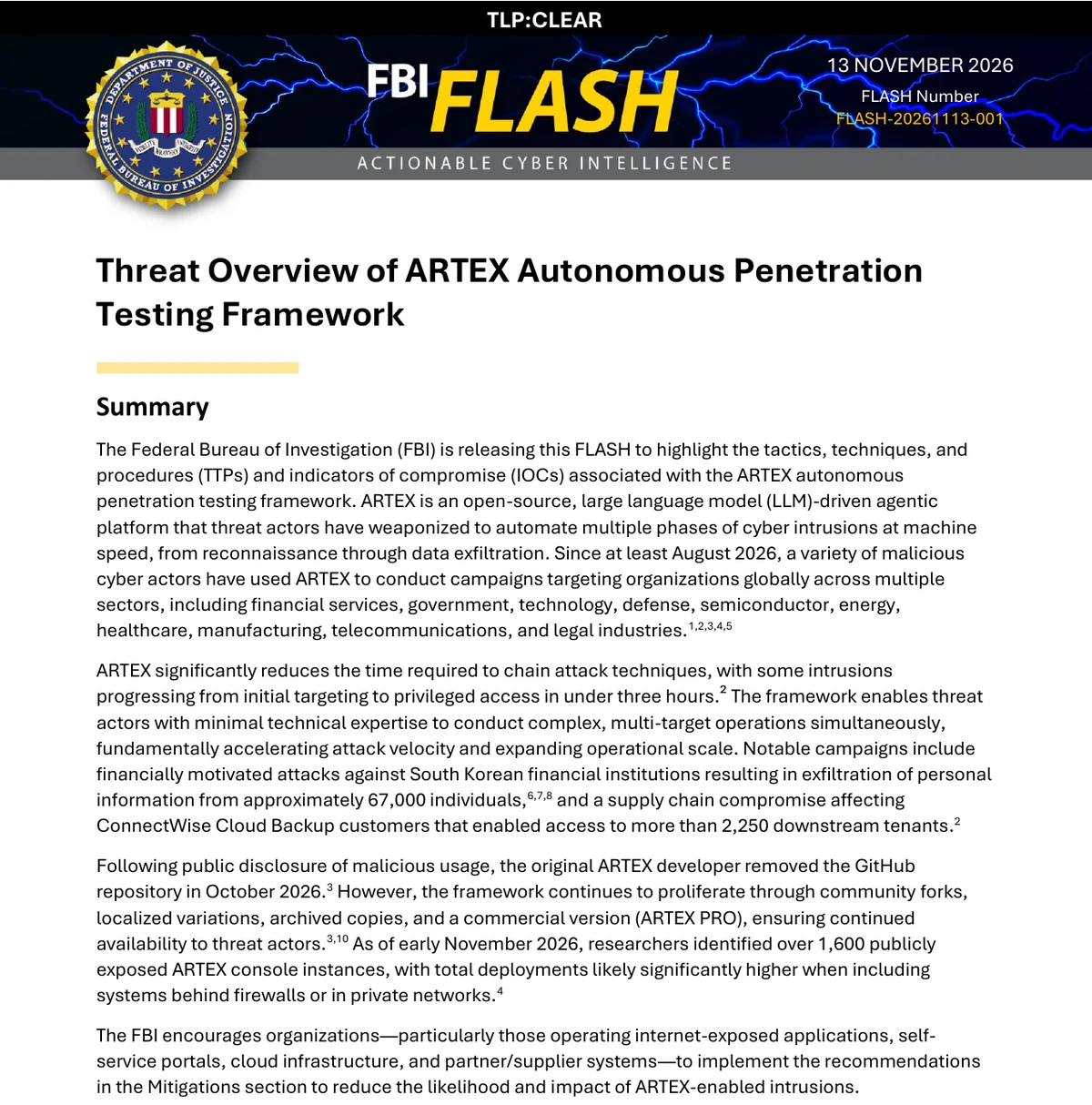
The FBI ties ARTEX to attacks on South Korean financial institutions that exposed personal information of approximately 67,000 people and to a ConnectWise Cloud Backup supply chain compromise reaching more than 2,250 downstream tenants. The original developer pulled the GitHub repository on October 8, 2026, but forks, archives and a commercial ARTEX PRO version remain. The FBI counts over 1,600 exposed ARTEX consoles in early November, while The Register cites a Censys figure of 1,465 as of November 4.
Which LLM Gateways and AI Apps ARTEX Targeted
ARTEX targeted two groups of software: gateways that hold keys for many model providers, and AI app builders that store provider keys in their settings. The playbook entries Amazon lists are old, well-documented weaknesses, so each one maps to a check an operator can run today.
| Group | Products named by Amazon | Playbook entries Amazon lists | What to check on your deployment |
|---|---|---|---|
| LLM gateways and proxies | One API, New API, Veloera, Sub2API, LiteLLM | Default administrator credentials such as the LiteLLM default master key; an isCliRequest header authentication bypass in One API family systems; anonymous management and provider settings endpoints | Admin UI and management API reachable only from a private network; master key long and random; provider settings return 401 without a token |
| AI app builders | Dify, FastGPT, Langflow, RAGFlow, Open WebUI, LobeChat, Ollama | Uninitialized installs that can be claimed; CVE-2025-3248 in Langflow; CVE-2026-28797 in RAGFlow; SSRF through URL-fetch features to cloud metadata | Setup wizard finished and first admin claimed; Langflow and RAGFlow patched; outbound access to the metadata service blocked |
| Code and artifacts | GitHub repos and event archives, npm and PyPI tarballs, container layers, notebooks, paste sites, Telegram | Secrets in client-side JavaScript, source maps, debug routes and environment files | Secret scanning on repos and published images; no provider key in any front-end bundle |
Gateways deserve the first look because the keys they hold are the reason the campaign paid for itself. Wiz Research found that 9.6% of 3,074 internet-facing LiteLLM instances it scanned accepted the default master key sk-1234 or required no authentication, and it notes that the LiteLLM master key also signs session tokens. Our LLM gateways guide compares how the main gateways handle admin authentication and key storage.
Does LiteLLM Still Ship With a Default Master Key?
Current LiteLLM releases no longer start with the documented default key, but older and maintenance builds still do. LiteLLM v1.104.0, uploaded to PyPI on October 3, 2026, refuses to boot with an unset, empty or publicly known master key, while our test of the 1.103.11 patch release from November 10 started with sk-1234.
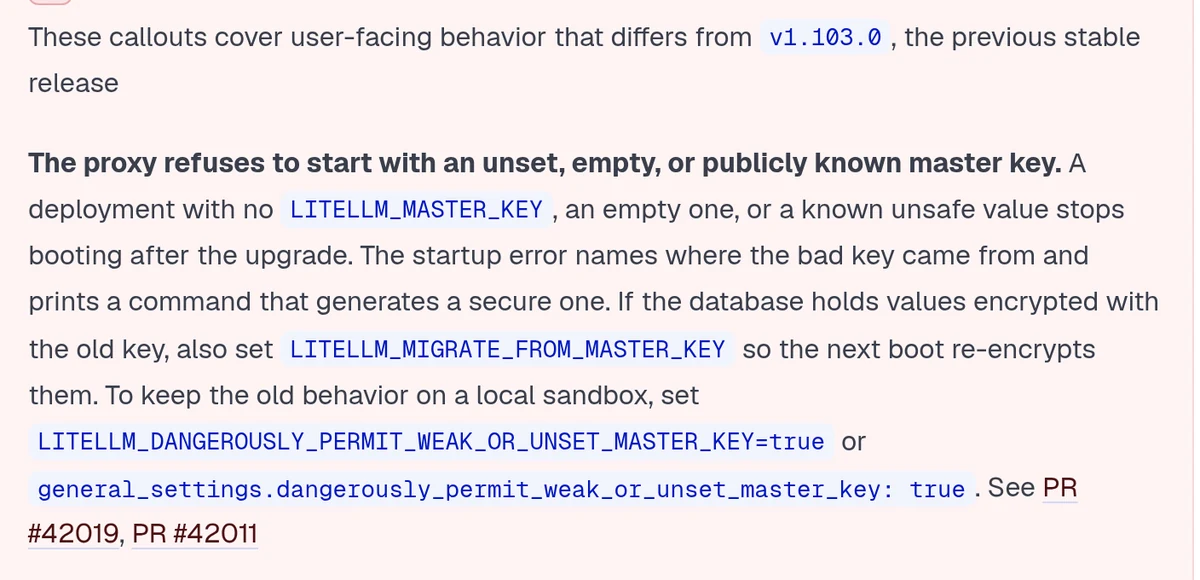
The v1.104.0 release notes describe the refusal as a breaking change from v1.103.0, cite PR #42019 and PR #42011, and offer LITELLM_DANGEROUSLY_PERMIT_WEAK_OR_UNSET_MASTER_KEY=true to keep the old behavior on a local sandbox. Teams whose database holds values encrypted with the old key also set LITELLM_MIGRATE_FROM_MASTER_KEY so the next boot re-encrypts them. Any deployment that sets the override flag in production is back to the pre-1.104.0 risk.
What We Found Testing LiteLLM Master Key Defaults
We installed LiteLLM from PyPI on November 17, 2026 and started five local proxies, each holding one fake OpenAI key and pointed at a fake upstream server that logged which key it received. We then sent requests as an outsider would, with no key, with sk-1234, and with the configured key.
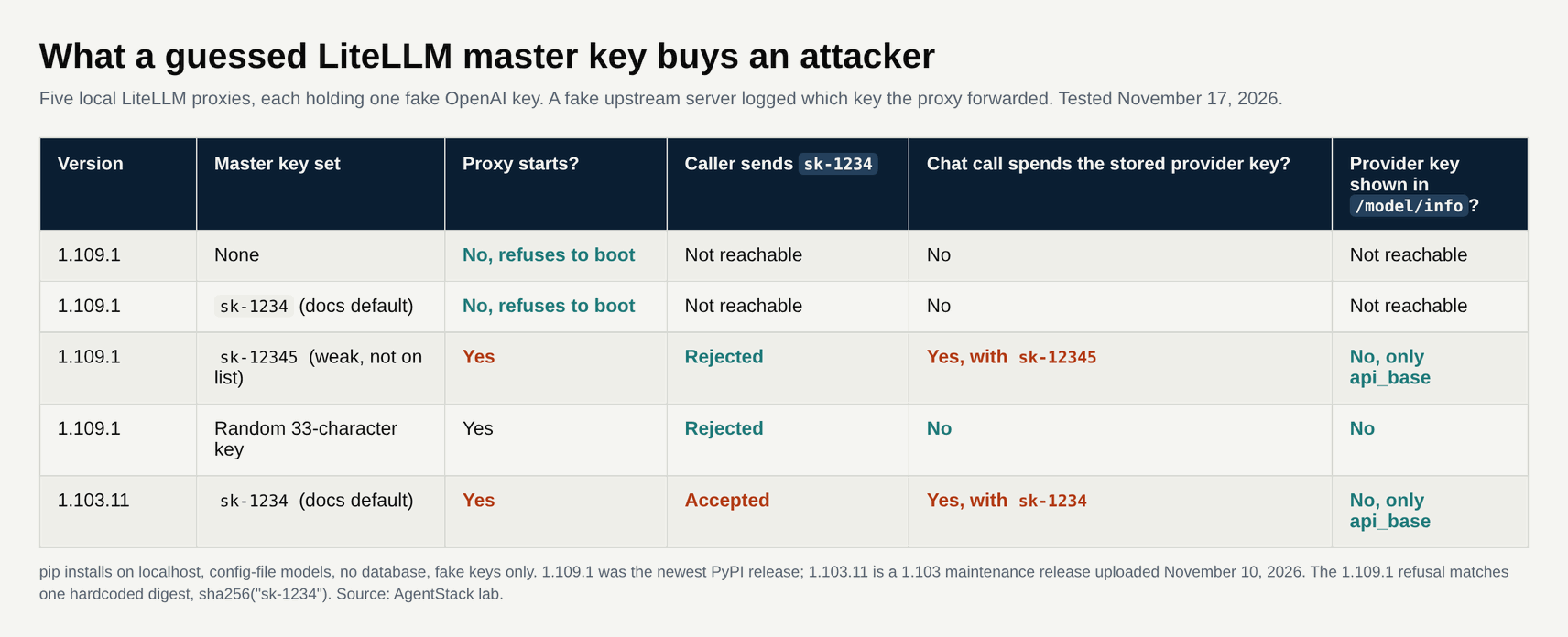
LiteLLM 1.109.1, the newest release on PyPI, refused to boot with no master key and with sk-1234. The startup error named the problem and printed a command for generating a secure key. The refusal list in the 1.109.1 code holds a single SHA-256 digest, the hash of sk-1234, so a proxy configured with sk-12345 started normally.
LiteLLM 1.103.11 has no boot check. It started with sk-1234, accepted that key from our test caller, and answered a chat request by forwarding the stored provider key to the upstream server. The admin endpoint /model/info returned only the API base and never the key, which shows that masking the key in the admin API does not stop the theft of inference.
That distinction matches the economics Amazon describes. An attacker who holds a working gateway key does not need to read the provider key to spend it, because every request through the gateway is billed to the stored account. Spend and usage monitoring, covered in our LLM cost monitoring tools roundup, is often the first place this shows up.
The test has limits. We ran pip installs on localhost with config-file models and no database, so database-backed virtual keys, the Admin UI and container image tags were not tested, and we did not test the override flag. We have no evidence about which LiteLLM versions the ARTEX targets were running.
Operators can run the same checks against gateways they operate:
# 1. Which LiteLLM version is running?
pip show litellm | grep Version          # in a container: docker exec <name> pip show litellm

# 2. Does your own gateway accept the documented default key? Run only against hosts you operate.
curl -s -o /dev/null -w "%{http_code}\n" -H "Authorization: Bearer sk-1234" https://your-gateway.example.com/v1/models
# 200 means the default key works: rotate now. Any other code means it was rejected.

# 3. Generate a long random replacement key
echo "LITELLM_MASTER_KEY=sk-$(openssl rand -hex 32)"
What LLM Gateway Teams Should Do Now
The fixes for ARTEX AI agents are basic hygiene, and Amazon says so directly: none of the techniques in the campaigns were new, and the agents succeeded where default credentials, exposed keys, unauthenticated endpoints and unpatched software were left in place. The order below puts the steps that stop free inference first.
- Take gateway admin UIs, management APIs and provider settings pages off the public internet, and put inference endpoints behind authentication.
- Upgrade LiteLLM to 1.104.0 or later, confirm the override flag is not set in production, and replace any short or guessable master key with a long random one.
- Rotate every provider key a gateway or AI app builder stores, at the provider, because deleting a key from a config file does not revoke it.
- Patch Langflow for CVE-2025-3248 and RAGFlow for CVE-2026-28797, finish any half-done setup wizards, and block app containers from the cloud metadata service.
- Alert on unexpected model spend, new models or regions, and off-hours token use, and check provider logs against the IP indicators in Amazon’s report.
Gateway choice affects how many of these steps are on you. Our LiteLLM alternatives roundup compares managed and self-hosted gateways, and the AI agent security tools guide covers controls for agent credentials. For the last wave of model-key theft, see our Black October LLMjacking coverage, and for a separate LiteLLM risk, our LiteLLM supply chain compromise analysis. Runtime controls can also sit in front of the model. Our guide to AI firewalls for LLM apps covers that layer.
Amazon’s Cairn disclosure is another agentic ops case. Agents found a MONAI Label path-traversal zero-day and planted sitecustomize.py for a root shell. Our Cairn AI agents MONAI Label zero-day report retests 0.8.5 versus 0.8.6 and Cairn without auth.
Shirudo is another agent-security runtime worth watching next to ARTEX-style offensive tooling. OpenAI and Cisco launched signed eBPF and Java shields on November 23, 2026. Our Shirudo launch write-up covers the Java4Shell demo, kernel prerequisites and an AI-agent sandbox policy lab.
FAQ
What is ARTEX?
ARTEX is an open-source agentic penetration testing framework written in Go. The FBI says a developer called Autumn-27 released it on GitHub in July 2026, and that threat actors now use forks and a commercial ARTEX PRO version to automate intrusions with models such as DeepSeek, Claude and GPT.
Was LiteLLM hacked in the ARTEX campaign?
Amazon names LiteLLM as one of the gateways the ARTEX agents targeted, and its playbook used the LiteLLM default master key. Amazon says it cannot verify the outcomes the agents reported, and it has not named victims, so exposed and weakly configured LiteLLM deployments were targeted, not the LiteLLM project itself.
Does upgrading LiteLLM fix the default master key problem?
Partly. LiteLLM 1.104.0 and later refuse to start with no master key or the documented sk-1234, which closes the most common default. The check matches one known value, so a weak key such as sk-12345 still started in our November 17, 2026 test. Use a long random key.
How can I tell if ARTEX stole my AI provider keys?
Check spend first. Amazon recommends watching for unexpected spend and unusual usage, so look for model calls you did not make, new models or regions, and off-hours token use. Compare provider logs with the IP indicators in Amazon’s report, then rotate any key a public gateway held.