
Last updated October 31, 2026. Versions, licenses, and protocol support were checked against each project’s docs, package registry, and GitHub repo, and all eight frameworks were used to build the same test server on that date.
The best MCP server frameworks in 2026 are FastMCP for Python teams, the official TypeScript SDK v2 for Node.js teams, and the official Go SDK for teams that want one small binary. The official Python SDK, FastMCP for TypeScript, xmcp, the Cloudflare Agents SDK, and mcp-go cover narrower needs, from spec-level control to edge hosting.
An MCP server framework handles the Model Context Protocol for you, so you write tools, resources, and prompts as plain functions. This guide sits in our MCP hub and the wider agent protocols coverage, and our MCP explainer covers servers and clients if you are new to the protocol.
We built the same server in all eight on October 31, 2026, then timed start-up, measured install size, and sent a bad argument to see how each one reports the error. No project paid for placement or reviewed this page, per our editorial standards and disclosure policy.
TL;DR
- FastMCP is the best overall pick for Python. Version 4 runs on the 2026-07-28 protocol and adds auth, proxying, server composition, and background tasks on top of the official SDK.
- The official TypeScript SDK v2 is the reference for Node.js. It now ships as separate server and client packages, and our server installed as three packages and 17 MB.
- Go starts fastest. The official Go SDK and mcp-go answered the first request in 4 and 6 milliseconds, against 448 to 631 milliseconds for the Python frameworks.
- Check the protocol version before you pick. FastMCP for TypeScript still runs on SDK v1, which its maintainers say will not get the 2026-07-28 revision.
- All eight are free and open source. Costs come from where you host the server, such as Cloudflare Workers or Prefect Horizon.
Best MCP Server Frameworks: Quick Picks
Pick the framework that matches the language your team already ships, then check that it supports the 2026-07-28 protocol and Streamable HTTP. The list below is ranked by protocol coverage, developer speed, production features, and how each one behaved in our test.
- FastMCP: best overall, with the most production features for Python servers.
- MCP TypeScript SDK v2: best for TypeScript teams that want the reference build.
- MCP Python SDK v2: best for Python teams that want the spec layer with fewer extras.
- MCP Go SDK: best for Go teams and small, fast binaries.
- FastMCP for TypeScript: best for quick TypeScript servers aimed at 2025-era clients.
- xmcp: best for file-based TypeScript projects that deploy to Vercel or a web framework.
- Cloudflare Agents SDK: best for remote servers on Cloudflare Workers.
- mcp-go: best for Go teams that prefer a builder-style API.
MCP Server Frameworks Compared at a Glance
Three of the eight are official SDKs from the MCP project, and seven of the eight already speak the 2026-07-28 protocol revision. The table sums up each one from its docs, package registry, and the test server we built on October 31, 2026.
| Framework | Language | Latest version | 2026-07-28 protocol | License |
|---|---|---|---|---|
| FastMCP | Python | 4.1.4 (Oct 26, 2026) | Yes | Apache 2.0 |
| MCP TypeScript SDK | TypeScript | 2.4.0 (Oct 23, 2026) | Yes | Apache 2.0 |
| MCP Python SDK | Python | 2.3.0 (Oct 2, 2026) | Yes | MIT |
| MCP Go SDK | Go | 1.8.0 (Sep 14, 2026) | Yes | MIT, moving to Apache 2.0 |
| FastMCP for TypeScript | TypeScript | 4.23.8 | No, built on SDK v1 | MIT |
| xmcp | TypeScript | 1.9.0 | Yes, via SDK v2 | MIT |
| Cloudflare Agents SDK | TypeScript on Workers | 0.32.0 | Yes, via SDK v2 | MIT |
| mcp-go | Go | 1.5.0 (Oct 30, 2026) | Yes | MIT |
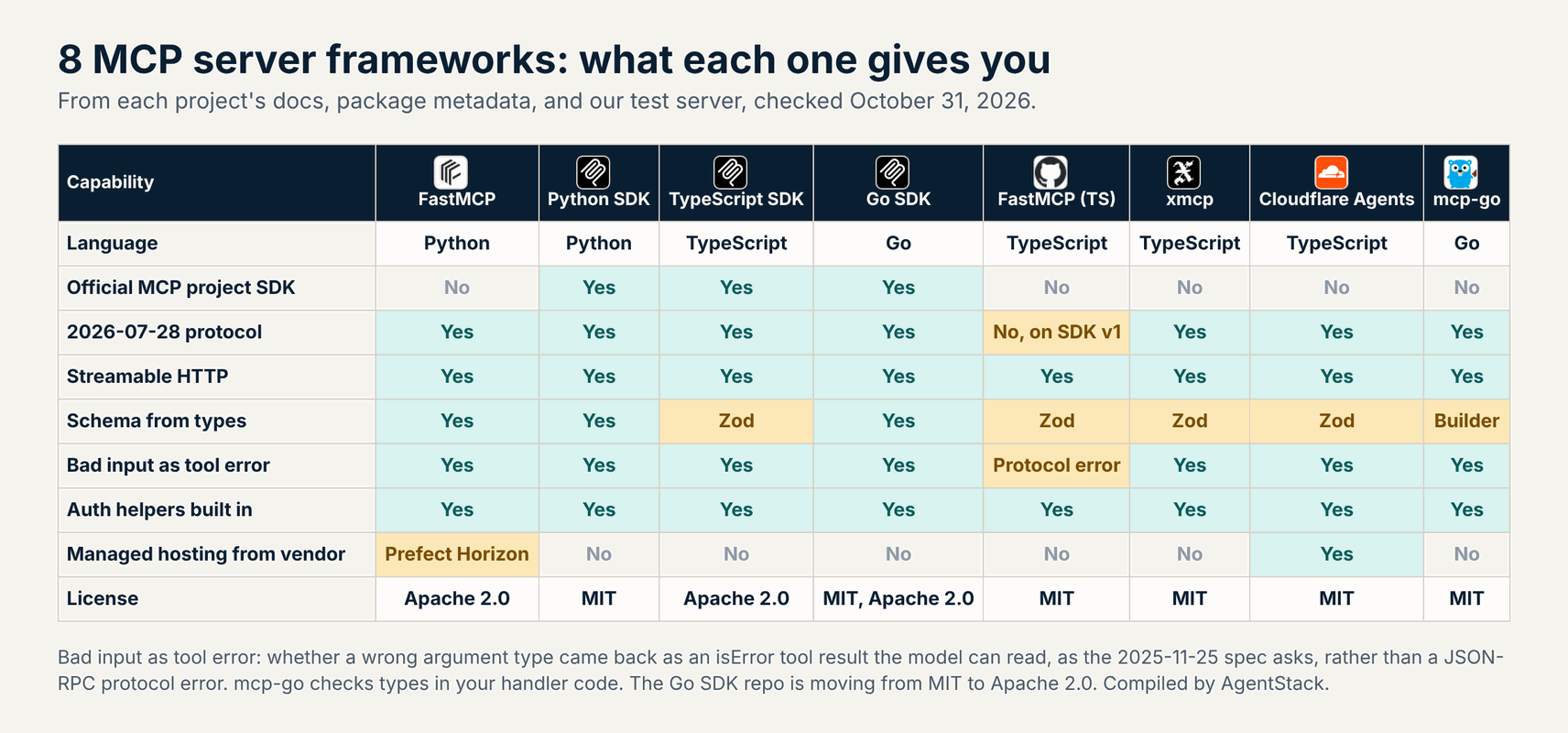
Verdict: the official SDKs and FastMCP lead on protocol coverage, while xmcp and Cloudflare win on deployment. Most teams need one framework per language they ship.
How We Tested These MCP Server Frameworks
We wrote one small order-lookup server in each framework, with two tools and one resource, and drove all of them with the same stdio test script. The tools were add, which takes two integers, and lookup_order, which returns a small JSON order. The resource was config://app.
The script started each server seven times and recorded the median time to the initialize reply. It then listed tools, called both of them, read the resource, and sent the string "two" where an integer was expected. The Cloudflare server ran under wrangler dev and was tested over HTTP.
# Python 3.12, installed with uv
fastmcp==4.1.4            # from fastmcp import FastMCP
mcp==2.3.0                # from mcp.server.mcpserver import MCPServer

# Node.js 22.20, runtime dependencies only
@modelcontextprotocol/server@2.4.0   # serveStdio(() => new McpServer(...))
fastmcp@4.23.8            # TypeScript FastMCP, on @modelcontextprotocol/sdk 1.x
xmcp@1.9.0                # npx xmcp build -> dist/stdio.js
agents@0.32.0             # createMcpHandler(factory), wrangler dev on :8799

# Go 1.27
github.com/modelcontextprotocol/go-sdk v1.8.0
github.com/mark3labs/mcp-go v1.5.0

# bad input test
tools/call add {"a": "two", "b": 3}
Every server answered a 2025-11-25 initialize handshake, so older clients keep working. The 2026-07-28 revision replaces that handshake with a server/discover call, so we took support for it from each project’s release notes and source code.
| Framework | Server lines | Cold start (median) | Install size | Tool list size | Bad input result |
|---|---|---|---|---|---|
| FastMCP | 19 | 631 ms | 81 MB, 62 packages | 726 chars | Tool error (isError) |
| MCP Python SDK | 19 | 448 ms | 38 MB, 28 packages | 636 chars | Tool error (isError) |
| MCP TypeScript SDK | 26 | 102 ms | 17 MB, 3 packages | 603 chars | Tool error (isError) |
| FastMCP for TypeScript | 26 | 244 ms | 64 MB, 194 packages | 651 chars | JSON-RPC error -32602 |
| xmcp | 27 across 4 files | 77 ms | 17 MB, 2 packages | 845 chars | Tool error (isError) |
| Cloudflare Agents SDK | 21 | HTTP, 4.7 ms per call locally | 97 MB, 98 packages | 603 chars | Tool error (isError) |
| MCP Go SDK | 49 | 4 ms | 11.9 MB binary | 969 chars | Tool error (isError) |
| mcp-go | 46 | 6 ms | 9.9 MB binary | 569 chars | Tool error from handler code |
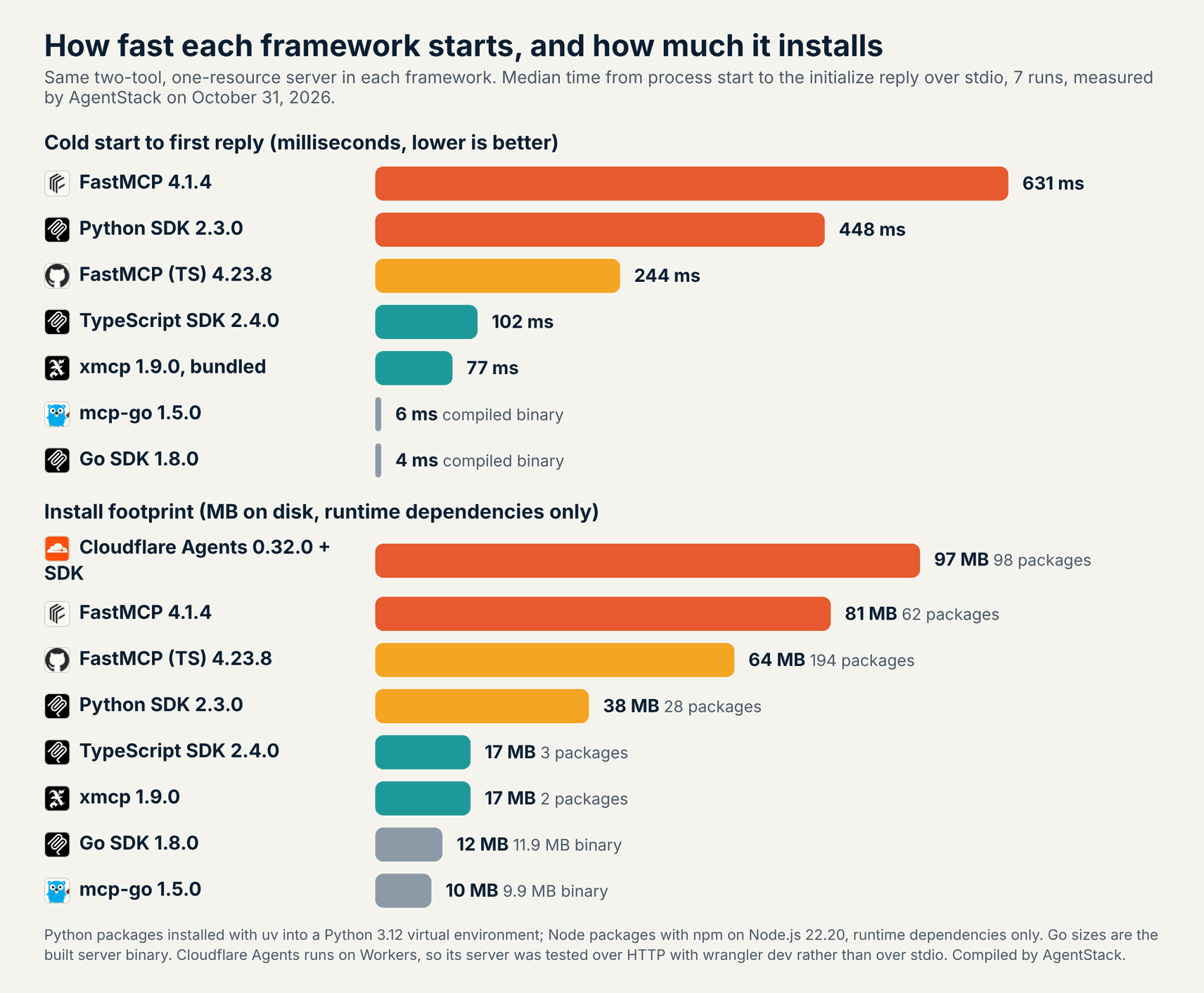
The error test matters most for agents, because a tool error goes back to the model as text it can read and fix, and a protocol error usually does not. FastMCP for TypeScript was the only framework that returned our bad argument as a JSON-RPC error. The Go SDK’s tool list was the largest because it adds an output schema for every typed tool.
1. FastMCP: Best Overall MCP Server Framework for Python
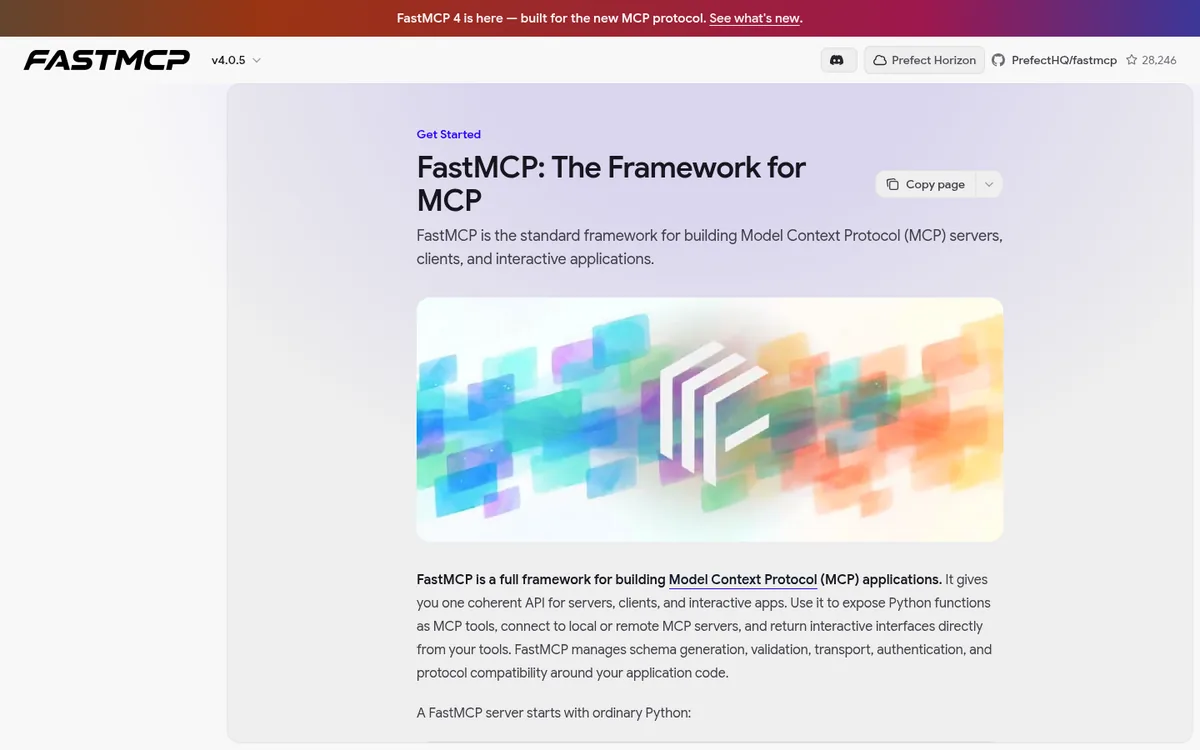
FastMCP is the best overall MCP server framework, because it pairs a few lines of decorated Python with the most production features of any option we tested. Prefect maintains it, and the FastMCP repo had about 28,200 GitHub stars on October 31, 2026.
The FastMCP 4 release notes say version 4 became stable on August 31, 2026 and sits on the Python SDK v2. One deployment negotiates the 2026-07-28 protocol with new clients and the older protocol with the rest. It adds interactive tools, background tasks through an extension, server composition, proxies, and OAuth helpers.
Our server took 19 lines and returned structured output for both tools without extra code. It was also the slowest to start at 631 milliseconds, which matters only for local stdio servers that clients launch on demand.
- Best for: Python teams that want auth, proxying, and composition in one package
- Language and runtime: Python, with Streamable HTTP and stdio
- Pricing (October 2026): free and open source under Apache 2.0; Prefect Horizon offers paid hosting
- Watch out for: run 4.1.1 or later after the FastMCP security advisories, and expect fast-moving releases
2. MCP TypeScript SDK v2: Best for TypeScript Teams
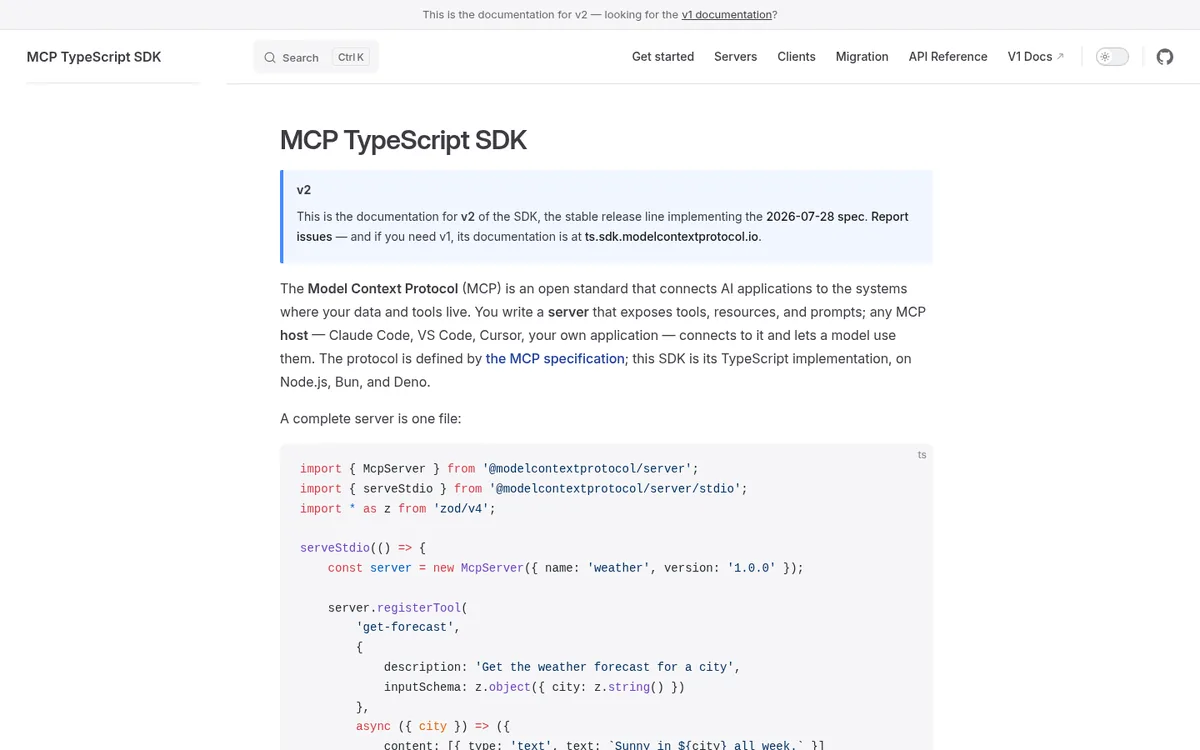
The official TypeScript SDK v2 is the best choice for Node.js teams, since it implements the 2026-07-28 protocol first and other TypeScript frameworks build on it. The v2 docs describe it as the stable release line, and v2 now ships as separate server, client, and core packages.
Our server needed 26 lines with Zod schemas, installed as three packages and 17 MB, and started in 102 milliseconds. Its serveStdio helper serves both the new protocol and 2025-era clients from one server factory. Version 2.4.0 added Skills over MCP, which our TypeScript SDK 2.4.0 report tested.
Adapters for Express, Fastify, Hono, and plain Node.js handle HTTP hosting. The v1 docs say version 1 stays on bug and security fixes for at least six months after the July 27, 2026 v2 release.
- Best for: TypeScript teams that want the reference build of the new protocol
- Language and runtime: TypeScript on Node.js, Bun, and Deno
- Pricing (October 2026): free and open source; the v2 server package is Apache 2.0
- Watch out for: v1 code needs the migration guide, since package names and several APIs changed
3. MCP Python SDK v2: Best for Spec-Level Control in Python
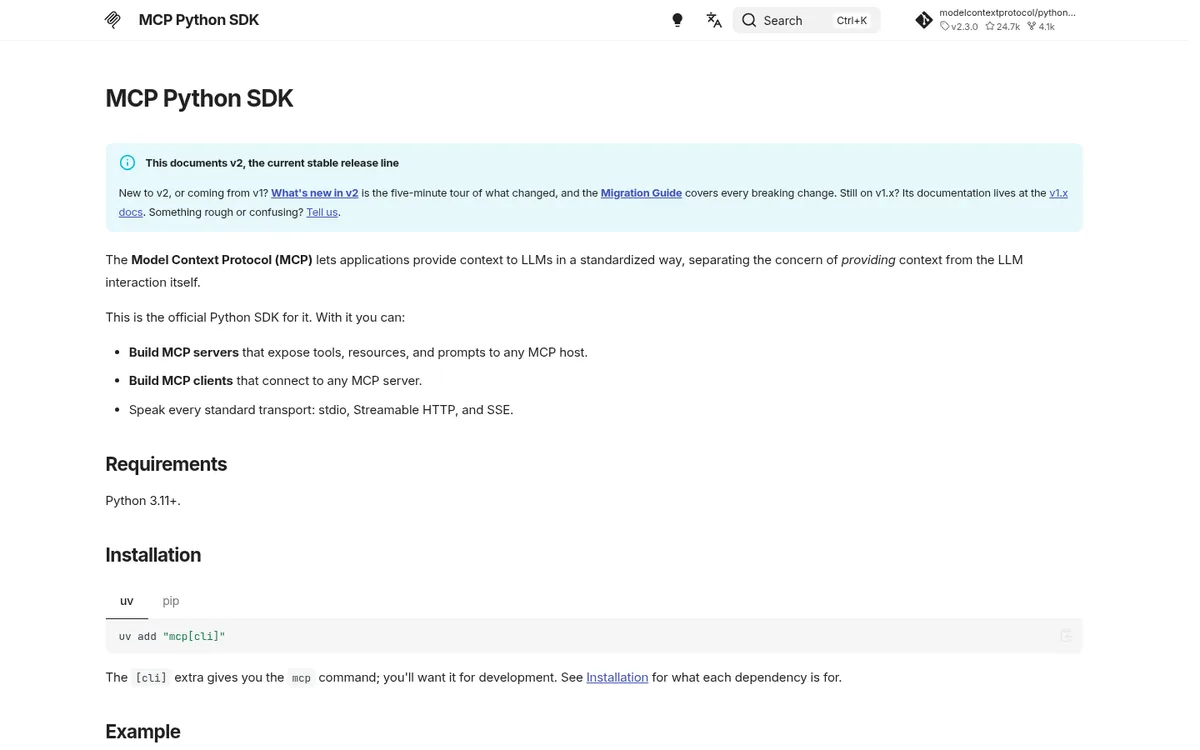
The official Python SDK v2 suits teams that want the protocol layer from the MCP project itself, with fewer moving parts than FastMCP. Version 2.0.0 shipped on July 28, 2026, the same day as the new protocol revision, and the Python SDK repo lists 2.3.0 from October 2 as the latest release.
Our server was the same 19 lines as FastMCP, with a smaller install of 38 MB against 81 MB and a faster start of 448 milliseconds. The catch came on the first run: v1 code that imports mcp.server.fastmcp fails on v2, because the class is now MCPServer. The migration guide lists every breaking change.
- Best for: Python teams that want official, lower-level building blocks
- Language and runtime: Python, with stdio, Streamable HTTP, and SSE
- Pricing (October 2026): free and open source under MIT
- Watch out for: pin
mcp<2for old code until you migrate, since v1 imports raise an error on v2
4. MCP Go SDK: Best for Go Teams and Small Binaries
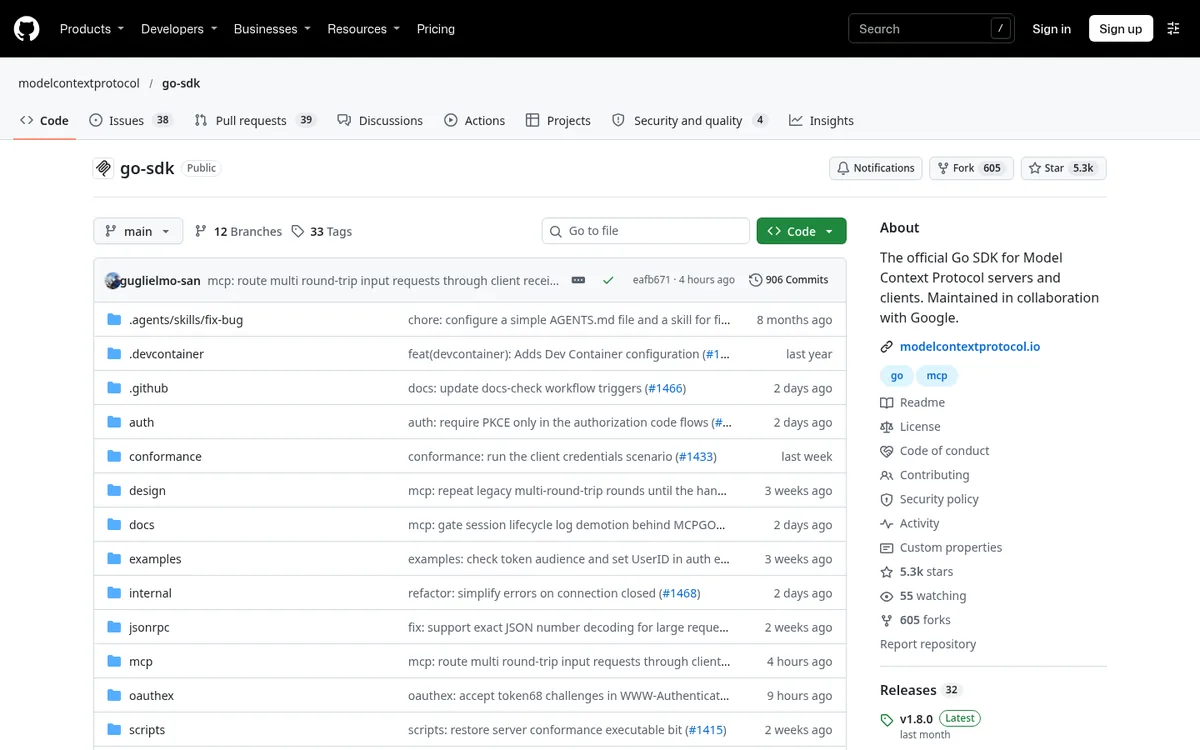
The official Go SDK is the best pick for Go teams, because typed tools come straight from Go structs and the server ships as one small binary. The Go SDK repo says Google helps maintain it, and our 49-line server built to an 11.9 MB binary that answered in 4 milliseconds.
The v1.7.0 release notes added full 2026-07-28 support in July 2026. Over HTTP, the new protocol works only when you set Stateless = true, while stateful sessions fall back to 2025-11-25. The SDK added output schemas for our typed tools, which made its tool list the largest we measured.
- Best for: platform and backend teams that write Go
- Language and runtime: Go, with stdio, Streamable HTTP, and in-memory transports
- Pricing (October 2026): free and open source; the repo is moving from MIT to Apache 2.0
- Watch out for: Go needs more lines per tool than Python, and the stateless switch is easy to miss
5. FastMCP for TypeScript: Best for Quick TypeScript Servers
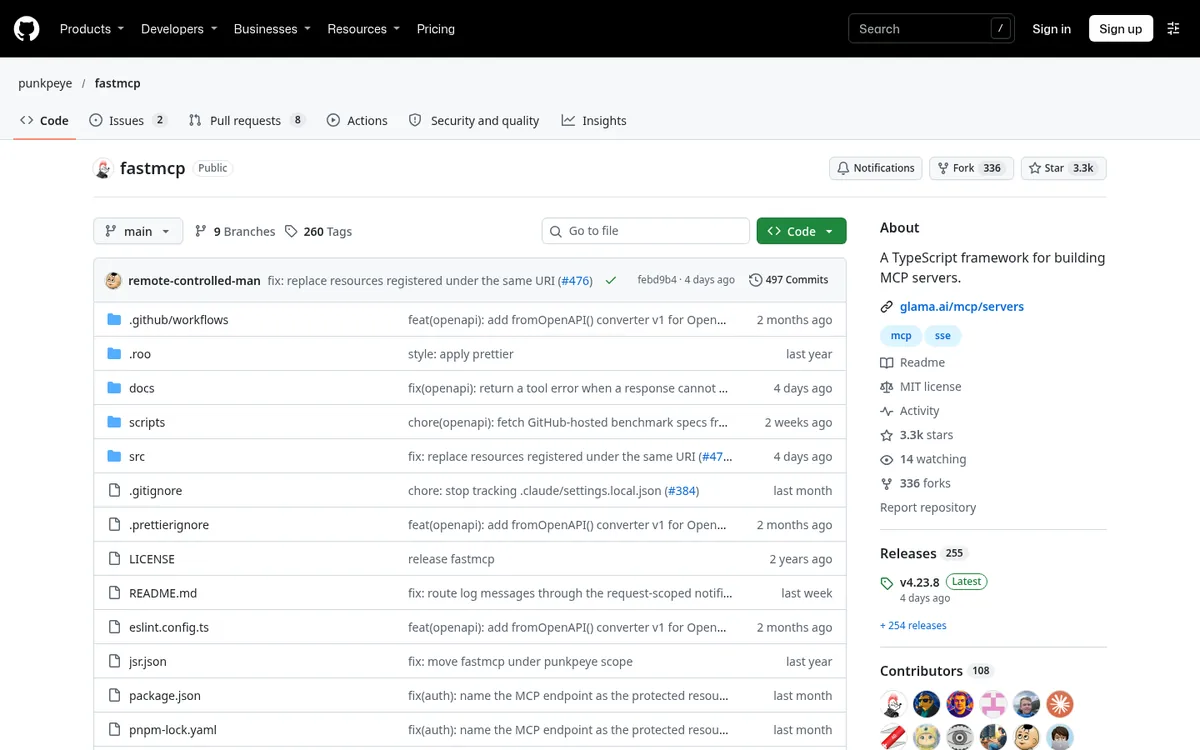
FastMCP for TypeScript is a good fit for quick servers aimed at current clients, with sessions, HTTP streaming, and auth hooks in a compact API. It is a separate community project from Python FastMCP, and the FastMCP TypeScript repo had about 3,300 stars on October 31, 2026.
Version 4.23.8 depends on the v1 TypeScript SDK, and its README says it supports protocol versions up to 2025-11-25 and does not support the 2026-07-28 revision. It was also the only framework that returned our bad argument as a JSON-RPC protocol error, which the 2025-11-25 spec asks servers to report as a tool error.
- Best for: TypeScript developers who want a small API and ship to current clients
- Language and runtime: TypeScript on Node.js, with stdio and HTTP streaming
- Pricing (October 2026): free and open source under MIT
- Watch out for: 194 installed packages, and no path to the new protocol until it moves to SDK v2
6. xmcp: Best for File-Based TypeScript Projects
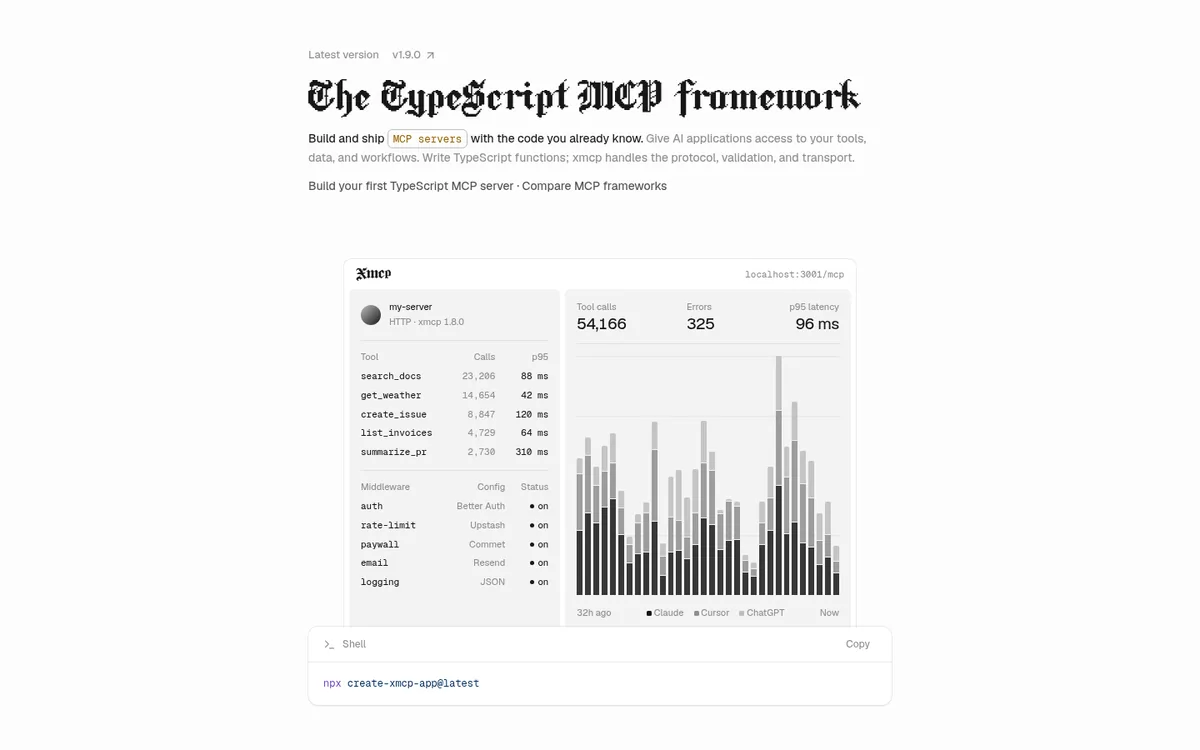
xmcp is the best choice for TypeScript teams who like file-based routing, since each tool, prompt, and resource is its own file that registers on build. The xmcp site lists middleware, auth integrations, and adapters that plug it into existing Next.js, Express, and NestJS apps.
It builds on the official v2 SDK and bundles the server into one file, which started in 77 milliseconds, the fastest of the Node.js options. The first build failed until we added the @xmcp-dev/compiler dev package, a tsconfig.json, and a config line for the unused prompts folder. Resource URIs come from folder names, per the xmcp resource docs.
- Best for: web teams that want MCP tools inside an existing TypeScript app
- Language and runtime: TypeScript, with HTTP and stdio from the same code
- Pricing (October 2026): free and open source under MIT
- Watch out for: file and folder names set tool names and resource URIs, so renames change the API
7. Cloudflare Agents SDK: Best for Remote Servers on Workers
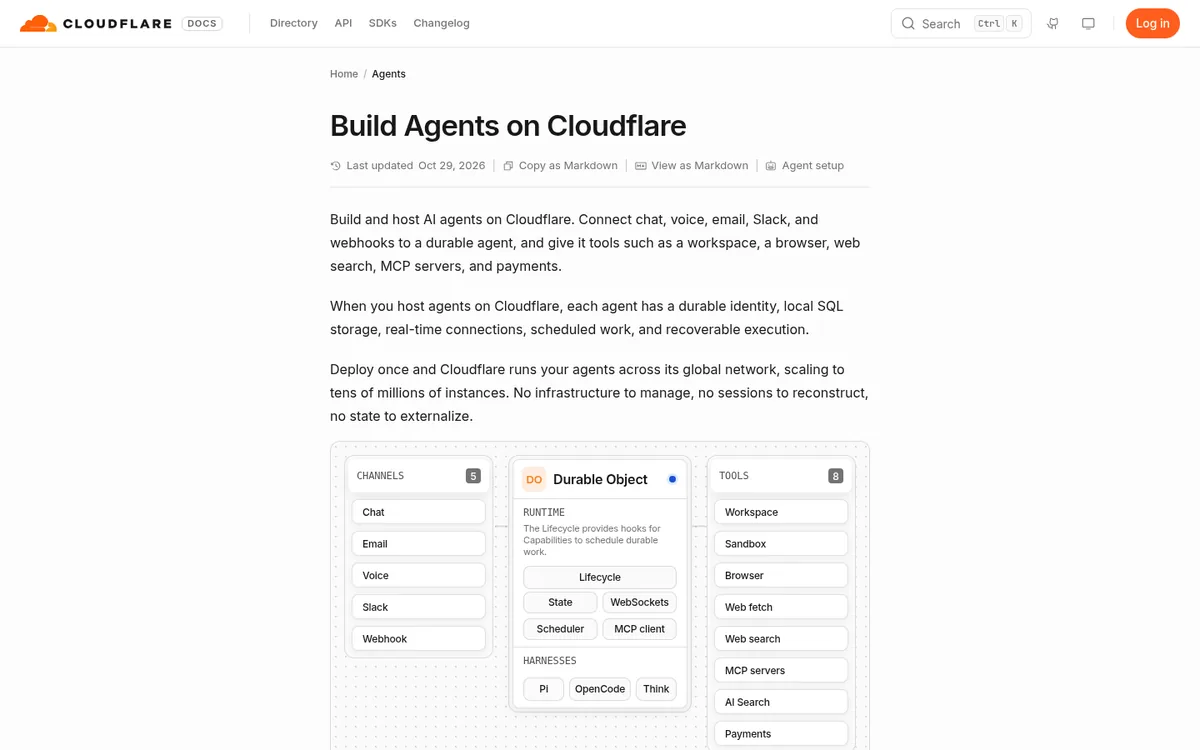
The Cloudflare Agents SDK is the best option for remote MCP servers that should run on the edge with no servers to manage. Its createMcpHandler takes a v2 SDK server factory and serves stateless Streamable HTTP, while McpAgent keeps sessions in Durable Objects, per the Cloudflare MCP docs.
Our 21-line worker ran locally under wrangler dev, returned no session ID, and answered tool calls in a median 4.7 milliseconds on the same machine. The install was the largest at 97 MB because the agents package covers far more than MCP. Our Cloudflare vs Vercel vs AgentCore guide compares hosting costs.
- Best for: teams that want global, serverless MCP endpoints with OAuth
- Language and runtime: TypeScript on Cloudflare Workers and Durable Objects
- Pricing (October 2026): the SDK is free under MIT; Workers has a free tier and usage-based paid plans
- Watch out for: local tests need wrangler, and the code is tied to the Workers runtime
8. mcp-go: Best Builder-Style Framework for Go
mcp-go is the best fit for Go developers who prefer building tools with option functions over struct tags. Mark3 Labs maintains it, the mcp-go repo had about 9,200 stars on October 31, 2026, and version 1.5.0 shipped on October 30 with the 2026-07-28 protocol as its latest version.
Our server built to a 9.9 MB binary that answered in 6 milliseconds, with the smallest tool list we measured at 569 characters. Typed checks live in your handler, so our add tool advertised a plain number type and rejected the string through RequireInt.
- Best for: Go developers who want a mature community framework
- Language and runtime: Go, with stdio, SSE, and Streamable HTTP
- Pricing (October 2026): free and open source under MIT
- Watch out for: argument types are only as strict as your handler code
Other MCP SDKs and Frameworks Worth Knowing
The MCP project also runs official SDKs for Java, C#, Kotlin, Rust, Swift, Ruby, and PHP, so most backend languages now have a supported option. We did not build test servers in these, so the table lists only facts from each repo on October 31, 2026.
| SDK or framework | Language | GitHub stars | Note |
|---|---|---|---|
| MCP Java SDK | Java | about 3,800 | Works with Spring AI |
| MCP C# SDK | C# | about 4,600 | Built with Microsoft |
| MCP Rust SDK | Rust | about 4,100 | Published as rmcp |
| MCP Kotlin SDK | Kotlin | about 1,500 | Built with JetBrains |
| mcp-framework | TypeScript | about 900 | No release since April 2026 |
How to Choose an MCP Server Framework
Start with the language your team already ships, then decide where the server will run, and only then compare features and start-up time. The guide below turns that into two questions, and the personas after it give each type of team a short starting plan.
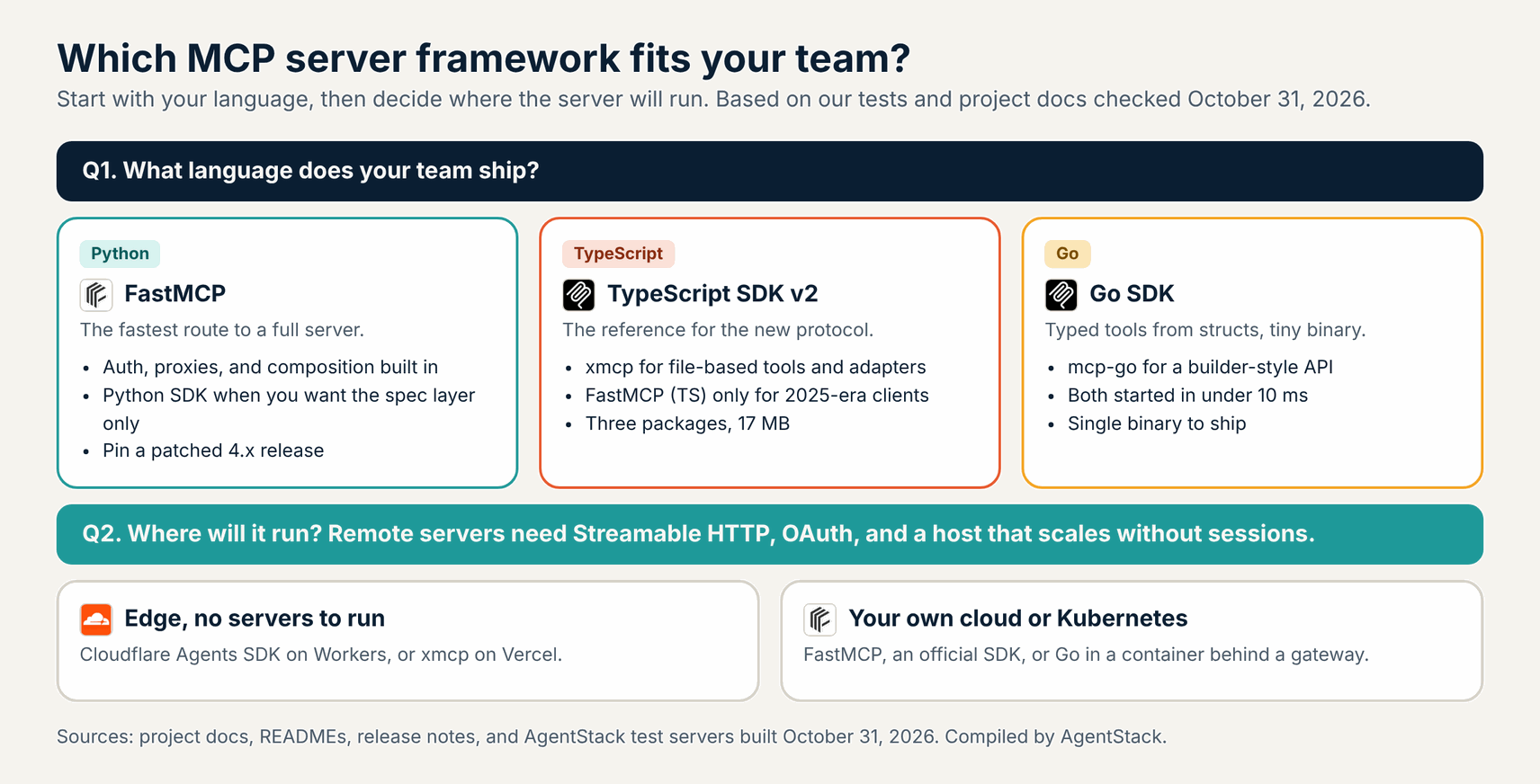
You build internal tools in Python
- Start with FastMCP and pin a patched 4.x release.
- Drop to the Python SDK only when you need control over each protocol message.
- Put remote servers behind one of the MCP gateways we reviewed.
You ship a TypeScript product
- Use the TypeScript SDK v2 for new servers, or xmcp inside an existing web app.
- Move FastMCP for TypeScript projects to SDK v2 code before clients drop the old handshake.
- Pick a host from our MCP hosting platforms guide.
You run a platform team in Go
- Use the Go SDK for typed tools, or mcp-go for a builder API.
- Set the stateless option when you serve the new protocol over HTTP.
- List finished servers in a catalog from our MCP registries guide.
Security Checks Before You Ship an MCP Server
A framework handles the protocol, but every tool still runs with the access you give it, so scope credentials and validate inputs before the first client connects. Our MCP tool security bugs report shows how often shipped servers carry flaws.
- Patch the framework: FastMCP fixed 14 advisories in October, so track releases for whichever framework you choose.
- Give each server its own identity: use short-lived credentials and the non-human identity tools we reviewed.
- Scan before you publish: run new servers through the MCP security tools in our roundup.
- Test tool behavior: add the server to the suites in our AI agent testing tools guide before rollout.
Frequently Asked Questions
What is an MCP server framework?
An MCP server framework is a library that handles the Model Context Protocol for you. You write tools, resources, and prompts as normal functions, and the framework builds schemas, validates input, and manages stdio or HTTP transports. FastMCP, the official SDKs, xmcp, and mcp-go are common examples in 2026.
Should I use FastMCP or the official Python SDK?
Use FastMCP when you want auth, proxying, server composition, and background tasks with little code. Use the official Python SDK when you want fewer dependencies and direct control over the protocol. In our test, the SDK installed in 38 MB and FastMCP in 81 MB, and both servers took 19 lines.
Which MCP frameworks support the 2026-07-28 protocol?
FastMCP 4, the Python SDK v2, the TypeScript SDK v2, the Go SDK since 1.7.0, mcp-go, xmcp, and the Cloudflare Agents SDK all support it, per their docs and source. FastMCP for TypeScript still runs on the v1 TypeScript SDK, which stops at the 2025-11-25 revision.
Which MCP server framework is fastest?
The Go frameworks were fastest in our test. The official Go SDK answered the first request in 4 milliseconds and mcp-go in 6. The bundled xmcp server took 77 milliseconds, the TypeScript SDK 102, and the Python frameworks 448 to 631. Start-up matters most for local stdio servers that clients launch on demand.
Do MCP server frameworks cost money?
No. All eight frameworks in this guide are free and open source under MIT or Apache 2.0 licenses. You pay only for hosting, such as Cloudflare Workers, Prefect Horizon for FastMCP, a cloud container service, or your own servers. Local stdio servers that run on a developer machine cost nothing extra.
Related Guides
If your framework builds confirmation steps, our MCP elicitation approval lab shows why ctx.elicit() fails on stateless 2026-07-28 connections and which pattern works on both revisions.
After you build a server with one of these frameworks, add tests to every pull request. Our tested list of MCP testing tools compares MCPJam, MCP Server Tester with Playwright, toolproof fuzzing and the official MCP Conformance suite on the same buggy FastMCP server.
Keep going with the MCP hub, our MCP explainer, the best MCP servers list, the CRM MCP servers roundup, and our AI agent frameworks guide. Each one covers a layer next to the server you build, from ready-made servers to the agents that call them.
More context sits in MCP hosting platforms, Smithery vs Glama vs the official MCP Registry, and our report on the FastMCP security advisories.
The Bottom Line
Choose FastMCP for Python, the official TypeScript SDK v2 for Node.js, and the official Go SDK for Go, then add xmcp or Cloudflare when deployment shapes the choice. Whatever you pick, confirm that it speaks the 2026-07-28 protocol and reports bad input as a tool error. For a category of production servers rather than the framework, see our database MCP servers guide for Postgres, Snowflake and more.
These frameworks ship releases every week or two, so recheck the linked docs before you start and build a small test server of your own first. Send corrections or your own results through our contact page. For a worked example of a server category rather than the framework itself, see our Playwright MCP vs Chrome DevTools MCP vs Browserbase comparison.