
Last updated October 23, 2026. We installed all three frameworks that day, crashed and resumed the same two-step job in each, and checked versions, releases, and advisories against GitHub and PyPI.
LangGraph vs CrewAI vs AutoGen is now a two-way choice for new projects: LangGraph suits teams that need durable, stateful workflows, CrewAI suits teams that want role-based agent crews running quickly, and AutoGen is archived and should only be migrated away from. Microsoft stopped maintaining AutoGen and points users to Microsoft Agent Framework instead.
All three are free, MIT-licensed Python libraries for building agents that call tools and hand work to each other. They differ in how they save progress, how heavy they are to install, and how actively they are maintained. This page sits in our agent frameworks hub, and our guide to the 12 best AI agent frameworks covers the wider field.
On October 23, 2026 we installed each framework into a clean Python 3.12 environment, scanned the dependencies for known vulnerabilities, and ran a crash and resume test five times per framework. No project or vendor paid for placement or reviewed this page, per our editorial standards and disclosure policy.
TL;DR
- AutoGen is archived. Its README says Microsoft is not providing bug fixes or security fixes and advises against production use. Its last release, 0.7.5, shipped on September 30, 2025.
- LangGraph’s default save mode can repeat work after a crash. With the default
durability="async", our killed job re-ran its research step in 5 of 5 trials. Withdurability="sync"it resumed with 0 repeats. - CrewAI resumed cleanly, with two catches. Checkpointing skipped finished work in 5 of 5 trials, but tools written with the
@tooldecorator broke checkpoint saving, and telemetry added about 10 seconds to each offline resume. - CrewAI is ten times heavier. It installed 137 packages and 775 MB, against 77 MB for LangGraph, and it was the only framework with known vulnerabilities in its dependency tree.
- LangGraph has the most usage by far. It logged 44.8 million PyPI downloads in the last month, about 18 times CrewAI’s 2.4 million.
LangGraph vs CrewAI vs AutoGen at a Glance
LangGraph is a graph runtime, CrewAI is a team of role-based agents, and AutoGen is a conversation framework that no longer gets updates. The table compares the three on fit, maintenance, how each saves progress, install size, and package health, using each project’s repository, PyPI, and our own install on October 23, 2026.
| Framework | Best for | Latest release | Saving progress | Install size | Known vulnerabilities |
|---|---|---|---|---|---|
| LangGraph | Durable, stateful workflows | 1.2.16, October 16, 2026 | Checkpointer after every step | 46 packages, 77 MB | 0 |
| CrewAI | Fast role-based crews | 1.15.28, October 14, 2026 | checkpoint=True on a crew or flow | 137 packages, 775 MB | 6 advisories in 3 packages |
| AutoGen | Existing apps only | 0.7.5, September 30, 2025 (archived) | Manual save_state() | 28 packages, 59 MB | 0, with no future fixes |
Verdict: Pick LangGraph when a crash must never repeat a costly or risky step, and pick CrewAI when you want a working multi-agent prototype with the least code. Treat AutoGen as legacy code and plan a move to Microsoft Agent Framework, which keeps AutoGen’s ideas and adds workflow checkpoints.
How We Tested LangGraph, CrewAI, and AutoGen
To compare LangGraph vs CrewAI vs AutoGen on equal terms, we built the same two-step job in each: a researcher agent calls a price lookup tool, then a writer agent summarizes the result. We then killed the process as the writer started and resumed it in a fresh process, to see what each framework had saved.
- Scripted models: each agent used a fake model that returns fixed replies, so runs were offline, free, and repeatable, and every model call was logged.
- Crash and resume: five trials per framework and setting, counting how many research calls ran again after the restart.
- Network check: a small hook blocked and counted every outbound DNS lookup during the resume.
- Install and dependency scan: package count and disk size after
uv pip install, then a pip-audit scan of each environment. - Project health: releases in the last 12 months, last month’s PyPI downloads, and GitHub stars, all checked on the same day.
What Our October 23 Hands-On Test Found
LangGraph in sync mode and CrewAI with a class-based tool resumed without repeating work, while LangGraph in its default async mode repeated the research step every time. AutoGen matched the best result only with hand-written save points, so defaults mattered more than framework names in this test.
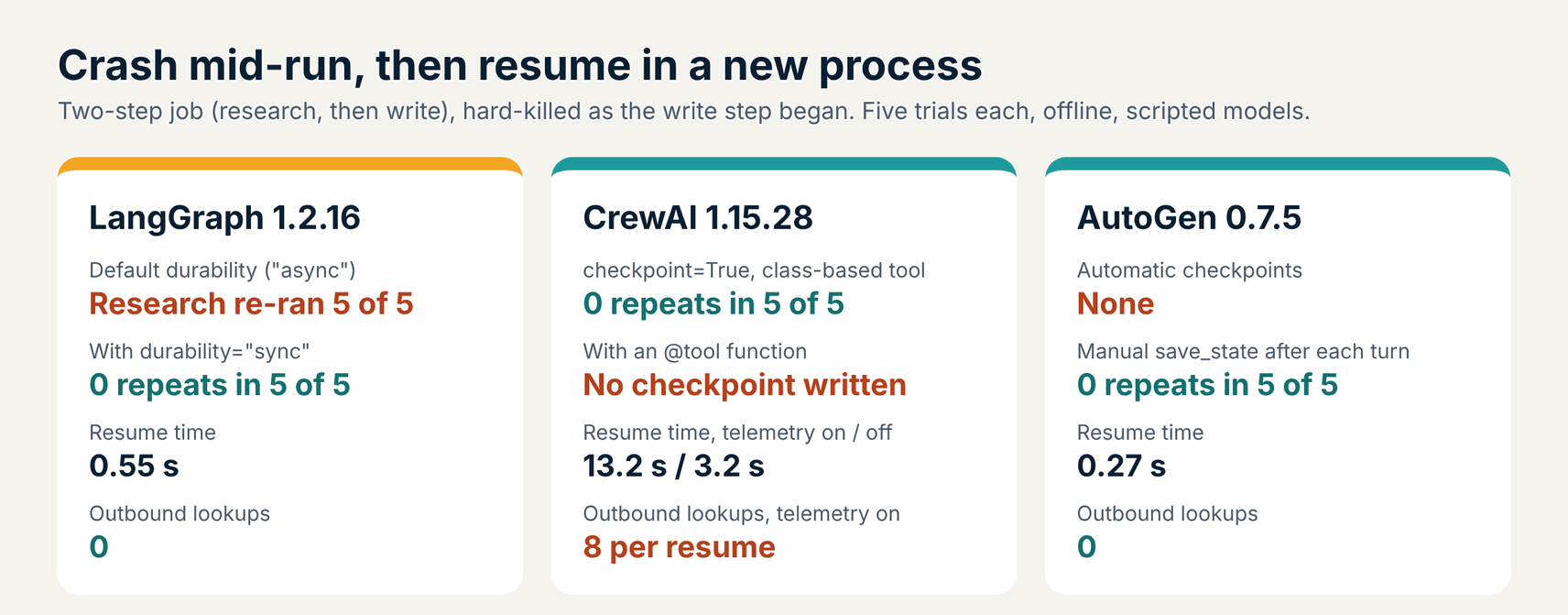
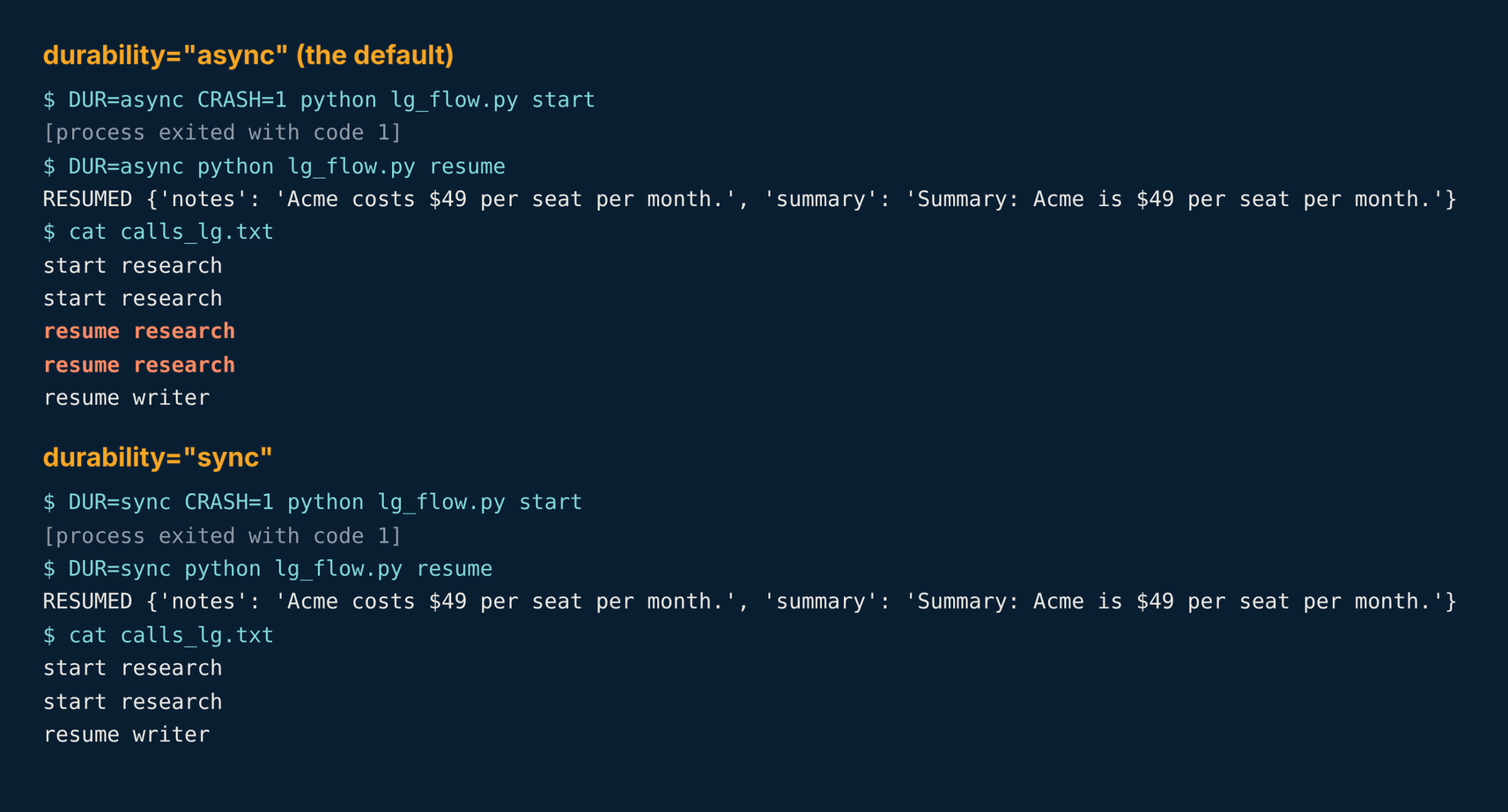
- LangGraph: in the default async mode the research step ran again in every trial, because the checkpoint for that step had not been written when the process died. Sync mode saved it first and resumed straight into the writer.
- CrewAI: with
checkpoint=Trueand aBaseToolclass, every resume skipped the finished research task. With telemetry on, each resume tried 8 lookups totelemetry.crewai.comand took 13.2 seconds offline, against 3.2 seconds with telemetry off. - AutoGen: it has no automatic checkpoints, so we called
save_state()after the first turn. With that in place,load_state()resumed in 0.27 seconds with no repeats. - Cold start: the median import time was 0.52 seconds for LangGraph, 0.54 seconds for AutoGen, and 1.96 seconds for CrewAI.
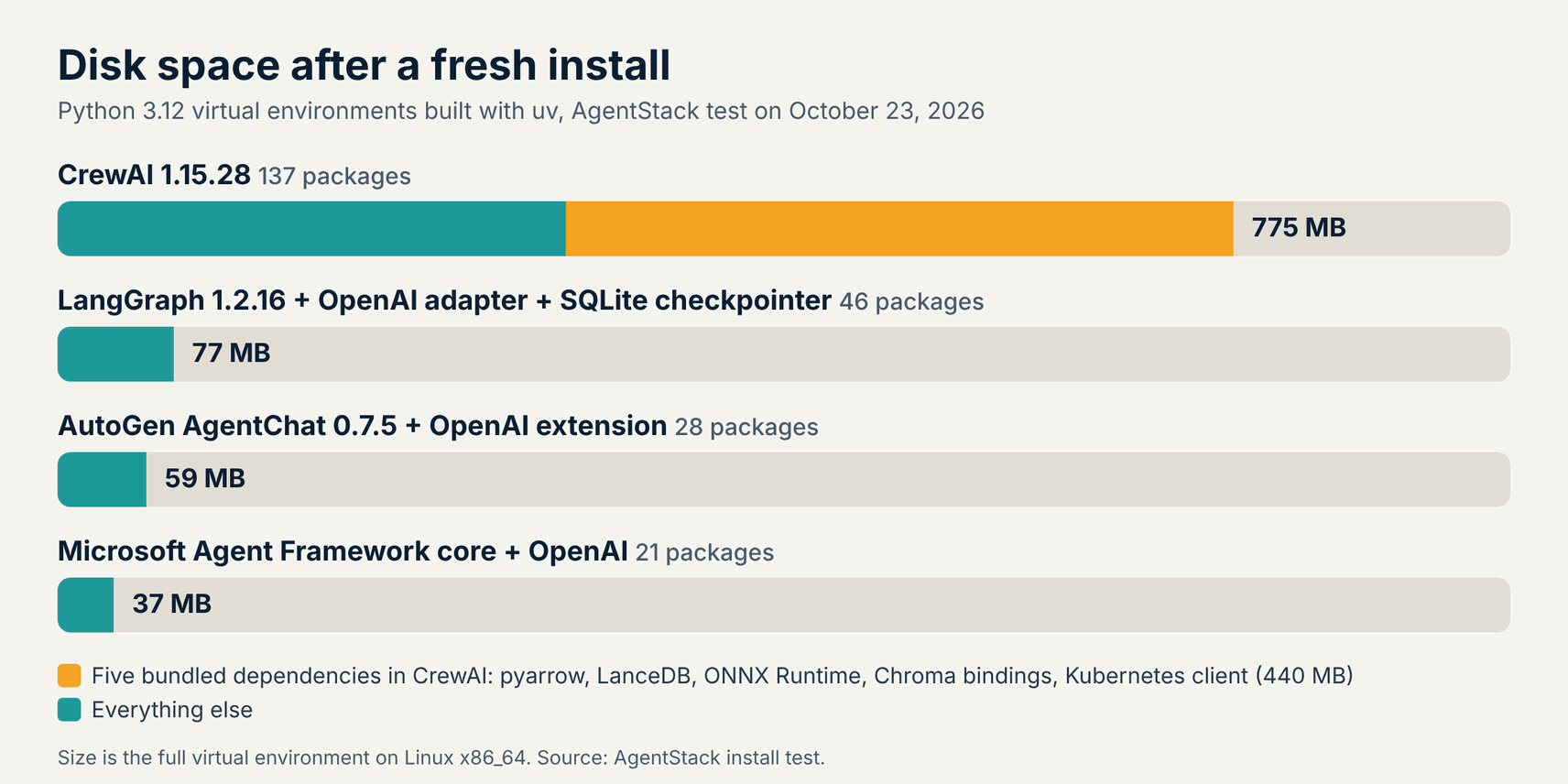
CrewAI took 775 MB because it bundles data and vector store libraries that many crews never use. pyarrow, LanceDB, ONNX Runtime, Chroma, and the Kubernetes client alone came to about 440 MB, which matters for container images and serverless size limits.
1. LangGraph: Best for Durable, Stateful Agent Workflows
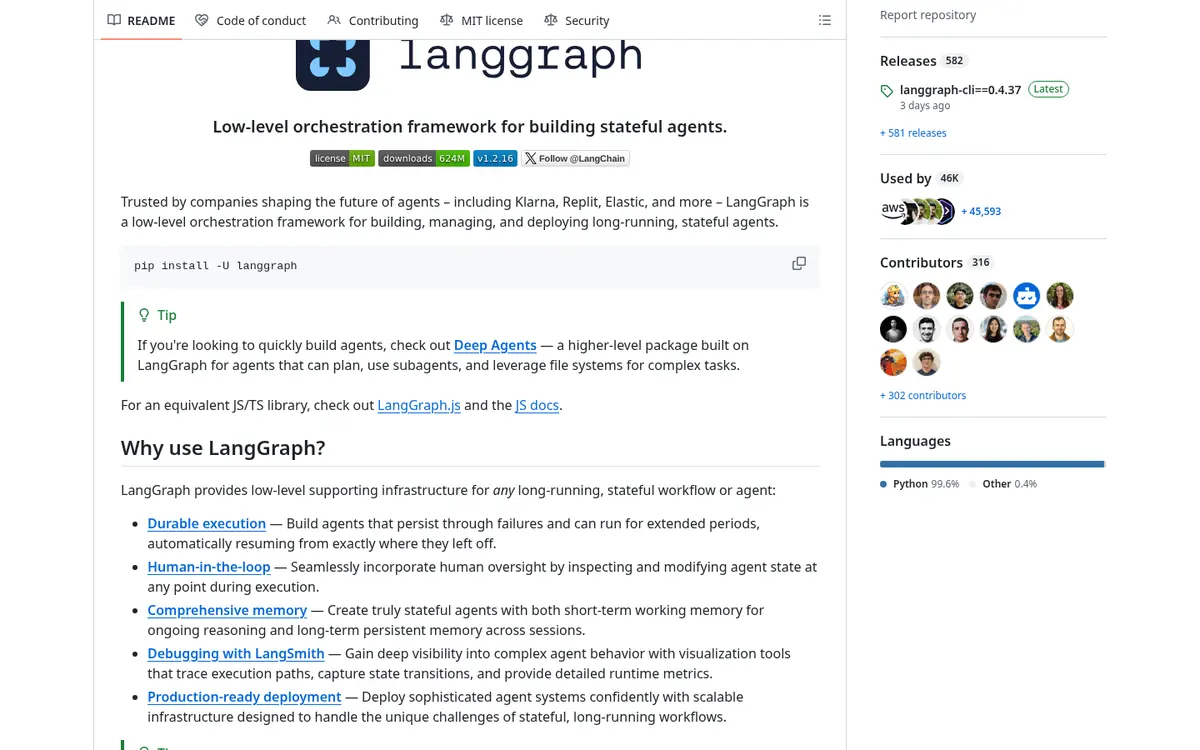
LangGraph models an agent as a graph of steps that share one state object, and a checkpointer saves that state after each step so a run can resume, pause for a human, or replay. Version 1.2.16 shipped on October 16, 2026, and the repository has 43,726 stars and 161 releases across its packages in the last 12 months.
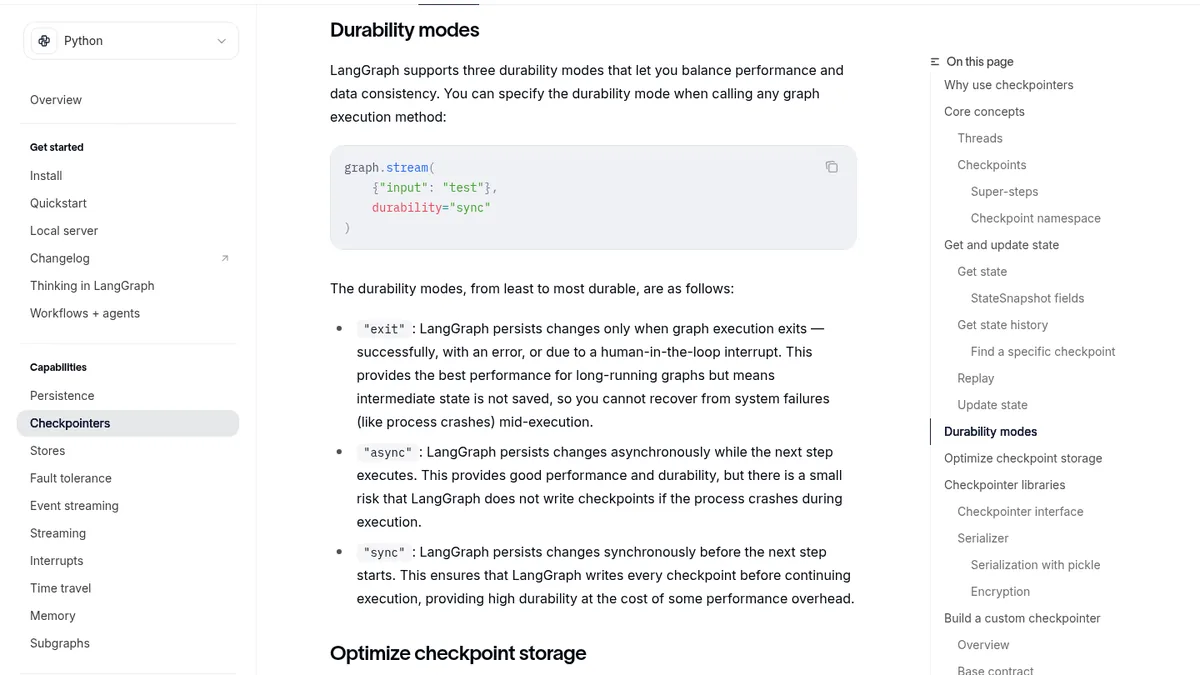
The setting that decides crash safety is durability. LangGraph’s checkpointer docs list three modes: "exit" saves only when the run ends, "async" saves while the next step runs, and "sync" saves before the next step starts. The docs warn that async mode carries a small risk of a missing checkpoint if the process crashes.
In our test, that small risk showed up every time: a hard kill right as the next step began lost the research checkpoint in 5 of 5 async runs. The research step ran again on resume, which is harmless for a price lookup but costly for a step that sends an email, charges a card, or calls a slow model.
LangGraph also had the lightest working install with a SQLite checkpointer, no known vulnerabilities, and no outbound calls during resume. Hosting is optional: LangSmith’s Plus plan costs $39 per seat per month and includes one free small serverless deployment, per the pricing page. Tracing options are compared in our LangSmith alternatives guide.
- Best for: teams building long-running or human-approved agent workflows where a repeated step is expensive or unsafe.
- Pricing (October 2026): free under MIT. LangSmith Developer is $0 for one seat, and Plus is $39 per seat per month plus usage.
- Watch out for: pass
durability="sync"for steps with side effects, and plan for a steeper learning curve than CrewAI’s role and task model.
2. CrewAI: Best for Fast Role-Based Multi-Agent Prototypes
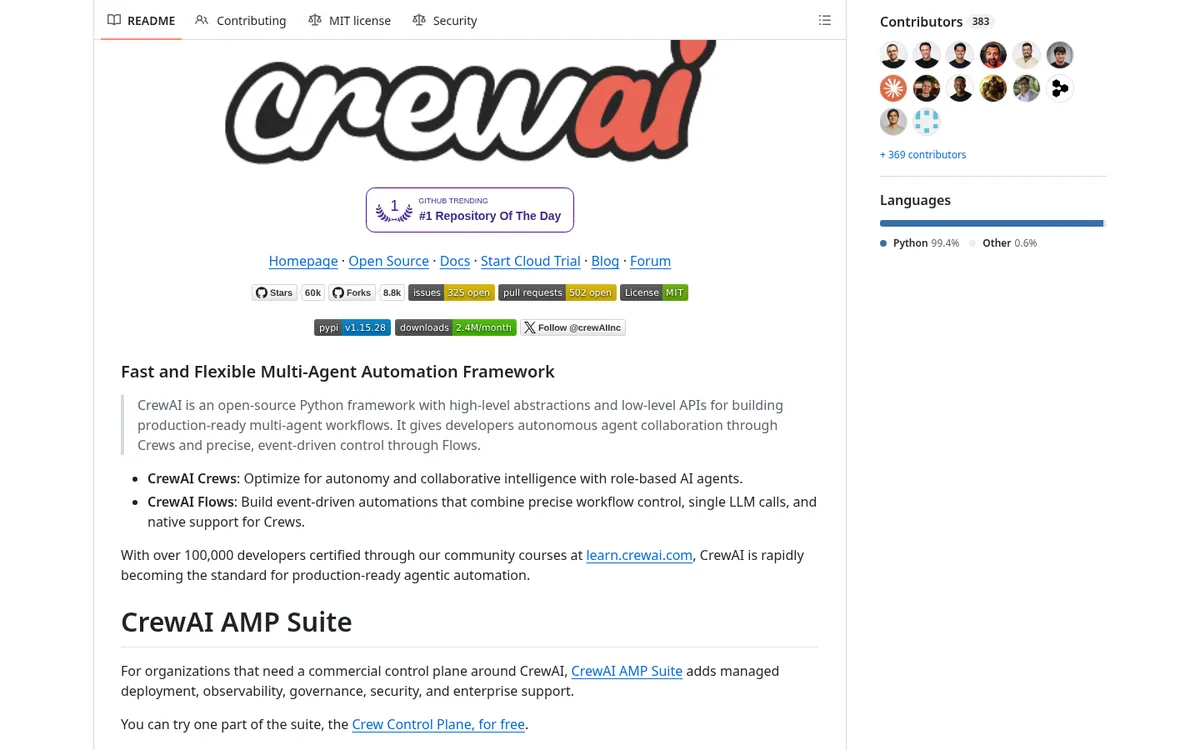
CrewAI lets you describe agents as roles with goals, give them tasks, and run them as a crew, with Flows for event-driven control when you need more structure. Version 1.15.28 shipped on October 14, 2026, the repository has 59,990 stars, and it tagged 123 releases in the last 12 months. It needs Python 3.10 to 3.13.
Its checkpointing docs describe checkpoint=True on a crew, flow, or agent, with a JSON file written to ./.checkpoints/ and a restore that skips finished tasks. That matched our test after one change: we passed our custom model objects back in after restore, because the checkpoint rebuilt them as default OpenAI clients that asked for an API key.
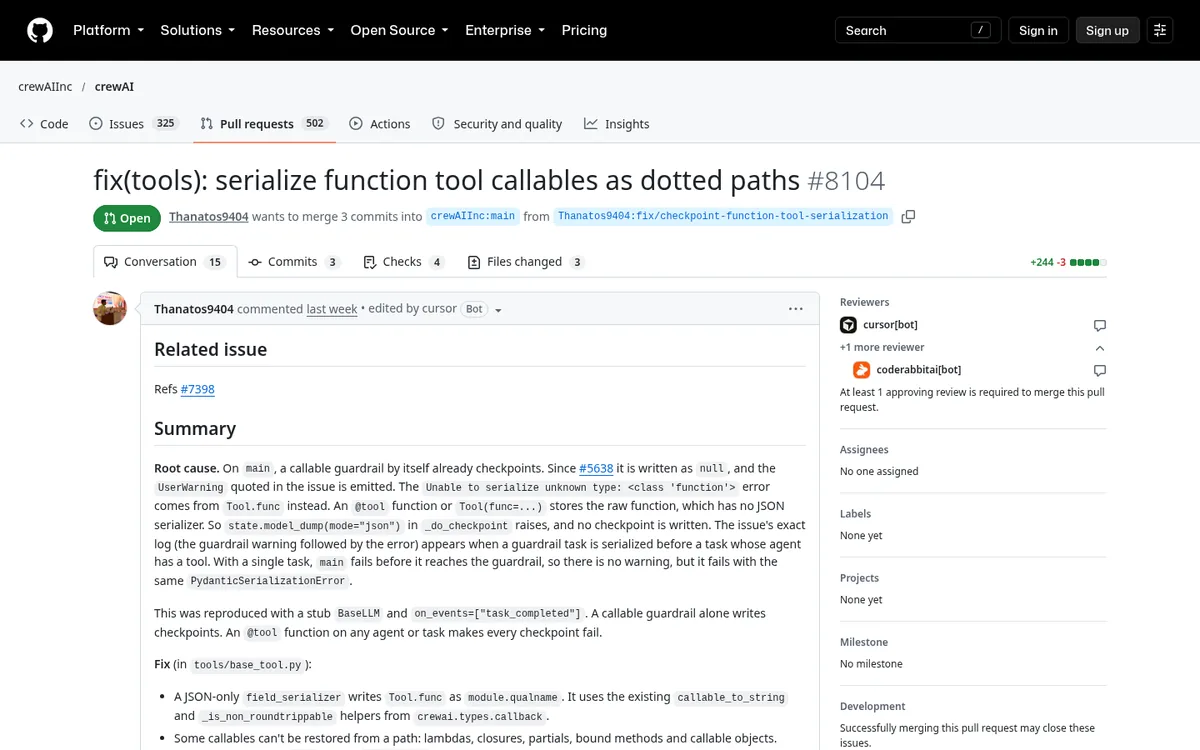
Tools written with the @tool decorator broke checkpoint saving in 3 of 3 runs. The crew finished, but each save failed with a PydanticSerializationError and no checkpoint file was written. Open pull request 8104 traces the cause to function tools that store raw Python callables, and a class-based BaseTool avoided the problem.
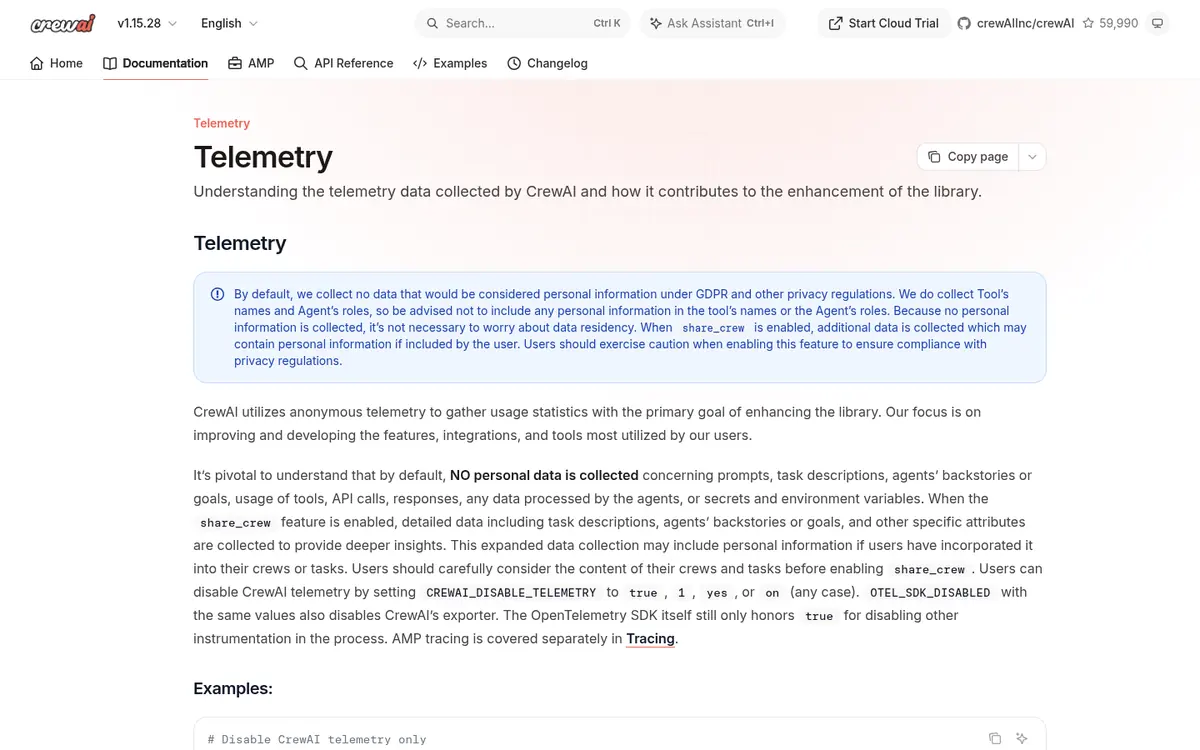
CrewAI also sends anonymous usage telemetry by default. Its telemetry page says no prompts, task text, or responses are collected unless you turn on share_crew, and that CREWAI_DISABLE_TELEMETRY or OTEL_SDK_DISABLED switches it off. Setting it cut our offline resume from 13.2 to 3.2 seconds.
The pip-audit scan found 6 advisories in 3 CrewAI dependencies: four in Chroma 1.5.9 with no fix yet, one in the MCP SDK 1.28.1, and one in uv 0.11.33. The Chroma issues concern its server API and the MCP advisory concerns stateful HTTP servers, but CrewAI pins both, so scanners will flag your image until a new release ships. A commit titled “resolve pip-audit findings” landed on October 22, 2026, but no release included it when we checked.
- Best for: teams that want a multi-agent prototype in an afternoon and are comfortable with a large dependency tree.
- Pricing (October 2026): free under MIT. The hosted Basic plan is free with 50 workflow executions a month, and Enterprise is priced by quote, per the pricing page.
- Watch out for: use
BaseToolclasses if you checkpoint, setCREWAI_DISABLE_TELEMETRY=truein locked-down networks, and rescan dependencies after each upgrade.
3. AutoGen: Archived and Best Replaced by Its Successor
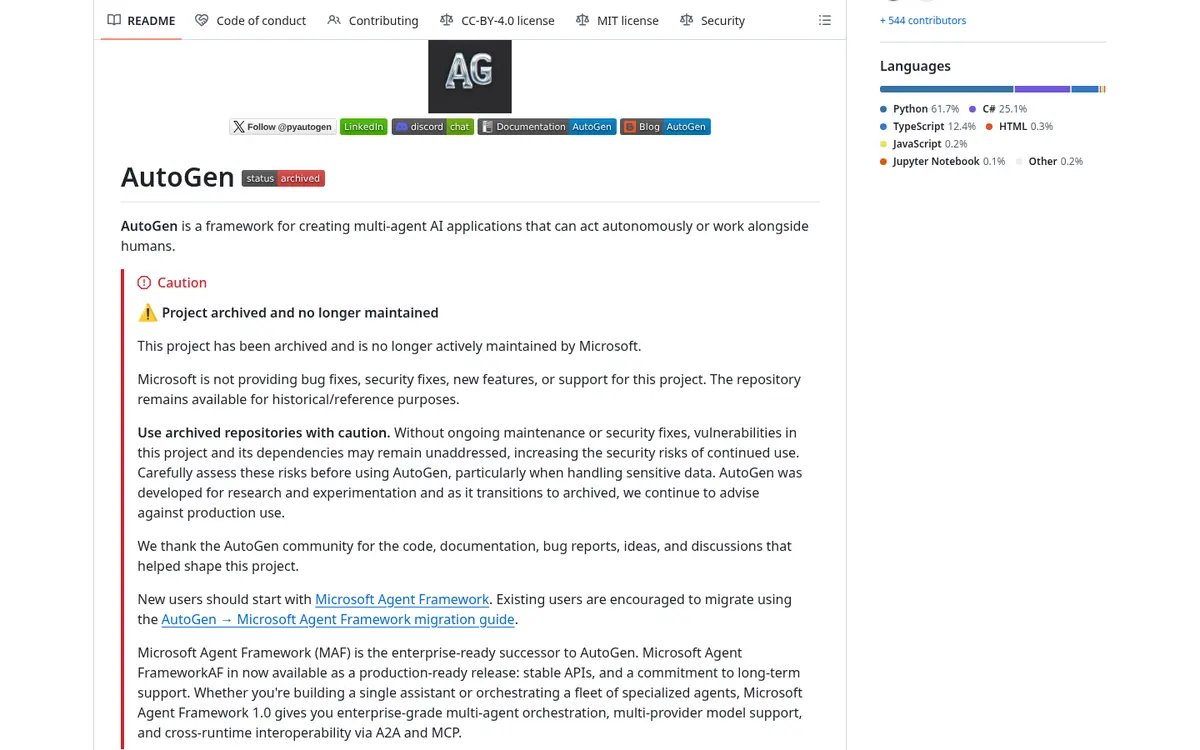
AutoGen is archived: its README says Microsoft is not providing bug fixes, security fixes, new features, or support, and advises against production use. The notice in the AutoGen repository was clarified in pull request 8366 on October 16, 2026, and the last release, 0.7.5, shipped on September 30, 2025, with none in the 12 months since.
The code still works. AutoGen AgentChat installed in 28 packages, scanned clean, and resumed our job in 0.27 seconds once we called save_state() and load_state() by hand, as its state guide shows. It still logged 379,923 PyPI downloads last month, so plenty of apps depend on it.
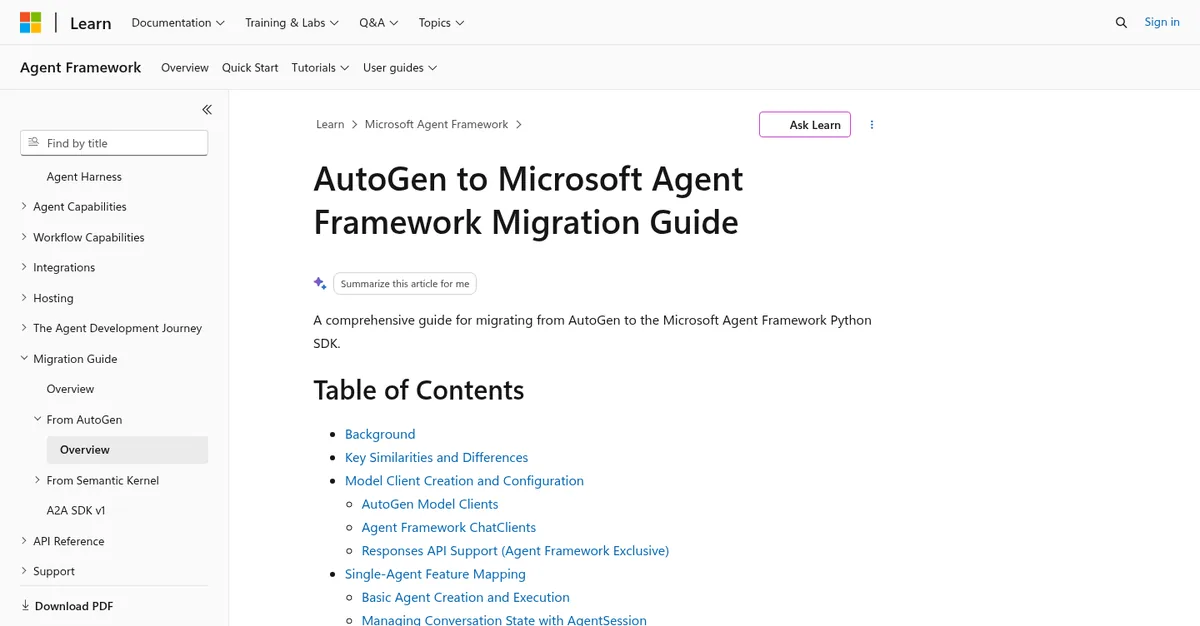
Microsoft’s migration guide maps AutoGen agents, tools, and group chats such as RoundRobinGroupChat to Microsoft Agent Framework. That framework writes a workflow checkpoint at the end of each superstep, shipped Python 1.23.0 on October 22, 2026, and installed in 21 packages and 37 MB with no known vulnerabilities in our scan.
- Best for: existing AutoGen apps that need to keep running while a migration is planned.
- Pricing (October 2026): free under MIT for the packages. There is no paid tier or support plan.
- Watch out for: no future security fixes, so any new advisory in AutoGen or its pinned dependencies stays open.
Maintenance, Security, and Adoption Compared
Release pace and dependency risk split the three more sharply than features do. LangGraph and CrewAI ship several releases a month, AutoGen ships none, and only CrewAI carried known advisories in our scan. The table also lists the two main successors for AutoGen users, checked on October 23, 2026.
| Framework | Releases, last 12 months | PyPI downloads, last month | GitHub stars | pip-audit result |
|---|---|---|---|---|
| LangGraph | 161 (all packages) | 44,769,952 | 43,726 | 0 known |
| CrewAI | 123 | 2,442,764 | 59,990 | 6 advisories |
| AutoGen | 0 | 379,923 (AgentChat) | 61,530 | 0 known, no future fixes |
| Microsoft Agent Framework | 120 (Python and .NET) | 1,005,851 (core) | 14,275 | 0 known |
| AG2 | 34 PyPI versions | 164,672 | Not checked | 0 known |
Verdict: LangGraph has the largest user base and a clean scan, which makes it the safer long-term default. CrewAI’s star count is high, but its download count and dependency weight point to a framework that suits prototypes and smaller deployments better than tightly controlled production images.
Resume a Crashed Run in Each Framework
Each framework needs one specific setting or call before a crashed run can pick up where it stopped. The snippets below are trimmed from the scripts we ran on October 23, 2026, with model setup removed, and each one resumed our job without repeating the research step.
# LangGraph 1.2.16: SQLite checkpointer, saved before each next step
from langgraph.checkpoint.sqlite import SqliteSaver
import sqlite3
app = graph.compile(checkpointer=SqliteSaver(sqlite3.connect("runs.db", check_same_thread=False)))
cfg = {"configurable": {"thread_id": "job-1"}}
app.invoke(inputs, cfg, durability="sync")   # first run
app.invoke(None, cfg, durability="sync")     # after a crash: resumes the same thread

# CrewAI 1.15.28: checkpoint=True, class-based tools, re-attach custom LLMs
import glob
from crewai import Crew, CheckpointConfig
crew = Crew(agents=[researcher, writer], tasks=[t1, t2], checkpoint=True)
crew.kickoff()
latest = sorted(glob.glob("./.checkpoints/**/*.json", recursive=True))[-1]
restored = Crew.from_checkpoint(CheckpointConfig(restore_from=latest))
restored.kickoff()                           # skips finished tasks

# AutoGen 0.7.5: no automatic checkpoints, so save after each turn
import json
await team.run(task="Find the Acme price, then summarize it.")
json.dump(await team.save_state(), open("team_state.json", "w"))
await team.load_state(json.load(open("team_state.json")))   # in the new process
await team.run()
Set CREWAI_DISABLE_TELEMETRY=true in the environment for offline or tightly firewalled runs. Whatever you pick, trace every resumed run with the same tooling as normal runs, using our AI agent observability tools guide or the open source LLM observability guide.
When to Use Something Other Than These Three
LangGraph and CrewAI cover most new Python agent projects, but some teams fit better elsewhere. The options below matter most for AutoGen users and for teams that want a smaller dependency tree, and our full frameworks guide compares nine more.
- Microsoft Agent Framework: the framework that AutoGen’s README names as its successor, with Python and .NET packages, graph-based workflows, and checkpointing. It is the shortest supported path for AutoGen code.
- AG2: a community project that describes itself as formerly AutoGen, released 1.2.1 on October 21, 2026, and uses the Apache 2.0 license. It suits teams that want AutoGen-style chats without moving to Microsoft’s new API.
- A gateway in front of any framework: route model calls through one of the LLM gateways we compared so you can switch frameworks later without rewriting keys and limits.
- MCP for tools: exposing tools over the Model Context Protocol keeps them usable across frameworks, so a later migration does not mean rewriting every tool.
Supply chain risk applies to every option here. The LiteLLM supply chain compromise showed how one popular Python dependency can expose secrets, so scan and pin agent framework dependencies like any other production code.
LangGraph, CrewAI, or AutoGen: Which Should You Choose?
The right choice depends on how costly a repeated step is, how much code your team wants to write, and how strict your rules are on image size and outbound traffic. Match your team to a profile below, then rerun our crash test on your own job before you commit.
Teams running long or approval-heavy workflows
- Use LangGraph with a Postgres or SQLite checkpointer and
durability="sync"on any step with side effects. - Add human approval with LangGraph interrupts, which reuse the same checkpoints.
- Test each workflow before launch, using our AI agent testing tools guide.
Small teams that want a working crew this week
- Start with CrewAI and write tools as
BaseToolclasses from day one. - Turn on
checkpoint=Trueand test a restore before you trust it. - Score outputs as the crew grows, using our AI agent evaluation tools guide.
Teams with existing AutoGen code
- Pin AutoGen 0.7.5 and add manual
save_state()calls while you plan the move. - Follow Microsoft’s migration guide to Microsoft Agent Framework, or test AG2 if you prefer the old API.
- Watch for new advisories with our MCP security tools guide if your agents call MCP servers.
Security teams with strict image and network rules
- Prefer LangGraph or Microsoft Agent Framework, which installed under 80 MB and scanned clean.
- If you use CrewAI, disable telemetry and rescan after every release.
- Keep model traffic behind one gateway and one trace store, as covered in our AgentOps tools guide.
Frequently Asked Questions
Is AutoGen still maintained in 2026?
No. AutoGen’s GitHub README says the project is archived and Microsoft is not providing bug fixes, security fixes, new features, or support, and it advises against production use. Its last release, 0.7.5, shipped on September 30, 2025. Microsoft points new users to Microsoft Agent Framework and publishes a migration guide.
Is LangGraph better than CrewAI?
LangGraph is better when a workflow must survive crashes without repeating steps, because it saves state after every step and lets you pick a sync save mode. CrewAI is better for quick role-based prototypes with less code. In our test, LangGraph also installed at about a tenth of CrewAI’s size.
Can LangGraph resume an agent after a crash?
Yes, if you compile the graph with a persistent checkpointer such as SQLite or Postgres and reuse the same thread ID. In our test, the default async save mode lost the last step’s checkpoint and re-ran it in 5 of 5 crashes, while durability set to sync resumed with no repeated steps.
Does CrewAI send telemetry by default?
Yes. CrewAI collects anonymous usage telemetry by default, and its docs say prompts, task text, and responses are not collected unless you turn on share_crew. You can turn telemetry off by setting CREWAI_DISABLE_TELEMETRY or OTEL_SDK_DISABLED to true. In our offline test, that cut resume time from 13.2 to 3.2 seconds.
What should I use instead of AutoGen?
Microsoft Agent Framework is the official successor, with a migration guide that maps AutoGen agents, tools, and group chats to its API, plus workflow checkpoints. AG2 is a community project that keeps an AutoGen-style API under the Apache 2.0 license. LangGraph and CrewAI are both reasonable choices for new projects.
Related Guides
Leaning away from CrewAI after this head-to-head? Our 8 best CrewAI alternatives guide ranks LangGraph, the OpenAI Agents SDK, Microsoft Agent Framework, Google ADK and four more for production multi-agent systems.
Python stacks like LangGraph and CrewAI cover one lane; TypeScript has its own three-way. Our Mastra vs Vercel AI SDK vs LangGraph.js head-to-head covers lean web agents, full frameworks and durable graphs in Node.
AutoGen still shows up in Microsoft roadmaps, but as a migrate-away choice. Our Microsoft Agent Framework vs Semantic Kernel vs AutoGen head-to-head covers support status, tool calling defaults, and what replaces AutoGen inside the Microsoft family.
For a broader multi-agent field beyond these three, our multi-agent frameworks ranking compares LangGraph, CrewAI, AutoGen successors and seven more on call count and context passing.
For a wider field than these three, our open source AI agent frameworks guide ranks 10 frameworks you can self-host by memory, install footprint, serving options and default telemetry.
If LangGraph wins for you, the next choice is which LangChain layer to build on. Our LangChain vs LangGraph vs Deep Agents comparison covers request size, install footprint and when each one fits.
Not set on any of these three? Our roundup of the 9 best LangGraph alternatives adds Microsoft Agent Framework, Pydantic AI, Mastra and six more, tested on the same job.
If you are also considering the model vendors’ own toolkits, our OpenAI Agents SDK vs Claude Agent SDK vs Google ADK comparison tests what each one sends home by default, how heavy each install is, and how each keeps sessions across processes.
For related coverage, see our Claude Managed Agents dynamic workflows coverage and AWS Infinity agent runtime news.
Read the agent frameworks hub, 12 best AI agent frameworks, AgentOps hub, agent observability coverage, AI agent observability tools, open source LLM observability, LangSmith alternatives, Langfuse vs LangSmith vs Braintrust, AI agent evaluation tools, AI agent testing tools, LLM gateways, MCP explained, and the LiteLLM supply chain compromise. Notes on how we work sit on editorial standards, disclosure, and contact.
The Bottom Line
Choose LangGraph for durable production workflows, CrewAI for the fastest multi-agent prototype, and Microsoft Agent Framework rather than AutoGen for anything new in the Microsoft ecosystem. The real difference in LangGraph vs CrewAI vs AutoGen is what happens after a crash, so set durability, checkpoints, and telemetry deliberately instead of trusting defaults.
All three projects change quickly, and AutoGen will not get fixes, so rerun your own crash test after each upgrade and check this page for updates. Send corrections or test results through our contact page.