


Last updated October 11, 2026. Prices, plan limits, licenses, and self-hosting terms were checked against each vendor’s own pricing pages, documentation, and GitHub repositories on that date.
LangSmith is a strong product with a pricing and hosting model that stops fitting many teams once agents reach production.
The best LangSmith alternatives in 2026 are Langfuse for most teams, Opik or Arize Phoenix for free self-hosting, and Braintrust for eval-gated releases. Stay on LangSmith if your agents run on LangGraph and you use its Deployment service, since no alternative replaces that runtime. This guide is part of our AgentOps tools map.
We compared eight LangSmith alternatives, five of them free to self-host, on licensing, tracing, evals, pricing, and migration effort. No vendor paid for placement or reviewed this page before publication, per our editorial standards and disclosure policy.
Every tool on this list accepts OpenTelemetry traces, so leaving LangSmith is now an exporter change more than a rewrite. The harder questions are who runs the backend, how each vendor meters usage, and whether you can get your data back out.
TL;DR
- Langfuse is the best LangSmith alternative for most teams: MIT licensed, free to self-host, and $29 per month on Cloud with unlimited users.
- Opik and Arize Phoenix self-host for free with no feature gates; Opik is Apache 2.0, while Phoenix uses the source-available Elastic License 2.0.
- Braintrust suits teams whose eval scores decide releases, with unlimited users on every plan and Pro at $249 per month.
- LangSmith costs $39 per seat per month on Plus plus $0.005 per base trace past 10,000, and self-hosting is an Enterprise add-on.
- On our worked example of 100,000 traces a month for 5 users, LangSmith Plus came to about $670, against $30 to $249 for the paid alternatives we could price.
- Bulk trace export became Enterprise-only for LangSmith accounts created after August 3, 2026, so plan your exit before your data grows.
The 8 Best LangSmith Alternatives at a Glance
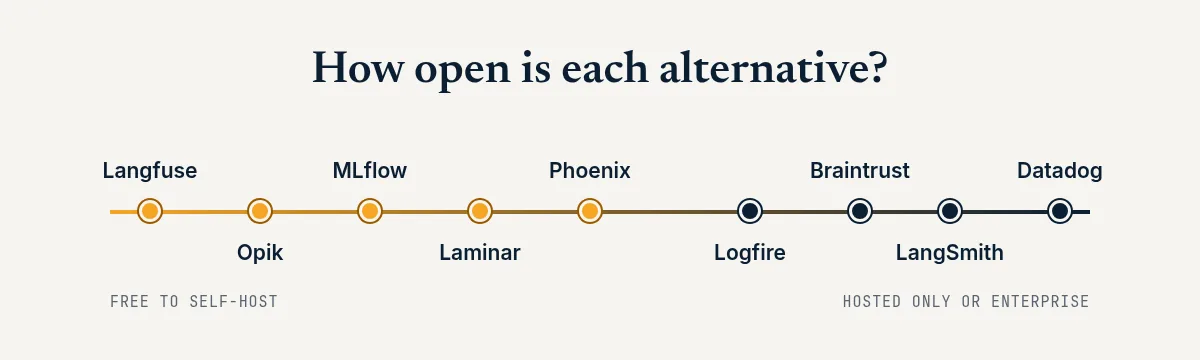
Langfuse, Arize Phoenix, Opik, MLflow, and Laminar are the open-source LangSmith alternatives you can self-host for free. Braintrust, Pydantic Logfire, and Datadog are hosted platforms that win on evals, full-stack telemetry, and APM integration. The table compares all eight against LangSmith on the facts that usually decide a switch.
| Tool | Open source and self-hosting | License | Tracing | Evals | Pricing entry point | Best for |
|---|---|---|---|---|---|---|
| LangSmith (incumbent) | Closed platform; self-hosting is an Enterprise add-on | Proprietary, MIT SDK | SDKs plus OTLP endpoint | Offline and online evals, human review | Free for 1 seat; Plus $39/seat/month | LangGraph teams using LangSmith Deployment |
| Langfuse | Yes, free self-host with all core features | MIT core, separate ee folders | SDKs plus OTLP endpoint | LLM-as-judge, datasets, annotation queues | Free; Core $29/month, unlimited users | Most teams leaving LangSmith |
| Arize Phoenix | Yes, free self-host with no feature gates | Elastic License 2.0 (source-available) | OpenTelemetry and OpenInference | Evals, datasets, experiments | Free self-host; Arize AX Pro $50/month | OpenTelemetry-first teams that want local-first tracing |
| Opik (Comet) | Yes, full feature set, same codebase as Cloud | Apache 2.0 | SDKs, 40+ integrations, OpenTelemetry | Test suites, 30+ metrics, annotation queues | Free; Pro Cloud $19/month | Budget teams that want Apache 2.0 |
| Braintrust | No; self-hosted data plane on Enterprise only | Proprietary, open-source SDKs | SDKs plus OpenTelemetry | Experiments, online scoring, score alerts | Free; Pro $249/month, unlimited users | Eval-gated release workflows |
| MLflow | Yes, self-host free; managed on Databricks | Apache 2.0 | MLflow Tracing, OpenTelemetry compatible | 50+ metrics and LLM judges | Free open source; Databricks usage pricing | Teams already on MLflow or Databricks |
| Laminar | Yes, Docker Compose or Helm; alerts need a license | Apache 2.0 | OpenTelemetry-native SDK, browser recordings | Evals, datasets, labeling queues | Free; Starter $30/month, unlimited seats | Browser agents and long-running agents |
| Pydantic Logfire | No; self-hosted only on Enterprise | Commercial platform, MIT SDK | Built on OpenTelemetry, full-stack | Evals and human review, no per-score fee | Free; Team $49/month with 5 seats | Python teams on Pydantic AI or FastAPI |
| Datadog Agent Observability | No; SaaS only | Proprietary | Datadog SDK or OpenTelemetry GenAI attributes | Evals, experiments, annotations | Free 40K LLM spans; Pro $160/month | Teams already on Datadog APM |
Decision kernel: choose Langfuse when you want the closest feature match with free self-hosting, Opik when you want Apache 2.0 and the cheapest Cloud plan, and Braintrust when evals gate every release. Choose Datadog only if you already pay for Datadog APM. No alternative replaces LangSmith Deployment, so LangGraph teams that host agents there should stay.
Verdict: Langfuse is the safest default because it matches LangSmith feature for feature and removes both seat fees and the Enterprise gate on self-hosting. Opik is the strongest pure open-source pick, Phoenix is the lightest to run locally, and the hosted options earn their place only when their specialty matches your main job.
Why Teams Look for a LangSmith Alternative in 2026
Teams leave LangSmith for six recurring reasons: per-seat fees, per-trace pricing, short default retention, Enterprise-only self-hosting, Enterprise-only bulk export for new accounts, and a growing set of separately metered LangChain products. None of these is a defect in tracing quality, which remains excellent for LangGraph agents.
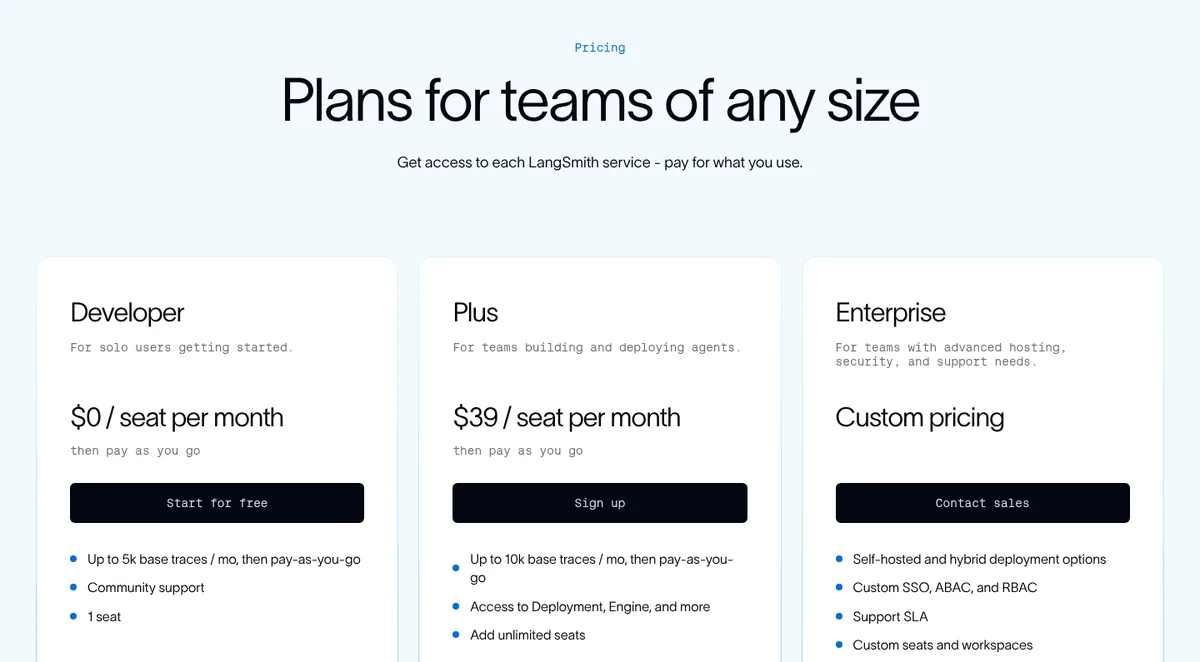
Every invited user is a paid seat
LangSmith Plus costs $39 per seat per month, and LangChain counts every user in the organization, including invited users, as a seat, according to its pricing FAQ. A team of 10 engineers, product managers, and reviewers pays $390 a month before a single trace is billed. Langfuse Core, Braintrust, Laminar Starter, and Arize AX charge nothing per user.
Trace pricing and retention upgrades add up
Plus includes 10,000 base traces a month, then charges 0.005 LangChain Standard Units per base trace, and one unit equals $1. That works out to $5 per 1,000 traces, so 1 million traces a month costs about $4,950 in trace fees alone on list prices.
Base traces keep 14 days of history, and extended traces keep 180 days for another $0.0025 each. LangSmith’s administration docs warn that online evaluators and automation rules can upgrade traces to extended retention automatically, which raises the bill as your eval coverage grows.
Self-hosting requires an Enterprise contract
Self-hosted LangSmith is described in LangChain’s own docs as an add-on to the Enterprise plan for its largest, most security-conscious customers. Teams that need traces inside their own cloud for compliance therefore face a sales process, while Langfuse, Phoenix, Opik, MLflow, and Laminar publish free self-hosting guides.
For a pure open source self-host shortlist (not only LangSmith replacements), see 8 best open source LLM observability tools.
Bulk trace export moved to Enterprise
For customers who signed up after August 3, 2026, LangSmith bulk export is only available on the Enterprise plan. Earlier customers keep bulk export on Plus until February 1, 2027, according to LangChain’s bulk export docs. Teams that want to own a Parquet copy of their traces in their own bucket should treat this as a reason to decide early.
Data residency and contracting limits
LangSmith Cloud runs in GCP US, GCP EU, GCP APAC, and AWS US, and organizations cannot migrate between regions. The regions FAQ also states that LangChain has no EU legal entity for customer contracting, which matters to European buyers whose procurement teams require one.
More LangChain products, more meters
LangSmith now bundles Deployment, Engine, Fleet, Sandboxes, and an LLM Gateway, each metered in LangChain Standard Units. Engine alone runs every 6 hours and consumes roughly 7 to 45 units per run, according to the pricing page, so a platform team that only wanted tracing ends up reviewing several usage lines.
Who Should Stay on LangSmith
LangSmith remains the right choice for teams that build on LangGraph and host agents on LangSmith Deployment, because no alternative on this list runs that agent runtime. It also stays cheap for one or two developers under 10,000 traces a month, where the Plus plan’s included allowance covers most usage.
- LangGraph teams using Deployment, Studio, or Fleet: the Plus plan includes one free small serverless deployment, and tracing, Studio debugging, and hosting share one account.
- Small teams with low volume: 1 to 2 seats and under 10,000 base traces a month cost $39 to $78 on Plus with no trace overage.
- Teams that want automated failure clustering: LangSmith Engine groups failing traces into issues and proposes fixes, which the alternatives match only in part, for example through Laminar’s signal clusters.
Disqualifier: LangSmith is the wrong tool if you must self-host without an Enterprise contract, if more than a handful of people need access, or if you need bulk exports of your traces on a self-serve plan.
How We Chose These LangSmith Alternatives
We started from 14 tools that appear in current LangSmith alternatives rankings and in AI answers to that query, then kept the eight that are actively developed, trace agents end to end, and publish pricing. We reviewed each vendor’s pricing page, documentation, license file, and GitHub repository on October 11, 2026.
- Replacement coverage: tracing, datasets, LLM-as-judge evals, human review, and prompt or experiment tooling, the jobs teams use LangSmith for.
- Hosting rights: whether you can self-host for free, and under which license.
- Pricing model: seats versus usage units, the free tier, and the first paid plan.
- Migration path: OpenTelemetry ingestion and documented routes off LangSmith.
- Ownership and momentum: recent releases, acquisitions, and maintenance status.
We did not run hands-on latency or scale benchmarks for this edition, so treat vendor performance claims as claims. GitHub star counts come from the GitHub API on October 11, 2026. For the wider market, including tools that are not LangSmith replacements, see our 12 best AI agent observability tools.
The 8 Best LangSmith Alternatives, Reviewed
The list is ordered by how many LangSmith users each tool fits, starting with the closest full replacement. Langfuse, Phoenix, and Opik cover tracing, evals, and prompts like LangSmith does, while Braintrust, MLflow, Laminar, Logfire, and Datadog each lead on one specific job.
1. Langfuse: best open-source LangSmith alternative for most teams
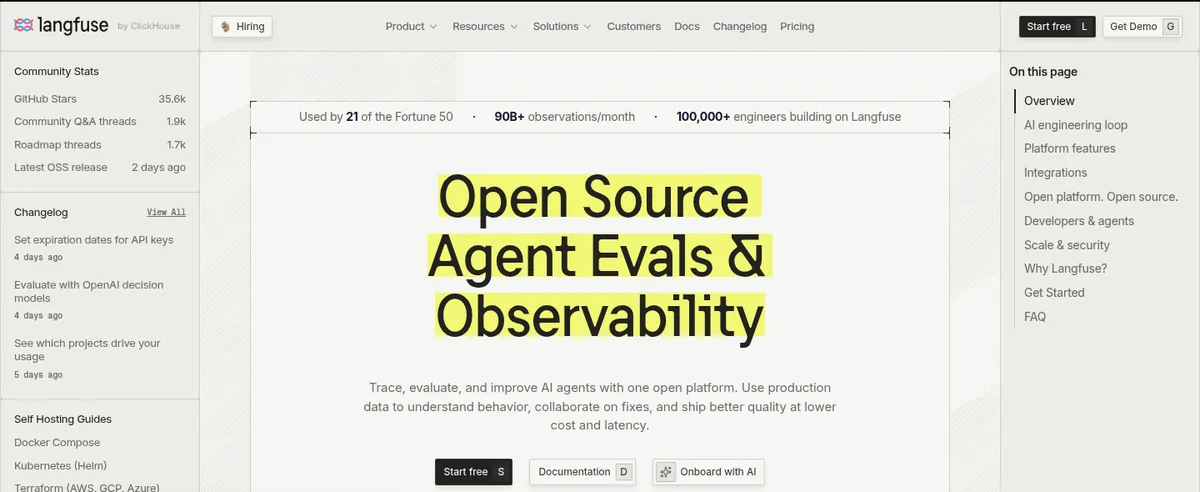
Verdict: Langfuse is the closest feature match to LangSmith, with free self-hosting and no seat fees from the first paid plan.
Langfuse is an open-source LLM engineering platform for tracing, evals, and prompt management, used by teams that want LangSmith’s workflow without its lock-in. The core is MIT licensed, with enterprise features in separate folders, per its license file, and the repository had 35,643 GitHub stars on October 11, 2026.
ClickHouse acquired Langfuse in January 2026, and the MIT license and self-hosting continue. The self-hosted edition includes all core features with no usage limits.
Best for: teams that want the LangSmith feature set, neutral framework support, and the option to self-host at any time.
Key features
- Agent traces and graphs, sessions, user tracking, and token and cost tracking.
- An OpenTelemetry endpoint plus native Python and JavaScript SDKs.
- Datasets, experiments, LLM-as-judge evaluators, and human annotation queues.
- Prompt versioning, release labels, a playground, and alerts to Slack or webhooks.
Pricing
- Self-hosted open source is free under MIT, with no usage caps.
- Hobby is free with 50,000 units a month, 2 users, and 30 days of data access.
- Core costs $29 per month for 100,000 units, then $8 per 100,000, with unlimited users and 90 days of data access.
- Pro costs $199 per month with 3 years of data access, and Enterprise starts at $2,499 per month.
Prices come from Langfuse pricing. A unit is any trace, observation, or score, per the billable units docs.
Pros and cons
Pros
- Free self-hosting with every core feature and no usage caps.
- Unlimited users from the $29 Core plan.
- Cloud regions in the US, EU, and Japan, plus a HIPAA-ready region on Pro.
Cons
- Every span counts as a billable unit on Cloud, so span-heavy agents raise the bill.
- Running ClickHouse in production takes real operations work.
- Project-level RBAC, audit logs, and retention policies need an enterprise license key when self-hosted.
Moving from LangSmith
Langfuse publishes a LangSmith migration guide. LangSmith’s OpenTelemetry mode can send the same spans to both tools while you verify, and LangChain apps can add the Langfuse callback handler instead.
2. Arize Phoenix: best for OpenTelemetry-first teams that want local-first tracing
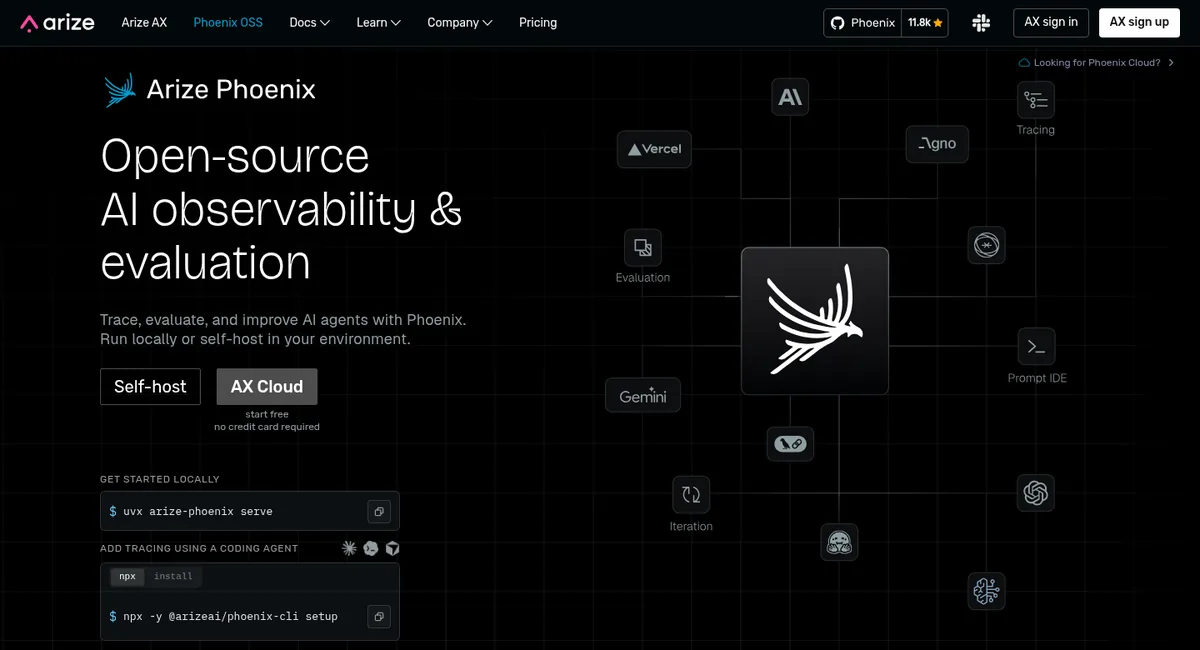
Verdict: Arize Phoenix is the lightest way to run LangSmith-style tracing and evals on your own machine or cluster for free.
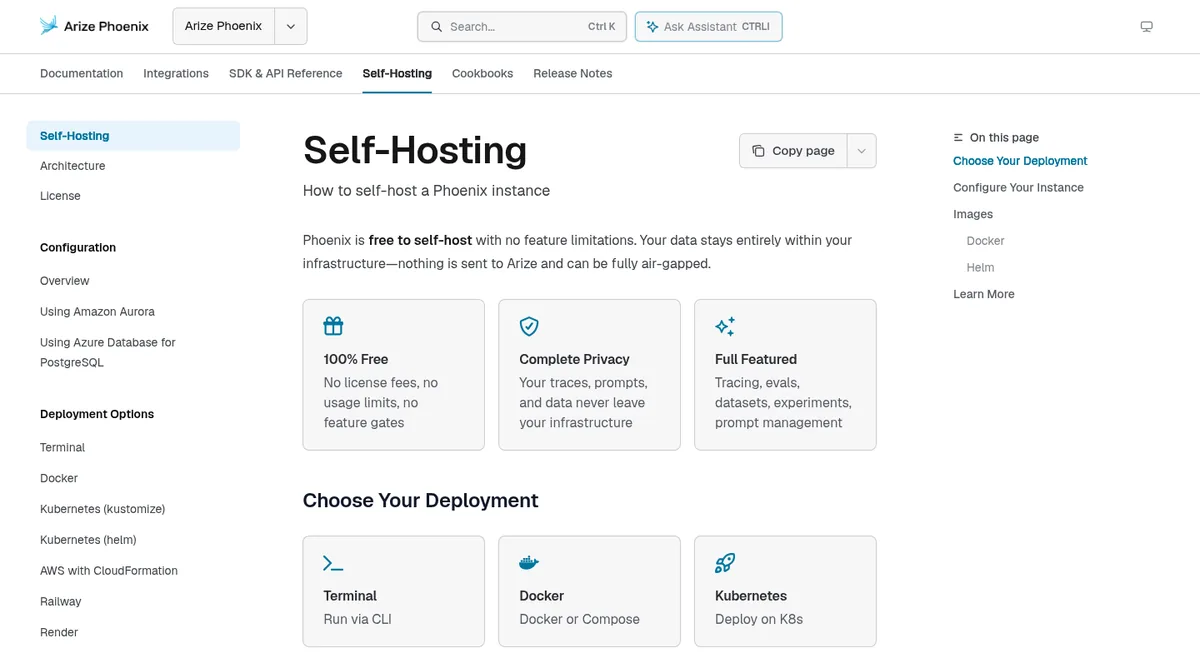
Arize Phoenix is an AI observability and evaluation platform built by Arize AI on OpenTelemetry and OpenInference instrumentation, for teams that want traces to stay inside their own infrastructure. It is free to self-host with no feature limits and can run fully air-gapped, according to the Phoenix self-hosting docs.
Phoenix is source-available under the Elastic License 2.0, which allows internal use but restricts offering Phoenix to others as a managed service. The repository had 11,785 GitHub stars on October 11, 2026, and Arize sells a separate managed platform called Arize AX.
Best for: OpenTelemetry-first teams, data-sovereign teams, and developers who want tracing on a laptop before buying anything.
Key features
- Tracing through OpenTelemetry, with OpenInference auto-instrumentation for common frameworks.
- LLM evals, versioned datasets, and experiments that compare prompt and model changes.
- A prompt playground and prompt management.
- Deployment by terminal, Docker, Kubernetes, AWS CloudFormation, Railway, Render, Cloud Run, or Azure.
Pricing
- Self-hosted Phoenix is free, with no license fees, usage limits, or feature gates.
- Arize AX Free includes 25,000 spans, 1 GB of ingestion, 15-day retention, and unlimited users.
- Arize AX Pro costs $50 per month for 50,000 spans, 10 GB, and 30-day retention.
- AX Enterprise is custom priced and adds self-hosted deployment, SSO, and audit logs.
Prices come from Arize pricing, reviewed October 11, 2026.
Pros and cons
Pros
- Free, full-featured self-hosting that installs with one command.
- OpenTelemetry-native, so instrumentation stays portable.
- Unlimited users on every Arize AX plan.
Cons
- The Elastic License 2.0 is not an OSI-approved open-source license.
- AX Pro caps at 50,000 spans a month, so production volume on managed Arize means an Enterprise quote.
- Phoenix and Arize AX are separate products, so moving from one to the other is a migration.
Moving from LangSmith
Point your OpenTelemetry exporter at the Phoenix collector endpoint, or use OpenInference instrumentors for LangChain and other frameworks. Rebuild LangSmith datasets as Phoenix datasets and port evaluators to Phoenix evals.
3. Opik by Comet: best Apache 2.0 platform with the cheapest Cloud plan
Verdict: Opik gives you LangSmith’s core workflow under a plain Apache 2.0 license, and its $19 Cloud plan is the lowest paid entry on this list.
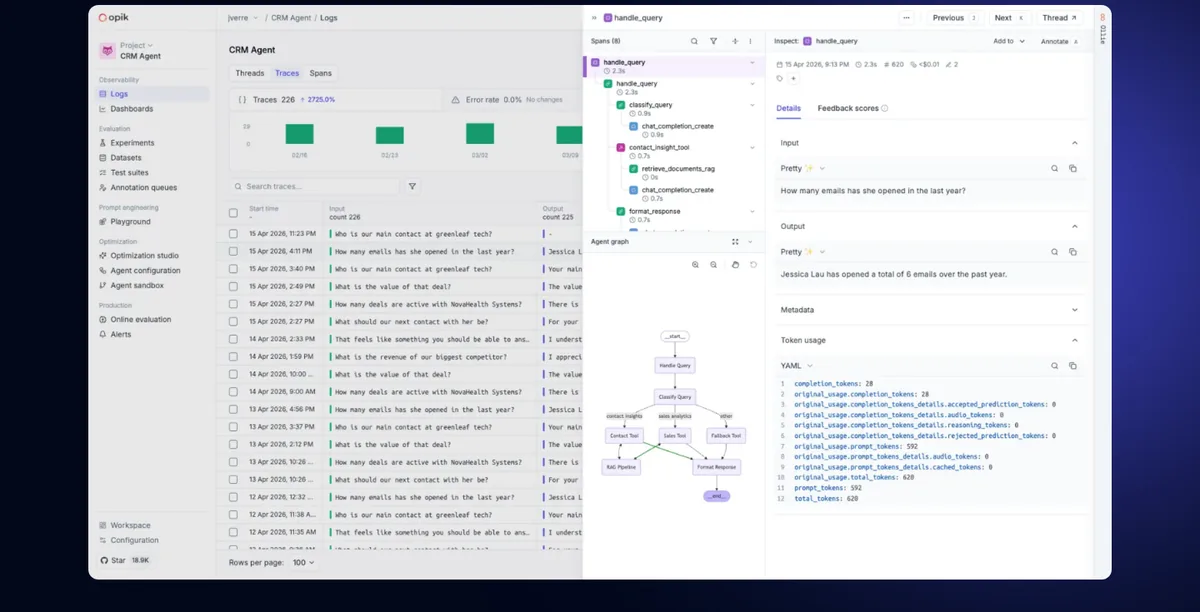
Opik is an open-source LLM observability and evaluation platform built by Comet for tracing, testing, and monitoring agents. It is Apache 2.0 licensed, and Comet describes the open-source build as the same codebase as its hosted versions, with the full feature set free to self-host.
The Opik repository had 22,500 GitHub stars on October 11, 2026. Self-hosting runs with a single script on Docker or through a Kubernetes Helm chart, per the Opik self-hosting docs.
Best for: cost-conscious teams and open-source purists who want a full self-hosted platform without license caveats.
Key features
- Agent tracing with execution graphs, sessions for multi-turn conversations, and cost tracking.
- 40+ framework integrations plus OpenTelemetry support for other languages.
- Test suites with pass or fail assertions, 30+ built-in metrics, and LLM-as-judge scoring.
- Annotation queues for subject matter experts, plus the Agent Optimizer and the Ollie assistant.
Pricing
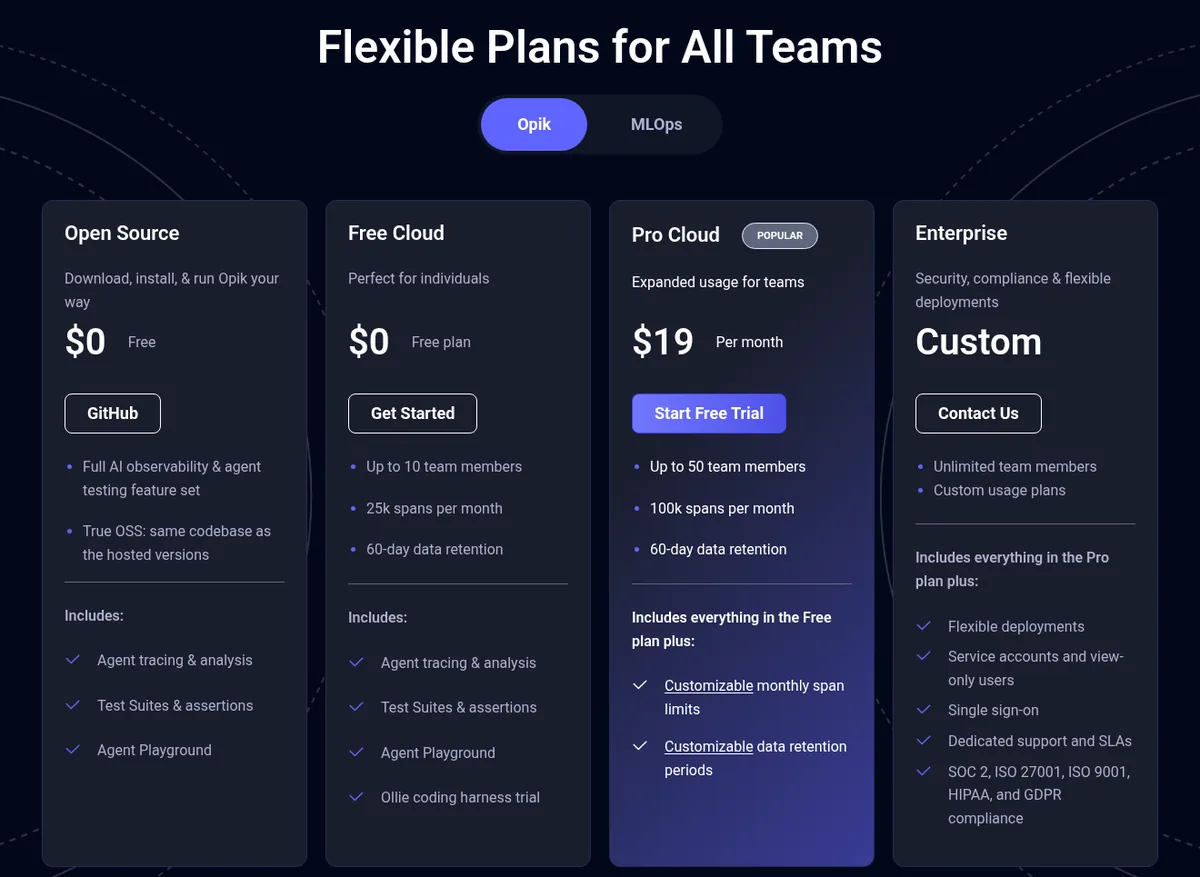
- Open source is free, with the full observability and testing feature set.
- Free Cloud includes up to 10 team members, 25,000 spans a month, and 60-day retention.
- Pro Cloud costs $19 per month for up to 50 members and 100,000 spans, then $5 per 100,000 spans.
- Extending retention from 60 to 400 days costs $29 per 100,000 spans, and Enterprise is custom priced.
Prices come from Comet pricing, reviewed October 11, 2026.
Pros and cons
Pros
- Apache 2.0 with no enterprise feature folders to work around.
- The lowest paid Cloud price on this list.
- SOC 2, ISO 27001, and HIPAA options on Enterprise.
Cons
- Cloud plans cap team members at 10 on Free and 50 on Pro.
- Retention past 60 days is priced per span, which adds up for long audit windows.
- Ollie’s code-editing features move to purchased tokens after the trial.
Moving from LangSmith
Comet publishes an Opik vs LangSmith comparison. Opik ships a LangChain integration and accepts OpenTelemetry spans, so most teams start by sending live traffic to both tools.
4. Braintrust: best for teams whose eval scores gate releases
Verdict: Braintrust is the strongest hosted LangSmith alternative for eval-driven teams, with unlimited users on every plan.
Braintrust is a proprietary evaluation and observability platform built around datasets, experiments, scorers, and playgrounds, for product and engineering teams that ship on eval results. Its SDKs are open source, and its autoevals scorer library is MIT licensed.
Braintrust raised an $80 million Series B led by ICONIQ in February 2026. Self-hosting is Enterprise only, with your cloud holding the data plane and Braintrust running the UI and control plane.
Best for: teams where product managers and engineers review outputs together and releases are blocked on eval regressions.
Key features
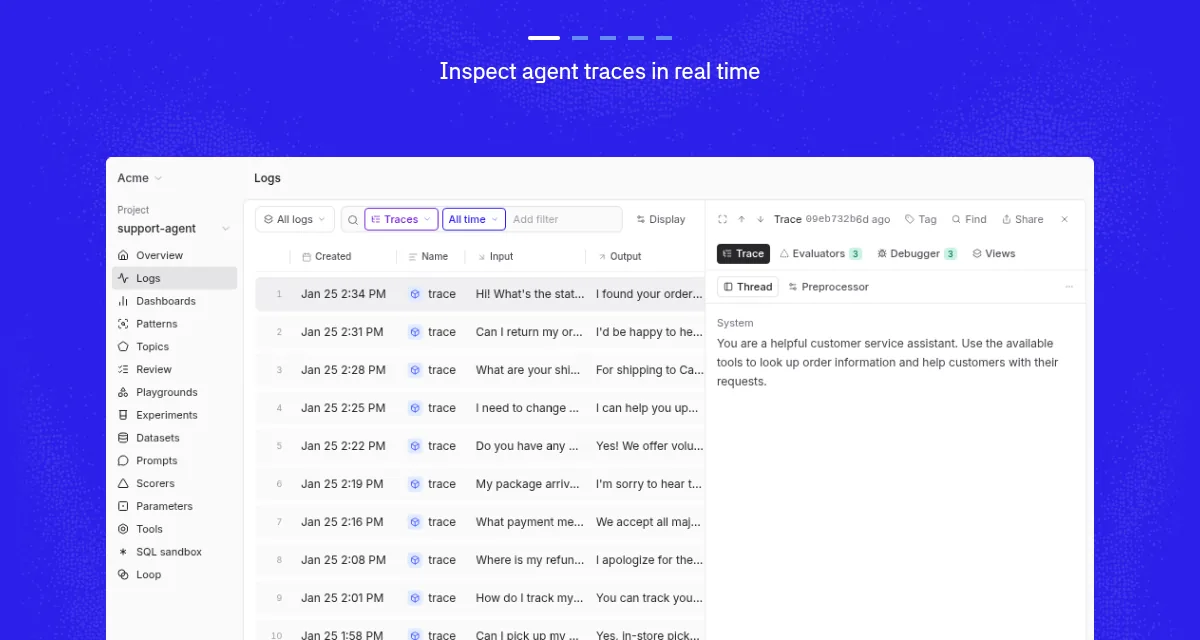
- Experiments on versioned datasets, with LLM-as-judge, autoevals, and custom code scorers.
- Online scoring of production traces with sampling and filters.
- Alerts written as conditions on scores, logs, and metrics.
- Loop, a built-in agent that runs evals and iterates on prompts, plus OpenTelemetry ingestion.
Pricing
- Starter is free with $10 in model credits, 1 GB of processed data, 10,000 scores, and 14-day retention.
- Pro costs $249 per month with $100 in credits, 5 GB, 50,000 scores, and 30-day retention.
- Pro overage runs $3 per GB and $1.50 per 1,000 scores, and Enterprise is custom priced.
Prices come from Braintrust pricing. Pro is free for 6 to 12 months for qualifying startups, according to the same page.
Pros and cons
Pros
- Unlimited users on every plan, including the free one.
- Score-based alerts tie quality directly to monitoring.
- Playgrounds run full evals side by side.
Cons
- Self-hosting is Enterprise only, the same gate LangSmith has.
- Billing on gigabytes plus scores takes modeling to forecast.
- No open-source server, so there is no free self-hosted fallback.
Moving from LangSmith
Braintrust accepts OpenTelemetry spans and wraps common SDKs, so tracing moves with an exporter change. Datasets and scorers need rebuilding, and our Langfuse vs LangSmith vs Braintrust comparison covers the three-way trade-offs in depth. If evals are your main reason to leave, our AI agent evaluation tools comparison ranks 10 eval-first options.
5. MLflow: best for teams already on MLflow or Databricks
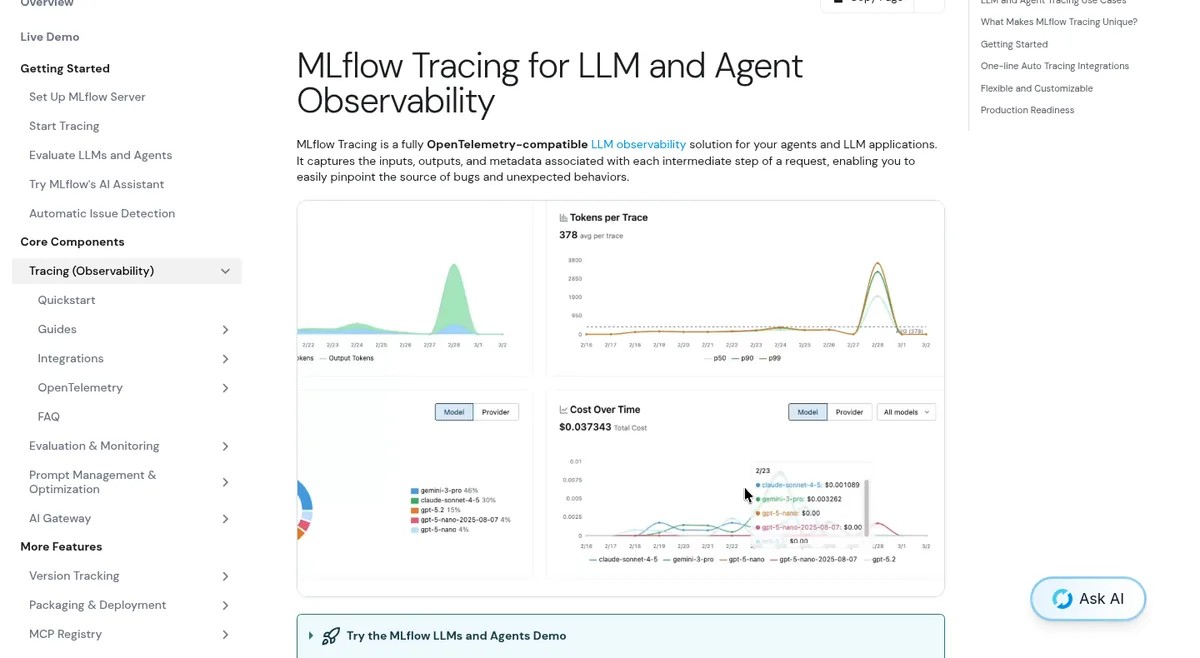
Verdict: MLflow is the natural LangSmith alternative for data teams that already track models in MLflow, since agent traces land next to their experiments.
MLflow is an Apache 2.0 open-source AI engineering platform for agents, LLMs, and ML models, and Databricks offers a managed version. MLflow Tracing is OpenTelemetry compatible and supports the GenAI semantic conventions for both export and ingestion, per its docs.
The MLflow repository had 28,342 GitHub stars on October 11, 2026, the most of any open-source tool on this list.
Best for: ML and data teams on Databricks, and teams that want one open-source system for models and agents.
Key features
- Tracing for OpenAI, LangChain, LlamaIndex, DSPy, Pydantic AI, and other frameworks.
- Evaluation with 50+ built-in metrics and LLM judges, plus custom scorers.
- Automatic issue detection across correctness, latency, adherence, and safety.
- A prompt registry with optimization, an AI gateway, and human feedback on traces.
Pricing
- Open-source MLflow is free, and your trace data stays on your own infrastructure.
- Managed MLflow runs on Databricks, which bills by platform consumption and offers a free trial.
- There is no separate per-trace or per-seat MLflow license fee.
We did not model Databricks consumption costs, which depend on your workspace and cloud contract.
Pros and cons
Pros
- Free, Apache 2.0, and backed by a large community.
- Agent traces, evals, and classic ML experiments share one tool.
- OpenTelemetry in and out reduces lock-in.
Cons
- Self-hosting means operating the tracking server, its database, and artifact storage yourself.
- Managed MLflow ties you to a Databricks account and its consumption pricing.
Moving from LangSmith
Turn on MLflow autologging for your framework, or send OpenTelemetry spans to the MLflow server. LangChain and LangGraph apps are traced by MLflow after one call to mlflow.langchain.autolog(), per the MLflow LangChain integration docs.
6. Laminar: best for browser agents and long-running agents
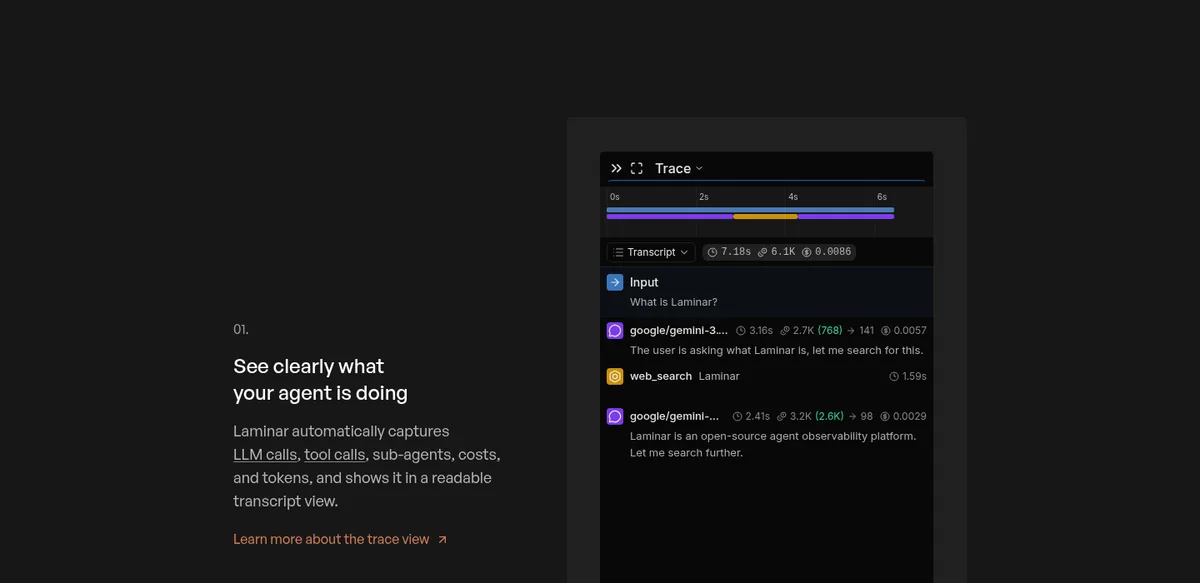
Verdict: Laminar is an agent-native open-source alternative that shows long agent runs as readable transcripts and records browser sessions next to the trace.
Laminar is an open-source observability platform purpose-built for AI agents, aimed at teams running coding, research, or browser agents with many steps. It is Apache 2.0 licensed, and its repository had 3,373 GitHub stars on October 11, 2026.
Laminar can be self-hosted with Docker Compose or a Kubernetes Helm chart. Signals, signal clusters, and email or Slack alerts require an enterprise license key when self-hosted.
Best for: teams running browser agents, coding agents, or other long multi-step runs where reading the transcript matters most.
Key features
- An OpenTelemetry-native SDK that auto-traces Vercel AI SDK, Browser Use, Stagehand, LangChain, OpenAI, Anthropic, and Gemini.
- Screen recording of browser agent sessions synced with the trace.
- Signals, which track agent behaviors you describe in plain English.
- Full-text trace search, a SQL editor, evaluations, datasets, and labeling queues.
Pricing
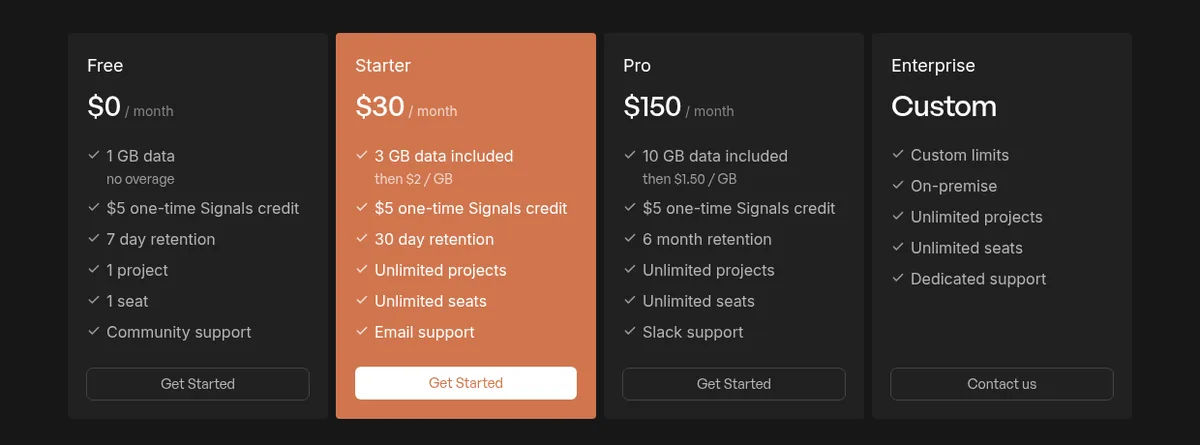
- Free costs $0 with 1 GB of data, 7-day retention, 1 project, and 1 seat.
- Starter costs $30 per month with 3 GB, then $2 per GB, 30-day retention, and unlimited seats.
- Pro costs $150 per month with 10 GB, then $1.50 per GB, and 6-month retention.
- Signals bill by analysis tokens at $0.05 per million input tokens and $0.30 per million output tokens.
Prices come from Laminar pricing, reviewed October 11, 2026.
Pros and cons
Pros
- Unlimited seats from the $30 Starter plan.
- Browser session replay that LangSmith does not offer.
- Gigabyte pricing keeps span-heavy agents cheap.
Cons
- A smaller community than Langfuse, Opik, or Phoenix.
- Alerts and Signals need a paid license on self-hosted deployments.
Moving from LangSmith
Laminar ingests OpenTelemetry and ships a LangChain integration, so you can run it beside LangSmith during a trial. It has no prompt registry on its feature list, so keep prompts in code or another tool.
7. Pydantic Logfire: best for Python teams that want one backend for agents and apps
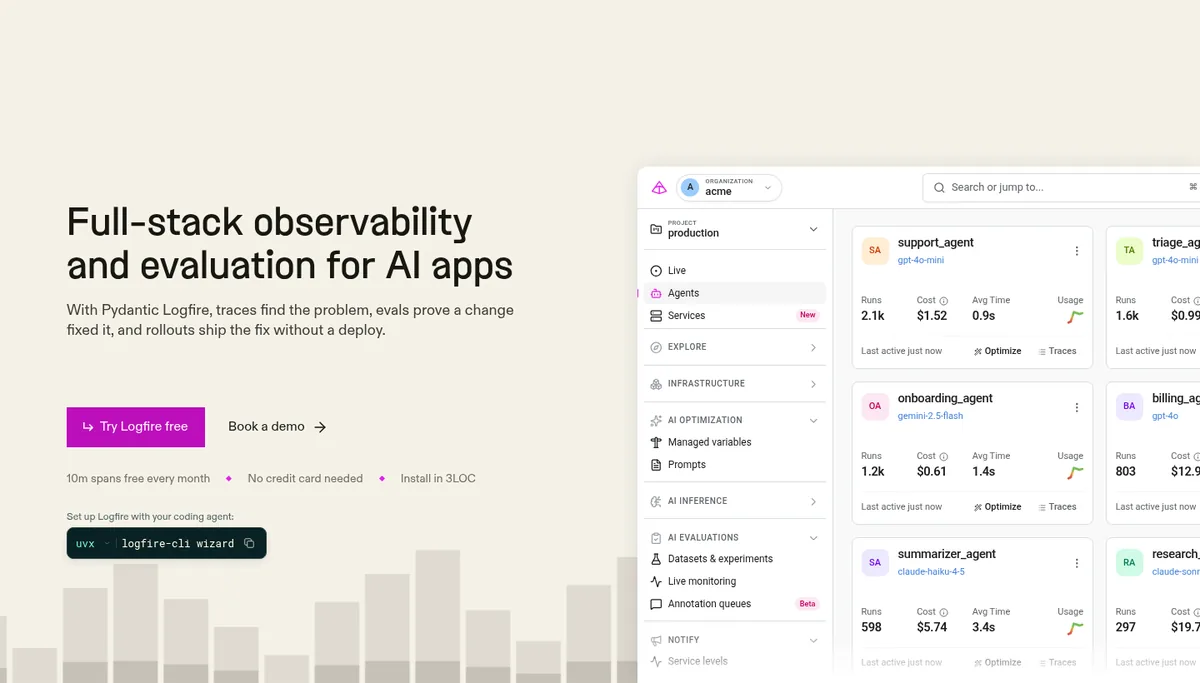
Verdict: Pydantic Logfire replaces LangSmith and a general APM in one OpenTelemetry backend, with per-record pricing that stays low at high span counts.
Pydantic Logfire is an observability and evaluation platform from the team behind Pydantic, built on OpenTelemetry for Python teams that trace agents alongside services, databases, and hosts. Its SDK is MIT licensed, while the platform itself is a commercial service.
Logfire traces Pydantic AI, LangChain, the OpenAI SDK, and anything instrumented with OpenTelemetry, per its documentation. Self-hosted deployment is available on the Enterprise plan.
Best for: Python teams, especially those on Pydantic AI or FastAPI, that want one OpenTelemetry backend for agents and the rest of the stack.
Key features
- Agent tracing from prompt through tool calls, on the same timeline as your services and hosts.
- AI output evaluations and human annotations with no per-score charge on paid plans.
- Dashboards, alerts, and service-level monitoring for the whole application.
- An AI gateway that accepts your own provider keys with no markup.
Pricing
- Personal is free with 10 million records a month, hard-capped, 1 seat, and 30-day retention.
- Team costs $49 per month with 5 seats and 10 million records, then $2 per million records.
- Growth costs $249 per month with unlimited seats and up to 90-day retention.
- Enterprise adds dedicated or self-hosted deployment, SSO, and custom retention.
Prices come from Pydantic pricing, reviewed October 11, 2026. Data can live in the EU or US region.
Pros and cons
Pros
- At $2 per million records, span-heavy agents stay cheap.
- One tool for agent traces and general application monitoring.
- Spending caps and a first-month refund policy on paid plans.
Cons
- Retention is 30 days below the Growth plan.
- The Team plan includes 5 seats, so larger teams move to Growth at $249.
- Self-hosting requires Enterprise.
Moving from LangSmith
Logfire is OpenTelemetry native, so the LangSmith SDK’s OTLP export can feed it during a trial. Its own SDK adds one-line instrumentation for Pydantic AI, LangChain, and the OpenAI SDK.
8. Datadog Agent Observability: best for teams already on Datadog APM
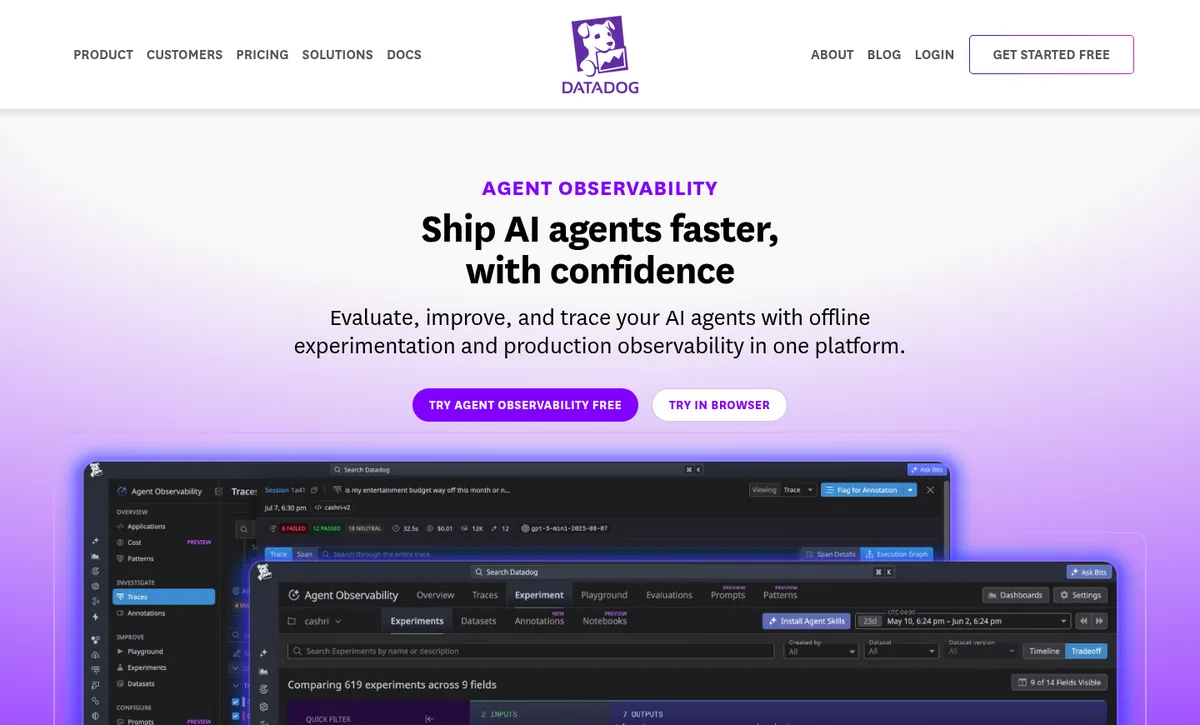
Verdict: Datadog Agent Observability is the right LangSmith alternative when your services already report to Datadog and you want agent traces in the same place.
Datadog Agent Observability, which Datadog’s pricing page still lists as LLM Observability, traces agents inside the Datadog platform used for APM, logs, and infrastructure. It is proprietary SaaS with no self-hosted option.
Datadog accepts its own SDK or OpenTelemetry spans, and its OpenTelemetry docs map OpenTelemetry GenAI, OpenLLMetry, and OpenInference attributes. Only LLM spans are billed, while tool, workflow, agent, embedding, and retrieval spans are free.
Best for: platform teams that already run Datadog APM and want one vendor, one bill, and one on-call workflow.
Key features
- End-to-end agent tracing linked to APM traces, logs, and infrastructure metrics.
- Datasets, experiments, prompt workflows, evaluations, and annotations on every plan.
- Production monitoring and dashboards, plus CLI and MCP access.
- Sensitive Data Scanner included, scaling with LLM usage.
Pricing
- Free includes up to 40,000 LLM spans a month and 15-day retention.
- Pro starts at $160 per month billed annually, or $200 month to month, for 100,000 LLM spans.
- Extra LLM spans are billed per 10,000, at $3.50 on annual terms in the pricing data we reviewed.
- Retention add-ons extend traces to 30, 60, or 90 days.
Prices come from Datadog pricing and the product page, reviewed October 11, 2026. Eval runs that call an LLM count as LLM spans.
Pros and cons
Pros
- Agent traces sit next to the rest of your production telemetry.
- Billing only on LLM spans keeps tool-heavy agents cheaper.
- Enterprise controls such as RBAC and HIPAA compliance.
Cons
- No self-hosting, and data stays in Datadog’s cloud.
- Value depends on already paying for Datadog; as a standalone tool it costs more than Langfuse or Opik.
Moving from LangSmith
Point OpenTelemetry spans at Datadog or switch to the ddtrace SDK. Many teams run Datadog for production monitoring and keep an open-source tool for development evals.
What Each LangSmith Alternative Costs for the Same Workload
On one realistic workload of 100,000 traces a month for 5 users, LangSmith Plus came to about $670 a month on list prices, while the paid alternatives we could price ranged from about $30 to $249. Seat fees and per-trace charges explain most of the gap, so your own ratio depends on team size and spans per trace.
Our scenario is a team of 5 running 100,000 agent traces a month, with 10 spans per trace, 3 of them LLM calls, and an LLM judge scoring 10% of traces. For the tools that bill by gigabyte, we assume about 10 KB of processed data per trace, which is our estimate and not a vendor figure.
| Tool and plan | Platform or seats | Usage | Scoring | Estimated monthly total |
|---|---|---|---|---|
| LangSmith Plus | $195 (5 x $39) | 90,000 extra base traces = $450 | 10,000 extended upgrades = $25 | About $670 |
| Braintrust Pro | $249 | 1 GB, inside the 5 GB allowance = $0 | 10,000 scores, inside 50,000 = $0 | About $249 |
| Datadog Pro (annual) | $160 | 210,000 extra LLM spans = $73.50 | Judge calls counted as LLM spans | About $234 |
| Langfuse Core | $29 | 1,010,000 extra units = $80.80 | 10,000 scores, counted as units | About $110 |
| Opik Pro Cloud | $19 | 900,000 extra spans = $45 | Not metered on the pricing page | About $64 |
| Pydantic Logfire Team | $49 (5 seats included) | 1 million records, inside 10 million = $0 | No per-score charge | About $49 |
| Laminar Starter | $30 | 1 GB, inside the 3 GB allowance = $0 | Signals not modeled | About $30 |
| Arize Phoenix or AX | $0 self-hosted; AX Pro $50 | 1 million spans exceeds the 50,000 AX Pro cap | Unlimited evals | Self-host infrastructure, or an AX Enterprise quote |
| MLflow | $0 self-hosted | No license metering | No license metering | Self-host infrastructure, or Databricks consumption |
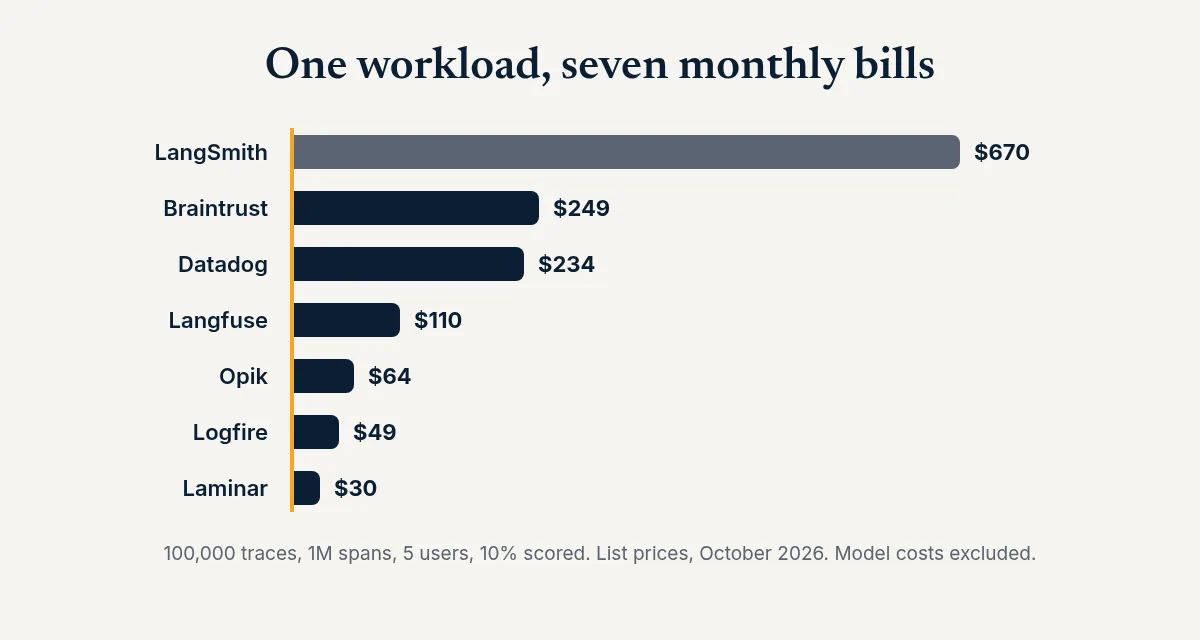
The gap widens with volume. At 1 million traces a month, LangSmith Plus trace fees alone reach about $4,950, while the same workload costs about $909 on Langfuse Core and about $514 on Opik Pro before volume discounts. Free self-hosting on Langfuse, Phoenix, Opik, MLflow, or Laminar removes license fees entirely, but you pay for servers, storage, and the people who run them.
Braintrust Starter could run this workload for $0 if it fits in 1 GB, at the cost of 14-day retention and one human review score per project. For a deeper three-way breakdown, see our Langfuse vs LangSmith vs Braintrust comparison, which prices a 50,000-run workload line by line.
How to Migrate Off LangSmith Without Losing Traces
The safest way to leave LangSmith is to send the same OpenTelemetry spans to LangSmith and the new tool in parallel, compare them for two weeks, move datasets and prompts, then switch LangSmith off. Historical traces usually stay in LangSmith until its 14-day or 180-day retention window expires.
- Inventory what lives in LangSmith. List projects, datasets, prompts, online evaluators, annotation queues, and alert rules, since each needs a home in the new tool.
- Turn on OpenTelemetry export. The LangSmith Python SDK can export spans over OTLP to another backend while still tracing to LangSmith.
- Run both tools side by side. Compare trace completeness, token and cost numbers, and the new tool’s usage page against your LangSmith bill.
- Move the durable assets. Read datasets and prompts out through the LangSmith SDK, recreate them in the new tool, and rebuild evaluators as judges or code scorers.
- Cut over and cancel. Switch LangSmith to OpenTelemetry-only export, remove seats, and keep the account until the history you need has aged out.
The environment variables below come from LangSmith’s OpenTelemetry guide and Langfuse’s OpenTelemetry docs, and they work with any OTLP backend. LangChain recommends langsmith SDK version 0.4.25 or later for fan-out.
# 1. Keep LangSmith tracing on and turn on OpenTelemetry export
export LANGSMITH_TRACING="true"
export LANGSMITH_OTEL_ENABLED="true"

# 2. Point the OTLP exporter at the new backend (Langfuse EU shown)
export OTEL_EXPORTER_OTLP_ENDPOINT="https://cloud.langfuse.com/api/public/otel"
export OTEL_EXPORTER_OTLP_HEADERS="Authorization=Basic ${AUTH_STRING}"

# 3. After the trial, stop sending traces to LangSmith
export LANGSMITH_OTEL_ONLY="true"
Before you cancel: export what you want to keep while you still can. Accounts created after August 3, 2026 need Enterprise for bulk trace export, so most teams on Plus move live instrumentation and durable assets and let old traces expire.
LangSmith Alternatives We Left Off, and Why
We excluded six tools that still appear in many LangSmith alternatives lists, because of maintenance status, ownership changes, product pivots, or a narrower scope. Several of these were strong picks in 2025, which is why older rankings still recommend them.
- Helicone: Mintlify acquired Helicone in March 2026, and Helicone says its services remain live in maintenance mode, with security updates, new models, and bug fixes but no new features.
- W&B Weave: CoreWeave’s Weave docs now describe CoreWeave Agent Lens as the successor to Weave, and pricing has moved under CoreWeave Forge. We will revisit it once the product naming settles.
- Galileo: Cisco completed its acquisition of Galileo on May 22, 2026, and Galileo’s pricing page now redirects to Splunk, so standalone buying terms are unclear.
- HoneyHive: the pricing page lists a free Developer plan with 10,000 events and up to 5 users, with everything above it custom priced, which makes it hard to compare for teams leaving a self-serve plan.
- Agenta: Agenta has repositioned as an open-source agent workspace, per its pricing page, so tracing is now one feature among many.
- OpenLLMetry by Traceloop: it is an instrumentation layer that ships traces to a backend, so pair it with any tool above. Our AgentOps tools map covers it in the instrumentation layer.
Which LangSmith Alternative Should You Choose?
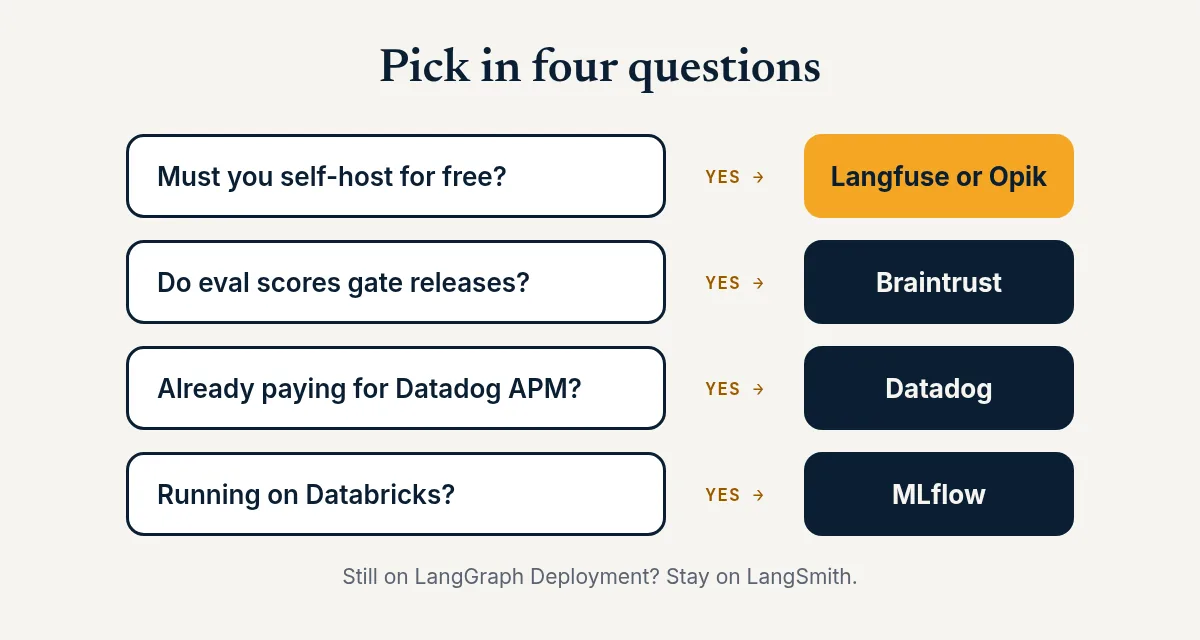
Choose by your hardest constraint first. Free self-hosting points to Langfuse or Opik, eval-gated releases point to Braintrust, an existing Datadog contract points to Datadog, and a Databricks platform points to MLflow. If none applies, trial Langfuse and one specialist side by side for two weeks on real traffic.
- Langfuse: best overall replacement, especially for teams larger than 5 people or with mixed frameworks.
- Arize Phoenix: best for OpenTelemetry-first teams and air-gapped or local-first setups.
- Opik: best for Apache 2.0 licensing and the cheapest managed Cloud plan.
- Braintrust: best when eval scores decide releases and many reviewers need access.
- MLflow: best for teams already on MLflow or Databricks.
- Laminar: best for browser agents and long multi-step runs.
- Pydantic Logfire: best for Python teams that want agents and services in one backend.
- Datadog: best for organizations that already standardize on Datadog APM.
Disqualifiers: skip the self-hosted route if nobody on the team can run ClickHouse or Postgres in production, skip Braintrust and Logfire if you need free self-hosting, and skip Datadog if you do not already use it. Skip all of them if LangSmith Deployment hosts your agents today.
Looking the other direction from Langfuse? Start with Langfuse alternatives.
Pricing shapes differ as much as feature sets. Compare the numbers in LangSmith vs Langfuse vs Braintrust pricing.
Frequently Asked Questions About LangSmith Alternatives
What is the best open-source alternative to LangSmith?
Langfuse is the best open-source alternative to LangSmith for most teams, with an MIT-licensed core, free self-hosting with all core features, and 35,643 GitHub stars as of October 2026. Opik is the pick for a plain Apache 2.0 license, and Arize Phoenix is free to self-host under the source-available Elastic License 2.0.
Is LangSmith free to use?
Yes, LangSmith has a free Developer plan for 1 seat with 5,000 base traces a month and 14-day retention. Teams need the Plus plan at $39 per seat per month, which includes 10,000 base traces, then charges $0.005 per extra base trace. Self-hosting and bulk export for new accounts require Enterprise.
Can you self-host LangSmith for free?
No, self-hosted LangSmith is an add-on to the Enterprise plan, and LangChain issues a license key for trials through its sales team. It runs on Kubernetes with ClickHouse, Postgres, and Redis. Teams that need free self-hosting usually choose Langfuse, Opik, Arize Phoenix, MLflow, or Laminar instead.
Which LangSmith alternatives have no per-seat pricing?
Langfuse Core, Braintrust, Laminar Starter, and Arize AX charge no per-user fee, and all offer unlimited users on paid plans. Opik Cloud caps members at 10 on Free and 50 on Pro without seat fees. Pydantic Logfire includes 5 seats on Team, and its Growth plan adds unlimited seats for $249 a month.
Do I have to rewrite my code to switch from LangSmith?
No, in most cases you change an exporter rather than rewrite code. The LangSmith SDK can export spans over OpenTelemetry to any OTLP backend, and every tool on this list accepts OpenTelemetry. Datasets, prompts, and evaluators still need to be recreated, which is where most migration time goes.
The Bottom Line: Leave LangSmith for Ownership and Price, Not Features
Most teams that leave LangSmith do it for seat fees, trace pricing, and hosting rights, and Langfuse answers all three with the closest feature match. Opik and Phoenix are the strongest free self-hosted picks, and Braintrust, MLflow, Laminar, Logfire, and Datadog win when their specialty is your main job. Instrument with OpenTelemetry first, and the choice stays reversible.
We recheck these prices quarterly, and vendors can send corrections through our contact page. For four more tools and the full feature matrix, read our guide to the best AI agent observability tools.
Related guides: the AgentOps tools map, Langfuse vs LangSmith vs Braintrust, AgentOps: observability, evals, and monitoring, agent observability, agent evals and testing, and AI gateways.