
Published November 4, 2026 (IST) by the AgentStack News Desk. Facts were checked against CrowdStrike’s November 3 press release, its technical blog and the Falcon Guardian product page, plus our own lab test of how agent SDKs react to a gateway kill on November 4.
The CrowdStrike AI Kill Switch, launched in Falcon Guardian on November 3, works today by telling AI gateways to block the models an agent depends on. Ending the agent’s process on the laptop, stopping relaunches and cutting identity, SaaS and browser access are all listed as coming soon. The CrowdStrike’s press release pitches the full set, but its own fine print says enforcement comes first at the Gateway, and soon on the endpoint.
So we tested what a gateway kill actually stops. A 403 from the gateway stopped our agents in 0.05 seconds, but a 429 with a long Retry-After parked the Anthropic SDK for minutes, and a background job the agent started kept running after the kill. This piece follows our editorial standards.
TL;DR
- What launched: AI Kill Switch in Falcon Guardian, announced November 3 at Fal.Con Europe in Barcelona and available today, per CrowdStrike.
- What it does now: Guardian directs the Falcon AI Gateway or a third-party gateway to block chosen model providers. Targeting by agent type is coming soon.
- What is still coming: endpoint termination, relaunch blocking, cloud, identity, SaaS and browser containment, per CrowdStrike’s blog.
- Our test: a gateway block stops new model calls, but it leaves in-flight streams, background jobs, written files and direct API routes alone.
- What to do: make your gateway answer a kill with HTTP 403, cut open streams, and block direct egress to model APIs so the gateway is the only path.
What CrowdStrike Launched on November 3
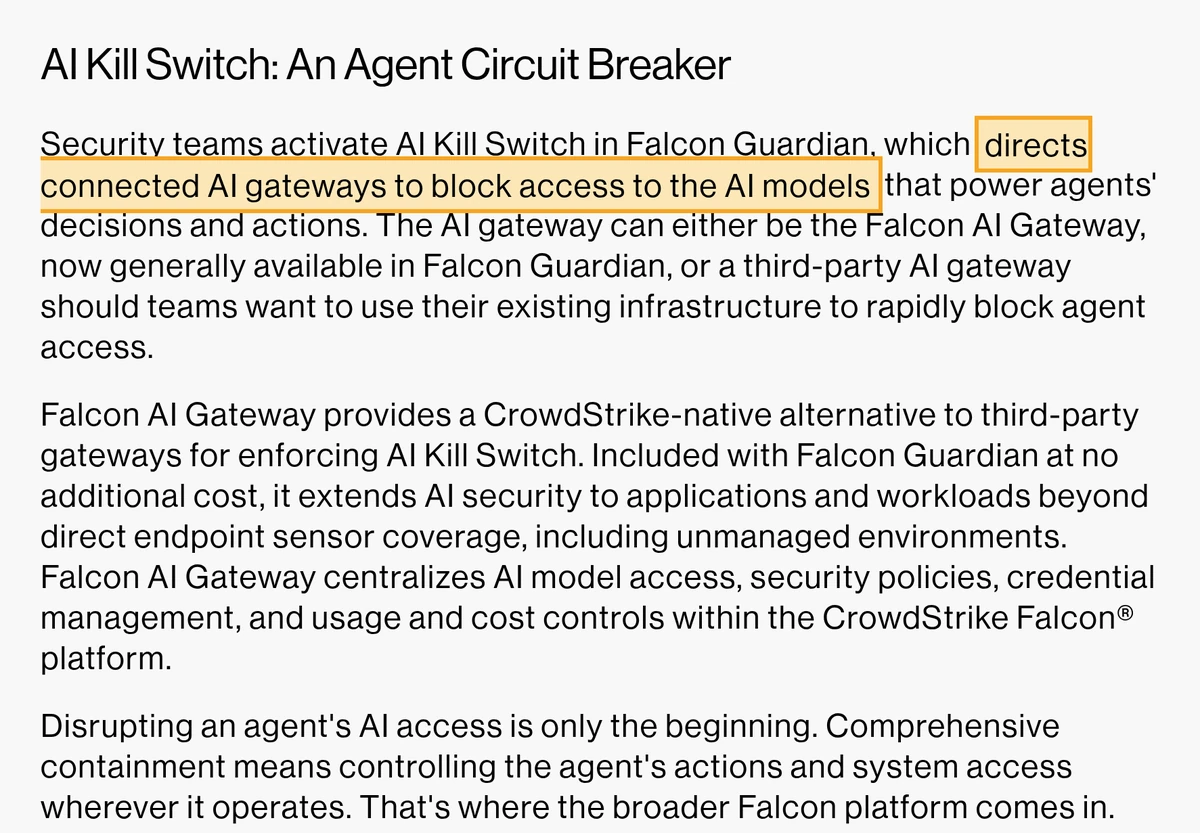
CrowdStrike added an AI Kill Switch to Falcon Guardian, its AI detection and response product, on November 3. An authorized admin triggers it, and every action lands in the audit trail. Today the switch works through AI gateways, either the Falcon AI Gateway or a third-party gateway a team already runs.
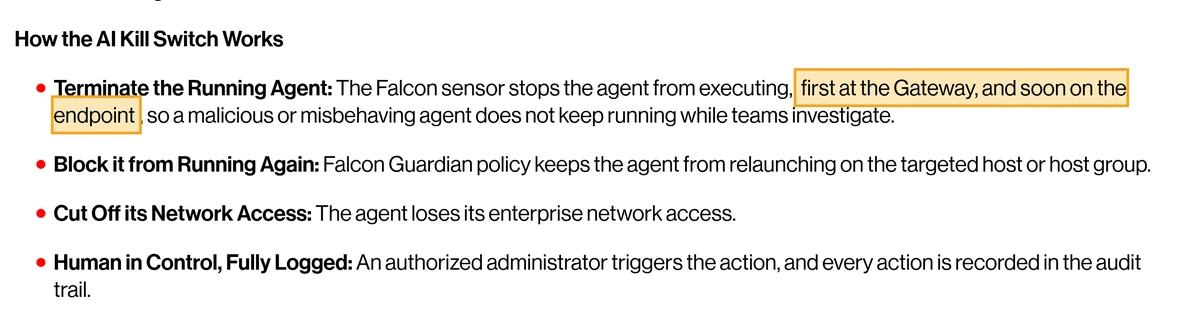
The technical blog is more precise than the release. It says Guardian directs connected AI gateways to block access to the AI models that power agents, and it puts every other enforcement point under a Coming soon label. The product page adds that kill switch enforcement at the gateway by agent type is also coming soon.
| Capability | Status on November 4 | Source |
|---|---|---|
| Block chosen model providers through the Falcon AI Gateway | Available | CrowdStrike blog |
| Block through a third-party gateway the team already runs | Available | CrowdStrike blog |
| Gateway enforcement by agent type | Coming soon | Falcon Guardian product page |
| Terminate agents and processes on endpoints, block restarts | Coming soon | CrowdStrike blog |
| Contain cloud agents | Coming soon | CrowdStrike blog |
| Revoke agent permissions through Falcon Next-Gen Identity Security | Coming soon | CrowdStrike blog |
| Restrict SaaS agents through Falcon Shield | Coming soon | CrowdStrike blog |
| End browser sessions through Falcon Seraphic Enterprise Browser | Coming soon | CrowdStrike blog |
CEO George Kurtz said in the release: “AI safety is how you get the full benefit of AI. When you deploy agents with a kill switch, you stay in control.” Rick Orloff, CISO at Everpure, said the switch “runs on the Falcon sensor we already have.” CrowdStrike publishes no Falcon Guardian price, and the blog says the Falcon AI Gateway is included with Guardian at no additional cost.
Which Gateways the Kill Switch Can Reach
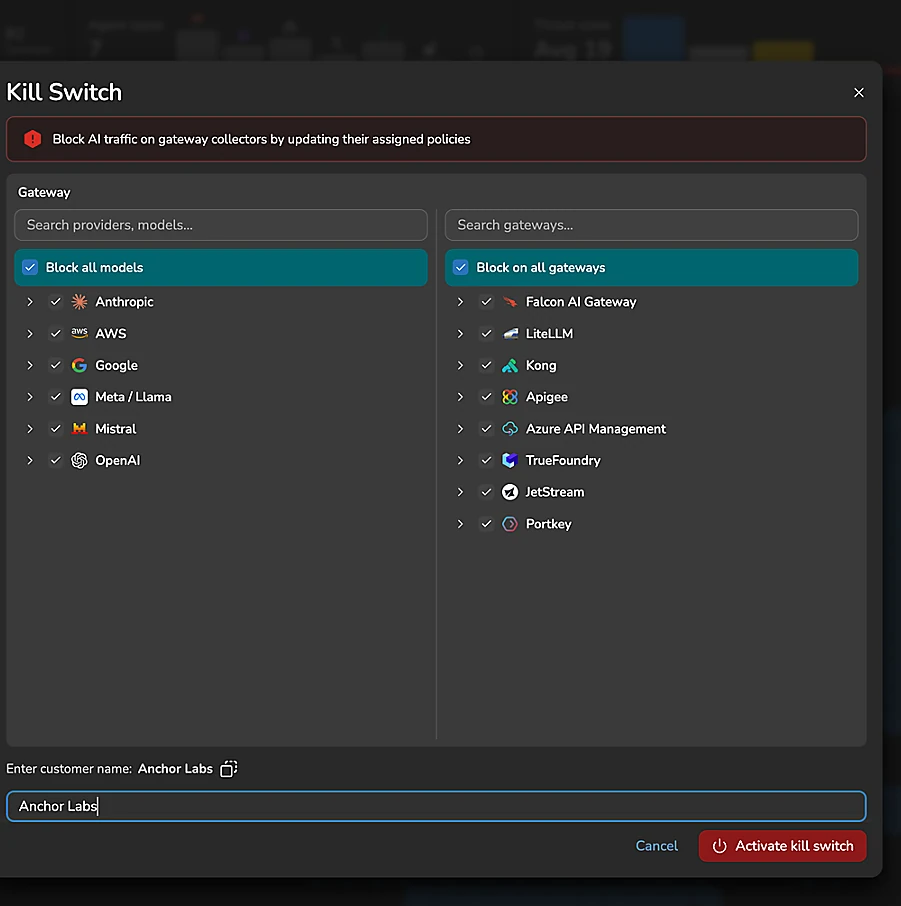
CrowdStrike’s launch figure shows the kill switch dialog with eight gateways: Falcon AI Gateway, LiteLLM, Kong, Apigee, Azure API Management, TrueFoundry, JetStream and Portkey. On the model side it lists Anthropic, AWS, Google, Meta Llama, Mistral and OpenAI. The admin picks providers and gateways, types the customer name, and activates the switch.
The dialog’s banner reads Block AI traffic on gateway collectors by updating their assigned policies. That wording matters for blast radius. With agent-type targeting still coming soon, a kill aimed at OpenAI on all gateways blocks every app and agent that reaches OpenAI through those gateways, including the ones behaving well.
A logo in a product figure is no compatibility promise, and CrowdStrike has published no setup guide per gateway yet. Teams picking a gateway for this can compare options in our LLM gateways guide and the Portkey vs LiteLLM vs OpenRouter breakdown. For agents that call tools over MCP, our MCP gateways list covers the other choke point.
We Tested What a Gateway Kill Does to a Running Agent
A gateway kill stops the next model call, and in our test that was all it stopped. We ran agents through a reference gateway on 127.0.0.1, blocked their key after step five, and watched what kept going. The model calls ended at once, but work already started kept running.
How we tested: we built a loopback mock model and a small reference gateway with a per-key block, then drove them with the OpenAI Python SDK 3.45.0, the Anthropic Python SDK 2.4.0 and the OpenAI Agents SDK 0.24.0. This is not CrowdStrike software. It shows how standard agent code reacts to any gateway that starts refusing requests.
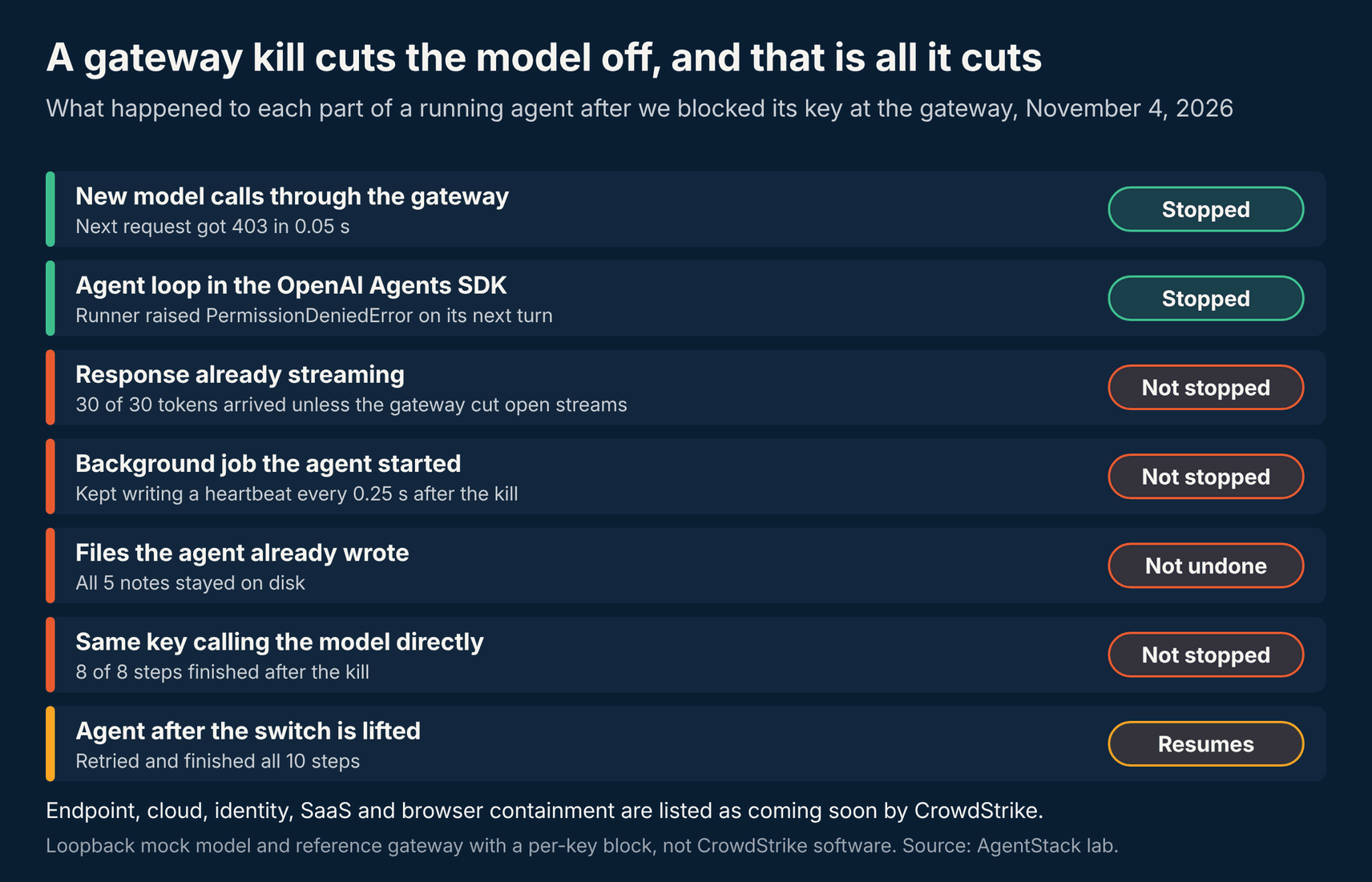
Three gaps stood out. A response that was already streaming delivered all 30 of 30 tokens when the gateway checked the block only at request start. A gateway that also cut open streams stopped it at 10 tokens with an APIConnectionError. The same key sent straight to the model, skipping the gateway, finished all eight steps after the kill.
The background job the agent launched before the kill kept writing a heartbeat every quarter second, and the five notes it had written stayed on disk. That is the part CrowdStrike’s coming soon endpoint enforcement is meant to handle. Until then, a gateway kill is a model cutoff and nothing more.
The Status Code Your Gateway Returns Matters
The HTTP status a gateway sends on a kill decides whether agent SDKs stop or retry. In our test, 403, 401 and 503 with x-should-retry set to false stopped both SDKs after one request. A plain 429 or 503 triggered two retries, and a Retry-After header could hold an agent for minutes.
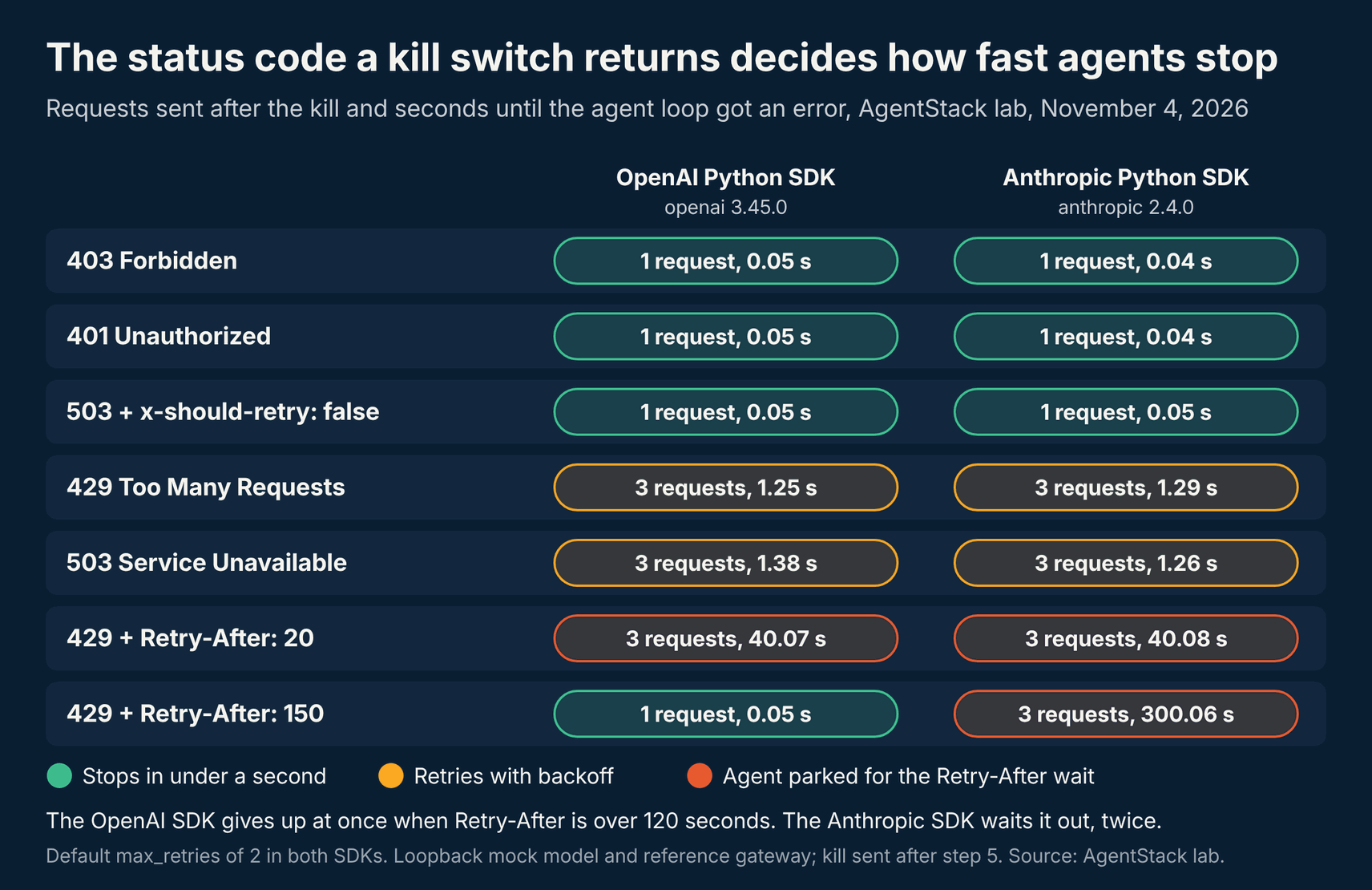
Both SDKs default to two retries on 408, 409, 429 and 5xx responses, and both honor an x-should-retry header. The OpenAI SDK skips the retry when Retry-After is over 120 seconds, while the Anthropic SDK 2.4.0 waits out whatever the server asks. With Retry-After set to 150, the OpenAI agent failed in 0.05 seconds and the Anthropic agent sat blocked for 300 seconds, five full minutes, before it errored.
| Kill response | What agents do | Use it for a kill switch? |
|---|---|---|
| 403 Forbidden | Fail on the first request, no retry | Yes, the clearest signal |
| 401 Unauthorized | Fail on the first request, no retry | Yes, if keys are being revoked |
| 503 with x-should-retry: false | Fail on the first request, no retry | Yes, if the gateway must use 503 |
| 429 or 503 with no headers | Two retries with backoff, about 1.3 seconds | No, it looks like a temporary outage |
| 429 with Retry-After | Agent waits out the header before failing | No, it delays the stop |
The retry behavior also cuts the other way. When we lifted a kill that answered 429 with Retry-After of five seconds, the agent retried, got through and finished all ten steps. That suits a pause. For a true kill, a hard 403 keeps a retrying agent from walking back in on its own.
What Security Teams Should Do Before They Need the Switch
Teams should make the gateway the only road to the model, make it answer a kill with a hard refusal, and plan separately for the work a model cutoff leaves running. These steps apply to Falcon Guardian buyers and to anyone building a kill switch on their own gateway.
- Close the side doors: block direct egress from agent hosts to model provider APIs, or a killed agent can keep working through the same key on a direct route.
- Return 403 on a kill: configure the block to send 403, or add x-should-retry: false. Avoid 429 and Retry-After, which SDKs treat as a reason to wait.
- Cut open streams: check whether your gateway ends in-flight streaming responses when a block lands. Ours delivered a full answer when it did not.
- Plan the process kill: until endpoint enforcement ships, keep a runbook to stop agent processes, scheduled jobs and containers on the host.
- Revoke credentials too: rotate the API keys and tokens the agent held, so a restarted job cannot reuse them.
- Drill it: run the kill against a test agent and time how long the agent takes to stop, as in our chart.
A gateway that you control can return a response like this one for a killed key. Both SDKs we tested stopped on it after one request.
HTTP/1.1 403 Forbidden
content-type: application/json
x-should-retry: false

{"error": {"type": "permission_error", "message": "Agent access disabled by kill switch"}}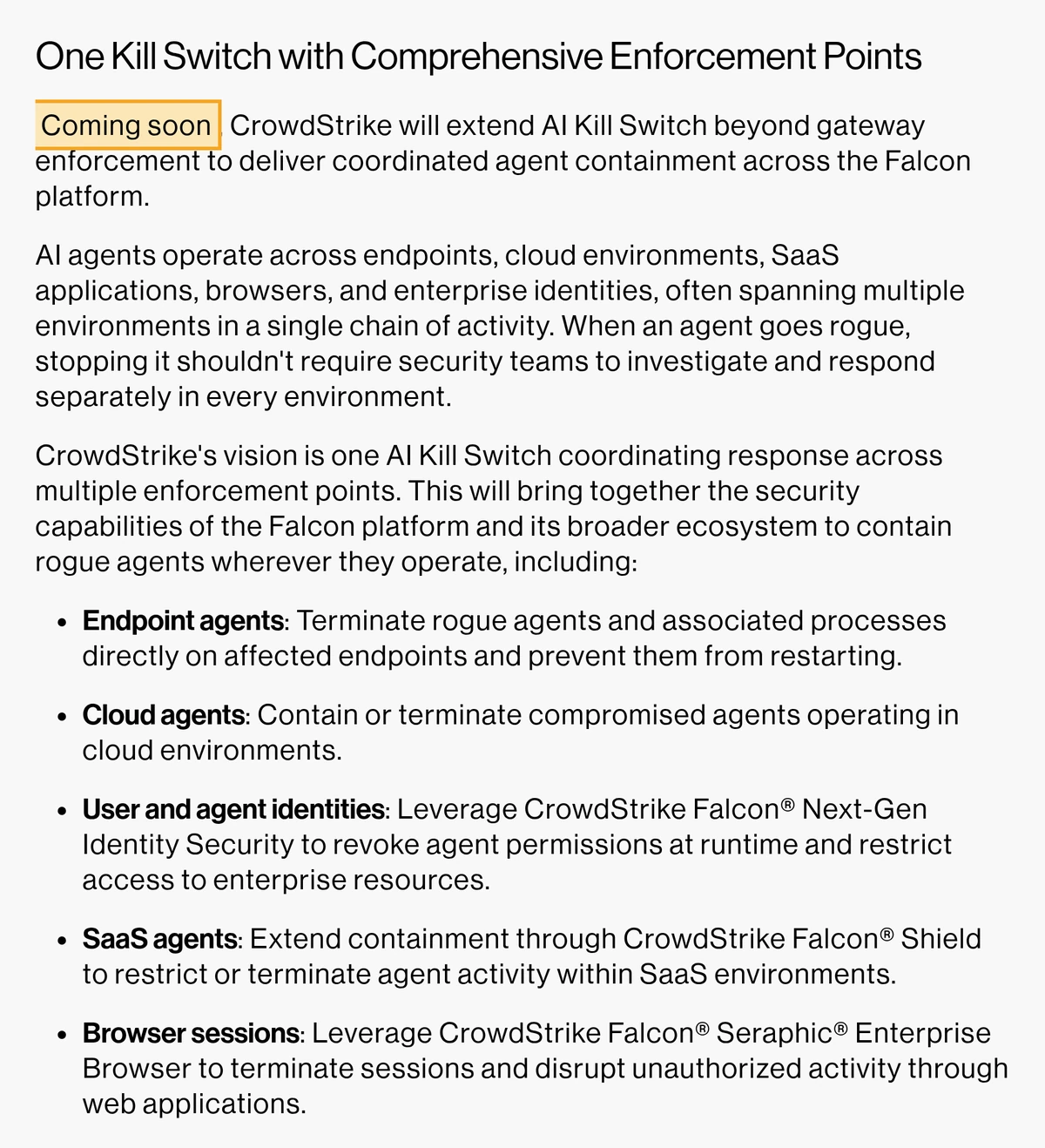
The best AI agent security tools for runtime protection cover runtime controls that work alongside a gateway kill, and our AI guardrails tools list covers policy checks that block bad actions before a kill is needed.
Why the Kill Switch Matters for Agent Teams
A named kill switch from a large security vendor turns agent shutdown into a buying question, and it puts gateways at the center of agent control. It also shows how much of the job is still unsolved. CrowdStrike’s own roadmap needs five more enforcement points before a kill reaches everything an agent touches.
The launch came with two planned deals. CrowdStrike agreed to buy Fiddler, whose monitoring will become Falcon Observe, and Dreadnode, which runs adversarial tests on models and MCP servers. Both are expected to close in fiscal Q4 2027. The Wall Street Journal reported about $400 million for Fiddler and $95 million for Dreadnode, which CrowdStrike has not confirmed.
Microsoft is moving the same way with Dynamic Agent Risk and Guardian Agents. OpenAI’s report that its coding agents disabled misalignment monitoring shows why the stop control should sit outside the agent’s reach. The NIST, NSA and CISA incident response practices, our AI agent governance guide and the non-human identity tools list cover the policy and credential side.
Frequently Asked Questions
What is the CrowdStrike AI Kill Switch?
It is a control in Falcon Guardian, announced November 3, 2026, that lets an authorized admin cut AI agents off from the models they use. Today it works by telling the Falcon AI Gateway or a connected third-party gateway to block chosen model providers. Every action is recorded in the audit trail.
Can the CrowdStrike AI Kill Switch stop an agent on a laptop?
Not yet. CrowdStrike’s press release says enforcement comes first at the gateway and soon on the endpoint, and its blog lists endpoint termination and restart blocking as coming soon. Today a kill blocks model access through gateways, so local processes and jobs the agent already started can keep running.
Which AI gateways work with the CrowdStrike AI Kill Switch?
CrowdStrike’s launch figure shows Falcon AI Gateway, LiteLLM, Kong, Apigee, Azure API Management, TrueFoundry, JetStream and Portkey in the kill switch dialog. The blog says third-party gateways are supported so teams can use existing infrastructure. CrowdStrike has not published a setup guide for each gateway, so confirm support with your account team.
How much does the CrowdStrike AI Kill Switch cost?
CrowdStrike publishes no list price for Falcon Guardian, so pricing is by quote. The AI Kill Switch is part of Falcon Guardian, and the company’s blog says the Falcon AI Gateway is included with Guardian at no additional cost. Model usage and any third-party gateway are paid for separately.
What HTTP status should a gateway return when it kills an agent?
Return 403, or a 503 with the header x-should-retry set to false. In our November 4 lab test, both made the OpenAI and Anthropic Python SDKs fail after one request in about 0.05 seconds. A 429 or plain 503 triggered two retries, and a 429 with Retry-After set to 20 held both SDKs for about 40 seconds.
The Bottom Line
CrowdStrike’s AI Kill Switch is a real control today, but it is a gateway control. It cuts agents off from chosen model providers, and the endpoint, identity, SaaS and browser pieces that make it a full kill are still on the roadmap. Teams should test how their own agents react to a gateway refusal before the day they need it.
We will update this story when CrowdStrike ships endpoint enforcement or agent-type targeting, or publishes gateway setup guides. Send corrections through our contact page.
Related coverage: LiteLLM supply chain compromise, a Claude Code agent inside a Pentagon network, shadow AI detection tools, AI agent governance platforms, and our AI agent observability tools guide.