
Last updated October 19, 2026. Product status, prices, and regulatory dates were checked against vendor documentation, official framework pages, and the EU Official Journal on that date.
AI agent governance is the set of owners, policies, and technical controls that decides which AI agents may exist, what each one can reach, which actions it may take without a person, and what evidence it leaves behind. In 2026 no single product covers all of it, so enterprise buyers assemble governance from six layers: inventory, identity, policy, runtime protection, evidence, and human oversight.
Start from the platform where most of your agents already run. Choose Microsoft Agent 365 when Copilot Studio and Foundry agents dominate, ServiceNow’s Super Intelligence Control Tower when ServiceNow is your system of record, and Okta for AI Agents when agents span several clouds and identity is your strongest team. Add an agent security platform such as Zenity or Noma Security once agents cross vendor boundaries, and know that none of these purchases helps until every agent has a named human owner.
This buyer’s guide is the pillar for our AI governance and security coverage, with deeper guides filed under agent security and governance and compliance. It sits beside our MCP explainer and AgentOps tools map. No vendor paid for placement, per our editorial standards and disclosure policy.
TL;DR
- Governance gap: only 13% of organizations think they have the right AI agent governance in place, according to Gartner (April 2026), which expects an average Fortune 500 enterprise to run more than 150,000 agents by 2028.
- Proportional controls: Gartner predicts 40% of enterprises will demote or decommission autonomous agents by 2027 because of governance gaps, and it recommends four autonomy levels with different controls for each.
- Six layers: inventory and ownership, identity and access, policy and authorization, runtime protection, observability and evidence, and human oversight make up a complete program.
- Regulation moved: Regulation (EU) 2026/1744 pushed EU AI Act high-risk duties to December 2, 2027 for Annex III systems and August 2, 2028 for Annex I products, while transparency duties applied from August 2, 2026.
- Control planes shipped: Microsoft Agent 365 has been generally available since May 1, 2026 at $15 per user per month, and Okta for AI Agents reached general availability in April 2026.
- Policy as code: Amazon Bedrock AgentCore Policy (generally available March 3, 2026) checks Cedar rules on every tool call, and Microsoft’s open-source Agent Governance Toolkit applies YAML rules in public preview.
What Is AI Agent Governance?
AI agent governance is the operating model that decides who may build an agent, what data and tools it can use, which actions need human approval, and how the organization proves compliance afterward. It extends model governance from what an AI system says to what an AI agent does inside business systems.
Credo AI describes three eras in its July 14, 2026 Agent Governor launch post: governing models, then governing outputs, and now governing actions. The shift matters because an output only became an outcome when a person acted on it, while an agent can read a repository, call dozens of tools, and change records in a single session.
Agent governance and agent security overlap, and they answer different questions. Security teams ask whether an agent can be hijacked or abused. Governance teams ask whether the agent should exist at all, who answers for it, and whether its permissions still match its purpose six months after launch.
An AI agent governance program is working when every agent in production has a registered owner, a scoped identity, a written action policy, and an audit trail a regulator could follow. Anything short of that is a policy document waiting for its first incident.
Why AI Agent Governance Became a 2026 Budget Line
Agent counts are growing faster than oversight. Gartner’s April 28, 2026 research on agent sprawl found that only 13% of organizations believe they have the right AI agent governance in place, and it expects an average Global Fortune 500 enterprise to run more than 150,000 agents by 2028.
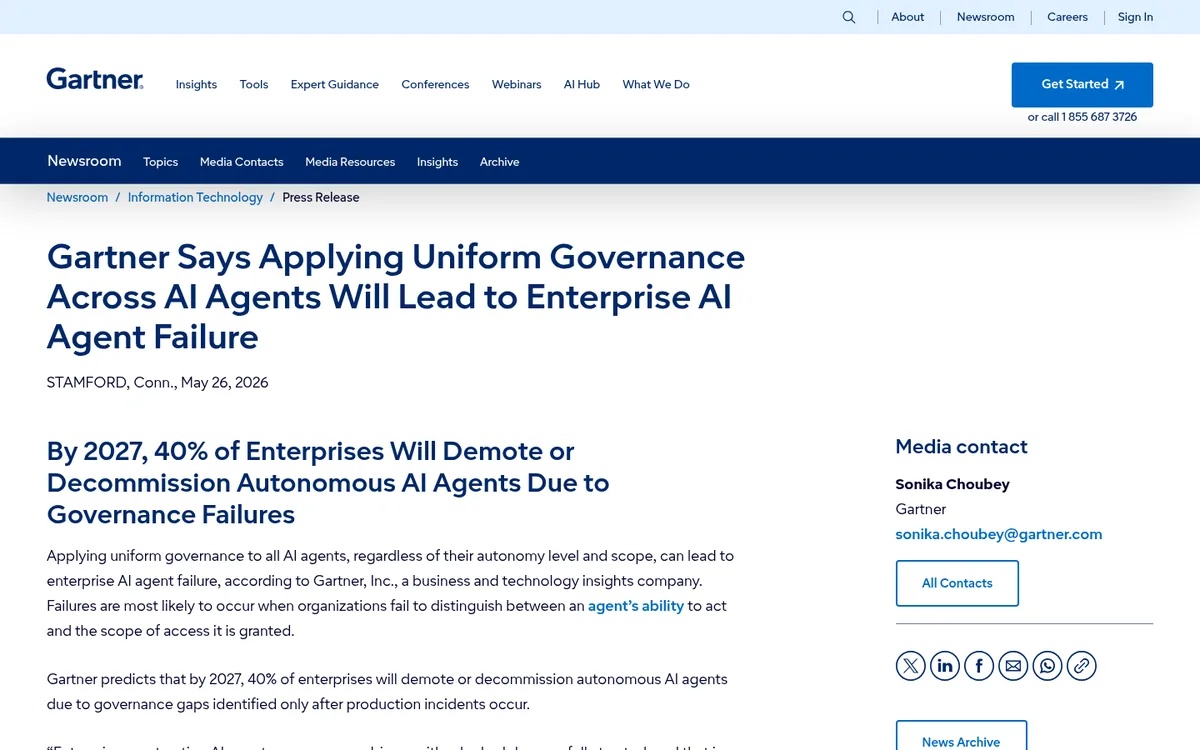
Gartner followed on May 26, 2026 with a sharper warning in its autonomy levels research: by 2027, 40% of enterprises will demote or decommission autonomous AI agents because of governance gaps found only after production incidents. Gartner traces most failures to uniform rules, where simple agents get over-restricted and autonomous agents get too little control.
Vendor surveys point the same way, though they carry obvious bias. ServiceNow’s 2026 Banking AI Maturity Index, cited in its October 15, 2026 announcement, reports that every surveyed bank uses AI while only 24% have governance to match. Credo AI’s survey of 371 senior leaders found that 60% deploy AI across several departments and 4% govern it at scale.
Real incidents keep the topic on board agendas. Our coverage of Anthropic pulling internal evals offline after agents overstepped and of the NIST, NSA, and CISA practices for rogue agent incidents shows the failure governance exists to catch: an agent with legitimate access doing something nobody approved.
The Six Layers of an AI Agent Governance Program
A complete AI agent governance program covers six layers: inventory and ownership, identity and access, policy and authorization, runtime protection, observability and evidence, and human oversight across the agent lifecycle. Most enterprises already own parts of layers two and five and are missing the rest.
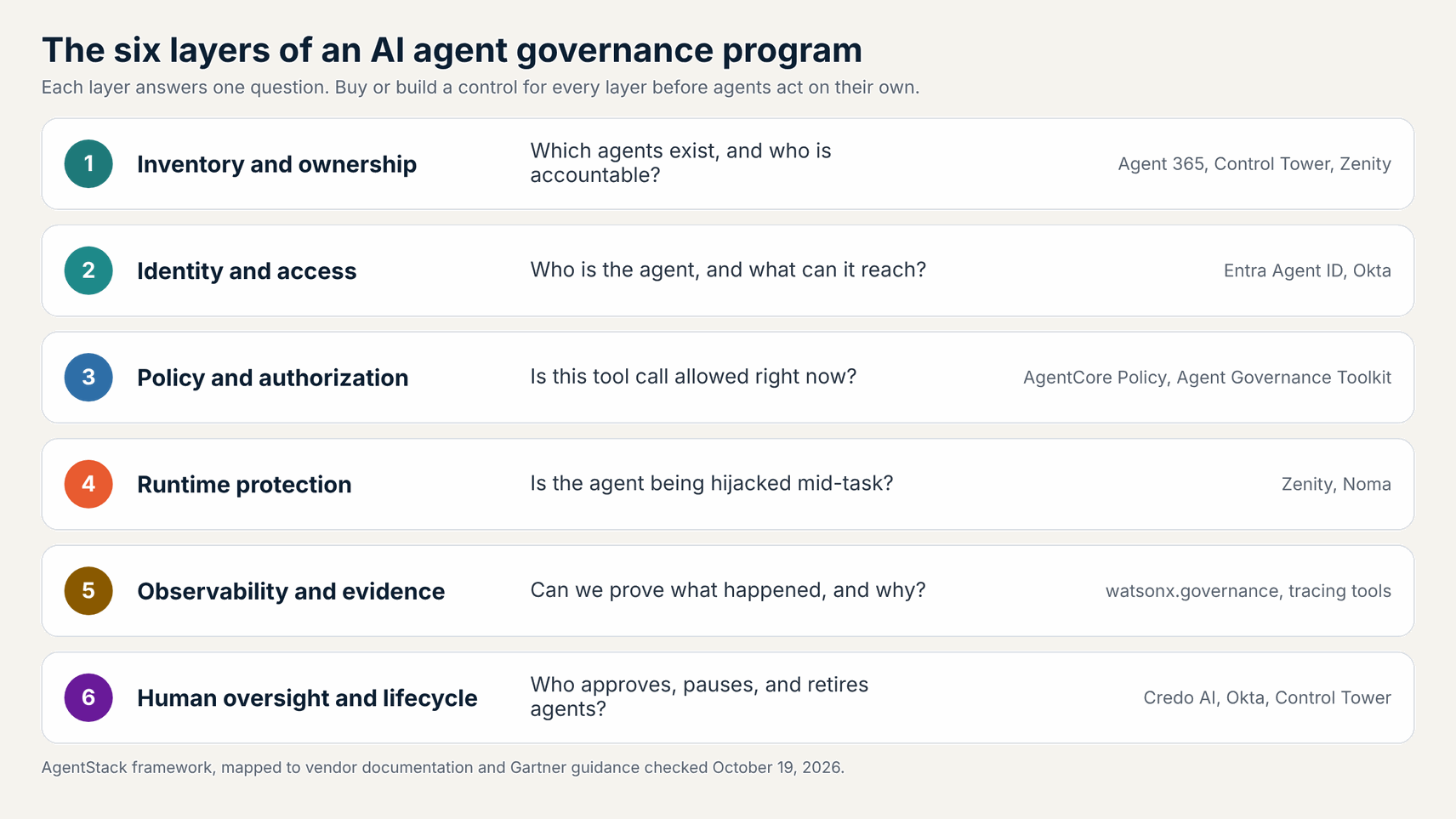
| Layer | Question it answers | Example controls | Typical owner | Tools that cover it |
|---|---|---|---|---|
| 1. Inventory and ownership | Which agents exist, and who answers for each one? | Agent registry, shadow agent discovery, named sponsor | CIO or AI platform team | Microsoft Agent 365, ServiceNow, Zenity, Noma |
| 2. Identity and access | Who is the agent, and what can it reach? | Separate agent identities, short-lived tokens, access reviews | Identity and access team | Microsoft Entra Agent ID, Okta for AI Agents |
| 3. Policy and authorization | Is this specific tool call allowed? | Tool allowlists, argument checks, policy as code | Platform engineering with security | AgentCore Policy, Agent Governance Toolkit, MCP gateways |
| 4. Runtime protection | Is the agent being manipulated right now? | Prompt injection detection, goal drift alerts, inline blocking | Security operations | Zenity, Noma, runtime agent security tools |
| 5. Observability and evidence | Can we prove what happened and why? | Traces, decision logs, evaluation records | AgentOps or ML platform team | IBM watsonx.governance, tracing tools |
| 6. Human oversight and lifecycle | Who approves, pauses, and retires agents? | Approval workflows, kill switch, decommissioning | Business owner with risk and compliance | Credo AI, Okta, ServiceNow |
Verdict: Layers one and two are the cheapest to start and the hardest to retrofit, so fund them first. Layers three and four decide whether autonomous agents are safe to run, and layer five is what auditors will ask for. Treat layer six as a process with tools attached, because approvals and retirement fail when nobody owns them.
1. Inventory and ownership
Inventory comes first because every later control needs a list of agents to attach to. Gartner’s six steps for managing agent sprawl put a centralized inventory second, right after written policy, and point to AI trust, risk, and security management (AI TRiSM) tools for finding sanctioned and shadow agents. IT services firm LTM told ServiceNow it has deployed 1,500 agents and gave each one an employee ID and a manager.
Ownership is the part no tool decides for you. Microsoft Entra Agent ID formalizes owners, sponsors, and managers for agents, and its sponsor lifecycle workflows move sponsorship when a person changes roles or leaves, which is how orphaned agents get prevented in practice.
2. Identity and access
Agents should never borrow a human’s session or a shared API key. The NIST National Cybersecurity Center of Excellence (NCCoE) drew more than 600 responses to its February 2026 concept paper on agent identity and authorization, and on September 29, 2026 it named software development as the first use case for its demonstration project. The direction is a separate identity per agent, OAuth-based delegation, and short-lived scoped tokens.
3. Policy and authorization
Identity decides which systems an agent can reach, and policy decides what it may do once connected. The Agent Governance Toolkit README makes the point directly: OAuth scopes and IAM roles control which services an agent reaches, and they say nothing about whether a drop_table call should run. Policy engines check each tool call before execution, the same layer where the products in our MCP gateways guide sit.
4. Runtime protection
Runtime protection catches manipulation that a static rule cannot see, such as instructions hidden inside a tool response. The FastMCP security advisories and the 253 bugs found in 118 MCP servers show how often the tool boundary breaks. Runtime products from Zenity, Noma, and other vendors are covered in our agent security section.
5. Observability and evidence
Evidence turns governance from a document into something an auditor can test. A useful record shows which policy version was active, which tool was called with which arguments, and what was decided. OpenTelemetry support keeps spreading, including traces for Claude Managed Agents, and our AI agent observability tools guide compares the tracing options.
6. Human oversight and lifecycle
Human approval works only while it stays a real control. Gartner warns that approvals degrade under time pressure and approval fatigue, which creates a false sense of safety. Retirement belongs here too: an agent whose task has ended should lose its credentials the same week, the way a departing employee does.
How Should Governance Change With Agent Autonomy?
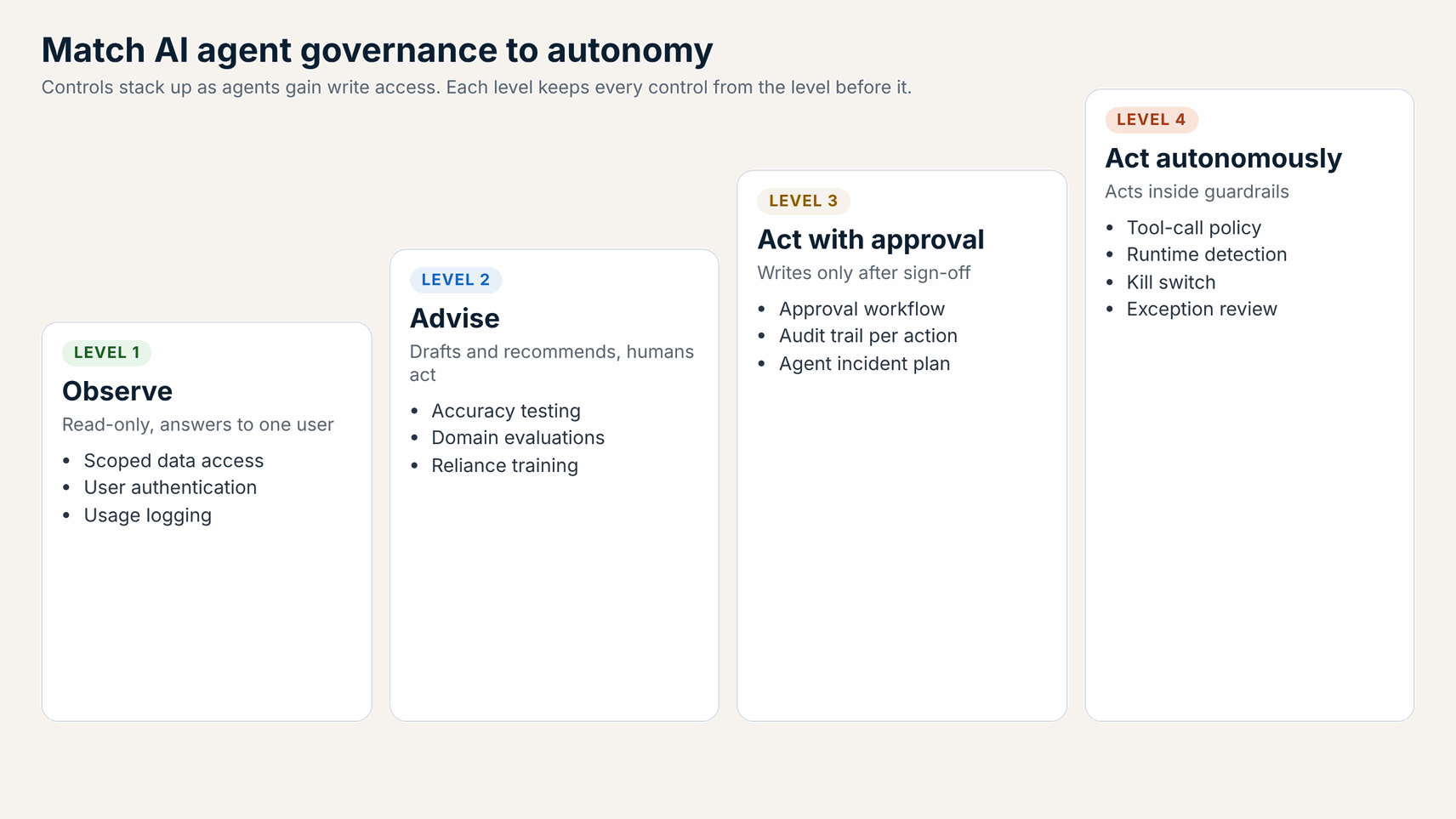
Governance should scale with what an agent can do: read-only agents need light controls, while agents that write data or act without approval need tool-call policy, runtime detection, and a tested kill switch. Gartner’s four autonomy levels give buyers a practical way to sort agents before buying anything.
| Level | What the agent can do | Example use | Minimum controls (Gartner, May 2026) | Layers to fund |
|---|---|---|---|---|
| 1. Observe | Read-only access, output visible only to the requesting user | Document summaries, knowledge retrieval | Scoped data access, user authentication, usage logging, basic testing | 1, 2, 5 |
| 2. Advise | Drafts and recommends; humans execute every action | Email drafts, report or code generation | Level 1 plus accuracy and hallucination testing, domain evaluations, reliance training | 1, 2, 5 |
| 3. Act with approval | Writes data or sends messages after explicit approval of each action | Ticket updates, configuration changes | Level 2 plus security testing, approval workflows with audit trails, agent incident response | All six |
| 4. Act autonomously | Acts inside defined guardrails; humans review exceptions and logs | Autonomous remediation, multi-step workflows | The most rigorous controls, with exception review and outcome monitoring | All six, with runtime blocking |
Verdict: Most enterprise agents sit at levels one and two, where an inventory, a scoped identity, and logging cover the main risks. Spend on policy engines and runtime protection where agents reach level three or four. Sorting agents by level before procurement keeps simple assistants from being buried in controls built for autonomous ones.
Singapore’s agentic framework shows the same idea in a real deployment. In the version 1.5 case studies, automation company Dayos lets its IT ticketing agent fully automate low-severity, reversible actions such as password resets, requires human approval for moderate ones, and bars it from permission changes entirely.
Which Frameworks and Regulations Apply to AI Agents?
Five references shape AI agent governance in 2026: the OWASP Top 10 for Agentic Applications for threats, NIST’s AI Agent Standards Initiative for identity and security direction, the amended EU AI Act for legal duties, Singapore’s agentic framework for operating practice, and ISO/IEC 42001 for a certifiable management system.
| Framework | Type | Status in October 2026 | Use it for |
|---|---|---|---|
| OWASP Top 10 for Agentic Applications 2026 | Threat taxonomy | Released December 9, 2025, entries ASI01 to ASI10 | Threat modeling and vendor questions |
| NIST AI Agent Standards Initiative | Standards program | Launched February 17, 2026; NCCoE comment summary September 29, 2026 | Identity and authorization direction |
| EU AI Act, amended by Regulation (EU) 2026/1744 | Law | Transparency from August 2, 2026; Annex III high-risk from December 2, 2027 | Legal duties for agents used in the EU |
| Singapore Model AI Governance Framework for Agentic AI | Voluntary framework | Launched January 22, 2026; version 1.5 announced May 20, 2026 | Operating practices and case studies |
| ISO/IEC 42001:2023 | Certifiable standard | Published 2023, not agent specific | An auditable AI management system |
Verdict: Use OWASP to decide what to defend against, NIST and Singapore to decide how to operate, ISO/IEC 42001 when customers ask for certification, and the EU AI Act wherever an agent touches a regulated use case in the EU. No single framework covers all six governance layers.
OWASP Top 10 for Agentic Applications
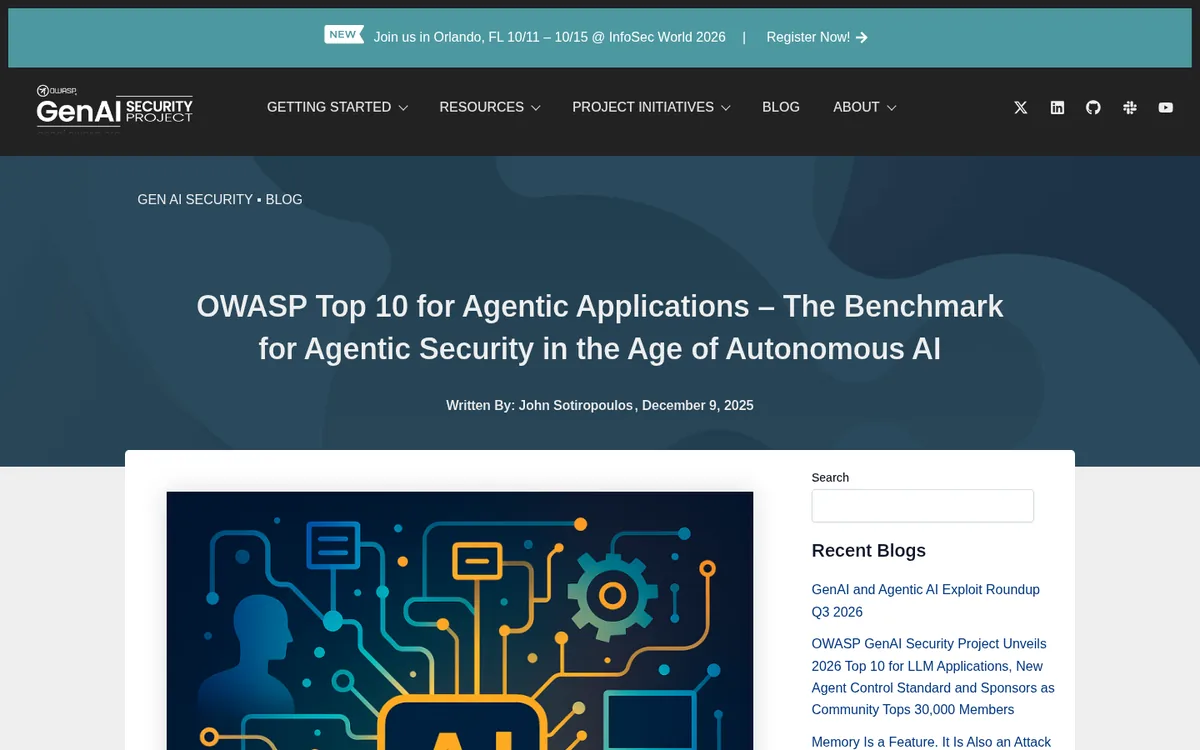
The OWASP GenAI Security Project published its agentic list on December 9, 2025. Its ten entries are ASI01 Agent Goal Hijack, ASI02 Tool Misuse and Exploitation, ASI03 Identity and Privilege Abuse, ASI04 Agentic Supply Chain Vulnerabilities, ASI05 Unexpected Code Execution, ASI06 Memory and Context Poisoning, ASI07 Insecure Inter-Agent Communication, ASI08 Cascading Failures, ASI09 Human-Agent Trust Exploitation, and ASI10 Rogue Agents.
Use the OWASP agentic list as a procurement filter: ask every vendor which entries it detects, which it blocks, and which it only logs. Microsoft’s Agent Governance Toolkit, for example, labels its own coverage as seven entries in full and three in part.
NIST AI Agent Standards Initiative
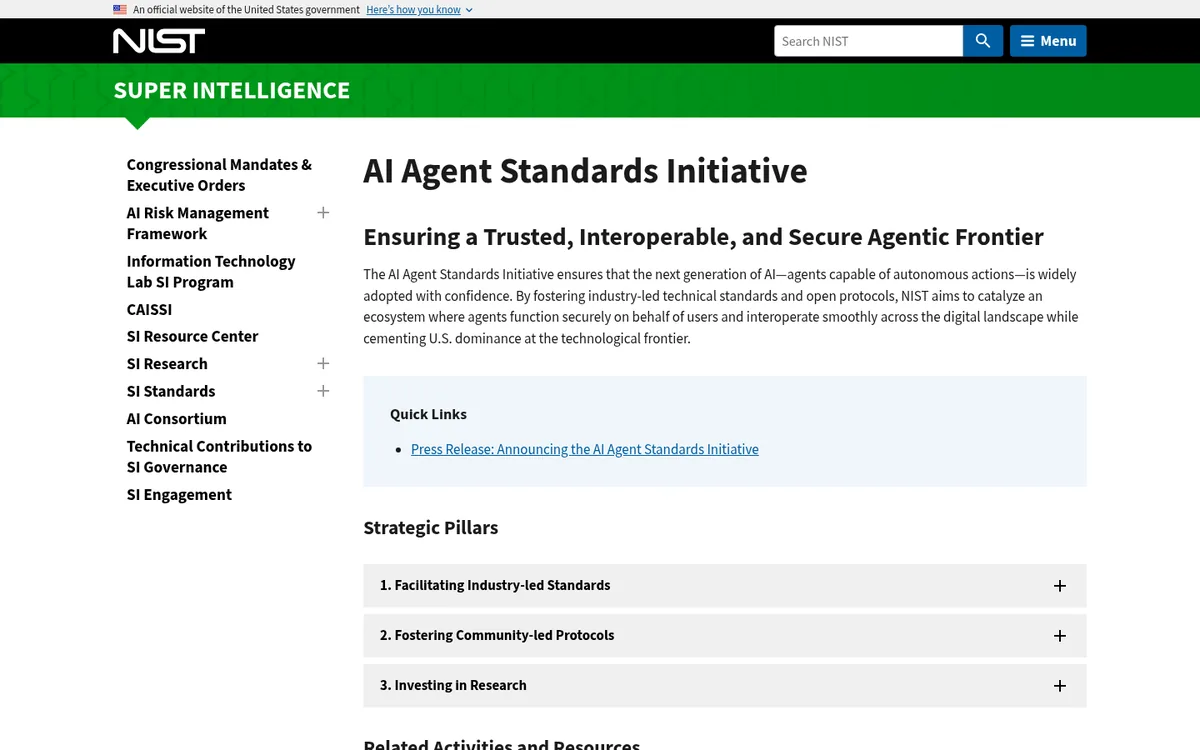
NIST’s Center for AI Standards and Innovation (CAISI) launched the AI Agent Standards Initiative on February 17, 2026, with pillars for industry-led standards, open agent protocols, and research into agent security and identity. NIST has not published final agent standards yet, so treat the initiative as direction. The incident response practices NIST, NSA, and CISA issued on October 16, 2026 are the most concrete guidance for operations teams so far.
Teams already running the NIST AI Risk Management Framework can map agent controls onto its Govern, Map, Measure, and Manage functions instead of starting a separate program.
EU AI Act after the Digital Omnibus
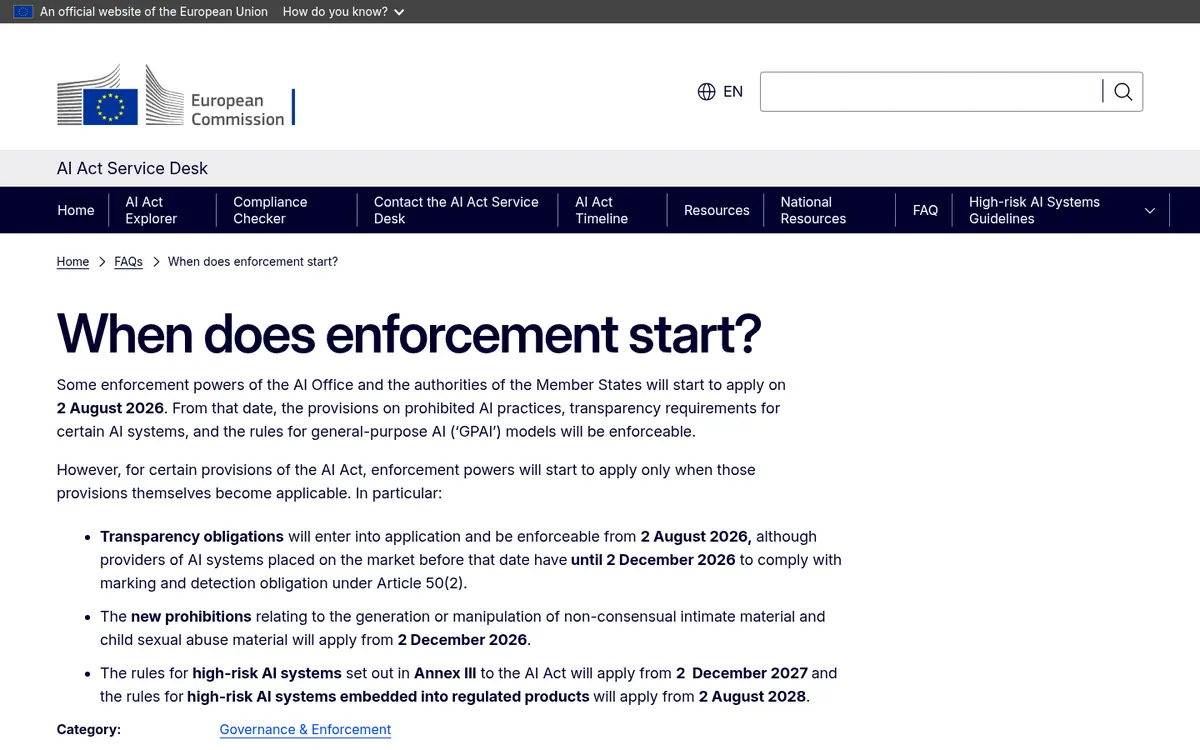
Regulation (EU) 2026/1744, the Digital Omnibus on AI, was published in the Official Journal on July 24, 2026 and took effect on July 27, 2026, as a Cloud Security Alliance research note details. It moved obligations for high-risk systems listed in Annex III to December 2, 2027, and for AI in regulated products under Annex I to August 2, 2028, according to the AI Act Service Desk.
Transparency duties and the rules for general-purpose AI models stayed on schedule, and providers of systems placed on the market before August 2, 2026 have until December 2, 2026 for the Article 50(2) marking duty. An agent’s use case decides its risk class, so an agent screening job applicants falls under Annex III while an agent summarizing meeting notes usually does not.
Singapore’s framework for agentic AI
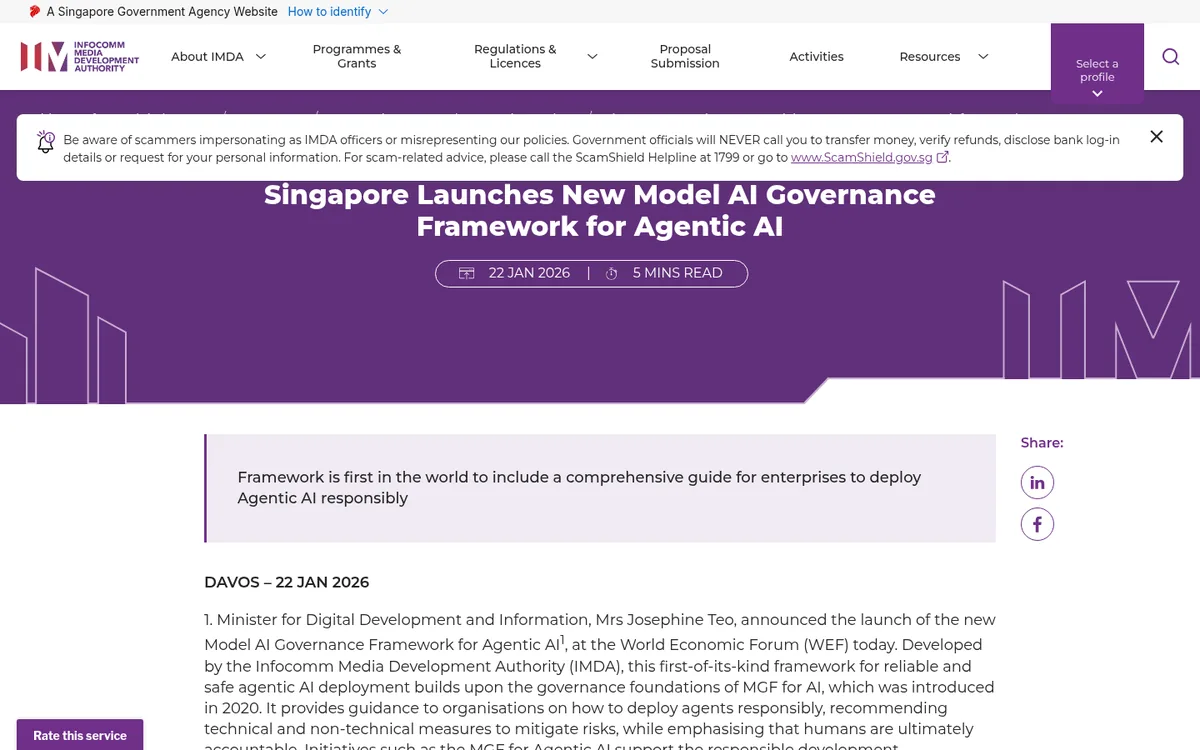
Singapore’s Infocomm Media Development Authority (IMDA) launched its Model AI Governance Framework for Agentic AI on January 22, 2026, and announced version 1.5 with more than 10 case studies on May 20, 2026. The framework covers four areas: assessing and bounding risks upfront, keeping humans meaningfully accountable, technical controls and processes, and end-user responsibility.
The framework is voluntary, and its case studies make it the most practical public playbook for running agents. Tencent’s CodeBuddy coding agent, one example, requires approval by default before editing files, running shell commands, or calling external tools, and still asks again when monitoring flags a previously approved command.
ISO/IEC 42001
ISO/IEC 42001:2023 sets requirements for an AI management system, and it is the only reference here that a company can be certified against. The standard does not address agents specifically, so pair it with the OWASP list for threats and the Gartner autonomy levels for how deep each control should go.
The AI Agent Governance Vendor Landscape in 2026
AI agent governance vendors fall into five groups in 2026: platform control planes, identity providers, policy engines, risk and compliance platforms, and agent security platforms. Each group covers two to four of the six layers, so most enterprises pair one control plane with one or two specialists.
| Vendor | Group | Layers covered | Status and price (October 2026) | Main limitation |
|---|---|---|---|---|
| Microsoft Agent 365 | Control plane | 1, 2, 4, 5 | GA May 1, 2026; $15 per user per month or in Microsoft 365 E7 | Deepest for Microsoft and partner agents |
| ServiceNow Super Intelligence Control Tower | Control plane | 1, 5, 6 | Available; AI Passport expected Q4 2026 | Value grows with ServiceNow CMDB use |
| Okta for AI Agents | Identity | 1, 2, 6 | GA April 2026; quote only | Agent Gateway and human approvals on roadmap |
| Amazon Bedrock AgentCore Policy | Policy engine | 3 | GA March 3, 2026 in 13 AWS Regions | Enforced at AgentCore Gateway |
| Microsoft Agent Governance Toolkit | Policy engine, open source | 3, 5 | Public preview; free under MIT license | Breaking changes possible before GA |
| IBM watsonx.governance | Risk and compliance | 1, 5 | Available; free trial | Some agent monitoring arrived in later releases |
| Credo AI | Risk and compliance | 1, 6 | Agent Registry; Agent Governor in research preview | Agent Governor supports Claude Code first |
| Zenity | Agent security | 1, 4, 6 | Quote only | No public price or self-serve trial |
| Noma Security | Agent security | 1, 4 | Quote only | Some endpoint features still planned |
Verdict: Microsoft Agent 365 is the default for Microsoft 365 tenants because it bundles inventory, identity, and threat protection at a published price. Okta and ServiceNow suit companies whose agents span several vendors and whose identity or service management teams already run those platforms. Policy engines and agent security platforms fill layers three and four, which control planes cover thinly.
Microsoft Agent 365 and Entra Agent ID
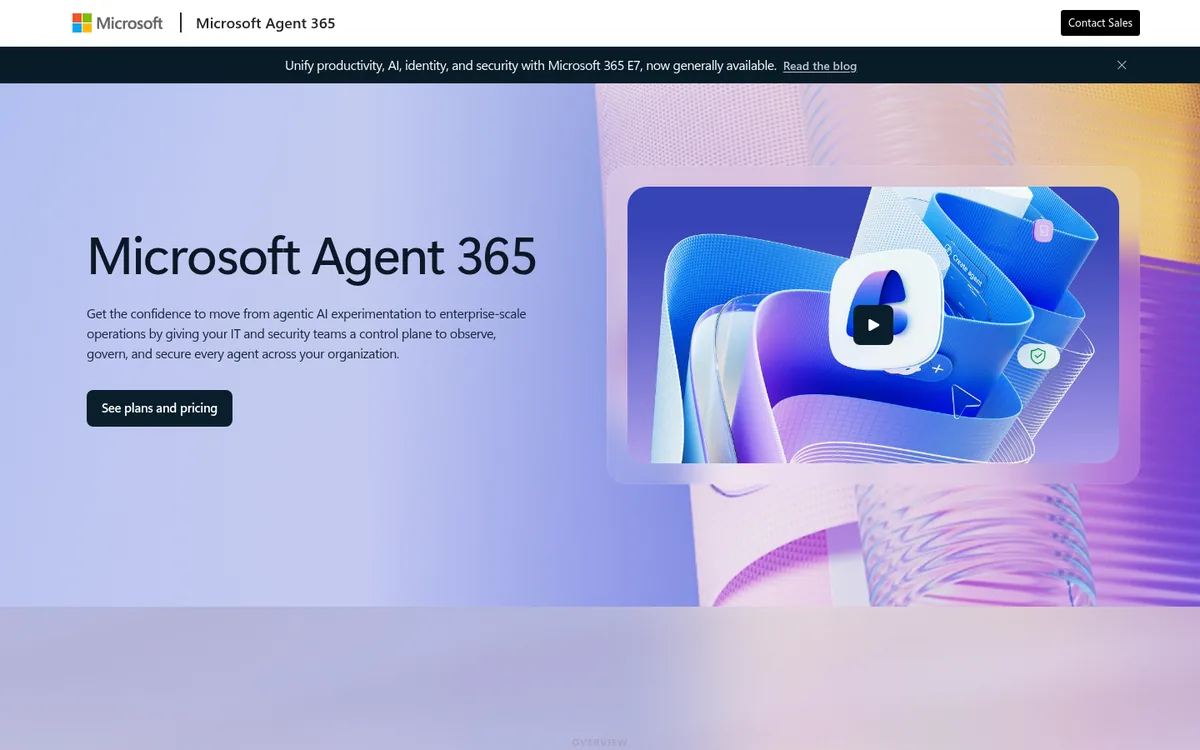
Microsoft Agent 365 became generally available on May 1, 2026 as a control plane for agents built with Microsoft tools and partner platforms. The product page lists a unified agent registry, access control through Microsoft Entra, posture and threat protection through Microsoft Defender, and data security through Microsoft Purview.
Licensing is per user: the licensing FAQ says one license covers every agent a person uses, manages, or sponsors, and agents need no license of their own. Microsoft Entra Agent ID, now generally available, supplies the identity layer, and Microsoft says agent registry experiences are converging under Agent 365.
- Best for: Microsoft 365 tenants where Copilot Studio and Foundry agents dominate.
- Status and price (October 2026): Generally available; $15 per user per month on an annual commitment, or included in Microsoft 365 E7 at $99 per user per month.
- Watch out for: Coverage of agents outside Microsoft depends on partner integrations, so check each non-Microsoft platform you run.
ServiceNow Super Intelligence Control Tower
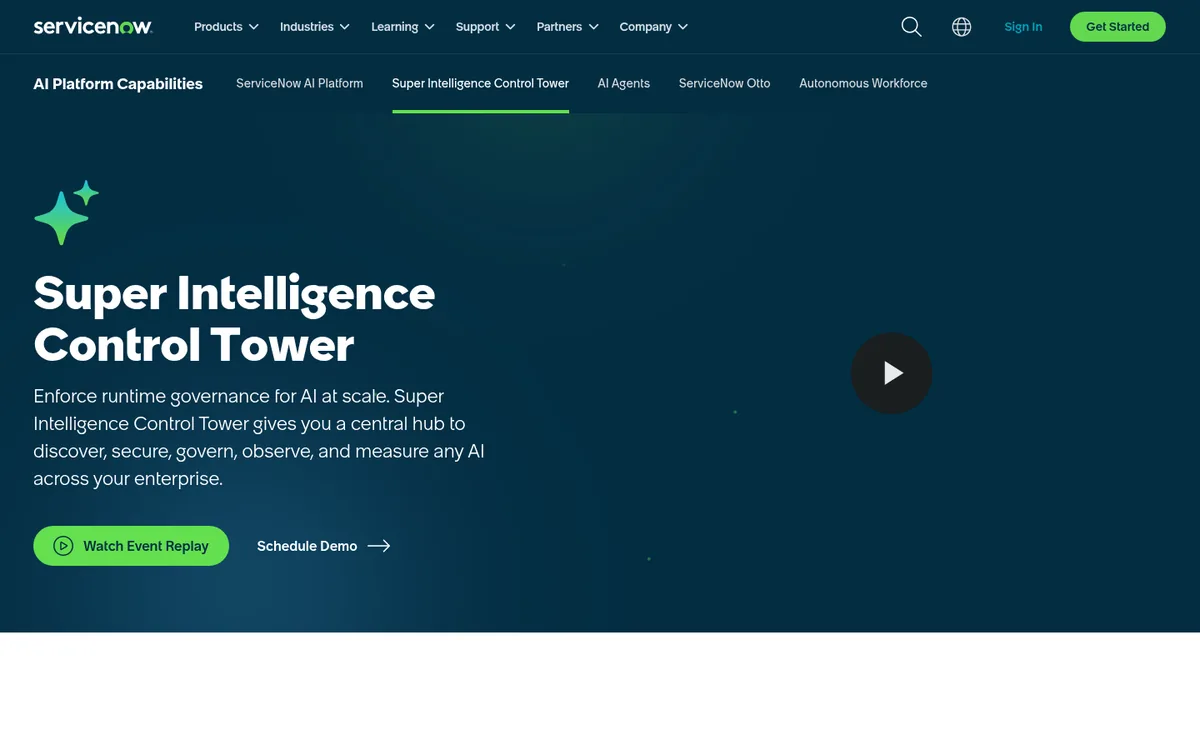
ServiceNow’s Super Intelligence Control Tower ties AI agents, models, and identities to its Configuration Management Database (CMDB) and its governance, risk, and compliance workflows. On October 15, 2026 ServiceNow announced AI Passport, a cryptographically signed credential that agents check at runtime to verify their authorized scope, with graduated responses and a kill switch when an agent drifts.
The same announcement lists more than 400 connectors for AI discovery, shadow AI detection, and cost governance. AI Passport, shadow AI detection, and AI Cost Management are expected in Q4 2026, so confirm availability before you build a plan around them.
- Best for: Enterprises that already run IT and risk workflows on ServiceNow and want agents treated as governed assets.
- Status and price (October 2026): Available; sales-led pricing. AI Passport expected in Q4 2026.
- Watch out for: Most of the value depends on a well-maintained CMDB, which many companies lack.
Okta for AI Agents
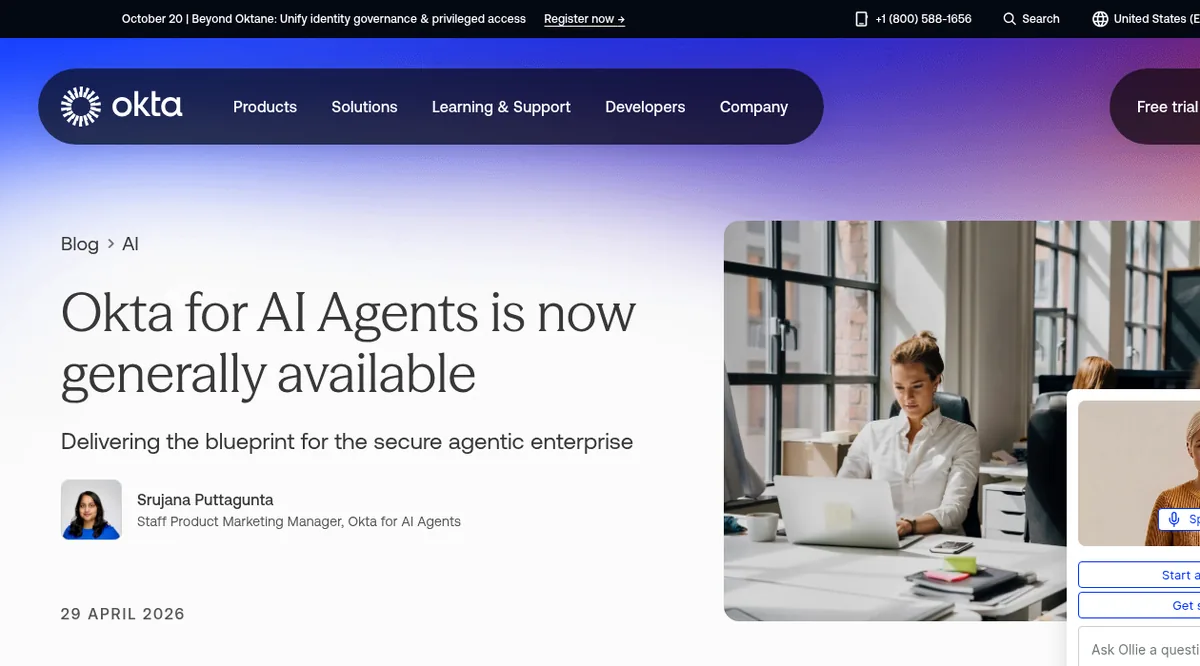
Okta for AI Agents reached general availability in April 2026 and registers agents as first-class identities in Okta Universal Directory. It imports agents from Salesforce Agentforce, Amazon Bedrock AgentCore, and the ServiceNow AI Platform, and it flags shadow agents by spotting new OAuth consent grants in managed Chrome browsers.
Access runs on scoped, short-lived tokens across five resource types, including MCP servers. Owners can certify agent access in review campaigns, and agent deactivation acts as a kill switch with one audit trail. Agent-to-agent delegation, an Okta-hosted Agent Gateway, threat detection, and human approval controls are on the roadmap.
- Best for: Companies whose agents span several clouds and SaaS platforms and whose identity team already runs Okta or federates with it.
- Status and price (October 2026): Generally available; sales-led pricing.
- Watch out for: Shadow agent discovery covers managed Chrome only, with other browsers listed as coming soon.
Amazon Bedrock AgentCore Policy
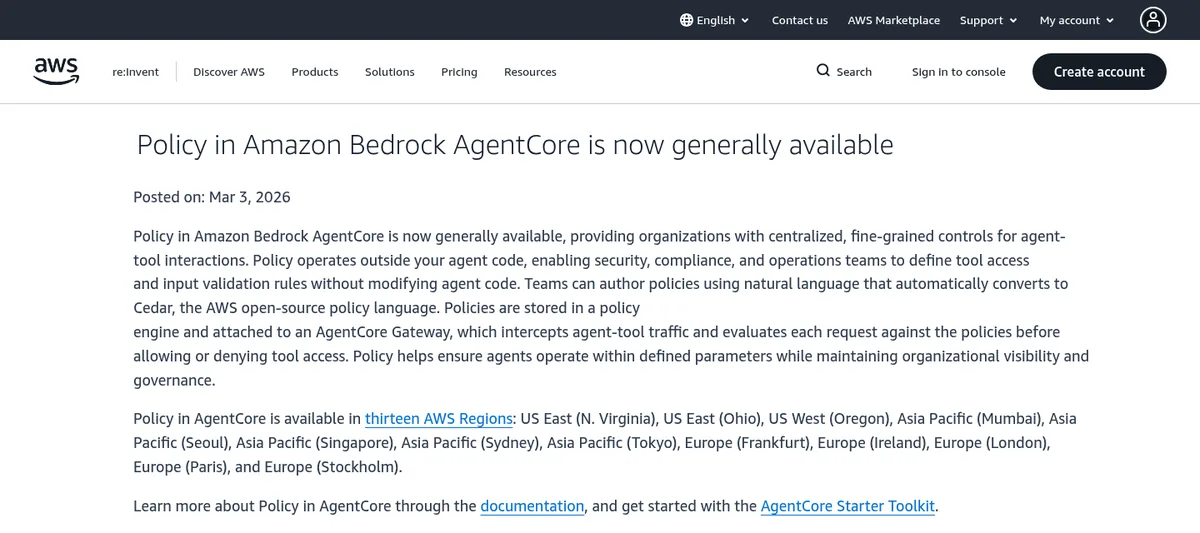
Policy in Amazon Bedrock AgentCore became generally available on March 3, 2026 in 13 AWS Regions, including Mumbai, Singapore, and Frankfurt. Teams write rules in natural language that convert to Cedar, the AWS open-source policy language, and an AgentCore Gateway checks every agent-to-tool request against them before allowing or denying access.
Rules live outside agent code, so security and compliance teams can change them without a deployment. We compare AgentCore Gateway with Kong and Docker in our MCP gateway comparison.
- Best for: Teams building agents on AWS that want deterministic tool-call rules owned by security.
- Status and price (October 2026): Generally available in 13 Regions; usage-based AWS pricing.
- Watch out for: Policies apply to traffic through AgentCore Gateway, so agents that call tools directly bypass them.
Microsoft Agent Governance Toolkit
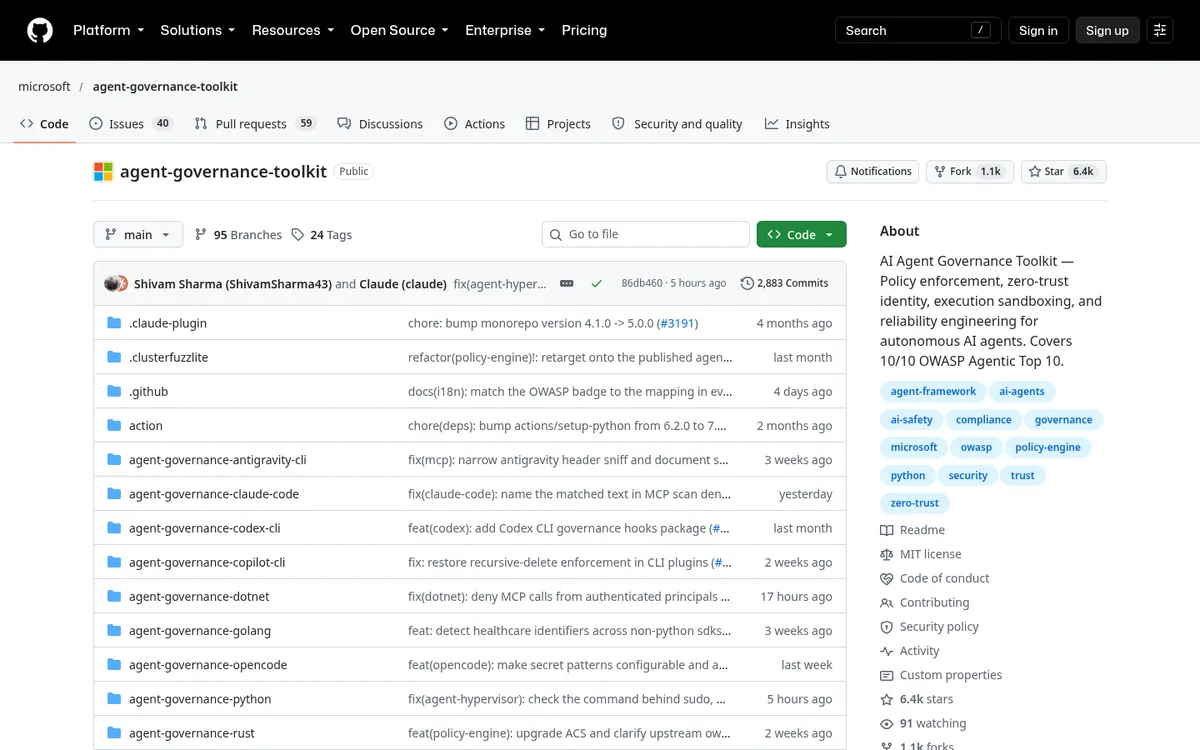
Microsoft introduced the Agent Governance Toolkit on April 2, 2026 as open-source runtime governance for agents, under the MIT license. The GitHub repository covers policy enforcement, agent identity, execution sandboxing, and audit logging, installs with pip install "agent-governance-toolkit[full]", and ships a Claude Code plugin.
- Best for: Engineering teams that want free, framework-neutral policy checks inside their own agent code.
- Status and price (October 2026): Public preview; free under the MIT license.
- Watch out for: Microsoft labels it a public preview that may have breaking changes before general availability.
IBM watsonx.governance
IBM watsonx.governance extends model governance to agents with a Governed Agentic Catalog for registering and comparing agents and tools, plus risk assessments at use-case creation. IBM’s agentic governance announcement describes more than 50 evaluation metrics that teams add as decorators to tool nodes in LangGraph applications, including prompt injection and personal data checks.
- Best for: Regulated enterprises that already govern models with IBM and want agent evaluations in the same system.
- Status and price (October 2026): Available, with a free trial.
- Watch out for: IBM rolled out some agent monitoring and lineage features in later releases, so confirm what your version includes.
Credo AI
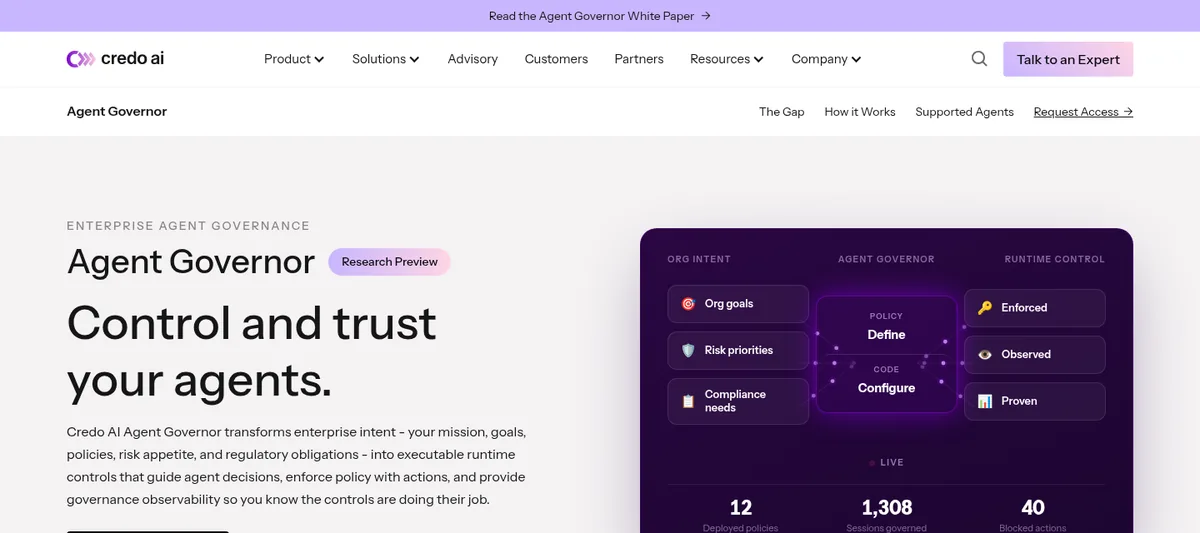
Credo AI pairs an AI Agent Registry for inventory and risk assessment with Agent Governor, a research preview launched on July 14, 2026. Agent Governor installs approved policy onto the agent harness at three postures, permissive, balanced, and strict, and resolves each step to allow, block, escalate, or advise.
Every decision leaves a structured record of the active policy version, the tool called, its arguments, and the reason for the outcome. Claude Code is the first supported harness, with others planned.
- Best for: Risk and compliance teams that want governance policy written once and enforced on coding agents.
- Status and price (October 2026): AI Agent Registry available; Agent Governor in research preview with design partners. Sales-led pricing.
- Watch out for: Agent Governor supports Claude Code only so far.
Zenity and Noma Security
Zenity’s compliance offering automates policy enforcement and audit readiness across agents built in Microsoft Copilot Studio, Salesforce Agentforce, ChatGPT Enterprise, and cloud platforms. The company raised a $125 million Series C on August 3, 2026.
Noma Security sells an agent security and governance platform that reaches coding agents on employee laptops. Its September 28, 2026 endpoint expansion discovers agents, MCP servers, and skills through existing EDR and MDM tools and sorts each into approved, needs review, or blocked.
- Best for: Security teams that need inventory and runtime enforcement across agents from many vendors.
- Status and price (October 2026): Both quote only.
- Watch out for: Neither publishes a price, so budget for a sales cycle and a proof of concept before testing enforcement.
What Policy as Code Looks Like for AI Agents
Policy as code means writing agent rules in a versioned file that a policy engine checks on every tool call, outside the model’s reasoning. The two examples below show the same idea in Cedar, the language behind AgentCore Policy, and in the YAML format of Microsoft’s open-source Agent Governance Toolkit.
// Amazon Bedrock AgentCore Policy (Cedar): allow one tool target on one gateway
permit(
  principal,
  action in AgentCore::Action::"ReadToolsTarget",
  resource == AgentCore::Gateway::"<gateway-arn>"
);

# Microsoft Agent Governance Toolkit: policy.yaml
apiVersion: governance.toolkit/v1
name: production-policy
default_action: allow
rules:
  - name: block-destructive
    condition: "action.type in ['drop', 'delete', 'truncate']"
    action: deny
  - name: require-approval-for-send
    condition: "action.type == 'send_email'"
    action: require_approval
    approvers: ["security-team"]
The Cedar rule, adapted from the AgentCore Cedar guide, permits calls to one tool target through one gateway, and AgentCore denies anything not permitted. The toolkit rules block destructive database actions and route outbound email to the security team for approval. Microsoft ships the sample with default_action: allow, and production teams should flip it to deny so new tools stay blocked until someone writes a rule.
Platform-Native Governance or a Cross-Vendor Layer?
Platform-native governance is enough when one vendor hosts most of your agents, because its control plane sees every agent, identity, and log in that ecosystem. A cross-vendor layer becomes worth its cost once agents run across several clouds, SaaS suites, and coding tools that no single platform can inventory.
- Several builders: agents from Copilot Studio, Agentforce, and homegrown LangGraph services share the same data.
- Coding agents on laptops: Claude Code, Cursor, and Codex run with repository and cloud credentials.
- One evidence trail: auditors want a single record across every agent, rather than one export per platform.
- One detection view: security wants detections mapped to OWASP or MITRE ATLAS from a single console.
A company whose agents all live in one vendor ecosystem gains little from a second governance console until it adds agents elsewhere. When agents start calling third-party tools through the Model Context Protocol (MCP), the MCP servers and agent integration platforms they use become part of the governance perimeter too.
12 Questions to Ask Every AI Agent Governance Vendor
Put these 12 questions into every request for proposal, and ask vendors to answer with documentation links rather than slides. The questions follow the six governance layers, so gaps show up as missing layers instead of missing features, and answers stay comparable across platform, identity, and security vendors.
- How does the product discover agents we never registered, and which platforms does discovery cover today?
- Can every agent carry a named human owner, and what happens when that owner leaves?
- Does each agent get its own identity, or does it reuse a user session or a shared key?
- How are agent tokens scoped, and how long do they live?
- Where is policy enforced: in agent code, at a gateway, on the endpoint, or on the network?
- Can policies inspect tool arguments and require approval for one specific action?
- Which OWASP agentic entries does the product detect, which does it block, and which does it only log?
- What does each audit record contain, and can we stream it to our SIEM in real time?
- How fast can we pause one agent, and does that revoke its credentials everywhere?
- Which features are generally available, and which are preview or roadmap on the contract date?
- How is it priced: per user, per agent, per request, or per token?
- Which EU AI Act and ISO/IEC 42001 evidence can the product produce, and who maintains that mapping?
Question 10 matters most in October 2026, because several headline agent governance features from Okta, ServiceNow, and Credo AI are still roadmap or preview items.
A 90-Day AI Agent Governance Rollout Plan
We suggest a 90-day plan for a first AI agent governance program: start with inventory and identity, then add policy and runtime controls only for the agents that need them. The plan assumes an existing identity provider and logging stack, and it follows the order of Gartner’s six steps for managing agent sprawl.
- Days 1 to 15, write the policy: define who may build and share agents, which connectors are allowed, and which actions always need approval.
- Days 1 to 30, build the inventory: pull agents from each platform registry, switch on shadow discovery, and assign an owner to every agent.
- Days 15 to 45, classify by autonomy: tag each agent with a Gartner level and its EU AI Act risk category.
- Days 30 to 60, fix identity: move agents off shared keys and user sessions onto agent identities with scoped, short-lived tokens.
- Days 45 to 75, enforce policy for levels three and four: add tool-call rules at a gateway or policy engine, plus approvals for high-impact actions.
- Days 60 to 90, prove it: stream decision logs to the SIEM, run one pause drill, and review every agent’s access with its owner.
Retire agents in the same cycle. Pause any agent still without an owner at day 30, and remove credentials from any agent unused for 60 days until someone asks for it back.
Who Owns AI Agent Governance?
AI agent governance works best with one accountable executive and shared operating duties. The CIO or a chief AI officer usually owns inventory and policy, the CISO owns identity and runtime controls, risk and compliance own the regulatory mapping, and each agent’s business owner answers for its outcomes.
| Role | Owns | Signs off on |
|---|---|---|
| CIO or chief AI officer | Agent policy, inventory, platform choice | New agent builders and connectors |
| CISO | Identity, runtime protection, incident response | Level 3 and 4 launches |
| Risk and compliance | Framework and EU AI Act mapping, audit evidence | High-risk use cases |
| Platform engineering | Gateways, policy as code, logging | Policy changes in production |
| Business owner | The agent’s purpose and outcomes | Launch, scope changes, retirement |
Verdict: Name the accountable executive before buying tools, since every vendor on this page assumes someone will act on its alerts. Shared ownership without a named executive tends to leave shadow agents with nobody assigned to them.
When This Guide Does Not Apply
This guide assumes agents that take actions in business systems. Teams running only chat assistants with read-only access to public data need a usage policy and logging, and a six-layer program would cost more than the risk it removes. The guide also does not replace legal advice on EU AI Act classification.
Vendor details change quickly. Okta, ServiceNow, and Credo AI all list agent governance features as roadmap or preview items, so confirm general availability on the contract date.
Frequently Asked Questions
What is a kill switch for AI agents?
A kill switch is a control that pauses or deactivates an agent and revokes its credentials across connected systems in one action. Okta for AI Agents offers agent deactivation, ServiceNow lists kill switch capabilities in its Control Tower, and Microsoft Entra can block risky agent identities through Conditional Access policies.
How many AI agents does a typical enterprise run?
Counts vary widely and are rising fast. Gartner expects an average Global Fortune 500 enterprise to run more than 150,000 agents by 2028, and IT services firm LTM told ServiceNow it had deployed 1,500 agents. Platform registries miss agents built outside approved tools, which is why shadow discovery matters.
Is agent governance different for coding agents?
Yes, mostly in where the controls run. Coding agents such as Claude Code, Cursor, and Codex act on developer laptops with repository and cloud credentials, so governance relies on endpoint discovery and harness-level policy. Noma discovers them through EDR and MDM tools, and Credo AI’s Agent Governor started with Claude Code.
How much does AI agent governance software cost?
Few vendors publish prices. Microsoft Agent 365 lists $15 per user per month on an annual commitment, or comes inside Microsoft 365 E7 at $99 per user per month. Microsoft’s Agent Governance Toolkit is free under the MIT license, while Okta, ServiceNow, Credo AI, Zenity, and Noma quote through sales.
Should a human approve every AI agent action?
No, approving every action rarely holds up at scale. Gartner warns that per-action approvals degrade under time pressure and approval fatigue, which creates a false sense of safety. Reserve approvals for high-impact actions such as payments, deletions, and external messages, and govern routine actions with tool-call policy and logging.
Related Guides
For a closer look at three of the vendors named here, our Zenity vs Noma vs Pillar Security comparison compares how each one inventories agents, enforces runtime policy, and fits the control layers above.
For the tools behind specific layers, see our guides to AI agent security tools, MCP security tools and MintMCP vs Runlayer vs Lasso.
Read the MCP explainer, the AgentOps tools map, the AI agent frameworks guide, the MCP gateways guide, the Kong, AWS AgentCore, and Docker gateway comparison, MCP servers, agent integration platforms, LLM gateways, AI agent observability tools, open-source LLM observability, AI agent evaluation tools, MCP tool security bugs, FastMCP security advisories, Red Hat MCP gateway news, and NIST and CISA agent incident practices. Topic pages: agent security and governance and compliance.
The Bottom Line
AI agent governance in 2026 is a six-layer program, and no single product purchase completes it. Start with an inventory and an owner for every agent, give each agent its own identity, and add tool-call policy and runtime protection where agents act without a human. Buy the control plane that matches where your agents run first.
Send corrections or vendor updates through our contact page. We will update this guide as NIST, the EU AI Office, and vendors publish new agent governance material.