

Last updated November 24, 2026. Lab used shirudo-dev/shirudo at commit 1e81ff5 (VERSION 0.0.0-dev), OpenSSL 3.5.7, and a Debian cloud VM on kernel 6.12.113.
Shirudo is an open-source Linux runtime from OpenAI and Cisco that lets AI agents write signed eBPF and Java “shields” that block an exploit on a running system until the real patch lands.
It launched on November 23, 2026, is pre-release, needs a patched bpf-next kernel and a TPM 2.0, and verifies who signed a shield, not whether the shield is correct. We ran its sandbox policy generator against an AI coding agent policy and checked a stock cloud kernel for its prerequisites. The policy compiler is strict and useful. A stock kernel cannot run it today.
This sits next to our AI agent security tools hub, the Cairn AI agents MONAI Label zero-day report, and the ARTEX AI agents LLM gateway keys write-up. No vendor paid for this page.
TL;DR
- OpenAI and Cisco (Isovalent) open-sourced Shirudo on Nov 23, 2026 under BSD 2-Clause, with BPF programs dual-licensed BSD and GPL. It is a rewrite of Tetragon built for agents.
- Agents such as Codex find a bug, write a small eBPF or Java bytecode shield, test it, and an operator signs and ships it as a .bee package through an OCI registry.
- Requirements are steep: a bpf-next kernel with the signed-loader ABI plus Shirudo’s carried patches, a TPM 2.0, ML-DSA-87 keys only, and clang 23 to build.
- Our check of a stock 6.12 cloud kernel found 0 of 6 required kernel symbols and no TPM device.
- Our app-sandbox lab compiled a coding-agent policy into a fixed 10,792-byte object. It rejected hostnames, path patterns, two wildcards, more than 64 patterns, and more than 128 networks.
What OpenAI and Cisco launched
OpenAI’s announcement describes Shirudo as a runtime that protects running Linux systems while teams roll out patches. A shield blocks the behavior that exposes a vulnerability and lets legitimate requests through. An operator approves it, and it deploys while the service keeps running. Greg Brockman framed it as protection for systems teams cannot patch tomorrow.
Cisco’s newsroom post calls it a step toward “self-defending, agent-driven security” where agents do the legwork and people keep the keys. SiliconANGLE reports Shirudo is the first project under a broader Secure Infrastructure Project umbrella.
The Isovalent post by Thomas Graf and Liz Rice explains the design choice. Human policy languages slow agents down, so Shirudo lets agents output code. Shirudo is a one-shot CLI with no daemon. The control plane on the target is an eBPF program loaded at boot.
How a shield moves from an agent to the kernel
Isovalent’s demo used Codex as the agentic control plane in four steps. The agent gathers a disclosure or hunts for a bug. It writes a reproducer, validates the exploit, picks the mitigation point (eBPF or Java runtime), and validates the shield. The shield is signed and rolled out, then hit counts show exploitation attempts.
- Build and sign (operator host). shirudo build writes a .upatch container. The signed bytes are the generated BPF loader plus its data, under a detached CMS signature.
- Publish. Packages (.bee) go to an OCI registry. Targets pull them on a systemd timer; the shipped tree-sync timer fires every 60 seconds.
- Verify (target kernel). After shirudo init, the kernel admits a BPF load from userspace only for a loader signed against the sealed .bpf keyring.
- Measure and attest (TPM). Every load and unload extends a per-boot TPM register. shirudo attest returns TPM-signed evidence an operator verifies offline.
One correction to some early coverage. Several write-ups say targets validate each signature using TPMs. In the project docs, the kernel checks signatures against its keyring, and the TPM records and signs the measurement trail. The two jobs are separate.
The Java4Shell demo, in detail
The headline test was a Codex-generated shield against Java4Shell on a running Elasticsearch service, with no restart. In the repo, the java-base64 upatch guards java.util.Base64$Decoder.decode0 against the x64 AVX-512 tail underflow tracked as CVE-2026-114938. It throws IllegalArgumentException for the crafted input shape before the native stub writes.
Isovalent’s Elasticsearch 9.5.5 log shows the guard installing on decode0, then rejecting a candidate with length 65, padding 1, remainder 1. The README is candid about scope. The agent reaches JVMs a systemd user manager starts after the load, root can start a JVM without it, and it is “not a boundary against root”. For containers, the same jar can attach to a running PID.
What a target needs today
The system requirements page says there is no compatibility mode and no fallback for an older kernel, so a missing piece fails the build, shirudo init, or the load. The FAQ says Shirudo is not ready for production and has no stable releases or supported release branches yet.
| Requirement | Detail from the docs |
|---|---|
| Kernel | bpf-next with the signed-loader ABI, plus carried patches: tpm_command and mm_read_access LSM hooks, sleepable inode hooks, BPF LSM xattr reads |
| x86-64 fix | Upstream commit 31ac959c915c, or detaching a shared hook can crash tasks |
| TPM | TPM 2.0 on every target; there is no mode without one |
| Signing | ML-DSA-87 only; existing keys are refused |
| Build host | clang 23 with the BPF target, OpenSSL 3.5 or newer |
| Coexistence | Cilium, Falco and bpftrace do not run as they are; their logic must ship as signed upatches |
Repo snapshot from the GitHub API around 12:30 PM IST on November 24: created October 13, 2026, about 1,769 commits, 791 stars, 64 forks, 58 open issues, and one test-kernel pre-release tag.
Lab: can a stock cloud kernel run it?
We checked a Debian cloud VM on kernel 6.12.113 with CONFIG_BPF_LSM=y and bpf in its active LSM list. We searched /proc/kallsyms for the kfuncs and LSM hooks the requirements page names, and looked for a TPM device. This is the kind of general-purpose host most teams run agents on.
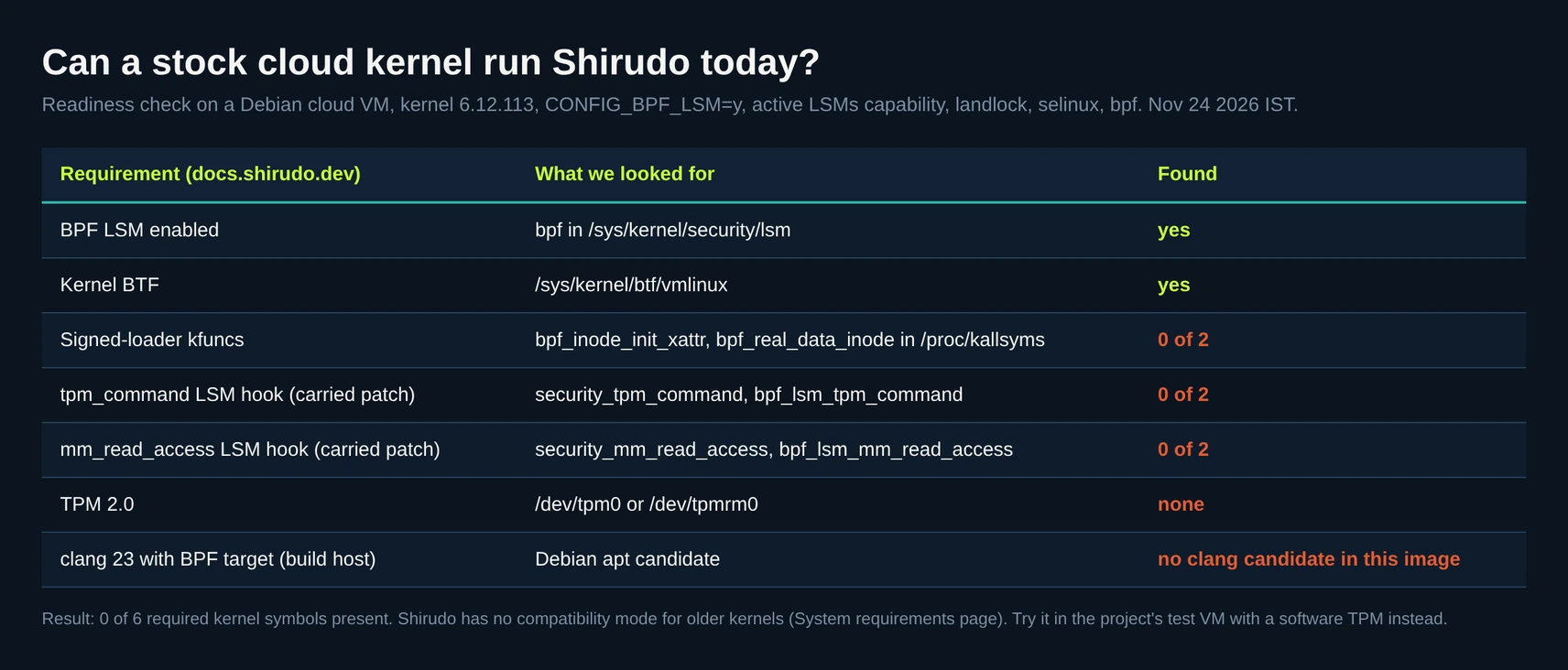
BPF LSM and kernel BTF were there, but the signed-loader kfuncs, the tpm_command hook, and the mm_read_access hook were not: 0 of 6 symbols matched, and there was no /dev/tpm0 or /dev/tpmrm0. This image also had no clang package candidate, so we could not build the operator binary here. For a first try, use the project’s test VM, which ships a software TPM.
Lab: confining an AI coding agent with app-sandbox
The docs pitch Shirudo to teams running LLM agents: signed rules limit which programs an agent runs, which files it writes, and which hosts it reaches, and root cannot detach them without the signing key. The app-sandbox upatch implements that. Its gen_policy.py compiles sandbox.toml into the policy object at build time, and we ran it with a coding-agent policy.
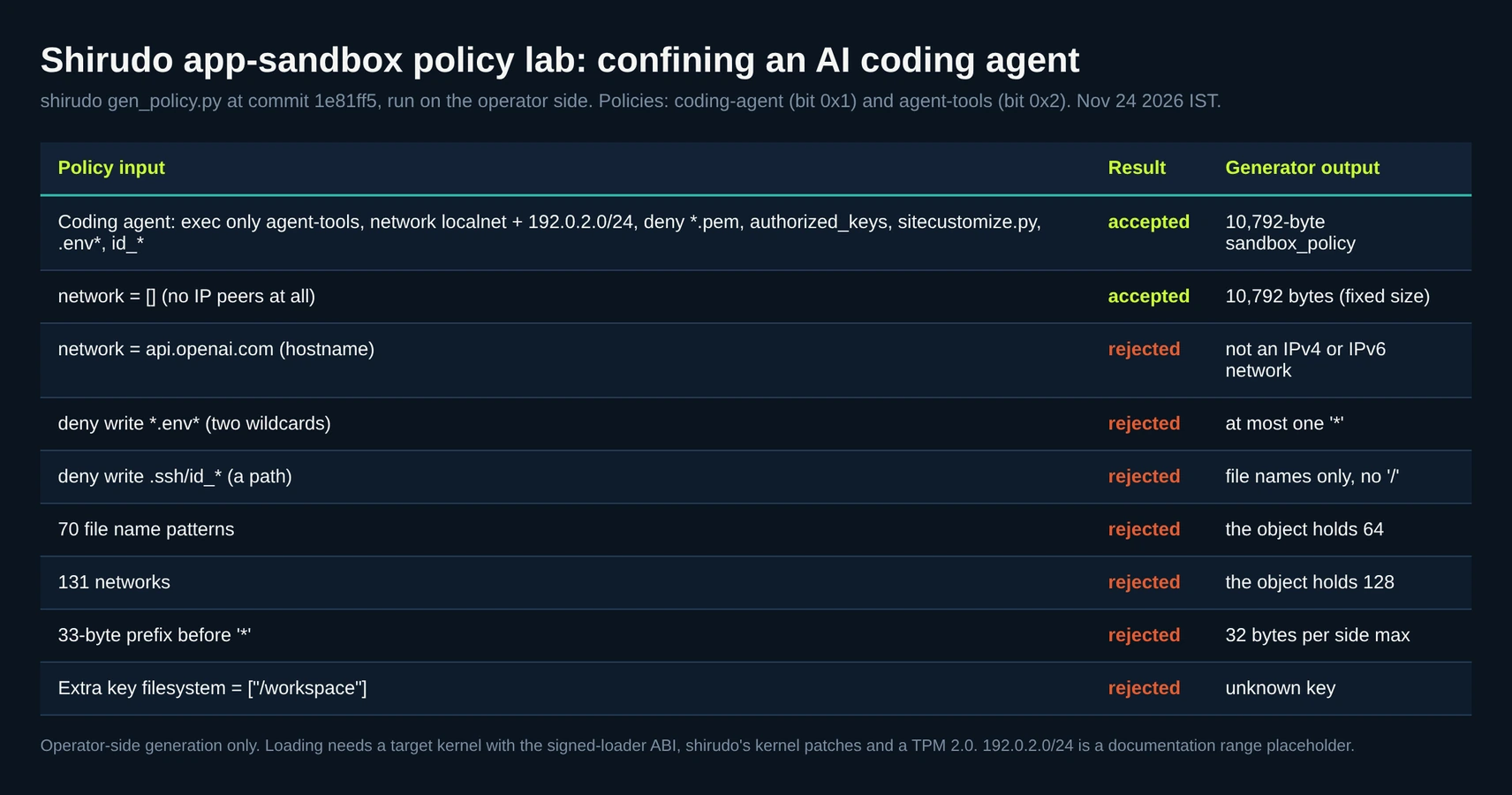
| Policy input | Result |
|---|---|
| exec only agent-tools; network localnet + 192.0.2.0/24; deny *.pem, authorized_keys, sitecustomize.py, .env*, id_* | accepted, 10,792 bytes |
| network = [] (no IP peers) | accepted, 10,792 bytes |
| network = api.openai.com | rejected: not an IPv4 or IPv6 network |
| deny *.env* (two wildcards) | rejected: at most one * |
| deny .ssh/id_* (a path) | rejected: file names only |
| 70 patterns / 131 networks | rejected: limits 64 and 128 |
| 33-byte prefix before * | rejected: 32 bytes per side |
Three findings matter for agent teams. First, “which hosts it may reach” means CIDR ranges, so an agent that calls a CDN-fronted LLM API needs IP ranges you maintain, not a hostname. Second, file rules match the last path component, so you can deny sitecustomize.py or authorized_keys anywhere but not one directory. Third, the README says a descriptor opened for writing before the task entered the sandbox still writes, and network rules cover connect, sendmsg and sendto on IP sockets only.
Signing cost: ML-DSA-87
Shirudo signs with ML-DSA-87 only, a post-quantum algorithm. With OpenSSL 3.5.7 we generated a key, signed a 64 KiB payload, and got a 4,627-byte signature and a 2,614-byte DER public key. Flipping one byte of the payload failed verification. That is plain OpenSSL, not shirudo’s CMS path, but it shows the size budget per artifact.
Limits the launch posts skip
- The threat model says plainly that Shirudo “establishes provenance, not correctness”. A signed shield can still be a bad mitigation.
- Root with a kernel exploit, or a module signed with a key the kernel trusts, goes around every check in that kernel (FAQ).
- Open item U4: repository index and tree signatures verify with whatever algorithm the certificate holds; use only certificates from shirudo genkey.
- If init fails at boot, the boot continues without enforcement, and only shirudo status and attestation show it.
- The kernel-cve manifest in the repo lists 3 detector shields as loaded_health_passed, each with predicate status source_derived_unvalidated.
What to do now
- Treat Shirudo as a lab project. Run the VM quickstart, not production.
- If you run coding agents on Linux hosts, draft an app-sandbox policy now: exec allow-list, CIDR egress list for your LLM endpoints, and deny patterns for keys, .env files and sitecustomize.py.
- Plan the kernel path before the agent path. You need a signed-loader bpf-next kernel, the carried patches and a TPM 2.0 on every target.
- Keep a human approval gate on shield rollout. The demo still has an operator approve and sign each shield.
- Keep patching. Shields cover the window until a fixed kernel or JDK ships.
Frequently Asked Questions
What is Shirudo?
Shirudo is an open-source BPF security platform for Linux from OpenAI and Cisco, launched November 23, 2026. It delivers signed eBPF and Java mitigations, called upatches or shields, to running machines without a reboot. Agents such as Codex can write and test shields, and operators sign and approve them. It is pre-release.
Is Shirudo ready for production?
No. The project FAQ says Shirudo is pre-release, with no stable releases or supported release branches. Targets need a bpf-next kernel with the signed-loader ABI, Shirudo’s carried kernel patches, and a TPM 2.0. The VM quickstart with a software TPM is the supported way to try it today.
Does Shirudo replace patching?
No. A shield covers the window until a machine runs a fixed kernel or runtime. The Java4Shell shield, for example, guards the Base64 decoder until the JDK is patched. The docs also say Shirudo establishes provenance, not correctness, so each shield still needs testing against real workloads.
Can Shirudo sandbox AI agents?
Yes, through the app-sandbox upatch. A policy limits which programs an agent runs, which networks it reaches, and which file names it creates, renames or writes. In our lab the generator accepted CIDR ranges only, file-name patterns only, and at most 64 patterns and 128 networks per package.
How is Shirudo related to Tetragon?
Isovalent says Shirudo has its roots in Tetragon, the eBPF runtime security project it open-sourced in 2022, rewritten for agents. The main change is that agents write mitigations as code instead of human policy files. Tetragon-style tools that load their own BPF cannot run unchanged on a Shirudo target.
Related Guides
For a second sandbox test, our Anthropic Siren write-up probed srt 0.0.83 against six escape rules, from host credential files to the container engine socket.
- AI agent security tools hub
- AI coding agent security tools
- Cairn AI agents and the MONAI Label zero-day
- ARTEX AI agents and LLM gateway keys
- CrowdStrike AI kill switch
Sources
- OpenAI: OpenAI and Cisco introduce Shirudo (Nov 23, 2026)
- Cisco newsroom: Cisco and OpenAI launch Shirudo (Nov 23, 2026)
- Isovalent: Cisco and OpenAI introduce Shirudo (Nov 23, 2026)
- shirudo-dev/shirudo repository
- Shirudo docs: System requirements
- Shirudo docs: Threat model
- The Hacker News coverage (Nov 24, 2026)