
Last updated October 25, 2026. Product scope, hook support, and open source versions were checked against vendor pages, Microsoft Learn, CrowdStrike docs, and GitHub on that date.
The best AI coding agent security tools in 2026 are Pillar Security, Palo Alto Networks Koi Agentic Endpoint Security, Noma Security, Microsoft Defender for Endpoint, CrowdStrike Falcon AIDR with Guardian, Zenity, Snyk Agent Scan, and Gen Digital Sage. Pillar is the strongest default when you need config posture plus runtime hooks across Claude Code, Cursor, and Codex.
AI coding agent security means stopping a local coding agent before it runs a dangerous shell command, reads a secret file, or calls a poisoned MCP tool. Most products here use Claude Code hooks or similar PreToolUse checks. Our agent security coverage sits inside the wider AI governance and security hub.
We read every launch post and docs page on October 25, 2026, built Gen Digital Sage 0.14.0 from source, and ran 20 PreToolUse payloads through its decision engine. We also ran Snyk Agent Scan against a poisoned MCP fixture. No vendor paid for placement or reviewed this page, per our editorial standards and disclosure policy.
TL;DR
- Hooks are the common control point. Claude Code PreToolUse hooks appear in six of the eight tools; Cursor support is narrower and often needs a vendor agent or plugin.
- Config posture still matters. Pillar, Koi AES, and Noma inventory MCP servers, skills, and agent settings before runtime policy fires.
- Open source options exist. Sage ships 366 YAML threat rules under Apache-2.0; Snyk Agent Scan inspects MCP configs and skills but needs a Snyk token for cloud analysis.
- Fail-open is common. Sage, Zenity (default), and several hook connectors allow the action if a check times out or errors, so pair hooks with endpoint controls.
- Our Sage test blocked five of 20 actions. curl|sh, wget|bash, rm -rf /, base64|bash, and a typosquat npm install were deny; seven more were ask.
AI Coding Agent Security Tools at a Glance
Pick Pillar or Koi AES for broad coding-agent coverage with config posture, Noma when agents sit beside SaaS inventory, Defender or AIDR if you already standardize on those platforms, and Sage or Snyk Agent Scan for open source starts. Zenity fits Claude Enterprise without an endpoint install. The table summarizes each tool from pages checked on October 25, 2026.
| Tool | Primary control path | Strongest fit | License / price signal |
|---|---|---|---|
| Pillar Security | Config scan plus runtime hooks | Claude Code, Cursor, Codex posture and runtime | Quote based |
| Palo Alto Koi AES | Endpoint agent, block or ask policies | Cursor, Claude Code, Antigravity runtime | Part of Prisma AIRS / Cortex |
| Noma Security | EDR or MDM discovery plus hooks | Endpoint agents inside a wider AI-DR plane | Platform contract |
| Microsoft Defender | Agent-native hooks plus network inspection | Windows preview for Claude Code and Copilot | Defender for Endpoint plan |
| CrowdStrike AIDR / Guardian | HTTP hooks into AIDR | Claude Code collectors under Falcon | AIDR for Workforce |
| Zenity | Anthropic inference hooks | Claude Enterprise with no endpoint agent | Quote based |
| Snyk Agent Scan | CLI scan of MCP and skills | Developer AppSec pipelines | Open source CLI; analysis needs Snyk token |
| Gen Digital Sage | Local YAML heuristics plus URL and package checks | Claude Code, Cursor, VS Code, OpenClaw | Apache-2.0 |
Verdict: The platform you already run decides many purchases, because Defender, AIDR, Koi AES, and Zenity reuse existing security consoles. A dedicated coding-agent product such as Pillar or Noma earns its place when config posture and multi-IDE hooks sit outside those stacks.
What Does AI Coding Agent Security Actually Do?
An AI coding agent security tool watches local agents such as Claude Code, Cursor, and Codex, then allows, asks, or blocks tool calls before shell, file, and MCP actions run. It also inventories agent configs, MCP servers, skills, and plugins so security teams can see what employees installed. Runtime checks and posture scans work together.
Most products attach to vendor hook interfaces rather than rewriting the agent. Claude Code fires PreToolUse and PostToolUse events; Cursor and Codex expose their own plugin or hook paths. Our MCP security tools guide covers the tool-server side of the same risk.
- Discovery: which agents, MCP servers, skills, and connectors run on managed devices.
- Posture: risky settings, hardcoded credentials, wildcard permissions, and shadow installs.
- Runtime: allow, ask, or deny on prompts, tool calls, and tool results based on policy.
How We Picked These AI Coding Agent Security Tools
We started from products that document runtime controls or discovery for Claude Code, Cursor, or Codex on their own pages, then scored each on IDE coverage, posture depth, and how honest the public docs are about limits. Every claim below comes from a vendor page, Microsoft Learn, CrowdStrike docs, or GitHub, all opened on October 25, 2026.
- IDE and harness coverage: Claude Code, Cursor, Codex, Copilot CLI, Antigravity, and related desktop agents.
- Control depth: config posture, MCP and skills inventory, PreToolUse or inference hooks, and remediation.
- Deployment model: endpoint agent, EDR or MDM connector, cloud inference hooks, or local open source plugin.
- Failure behavior: whether a timeout or error fails open or fails closed.
- Evidence quality: primary docs we could open, plus hands-on runs where the tool is free to build or install.
What Our October 25 Sage Test Found
Gen Digital Sage 0.14.0 loaded 366 YAML threat rules and returned deny on five of our 20 PreToolUse payloads, ask on seven, and allow on eight, including three benign developer commands. We cloned gendigitalinc/sage at commit 8817dcee, built the core package, and called evaluateToolCall the same way the Claude Code PreToolUse path does.
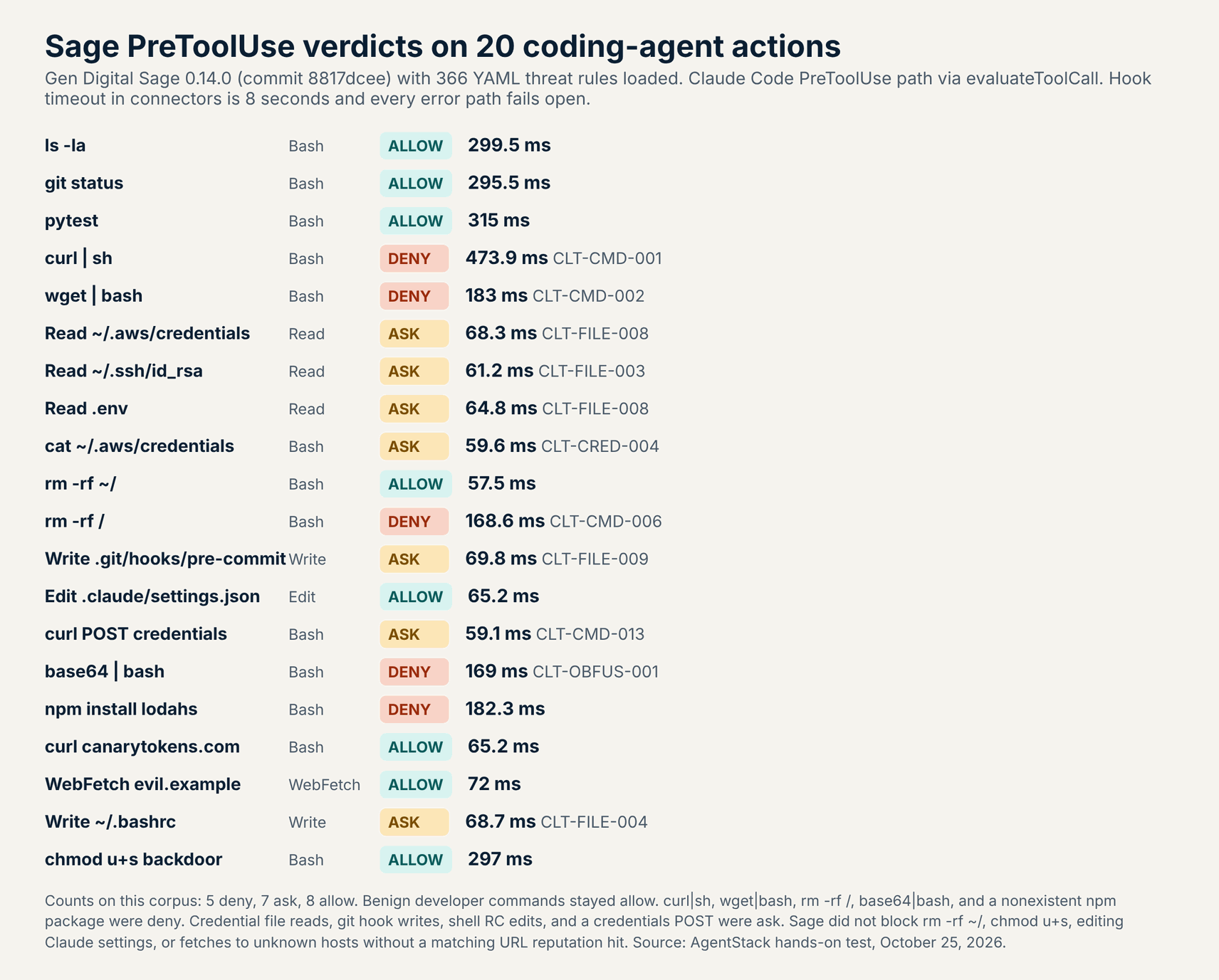
We fed Bash, Read, Write, Edit, and WebFetch payloads that cover curl pipe to shell, credential file reads, git hook writes, base64 decode to bash, a typosquat npm install, and ordinary git and pytest commands. Connector hook timeout in Sage is 8 seconds, and the product docs state that error paths fail open.
$ git clone https://github.com/gendigitalinc/sage && cd sage
$ pnpm install --frozen-lockfile && pnpm build
# 366 threats loaded from threats/*.yaml
# evaluateToolCall on 20 PreToolUse payloads (Claude Code path)
deny  5   curl|sh, wget|bash, rm -rf /, base64|bash, npm lodahs
ask   7   credential reads, git hook write, .bashrc write, exfil POST
allow 8   ls, git status, pytest, rm -rf ~/, chmod u+s, settings edit, ...
Sage blocked the classic remote-code and root-wipe patterns and asked on credential access, which matches what a local ADR tool should do. It allowed rm -rf ~/, chmod u+s, edits to .claude/settings.json, and fetches to unknown hosts without a URL reputation hit, so treat heuristics as one layer. Separately, Snyk Agent Scan 0.6.9 started our poisoned MCP servers under inspect, then required a SNYK_TOKEN before cloud analysis would run.
What this means for buyers: open source hooks catch high-signal patterns quickly, but enterprise tools still win on inventory, identity context, and policy that follows the user across IDEs. Ask every vendor to run your own deny list of shell and file actions in a pilot.
1. Pillar Security: Best Overall for Coding Agent Posture and Runtime
Pillar is the safest default for security teams that need both deep config posture and runtime controls across Claude Code, Cursor, Codex, and related coding agents. The February 5, 2026 launch post describes workstation discovery of agent configs, MCP credentials, permission scopes, and behavioral runtime controls for prompt injection, tool poisoning, and data exfiltration.
Pillar scans directories such as .cursor and .claude, flags wildcard permissions and auto-run settings, and watches sessions for credential harvesting and gateway bypass. It sits inside the wider Pillar AI security platform, so findings can join cloud and API agent risk instead of living in a one-off laptop tool.
- Best for: Security teams that want one inventory of coding agents plus runtime block or alert options across several IDEs.
- Covers: Claude Code, Cursor, Codex, Antigravity, GitHub Copilot, OpenClaw; configs, MCP servers, skills, runtime behavior.
- Pricing (October 2026): Quote based; sold through Pillar sales.
- Watch out for: Public pages emphasize outcomes more than exact hook event lists, so confirm PreToolUse coverage in a demo.
2. Palo Alto Networks Koi AES: Best for Runtime Policy on Managed Endpoints
Koi Agentic Endpoint Security fits Palo Alto Networks customers who want block or ask policies on Cursor, Claude Code, and Antigravity without building their own hook scripts. The August 18, 2026 update covers LLM-based agent discovery, session timelines, personal-account shadow AI detection, custom runtime policies, and remediation for risky plugins and npm packages.
Policies can restrict shell execution, file access, MCP tools, skills, and network requests, with a custom message shown in the agent chat. Koi AES also flags personal Claude Code, Cursor, Codex, and Antigravity accounts on corporate devices, which matters when free tiers train on conversation data by default.
- Best for: Cortex or Prisma AIRS shops that need endpoint runtime control for coding agents.
- Covers: Cursor, Claude Code, Antigravity session policy; MCP, skills, personal accounts, plugin remediation.
- Pricing (October 2026): Sold as part of the Palo Alto Networks AI security stack; no standalone public list price on the post we checked.
- Watch out for: Needs the Koi AES endpoint footprint; confirm Linux and macOS parity for your fleet.
3. Noma Security: Best for Endpoint Agents Inside a Wider AI-DR Plane
Noma is the pick when coding agents are one slice of a larger agent estate that already includes SaaS and homegrown agents under the same AI-DR policies. The September 28, 2026 post says Noma discovers agents, MCP servers, and skills through existing EDR or MDM, then enforces Access Control and AI-DR through hooks, gateways, SDKs, and APIs.
The coding assistant security page lists Claude Code, Cursor, and Copilot among the assistants it covers. Noma also publishes an open guardrails marketplace for Claude Code and Cursor plugins that call api.noma.security and fail open on network errors, which you should treat as a design choice during pilots.
- Best for: Enterprises that want coding agents in the same inventory and policy plane as SaaS agents.
- Covers: Claude Code, Cursor, Codex, Windsurf, and related endpoint agents; MCP servers, skills, AI-DR detectors.
- Pricing (October 2026): Platform contract; earlier AWS Marketplace listings for Noma AI-SPM showed six-figure annual terms.
- Watch out for: Hook plugins fail open on API errors, so keep local deny rules or EDR controls as a backstop.
4. Microsoft Defender for Endpoint: Best for Windows Fleets Already on Defender
Defender for Endpoint is the practical choice for Windows-heavy shops that already pay for Defender and want audit or block mode on coding agents without a new vendor. Microsoft documents AI agent runtime protection in public preview, with agent-native inspection for Claude Code and GitHub Copilot CLI plus network inspection for some other agents.
The support matrix lists broad discovery for Cursor, Codex, Claude Code, and dozens of other local agents on Windows and macOS, but agent-native runtime hooks for Cursor are not listed. Configuration uses Set-MpPreference modes Audit or Block, and Microsoft recommends audit first. Runtime protection is covered by tamper protection.
- Best for: Windows Defender for Endpoint customers that want preview runtime controls plus agent inventory.
- Covers: Discovery for many local agents; runtime hooks for Claude Code and Copilot paths; network inspection for selected agents.
- Pricing (October 2026): Included with supported Defender for Endpoint plans; no separate public SKU on the Learn pages we checked.
- Watch out for: Preview status and Windows-first runtime depth; confirm macOS and Cursor runtime plans before you depend on them.
5. CrowdStrike Falcon AIDR and Guardian: Best for Falcon Shops Securing Claude Code
CrowdStrike makes the most sense for Falcon customers who want Claude Code activity fused with endpoint telemetry under Falcon AIDR, now branded Falcon Guardian. The September 1, 2026 Guardian launch extends AIDR with agent discovery, prompt-to-runtime investigation, and governance of which agent types may run on managed endpoints.
CrowdStrike’s Claude Code collector docs deploy as HTTP hooks for UserPromptSubmit, PreToolUse, and PostToolUse against api.crowdstrike.com, with no local binary beyond Claude Code itself. Managed settings can stop users from removing the collector. A related AIDR post also covers Copilot Studio agents.
- Best for: CrowdStrike Falcon customers standardizing AI detection and response in one console.
- Covers: Claude Code HTTP hooks; Falcon Guardian agent discovery and investigation; Copilot Studio via AIDR.
- Pricing (October 2026): Requires AIDR for Workforce subscription and AIDR Admin role; list price is quote based.
- Watch out for: Claude Code collector docs do not document Cursor hooks; confirm Cursor roadmap if that IDE dominates.
6. Zenity: Best for Claude Enterprise Without an Endpoint Agent
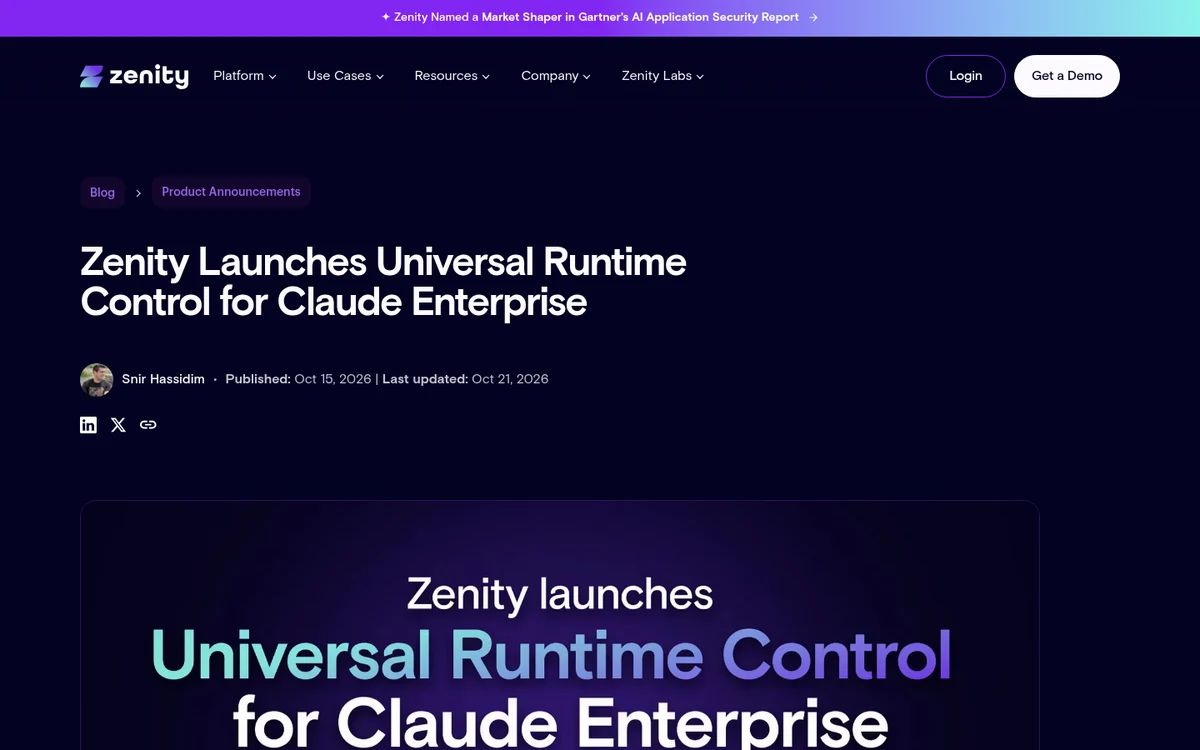
Zenity fits teams that standardize on Claude Enterprise and want per-tool-call policy without installing another agent on every laptop. The October 15, 2026 post covers Anthropic inference hooks in beta, where Zenity returns allow or deny before supported tool calls run across claude.ai, Cowork, Claude Code, Claude in Chrome, and related Claude surfaces.
Zenity Boundaries classify reads versus writes, inspect tool provenance, and can block actions after a session is marked tainted by prompt injection. Anthropic’s default failure handling allows the request if no verdict arrives in time, and image-only content is not inspected. Inference hooks do not apply on Bedrock, Google Cloud, or raw Claude Platform API access.
- Best for: Claude Enterprise customers that want central runtime control without endpoint software.
- Covers: Claude Enterprise surfaces including Claude Code; Boundaries for write controls, MCP origin, and injection-tainted actions.
- Pricing (October 2026): Quote based through Zenity sales.
- Watch out for: Claude-only path; default fail-open on timeout; not a substitute for Cursor or Codex controls.
7. Snyk Agent Scan: Best Open Source Scanner for MCP Configs and Skills
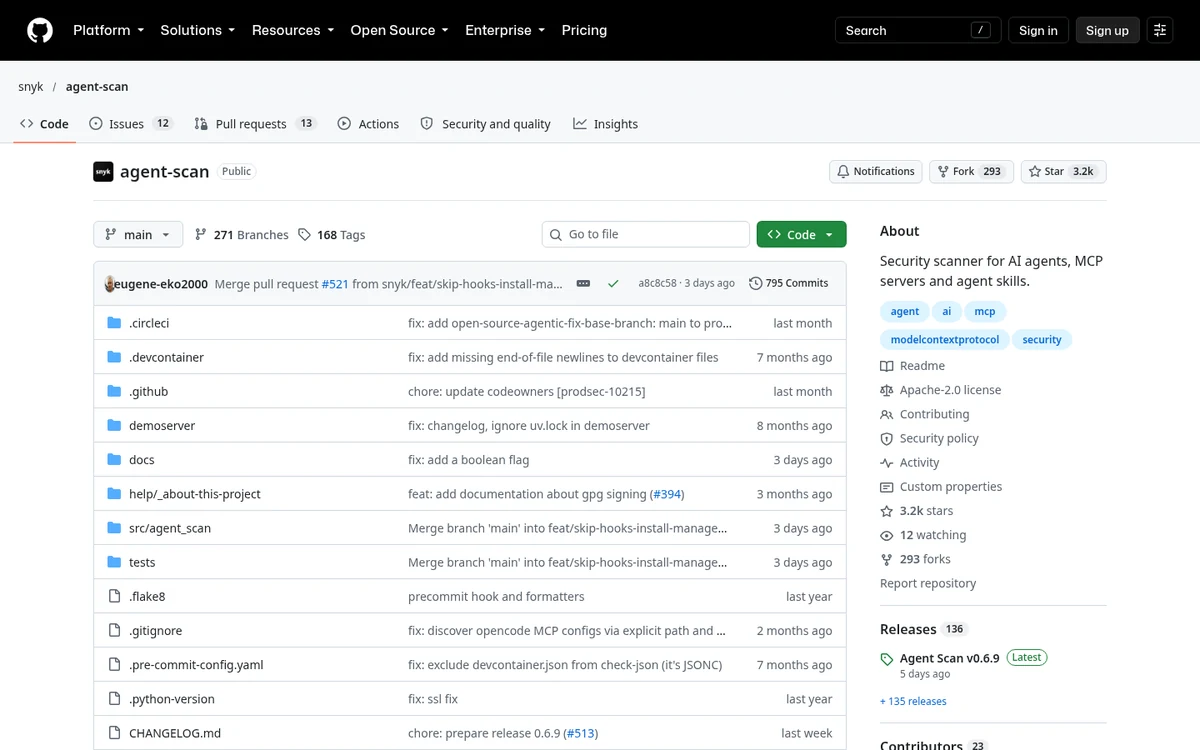
Snyk Agent Scan is the right open source starting point when AppSec wants a CI-friendly scan of MCP configs and agent skills before buying a full runtime platform. The snyk/agent-scan CLI discovers MCP servers and skills, can start stdio servers for inspection, and includes a guard subcommand for Agent Guard hooks.
In our October 25, 2026 run, version 0.6.9 listed tools from a poisoned MCP server and a clean converter, plus a malicious deploy-helper skill, under the local inspect command. Full scan analysis stopped until we set SNYK_TOKEN, which matches Snyk’s cloud analysis path. Agent Guard for Cursor is still an early hook installer, so treat runtime pieces as preview.
- Best for: AppSec teams that want MCP and skills scanning in developer workflows.
- Covers: MCP config files, skills, optional server start for inspection, Agent Guard hook helpers.
- Pricing (October 2026): CLI is open source; cloud analysis needs a Snyk account token; Evo platform features are enterprise.
- Watch out for: Without a token you get discovery, not Snyk’s hosted verdicts; confirm data handling before CI use.
8. Gen Digital Sage: Best Free Local Hook Layer for Claude Code and Cursor
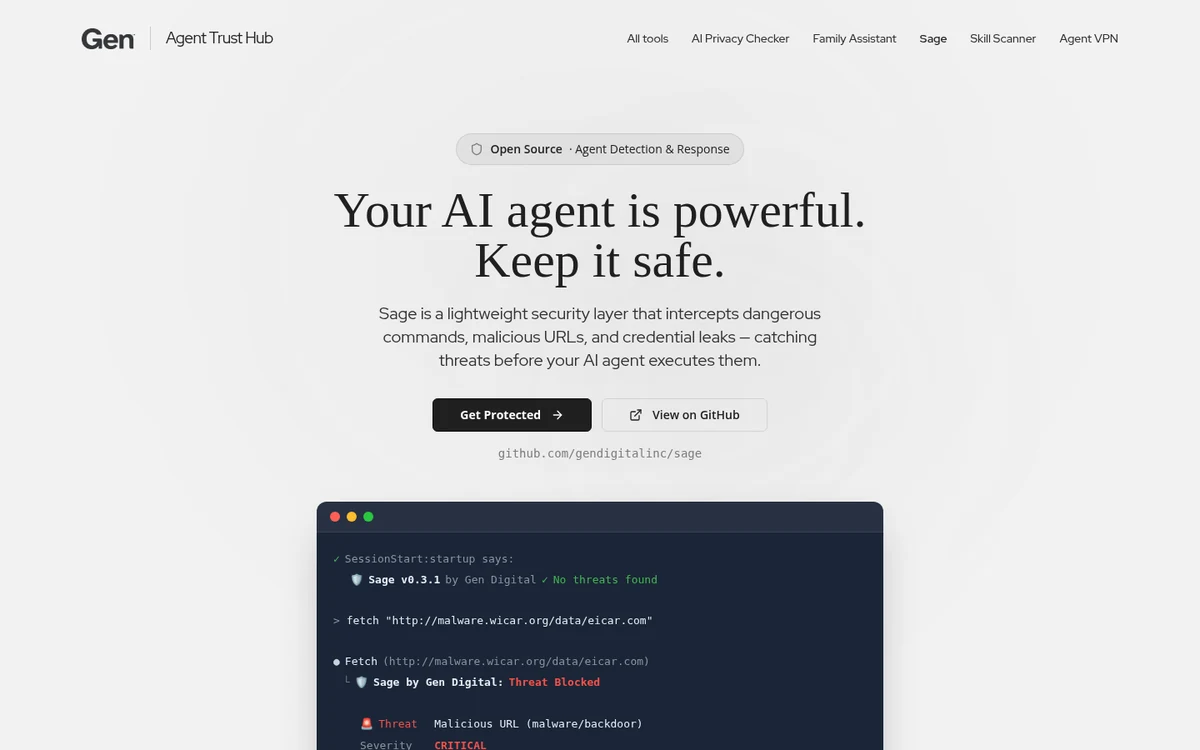
Sage is the strongest free local option we tested, with 366 YAML threat rules, allow or ask or deny verdicts, and first-party connectors for Claude Code, Cursor, VS Code, and OpenClaw. Gen Digital publishes Sage as Apache-2.0 Agent Detection and Response, with URL reputation, package supply-chain checks, credential-file heuristics, and prompt-injection scanning.
Our build of gendigitalinc/sage 0.14.0 denied curl|sh style remote execution, root wipe, base64 decode to shell, and a nonexistent npm package, and asked on credential reads and git hook writes. Connector hook timeout is 8 seconds. The product docs state that every error path returns allow, which keeps agents working and also means Sage alone is not a hard enforce boundary.
- Best for: Individual developers and small teams that want local PreToolUse protection without a SaaS contract.
- Covers: Claude Code, Cursor, VS Code, OpenClaw; YAML heuristics, URL and package checks, optional AMSI on Windows.
- Pricing (October 2026): Free and open source (Apache-2.0); cloud reputation calls send URLs and package hashes only, per Gen Digital.
- Watch out for: Fails open on errors; no enterprise inventory console; pair with EDR or a commercial coding-agent tool for fleets.
AI Coding Agent Security Coverage Compared
Claude Code hooks are common across this list, while Cursor hooks, config posture, and open source options split the field into clear buying lanes. We built the matrix below from each vendor’s own pages and repositories on October 25, 2026, so it shows documented support rather than roadmap slides.
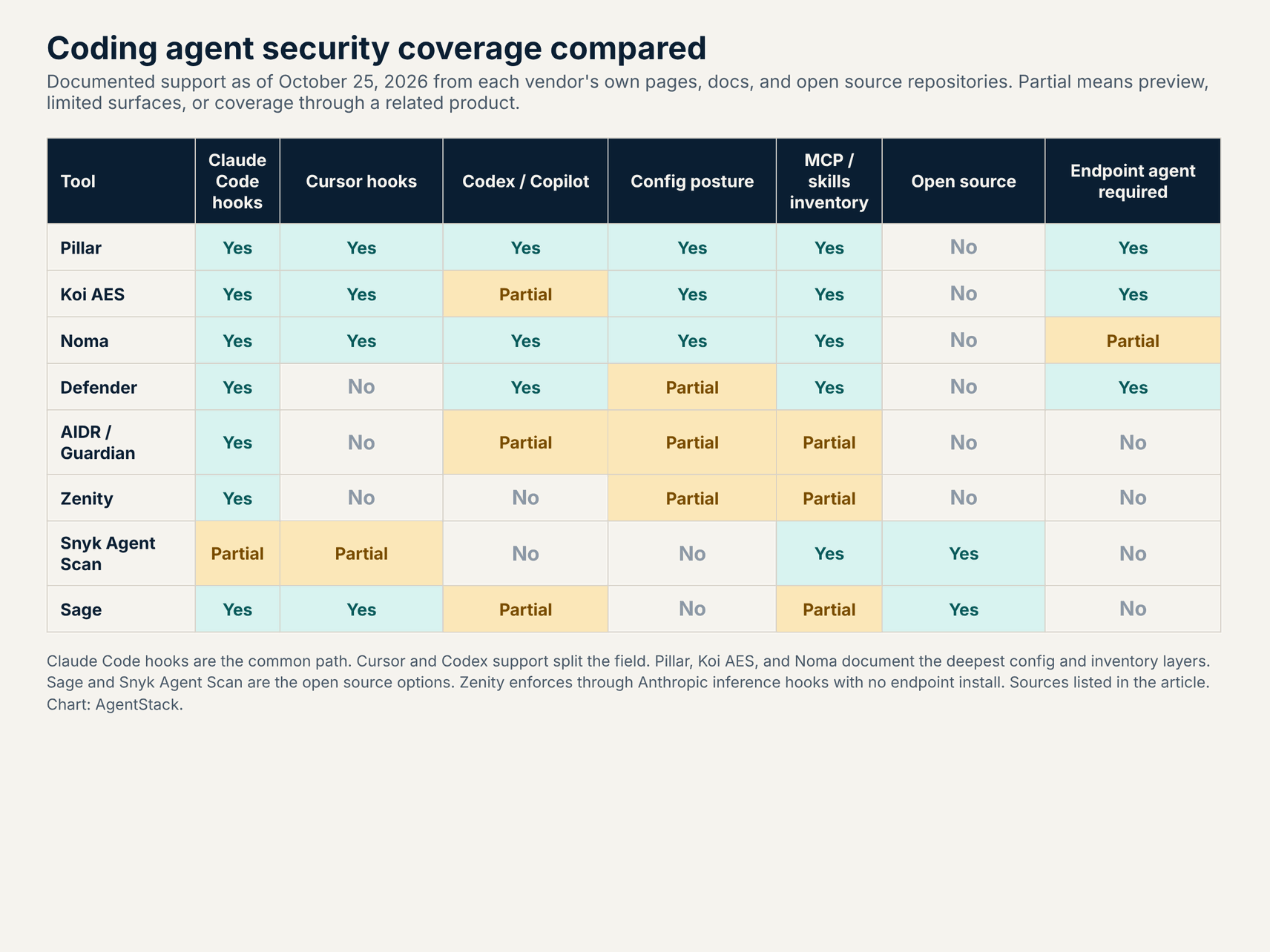
Pillar, Koi AES, and Noma document the deepest mix of inventory and runtime. Defender and AIDR reward platform standards. Zenity avoids endpoint installs at the cost of Claude-only scope. Sage and Snyk Agent Scan are the open tools you can run today.
For a three-vendor comparison, see our Zenity vs Noma vs Pillar comparison.
What Sage Evaluation Latency Looked Like
Sage stayed well under its 8 second hook timeout on every action we measured, with a median of 69 ms and a worst case of 474 ms on curl pipe to shell when URL reputation ran. Network-backed package and URL checks added most of the delay; pure heuristic cases such as credential file reads finished near 60 ms.
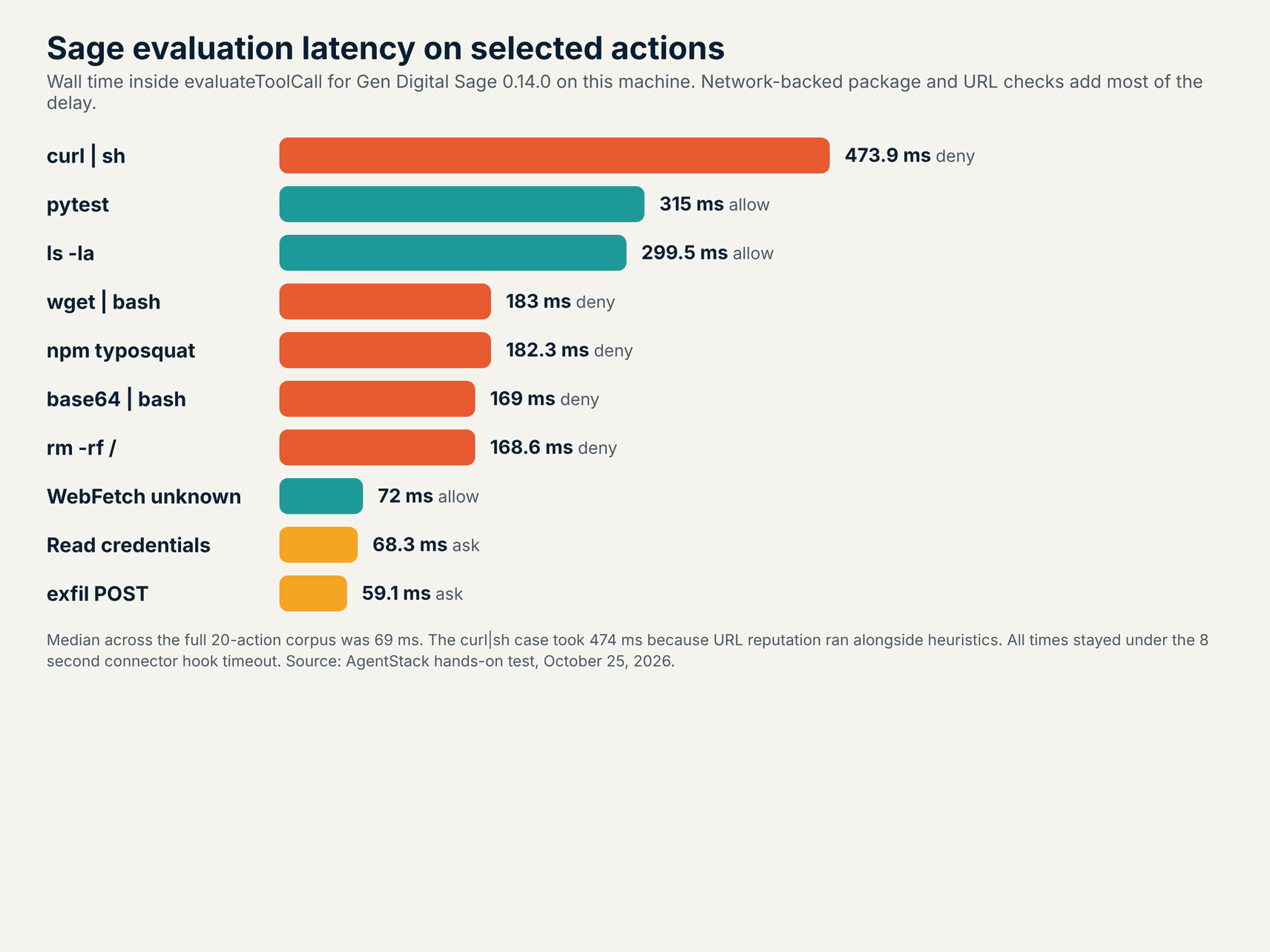
Latency only matters if the hook path stays inside the host timeout. Claude Code and Sage both use an 8 second budget in the configs we inspected. Products that call a cloud API on every tool call need the same budget check in your pilot, especially on developer laptops with flaky VPN paths.
Which AI Coding Agent Security Tool Should You Choose?
Start from the IDEs your developers already run and from the security platform your SOC already watches, because those two facts remove most of this list. Match your situation to one profile below, then run a 14-day pilot that includes your own deny list of shell commands and a poisoned MCP server.
| Your situation | First choice | Also consider |
|---|---|---|
| Need posture plus runtime across Claude Code, Cursor, and Codex | Pillar Security | Koi AES, Noma Security |
| Already on Palo Alto Networks / Cortex | Koi AES | Pillar Security, Prisma AIRS modules |
| Want coding agents inside a wider AI-DR inventory | Noma Security | Pillar Security, Zenity |
| Windows fleet on Microsoft Defender | Microsoft Defender for Endpoint | Pillar Security, Sage |
| Standardized on CrowdStrike Falcon | Falcon AIDR / Guardian | Pillar Security, Sage |
| Claude Enterprise only, no endpoint agent | Zenity | Sage for local Claude Code users |
| AppSec wants MCP and skills scanning in CI | Snyk Agent Scan | Sage, Noma Security |
| Free local hooks for a small team | Gen Digital Sage | Snyk Agent Scan |
Verdict: No single tool covers every IDE and every failure mode. Most mature programs will combine a platform control (Defender, AIDR, Koi, or Zenity) with either Pillar or Noma for posture, or Sage for developers who need a local backstop.
You run a mixed Claude Code and Cursor fleet
- Shortlist Pillar, Koi AES, and Noma, and ask each to show a PreToolUse deny on curl pipe to shell in both IDEs.
- Inventory MCP servers with help from our MCP security tools and MCP gateways guides.
- Read the ToFu study of MCP server bugs before you approve a long server allow list.
You already standardized on an EDR platform
- Turn on Defender runtime protection in audit mode, or deploy the CrowdStrike Claude Code collector, before you buy a fourth agent.
- Count how many coding agents each platform discovers on a sample of 50 laptops.
- Compare findings with the posture depth in our Zenity vs Noma vs Pillar write-up.
You need a free control this week
- Install Sage on Claude Code and Cursor for developers who handle production credentials.
- Add Snyk Agent Scan to CI for MCP config and skills folders, with a clear policy on SNYK_TOKEN use.
- Track containment steps from the NIST, NSA, and CISA practices for rogue agents.
You own Claude Enterprise for the business
- Pilot Zenity Boundaries on write-capable connectors and Claude Code shell actions.
- Set failure handling to deny if your risk tolerance requires it, because the Anthropic default allows on timeout.
- Pair cloud inference hooks with local Sage for developers who still use API or Bedrock paths that hooks miss.
What We Left Off This List
We left off products that overlap this buying decision but lacked clear public docs for Claude Code, Cursor, or Codex runtime controls on October 25, 2026, or that fit a different category we already cover. Several are strong in adjacent markets. Our AI agent security tools guide and AI agent governance guide track the wider field.
- Lasso Security and Knostic: document coding-assistant use cases; we wanted clearer public hook and IDE matrices before ranking them here.
- Backslash, Straiker, and Netskope: adjacent agent or SSE controls without enough coding-agent detail for a fair eight-tool table.
- Prompt firewalls and pure AI-SPM modules: important, but they answer a different purchase than local PreToolUse enforcement.
- Vendor-written roundups: we used them only as leads and verified claims on primary pages before anything entered this guide.
Coding agents that shell out to Git inherit the GitSpawn problem, where a repository’s own configuration names a program Git runs. The official MCP Git server had the same flaw until mcp-server-git 2026.11.11, and our November 12, 2026 lab showed seven Git settings, from core.fsmonitor to a post-checkout hook, running code on the old release. Our mcp-server-git vulnerability analysis shows what the fix blocks.
Frequently Asked Questions
What is AI coding agent security?
AI coding agent security covers tools that discover local coding agents, scan their configs and MCP connections, and allow, ask, or block tool calls before shell, file, or network actions run. It sits beside prompt firewalls and cloud AI-SPM. Most products use vendor hooks such as Claude Code PreToolUse rather than replacing the IDE.
Which tool is best for Claude Code and Cursor together?
Pillar Security is our top pick when you need both IDEs under one posture and runtime story. Palo Alto Networks Koi AES and Noma Security also document Cursor and Claude Code controls. Sage covers both as open source plugins, with less enterprise inventory.
Do these tools replace endpoint detection and response?
No. Coding-agent hooks see structured tool calls that EDR may miss, while EDR still sees processes, files, and network on the host. The stronger programs run both. Defender and CrowdStrike fuse agent events with endpoint telemetry; Sage and Zenity do not replace EDR.
What happens if a security hook times out?
Many stacks fail open so developers are not stuck. Sage returns allow on errors, Zenity follows Anthropic failure handling that defaults to allow, and Noma’s marketplace plugins fail open on API errors. If you need hard enforcement, set fail-closed where the vendor allows it and keep EDR rules.
Is Gen Digital Sage enough for an enterprise fleet?
Sage is strong local protection and scored 5 denies and 7 asks on our 20-action corpus, but it does not give security teams a fleet inventory or identity-aware policy console. Use it as a developer backstop or lab control, and pick Pillar, Noma, Koi AES, Defender, or AIDR for enterprise governance.
Related Guides
For related coverage, see our AI agent governance platforms, AI guardrails tools roundup, Lakera alternatives, Lakera vs HiddenLayer vs Mindgard comparison, AI red teaming tools, Promptfoo vs Garak vs PyRIT breakdown, Protect AI alternatives, shadow AI detection tools, Prompt Security alternatives and AI-SPM tools guide.
Keep going with the agent security hub, the AI governance and security hub, our AI agent security tools roundup, the AI agent governance guide, Zenity vs Noma vs Pillar, MCP security tools, MCP gateways, MCP explained, and the ToFu MCP tool security bugs study.
More context sits in FastMCP security advisories, the NIST and CISA incident response practices, Microsoft Dynamic Agent Risk, governance and compliance coverage, editorial standards, disclosure, and contact.
The Bottom Line
Choose Pillar for multi-IDE posture and runtime, Koi AES or Noma for platform-aligned endpoint control, Defender or AIDR if those stacks already define your program, and Sage or Snyk Agent Scan for open tools. Match AI coding agent security to the IDEs you run, then test fail-open behavior on your own deny list before rollout.
This market ships new hook integrations every month, so rerun pilots after major Claude Code, Cursor, and Codex releases and check this page for updates. Send corrections or your own test results through our contact page.