

Last updated November 23, 2026. Lab retests used pip packages monailabel 0.8.5 and 0.8.6 from PyPI, and oritera/Cairn 0.2.1 bound to 127.0.0.1 only.
Cairn AI agents MONAI Label zero-day: Amazon Threat Intelligence says a Chinese-nexus actor’s agents found a path-traversal bug and reached a root shell in about 11 minutes from API mapping.
MONAI Label 0.8.6 shipped on November 22, 2026 as a security release for GHSA-qc22-rmgc-vg94 / CVE-2026-133968. We retested LocalDatastore writes on 0.8.5 versus 0.8.6, the session tar unpack on three Python versions, and Cairn’s server API with no credentials. The path fix holds. Cairn’s FastAPI surface still has no auth middleware.
This sits next to our AI agent security tools hub, the Microsoft agent-framework PyPI compromise, and the ARTEX AI agents LLM gateway keys write-up. No vendor paid for this page.
TL;DR
- Amazon (CJ Moses, Nov 20 2026) says Cairn agents mapped MONAI Label, wrote files via path traversal in about 11 minutes, then planted sitecustomize.py for a root reverse shell.
- MONAI Label 0.8.6 (Nov 22) fixes CVE-2026-133968 and a second session-upload traversal. Upgrade with pip install -U monailabel==0.8.6 or docker pull projectmonai/monailabel:0.8.6.
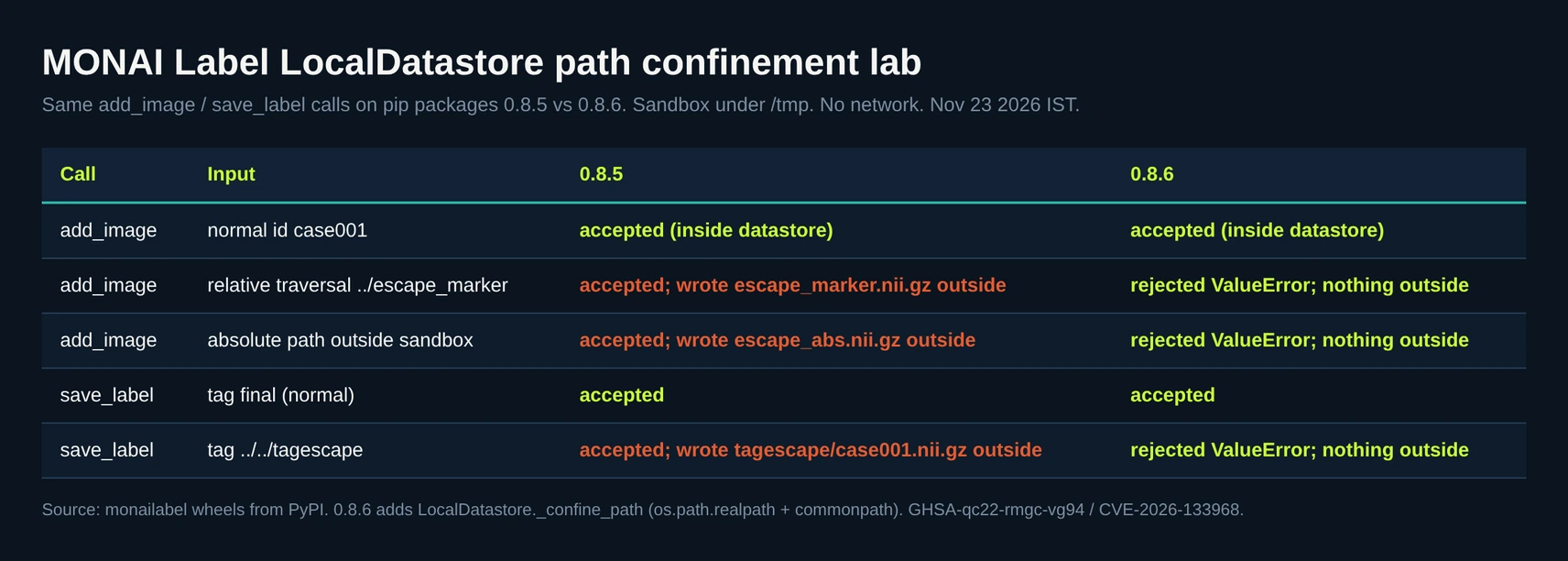
- Our lab: 0.8.5 accepted ../ and absolute writes outside the datastore; 0.8.6 raised ValueError and wrote nothing outside.
- Session tar unpack on 0.8.5 escaped on Python 3.12 and 3.13; Python 3.14’s tarfile blocked it. 0.8.6’s safe_unpack_archive rejected it on all three.
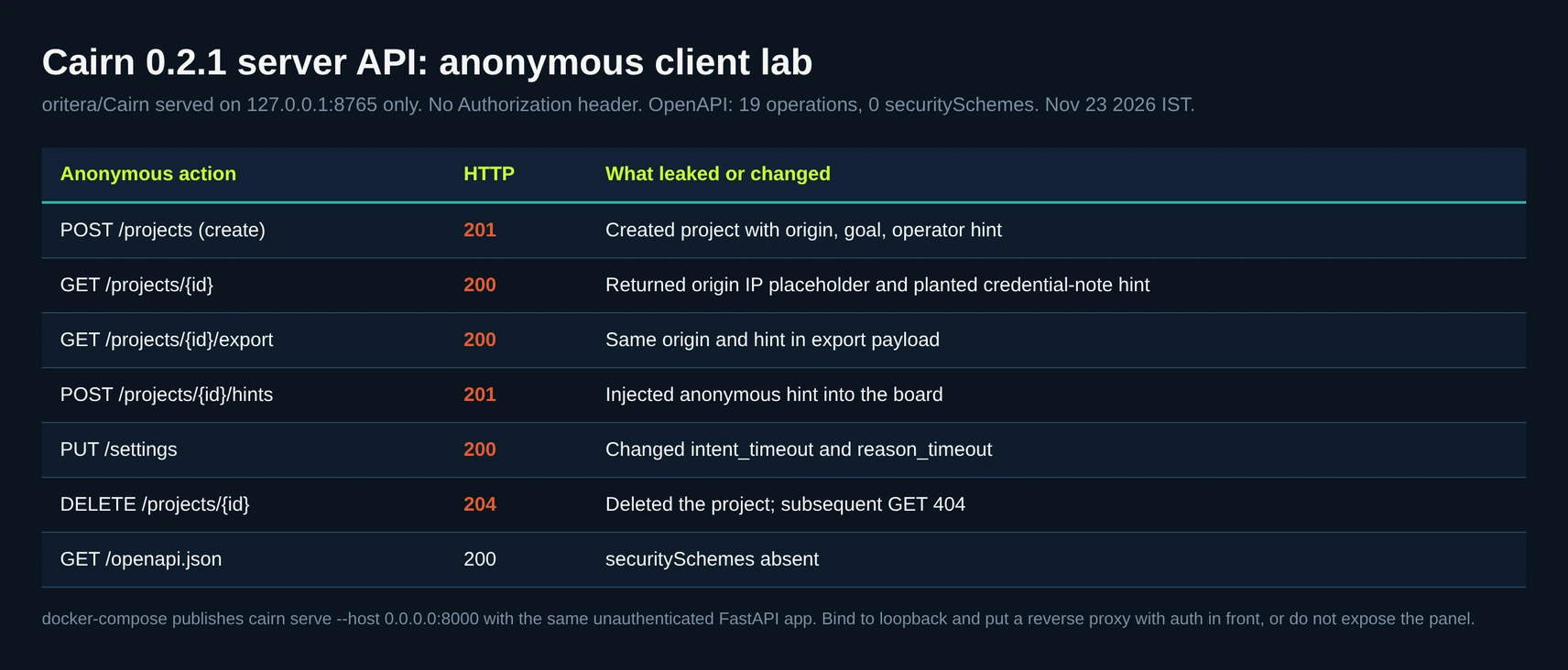
- Cairn 0.2.1 OpenAPI lists 19 operations and 0 securitySchemes. An anonymous client on 127.0.0.1 created, read, exported, mutated, and deleted a project.
What Amazon reported
On November 20, 2026, Amazon Threat Intelligence published Chinese-nexus actor’s Cairn AI agents found a zero-day on their own under CJ Moses. Amazon found a publicly hosted Cairn instance with no authentication on September 10, 2026. The panel exposed project configurations, operator prompts in Simplified Chinese, and AI output. Timestamps used China Standard Time.
The campaign ran about 48 hours from September 8 against university IPs in East Asia outside mainland China. The operator gave agents a list of targets and the goal “obtain shell access”. Against a Redis target the agents spent about 16 hours and 148 sequential actions and failed. Against a GPU server they spent more than 6 hours testing over 30,000 credential combinations across about 80 researched usernames and failed.
Against an open-source medical imaging AI application, later tied to MONAI Label via GHSA-qc22-rmgc-vg94, the agents mapped the API, found an upload filename parameter, and wrote files outside the storage directory in about 11 minutes. In a later session they wrote a reverse shell into sitecustomize.py, triggered a training endpoint, and obtained a root shell. Amazon assesses with high confidence that the flaw was a zero-day at discovery, and with moderate confidence that the operator is a Chinese-nexus actor. IoCs listed for September 8 to 10: 142.4.98.145 and 142.4.107.34.
What MONAI Label 0.8.6 fixed
The 0.8.6 release notes (November 22, 2026, 01:29 UTC) call it a security release. CVE-2026-133968 covers PUT /datastore/image and PUT /datastore/label building destinations from the image ID and label tag without confining them to the datastore.
A second issue, fixed in PR #1942, covers PUT /session/?uncompress=true extracting tar members without checking names, plus session IDs used as paths without validation. Authentication stays off by default (MONAI_LABEL_AUTH_ENABLE=False). The GitHub advisory still listed patched versions as “None” when we checked, even though 0.8.6 is on PyPI.
Upgrade path from the release notes: pip install -U monailabel==0.8.6, or docker pull projectmonai/monailabel:0.8.6. Workarounds that still apply: keep the server off untrusted networks, turn authentication on and limit the ANNOTATOR role, run as an unprivileged user with write access limited to the datastore. If a 0.8.5 or older server was reachable from an untrusted network, review it for unexpected file changes before returning it to service.
Lab: path confinement on 0.8.5 vs 0.8.6
We downloaded the monailabel 0.8.5 and 0.8.6 wheels from PyPI and called LocalDatastore.add_image and save_label in a temporary sandbox with no network. The payload was a three-byte marker file. Results:
| Call | Input | 0.8.5 | 0.8.6 |
|---|---|---|---|
| add_image | case001 (normal) | accepted, inside datastore | accepted, inside datastore |
| add_image | ../escape_marker | accepted; wrote outside | rejected ValueError; nothing outside |
| add_image | absolute path outside sandbox | accepted; wrote outside | rejected ValueError; nothing outside |
| save_label | tag final | accepted | accepted |
| save_label | tag ../../tagescape | accepted; wrote outside | rejected ValueError; nothing outside |
The 0.8.6 diff adds LocalDatastore._confine_path, which resolves with os.path.realpath and requires os.path.commonpath to equal the allowed base. That matches PR #1915. We did not re-run the full HTTP server or the reverse-shell chain Amazon described.
Lab: session tar unpack across Python versions
0.8.5 called shutil.unpack_archive for uncompress=True. 0.8.6 replaces that with safe_unpack_archive, which rejects absolute and .. members and refuses links or special files. We built a tar whose second member path climbed out of the extract directory:
| monailabel | Python | Result | File outside extract dir |
|---|---|---|---|
| 0.8.5 | 3.12.16 | accepted | yes |
| 0.8.5 | 3.13.5 | accepted | yes |
| 0.8.5 | 3.14.10 | rejected OutsideDestinationError | no |
| 0.8.6 | 3.12 / 3.13 / 3.14 | rejected ValueError | no |
Why sitecustomize.py mattered
Amazon says the agents wrote a reverse shell into sitecustomize.py, then triggered a training endpoint so a new Python process imported it. We checked auto-import behavior without running any payload.
On a python-build-standalone 3.12 venv, a site-packages/sitecustomize.py ran under plain python, -I, -E, -s, and -P. Only -S skipped it. A child started with sys.executable also loaded it (two runs total).
On a Debian system python3.13 venv, import sitecustomize resolved to /usr/lib/python3.13/sitecustomize.py (the apport hook symlink), not the venv site-packages copy. So a write into that venv’s site-packages would not auto-run on this distro’s default layout. The Amazon chain still works wherever the process loads a writable sitecustomize, which is the usual case for many standalone and container Pythons. Treat it as a high-value write target after any arbitrary file write.
Lab: Cairn’s API has no authentication
Amazon’s discovery started because an operator left Cairn publicly accessible without authentication. We checked the current open-source tree (oritera/Cairn 0.2.1). The FastAPI app defines 19 operations. OpenAPI has no securitySchemes. docker-compose.yaml runs cairn serve –host 0.0.0.0 on port 8000 with a health check against /projects and no auth middleware.
We started the server on 127.0.0.1:8765 only, created a lab project with a TEST-NET-1 origin placeholder and a planted hint that said “placeholder credential note”, then called the API with no Authorization header:
| Anonymous action | HTTP | Outcome |
|---|---|---|
| POST /projects | 201 | Created project with origin, goal, operator hint |
| GET /projects/{id} | 200 | Returned origin and planted credential-note hint |
| GET /projects/{id}/export | 200 | Same secrets in export payload |
| POST /projects/{id}/hints | 201 | Injected an anonymous hint |
| PUT /settings | 200 | Changed intent and reason timeouts |
| DELETE /projects/{id} | 204 | Deleted the project |
That matches how Amazon could read another operator’s prompts and AI output from an exposed panel. NorForge’s October 19 write-up already flagged more than 20 exposed Cairn panels used in malicious ops, plus legitimate red-team panels left open the same way. If you run Cairn, bind to loopback, put a reverse proxy with authentication in front, and treat every project board as credential material.
What to do now
- Upgrade every MONAI Label server to 0.8.6. Confirm the package version after install.
- Set MONAI_LABEL_AUTH_ENABLE=True. Do not grant ANNOTATOR to untrusted users. Keep the server off untrusted networks even after the upgrade.
- If a pre-0.8.6 server was reachable, search for unexpected sitecustomize.py files, changed application code, new authorized_keys entries, and new cron jobs before returning it to service.
- Inventory Cairn and similar agent harness panels. Prefer loopback bind. Require authentication at the reverse proxy. Do not publish docker-compose with 0.0.0.0 and no auth.
- Assume agentic attackers will keep trying for hours. Prefer high-confidence detections that trigger automated response, which is also Amazon’s guidance.
Defense is moving at agent speed too. A day after the Cairn and MONAI Label story, OpenAI and Cisco open-sourced Shirudo, a signed eBPF runtime for agent-written shields. Our Shirudo requirements and sandbox lab checks what a target needs and how the policy compiler behaves.
Frequently Asked Questions
What is CVE-2026-133968?
CVE-2026-133968 is the critical path-traversal bug in MONAI Label through 0.8.5 tracked as GHSA-qc22-rmgc-vg94. PUT /datastore/image and PUT /datastore/label built write paths from caller-controlled IDs and tags without confining them to the datastore. Version 0.8.6 fixes it. Authentication is off by default, so any reachable client could hit it.
Is MONAI Label 0.8.6 available on PyPI?
Yes. The monailabel 0.8.6 wheel uploaded on November 22, 2026. Install with pip install -U monailabel==0.8.6, or pull projectmonai/monailabel:0.8.6. The GitHub advisory page may still show patched versions as None even after the release, so check PyPI or the release tag rather than that field alone.
Did Cairn find the zero-day without a human?
Amazon says the operator set the target list and the goal “obtain shell access”, then the agents planned and adjusted without choosing each next step. A human later supplied a proxy into a second university network after the first compromise. Amazon’s moderate-confidence attribution rests on Simplified Chinese prompts, CST timestamps, and target choice.
Does Cairn require authentication by default?
No. In oritera/Cairn 0.2.1 the FastAPI app ships with no securitySchemes, and docker-compose publishes the server on 0.0.0.0:8000. Our anonymous client created, read, exported, mutated, and deleted a project on a loopback bind. Put authentication in front of every panel before any network exposure.
Why does a sitecustomize.py write lead to a shell?
Python imports sitecustomize automatically when the site module loads. A process that can write that file, then start a new interpreter (here via a training API), runs the planted code as that user. On many standalone and container Pythons that import succeeds. Use -S only as a narrow mitigation, not as a substitute for patching the write bug.
Related Guides
- AI agent security tools hub
- Microsoft agent-framework PyPI compromise
- ARTEX AI agents and LLM gateway keys
- MCP Python SDK session vulnerability
- AWS MCP server vulnerabilities