

Updated November 18, 2026. Based on AWS Security Bulletins 2026-184 and 2026-185 (November 16), the matching GitHub advisories, PyPI release history, and our own test run on November 18 with aws-pricing-mcp-server 1.0.30 and 1.1.2 and timestream-for-influxdb-mcp-server 0.0.18 and 0.1.4.
Two AWS MCP server vulnerabilities went public on November 16, 2026: CVE-2026-126816 lets a prompt-injected agent write files outside the intended folder, anywhere the AWS Pricing MCP Server process can write, and CVE-2026-126681 lets one steal the InfluxDB API token held by the AWS Labs Timestream for InfluxDB MCP Server. Both servers are open-source Model Context Protocol (MCP) servers that AWS Labs publishes on PyPI for AI assistants and coding agents to call AWS APIs and data stores.
Upgrade awslabs.aws-pricing-mcp-server to 1.0.31 or later and awslabs.timestream-for-influxdb-mcp-server to 0.0.19 or later, move off the deprecated awslabs.cost-analysis-mcp-server, and rotate any InfluxDB token the Timestream server held. Both fixes were already on PyPI in June and July 2026, and on November 18 neither advisory had reached OSV.dev or the GitHub Advisory Database, so pip-audit still reported the vulnerable versions as clean in our test.
TL;DR
- AWS disclosed CVE-2026-126816 (AWS Pricing MCP Server before 1.0.31) and CVE-2026-126681 (Timestream for InfluxDB MCP Server 0.0.12 to 0.0.18) on November 16, 2026, each rated 5.5 Moderate on GitHub.
- The Pricing server’s generate_cost_report tool wrote files and was still marked readOnlyHint, so MCP clients that auto-approve read-only tools could run it without asking.
- In our test, version 1.0.30 wrote reports outside its directory through ../ and absolute paths, and the Timestream 0.0.18 server sent its own token to a URL the caller supplied.
- The fixed releases reached PyPI 160 days (Pricing, June 9) and 111 days (Timestream, July 28) before the public bulletins.
- pip-audit returned “No known vulnerabilities found” for the vulnerable pins on November 18, because neither advisory was in OSV.dev or GitHub’s global advisory database yet.
What AWS Disclosed on November 16
AWS published two security bulletins on November 16, 2026, both rated Important by AWS and Moderate (CVSS 3.1 score 5.5) on GitHub. CVE-2026-126816 covers path traversal in the AWS Pricing MCP Server’s cost report tool, and CVE-2026-126681 covers token exposure in the Timestream for InfluxDB MCP Server. Both need an attacker who can get content in front of the agent.
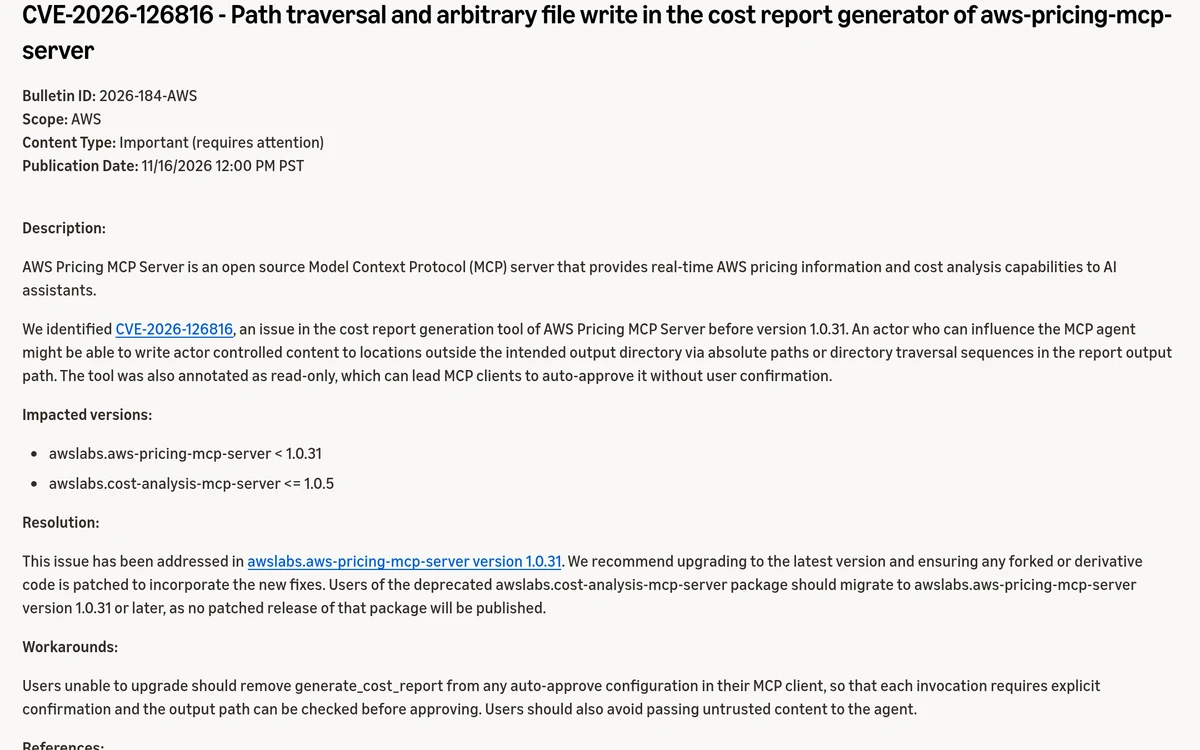
For the Pricing server, the bulletin says an actor who can influence the MCP agent could write actor-controlled content outside the intended output directory through absolute paths or ../ sequences in the report’s output_file parameter. The GitHub advisory GHSA-mqm3-w68j-75mw adds the second half of the problem: the tool was annotated read-only, so clients set to auto-approve read-only tools could run it without asking the user.
The deprecated awslabs.cost-analysis-mcp-server, the Pricing server’s predecessor, is affected in every version up to 1.0.5, and AWS says no patched release of that package will ship. AWS limits the impact to files the server process can write on the machine running it, and says no managed AWS service is affected. The advisory credits researcher Ryan von Brubeck.
How the Timestream Token Leak Works
The Timestream for InfluxDB MCP Server lets each InfluxDB tool call pass its own url, token and org, and versions 0.0.12 to 0.0.18 filled any missing value from the server’s environment. A prompt-injected agent could therefore pass only a hostile URL, and the server would send its configured token there, according to GHSA-2f9r-g4f3-wc2j.
AWS says a remote unauthenticated actor could plant that crafted InfluxDB URL through prompt injection, and that the leaked token grants whatever access it carries to the customer’s InfluxDB data. The fix in 0.0.19 treats connection settings as one trust boundary: per the 0.0.19 release notes on PyPI, a caller-supplied URL must match INFLUXDB_URL or an entry in INFLUXDB_ALLOWED_URLS, and server credentials never complete a partial caller configuration. The advisory credits @Yuremin, @FORIMOC and @invoke1442.
There is a second, unrelated reason to go past 0.0.19. Our check of the published packages found that versions up to 0.1.1 let the caller turn on writes with a tool_write_mode tool argument, and 0.1.2, released September 22, 2026, replaced it with an operator-set ALLOW_WRITE environment variable. No CVE covers that change, but a prompt-injected agent on 0.1.1 or older can still authorize its own writes.
We Tested Both Servers: What Actually Happened
We ran the last vulnerable and the latest release of each server on localhost on November 18, 2026, and called them from a Python MCP client over stdio, the same transport desktop clients use. Version 1.0.30 of the Pricing server wrote cost reports outside its directory, and Timestream 0.0.18 sent its own token to a listener we controlled.
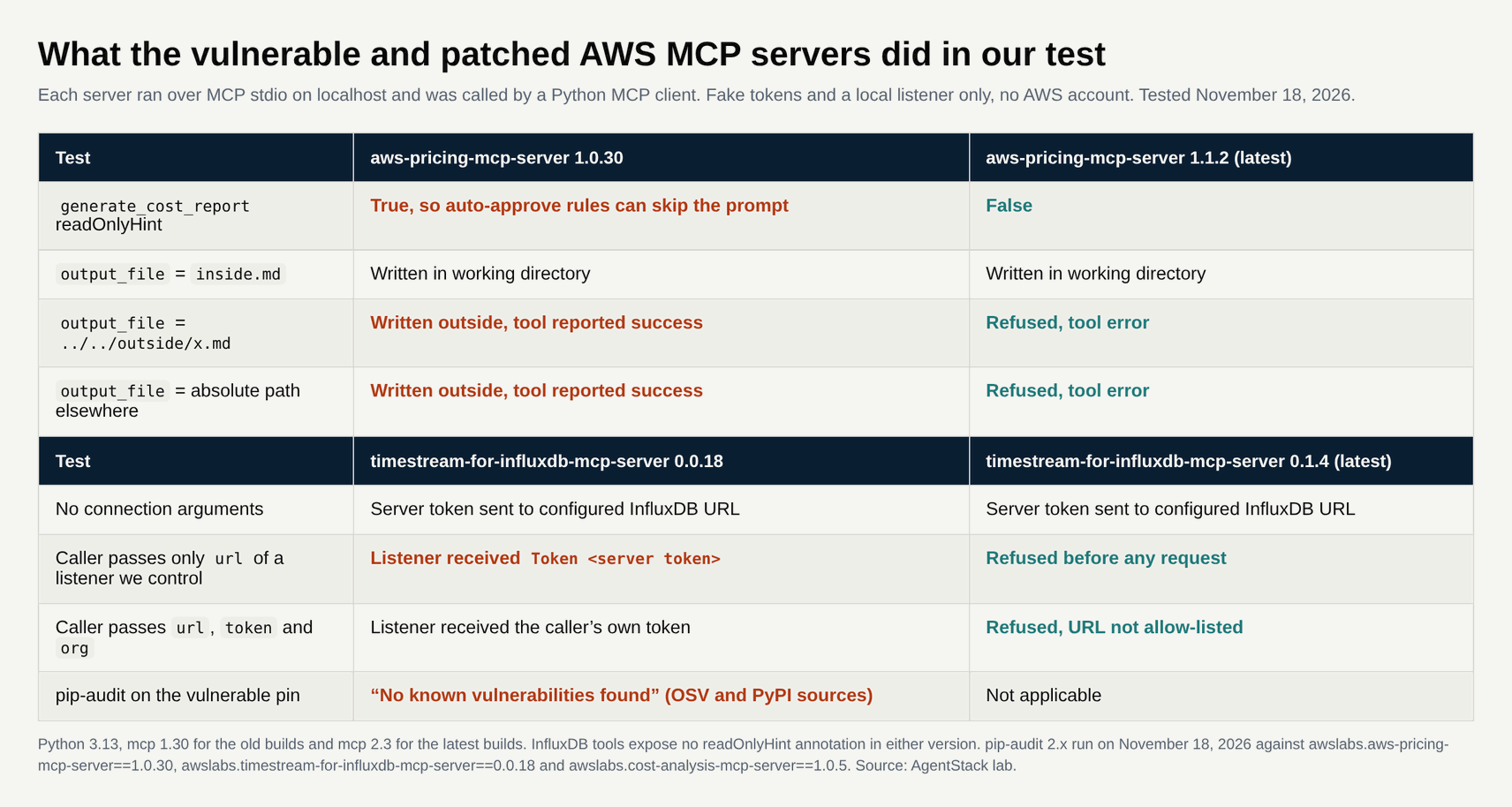
On 1.0.30, all nine Pricing tools, including generate_cost_report, reported readOnlyHint: true. A relative path of ../../outside/ and an absolute path both produced a written report outside the working directory, and the tool returned its normal report text with no hint that the file had landed elsewhere. On 1.1.2, only generate_cost_report changed to false, and both escape attempts came back as a tool error with nothing written.
The Timestream result was more direct. With the server configured for a fake InfluxDB at one local port, a call to InfluxDBListBuckets that passed only a second port as url made 0.0.18 send Token LAB-SERVER-TOKEN-0f3a, our fake server token, to that second listener. Version 0.1.4 refused the same call before sending any request, and it also refused a complete caller-supplied URL, token and org that was not on the allow list.
The test has limits. We used fake tokens, no AWS account and no real InfluxDB, and we called tools directly instead of planting an injection in a live agent session. The old builds also crash at startup with mcp 2.x installed, because they import a module the 2.x SDK renamed, so we pinned mcp below 2.0 for them. That means fresh installs of a vulnerable pin fail today, while existing environments and lockfiles keep running.
Teams can check their own machines for AWS MCP server vulnerabilities with three commands:
# 1. Which AWS Labs MCP servers and versions are installed? (also check uvx lines in MCP client configs)
pip show awslabs.aws-pricing-mcp-server awslabs.cost-analysis-mcp-server awslabs.timestream-for-influxdb-mcp-server 2>/dev/null | grep -E "^(Name|Version)"

# 2. Is the cost report tool on an auto-approve list? (paths vary by client)
grep -rn "generate_cost_report" ~/.cursor ~/.aws/amazonq ~/.claude* 2>/dev/null

# 3. Upgrade to fixed versions
pip install --upgrade "awslabs.aws-pricing-mcp-server>=1.0.31" "awslabs.timestream-for-influxdb-mcp-server>=0.1.2"
Why the Fixes Shipped Months Before the CVEs
AWS fixed both bugs quietly and disclosed them later. The Pricing fix, pull request #3792, merged on June 9, 2026 and shipped the same day in 1.0.31, which is 160 days before the bulletin. Timestream 0.0.19 reached PyPI on July 28, 2026, which is 111 days before its bulletin, according to PyPI upload times.
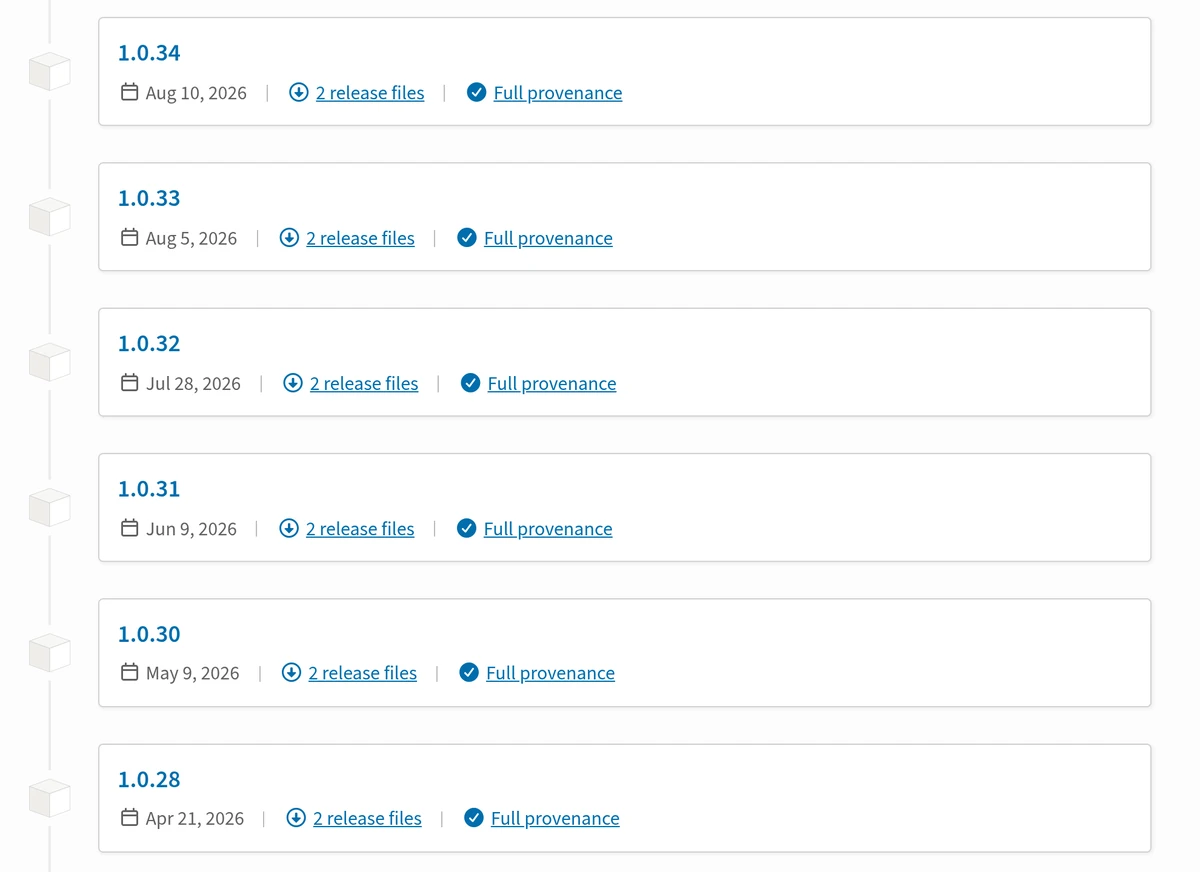
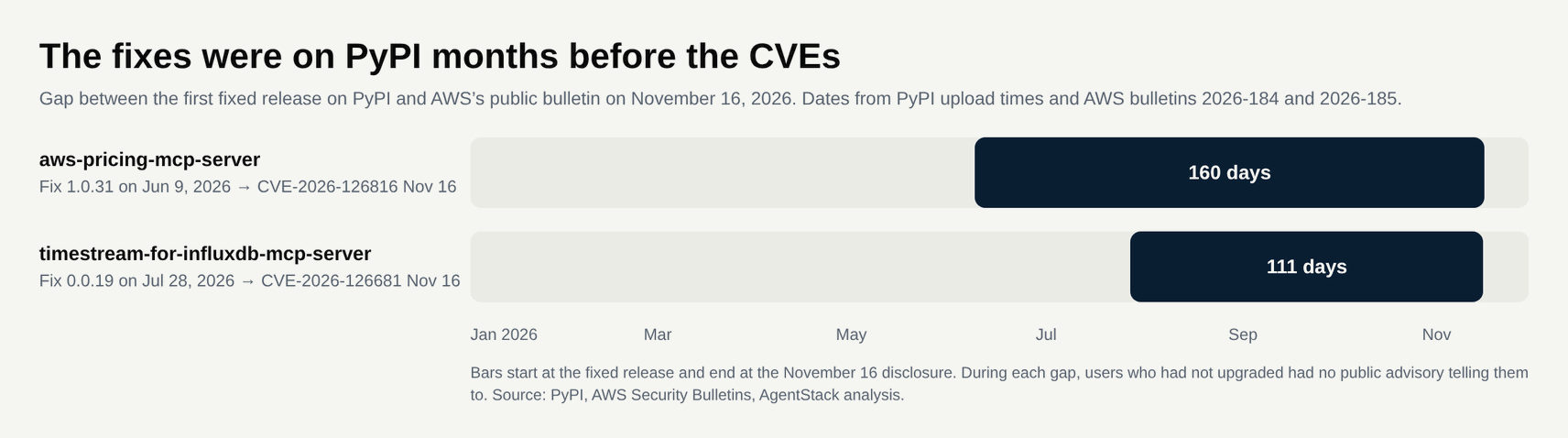
A quiet fix protects users who update often, because anyone who ran uvx ...@latest after June 9 already had the Pricing patch. Teams that pinned an MCP server version in a config or lockfile had no advisory to prompt an upgrade during those months. The pull request itself was public and described the path confinement and the corrected readOnlyHint, so the fix was visible to anyone reading the repository.
Why pip-audit and Dependabot Will Not Flag These Yet
On November 18, 2026, neither advisory appeared in OSV.dev or in GitHub’s global advisory database, which feed pip-audit and Dependabot alerts. Our pip-audit run against the three vulnerable pins returned “No known vulnerabilities found” with both its OSV and PyPI sources, while the same OSV query for an old LiteLLM release returned 66 advisories.
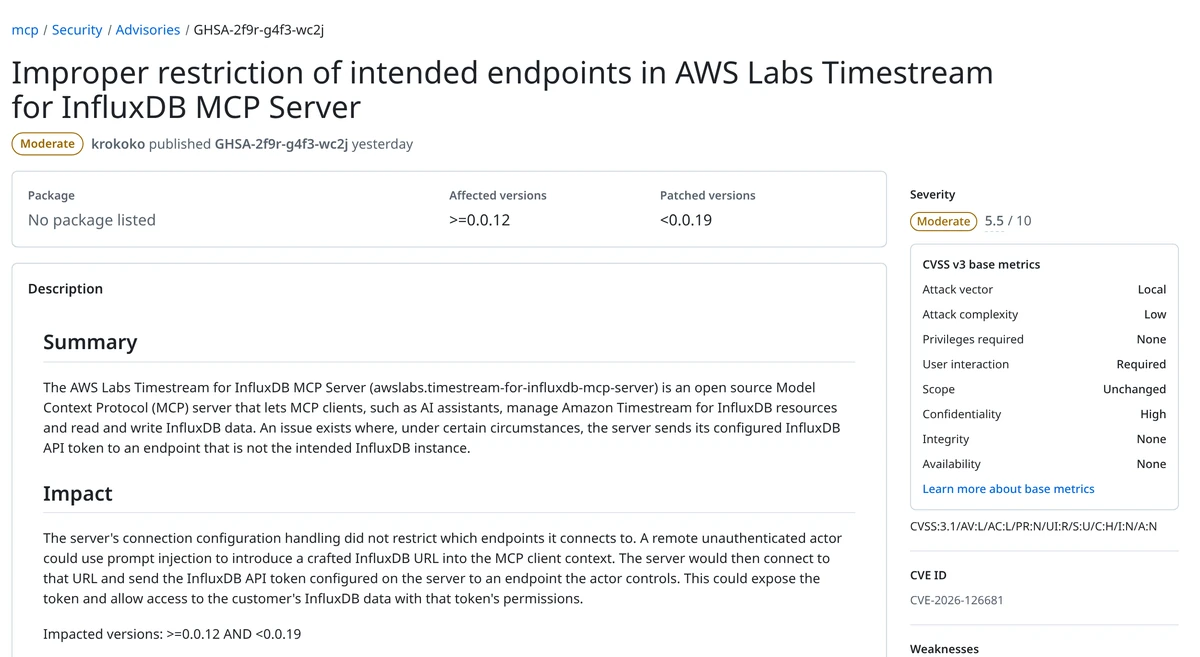
The Timestream advisory has a second problem that may outlast the database delay. It names no package and ecosystem, and its version fields are swapped, with the vulnerable range “<0.0.19” filed under patched versions. Scanners match advisories by package name and version range, so this record cannot match an installed package until someone corrects it. The Pricing advisory lists its package correctly.
The delay is not limited to this week. Three older awslabs/mcp advisories we checked, from September 9, November 2 and November 10, 2026, were also absent from OSV.dev and GitHub’s global database on November 18. Until that changes, teams that rely on dependency scanners for AWS Labs MCP servers should track the repository’s own advisory page and the AWS bulletin feed.
What the readOnlyHint Mistake Means for MCP Auto-Approve
In the MCP specification, readOnlyHint is a hint from the server, and the spec tells clients not to trust annotations from untrusted servers. AWS’s own advisory notes that some clients auto-approve tools marked read-only. One wrong flag on an official AWS server was enough to let a file-writing tool skip the prompt.
The same pattern showed up in our test of Microsoft Agent Framework MCP approvals and in the mcp-server-git vulnerability, where read-only Git tools could run code. The safer rule is to approve by tool name for servers you have reviewed and keep write-capable tools on a prompt, whatever the annotation says. Our MCP clients comparison compares how the major clients connect to and manage servers.
What MCP Server Users Should Do Now
The steps below apply to anyone running AWS Labs MCP servers on developer machines or agent runners as of November 18, 2026. They put the token rotation and the auto-approve check first, because those close exposure that an upgrade alone does not undo.
- Rotate any InfluxDB API token configured for a Timestream for InfluxDB MCP Server before 0.0.19, and give the replacement the least permissions the agent needs.
- Upgrade to awslabs.aws-pricing-mcp-server 1.0.31 or later and awslabs.timestream-for-influxdb-mcp-server 0.1.2 or later, so caller-set write mode is gone too.
- Replace awslabs.cost-analysis-mcp-server with the Pricing server, because PyPI marks 1.0.5 as yanked but exact pins still install it and no fix will ship.
- Remove
generate_cost_reportand any other write-capable tool from auto-approve lists, and setAWS_PRICING_MCP_OUTPUT_DIRto a dedicated folder. - Watch the awslabs/mcp security advisories page directly until OSV.dev and the GitHub Advisory Database carry these records.
For the bigger picture, our guide to the best MCP servers for enterprise teams covers which servers suit production use, and the MCP security tools roundup compares products that enforce tool-level policy instead of trusting annotations. Prompt injection is the entry point for both CVEs, so the prompt injection detection tools and AI agent security tools guides cover the controls in front of the agent.
Official MCP and medical imaging servers both keep shipping path and auth issues. Amazon tied a Cairn-driven campaign to a MONAI Label zero-day now fixed in 0.8.6. Our Cairn AI agents MONAI Label zero-day write-up retests the patch and Cairn’s open panel.
FAQ
Which AWS MCP servers are affected by CVE-2026-126816 and CVE-2026-126681?
CVE-2026-126816 affects awslabs.aws-pricing-mcp-server before 1.0.31 and the deprecated awslabs.cost-analysis-mcp-server up to 1.0.5. CVE-2026-126681 affects awslabs.timestream-for-influxdb-mcp-server from 0.0.12 through 0.0.18. AWS says no managed AWS service is affected, so the risk sits on developer machines and agent runners that run these servers locally. Check installed versions with pip show or the uvx lines in your MCP client configuration.
Do I need to rotate my InfluxDB token after upgrading?
Yes, if a Timestream for InfluxDB MCP Server before 0.0.19 ever held that token. AWS recommends rotating any InfluxDB API token configured for an affected version, because upgrading stops future leaks but cannot revoke a token an attacker may already have copied. Use a least-privilege token afterwards.
Why does pip-audit not report these AWS MCP vulnerabilities?
On November 18, 2026, neither advisory was in OSV.dev or GitHub’s global advisory database, which pip-audit and Dependabot rely on. The Timestream advisory also lists no package and has swapped version fields. Check versions by hand with pip show until the databases catch up.
Is readOnlyHint safe to use for MCP auto-approval?
No. The MCP specification calls readOnlyHint a hint and says clients should not trust annotations from untrusted servers. The AWS Pricing MCP Server marked a file-writing tool read-only for months. Approve tools by name after review, and keep any tool that writes files or sends data on a manual prompt.