
Last updated October 23, 2026. We built the same two-agent job in all 10 frameworks that day, ran each five times offline, logged every model request, and checked docs, releases, and downloads.
The best multi-agent frameworks in 2026 are LangGraph, OpenAI Agents SDK, and Microsoft Agent Framework, because each gives you clear control over which agent runs next and what context it receives. CrewAI, Google ADK, and Pydantic AI follow, and the right pick depends on whether you want a coordinator model, a fixed pipeline, or handoffs.
Multi-agent frameworks let several specialized agents share one job: a coordinator delegates, a pipeline passes work along, or agents hand control to each other. This guide sits in our agent frameworks hub, and our guide to the 12 best AI agent frameworks covers single-agent features, tools, and memory.
On October 23, 2026 we wired a pricing agent and a writer agent together in each framework’s own recommended pattern, then recorded every request sent to a local model server. No vendor paid for placement or reviewed this page, per our editorial standards and disclosure policy.
TL;DR
- All 10 frameworks finished the two-agent job in 5 of 5 offline runs and returned the same correct answer, with identical request logs in every run.
- The pattern sets the bill. Fixed pipelines in CrewAI, Microsoft Agent Framework, Google ADK, Strands Agents, and LlamaIndex used 3 model calls. Coordinator patterns in the other five used 6.
- Prompt traffic ranged from 1.9 KB to 34.9 KB for the same job. Strands Agents and Microsoft Agent Framework sent the least, and smolagents sent the most.
- Context leaks by default in shared-history patterns. Google ADK, LlamaIndex, and Microsoft Agent Framework forwarded the raw tool output to the writer, while agents-as-tools patterns sent it only a short request.
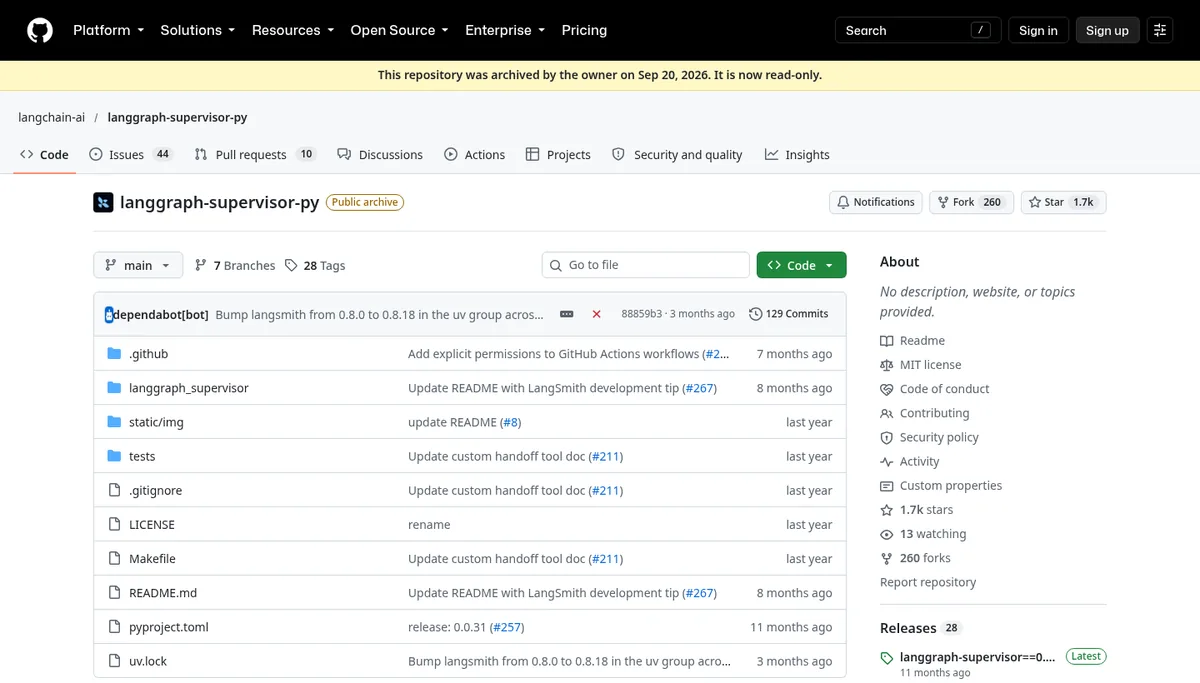
- Two names changed status this year. The langgraph-supervisor library was archived on September 20, 2026, and AutoGen is archived, with Microsoft pointing new users to Agent Framework.
Multi-Agent Frameworks Compared at a Glance
Every framework here can coordinate agents, so the useful differences are the built-in patterns, how many model calls a pattern costs, and what context reaches each agent. The table combines each project’s documentation with our own test on October 23, 2026. Calls and bytes are per job, using the pattern listed.
| Framework | Pattern we tested | Other built-in patterns | Model calls | Prompt traffic | Peak memory |
|---|---|---|---|---|---|
| LangGraph (LangChain) | Subagents as tools | Handoffs, skills, router, custom graphs | 6 | 4.5 KB | 93 MB |
| OpenAI Agents SDK | Agents as tools | Handoffs | 6 | 5.5 KB | 99 MB |
| Microsoft Agent Framework | Sequential workflow | Concurrent, handoff, group chat, Magentic | 3 | 2.0 KB | 62 MB |
| CrewAI | Sequential crew | Hierarchical crew with a manager | 3 | 2.4 KB | 189 MB |
| Google ADK | SequentialAgent | Graph, dynamic, and collaborative workflows | 3 | 3.8 KB | 96 MB |
| Pydantic AI | Delegation tools | Hand-off in code, graphs, SubAgents | 6 | 5.0 KB | 75 MB |
| Agno | Team, coordinate mode | Route, broadcast, tasks modes | 6 | 9.7 KB | 68 MB |
| Strands Agents | Graph with two nodes | Agents as tools, Swarm, Workflow, A2A | 3 | 1.9 KB | 104 MB |
| LlamaIndex | AgentWorkflow handoff | Orchestrator agent, custom planner | 3 | 4.1 KB | 180 MB |
| smolagents | Managed agents | Nested managers | 6 | 34.9 KB | 73 MB |
Verdict: Choose LangGraph when you want full control of context and routing, OpenAI Agents SDK for the simplest handoffs and agents-as-tools, and Microsoft Agent Framework for the widest set of ready-made orchestrations. Pick CrewAI for role-based crews, Google ADK for graph workflows on Google Cloud, and Pydantic AI for typed delegation inside Python services.
How We Chose and Tested These Frameworks
We started with code-first Python frameworks that document at least one multi-agent pattern, shipped a release in 2026, and can talk to any OpenAI-compatible endpoint or, for Google ADK, a Gemini-compatible one. That ruled out no-code builders, hosted-only platforms, and projects that are archived.
- Same job everywhere: a pricing agent calls one lookup tool, and a writer agent turns the price into a one-line summary for the customer. The user prompt carried a customer reference,
QX-58, so we could see which agent received it. - Idiomatic pattern: we used the pattern each project’s multi-agent docs lead with, such as agents as tools in OpenAI Agents SDK, a Team in Agno, and a sequential workflow in Microsoft Agent Framework.
- Scripted model: a local server played the model with fixed replies and logged each request’s role, size, tools offered, and whether it contained the customer reference or the raw tool output.
- Offline and measured: DNS was blocked and all other traffic went to a proxy that refused it. We took peak memory for the whole process, wall time, and median cold import time over five runs each, with telemetry switched off.
- Project health: GitHub stars, license, latest PyPI release, and last month’s downloads from pypistats, all collected the same day.
A scripted model makes the same choices every time, so these numbers show the overhead each framework adds, not how well a real model coordinates. Real prompts and tool outputs are larger, which makes the differences grow. We left out AutoGen, which its README says is archived, and the community fork AG2, whose new 1.x API we will test in a later round.
What Our October 23 Hands-On Test Found
The biggest cost driver was the pattern, not the framework: every coordinator pattern needed 6 model calls, and every fixed pipeline needed 3. A coordinator model reads the task, delegates twice, and then answers, so it adds three calls that a fixed pipeline skips, plus the tokens to describe each specialist.
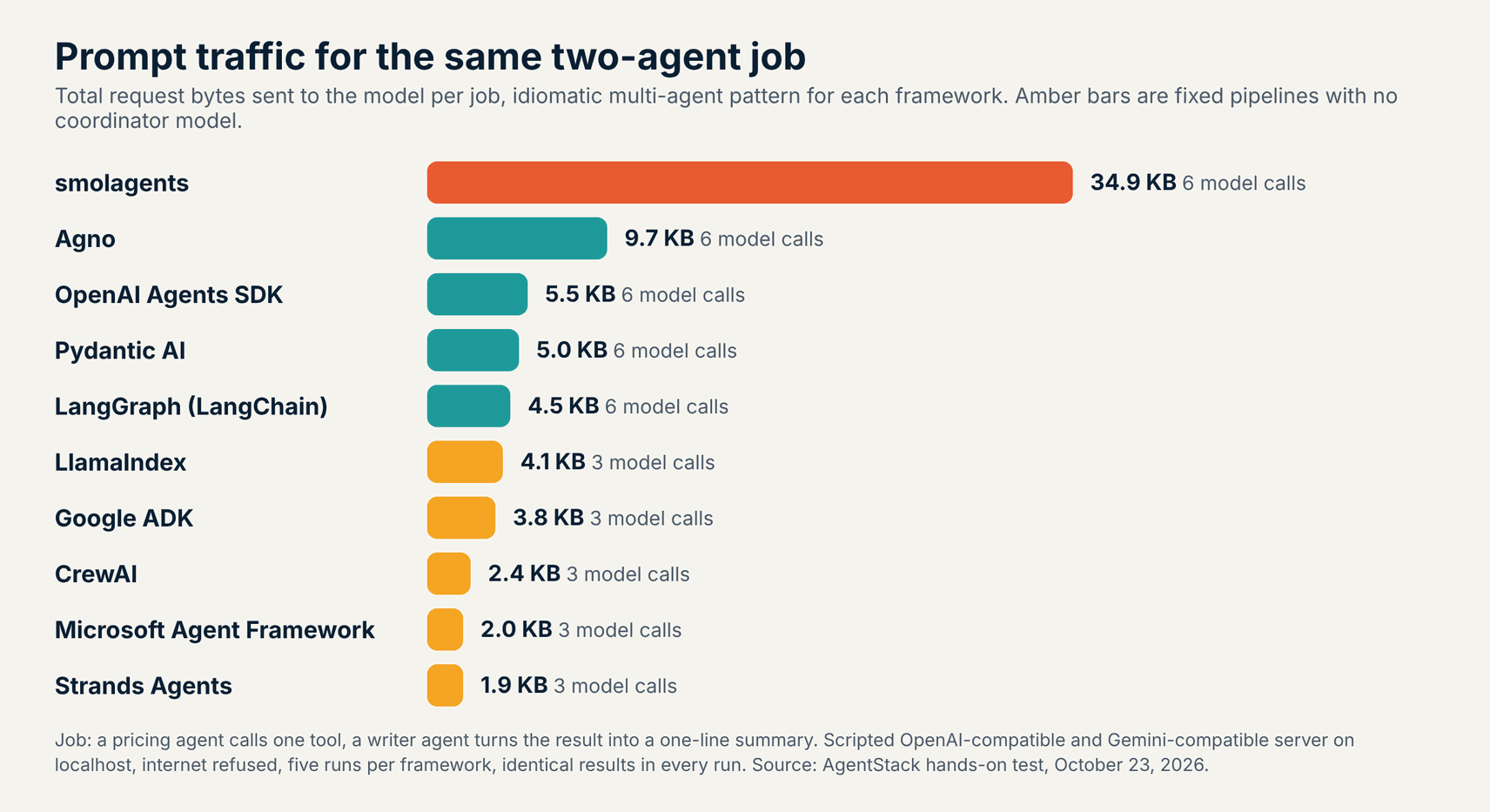
- Leanest traffic: Strands Agents at 1.9 KB and Microsoft Agent Framework at 2.0 KB, followed by CrewAI at 2.4 KB.
- Heaviest traffic: smolagents at 34.9 KB, about 18 times the leanest, because its built-in system prompts are long. Agno came next at 9.7 KB.
- Lowest memory: Microsoft Agent Framework peaked at 62 MB, then Agno at 68 MB and smolagents at 73 MB. CrewAI at 189 MB and LlamaIndex at 180 MB were the heaviest.
- Fastest runs: Microsoft Agent Framework at 0.76 seconds and Agno at 0.88 seconds. CrewAI was slowest at 3.0 seconds, and LlamaIndex took 2.21.
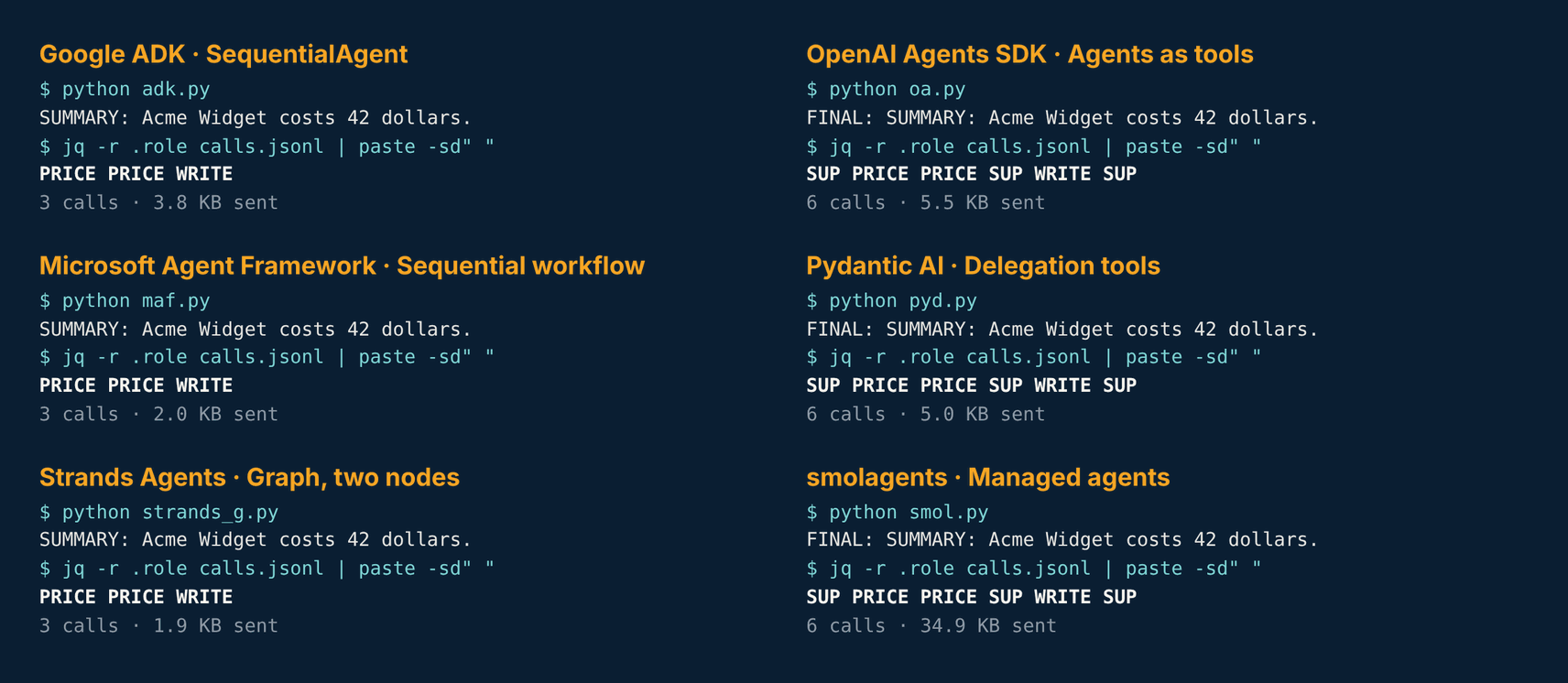
What the second agent sees matters as much as cost: in Google ADK, LlamaIndex, and Microsoft Agent Framework, the writer received the raw tool output without any extra code. That helps continuity, but it also sends internal data and extra tokens to an agent that may not need them.
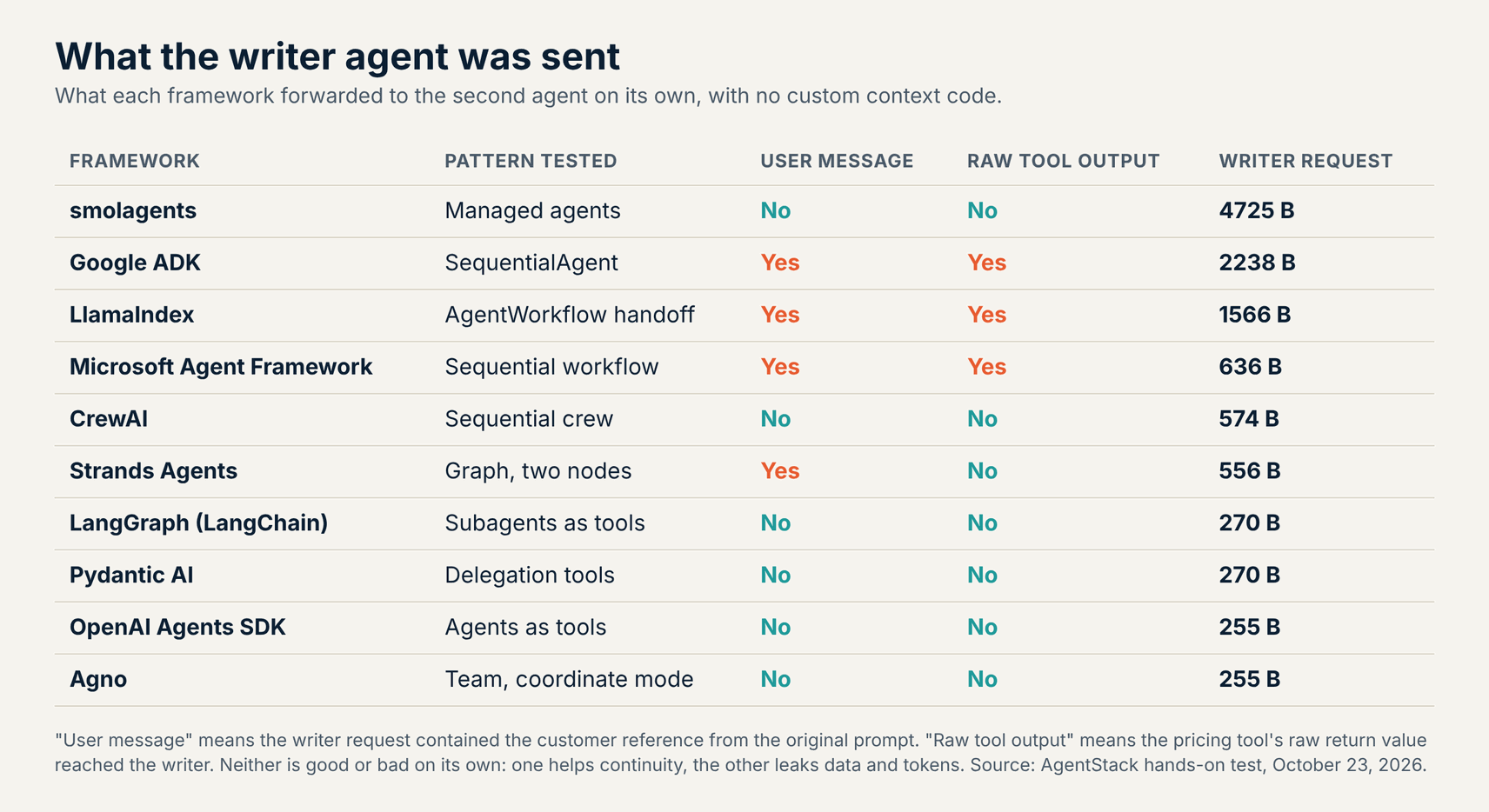
Agents-as-tools patterns in LangGraph, OpenAI Agents SDK, Pydantic AI, and Agno sent the writer only the short request the coordinator wrote, around 255 to 270 bytes. In a real system the coordinator model decides what to pass along, so write its instructions to include anything the specialist needs, such as an account ID.
1. LangGraph: Best for Full Control Over Context
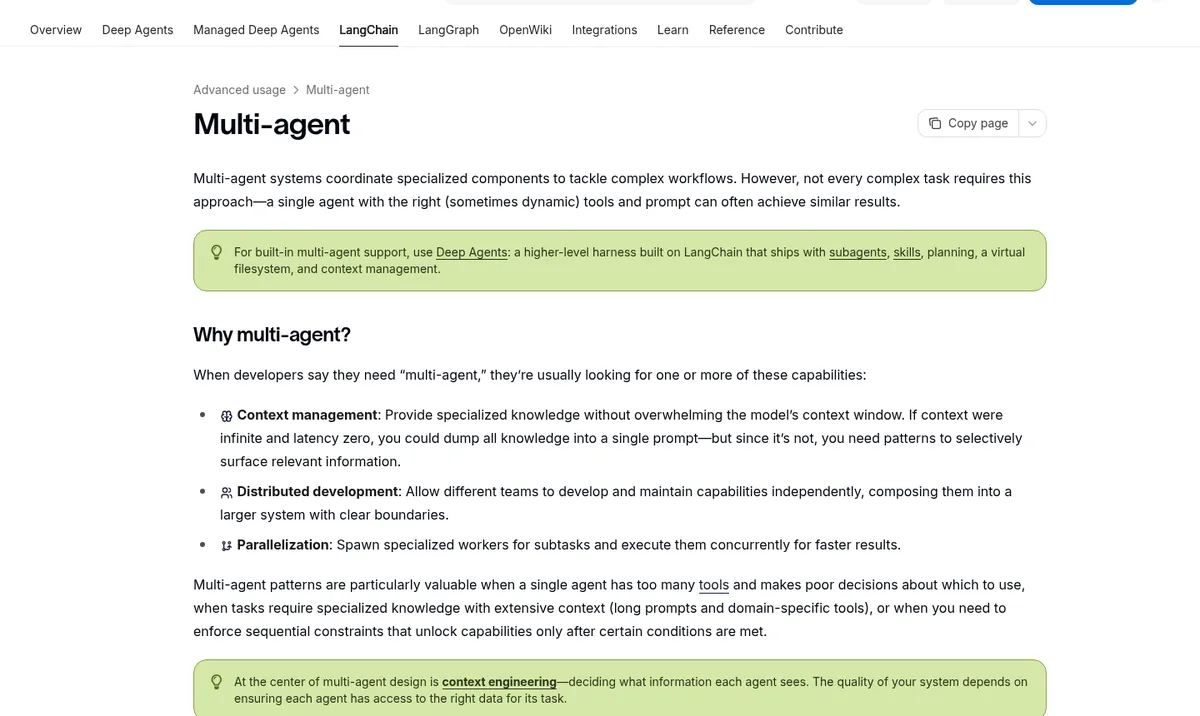
LangGraph gives you the most say over what each agent sees, which LangChain calls context engineering, the center of multi-agent design. Its multi-agent docs cover five patterns: subagents, handoffs, skills, router, and custom workflows built as graphs. langgraph had 44.8 million PyPI downloads last month, the most of any framework here.
Our recommended-pattern run used create_agent with two subagents wrapped as tools: 6 calls, 4.5 KB, a 270-byte writer request, and 93 MB peak memory. The older langgraph-supervisor library was archived on September 20, 2026, and its README now recommends the tool-based pattern. In our run, the archived library sent 7.2 KB and passed the full history to the writer.
- Best for: teams that want to decide exactly which messages, state, and tools each agent receives.
- Patterns built in (October 2026): subagents, handoffs, skills, router, and custom graphs with checkpoints.
- Watch out for: more code to write than in role-based frameworks, and old tutorials that still use the archived supervisor library.
2. OpenAI Agents SDK: Best for Simple Handoffs and Agents as Tools
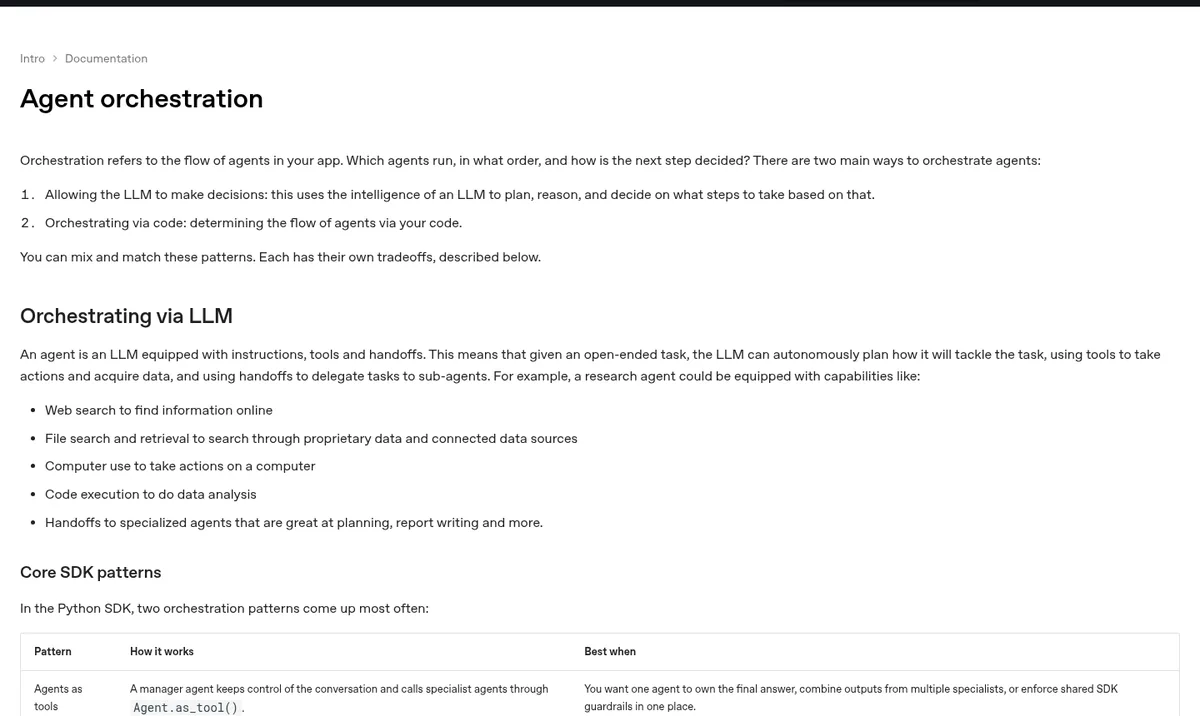
OpenAI Agents SDK makes the two most common patterns one-liners: Agent.as_tool() for a manager that keeps control, and handoffs for a triage agent that passes the turn on. The orchestration docs explain when to use each and show how to combine them. The repository has 30,246 stars, and the package had 12.4 million downloads last month.
Our agents-as-tools run made 6 calls, sent 5.5 KB, and peaked at 99 MB, and the writer saw only a 255-byte request. Handoffs work differently: the handoffs docs say the new agent sees the entire previous conversation unless you set an input_filter. Tracing uploads to OpenAI are on by default, so switch them off if you run another model.
- Best for: teams that want the shortest path to a triage agent and a few specialists.
- Patterns built in (October 2026): agents as tools, handoffs with input filters, and code-driven orchestration.
- Watch out for: tracing that uploads to OpenAI by default, and version 0.24.0, still below 1.0.
3. Microsoft Agent Framework: Best Range of Ready-Made Orchestrations
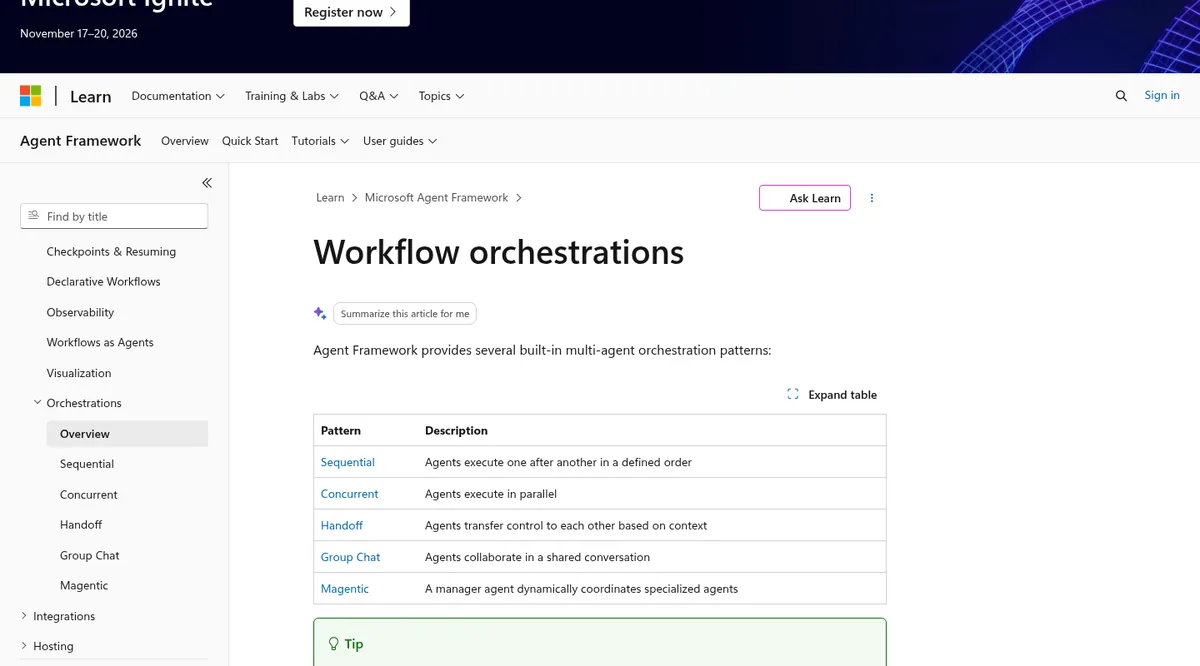
Microsoft Agent Framework ships five ready-made orchestrations, and it was the lightest framework in our test at 62 MB peak and 0.21 seconds to import. The orchestration docs list sequential, concurrent, handoff, group chat, and Magentic, where a manager agent coordinates specialists, with human approval steps built in. It is the successor Microsoft recommends to AutoGen users.
Its sequential workflow ran in 3 calls and 2.0 KB, but the writer received the customer reference and the raw tool output. That is documented: the sequential orchestration docs say each agent consumes the previous agent’s full conversation by default, and you can switch it to take only the previous response. Orchestrations ship in the separate agent-framework-orchestrations package.
- Best for: .NET and Python teams, AutoGen migrations, and dense deployments.
- Patterns built in (October 2026): sequential, concurrent, handoff, group chat, and Magentic, plus custom workflows.
- Watch out for: full-conversation passing by default and a split across many add-on packages.
4. CrewAI: Best for Role-Based Agent Crews
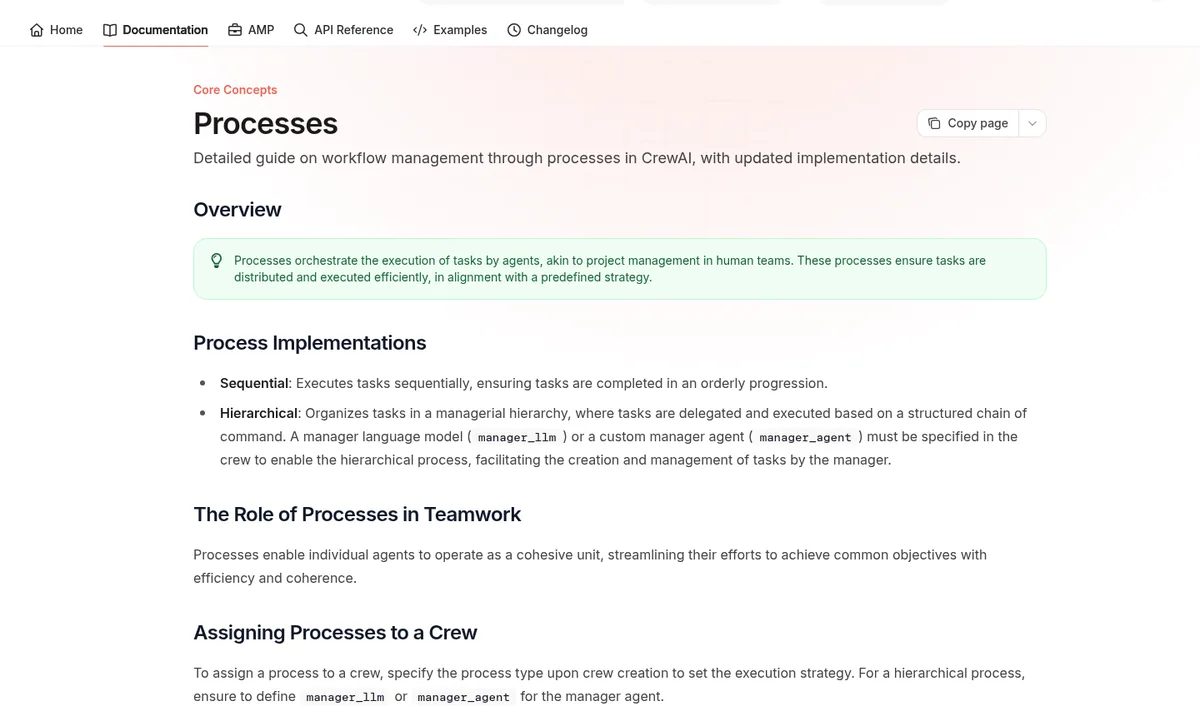
CrewAI is the most starred framework here at 60,032 stars, and its crews map neatly to how teams already think about roles and tasks. The processes docs describe a sequential process, where each task’s output becomes context for the next, and a hierarchical process that needs a manager model or manager agent.
Our sequential crew used 3 calls and 2.4 KB, and the writer saw only the pricing agent’s answer, not the customer reference or raw tool output. It was also the heaviest in our test at 189 MB and 3.0 seconds per run. CrewAI sends telemetry by default, so set CREWAI_DISABLE_TELEMETRY=true before production.
- Best for: teams that want role, goal, and task definitions without designing a graph.
- Patterns built in (October 2026): sequential and hierarchical crews, plus Flows for event-driven control.
- Watch out for: high memory use, telemetry on by default, and a hierarchical mode that adds manager model calls.
5. Google ADK: Best for Graph Workflows on Google Cloud
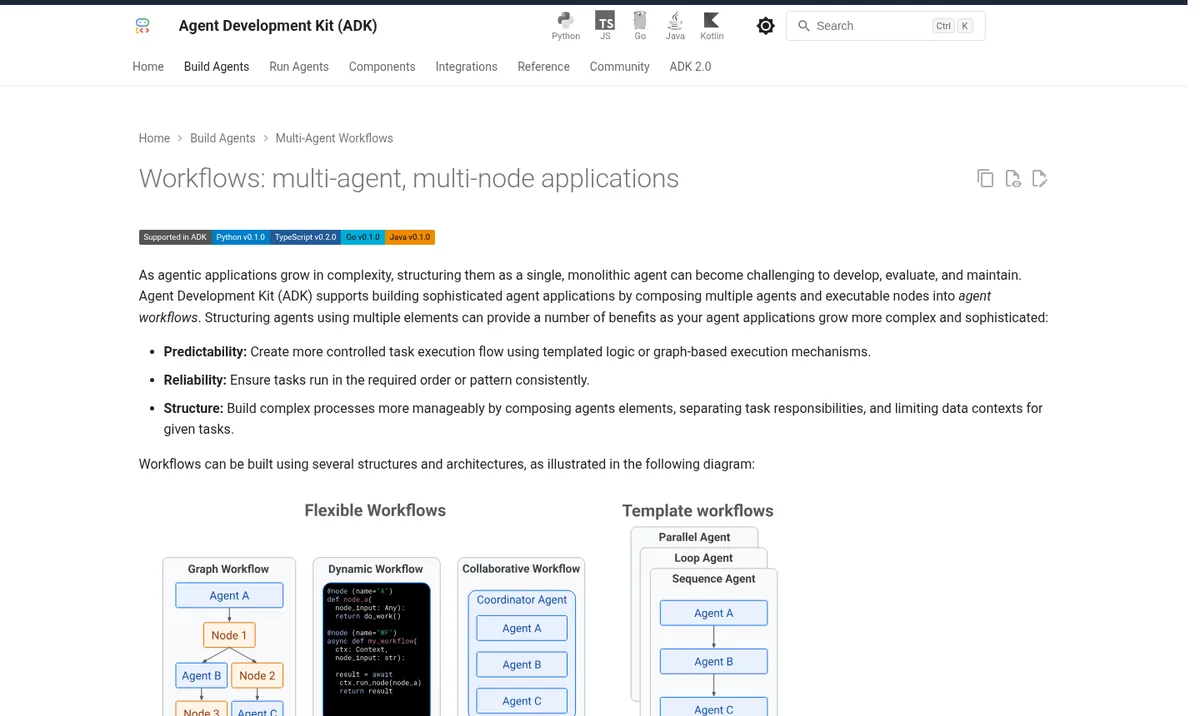
Google ADK 2.0 moved multi-agent work to graph, dynamic, and collaborative workflows, and the older template agents are now superseded. The workflow docs describe all four types, and the template workflow page says sequential, loop, and parallel agents were superseded in ADK 2.0 for Python and Go. ADK 2.12.0 printed a deprecation warning for SequentialAgent in our run.
The sequential pipeline still worked in 3 calls, but it sent the most to the writer of any pipeline, 2,238 bytes, including the customer reference and raw tool output from shared session history. New projects should start with graph workflows. The package had 10.1 million downloads last month.
- Best for: teams on Gemini and Google Cloud that want graph workflows plus a dev UI.
- Patterns built in (October 2026): graph, dynamic, and collaborative workflows, with older sequential, loop, and parallel agents.
- Watch out for: a fast-moving API, deprecation warnings on template agents, and Google Cloud defaults in deploy docs.
6. Pydantic AI: Best for Typed Delegation in Python Services
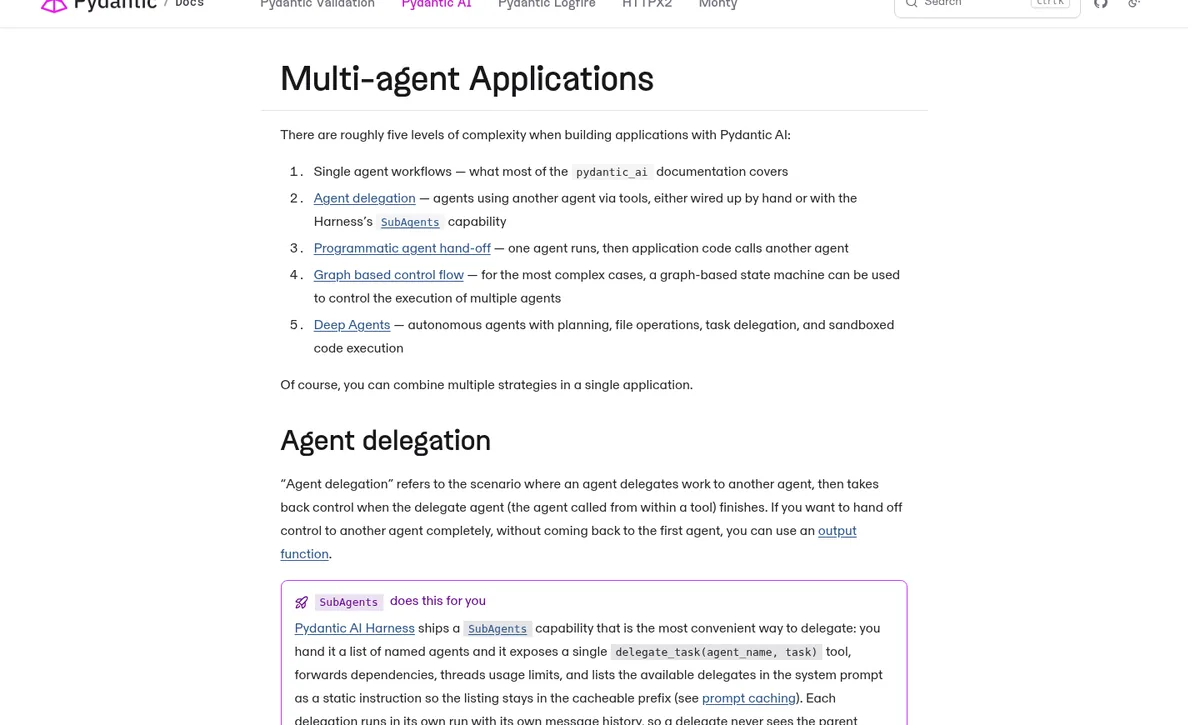
Pydantic AI treats multi-agent work as plain Python: one agent calls another inside a tool, and usage limits carry through to the whole run. Its multi-agent docs describe five levels of complexity, from delegation to graphs and deep agents, and a SubAgents capability where each delegate runs with its own message history.
Our delegation run made 6 calls, sent 5.0 KB, and peaked at 75 MB, and the writer saw a 270-byte request. Passing usage=ctx.usage to each delegate made token use count toward the parent run, which helps with budget caps. pydantic-ai-slim had 23.9 million downloads last month.
- Best for: Python teams that want typed inputs and outputs between agents.
- Patterns built in (October 2026): delegation through tools, hand-off in code, graphs, and SubAgents.
- Watch out for: fewer ready-made team patterns than CrewAI or Agno, so you write more orchestration yourself.
7. Agno: Best Built-In Team Modes
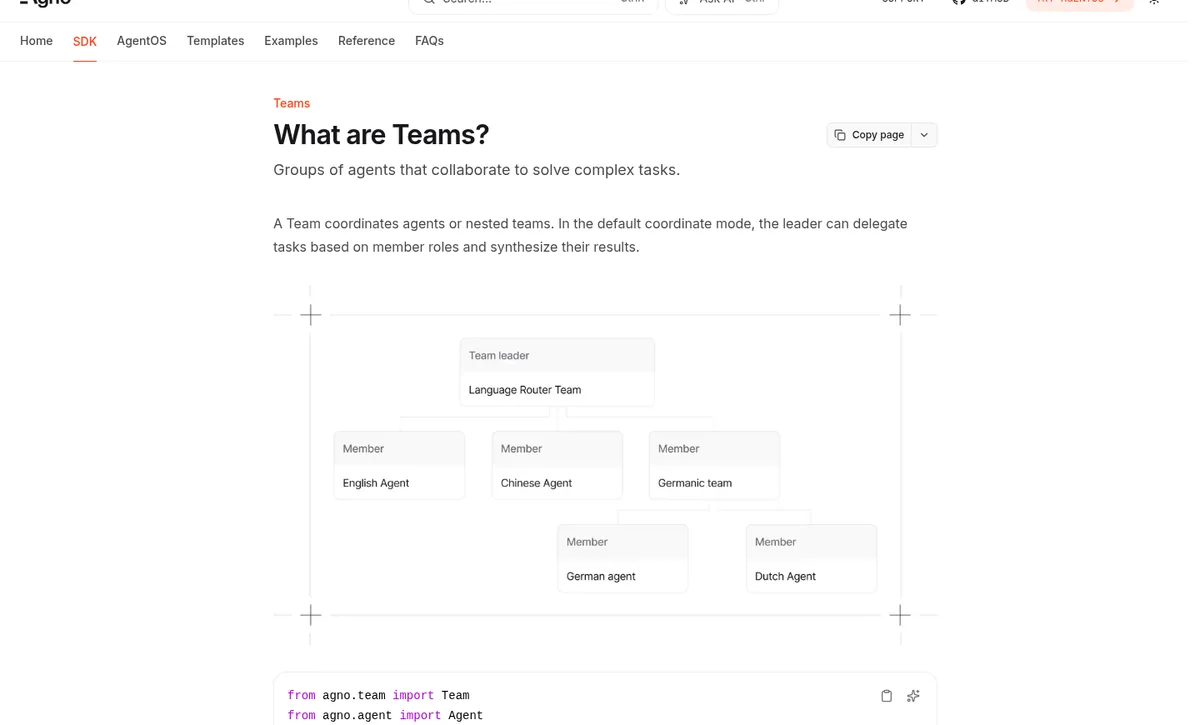
Agno lets you swap orchestration styles with one setting, choosing coordinate, route, broadcast, or tasks mode without changing the member agents. The delegation docs describe each mode, and the Teams overview warns that leader and member calls add latency and tokens. The repository has 42,874 stars.
In the default coordinate mode, our team made 6 calls and sent 9.7 KB, the second highest, because the leader’s requests were the largest at up to 3.1 KB. It was still light at 68 MB and 0.88 seconds per run. Agno shipped 3.1.10 on October 23, a day after the 3.1.9 we tested.
- Best for: teams that want routing, broadcast, and task-list patterns without writing them.
- Patterns built in (October 2026): coordinate, route, broadcast, and tasks modes, plus nested teams.
- Watch out for: large leader prompts, telemetry on by default, and frequent releases.
8. Strands Agents: Best Lean Graphs and Swarms
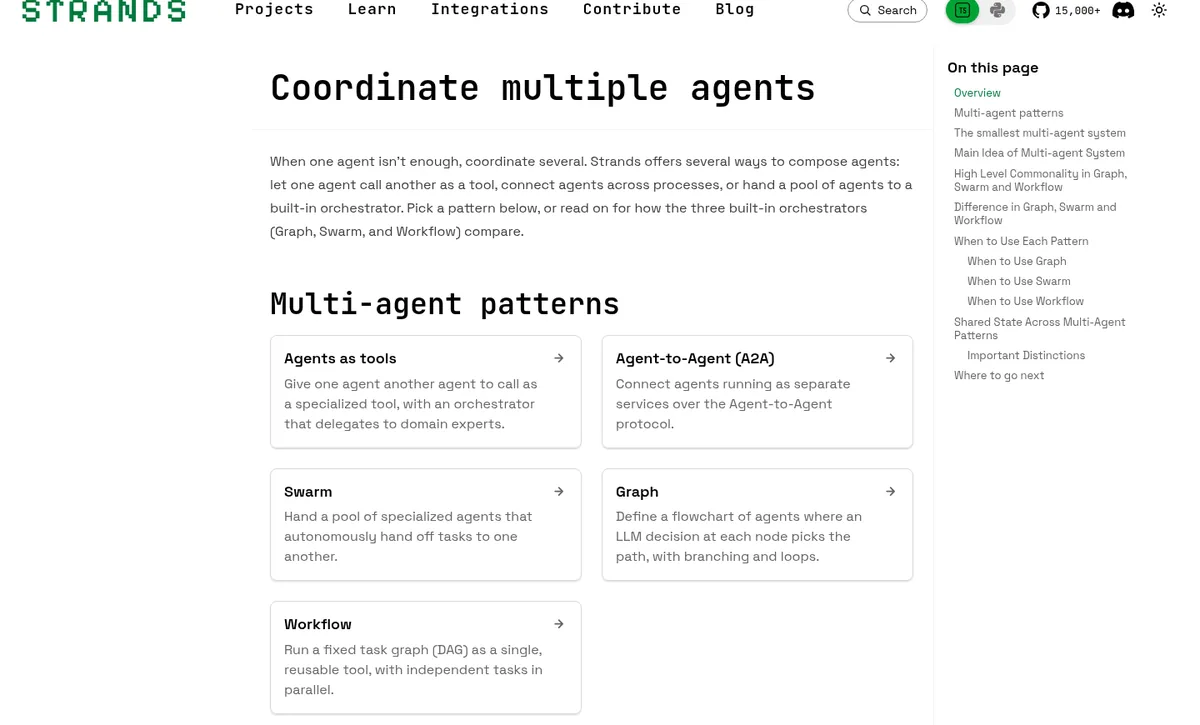
Strands Agents sent the least prompt traffic of all 10 frameworks, 1.9 KB per job, with its two-node graph. Its multi-agent patterns docs cover agents as tools, Agent-to-Agent over A2A, Swarm, Graph, and Workflow. strands-agents had 37.1 million downloads last month, second only to LangGraph.
The writer received the customer reference but not the raw tool output. Our graph printed a warning that no execution limit or timeout was set, so execution was unbounded. Set those limits on every graph that has loops. Peak memory was 104 MB.
- Best for: AWS and Kubernetes teams that want swarms, graphs, and A2A in one SDK.
- Patterns built in (October 2026): agents as tools, Swarm, Graph, Workflow, and A2A.
- Watch out for: graphs with no execution limit by default, and AWS-flavored examples.
9. LlamaIndex: Best for Multi-Agent Workflows Over Your Data
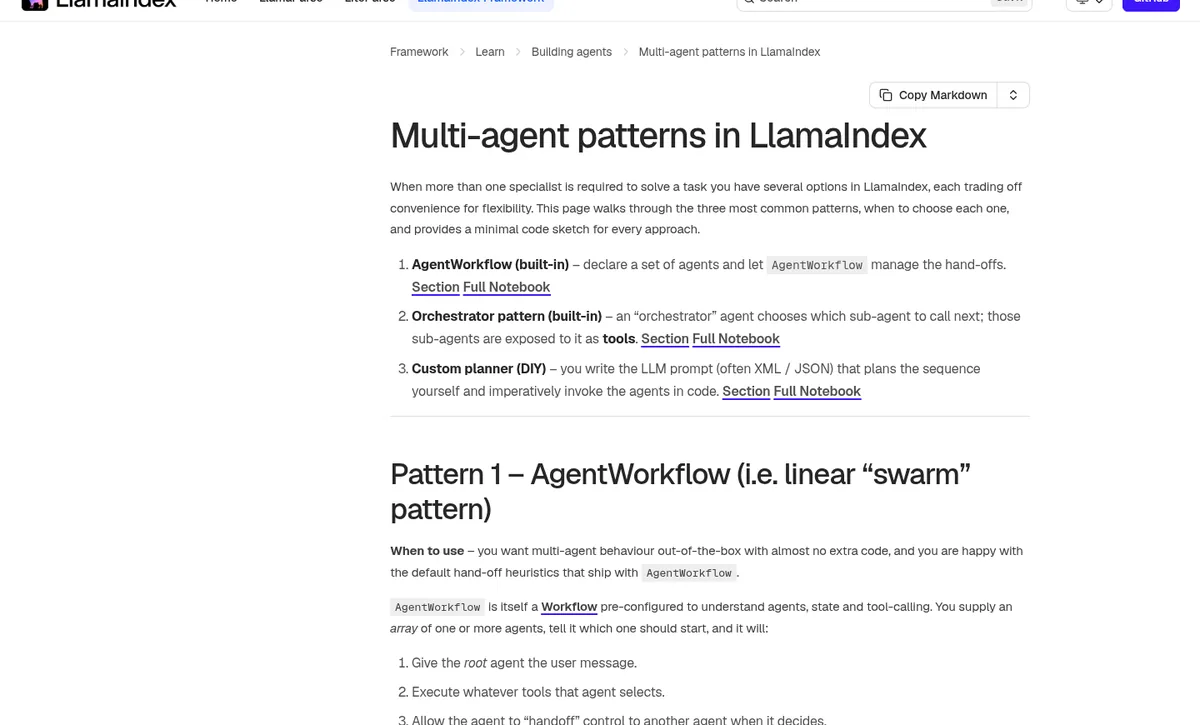
LlamaIndex AgentWorkflow handles handoffs between agents for you, which suits research, writing, and review teams built over your own documents. The multi-agent docs describe three patterns: AgentWorkflow, an orchestrator agent that calls sub-agents as tools, and a custom planner you write yourself.
Our handoff run took 3 calls and 4.1 KB, and the writer saw the customer reference and raw tool output because the conversation moves with the handoff. LlamaIndex was one of the heaviest at 180 MB and 2.21 seconds per run. llama-index-core last shipped on September 21, 2026.
- Best for: retrieval-heavy teams already using LlamaIndex for data connectors.
- Patterns built in (October 2026): AgentWorkflow handoffs, orchestrator agents, and custom planners.
- Watch out for: high memory use and full history passed on each handoff.
10. smolagents: Best Minimal Hierarchies for Code Agents
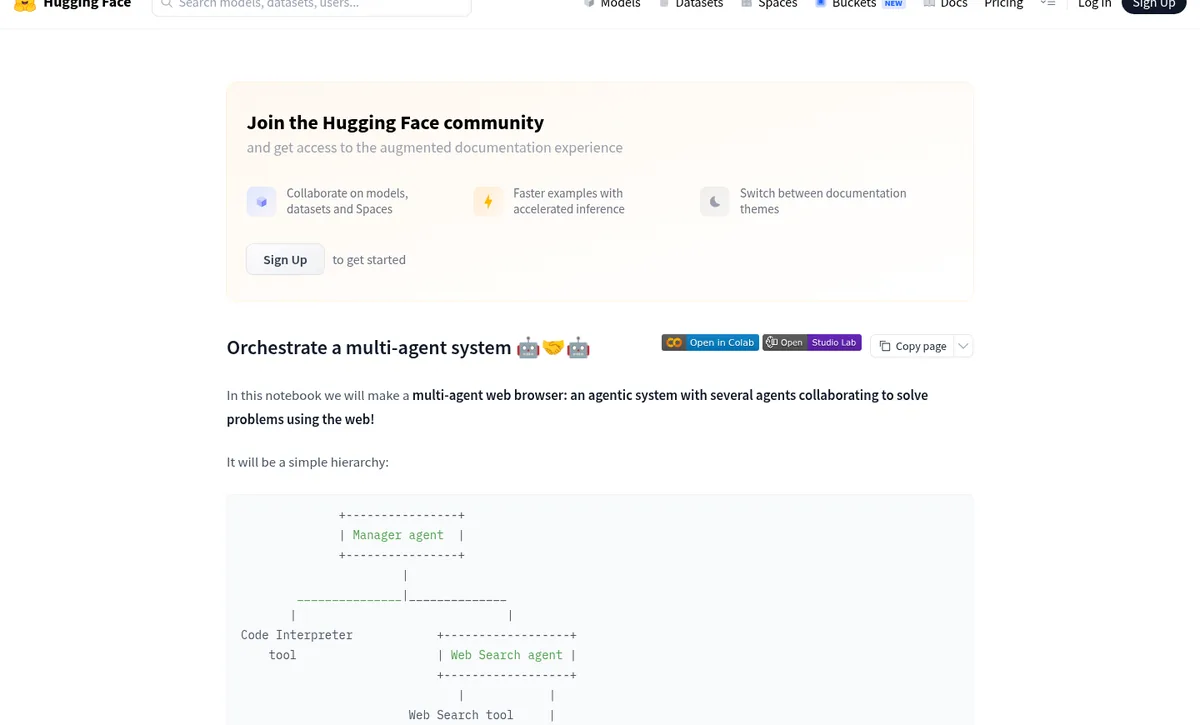
smolagents builds hierarchies by passing agents to a manager as managed agents, and it was light at 73 MB, but it sent the most prompt traffic by far. The multi-agent docs show a manager agent that calls a web search agent. The repository has 30,013 stars.
Our manager and two managed agents made 6 calls and sent 34.9 KB, with single requests up to 7.0 KB, about 18 times the leanest framework. That overhead grows with every step. The last release, 1.26.0, shipped on May 29, 2026, and the package had 426,000 downloads last month.
- Best for: researchers and small teams that want readable code agents in a short hierarchy.
- Patterns built in (October 2026): managed agents under a manager, with code or tool-calling agents.
- Watch out for: large built-in prompts, a slow release pace, and sandboxing you must set up for code agents.
Maintenance and Adoption Compared
LangGraph, Strands Agents, and Pydantic AI lead on downloads, while CrewAI and LlamaIndex lead on stars. The table uses GitHub, PyPI, and pypistats data collected on October 23, 2026. Downloads show real installs better than stars do, though CI pipelines inflate them for every project.
| Framework | GitHub stars | License | Latest release | Downloads, last month |
|---|---|---|---|---|
| LangGraph | 43,788 | MIT | 1.2.16, Oct 16 | 44.8 million |
| OpenAI Agents SDK | 30,246 | MIT | 0.24.0, Oct 15 | 12.4 million |
| Microsoft Agent Framework | 14,289 | MIT | 1.23.0, Oct 22 | 1.0 million (core) |
| CrewAI | 60,032 | MIT | 1.15.28, Oct 14 | 2.4 million |
| Google ADK | 21,980 | Apache 2.0 | 2.12.0, Oct 13 | 10.1 million |
| Pydantic AI | 20,818 | MIT | 2.60.0, Oct 23 | 23.9 million (slim) |
| Agno | 42,874 | Apache 2.0 | 3.1.10, Oct 23 | 1.8 million |
| Strands Agents | 8,933 | Apache 2.0 | 1.62.0, Oct 21 | 37.1 million |
| LlamaIndex (core) | 52,637 | MIT | 0.14.25, Sep 21 | 6.6 million |
| smolagents | 30,013 | Apache 2.0 | 1.26.0, May 29 | 426,000 |
All 10 projects pushed code to GitHub within the last two days, so none looks abandoned. smolagents is the outlier on releases, and LlamaIndex core is quieter than its workflow packages.
How to Control Context Between Agents
The writer-context test points to one habit worth adopting in any framework: decide what each agent gets instead of passing everything. The tool-based supervisor below is the pattern LangChain now recommends, and it is the code we ran. The coordinator writes each request, so the writer never sees the raw tool output.
from langchain.agents import create_agent
from langchain.tools import tool

pricing = create_agent(llm, tools=[get_price], system_prompt=PRICE)
writer = create_agent(llm, tools=[], system_prompt=WRITE)

@tool
def ask_pricing(request: str) -> str:
    """Ask the pricing specialist."""
    out = pricing.invoke({"messages": [{"role": "user", "content": request}]})
    return out["messages"][-1].content

@tool
def ask_writer(request: str) -> str:
    """Ask the writer."""
    out = writer.invoke({"messages": [{"role": "user", "content": request}]})
    return out["messages"][-1].content

supervisor = create_agent(llm, tools=[ask_pricing, ask_writer], system_prompt=SUP)- OpenAI Agents SDK: add an
input_filterto each handoff to trim the history the next agent receives. - Microsoft Agent Framework: configure sequential agents to take only the previous agent’s response instead of the full conversation.
- Google ADK: keep raw tool results out of shared state, and pass a short summary through
output_keyinstead. - Strands Agents: set an execution limit and a timeout on every graph or swarm.
Then watch the result in production. Our AI agent observability tools guide covers tracing for multi-agent runs, and our LLM cost monitoring tools guide shows how to catch coordinators that burn tokens.
Which Multi-Agent Framework Should You Choose?
Match your team to a profile below, then rebuild our two-agent job with your own prompts and a logging model endpoint before you commit. Each profile names a first choice, a fallback, and the next check to run, so you can shortlist two frameworks in one afternoon.
Teams building a support or triage assistant
- Start with OpenAI Agents SDK handoffs, adding input filters so each specialist sees only what it needs.
- Use LangGraph handoffs instead when routing depends on state you must persist and replay.
- Test routing mistakes before launch with our AI agent testing tools guide.
Teams with fixed, repeatable pipelines
- Choose Microsoft Agent Framework or Strands Agents for the lowest call count and traffic.
- Use CrewAI if your team prefers defining roles and tasks over wiring graphs.
- Score each stage’s output with our AI agent evaluation tools guide.
Platform teams running many agent teams
- Pick LangGraph or Pydantic AI for explicit control of context and budgets.
- Avoid default full-history passing, and cap model calls per job.
- Route all model traffic through one of the LLM gateways we compared, and version prompts with our prompt management tools guide.
Teams on a single cloud
- Use Google ADK graph workflows on Google Cloud, Strands Agents on AWS, and Microsoft Agent Framework on Azure.
- See how managed runtimes handle large agent fans in our Claude Managed Agents dynamic workflows report.
- Connect tools through the Model Context Protocol or one of the agent integration platforms we reviewed.
Frequently Asked Questions
What is the best multi-agent framework in 2026?
LangGraph is the best overall multi-agent framework for teams that want full control of context and routing. OpenAI Agents SDK is the simplest for handoffs and agents as tools, and Microsoft Agent Framework offers the most ready-made orchestrations, including sequential, concurrent, handoff, group chat, and Magentic.
Do multi-agent systems cost more than a single agent?
Usually yes. In our October 2026 test, coordinator patterns needed 6 model calls for a two-agent job, while fixed pipelines needed 3. Prompt traffic for the same job ranged from 1.9 KB in Strands Agents to 34.9 KB in smolagents, so the framework and pattern both change your token bill.
Is AutoGen still maintained?
No. The AutoGen README says the project is archived and no longer maintained by Microsoft, and it advises against production use. Microsoft recommends Microsoft Agent Framework for new projects and publishes a migration guide. AG2 is a separate community fork with its own releases on PyPI.
Is langgraph-supervisor deprecated?
The langgraph-supervisor repository was archived on September 20, 2026, and is now read-only. Its README recommends building the supervisor pattern directly with tool calling, as shown in the LangChain multi-agent guide. In our test, that tool-based pattern sent less data than the archived library and kept the writer’s context short.
How do I stop agents from sharing too much context?
Use an agents-as-tools pattern, where a coordinator writes a short request to each specialist, or filter history at handoffs. In our test, Google ADK, LlamaIndex, and Microsoft Agent Framework forwarded raw tool output to the next agent by default, while agents-as-tools patterns sent only about 255 to 270 bytes.
Related Guides
CrewAI is the default many teams start with for multi-agent work. Our best CrewAI alternatives for production multi-agent systems shows which frameworks keep crew-style roles with less install weight and tighter state control.
Multi-agent orchestration in TypeScript often lands on Mastra or LangGraph.js. Our Mastra vs Vercel AI SDK vs LangGraph.js guide compares tool loops, restart behaviour and when Vercel AI SDK stays enough.
Multi-agent orchestration on Azure often lands on Microsoft’s stack. Our Microsoft Agent Framework vs Semantic Kernel vs AutoGen guide compares tool loops, memory defaults and which option Microsoft still supports.
Multi-agent orchestration is one filter; language is another. Our TypeScript AI agent frameworks comparison tests ten JS/TS stacks for Node.js teams that do not want a Python runtime.
For related coverage, see our LangGraph vs CrewAI vs AutoGen comparison, LangGraph alternatives guide, LangChain vs LangGraph vs Deep Agents comparison, open source AI agent frameworks you can self-host and OpenAI Agents SDK vs Claude Agent SDK vs Google ADK comparison.
Read the agent frameworks hub, 12 best AI agent frameworks, AgentOps hub, agent observability coverage, AI agent observability tools, AI agent evaluation tools, AI agent testing tools, LLM cost monitoring tools, prompt management tools, LLM gateways, agent integration platforms, and MCP explained. Notes on how we work sit on editorial standards, disclosure, and contact.
The Bottom Line
For most teams, LangGraph, OpenAI Agents SDK, and Microsoft Agent Framework are the strongest multi-agent frameworks in 2026, as long as you choose the pattern and context passing on purpose. Pipelines cost half the model calls of a coordinator, and shared-history defaults can leak raw tool output to agents that never needed it.
These projects change quickly, as the archived supervisor library and ADK’s new workflows show, so rerun a logged test after each upgrade. Send corrections or your own results through our contact page.