
Last updated October 23, 2026. We installed all three SDKs that day, ran the same tool calling job in each with outbound traffic logged, and checked releases, downloads, and advisories against GitHub and PyPI.
OpenAI Agents SDK vs Claude Agent SDK vs Google ADK comes down to three different bets: OpenAI gives you a light, model flexible toolkit, Claude gives you the full Claude Code agent as a library, and Google ADK gives you a model agnostic framework built for deployment on Google Cloud. Each one comes from a model vendor, and each one nudges you toward that vendor’s models and services in a different way.
All three are free, open source Python libraries for building agents that call tools, remember conversations, and hand work to other agents. This page sits in our agent frameworks hub, and our guide to the 12 best AI agent frameworks covers independent options such as LangGraph and CrewAI.
On October 23, 2026 we installed each SDK into a clean Python 3.12 environment, scanned its dependencies, and ran one identical job five times per setting against a scripted local model, with every outbound connection logged and refused. No vendor paid for placement or reviewed this page, per our editorial standards and disclosure policy.
TL;DR
- OpenAI Agents SDK sends traces to OpenAI by default. Even with our model running locally, every run tried 3 uploads to
api.openai.com, and the docs say traced spans include model inputs and outputs unless you change a setting. - Claude Agent SDK makes an extra model call you did not ask for. Each run made 3 model calls instead of 2, because Claude Code asks a small model to title the session, and it tried 5 connections to
api.anthropic.com. One environment variable removed both. - Google ADK was the quietest. It made exactly 2 model calls and 0 outside connections by default, but its pinned OpenTelemetry version carries a moderate advisory that cannot be patched within ADK’s version range.
- Claude Agent SDK is the heaviest install by far. It took 313 MB, mostly a bundled 280 MB Claude Code binary, against 71 MB for ADK and 57 MB for OpenAI.
- All three kept memory across processes. Each one recalled an order code from an earlier run in 3 of 3 trials, using SQLite for OpenAI and ADK and session files for Claude.
OpenAI Agents SDK vs Claude Agent SDK vs Google ADK at a Glance
OpenAI Agents SDK is a small agent loop, Claude Agent SDK wraps a complete coding agent, and Google ADK is a full framework with graphs, evaluation, and deployment tools. The table compares fit, model choice, maintenance, defaults, and install size, using each project’s repository, documentation, PyPI, and our own test on October 23, 2026.
| SDK | Best for | Models | Latest release | Phones home by default | Install size |
|---|---|---|---|---|---|
| OpenAI Agents SDK | Light, model flexible agents with handoffs | OpenAI plus 100+ others via adapters | 0.24.0, October 15, 2026 | Yes, traces to OpenAI | 38 packages, 57 MB |
| Claude Agent SDK | Agents that read files, run commands, and edit code | Claude only, via Anthropic or major clouds | 0.2.173, October 22, 2026 | Yes, metrics and a title call | 30 packages, 313 MB |
| Google ADK | Structured agent apps deployed on Google Cloud | Gemini first, plus Claude, OpenAI, Ollama, vLLM, LiteLLM | 2.12.0, October 13, 2026 | No, in our test | 48 packages, 71 MB |
Verdict: Pick OpenAI Agents SDK for the simplest code and the widest model choice, Claude Agent SDK when the agent needs to work on files and shells the way Claude Code does, and Google ADK when you want structure, evaluation, and a deployment path on Google Cloud. Whichever you choose, switch off the default telemetry you do not want before production.
How We Tested the Three SDKs
To compare the three SDKs on equal terms, we built the same job in each: a shop assistant calls one price lookup tool, then writes a one line summary. We pointed every SDK at a local server that played the model’s part with fixed replies, so runs were offline, free, and repeatable, and every model request was counted.
- Network check: all traffic went through a logging proxy that recorded and refused every connection to the internet, so anything an SDK sent outside the box showed up in the log.
- Defaults first: five runs per SDK with default settings, then five more with each vendor’s documented switch for tracing or nonessential traffic turned off.
- Memory test: one process told the agent an order code, and a second process asked for it back, using each SDK’s own persistent session store.
- Install and dependency scan: package count and disk size after
uv pip install, then a pip-audit scan of each environment. - Project health: releases in the last 12 months, last month’s PyPI downloads, and GitHub stars, all checked the same day.
What Our October 23 Hands-On Test Found
Every SDK finished the job correctly in 5 of 5 runs, but only Google ADK did it without contacting its vendor. The differences were all in defaults: what each SDK sends home, and how many model calls it makes on your bill.
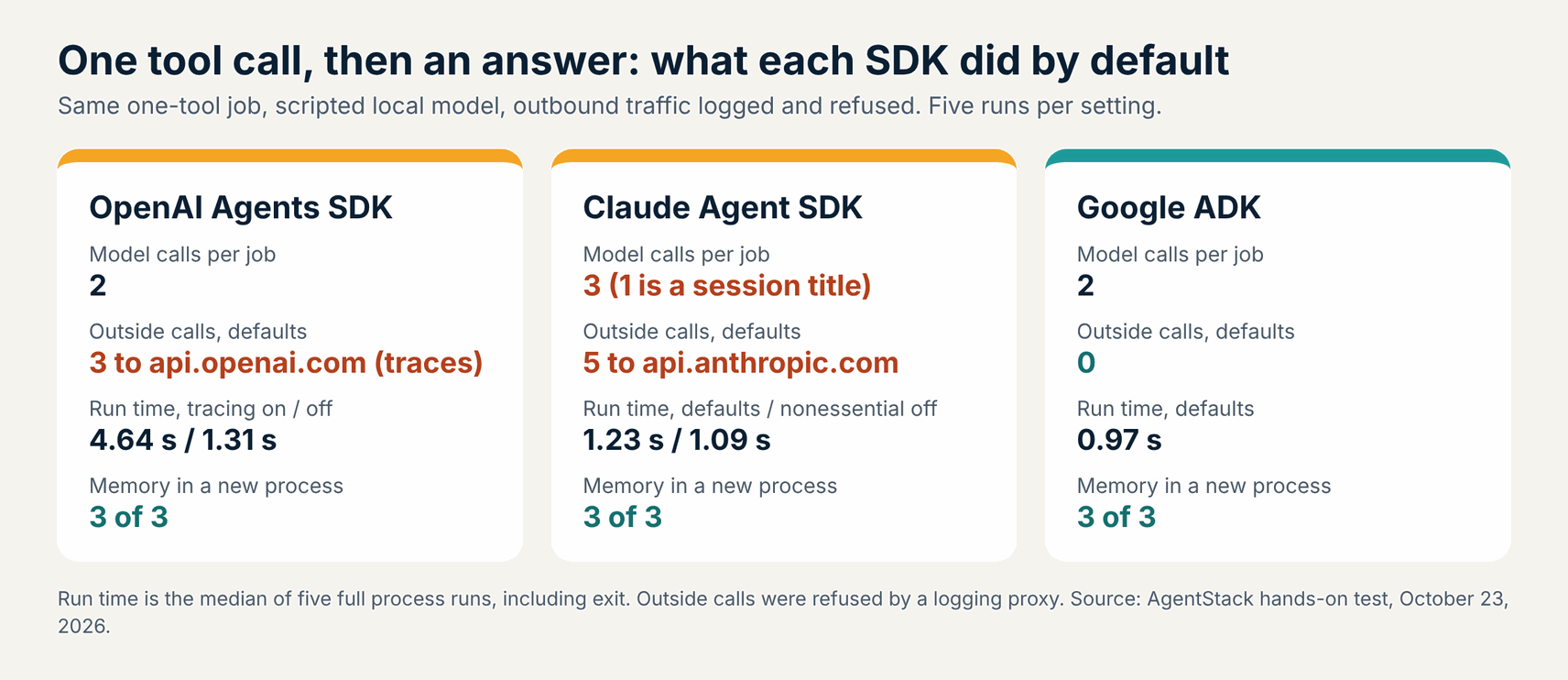
- OpenAI Agents SDK: 2 model calls and 3 refused connections to
api.openai.comper run, which were trace uploads. Because they failed offline and retried, each run took a median 4.64 seconds, against 1.31 seconds with tracing off. - Claude Agent SDK: 3 model calls per run, where the third had no tools and only asked for a short session title, plus 5 refused connections to
api.anthropic.com. WithCLAUDE_CODE_DISABLE_NONESSENTIAL_TRAFFIC=1it made 2 calls and 0 connections. - Google ADK: 2 model calls, 0 outside connections, and the fastest median run at 0.97 seconds.
- Memory: all three recalled the order code in a new process in 3 of 3 trials. The median cold import was 0.54 seconds for ADK, 0.61 seconds for Claude, and 1.2 seconds for OpenAI.
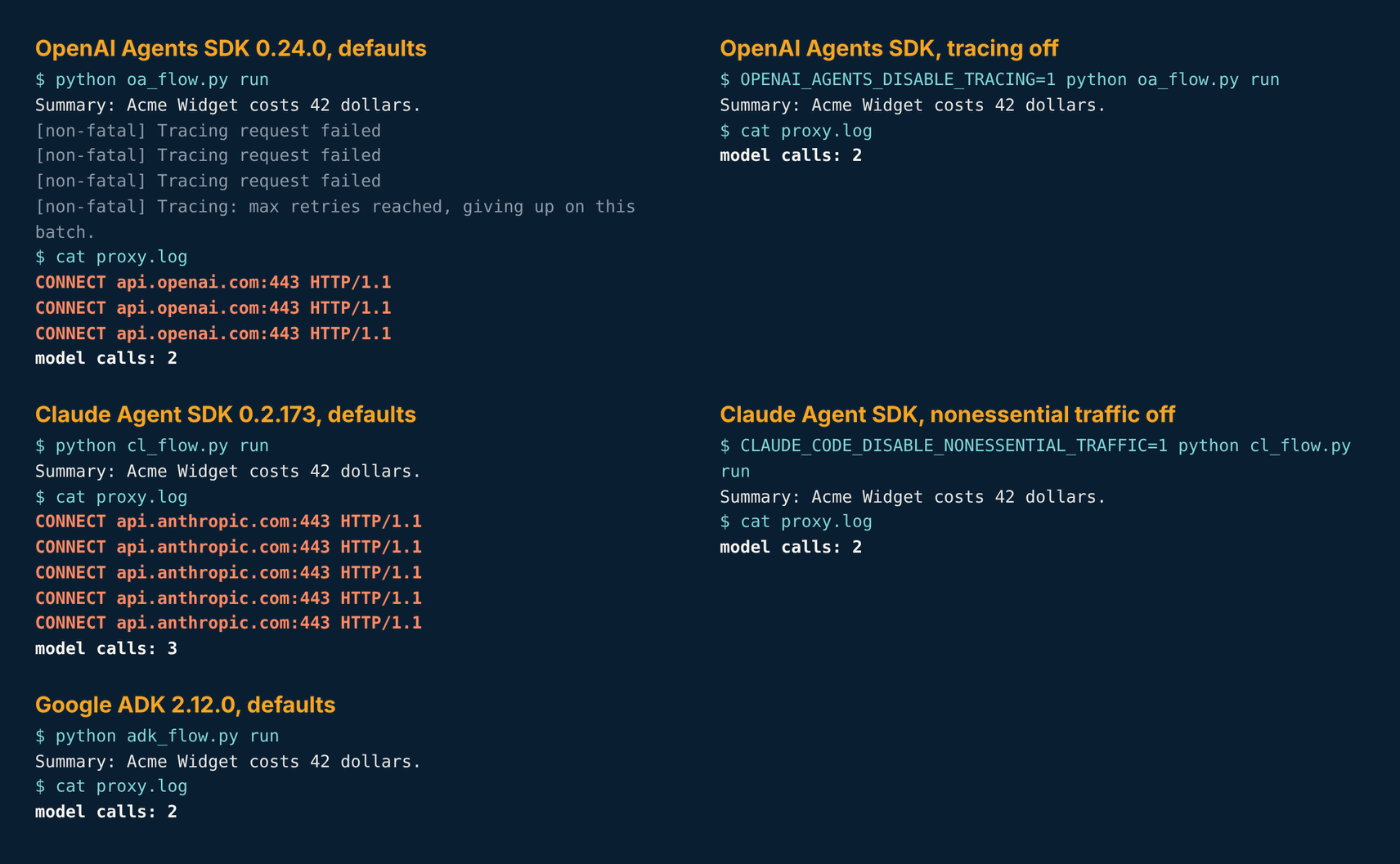
An extra title call is small, but it is still a model request billed to your account on every new session. The trace uploads matter more for privacy than cost, because they leave your network even when you run your own model behind a gateway.
1. OpenAI Agents SDK: Best for Light, Model Flexible Agents
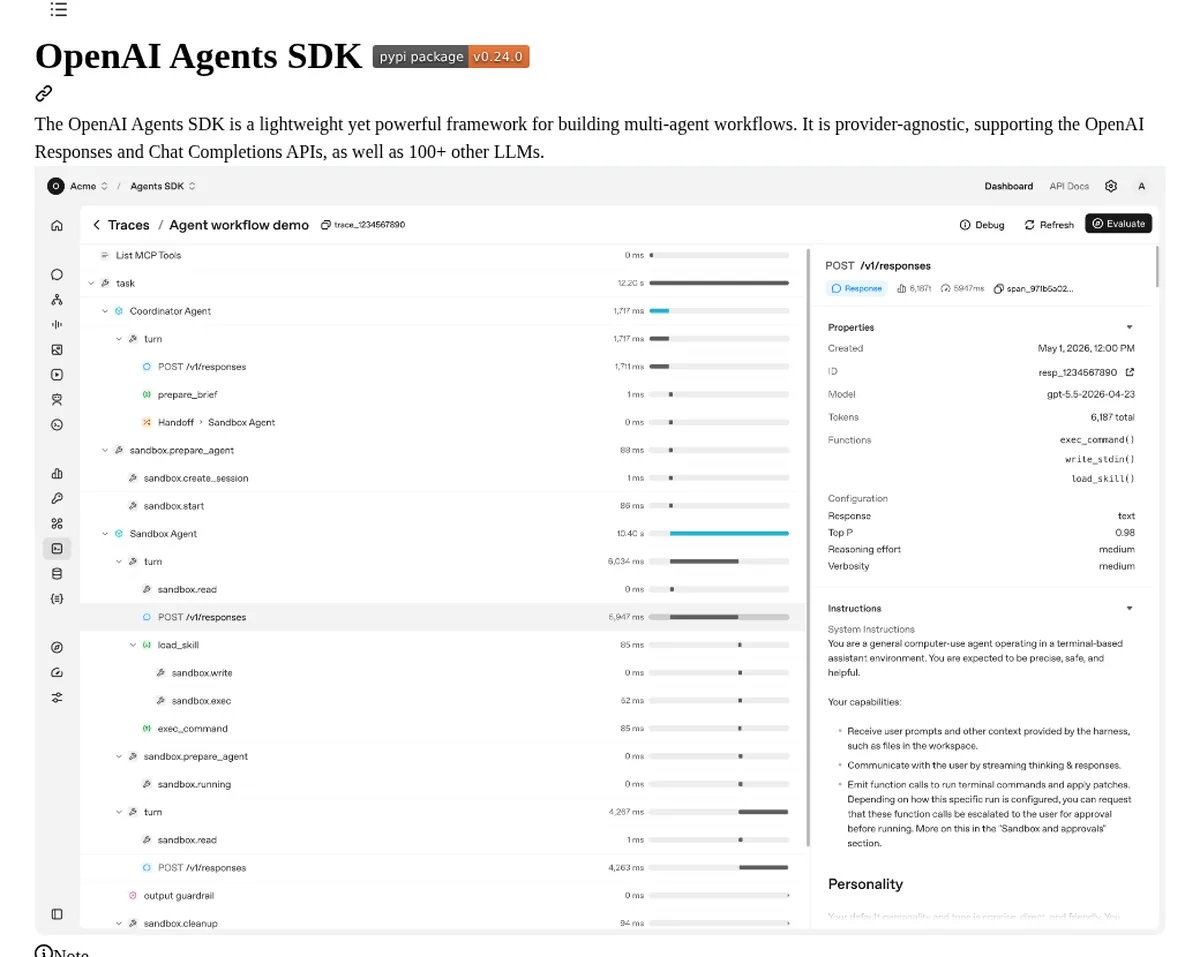
OpenAI Agents SDK is a lightweight agent loop with tools, handoffs between agents, guardrails, sessions, and sandbox agents, and its README calls it provider agnostic. Version 0.24.0 shipped on October 15, 2026, the repository has 30,233 stars, and it tagged 87 releases in the last 12 months. A TypeScript version also exists.
It talks to OpenAI’s Responses and Chat Completions APIs and, per its models docs, to other providers through LiteLLM and Any LLM adapters. We used its Chat Completions model class with a local endpoint, and the agent code did not change. Its sessions docs list SQLite, Redis, SQLAlchemy, MongoDB, Dapr, and encrypted session stores.
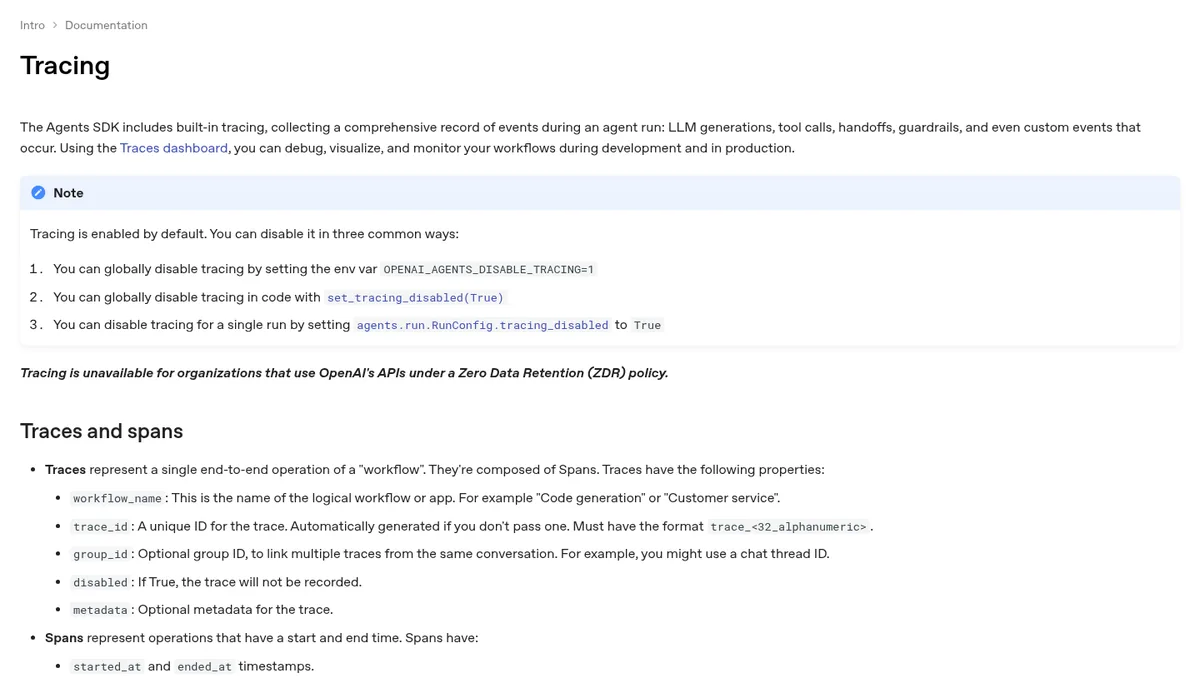
Tracing is on by default and uploads to OpenAI, even when the model is not OpenAI. The tracing docs say you can turn it off with OPENAI_AGENTS_DISABLE_TRACING=1, set_tracing_disabled(True), or a per run setting, that it is unavailable to Zero Data Retention organizations, and that spans include model inputs and outputs unless trace_include_sensitive_data is set to false.
The traces are useful during development, since they show every model call, tool call, and handoff in OpenAI’s dashboard. For production, many teams send traces to their own store instead, using the tools in our AI agent observability guide or the open source LLM observability guide.
- Best for: teams that want the least code, handoffs between agents, and the freedom to switch model providers later.
- Pricing (October 2026): free under MIT. You pay for model usage at your provider’s rates.
- Watch out for: disable tracing or set
trace_include_sensitive_datato false before handling customer data, and pin versions, because the SDK is still below 1.0.
2. Claude Agent SDK: Best for Agents That Work on Files and Code
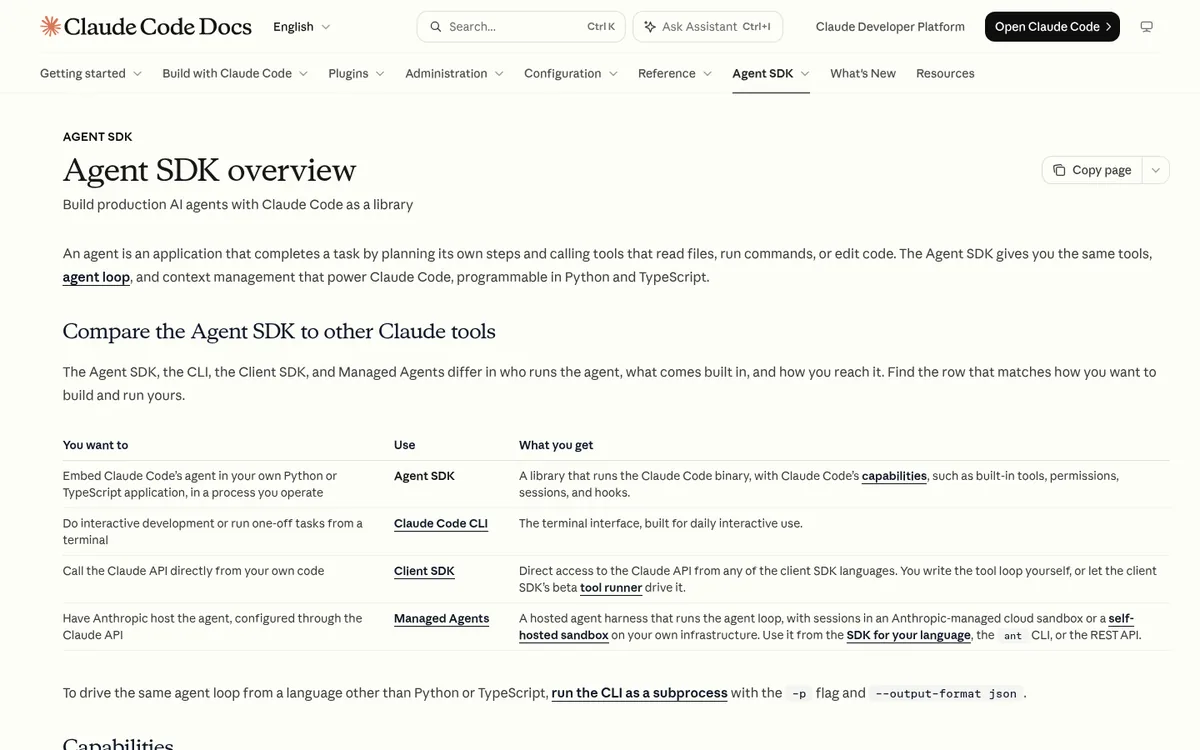
Claude Agent SDK gives you the same tools, agent loop, and context management that power Claude Code, programmable in Python and TypeScript. That means built in tools for reading and editing files, running commands, and searching the web, plus permissions, hooks, subagents, and MCP support. Version 0.2.173 shipped on October 22, 2026, and the repository tagged 167 releases in the last 12 months.
It had the most PyPI downloads of the three last month, at 29.8 million. The overview also notes that third party developers may not offer claude.ai login or rate limits in their products without approval, so plan on API keys or a cloud provider for anything you ship.
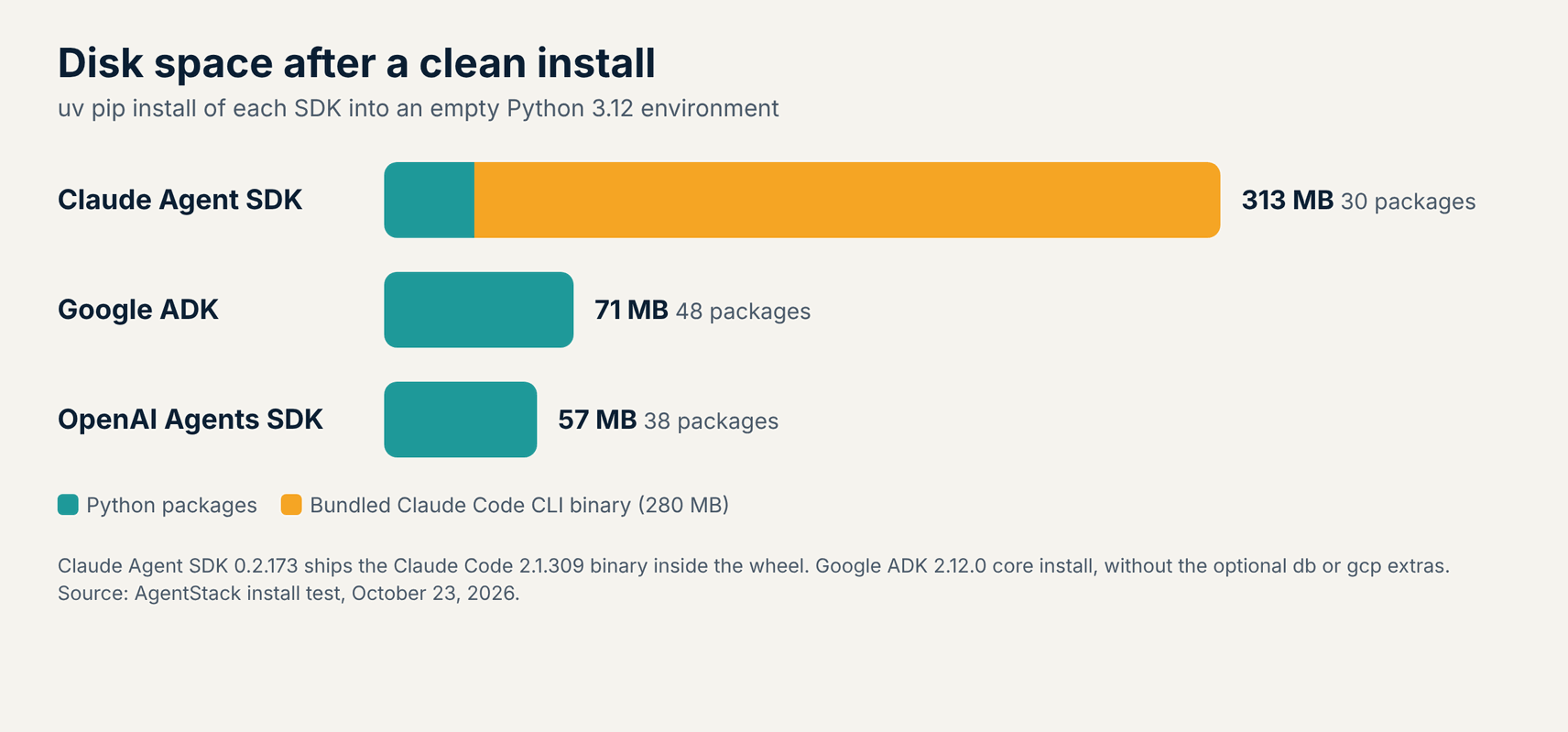
The Python package ships a 280 MB Claude Code binary, which is why the install is more than four times the size of ADK. The SDK starts that binary as a subprocess for each session, and in our test it worked fine against a local endpoint once we set ANTHROPIC_BASE_URL. Claude models are also reachable through Amazon Bedrock, Google Cloud, and Microsoft Foundry.
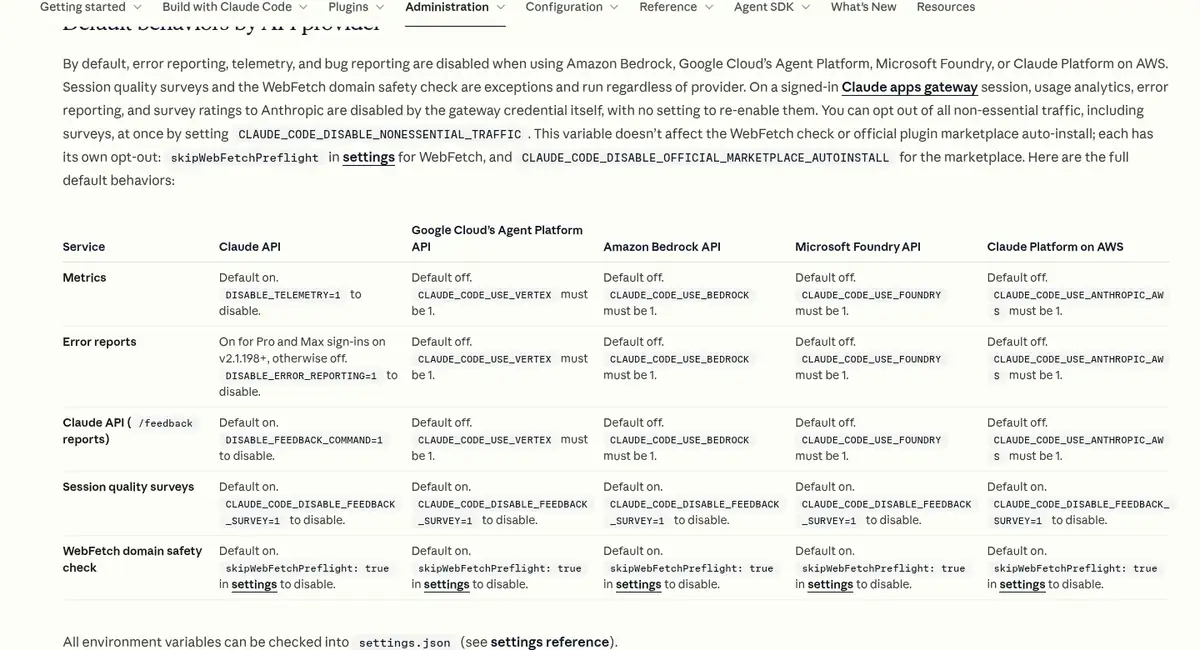
Claude Code’s data usage page lists metrics and error reports as on by default for the Claude API, and off by default on Bedrock, Google Cloud, Microsoft Foundry, and Claude Platform on AWS. Setting CLAUDE_CODE_DISABLE_NONESSENTIAL_TRAFFIC turns them off together, and in our test it also removed the session title call.
Sessions are saved as files under the Claude config folder and can be resumed by ID or forked, per the sessions guide. For hosted runs instead of your own servers, see our coverage of Claude Managed Agents, and for traces from Claude, our report on Claude Platform OpenTelemetry traces.
- Best for: teams building coding, research, or operations agents that need real file and shell access with permission controls.
- Pricing (October 2026): free under MIT. You pay Claude API usage, or your cloud provider’s rates for Claude on Bedrock, Google Cloud, or Foundry.
- Watch out for: the 313 MB install in containers, the extra title request per session, and the claude.ai login rule if you ship an end user product.
3. Google ADK: Best for Structured Agent Apps on Google Cloud
Google ADK is a code first framework for building, evaluating, and deploying agents, and its README says that while it is optimized for Gemini, it is model agnostic and deployment agnostic. Version 2.12.0 shipped on October 13, 2026, the repository has 21,966 stars and 62 releases in the last 12 months, and it is the only one of the three under Apache 2.0.
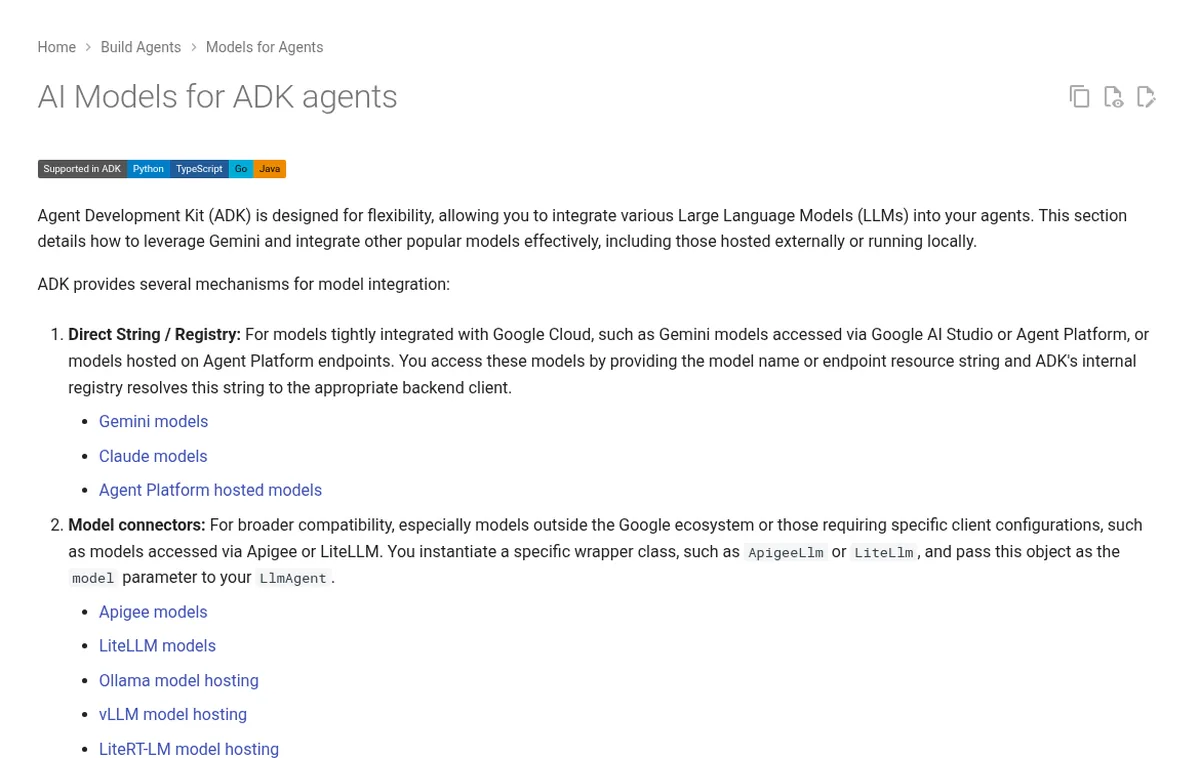
ADK 2.x includes a graph based workflow runtime with routing, loops, retries, and human approval steps, plus built in evaluation. It has the widest language spread: Python, TypeScript, Java, Kotlin, and Go. Its models guide covers Gemini, Claude, Apigee, LiteLLM, Ollama, and vLLM, and its sessions docs cover in memory, database, and Agent Platform stores.
ADK made zero outside connections in our test, but its dependency pin leaves one moderate advisory unpatched. pip-audit flagged opentelemetry-api 1.42.1 for CVE-2026-114603, an unbounded tracestate parsing issue rated 5.3 that is fixed in 1.45.1. ADK 2.12.0 requires a version at or below 1.42.1, so you cannot upgrade it without overriding ADK’s pin.
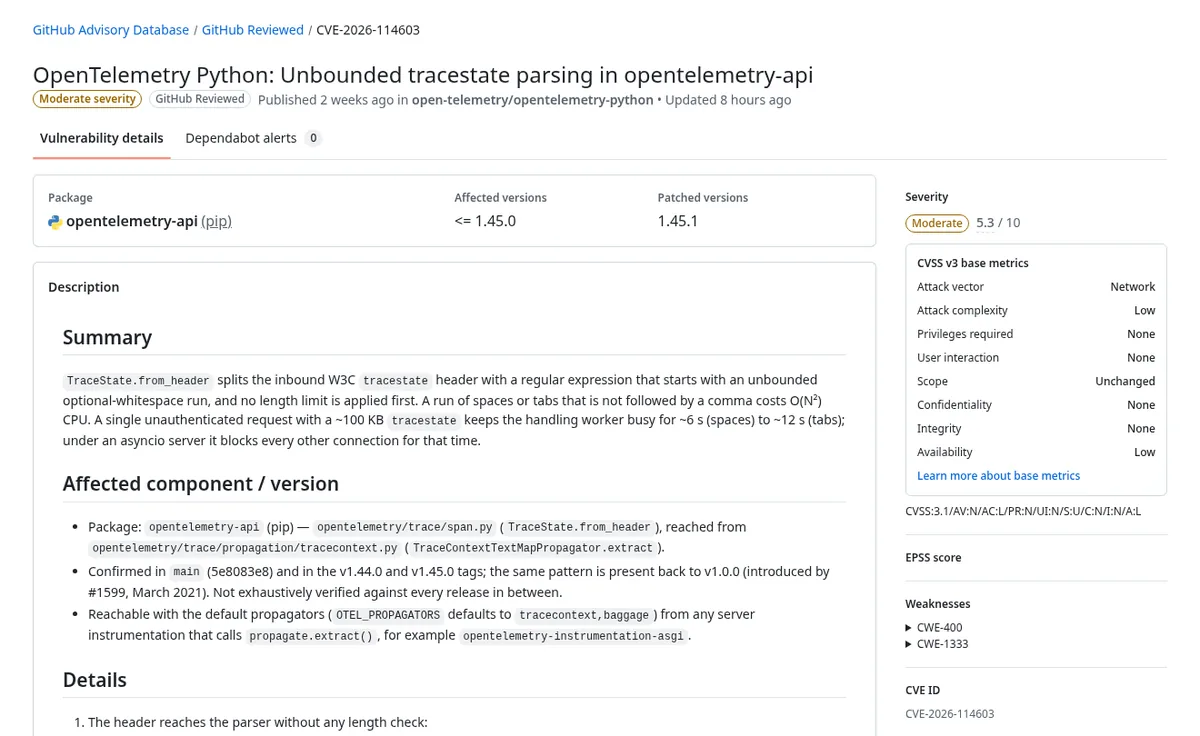
The issue affects services that parse trace headers from untrusted requests, so it matters most if you expose an ADK agent as a public HTTP service. Deployment is one command to Cloud Run, GKE, or Agent Platform, per the ADK docs, or a container anywhere else.
- Best for: teams that want graphs, evaluation, and many languages in one framework, especially on Google Cloud.
- Pricing (October 2026): free under Apache 2.0. You pay for model usage and for any Google Cloud hosting you use, at Google Cloud rates.
- Watch out for: the OpenTelemetry pin in security scans, Python 3.11 or later, and a steeper learning curve than OpenAI’s SDK.
Maintenance and Security Compared
All three projects ship releases more than once a week, so pinning versions matters more than picking the most active one. The table uses GitHub and PyPI data and our pip-audit scans from October 23, 2026.
| SDK | GitHub stars | Releases, last 12 months | PyPI downloads, last month | License | Known advisories |
|---|---|---|---|---|---|
| OpenAI Agents SDK | 30,233 | 87 | 12.4 million | MIT | 0 |
| Claude Agent SDK | 8,334 | 167 | 29.8 million | MIT | 0 |
| Google ADK | 21,966 | 62 | 10.1 million | Apache 2.0 | 1 moderate, in pinned opentelemetry-api |
Turning Off Telemetry and Keeping Sessions
These are the settings we used to stop outbound traffic and keep memory between processes. Each one comes from the vendor’s own documentation and worked in our test.
# OpenAI Agents SDK 0.24.0: tracing off, history kept in SQLite
from agents import Agent, Runner, SQLiteSession, set_tracing_disabled
set_tracing_disabled(True)          # or OPENAI_AGENTS_DISABLE_TRACING=1
session = SQLiteSession("job-1", "sessions.db")
result = await Runner.run(agent, "What was my order code?", session=session)

# Claude Agent SDK 0.2.173: no nonessential traffic, resume by session ID
from claude_agent_sdk import query, ClaudeAgentOptions
opts = ClaudeAgentOptions(
    mcp_servers={"shop": shop_server},
    allowed_tools=["mcp__shop__get_price"],
    env={"CLAUDE_CODE_DISABLE_NONESSENTIAL_TRAFFIC": "1"},
    resume=saved_session_id,        # None on the first run
)
async for message in query(prompt="What was my order code?", options=opts):
    ...

# Google ADK 2.12.0: history kept in SQLite
from google.adk.runners import Runner
from google.adk.sessions.sqlite_session_service import SqliteSessionService
service = SqliteSessionService(db_path="sessions.db")
runner = Runner(app_name="shop", agent=agent, session_service=service)
If you want traces without sending them to a model vendor, export them to your own backend and compare options in Langfuse vs LangSmith vs Braintrust. Routing all three SDKs through one of the LLM gateways we compared also gives you one place for keys, limits, and logs.
When to Use Something Other Than These Three
Vendor SDKs are convenient, but each leans toward its maker’s models and cloud. These options suit teams that want more independence, and our full frameworks guide compares nine more.
- An independent framework: LangGraph, CrewAI, and similar projects are not tied to a model vendor, which helps if you expect to switch providers often.
- MCP for tools: exposing tools over the Model Context Protocol keeps them usable across all three SDKs, since each one can call MCP servers. Our MCP servers guide lists ready made ones.
- Managed hosting: if you mainly need somewhere to run tools, compare MCP hosting platforms and our test of Cloudflare vs Vercel vs AgentCore.
- Plain API calls: for a single tool call, the vendor’s normal client SDK is smaller than any agent framework. Scan dependencies either way, as the LiteLLM supply chain compromise showed.
OpenAI, Claude, or Google ADK: Which Should You Choose?
The right SDK depends on what your agent touches, which models you use, and how strict your network rules are. Match your team to a profile below, then run your own job with outbound traffic logged before you commit.
Product teams shipping chat or support agents
- Start with OpenAI Agents SDK for handoffs, guardrails, and the least code.
- Use an adapter if you want non OpenAI models, and keep tracing off for customer data.
- Score answers before launch with our AI agent evaluation tools guide.
Teams building coding or operations agents
- Use Claude Agent SDK for built in file, shell, and web tools with permission controls.
- Set
CLAUDE_CODE_DISABLE_NONESSENTIAL_TRAFFIC=1and budget for the larger image. - Test risky tool use in a sandbox first, using our AI agent testing tools guide.
Teams on Google Cloud or with many languages
- Pick Google ADK for graph workflows, built in evaluation, and Go, Java, or Kotlin support.
- Track the OpenTelemetry advisory in scans until a new ADK release widens the pin.
- Send traces to your own store, as covered on our agent observability hub.
Security teams with strict outbound rules
- Prefer ADK, which sent nothing outside by default, or turn off OpenAI tracing and Claude nonessential traffic.
- Run each SDK behind a logging proxy once, as we did, to confirm what leaves the network.
- Keep one trace store and one gateway, as covered on our AgentOps hub.
Frequently Asked Questions
Which is better, OpenAI Agents SDK or Claude Agent SDK?
OpenAI Agents SDK is better for light agents with handoffs and a choice of model providers, because it is small and works with many models. Claude Agent SDK is better when the agent must read files, run commands, and edit code, because it embeds Claude Code. Claude Agent SDK only runs Claude models.
Does OpenAI Agents SDK send data to OpenAI?
Yes, by default. Tracing is on and uploads spans to OpenAI, and the docs say generation and tool spans include inputs and outputs unless you set trace_include_sensitive_data to false. In our test, it tried three trace uploads per run even with a local model. Set OPENAI_AGENTS_DISABLE_TRACING to 1 to stop it.
Can Google ADK use models other than Gemini?
Yes. ADK describes itself as optimized for Gemini but model agnostic, and its models guide covers Claude, OpenAI models through LiteLLM, Apigee, Ollama, and vLLM. In our test, ADK ran against a local model endpoint with no code changes beyond the base URL, and it made no outside connections during the run.
Why is the Claude Agent SDK install so large?
The Python package bundles the Claude Code command line binary, which took 280 MB of the 313 MB install in our test. The SDK starts that binary for each session to run the agent loop and tools. OpenAI Agents SDK installed in 57 MB and Google ADK in 71 MB, so plan container sizes accordingly.
Do these agent SDKs remember conversations between runs?
Yes, all three do when you use a persistent session store. OpenAI Agents SDK has SQLite, Redis, and SQLAlchemy sessions, Google ADK has SQLite and database services, and Claude Agent SDK saves session files you resume by ID. In our test, each one recalled an order code in a new process in three of three trials.
Related Guides
Vendor SDKs are often the exit route from CrewAI. Our CrewAI alternatives guide ranks the OpenAI Agents SDK and Google ADK against LangGraph, Pydantic AI and others for lean handoffs and cloud fit.
Vendor SDKs are one lane; TypeScript agent frameworks are another. Our Mastra vs Vercel AI SDK vs LangGraph.js guide compares install footprint, tool loops and restart behaviour for JS/TS teams.
Vendor SDKs are one lane; Microsoft’s own frameworks are another. Our Microsoft Agent Framework vs Semantic Kernel vs AutoGen guide compares support status, memory defaults and migration for teams already on Azure.
Vendor SDKs are one lane; full TypeScript frameworks are another. Our TypeScript AI agent frameworks guide compares OpenAI Agents SDK (JS), Mastra, Vercel AI SDK and seven more for Node.js teams.
Comparing vendor SDKs for multi-agent work? Our multi-agent frameworks guide ran the same two-agent job in OpenAI Agents SDK, Google ADK, Microsoft Agent Framework and seven more.
Want to avoid vendor SDKs altogether? Our open source AI agent frameworks you can self-host compares model-neutral options tested against a local model.
If you would rather stay model-neutral, our LangChain vs LangGraph vs Deep Agents comparison tests the open-source LangChain stack on the same kind of tool calling job.
If you are weighing these vendor SDKs against LangGraph, our LangGraph alternatives guide tests all three alongside six independent frameworks and shows how LangGraph concepts map to each.
For related coverage, see our LangGraph vs CrewAI vs AutoGen comparison, AWS Infinity agent runtime news and OpenAI misalignment monitoring for API agents.
Read the agent frameworks hub, 12 best AI agent frameworks, AgentOps hub, agent observability coverage, AI agent observability tools, open source LLM observability, Langfuse vs LangSmith vs Braintrust, AI agent evaluation tools, AI agent testing tools, LLM gateways, MCP explained, MCP servers, MCP hosting platforms, Cloudflare vs Vercel vs AgentCore, Claude Managed Agents, and Claude Platform OpenTelemetry traces. Notes on how we work sit on editorial standards, disclosure, and contact.
The Bottom Line
Choose OpenAI Agents SDK for light, model flexible agents, Claude Agent SDK for agents that work on files and code, and Google ADK for structured apps on Google Cloud. The biggest surprise in OpenAI Agents SDK vs Claude Agent SDK vs Google ADK was not features but defaults, so check what each one sends home before you ship.
All three release often, so rerun a logged test after each upgrade and check this page for updates. Send corrections or your own results through our contact page.