
Last updated October 22, 2026. Product scope, ownership, and list prices were checked against vendor pages, Microsoft Learn, AWS Marketplace, the Azure Retail Prices API, GitHub, and PyPI on that date.
The best AI-SPM tools in 2026 are Wiz, Palo Alto Networks Prisma AIRS, Microsoft Defender for Cloud, Orca Security, CrowdStrike Falcon Cloud Security, Noma Security, Snyk Evo AI-SPM, and Zscaler AI-SPM. Wiz is the strongest default for multicloud teams, and Noma or Prisma AIRS fit teams whose AI estate now runs past the cloud into SaaS agents and laptops.
AI security posture management (AI-SPM) answers a plain question: which models, AI services, agents, and Model Context Protocol (MCP) servers do we run, and which of them are exposed? These ai-spm tools build that inventory, often called an AI bill of materials (AI-BOM), and flag risky configurations. Our agent security coverage sits inside the wider AI governance and security hub.
We read every vendor page and pricing listing on October 22, 2026, priced each tool on AWS Marketplace or the Azure Retail Prices API, and ran an open source AI-BOM scanner against five public agent repositories. No vendor paid for placement or reviewed this page, per our editorial standards and disclosure policy.
TL;DR
- Most AI-SPM now ships inside a cloud security platform. Six of the eight tools here are modules of a CNAPP or data security suite, and only Noma and Snyk sell AI-SPM as a lead product.
- Coverage splits on where your AI runs. Every tool reads managed cloud AI services, but only Prisma AIRS, Noma, and Zscaler document SaaS agents, endpoint agents, and MCP servers together.
- Microsoft moved agent posture to a new license. Since July 1, 2026, Defender agent discovery for Foundry and third-party cloud agents needs Microsoft Agent 365, listed at $15 per user per month.
- Published prices span a wide range. Defender CSPM starts at $0.007 per billable resource per hour, while Noma lists a $200,000 annual platform contract on AWS Marketplace.
- Free AI-BOM scanners are noisy. In our test, 16 of 24 shadow AI flags from an open source scanner were a wrong CrewAI label on code that never imports CrewAI.
AI-SPM Tools at a Glance
Pick Wiz or Orca for agentless multicloud posture, Microsoft Defender for Azure-first estates, CrowdStrike for Falcon shops, and Noma, Prisma AIRS, or Zscaler when agents live outside the cloud. Snyk fits teams that want AI governance inside developer pipelines. The table summarizes each tool from vendor pages and listings checked on October 22, 2026.
| Tool | Platform it ships in | Strongest coverage | Lowest public price |
|---|---|---|---|
| Wiz AI-SPM | Wiz Cloud, now part of Google | Agentless AI-BOM and attack paths across clouds | $24,000 per 100 workloads a year |
| Palo Alto Prisma AIRS | Prisma AIRS and Cortex Cloud | Posture plus model scanning, red teaming, and runtime | $4,353 runtime API unit a year |
| Microsoft Defender for Cloud | Defender CSPM plan | Azure AI Foundry, Azure OpenAI, Bedrock, Vertex AI | $0.007 per billable resource per hour |
| Orca Security | Orca Cloud Security Platform | Agentless scanning of 50+ AI models and packages | $7,000 a month workload pack |
| CrowdStrike Falcon Cloud Security | Falcon platform | AI packages in container images and model scanning | $0.023 per host per hour |
| Noma Security | Standalone AI security platform | Agents across endpoint, SaaS, and cloud, plus MCP | $200,000 platform contract a year |
| Snyk Evo AI-SPM | Snyk enterprise platform | AI-BOM from code, model risk scores, CI policy | Not published |
| Zscaler AI-SPM | Zscaler data security and AI Protect | AI data, RAG stores, agents, and MCP servers | Not published |
Verdict: The platform you already run decides most AI-SPM purchases, because each module reuses that platform’s connectors and graph. A dedicated tool such as Noma earns its place when agents run in SaaS apps and on laptops that a cloud scanner never sees.
What Does an AI-SPM Tool Actually Do?
An AI-SPM tool keeps a live inventory of AI assets, maps how they connect to data and identities, and flags misconfigurations before an attacker finds them. It works like cloud security posture management (CSPM) aimed at models, AI services, vector stores, agents, and MCP servers. Most products read cloud APIs and code repositories without installing agents.
AI-SPM sits beside runtime protection. Posture tools find an exposed Azure OpenAI endpoint or an unapproved model; runtime guardrails inspect prompts and tool calls as they happen. Most vendors here sell both, so check which module a demo actually shows. Our MCP security tools guide covers the runtime side for agent tool access.
- Discovery: managed AI services, self-hosted models, AI packages in code and containers, agents, and MCP servers.
- Risk context: public exposure, overprivileged identities, sensitive training or retrieval data, and attack paths.
- Governance: policies mapped to frameworks such as the NIST AI Risk Management Framework, the EU AI Act, ISO 42001, and the OWASP Top 10 for LLM applications.
How We Picked These AI-SPM Tools
We started from products that use the AI-SPM label on their own pages and then scored each on how much of a modern AI estate it can inventory. Every claim below comes from a vendor page, Microsoft Learn, a press release, AWS Marketplace, the Azure Retail Prices API, GitHub, or PyPI, all opened on October 22, 2026.
- Discovery breadth: cloud AI services, self-hosted models, code and repositories, SaaS and endpoint agents, and MCP servers.
- Risk depth: attack path analysis, data sensitivity, model or package scanning, and compliance mapping.
- Deployment: agentless connectors, sensors, or endpoint integrations through existing EDR or MDM tools.
- Price transparency: whether any list price, usage rate, or contract unit is public.
- Fit with what teams already run: how much a buyer gains by staying inside an existing cloud or security platform.
What Our October 22 AI-BOM Test Found
An open source AI-BOM scanner found 308 AI components across five public agent repositories, but 16 of its 24 shadow AI flags were wrong. We ran Trusera ai-bom 3.6.0 from PyPI on October 22, 2026 against shallow clones of five well-known projects, then checked every flag against the source code by hand.
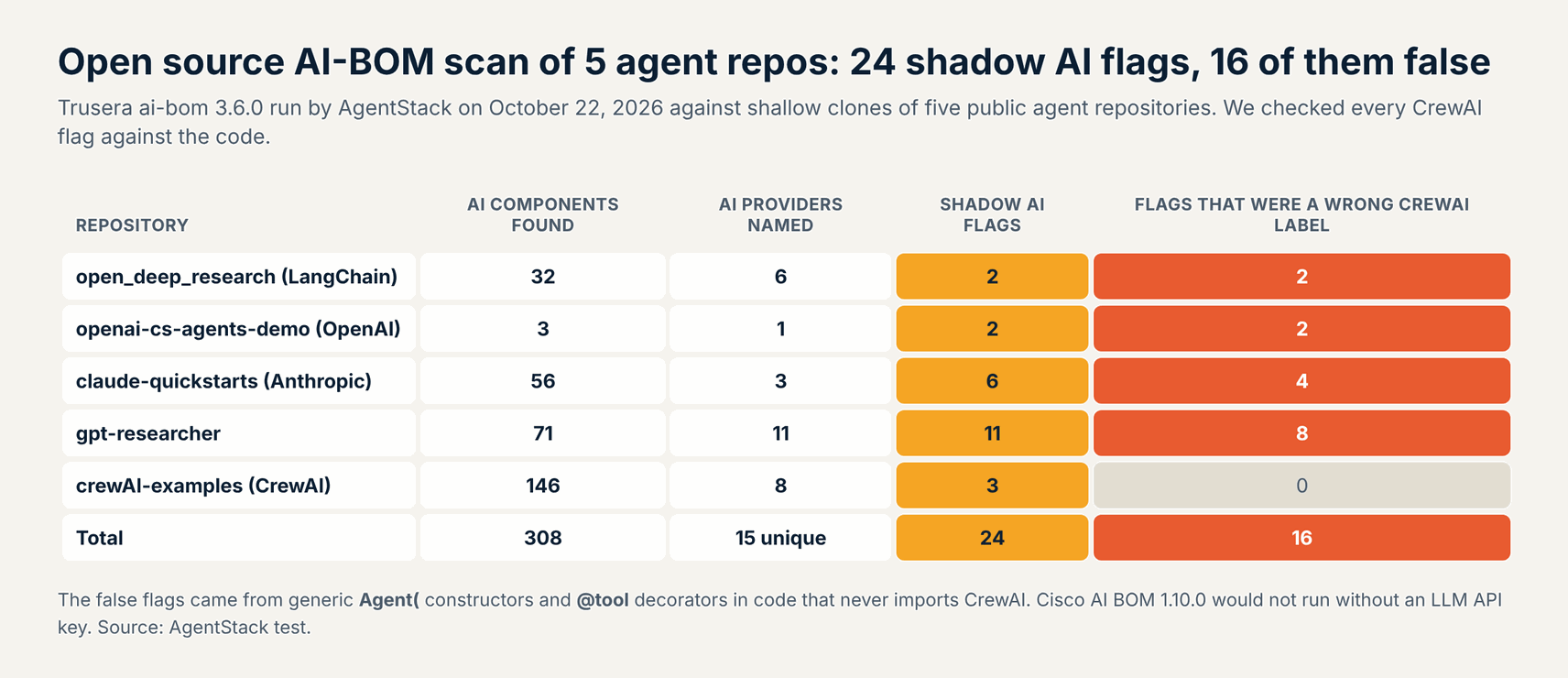
The scanner named 15 distinct providers and frameworks, from Anthropic and Azure OpenAI to vLLM, Ollama, and LiteLLM, and it caught two OpenAI model names in crewAI-examples with no version pinned. It also flagged one deprecated OpenAI model in the same repository.
$ pip install ai-bom==3.6.0
$ ai-bom scan repos/openai-cs-agents-demo -f json -o out.json -q
# 3 components, 2 flagged shadow_ai, both labeled CrewAI
python-backend/airline/guardrails.py:24   guardrail_agent = Agent(
ui/app/page.tsx:40                         (no CrewAI import anywhere)

$ cisco-aibom analyze repos/open_deep_research
Error: --llm-model (or AIBOM_LLM_MODEL env var) is required.
The false flags came from generic patterns. The scanner read any Agent( constructor or @tool decorator as CrewAI, so the OpenAI customer service demo, Anthropic quickstarts, and LangChain open deep research all showed CrewAI they do not use. Cisco’s open source AI BOM 1.10.0 would not scan at all without an LLM API key.
What this means for buyers: free scanners are a fine first pass for a developer, but a security team needs the context a commercial AI-SPM adds, such as who deployed an asset, what data it touches, and whether it is reachable from the internet. Ask every vendor in a pilot for its false positive rate on your own repositories.
1. Wiz AI-SPM: Best Overall for Multicloud AI Inventory
Wiz is the safest default for teams running AI across several clouds, because its AI-BOM and attack paths sit on the same Security Graph that already maps their cloud risk. Google completed its $32 billion purchase of Wiz on March 11, 2026, and Wiz kept its brand and its support for AWS, Azure, and Oracle Cloud.
The Wiz AI-SPM page lists an agentless AI-BOM, an AI service catalog, AI security rules, detection of exposed AI endpoints, and AI attack path analysis. It detects managed services such as Amazon SageMaker and OpenAI along with AI SDKs in code, and Wiz now adds runtime protection against prompt injection and rogue agents.
- Best for: Multicloud security teams that already use Wiz and want AI risk in the same graph and queue.
- Covers: Cloud AI services, AI pipelines and SDKs in code, attack paths, and runtime threats.
- Pricing (October 2026): Quote based. The AWS Marketplace listing shows Wiz’s two base tiers at $24,000 and $38,000 per 100 cloud workloads a year.
- Watch out for: The Wiz page does not document SaaS agents, endpoint agents, or MCP servers, so pair it with an agent-focused tool if those matter.
2. Palo Alto Networks Prisma AIRS: Best for Full Lifecycle AI Security
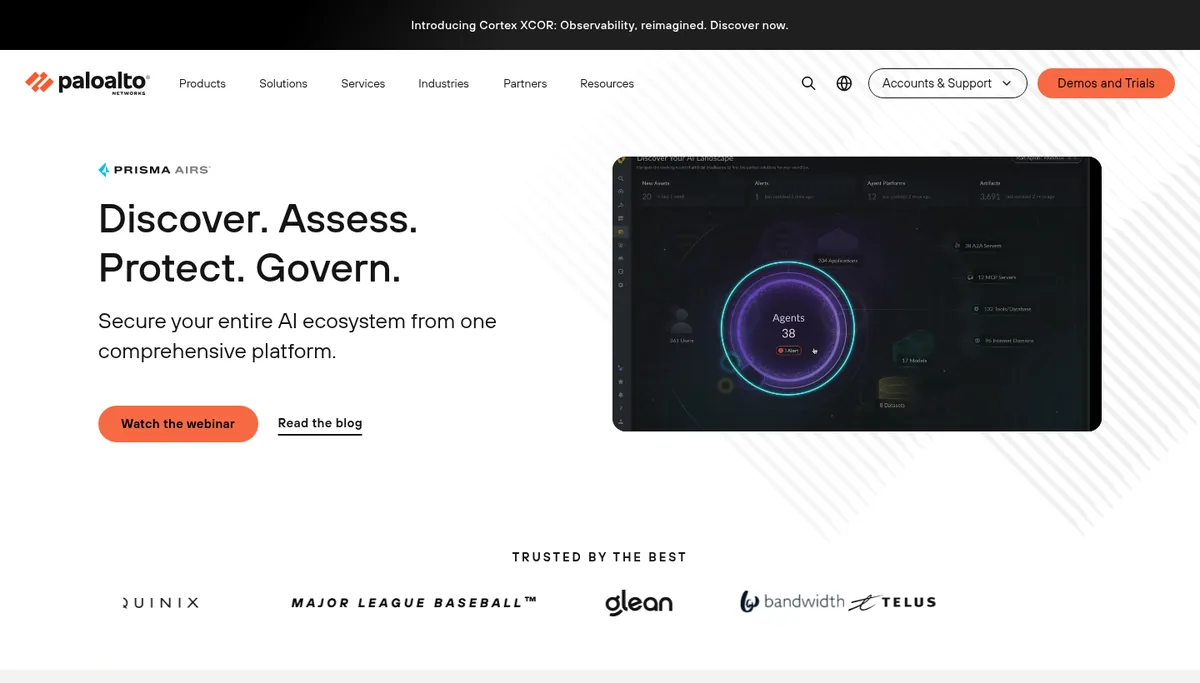
Prisma AIRS covers the widest scope on this list, with AI posture management sold beside model scanning, red teaming, runtime security, and agent identity controls. Gartner named Palo Alto Networks a Market Shaper in its September 2026 Emerging Market Quadrant for AI Application Security.
The Prisma AIRS page groups the product into an AI gateway, AI supply chain security, AI red teaming, AI runtime security, AI posture management, agent identity security, and agentic endpoint security. The older Prisma Cloud AI-SPM page now promotes Cortex Cloud, which tells buyers where the cloud posture side lives.
- Best for: Palo Alto Networks customers that want posture, testing, and runtime controls from one vendor.
- Covers: Cloud AI services, models and their supply chain, agents, endpoints, and MCP traffic.
- Pricing (October 2026): Posture management is quoted. The Prisma AIRS API listing shows $4,353 per 12-month unit of runtime API calls.
- Watch out for: Product names have moved between Prisma Cloud, Cortex Cloud, and Prisma AIRS, so get the exact SKUs in writing.
3. Microsoft Defender for Cloud: Best for Azure-First AI Estates
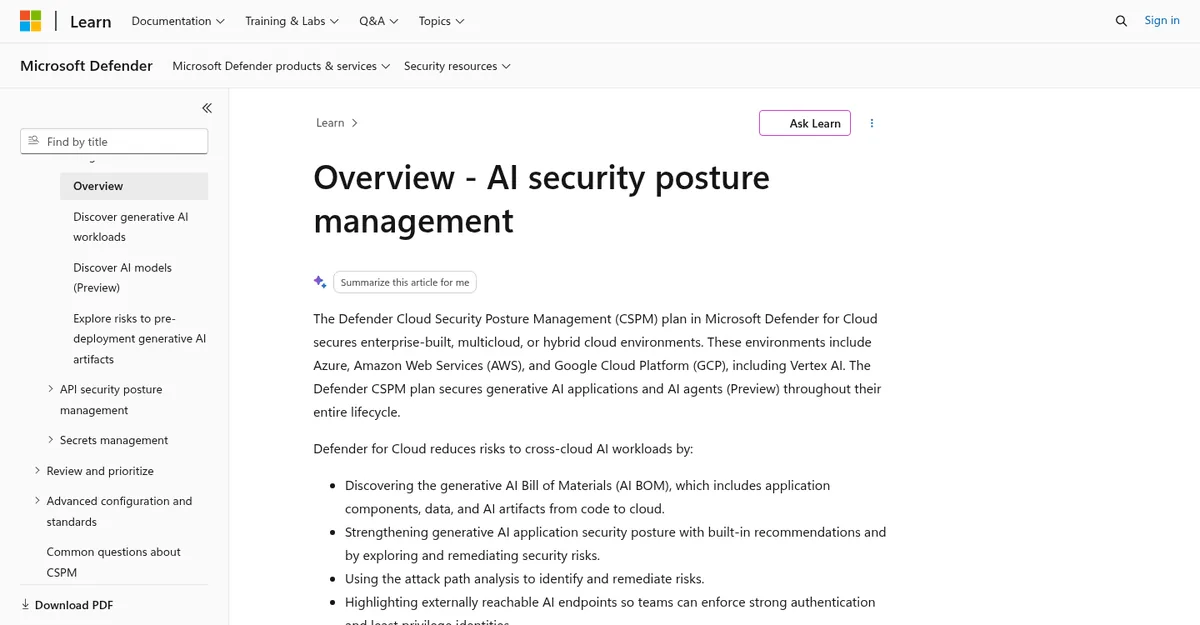
Defender for Cloud is the cheapest way into AI-SPM for Azure-heavy teams, because AI posture comes inside the Defender CSPM plan they may already pay for. The Microsoft Learn overview says Defender CSPM discovers a generative AI bill of materials across Azure, AWS, and Google Cloud, including Vertex AI.
Defender maps attack paths to AI workloads and flags externally reachable AI endpoints. Agent coverage changed in 2026: since July 1, agent discovery and posture for Microsoft Foundry and third-party cloud agents require a Microsoft Agent 365 license, which Microsoft sells at $15 per user per month on its own.
- Best for: Azure-first teams already on Defender for Cloud that also run some AI on AWS or Google Cloud.
- Covers: Azure OpenAI, Azure AI Foundry, Azure Machine Learning, Amazon Bedrock, and Vertex AI.
- Pricing (October 2026): Defender CSPM is $0.007 per billable resource per hour in the Azure Retail Prices API, about $5.11 a month; AI resources are not billed on their own.
- Watch out for: Agent-level posture now sits behind Agent 365, so budget for both licenses if you need agent inventory.
4. Orca Security: Best Agentless Option for AI Packages and Models
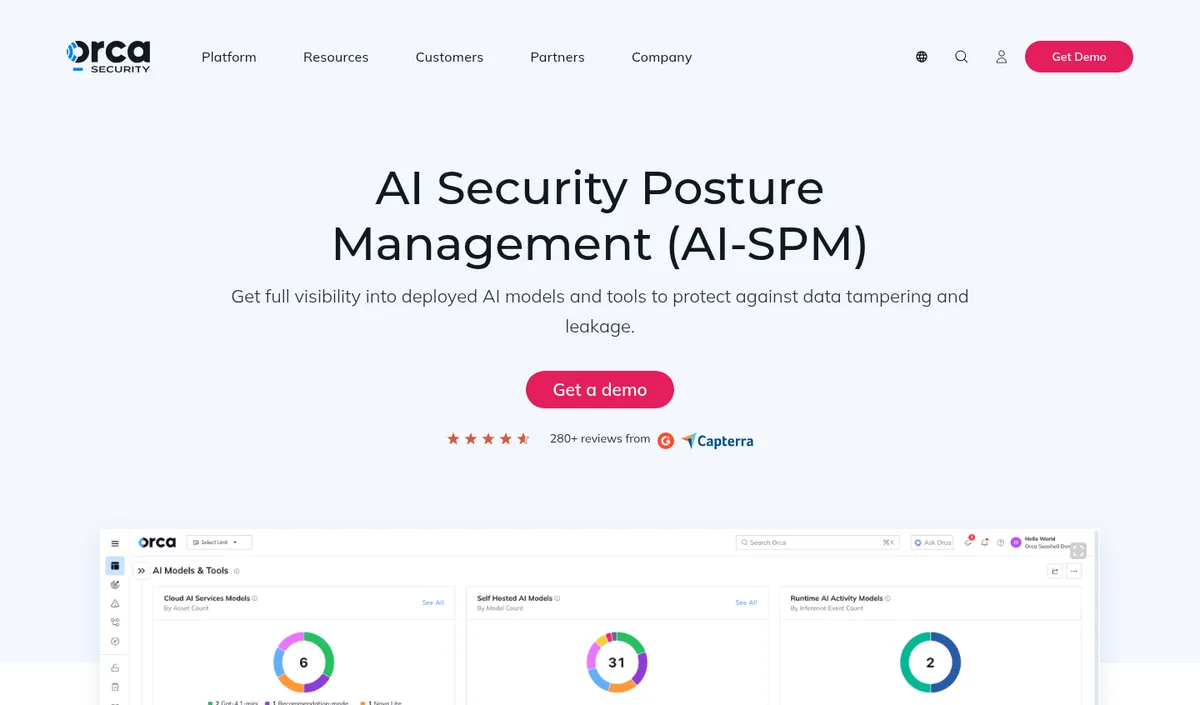
Orca suits teams that want AI coverage without deploying anything, since its SideScanning reads workloads from the cloud side and inventories more than 50 AI models and packages. Orca added AI-SPM to its platform on March 19, 2024, and it has extended that coverage since.
The Orca AI-SPM page covers packages such as PyTorch, TensorFlow, OpenAI, Hugging Face, and scikit-learn, and it detects AI keys and tokens exposed in code repositories. Orca’s runtime AI post adds the Orca Sensor, which captures outbound LLM requests and inbound MCP activity and maps them to the workload that made them.
- Best for: Teams that want agentless AI inventory and data risk alongside cloud posture.
- Covers: Cloud AI services, self-hosted models, AI packages, exposed AI keys, and training data risk.
- Pricing (October 2026): Quote based. The AWS Marketplace listing shows workload packs from $7,000 to $30,000 a month.
- Watch out for: MCP and LLM activity detection needs the Orca Sensor, which gives up part of the agentless pitch.
5. CrowdStrike Falcon Cloud Security: Best for Teams on CrowdStrike Falcon
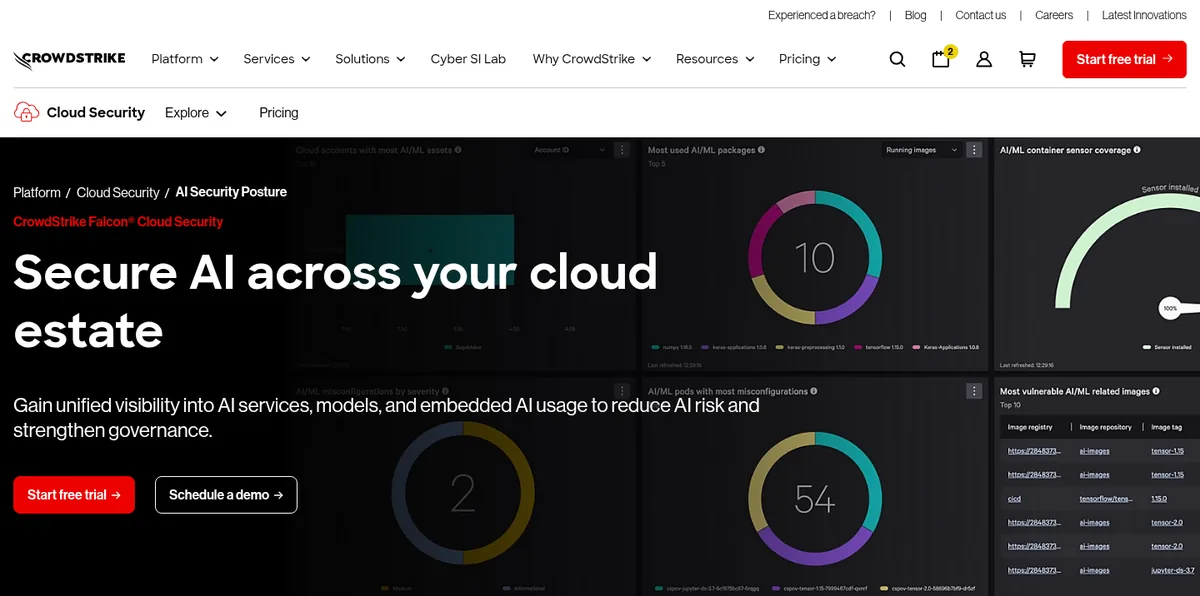
CrowdStrike makes most sense for Falcon customers, because its AI posture views reuse the same cloud connectors, image scanning, and console their security team already watches. The AI security posture page promises visibility into AI services, models, packages, and usage across the cloud estate.
Falcon Cloud Security finds AI packages inside container images and running workloads, which helps when teams bake models into containers. CrowdStrike’s September 22, 2025 post adds real-time detection of AI components during development and scanning of AI models across AWS, Azure, and Google Cloud.
- Best for: Enterprises standardized on CrowdStrike Falcon that want AI posture in the same console.
- Covers: Cloud AI services, AI packages in container images, model scanning, and runtime threats.
- Pricing (October 2026): Pay as you go on the AWS Marketplace listing at $0.023 per active host per hour, with a 30-day trial worth up to $500 in credits.
- Watch out for: Agent and MCP coverage is not documented on the AI posture page, so check that roadmap before you rely on it.
6. Noma Security: Best for Agents Outside the Cloud
Noma is the pick when agents run in SaaS apps and on employee laptops, since it inventories agents, MCP servers, skills, and models across endpoint, SaaS, and cloud from one console. It raised a $100 million Series B led by Evolution Equity Partners on July 31, 2025.
The Noma AI-SPM page says it connects to cloud platforms, SaaS platforms, code repositories, and endpoints through existing EDR or MDM tools. It flags toxic combinations of agent permissions and maps findings to the NIST AI RMF, the EU AI Act, ISO 42001, the OWASP Top 10 for LLM applications, and MITRE ATLAS.
- Best for: Security teams that need one inventory of homegrown, SaaS, and desktop agents plus their MCP servers.
- Covers: Endpoint, SaaS, and cloud agents, MCP servers, skills, models, and the AI supply chain.
- Pricing (October 2026): $200,000 per 12-month platform contract on AWS Marketplace; a usage listing charges $130 per asset scanned.
- Watch out for: The entry contract is the highest published price here, which is steep for a small AI footprint.
7. Snyk Evo AI-SPM: Best for AI Governance in Developer Pipelines
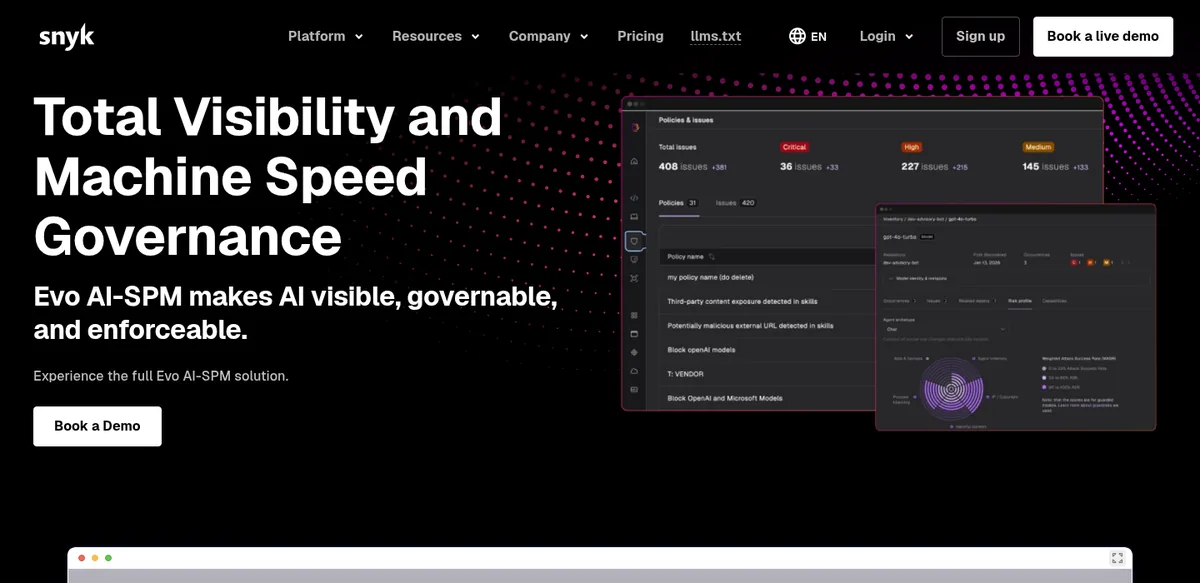
Snyk Evo AI-SPM fits AppSec teams that want AI rules enforced in pull requests and CI, before a model or MCP server reaches production. Snyk made it generally available on March 23, 2026 at RSA Conference, with discovery, risk intelligence, and policy agents.
The Evo AI-SPM page says it maps models, agents, frameworks, datasets, MCP servers, and skills across code and running apps into an AI-BOM. It scores each model on Attack Success Rate across five categories, on a 0 to 1,000 index, and five built-in policies raise issues when a model’s risk index passes 300.
- Best for: AppSec and platform teams already on Snyk that want model and MCP approval inside developer workflows.
- Covers: AI in code and running apps, model risk scores, MCP servers, skills, and CI policy.
- Pricing (October 2026): Not published; Evo AI-SPM needs a Snyk enterprise subscription, per the Snyk plans page.
- Watch out for: Agent Scan and Agent Red Teaming are open previews and Agent Guard is a private preview, so runtime pieces are early.
8. Zscaler AI-SPM: Best for Data-Centric AI Posture
Zscaler AI-SPM suits teams whose biggest worry is sensitive data flowing into models and retrieval stores, because it grew out of Zscaler data security posture management. The launch post covers AI models, agents, training data, and vector databases for retrieval-augmented generation (RAG), with NIST AI 600-1 compliance views.
Zscaler pushed further into agents on June 9, 2026. Its Zenith Live announcement added discovery of AI agents and MCP servers in public clouds, code scanning of agentic codebases, AI visibility on endpoints, and red teaming for MCP servers, plus an Agent Registry and MCP and A2A brokers.
- Best for: Zscaler customers that want AI posture tied to data classification and zero trust access.
- Covers: AI data and RAG stores, models, agents, MCP servers, embedded SaaS AI, and endpoints.
- Pricing (October 2026): Not published; sold through Zscaler sales with its data security platform.
- Watch out for: Many agent features arrived in June 2026, so confirm which ones are generally available in your region.
AI-SPM Coverage Compared
Every tool reads managed cloud AI services, but only Prisma AIRS, Noma, and Zscaler document coverage for SaaS and endpoint agents, MCP servers, and runtime protection together. We built the matrix below from each vendor’s own pages on October 22, 2026, so it shows what they claim and publish, which is a starting point for a pilot.
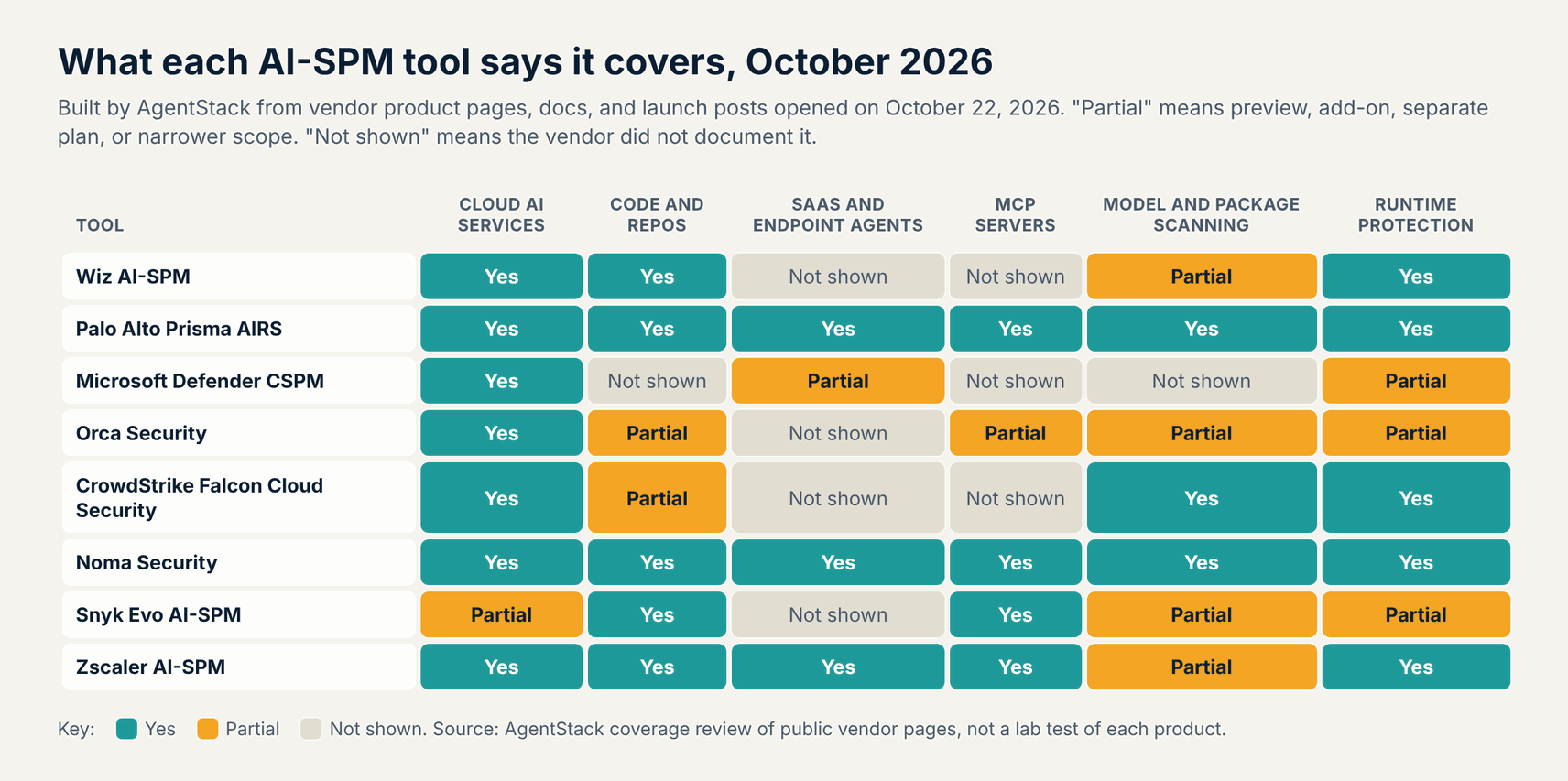
Cloud-first tools such as Wiz and Microsoft Defender go deepest on attack paths inside AWS, Azure, and Google Cloud. Agent-first tools such as Noma reach desktop agents like Claude Code that never touch a cloud account, which matters more each quarter, as our report on Microsoft Dynamic Agent Risk shows.
What AI-SPM Tools Cost
Six of the eight tools publish some price, but each uses a different unit, from Microsoft at $0.007 per resource hour to Noma at $200,000 a year. We pulled every figure from AWS Marketplace or the Azure Retail Prices API on October 22, 2026. Treat these as entry points, since enterprise deals are negotiated.
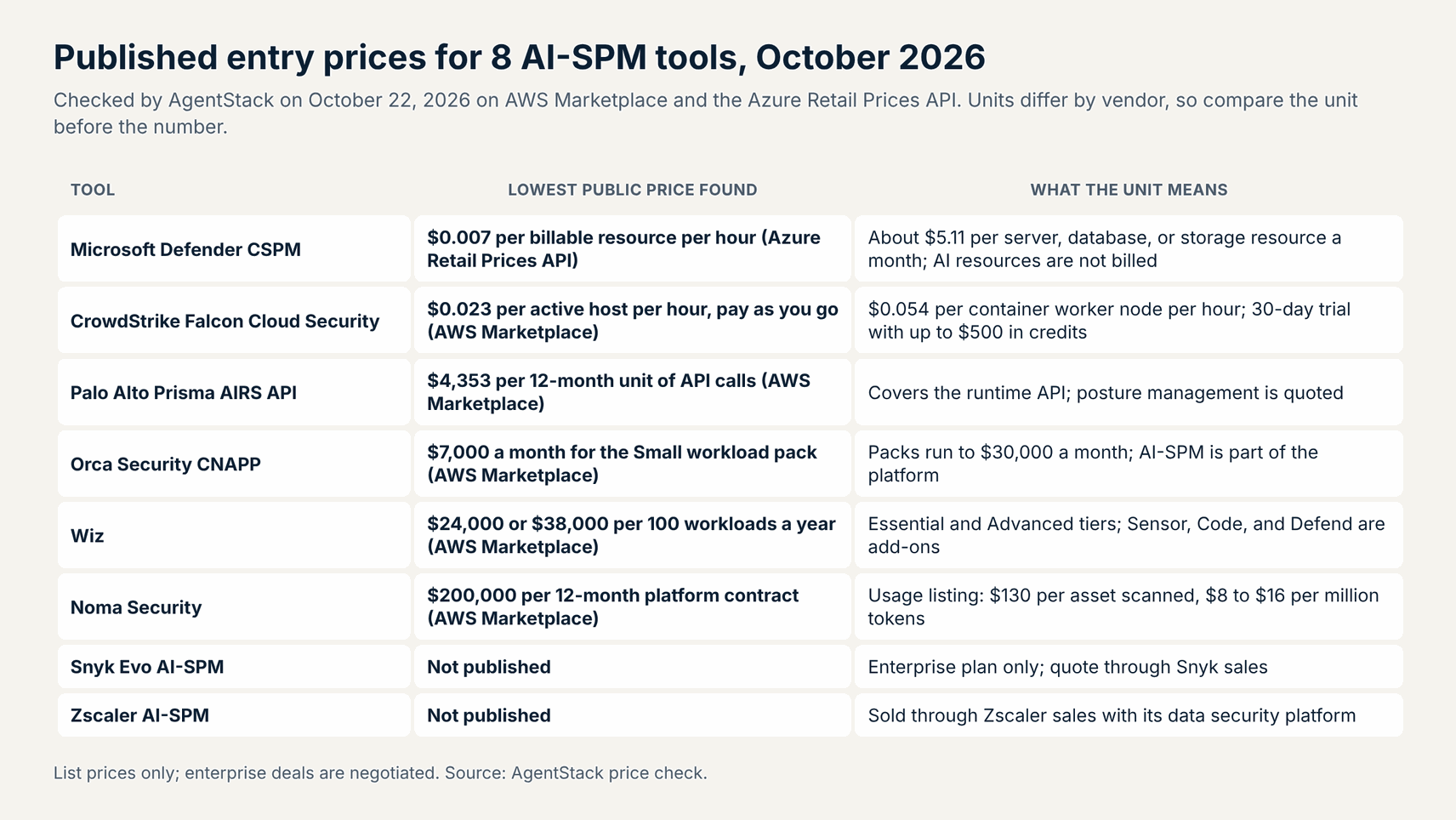
The units hide most of the difference. Defender CSPM bills servers, databases, storage, and serverless resources, per Microsoft’s pricing page, so a Microsoft shop pays mostly for what it already protects. Wiz, Orca, and CrowdStrike price by workloads or hosts, and Noma prices the whole platform.
Which AI-SPM Tool Should You Choose?
Start from the platform your security team already runs and from where your AI actually lives, because those two facts narrow this list fast. Match your situation to one profile below, then run a 30-day pilot on one production cloud account, one agent-heavy code repository, and a sample of employee laptops.
| Your situation | First choice | Also consider |
|---|---|---|
| Multicloud AI on AWS, Azure, and Google Cloud | Wiz AI-SPM | Orca Security, Prisma AIRS |
| Mostly Azure and Microsoft 365 | Microsoft Defender for Cloud | Wiz AI-SPM, Noma Security |
| Already on CrowdStrike Falcon | CrowdStrike Falcon Cloud Security | Wiz AI-SPM, Noma Security |
| Agents in SaaS apps and on laptops | Noma Security | Zscaler AI-SPM, Prisma AIRS |
| AI rules enforced in CI and pull requests | Snyk Evo AI-SPM | Noma Security, Prisma AIRS |
| Sensitive data in training sets and RAG stores | Zscaler AI-SPM | Orca Security, Microsoft Defender |
Verdict: No single tool wins every row, and most large teams end up with a cloud posture module plus one agent-focused product. Noma and Prisma AIRS appear in the most rows, which reflects how far agents have spread beyond cloud accounts.
You run a multicloud AI platform team
- Shortlist Wiz, Orca, and Prisma AIRS, and ask each to show an attack path from a public endpoint to a model or vector store.
- Put model traffic behind one of the LLM gateways we compared, so posture findings and usage logs line up.
- Check your Python AI dependencies after reading how the LiteLLM supply chain compromise spread.
You are an Azure and Microsoft 365 shop
- Turn on Defender CSPM first, since AI resources add no extra billable units.
- Price Agent 365 for the people who build or sponsor agents before you plan agent inventory.
- Read how Microsoft Dynamic Agent Risk treats agents as insiders before you buy overlapping tools.
Your agents live on laptops and in SaaS
- Pilot Noma or Zscaler with your EDR or MDM connected, and count the desktop agents and MCP servers each one finds.
- Route agent tool calls through one of the MCP gateways we compared, and review the MCP security tools for runtime control.
- Read the ToFu study of 253 MCP server bugs and the FastMCP security advisories to see what discovery should catch.
You own AppSec for AI builders
- Test Snyk Evo AI-SPM on two repositories that use different agent frameworks, and compare its AI-BOM with a free scanner.
- Add pre-launch checks from our AI agent testing tools guide.
- Plan containment with the NIST, NSA, and CISA practices for rogue agents.
What We Left Off This List
We left off products that use the AI-SPM label but fit a different buying decision, or that lacked enough public detail on October 22, 2026 for a fair comparison of coverage and price. Several are strong products in their home category. Our governance and compliance coverage tracks the wider AI governance market.
- Tenable, Sysdig, Upwind, and SentinelOne: each adds AI workload visibility to its cloud platform, and each is worth a look if you already run it.
- Cyera and other data security posture tools: strong on sensitive data in AI pipelines, with less depth on agents and models.
- Runtime guardrails and prompt firewalls: products that inspect prompts and tool calls belong to a separate decision from posture.
- Free AI-BOM scanners: Trusera ai-bom and Cisco AI BOM are useful for developers, but our test shows they need a human review step.
Frequently Asked Questions
What is the difference between AI-SPM and CSPM?
CSPM checks cloud infrastructure settings such as storage buckets, networks, and identities. AI-SPM applies the same posture approach to AI assets: models, managed AI services, vector stores, agents, and MCP servers. Most AI-SPM tools here ship as a module of a CSPM or CNAPP platform, so they share its connectors and risk graph.
Which AI-SPM tool is best for multicloud teams?
Wiz is our top pick for multicloud teams, because its agentless AI-BOM and AI attack paths sit on the same graph that maps the rest of their AWS, Azure, Google Cloud, and Oracle risk. Orca is a close alternative with agentless scanning of more than 50 AI models and packages.
Does Microsoft Defender for Cloud include AI-SPM?
Yes. AI posture management is part of the paid Defender CSPM plan, which costs $0.007 per billable resource per hour, and AI resources are not billed separately. Since July 1, 2026, agent discovery for Microsoft Foundry and third-party cloud agents needs a Microsoft Agent 365 license at $15 per user per month.
Do AI-SPM tools cover MCP servers?
Some do. Prisma AIRS, Noma Security, Snyk Evo AI-SPM, and Zscaler document MCP server discovery, and Orca detects MCP activity through its runtime sensor. The Wiz, Microsoft Defender, and CrowdStrike AI posture pages we checked on October 22, 2026 did not document MCP servers, so ask for a demo.
Are free AI-BOM scanners a substitute for AI-SPM?
No. In our October 22, 2026 test, Trusera ai-bom found 308 AI components in five agent repositories, but 16 of its 24 shadow AI flags were wrong. Cisco AI BOM needed an LLM API key to run. Free scanners help developers, but they lack the exposure and data context.
Related Guides
For related coverage, see our best AI agent security tools, shadow AI detection tools, Prompt Security alternatives, Protect AI alternatives, Zenity vs Noma vs Pillar Security comparison and AI agent governance platforms.
Read the agent security hub, AI governance and security hub, governance and compliance coverage, MCP security tools, MCP gateways, MCP explained, LLM gateways, AI agent frameworks, AI agent testing tools, LiteLLM supply chain compromise, FastMCP security advisories, ToFu MCP tool security bugs, NIST and CISA incident response practices, Microsoft Dynamic Agent Risk, and coding agents that disabled monitoring. Notes on how we work sit on editorial standards, disclosure, and contact.
The Bottom Line
Choose Wiz for multicloud AI inventory, Microsoft Defender for Azure-first estates, CrowdStrike for Falcon shops, and Noma, Prisma AIRS, or Zscaler when agents run outside the cloud. Pick ai-spm tools that match where your AI runs today, then test each finalist on your own repositories and accounts before you sign.
This market changes owners, product names, and licenses every few months, so rerun your pilot after major releases and check this page for updates. Send corrections or your own test results through our contact page.