
Last updated October 22, 2026. Ownership, product names, pricing, and deployment details were checked against vendor pages, SEC filings, AWS Marketplace, GitHub, and PyPI on that date.
The best Prompt Security alternatives in 2026 are Lasso Security, CrowdStrike Falcon Guardian, WitnessAI, Harmonic Security, Cato AI Security, Check Point AI Security, and F5 AI Guardrails. Lasso is the closest like-for-like swap, because it still covers employee chatbots, local coding agents, homegrown apps, and Model Context Protocol (MCP) traffic as an independent company.
Teams look for Prompt Security alternatives because SentinelOne closed its purchase of Prompt Security on September 5, 2025, and the product now ships inside the SentinelOne Singularity Platform. That suits SentinelOne customers, but buyers on another endpoint stack now face a quote-only bundle. Our agent security coverage sits inside the wider AI governance and security hub.
We checked every vendor page, AWS Marketplace listing, and SEC filing on October 22, 2026, and we ran Lasso’s open source MCP gateway against 17 types of synthetic secrets. No vendor paid for placement or reviewed this page, per our editorial standards and disclosure policy.
TL;DR
- Prompt Security is alive, but it is now a SentinelOne product. The product page lives on sentinelone.com, and every AWS Marketplace dimension tells buyers to contact SentinelOne for pricing.
- Lasso is the closest independent replacement. It raised $30 million on September 2, 2026 and covers browsers, desktop agents, apps, and MCP servers.
- Four of the seven alternatives were also bought in 2025. CrowdStrike, Cato Networks, F5, and Check Point each closed an AI security acquisition between September 3 and October 22, 2025.
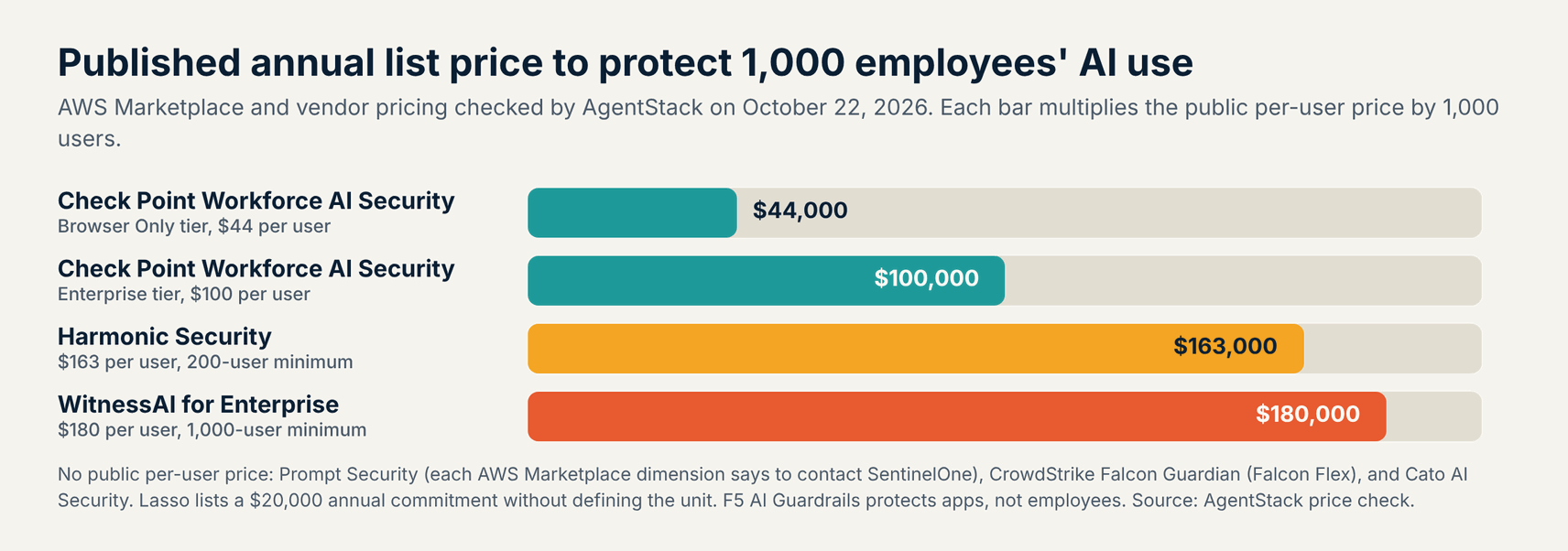
- Only three vendors publish a per-user price. Covering 1,000 employees costs $44,000 to $100,000 with Check Point, $163,000 with Harmonic, and $180,000 with WitnessAI at list.
- Lasso’s free MCP gateway masked 7 of 17 secret types in our test. It checked tool results only and let every secret in tool call arguments through.
Prompt Security Alternatives at a Glance
Pick Lasso to replace the full Prompt Security platform, CrowdStrike or Cato to stay inside an existing security platform, WitnessAI or Harmonic for workforce AI, and F5 for homegrown apps. The table maps each alternative to the Prompt Security module it replaces, using vendor pages and AWS Marketplace listings checked on October 22, 2026.
| Alternative | Owner | Replaces | How it deploys | Public price |
|---|---|---|---|---|
| Lasso Security | Independent | Employees, code assistants, homegrown apps, agents | Browser extension, proxy, API, AI gateway, open source MCP gateway | $20,000 annual commit on AWS |
| CrowdStrike Falcon Guardian | CrowdStrike (Pangea) | Employees, code assistants, homegrown apps, agents | Falcon sensor, browser collectors, SDK, API gateways | Not published |
| WitnessAI | Independent | Employees, homegrown apps, agents | Network level, no browser extension | $180 per user, 1,000 minimum |
| Harmonic Security | Independent | Employees, code assistants, agents | Browser and local MCP connectors | $163 per user, 200 minimum |
| Cato AI Security | Cato Networks (Aim) | Employees, code assistants, homegrown apps, agents | Cato SASE cloud, endpoint, on-premises Outposts | Licensed per user, quote only |
| Check Point AI Security | Check Point (Lakera) | Employees, homegrown apps, agents | Browser, SaaS, and runtime API | $44 or $100 per user |
| F5 AI Guardrails | F5 (CalypsoAI) | Homegrown apps and agents | Cloud, on-premises, or air-gapped | $100,000 contract unit on AWS |
Verdict: Teams that used all four Prompt Security modules should start with Lasso, CrowdStrike, or Cato, since each covers employees, code assistants, homegrown apps, and agents. Teams that only bought Prompt for Employees have a wider field, and WitnessAI, Harmonic, and Check Point are the three with a published per-user price.
What Changed at Prompt Security After the SentinelOne Deal?
Prompt Security still ships and still gets updates, but it now sells as part of SentinelOne Singularity, with SentinelOne pricing and a SentinelOne console. SentinelOne announced the deal on August 5, 2025, and its 8-K puts the consideration at about $180 million in cash and stock.
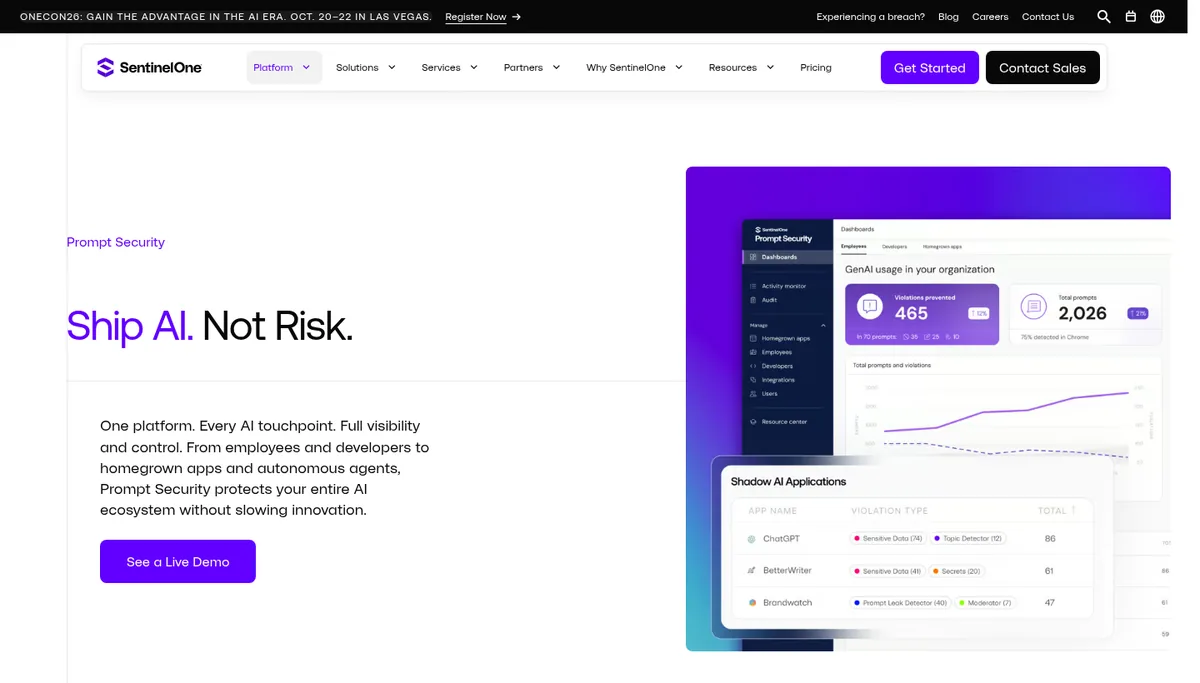
The Prompt Security product page says the product is built into the Singularity Platform and governs more than 15,000 AI services, including GitHub Copilot, Cursor, and Claude Code. SentinelOne has kept shipping: it added an agentless Claude Compliance API integration, and on August 4, 2026 it expanded its AWS work around Amazon Bedrock AgentCore, with full availability targeted for AWS re:Invent 2026.
The old brand site now reads as a SentinelOne resource hub. On October 22, 2026, prompt.security carried the page title Prompt Security, From SentinelOne, and its open source projects, such as the ps-fuzz prompt fuzzer with 719 GitHub stars, were still public.
What this means for buyers: nothing is being shut down, so there is no forced migration. The pressure comes at renewal, when a standalone Prompt Security contract becomes a conversation about the wider Singularity Platform.
The 2025 Buying Spree Behind Four of These Alternatives
Five AI security startups changed hands between September 3 and October 22, 2025, and four of them now power alternatives on this list. Cato Networks bought Aim Security, SentinelOne bought Prompt Security, CrowdStrike bought Pangea, F5 bought CalypsoAI, and Check Point bought Lakera. We pulled each disclosed price from the buyer’s SEC filing.
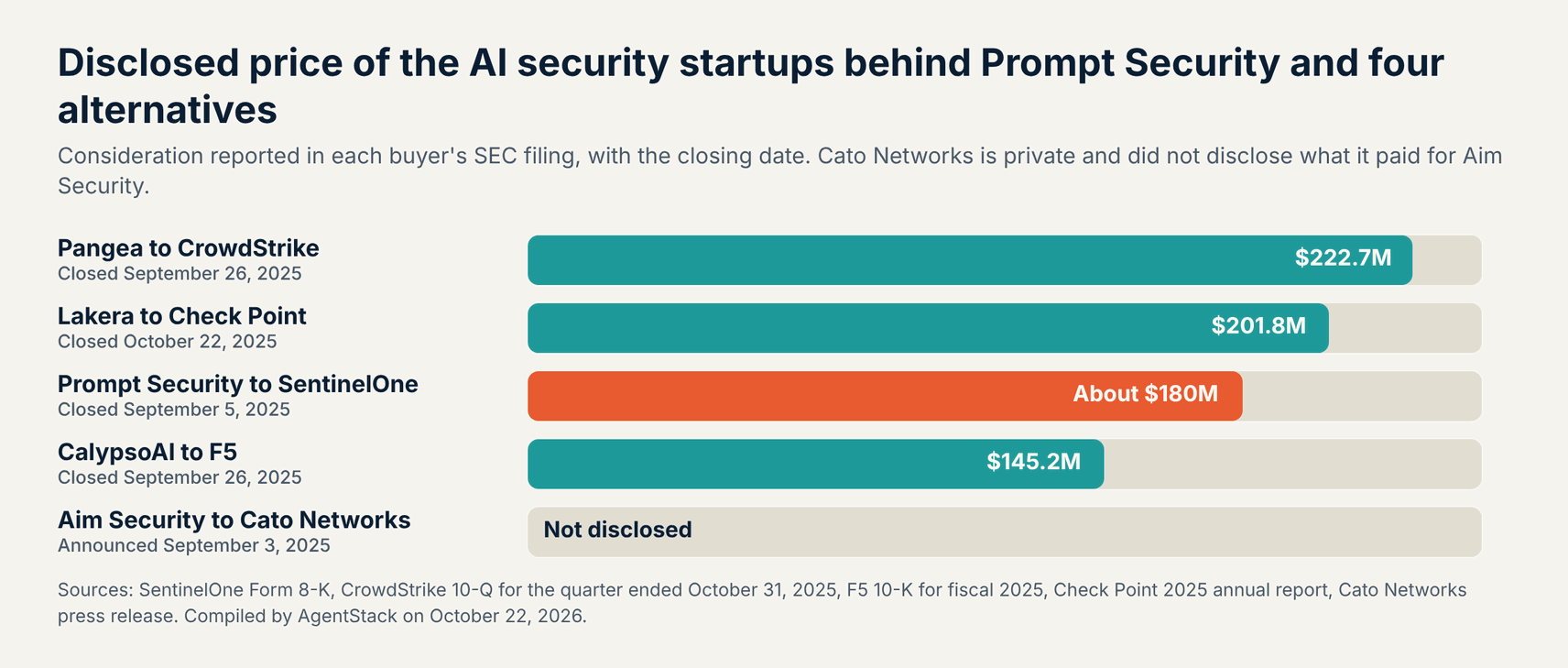
CrowdStrike paid $222.7 million for Pangea, per its 10-Q, and F5 paid $145.2 million in cash for CalypsoAI, per its 10-K. Check Point’s annual report records $201.8 million for Lakera. Cato Networks is private and did not disclose a price.
Leaving one acquired product for another is a fair choice, but it should be a deliberate one. The independent options here are Lasso, WitnessAI, and Harmonic, and all three raised money in 2026.
How We Picked These Alternatives
We scored each alternative on how much of Prompt Security’s footprint it can take over, starting with employee AI use, then AI code assistants, then homegrown apps and agents. Every claim comes from a vendor page, documentation, an SEC filing, AWS Marketplace, GitHub, or PyPI, all opened on October 22, 2026.
- Coverage of Prompt Security’s four modules: Prompt for Employees, Prompt for AI Code Assistants, Prompt for Homegrown Apps, and Prompt for Agentic AI.
- Deployment fit: browser extension, endpoint sensor, network or secure access service edge (SASE), API, or self-hosted.
- Agent and MCP controls: discovery of MCP servers and policy on tool calls, beyond chat prompts.
- Ownership: independent vendor or part of a larger security platform, and when that changed.
- Price transparency: whether a list price or contract minimum is public.
What Our October 22 Tests Found
Lasso’s free MCP gateway masked 7 of 17 secret types in tool results and none of the 17 in tool call arguments, so treat it as a starting point that needs a paid guardrail behind it. We tested version 1.2.1 from PyPI with its built-in basic plugin on October 22, 2026.
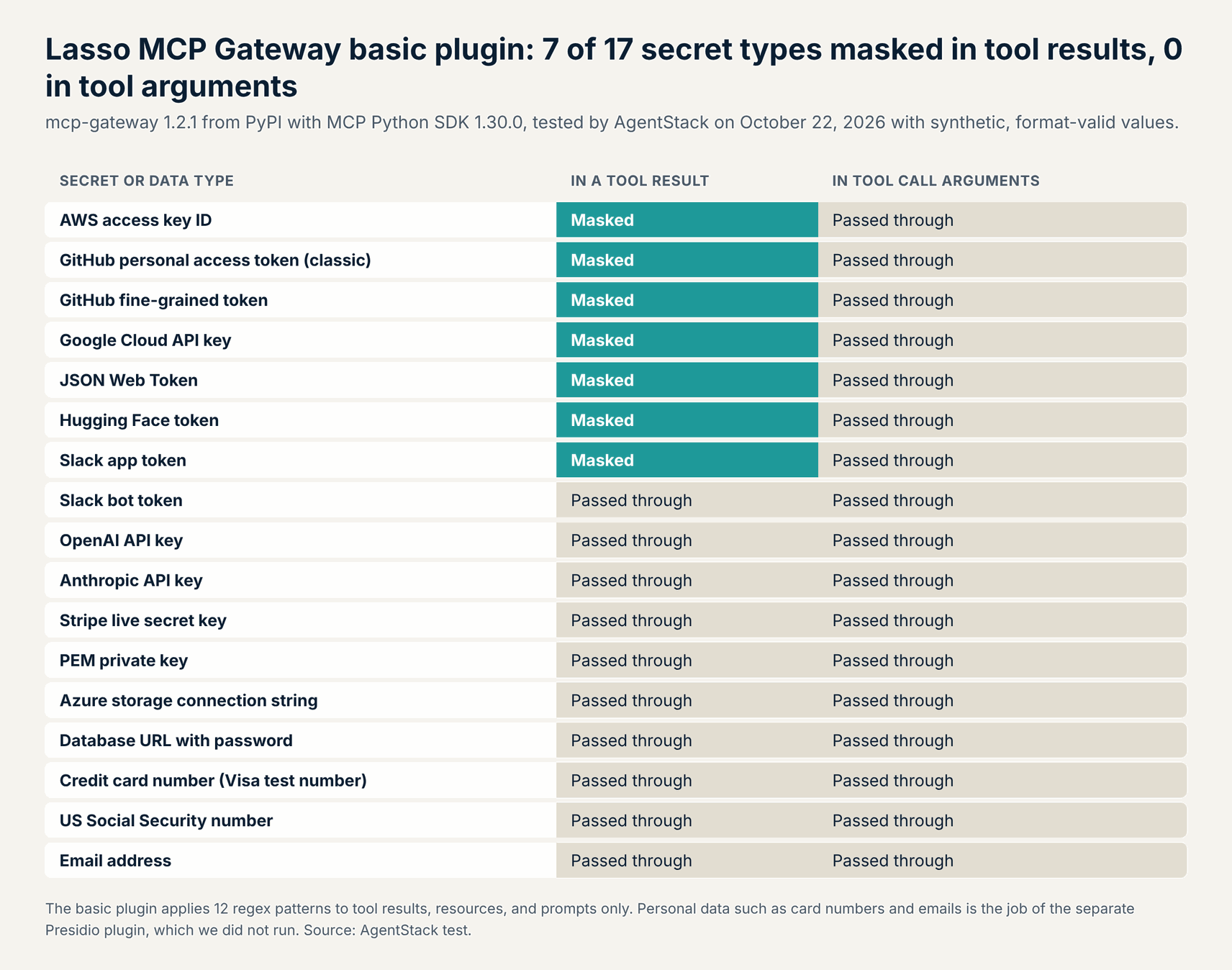
We fed each synthetic value through the plugin’s response and request handlers. It masked AWS keys, both GitHub token formats, Google Cloud keys, JSON Web Tokens, Hugging Face tokens, and Slack app tokens. It missed OpenAI and Anthropic API keys, Slack bot tokens, Stripe keys, a PEM private key, an Azure connection string, and a database URL.
$ pip install mcp-gateway==1.2.1        # pulls MCP Python SDK 2.3.0
ModuleNotFoundError: No module named 'httpx'
$ pip install httpx
AttributeError: 'CallToolResult' object has no attribute 'isError'

$ pip install mcp-gateway==1.2.1 "mcp<2"  # MCP Python SDK 1.30.0
$ python mcpgw_test.py
response masked 7 / 17
args masked 0 / 17
Install friction was the second finding. A plain install on Python 3.13 pulled version 2.3.0 of the MCP Python SDK, and the gateway failed until we pinned mcp<2. The mcp-gateway repository has 396 stars and had not been updated since January 22, 2026, while Lasso’s commercial plugin needs a LASSO_API_KEY.
1. Lasso Security: Best Independent Replacement for the Full Prompt Security Platform
Lasso Security is the closest independent match for Prompt Security, because it covers employee chatbots, local coding agents, homegrown apps, and MCP traffic from one platform. It raised $30 million in a round led by ClearSky on September 2, 2026, and it launched LEAP, a guardrail that runs on ordinary CPUs.
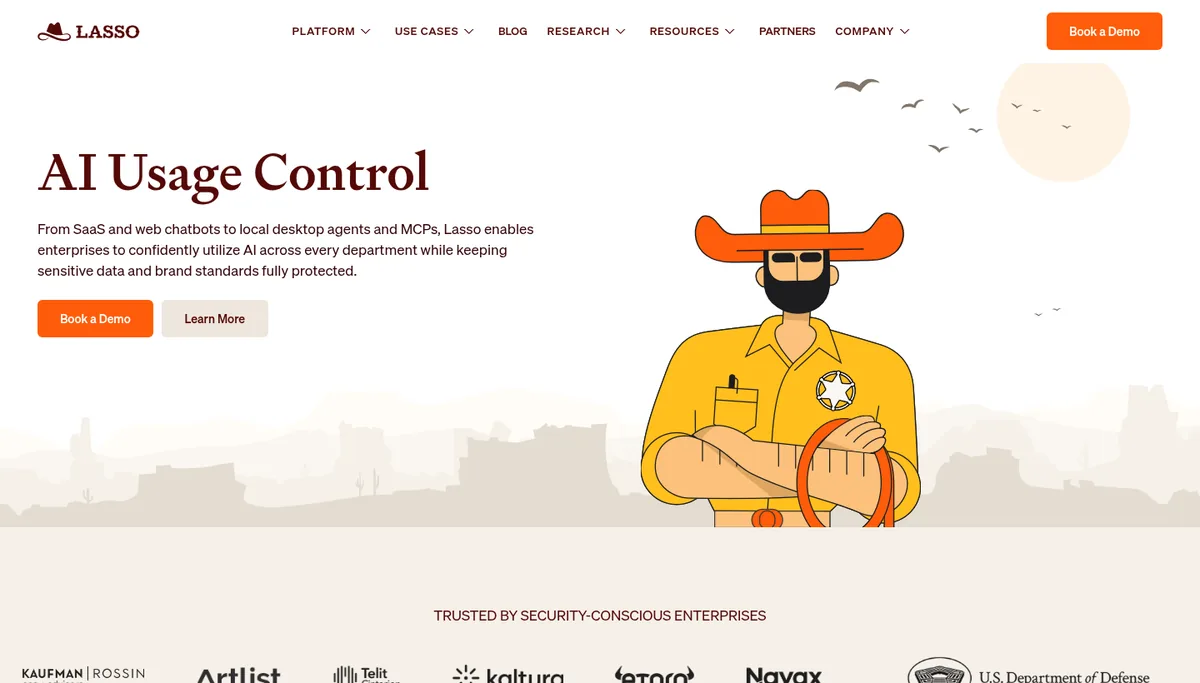
Its AI Usage Control module covers SaaS and web chatbots, local desktop agents, and MCP servers, with real-time masking and coaching for employees. For apps, Lasso enforces policy inline at a proxy, an API, or an AI gateway, per its platform page. Its open source claude-hooks project, with 267 GitHub stars, adds prompt injection checks to Claude Code.
Lasso says LEAP returns a verdict in under 5 milliseconds, a benchmark it ran itself, and SiliconANGLE reported customers including BMW, eToro, Fiverr, and the US Department of Homeland Security.
- Best for: Security teams that want one independent vendor for all four Prompt Security modules.
- Replaces: Prompt for Employees, AI Code Assistants, Homegrown Apps, and Agentic AI.
- Pricing (October 2026): The AWS Marketplace listing shows one $20,000 annual commitment without defining the unit; larger deals are quoted.
- Watch out for: The free MCP gateway is a thin layer in our test, so budget for the commercial guardrail if MCP traffic carries secrets.
2. CrowdStrike Falcon Guardian: Best for Teams Standardized on CrowdStrike Falcon
Falcon Guardian is the mirror image of the SentinelOne deal: an endpoint leader that bought an AI security startup and folded it into its sensor and console. CrowdStrike agreed to buy Pangea in September 2025, made Falcon AI Detection and Response (AIDR) generally available on December 15, 2025, and introduced Falcon Guardian on September 1, 2026.
The AIDR documentation lists collectors for the Falcon sensor, managed Chrome, Edge, and Firefox browsers, application SDKs, and API gateways such as Kong, LiteLLM, and Portkey. Agentic collectors cover Claude Code, Copilot Studio, and an MCP proxy, and the Falcon sensor inspects desktop AI apps and coding assistants on the network.
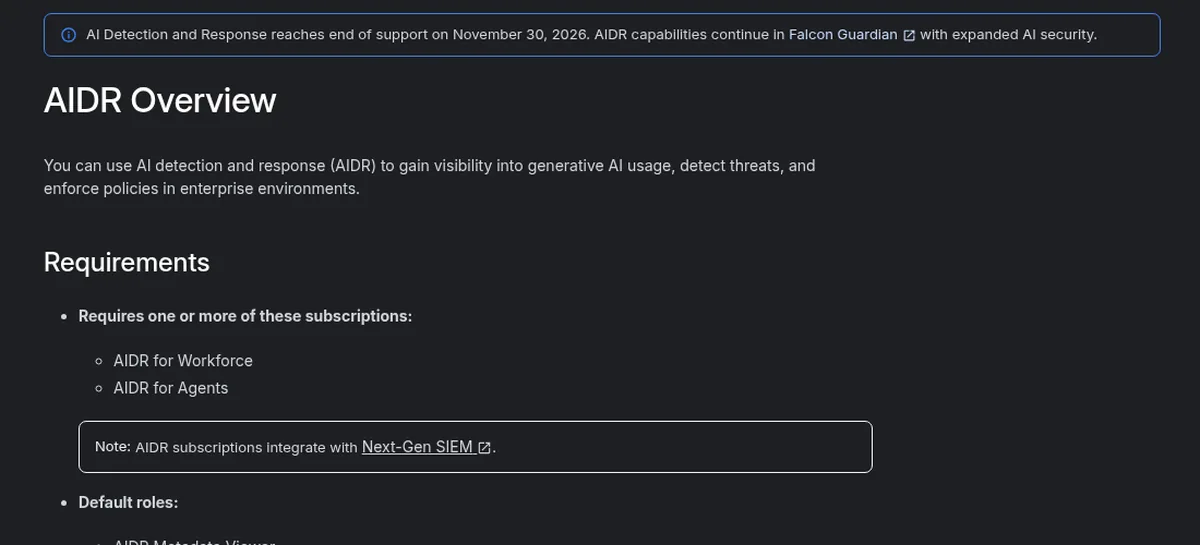
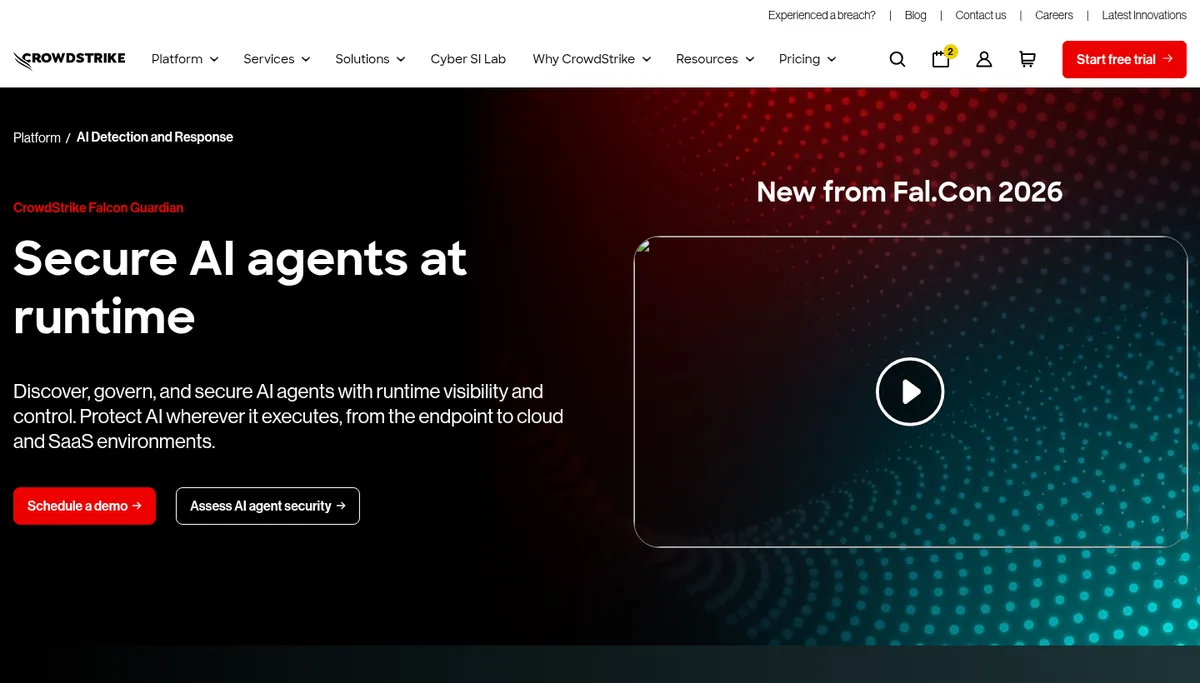
That banner matters for timing. AIDR reaches end of support on November 30, 2026, with its capabilities moving into Falcon Guardian, so new buyers should contract for Falcon Guardian directly.
- Best for: Enterprises already running the Falcon sensor that want AI controls in the same console and SIEM.
- Replaces: Prompt for Employees, AI Code Assistants, Homegrown Apps, and Agentic AI.
- Pricing (October 2026): Not published; sold through CrowdStrike sales.
- Watch out for: The Falcon Guardian AI gateway is announced as coming, and AIDR runs only in the US-1, US-2, and EU-1 CrowdStrike clouds.
3. WitnessAI: Best Network-Level Option Without a Browser Extension
WitnessAI fits teams that do not want to deploy a browser extension, because it sees AI traffic at the network level, including desktop apps such as Windows 11 Copilot. It raised a $58 million round led by Sound Ventures on January 13, 2026, and launched Agentic Security the same day.
Per its product page, WitnessAI catalogs AI apps, agents, and MCP servers, classifies prompts by intent, and tokenizes sensitive data before it reaches a model. It can enforce an approved list of MCP servers and tools at the network for every IDE and agent, and it routes sensitive prompts to internal models.
- Best for: Large enterprises with a mature proxy or SASE stack that want coverage without endpoint software.
- Replaces: Prompt for Employees, Homegrown Apps, and Agentic AI.
- Pricing (October 2026): The AWS Marketplace listing shows $180 per user with a 1,000-user minimum, $24 per agent with a 2,500-agent minimum, and $300,000 a year for model protection.
- Watch out for: The 1,000-user floor puts the entry price at $180,000 a year, which prices out smaller teams.
4. Harmonic Security: Best for Workforce Data Protection Across Coding Agents
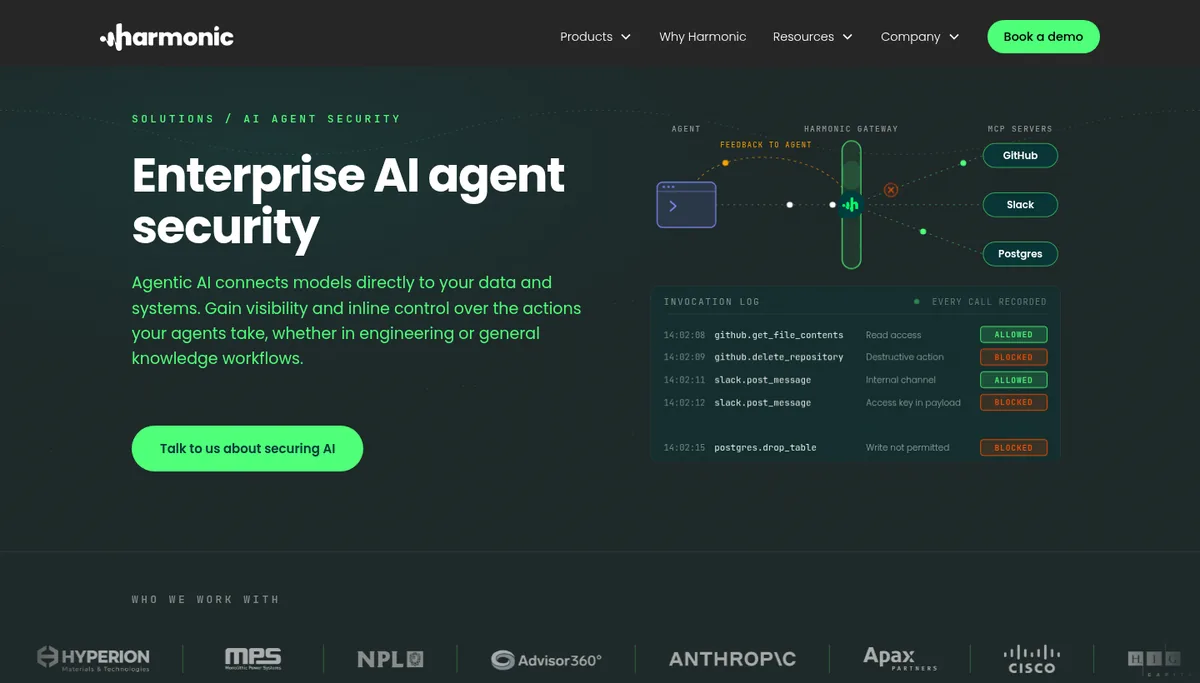
Harmonic Security is the strongest pick for teams whose Prompt Security rollout was mostly about employees and developers sharing sensitive data with AI. It raised a $50 million Series B on October 14, 2026, and its controls follow the same policy across web, desktop, and coding tools.
Its agent security page says Harmonic inventories MCP clients such as Claude Code, Codex, and Cursor, logs every tool call, and enforces what data each tool may receive. Blocked actions return feedback to the agent so it can try a safe path, which keeps developers moving without a ticket to security.
- Best for: Security teams that want employee data protection and coding agent controls with a published per-seat price.
- Replaces: Prompt for Employees, AI Code Assistants, and the MCP part of Agentic AI.
- Pricing (October 2026): $163 per user a year with a 200-user minimum on AWS Marketplace.
- Watch out for: Pricing is per employee seat, so ask how Harmonic charges for protecting homegrown apps and customer-facing chatbots.
5. Cato AI Security: Best for Cato SASE Customers
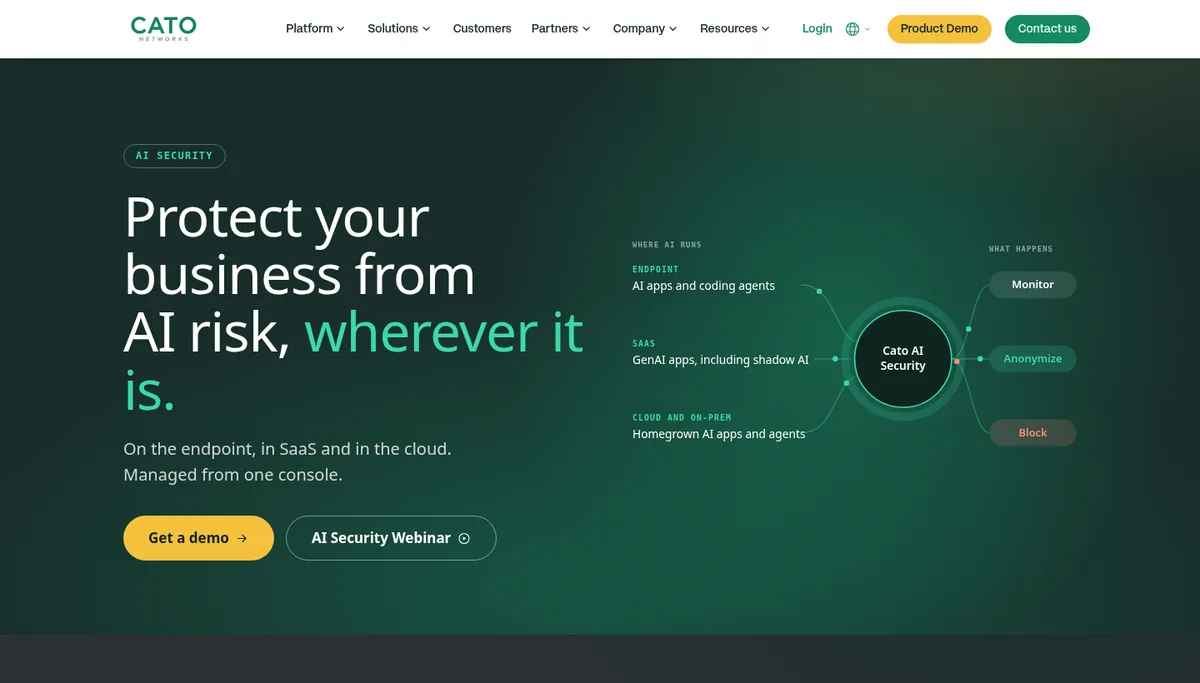
Cato AI Security is the natural pick for Cato SASE customers, because it is built on Aim Security and enforces AI policy in the same cloud that already carries their traffic. Cato acquired Aim Security on September 3, 2025 and launched Cato AI Security on March 17, 2026.
The Cato AI Security page covers coding agents on the endpoint with enforcement for Claude Code, Cursor, and Codex, plus AI apps in the browser. It protects homegrown apps through the Cato cloud, an AI gateway you already run, or on premises with Outposts, and it inspects agent prompts, responses, and tool calls.
- Best for: Enterprises already on Cato SASE that want AI policy in the same console as their network security.
- Replaces: Prompt for Employees, AI Code Assistants, Homegrown Apps, and Agentic AI.
- Pricing (October 2026): Quote only. The Cato product catalog licenses AI Security for Users per user and AI Security for Applications by total employee count.
- Watch out for: Employee coverage assumes traffic runs through the Cato Cloud, so it is a harder sell if you do not use Cato for networking.
6. Check Point AI Security: Best Published Per-User Price for Employee AI
Check Point is the cheapest published way to cover employee AI use on this list, at $44 per user for its browser-only tier. It acquired Lakera in 2025, closing on October 22, 2025, and now sells workforce AI security, runtime guardrails, and red teaming together.
Its AI security page covers AI use across browsers, SaaS tools, and copilots, prompt injection blocking at the application edge, and restrictions on agent tool use. The AWS Marketplace listing prices Workforce AI Security at $100 per user for Enterprise and $44 per user for Browser Only, and agent guardrails at $74,000 a year for 10 million requests.
- Best for: Check Point customers, and any team that needs a list price before it starts procurement.
- Replaces: Prompt for Employees, Homegrown Apps, and Agentic AI.
- Pricing (October 2026): $44 or $100 per user a year for employees; $74,000 a year for 10 million runtime requests.
- Watch out for: Check Point’s public pages do not detail AI code assistant controls the way Prompt Security does, so test IDE coverage in the pilot.
7. F5 AI Guardrails: Best for Homegrown Apps in On-Premises or Air-Gapped Networks
F5 AI Guardrails replaces Prompt for Homegrown Apps and Prompt for Agentic AI for teams that must keep every prompt inside their own network. F5 completed its CalypsoAI acquisition in September 2025 and sells the product with F5 AI Red Team.
The product page says the guardrails run in AWS, Azure, Google Cloud, on premises, or fully air-gapped, and that F5 adds more than 10,000 attack patterns to its library each month. It audits and blocks unauthorized tool calls and ships audit templates for GDPR, HIPAA, and the EU AI Act.
- Best for: Regulated teams protecting internal chatbots and agents that cannot send data to a SaaS guardrail.
- Replaces: Prompt for Homegrown Apps and Prompt for Agentic AI.
- Pricing (October 2026): Quoted through F5; the AWS Marketplace listing shows one contract unit at $100,000 for 12 months.
- Watch out for: F5 does not cover employee browser use or AI code assistants, so pair it with a workforce tool from this list.
What Each Prompt Security Alternative Costs
Three of the eight products we checked publish a per-user price, and covering 1,000 employees at list ranges from $44,000 with Check Point to $180,000 with WitnessAI. We multiplied each public per-user price by 1,000 seats, using AWS Marketplace listings opened on October 22, 2026.
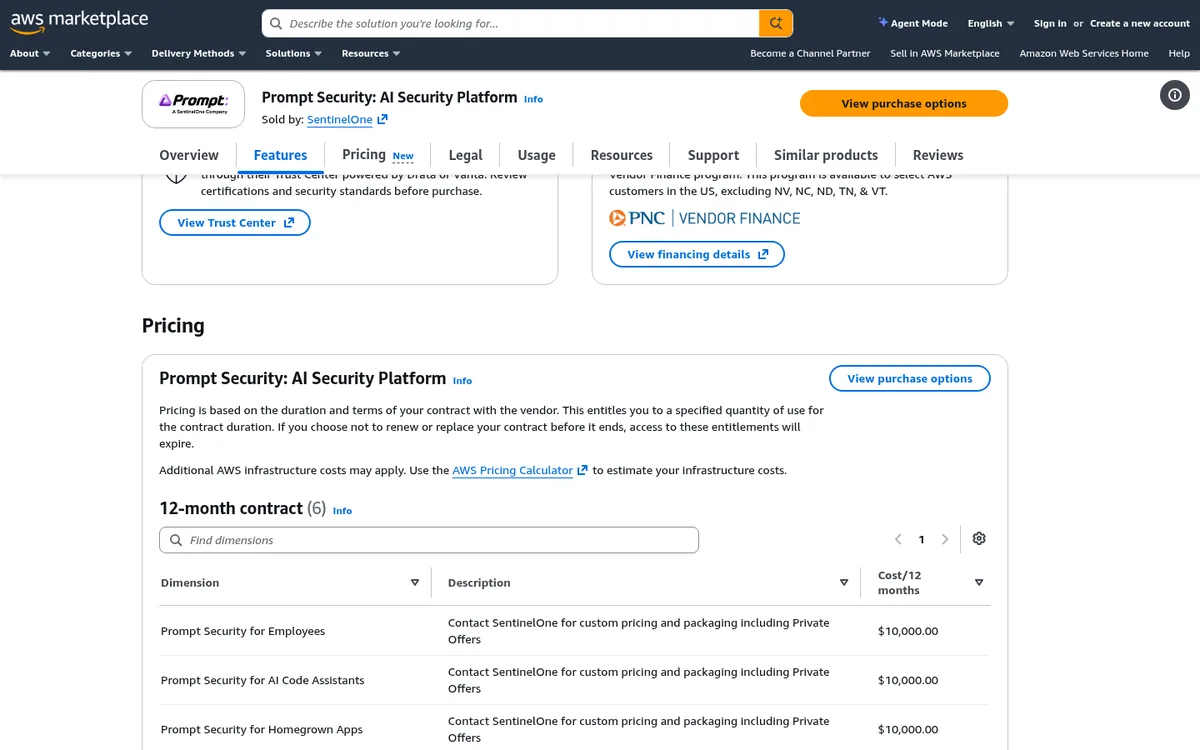
Prompt Security itself is quote only. Its current AWS Marketplace listing is sold by SentinelOne and has six 12-month dimensions, three hosted and three self-hosted, each showing $10,000 beside a note to contact SentinelOne for custom pricing. An older Prompt Security listing returned Page not found on October 22, 2026.
Should You Stay on Prompt Security?
Staying makes sense if you already run SentinelOne Singularity, because Prompt Security now shares its console, data, and sales team with your endpoint tools. The product is still actively maintained: its Chrome extension reached version 7.1.68 on October 13, 2026 and shows 400,000 users.

Leaving makes more sense if your endpoint vendor is CrowdStrike, Microsoft, or another rival, if you need a published price, or if you want an independent vendor. Ask SentinelOne for a standalone Prompt Security price and a written roadmap before renewal, then compare it with the alternatives above.
Which Prompt Security Alternative Should You Choose?
Start from the Prompt Security module you depend on most and the security platform you already run, because those two facts narrow this list fast. Match your situation to one profile below, then run a 30-day pilot with real employees, one coding team, and one staging agent.
| Prompt Security module | First choice | Also consider |
|---|---|---|
| Prompt for Employees | Check Point AI Security for a list price | WitnessAI, Harmonic Security, Lasso Security |
| Prompt for AI Code Assistants | Harmonic Security | Lasso Security, CrowdStrike Falcon Guardian, Cato AI Security |
| Prompt for Homegrown Apps | F5 AI Guardrails for private networks | Lasso Security, Check Point AI Security, WitnessAI |
| Prompt for Agentic AI | Lasso Security | CrowdStrike Falcon Guardian, Cato AI Security, Harmonic Security |
Verdict: No single alternative wins all four rows, so the cleanest swap depends on which module carries most of your Prompt Security spend. Lasso appears in every row, which is why it leads this list for teams replacing the whole platform.
You used all four Prompt Security modules
- Shortlist Lasso, CrowdStrike Falcon Guardian, and Cato AI Security.
- Ask each to show the same policy blocking a secret in a browser chat, a Claude Code session, and an MCP tool call.
- Plan incident handling with the NIST, NSA, and CISA practices for rogue agents.
You mainly bought Prompt for Employees
- Compare Check Point, Harmonic, and WitnessAI, since all three publish prices.
- Pick WitnessAI if you cannot install browser extensions on managed devices.
- Read how Microsoft Dynamic Agent Risk handles agents acting as insiders before you buy overlapping controls.
You mainly protected AI code assistants
- Test Harmonic and Lasso on Claude Code, Cursor, and Codex.
- Route agent tool traffic through one of the MCP gateways we compared, and scan servers with the MCP security tools we reviewed.
- Read why coding agents disabled their own monitoring before you trust agent logs alone.
You mainly guarded homegrown apps
- Choose F5 AI Guardrails for on-premises or air-gapped apps, or Check Point for a priced API.
- Put model calls behind one of the LLM gateways we compared, so the guardrail sits in one place.
- Add pre-launch checks from our AI agent testing tools guide.
What We Left Off This List
We left off well-known AI security and data protection tools that do not replace Prompt Security’s mix of employee, developer, app, and agent coverage, or that fit better in a different buying decision. Our governance and compliance coverage tracks the broader AI governance market.
- Palo Alto Networks Prisma AIRS: built mainly for model, app, and agent runtime security, and sold mostly to Palo Alto Networks firewall customers.
- Netskope and Zscaler: secure web gateways with AI app controls, better treated as network security purchases.
- Zenity, Noma Security, and Pillar Security: focused on securing AI agents and apps, with less emphasis on employee chatbot use.
- Nightfall AI: a data loss prevention (DLP) product that covers AI apps among many SaaS channels.
Frequently Asked Questions
Is Prompt Security still available after the SentinelOne acquisition?
Yes. SentinelOne completed the acquisition on September 5, 2025 and still sells Prompt Security as part of the Singularity Platform. The Chrome extension was updated on October 13, 2026, and the AWS Marketplace listing is now sold by SentinelOne, with pricing quoted on request instead of a public per-seat rate.
What is the closest alternative to Prompt Security?
Lasso Security is the closest independent alternative. It covers employee chatbots, local coding agents, homegrown apps, and MCP traffic, which matches Prompt Security’s four modules. CrowdStrike Falcon Guardian and Cato AI Security cover the same ground, but both are parts of larger security platforms with their own lock-in.
Which Prompt Security alternatives publish pricing?
Check Point, Harmonic Security, and WitnessAI publish per-user prices on AWS Marketplace. Check Point charges $44 or $100 per user a year, Harmonic charges $163 with a 200-user minimum, and WitnessAI charges $180 with a 1,000-user minimum. Lasso lists a $20,000 annual commitment without defining the unit.
Which alternative works without a browser extension?
WitnessAI works at the network level and says it needs no browser extension or endpoint client, including for desktop apps such as Windows 11 Copilot. Cato AI Security also inspects traffic in its SASE cloud. Both depend on employee traffic flowing through the proxy or SASE service you already run.
Is Lasso’s open source MCP gateway enough to replace Prompt Security?
No. In our October 22, 2026 test, the basic plugin in mcp-gateway 1.2.1 masked 7 of 17 secret types in tool results and none in tool call arguments. It also failed to run with version 2 of the MCP Python SDK. Treat it as a free starting layer, not a full replacement.
Related Guides
Prompt-layer tools protect AI use at runtime. For an inventory of the models, agents and AI services behind them, our AI-SPM tools guide compares 8 posture management platforms.
For related coverage, see our best AI agent security tools, Lakera alternatives, Protect AI alternatives, shadow AI detection tools and AI guardrails tools.
Read the agent security hub, AI governance and security hub, governance and compliance coverage, MCP security tools, MCP gateways, MintMCP vs Runlayer vs Lasso, LLM gateways, AI agent testing tools, FastMCP security advisories, ToFu MCP tool security bugs, LiteLLM supply chain compromise, NIST and CISA incident response practices, Microsoft Dynamic Agent Risk, and coding agents that disabled monitoring. Notes on how we work sit on editorial standards, disclosure, and contact.
The Bottom Line
Replace Prompt Security with Lasso if you want an independent platform, with CrowdStrike or Cato if you already run their stack, and with Check Point, Harmonic, or WitnessAI if employee AI is the main job. Compare Prompt Security alternatives against a standalone SentinelOne quote before your renewal date.
This market changes owners and product names every few months, so rerun your pilot after each major release and check this page for updates. Send corrections or your own test results through our contact page.