

Last updated October 16, 2026. Product claims, pricing cues, and deployment options were checked against each vendor’s primary docs, pricing pages, and public repositories on that date.
MintMCP vs Runlayer vs Lasso is the shortlist many platform and security teams reach once they decide MCP tool access needs a real control plane, not another notebook proxy. All three sit on Model Context Protocol traffic. Each one centers a different buyer problem.
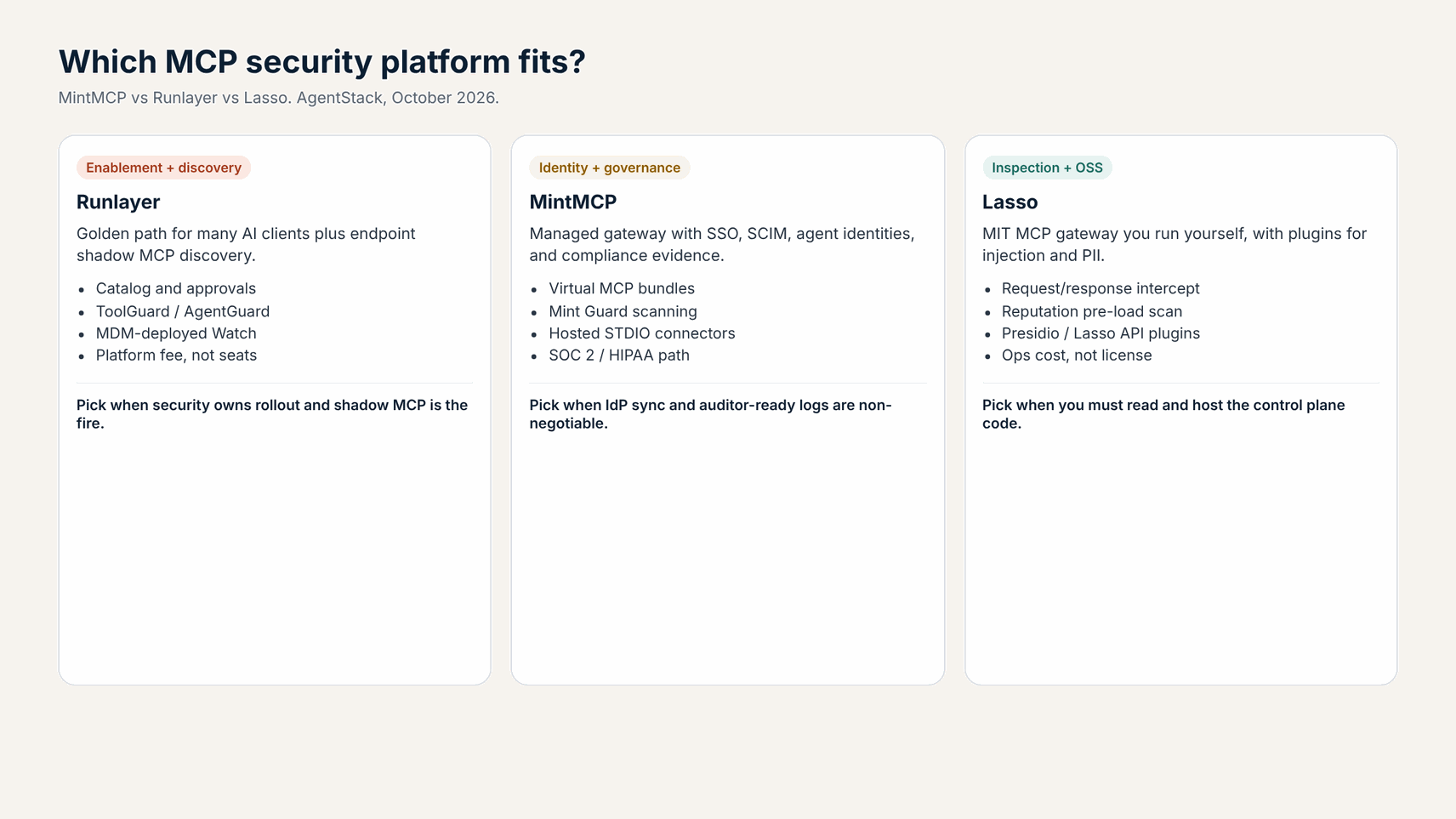
Runlayer sells enablement plus shadow discovery and runtime ToolGuard. MintMCP sells managed identity, SCIM, and auditor-ready governance. Lasso sells an MIT open-source MCP gateway you can inspect and host, with optional cloud guardrail APIs.
This comparison sits next to our MCP gateways roundup and the broader AgentOps tools map. For model-path cost and routing, see LLM gateways. No vendor paid for placement or reviewed this page, per our editorial standards and disclosure policy.
TL;DR
- Runlayer fits when security and platform need one golden path across many AI clients, plus MDM-deployed shadow MCP discovery and ToolGuard scans on tool definitions and calls.
- MintMCP (Mintive) fits when SSO, SCIM, agent identities, Virtual MCP bundles, and SOC 2 or HIPAA evidence matter more than endpoint agents.
- Lasso fits when you must self-host an MIT MCP gateway, read the code, and plug in reputation scanning plus request and response inspection.
- Pricing shapes differ: Runlayer quotes a platform fee without per-user seats; MintMCP publishes Teams at about $1,250 per month for 50 seats and custom Enterprise; Lasso OSS is MIT with ops cost, and paid Lasso APIs are optional for deeper guardrails.
- None replaces an LLM gateway. Pair any of these with model routing when token cost and failover are separate problems.
- Prove a deny on your riskiest tool in a staging tenant before you standardize the catalog.
MintMCP vs Runlayer vs Lasso: The Short Answer
Pick Runlayer if employees already use Claude, Cursor, ChatGPT, and internal agents faster than security can review each MCP, and you need discovery on the laptop plus runtime models. Pick MintMCP if regulated teams need directory-synced access, hosted connectors for STDIO servers, and logs you can hand an auditor. Pick Lasso if engineering must own the gateway binary and wants plugin-based inspection without a sales-led seat contract on day one.
| Runlayer | MintMCP | Lasso Security | |
|---|---|---|---|
| Center of gravity | AI enablement + MCP security control plane | Managed enterprise MCP gateway and identity | OSS MCP gateway + broader AI security platform |
| Strongest differentiator | Shadow AI Watch via MDM; ToolGuard / AgentGuard | SSO/SCIM, Virtual MCP bundles, hosted STDIO | MIT gateway with plugins and reputation pre-load |
| Identity depth | IdP-aware policy, agent accounts, OAuth state | SSO (SAML/OIDC), SCIM 2.0, user and agent identities | Bring your own IdP; gateway itself is not a full IdP product |
| Runtime inspection | ToolGuard 50 to 100 ms models; AgentGuard trajectories | Mint Guard for injection, secrets, PII | basic / Presidio / Lasso API plugins on I/O |
| Shadow / discovery | Endpoint Watch for unmanaged MCPs, skills, plugins | Registry and managed server lifecycle; less endpoint MDM | Security scanner on servers before load; not MDM Watch |
| Deploy shape | Hosted or self-host in customer AWS (ECS/EKS) | Cloud-hosted; self-host / VPC on request | Self-host gateway (Docker/Python); Lasso SaaS optional |
| License / entry | Sales demo; platform fee (not per-seat) | Trial / sales; Teams ~$1,250/mo for 50 seats | MIT OSS on GitHub; commercial Lasso platform separate |
| Best buyer | CISO + AI platform rolling out company-wide agents | IT / compliance in regulated SaaS | AppSec / platform engineers who self-host |
Verdict: Treat Runlayer as the enablement-and-discovery control plane, MintMCP as the identity-and-compliance gateway, and Lasso as the inspectable self-hosted inspection layer. Many enterprises will mix two of these rather than force one product to win every row.
How We Compared These Three MCP Security Platforms
We scored each product on the controls buyers actually prove in RFPs, not on catalog size marketing.
- Tool-access deny: Can you block a named tool or server for a named identity before the call runs?
- Identity binding: SSO, SCIM or directory sync, agent identities, and attributable audit.
- Runtime inspection: Prompt injection, tool poisoning, secrets, PII, and trajectory or intent checks.
- Shadow MCP visibility: Finding unsanctioned servers on endpoints or in configs before they become production paths.
- Deploy clarity: Hosted versus self-host, residency, and what you operate day two.
- Pricing clarity: Published list cues versus sales-only quotes, and what meters cost.
We also read public incident research such as ToFu finding hundreds of MCP server bugs, because tool poisoning and rug pulls are why these platforms exist. Screenshots below were captured October 16, 2026 from each vendor’s public homepage.
Three Platforms, Three Centers of Gravity
Runlayer
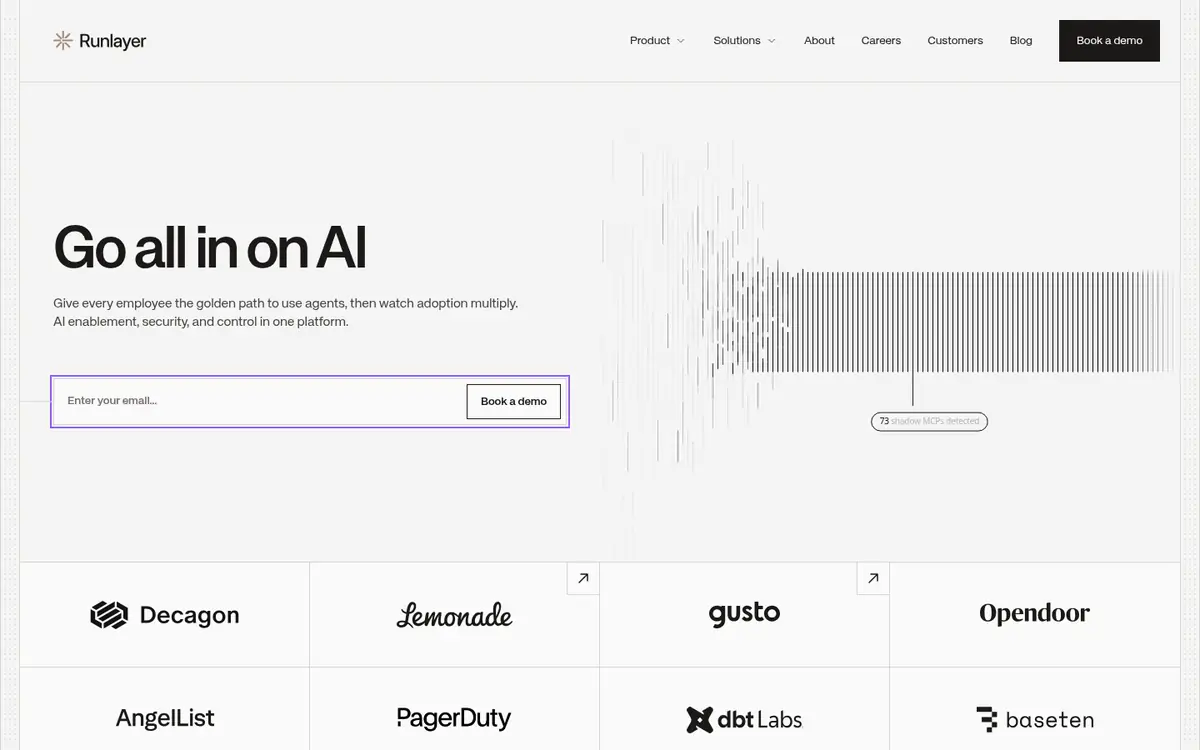
Runlayer is built for companies that want a golden path for agents across many clients, instead of only a proxy. The MCP gateway catalogs approved connectors, routes Claude, Cursor, ChatGPT, Codex, and other clients through identity-aware policy, and keeps an audit trail per request.
Security depth sits in ToolGuard and AgentGuard. Docs describe ToolGuard models that scan tool definitions, tool calls, intent drift, skill files, PII, and credentials with typical inference of 50 to 100 ms (ToolGuard docs). Shadow AI Watch installs through Jamf, Intune, Kandji, Mosyle, or similar MDM to inventory unmanaged MCP servers and skills on endpoints.
Public customer names on the homepage include Gusto, Jane, and Homebase, with advisor David Soria Parra (MCP co-creator) featured. Pricing is sales-led. Leadership has stated Runlayer prefers a platform fee over per-user seats so rollout is not taxed per employee. Self-host paths in customer AWS (ECS Fargate or EKS) are documented for enterprises that need residency.
Buy Runlayer when shadow MCP on laptops is already a problem and security wants runtime models plus catalog approvals in one vendor.
MintMCP
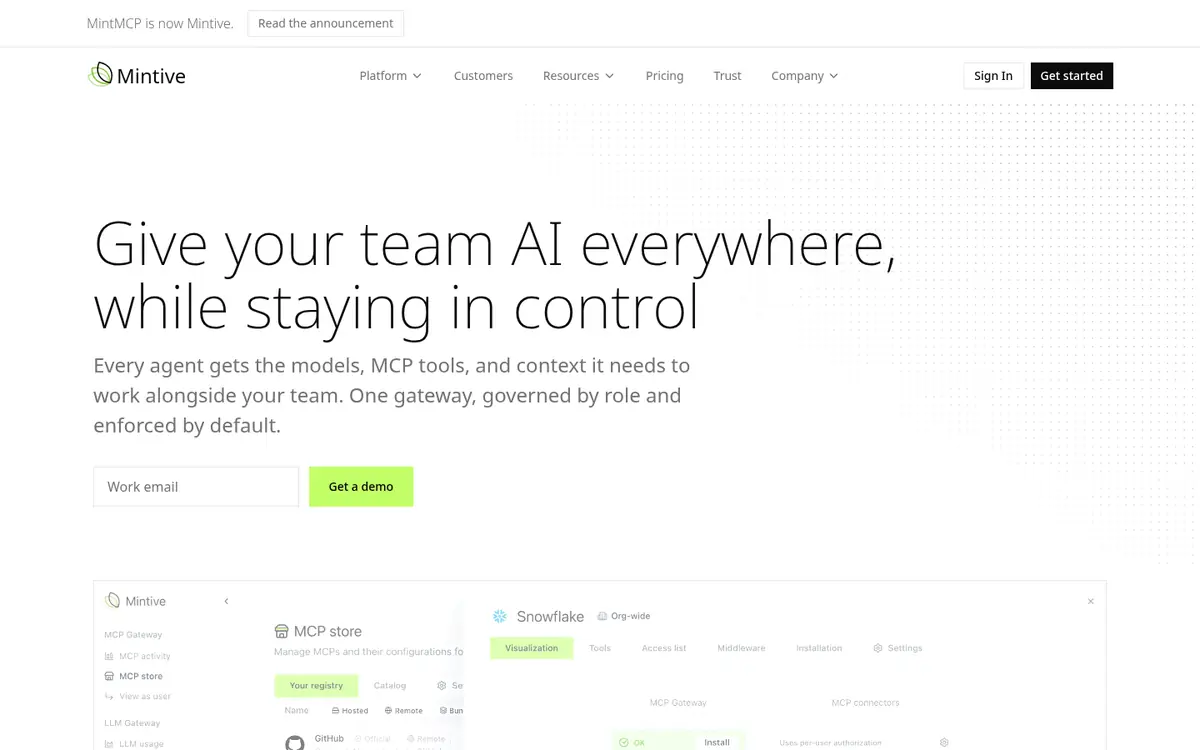
MintMCP, now under the Mintive brand on many pages, is the managed governance gateway for regulated rollouts. The MCP Gateway turns STDIO and local servers into OAuth-protected services, hosts connectors, and exposes Virtual MCP bundles scoped by role.
Identity is the headline. Docs cover SSO with SAML or OIDC and SCIM 2.0 for Okta, Microsoft Entra ID, and other IdPs, plus user and agent identities, credential vaulting, and full audit trails. Mint Guard screens tool calls for prompt injection, secrets, and PII, with monitor-before-enforce options described in Mintive materials.
Compliance packaging is explicit: pricing and trust materials cite SOC 2 Type II, HIPAA-aligned controls with BAA availability, penetration tests, and data residency options (Trust Center). A commonly cited Teams cue is about $1,250 per month for 50 seats, with additional seats around $25 each and custom Enterprise for 100+ seats, VPC, or white-glove deployment. Exact quotes still come from sales.
Buy MintMCP when directory sync, agent identities, and auditor-ready evidence matter more than MDM endpoint agents.
Lasso Security
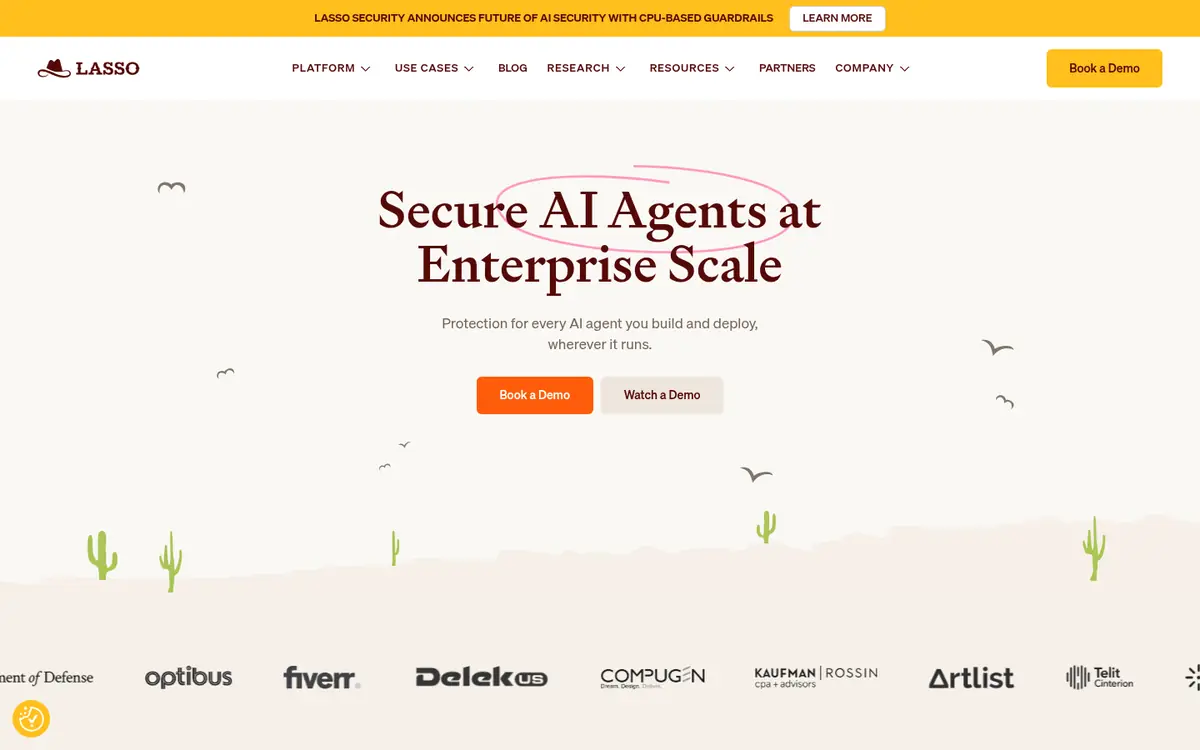
Lasso is a wider AI security platform that also ships an MIT Model Context Protocol gateway you can self-host. The commercial site emphasizes discovery, AI-BOM, red teaming, runtime enforcement, and detection and response across agents. The piece buyers compare here is the open lasso-security/mcp-gateway repository.
That gateway reads an mcp.json, manages server lifecycle, intercepts requests and responses, and exposes a unified tool surface. Built-in plugins include basic secret masking, optional Presidio PII masking, and a Lasso API plugin for prompt injection, harmful content, and policy checks. A security scanner scores server reputation (Smithery, NPM, GitHub) and tool descriptions before load, with automatic blocking below a reputation threshold.
The gateway is MIT licensed. You own deploy, upgrades, log storage, and failure modes. Advanced Lasso cloud detections need the commercial API. That split is the point: AppSec can start with OSS inspection, then buy platform depth if red teaming and portfolio AI-SPM matter.
Buy Lasso when you need readable gateway code, self-host by default, and are willing to pair identity from your IdP or another gateway.
Capability Matrix: Deny, Inspect, Identity, Discover, Host
| Control | Runlayer | MintMCP | Lasso MCP Gateway |
|---|---|---|---|
| Per-tool / per-server deny | Strong (policy on tool, resource, identity, client, runtime) | Strong (RBAC + bundle allowlists) | Moderate (config and plugins; less IdP-native RBAC) |
| I/O and poisoning inspection | Strong (ToolGuard + AgentGuard) | Strong (Mint Guard) | Strong (plugins + reputation scanner) |
| SSO / SCIM | Strong IdP integration | Strong SAML/OIDC + SCIM 2.0 | Bring your own; not the product focus |
| Agent identities | Agent accounts in policy | First-class user and agent identities | Depends on how you wire auth |
| Shadow MCP discovery | MDM Watch on endpoints | Managed registry / lifecycle; limited endpoint MDM | Pre-load scanner on configured servers |
| Catalog / connectors | 18,000+ MCP catalog cited publicly | 10,000+ servers / 1,000+ connectors cited | Whatever you put in mcp.json |
| Self-host path | Yes (AWS ECS/EKS) | On request / VPC | Yes (primary path for the OSS gateway) |
| Open source core | No | No | Yes (MIT gateway) |
Verdict: Runlayer wins discovery-plus-runtime models. MintMCP wins directory-native identity and managed hosting. Lasso wins code ownership and plugin inspection without a seat tax.
Identity and Access: Who Is Allowed to Call Which Tool?
If your RFP leads with Okta or Entra sync, MintMCP is usually the cleanest fit among these three. SCIM provisioning creates, updates, and deactivates users from the IdP, and groups can drive Virtual MCP access. Runlayer also binds policy to users, groups, roles, agent accounts, clients, and OAuth state, which is strong for mixed human and agent traffic, but public materials emphasize the golden path and Watch more than SCIM wizard depth.
Lasso’s OSS gateway does not replace an identity provider. Teams typically put SSO in front with their own reverse proxy, or they run Lasso beside MintMCP or Runlayer for inspection only. That architecture is valid. It is not a one-box IdP story.
Test the same deny in all three pilots: a finance-only MCP tool must fail for an engineering identity, and the failure must show up in audit with actor, tool, and policy reason.
Runtime Security: ToolGuard, Mint Guard, and Lasso Plugins
Tool poisoning hides instructions in tool descriptions. Rug pulls change schemas after trust is earned. Runtime inspection is how you catch both without reading every server by hand.
Runlayer’s ToolGuard family is purpose-built for MCP list, call, and intent checks, with configurable allow, alert, mask, or block actions and Security Dashboard integration. MintMCP’s Mint Guard focuses on injection, secrets, and PII on gateway tool calls, with monitoring mode before hard enforce. Lasso’s path is plugin composition: start with basic secret masking, add Presidio for PII, add the Lasso API plugin when you want cloud classifications, and keep the pre-load reputation scanner on.
# Illustrative Lasso-style flow (conceptual)
# 1) Scan server reputation before register
# 2) Intercept tools/call arguments and results
# 3) Mask secrets / PII, then forward or block

if reputation_score(server) < 30:
    block_load(server)
else:
    result = call_tool(server, tool, args)
    result = mask_secrets(result)
    return result
None of these replaces evals or tracing. Keep agent observability next to the security gateway so you can explain what an agent did after a block.
Shadow MCP and Catalog Governance
Runlayer is the clearest answer when the problem is unmanaged MCP configs on employee devices. Watch deployed through MDM inventories unsanctioned servers, skills, and plugins, then funnels people toward the approved catalog. That is a security operations workflow, more than an API gateway feature.
MintMCP attacks the same chaos from the managed center: host the STDIO servers that used to live on laptops, wrap them in OAuth, and publish role bundles. Discovery is stronger for what you onboard than for what you never saw on a MacBook.
Lasso’s scanner evaluates servers you are about to load. It will not find the random Smithery install a designer added to Cursor last night unless that config flows through your gateway. Pair Lasso with endpoint controls or an MDM inventory if shadow MCP is the primary risk.
Deployment and Operations
| Question | Runlayer | MintMCP | Lasso |
|---|---|---|---|
| Default deploy | Vendor-hosted control plane | Vendor-hosted gateway | Self-hosted OSS gateway |
| Residency / VPC | Self-host in customer AWS | VPC / self-host on request | Wherever you run containers |
| Day-two ops | Vendor ops + your policies | Vendor ops + your IdP | You patch, scale, and store logs |
| Failure mode ownership | Shared with vendor SLA | Shared with vendor SLA | Yours |
Verdict: Choose Lasso only if you already operate gateways. Choose MintMCP or Runlayer if you want the vendor on the pager for the control plane itself.
Pricing Compared: Platform Fee, Seats, and Ops Cost
Public list prices remain incomplete for all three. Treat the table as directional cues you must reconfirm on a quote.
| Platform | Published entry cue | What usually drives cost | Notes |
|---|---|---|---|
| Runlayer | Book a demo | Platform fee by deploy size and modules | Leadership states no per-user seat tax |
| MintMCP | Teams ~$1,250/mo for 50 seats; Enterprise custom | Seats, connectors, guardrails, VPC | Additional seats ~$25; sales confirms |
| Lasso OSS gateway | MIT, free to run | Compute, logging, eng time | Lasso commercial APIs / platform priced separately |
Model seat math carefully. A 200-person AI rollout on MintMCP Teams-style metering is a different budget conversation than a Runlayer platform fee meant to cover the company. Lasso looks free until you count the two engineers who own upgrades and the SIEM pipeline.
Always line-item provider tokens separately. An {il(LLMGW, ‘LLM gateway’)} bill is not an MCP security bill.
Head-to-Head: Each Pair Compared
MintMCP vs Runlayer
Choose MintMCP when the buying committee is IT, GRC, and a regulated vertical that needs SCIM, Virtual MCP bundles, and SOC 2 or HIPAA paperwork in the first packet. Choose Runlayer when the buying committee is security plus AI platform, shadow MCP is already visible on endpoints, and ToolGuard plus catalog approvals are the demo that wins.
Overlap is real: both offer governed MCP access, audit, and runtime scanning. Runlayer leans enablement and discovery. MintMCP leans managed hosting and directory identity.
MintMCP vs Lasso
Choose MintMCP when you do not want to operate a gateway and you need SSO and SCIM on week one. Choose Lasso when legal or architecture requires MIT code you can fork, and your AppSec team already runs open-source security tooling.
A common pattern is Lasso for inspection in lower environments and MintMCP for production identity. Do not assume one license covers both.
Runlayer vs Lasso
Choose Runlayer when MDM Watch and company-wide golden path matter more than reading gateway source. Choose Lasso when you want plugin-level control of masking and reputation thresholds without buying an enablement suite.
If you need both endpoint discovery and OSS inspection, Runlayer Watch plus Lasso gateway is a coherent stack. Expect integration work on audit normalization.
Which One Should You Choose?
Start from the control you lack, not from the largest catalog number.
Choose Runlayer if
- Employees use multiple AI clients and unsanctioned MCP configs already show up on endpoints.
- You want ToolGuard-style runtime models and AgentGuard trajectory checks in the same vendor as the catalog.
- A platform fee without per-seat metering matches how you buy security infrastructure.
- Self-host in your AWS account is an acceptable path for residency.
Choose MintMCP if
- Okta or Entra SCIM and agent identities are on the must-have list.
- You need managed hosting for STDIO servers and Virtual MCP bundles by role.
- SOC 2 Type II, HIPAA BAA, and residency options must appear in the security questionnaire.
- A seat-based SaaS quote is acceptable for the first 50 to 100 AI users.
Choose Lasso if
- MIT source and self-host are hard requirements.
- You want reputation scanning and pluggable I/O masking before any sales call.
- AppSec will own gateway ops and can wire IdP separately.
- You may later expand into Lasso’s broader red teaming and AI-SPM platform.
What None of the Three Replaces
- LLM routing and token budgets: still an LLM gateway or provider console problem.
- Agent evals and simulation: still an evals stack; see the AgentOps map.
- Framework choice: LangGraph, CrewAI, and peers remain separate; see AI agent frameworks.
- Endpoint DLP for every desktop app: Runlayer Watch helps for MCP configs; it is not a full enterprise DLP suite.
Frequently Asked Questions
What is the difference between MintMCP, Runlayer, and Lasso?
MintMCP is a managed MCP gateway centered on SSO, SCIM, agent identities, and compliance evidence. Runlayer is an AI enablement and security control plane with catalog governance, MDM shadow discovery, and ToolGuard runtime models. Lasso offers an MIT open-source MCP gateway with inspection plugins, plus a broader commercial AI security platform.
Is MintMCP the same as Mintive?
Mintive is the company brand now used on many MintMCP pages and blogs. The product URLs and gateway docs still live on mintmcp.com. In RFPs, treat MintMCP as the gateway product name and Mintive as the vendor entity, and confirm legal names on the order form.
Does Runlayer charge per seat?
Public leadership commentary says Runlayer prefers a platform fee scoped to deployment size and modules rather than per-user seats. There is no public list price page with seat tiers. Budget through a demo quote and ask which modules (gateway, Watch, ToolGuard) are included.
Is Lasso MCP Gateway free for production?
The mcp-gateway repository is MIT licensed, so you can run it in production without a Lasso license fee. You still pay for infrastructure, observability, and engineering time. Optional Lasso API plugins and the wider Lasso platform are commercial and priced separately.
Can I use an LLM gateway instead of these tools?
An LLM gateway governs model requests, cost, and failover. It does not replace per-tool MCP allowlists, schema pinning, or MCP-aware inspection. Most enterprises run an LLM gateway beside an MCP security gateway or portal when agents call tools over Model Context Protocol.
Related Guides
Platforms like these rely on a clean inventory of approved servers. Our enterprise MCP registries guide compares eight registries and catalogs that enterprise teams use to publish that inventory.
If you need coverage beyond the MCP layer, our Zenity vs Noma vs Pillar Security comparison compares three platforms that discover, posture-check, and protect AI agents across the enterprise.
MintMCP, Runlayer, and Lasso cover the MCP layer. For the full control model, frameworks, and vendor groups, read our AI agent governance buyer’s guide.
MintMCP, Runlayer, and Lasso secure the MCP layer. For protection across prompts, tool calls, and agent behavior, our AI agent security tools guide compares 12 runtime security platforms.
If cost is the deciding factor, our MCP gateway pricing comparison shows how per-seat, per-request, and per-tool-call pricing models differ across six MCP gateways, including MintMCP.
Continue with the 10 best MCP gateways, the AgentOps tools map, ToFu MCP tool security findings, LLM gateways, AI agent observability tools, AI agent frameworks, and the MCP topic hub. Editorial notes live on our standards, disclosure, and contact pages.
The Bottom Line
Pick Runlayer for golden-path enablement and shadow MCP discovery, MintMCP for directory-native governance and managed connectors, and Lasso when you must own an MIT inspection gateway. Prove one deny rule and one audit export in staging before you announce a company standard.