

Updated November 21, 2026. Based on VulnCheck’s exploited-vulnerabilities catalog, GitHub advisories GHSA-jpw9-pfvf-9f58 and GHSA-mx89-jjx9-gjr8, OSV PYSEC-2026-3482, the mcp 1.27.2 release notes, and our own November 21 lab run across mcp 1.27.1 and 1.27.2.
A known MCP Python SDK vulnerability, CVE-2026-52869, moved from theory to active-exploitation status on November 20, 2026, when VulnCheck added it to its exploited catalog after its own canaries saw attempts. The bug lets a second authenticated client take over another client’s session on a Model Context Protocol (MCP) server that uses an HTTP transport with bearer-token authentication. The fix shipped in mcp 1.27.2 back in May. VulnCheck flagged a second AI-tooling bug the same day, an MCPHub remote code execution flaw (CVE-2026-79748).
Upgrade the mcp package now. 1.27.2 closes this bug, but pip-audit shows seven other mcp CVEs on 1.27.1, so move to 1.30.0 on the 1.x line, or 2.2.0 or later, to clear them all. If you run MCPHub, upgrade to 0.12.15 or later and keep it off the public internet. We reproduced the session takeover on 1.27.1 and confirmed 1.27.2 blocks it, including the harder case where many users share one OAuth client.
TL;DR
- CVE-2026-52869 is a session authorization bypass in the MCP Python SDK (the
mcppackage on PyPI). It affects servers on the SSE or stateful Streamable HTTP transport that use the SDK’s bearer-token auth. CVSS 7.1. - In our lab on mcp 1.27.1, a second client with a different valid token and the victim’s session ID ran a tool call inside the victim’s session (HTTP 200). On 1.27.2 the same request returned HTTP 404.
- The exploit is not anonymous: the attacker needs a valid token and a session ID obtained out of band, such as from logs or unencrypted traffic.
- Upgrading to 1.27.2 closes this CVE and one companion, but pip-audit lists eight mcp CVEs on 1.27.1; six more need 1.28.1 or 1.30.0 / 2.2.0.
- VulnCheck also flagged MCPHub CVE-2026-79748 (CVSS 9.9) as exploited: any logged-in non-admin could register a server command and get code execution as the hub’s OS user. Fixed in 0.12.15.
What Got Flagged on November 20, 2026
VulnCheck’s canaries added three vulnerabilities to its exploited-vulnerabilities catalog on November 20, 2026. Two run AI agent tooling built on MCP: CVE-2026-52869 in the MCP Python SDK and CVE-2026-79748 in MCPHub. None of the three is in CISA’s Known Exploited Vulnerabilities catalog as of that date.
A write-up by Patrick Duggan collected the three flags.
CVE-2026-52869 is not new. GitHub published the advisory on June 5, 2026, and the fix shipped in mcp 1.27.2 before that. What changed is the exploitation signal: VulnCheck records its earliest evidence of attempts, dated November 20. The mcp package is pulled roughly 331 million times a month, so the population of affected servers is large even if the exploitable configuration is specific.
How the MCP Python SDK Session Bug Works
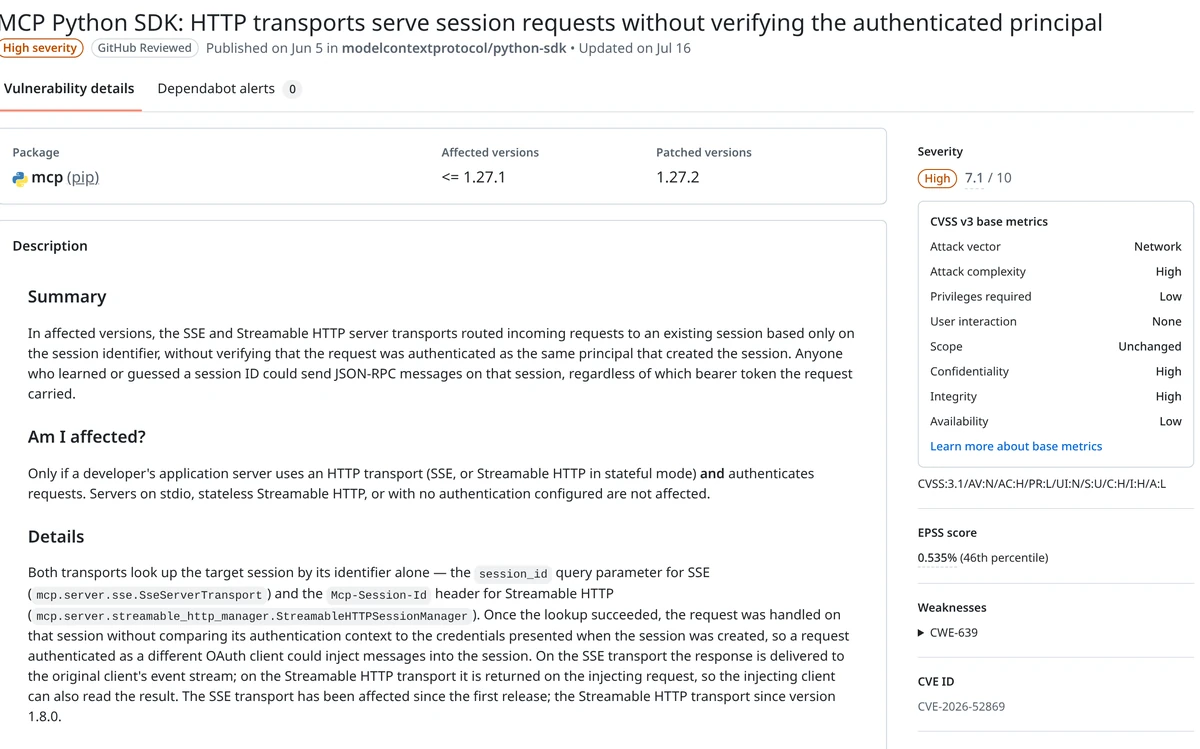
On the SSE and stateful Streamable HTTP transports, an MCP server tracks each client in a session. Per the advisory, both transports looked up that session by its identifier alone: the session_id query parameter for SSE, or the Mcp-Session-Id header for Streamable HTTP. The lookup never checked the request came from the client that created the session.
So any client holding a different valid bearer token and a known session ID could inject JSON-RPC messages into someone else’s session. On SSE the response goes to the original client’s event stream; on Streamable HTTP it returns on the injecting request, so the attacker can read the reply too. Session IDs are random UUIDs, which means an attacker has to obtain one out of band, from logs, a shared URL, or unencrypted traffic, rather than guess it. The SSE transport was affected since the SDK’s first release, Streamable HTTP since version 1.8.0.
Servers on stdio, on stateless Streamable HTTP, or with no authentication are not affected. Stdio has no HTTP session, and stateless mode builds a fresh transport per request and keeps no session map, so there is nothing to reuse. The bug matters only where authentication is meant to separate clients and a retained HTTP session sits behind it.
We Reproduced the Session Takeover on 1.27.1
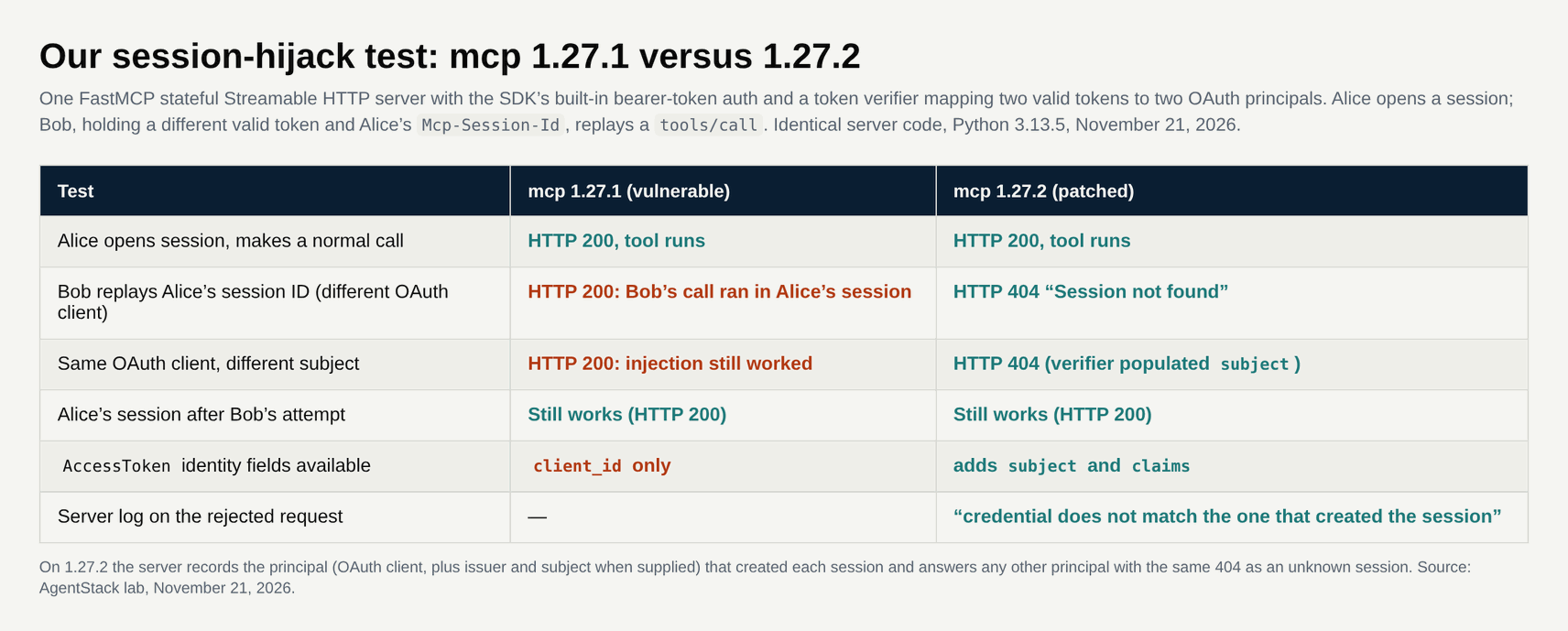
We built one FastMCP server with a single tool, the stateful Streamable HTTP transport, and the SDK’s built-in bearer-token authentication. A token verifier mapped two valid tokens to two different OAuth principals, Alice and Bob. We ran the identical server code under mcp 1.27.1 and under 1.27.2 on Python 3.13.5, November 21, 2026.
Alice opened a session and ran the tool normally. We copied Alice’s Mcp-Session-Id into a request carrying Bob’s token, as if Bob had scraped it from a log, and called the tool again with a marker argument. On 1.27.1 the server ran Bob’s call inside Alice’s session and returned HTTP 200 with our marker. On 1.27.2 the same request returned HTTP 404 with the body “Session not found”, and the server logged “credential does not match the one that created the session.” Alice’s own session kept working in both cases.
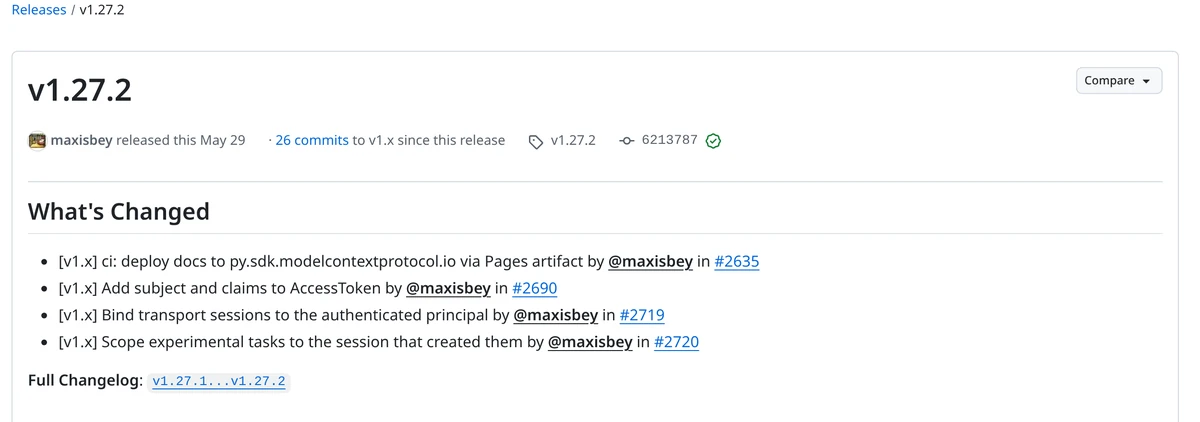
The patch, summarized in the 1.27.2 release notes, records the principal that created each session, using the OAuth client ID plus the token’s issuer and subject when the verifier supplies them, then answers any mismatched request with the same 404 used for an unknown session. The release also added subject and claims to the SDK’s AccessToken: on 1.27.1 those fields do not exist, which is why the older version cannot tell two users apart at all.
The Shared OAuth Client Trap
One result is worth stating on its own, because it is where a fast patch can still leave a hole. Hosted MCP clients and gateways often route many end users through a single OAuth client ID. We re-ran the test with both tokens on the same client ID but different subjects.
On 1.27.1 the injection still worked. On 1.27.2 it was blocked, but only because our token verifier populated AccessToken.subject from the token’s sub claim. If the verifier leaves subject empty, 1.27.2 separates sessions per client, not per user, and two users behind the same client collapse into one principal. Gateways and multi-tenant servers should confirm their verifier supplies a stable subject, and anyone using a custom auth backend instead of the built-in one has to enforce the same session-to-principal check themselves.
Patching to 1.27.2 Is Not the Whole Fix
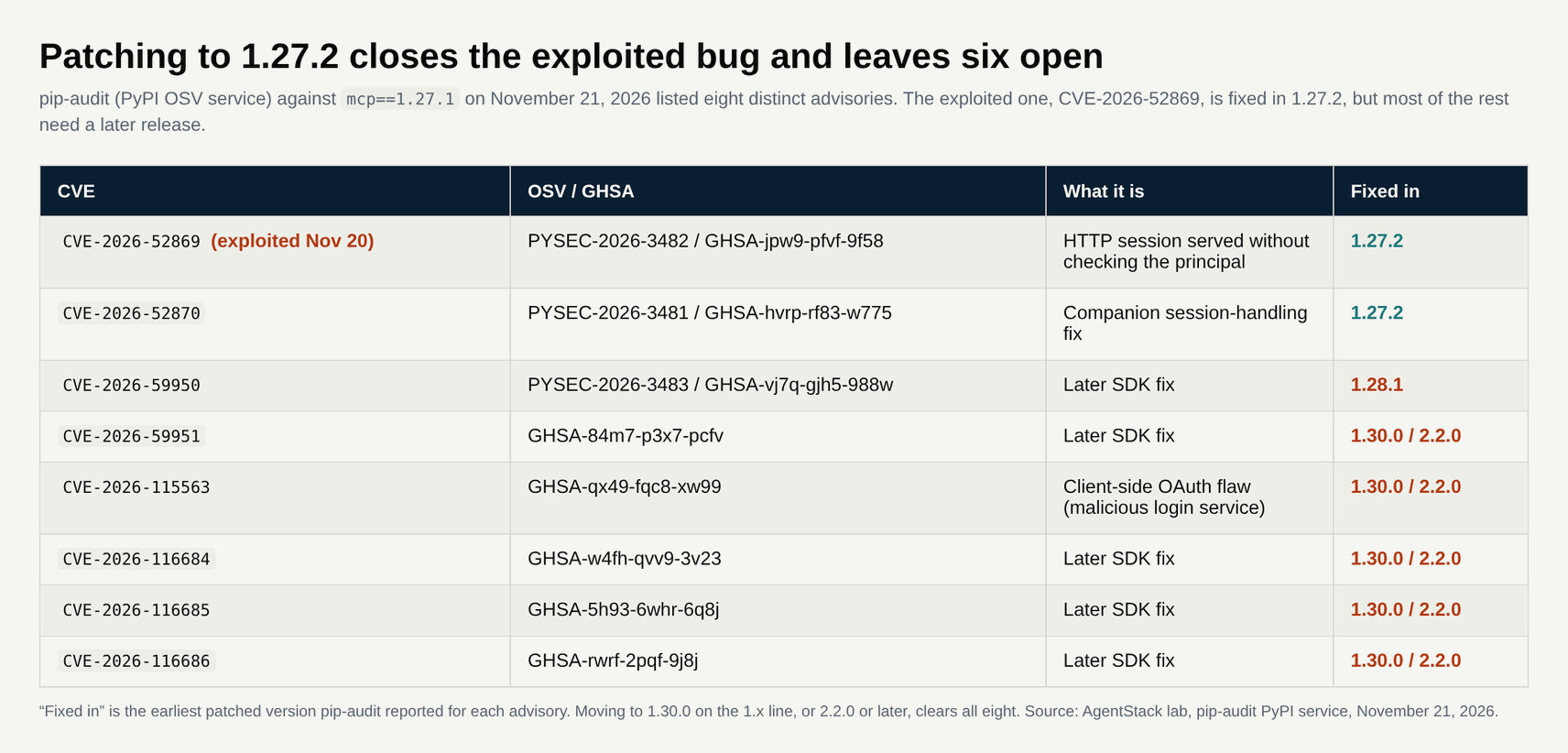
We ran pip-audit against mcp==1.27.1 using its default PyPI service. It did flag CVE-2026-52869 (as PYSEC-2026-3482) and pointed to the 1.27.2 fix, so the scanner catches this one. It also listed eight distinct mcp advisories in total, and only two of them, CVE-2026-52869 and its companion CVE-2026-52870, are closed by 1.27.2.
The rest need later releases: CVE-2026-59950 is fixed in 1.28.1, and CVE-2026-59951, CVE-2026-116684, CVE-2026-116685, CVE-2026-116686 and the client-side OAuth flaw CVE-2026-115563 are fixed in 1.30.0 or 2.2.0. Stopping at 1.27.2 closes the bug that is being exploited now and leaves six open. Moving to 1.30.0 on the 1.x line, or 2.2.0 or later, clears all eight.
The Other Flagged Bug: MCPHub Code Execution
The second exploited AI-tooling bug is in MCPHub (@samanhappy/mcphub), a self-hosted hub that runs many MCP servers behind one endpoint. Per the advisory for CVE-2026-79748 (CVSS 9.9), the endpoints that add or edit a server checked that you were logged in but not that you were an admin, and did not restrict the command.
Those two endpoints are POST /api/servers and PUT /api/servers/:name. Any logged-in non-admin account could register a server whose command is a shell, and MCPHub ran it at once as its own OS user, commonly root in the published Docker image.
The hub also stores the API keys for every upstream MCP server it fronts, so a takeover leaks those too. A single-admin hub with no other accounts is not reachable this way, but one leaked low-privilege login is enough. Upgrade to 0.12.15 or later, close self-registration, and keep the hub off the public internet until you do.
This is the latest in a run of MCP tooling flaws we have tested hands-on, from the mcp-server-git command execution bug to the MCP Inspector security fixes and yesterday’s Microsoft agent-framework PyPI compromise. For the broader defensive picture, see our guide to AI agent security tools and how MCP clients connect to servers.
What MCP and Agent Teams Should Do Now
These steps apply to any service that hosts an MCP server on an HTTP transport, and to any MCPHub deployment. This bug is in the official SDK rather than a third-party server. Our MCP servers list is still the place to start when you are choosing what to run. Session hijacks are one reason to put a control layer in front of MCP. Our MCP security tools guide covers gateways and policy engines built for that. The official Python SDK is one of the kits we also cover in our MCP server frameworks guide, alongside FastMCP and other official SDKs.
- Check the
mcpversion in every service that hosts an MCP server, inside the built image rather than a developer checkout:python -c "from importlib.metadata import version; print(version('mcp'))". Upgrade to 1.30.0 on the 1.x line, or 2.2.0 or later. - Classify each MCP route. The bug applies only to SSE or stateful Streamable HTTP with authentication. Prefer stateless Streamable HTTP where the server does not need retained session state.
- If you run a gateway or hosted client that shares one OAuth client across users, confirm your token verifier populates
AccessToken.subjectfrom the token’ssubclaim, or sessions separate per client, not per user. - Keep session IDs out of logs, URLs, and any telemetry an attacker could read, since the exploit needs a session ID obtained out of band. Require TLS so session IDs are not observable on the wire.
- After upgrading, run a negative test: create a session as one principal, replay its session ID with a second valid token, and confirm the server returns 404.
- For MCPHub, check the version with
npm ls @samanhappy/mcphubor the image tag, upgrade to 0.12.15 or later, list every non-admin account, and review web logs for POST or PUT requests to/api/serversyou did not make.
Beyond MCP SDK session bugs, Amazon says Cairn AI agents found a MONAI Label zero-day that is now CVE-2026-133968 in 0.8.6. Our Cairn and MONAI Label lab covers path confinement, session tar unpack, and Cairn’s auth-less FastAPI surface.
For another Python SDK check, our MCP Tasks and Elicitation GA report tested mcp 2.3.0 elicitation on both protocol revisions, including forged requestState and secret fields in forms.
Is my MCP Python SDK server affected by CVE-2026-52869?
It is affected only if the mcp package is 1.27.1 or earlier and the server uses bearer-token authentication with the SSE or stateful Streamable HTTP transport. Servers on stdio, on stateless Streamable HTTP, or with no authentication are not affected by this specific bug.
What does the CVE-2026-52869 exploit actually allow?
A second client that already holds a valid bearer token, and has obtained another client’s session ID out of band, can inject JSON-RPC messages into that session. On Streamable HTTP it also reads the responses. In our lab on mcp 1.27.1 this ran a tool call inside the victim’s session and returned HTTP 200.
Is upgrading to mcp 1.27.2 enough?
It closes CVE-2026-52869 and one companion CVE. But pip-audit lists eight advisories against 1.27.1, and the other six need 1.28.1 or 1.30.0 and 2.2.0. Move to 1.30.0 on the 1.x line, or 2.2.0 or later, to clear all of them.
Do random UUID session IDs make the bug safe to ignore?
No. Random IDs stop blind guessing, but the advisory calls out out-of-band acquisition through logs or network observation. The real fix binds each session to the principal that created it, which 1.27.2 does, so the ID alone is no longer enough to use a session.
What is the MCPHub vulnerability flagged the same day?
CVE-2026-79748 (CVSS 9.9) let any logged-in non-admin MCPHub user register or edit a server command through the API, and the hub ran it immediately as its OS user, often root. It also leaks the API keys MCPHub stores for upstream servers. Upgrade to 0.12.15 or later.
Sources: GitHub advisory GHSA-jpw9-pfvf-9f58 and the modelcontextprotocol/python-sdk security advisory (2026); OSV PYSEC-2026-3482 (2026); mcp 1.27.2 release notes (2026); python-sdk issue #2100 (2026); Snyk SNYK-PYTHON-MCP-18016318 (2026); pip-audit project (2026); GitHub advisory GHSA-mx89-jjx9-gjr8 and NVD CVE-2026-79748 for MCPHub (2026); dugganusa.com VulnCheck canaries write-up (November 20, 2026); VulnCheck exploited-vulnerabilities catalog (November 20, 2026). Our own lab run: AgentStack, November 21, 2026.