

Published October 15, 2026 (IST) by the AgentStack News Desk. Facts were checked against Anthropic’s Claude Platform article on agent observability (dated October 14, 2026) and the OpenTelemetry GenAI semantic conventions documentation.
Anthropic opened a public beta for OpenTelemetry (OTel) traces on the Claude Platform on October 14, 2026. Traces can leave Claude Managed Agents, the Messages API, and the Claude software development kits (SDKs) and land in any tool that accepts OpenTelemetry Protocol (OTLP) data.
The company frames the release as the same path many teams already use for Claude Code and Cowork telemetry: one destination in the Claude Console, then standard spans with latency, tokens, and IDs in the observability stack you already run.
The practical change for operators: model calls, tool use, and Model Context Protocol (MCP) server calls can share one trace timeline with the rest of your services. This report draws on the Claude Platform announcement and the OpenTelemetry GenAI semantic conventions, per our editorial standards.
TL;DR
- What landed: native OpenTelemetry traces from Claude Managed Agents, the Messages API, and Claude SDKs, announced October 14, 2026.
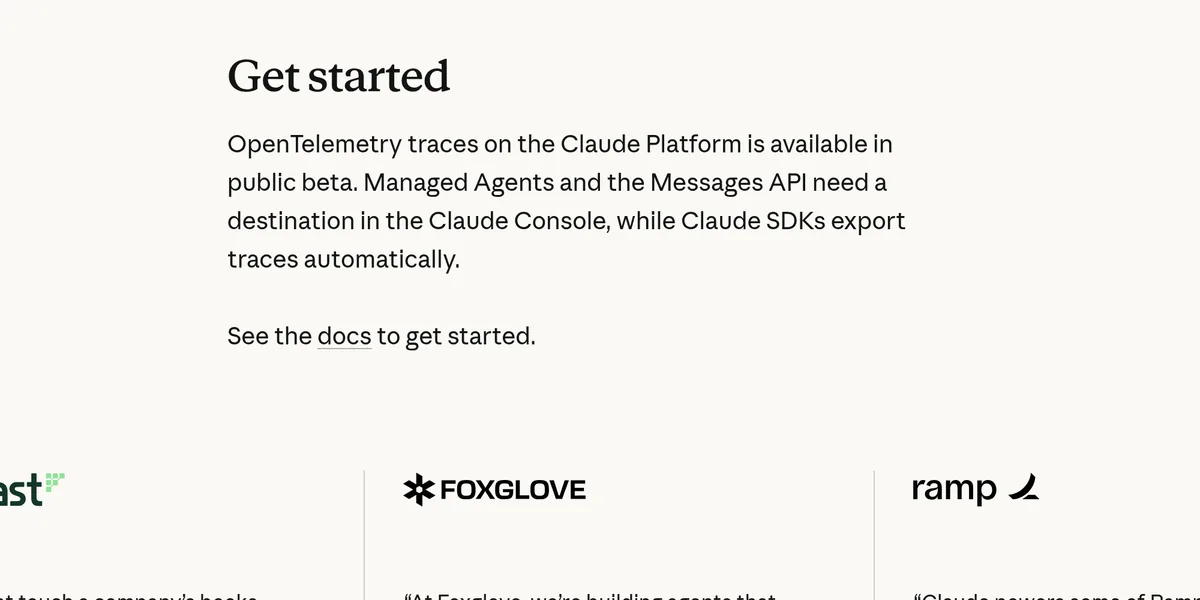
- Status: public beta. Managed Agents and the Messages API need a destination in the Claude Console; Claude SDKs export traces automatically.
- What each span can cover: agent turns, model calls, tool use, and MCP server calls, with latency, tokens, and IDs.
- Interop claim: traces follow OpenTelemetry GenAI semantic conventions so Claude and other providers can sit in the same dashboards.
- Named backends: Grafana Cloud, Honeycomb, Sentry, Splunk for stack debugging; Arize AI, Braintrust, Datadog, Langfuse, LangSmith, New Relic, and PostHog for evals and quality; Databricks Unity Gateway for org-level usage.
- Operator takeaway: wire a Console destination (or rely on SDK export), confirm GenAI attributes arrive, and treat traces as the gate before widening agent permissions.
What Anthropic Shipped for Claude Platform Traces
The announcement covers three Claude Platform surfaces in one export path: Managed Agents, the Messages API, and the Claude SDKs. Destinations are configured in the Claude Console for Managed Agents and Messages, while SDKs are described as exporting automatically, so application code that already uses the SDK can emit spans without a separate Console click for that path.
Anthropic says teams that already send Claude Code or Cowork traces into an observability tool can bring platform-built agents into the same place. That matters for shops that split coding agents and production agents across two telemetry stories today.
| Surface | How export is described | What the announcement says you see |
|---|---|---|
| Claude Managed Agents | Destination in the Claude Console | Agent turns, model calls, tool use, MCP server calls |
| Messages API | Destination in the Claude Console | Model and tool activity as standard OTel traces |
| Claude SDKs | Export traces automatically | Same OTel path without a separate Console step called out |
| Claude Code / Cowork | Existing OTel path (referenced) | Prior telemetry can share the destination with platform agents |
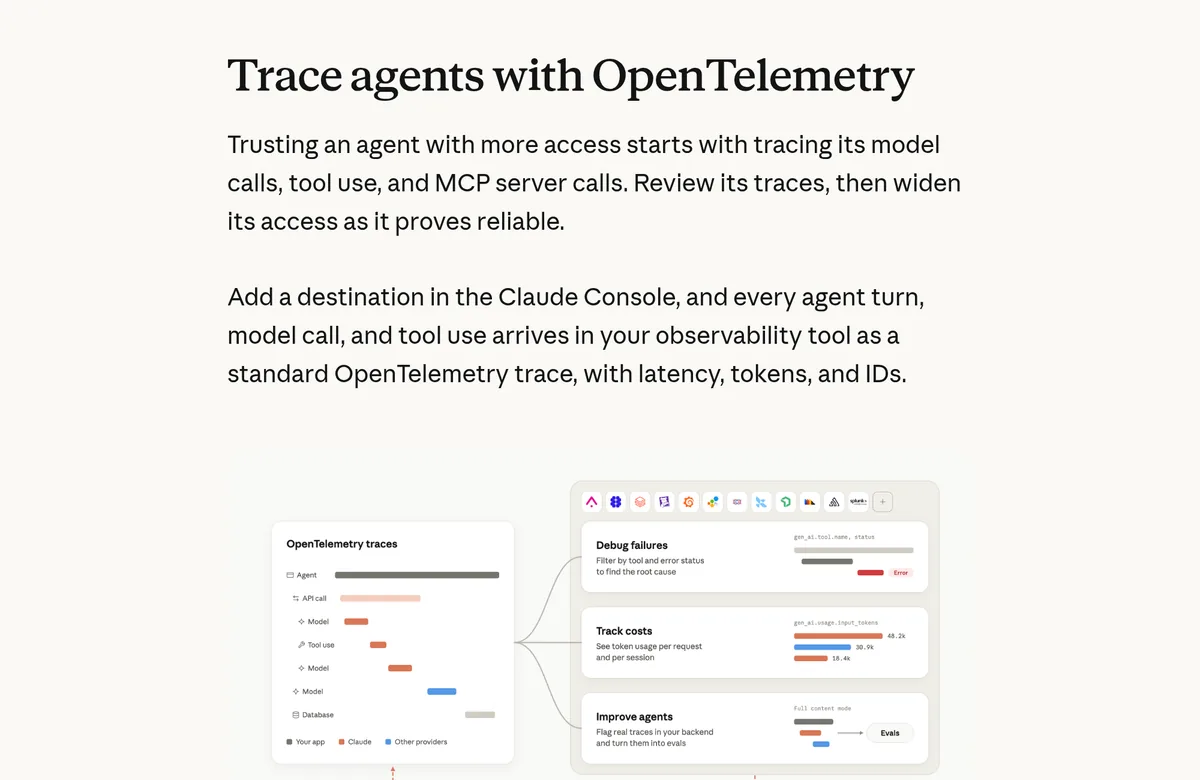
Anthropic ties trust to evidence: review traces, then widen access as the agent proves reliable. That framing matches how many AgentOps teams already stage tool permissions, and it puts MCP server calls on the same timeline as model steps.
Which Observability Tools Anthropic Named
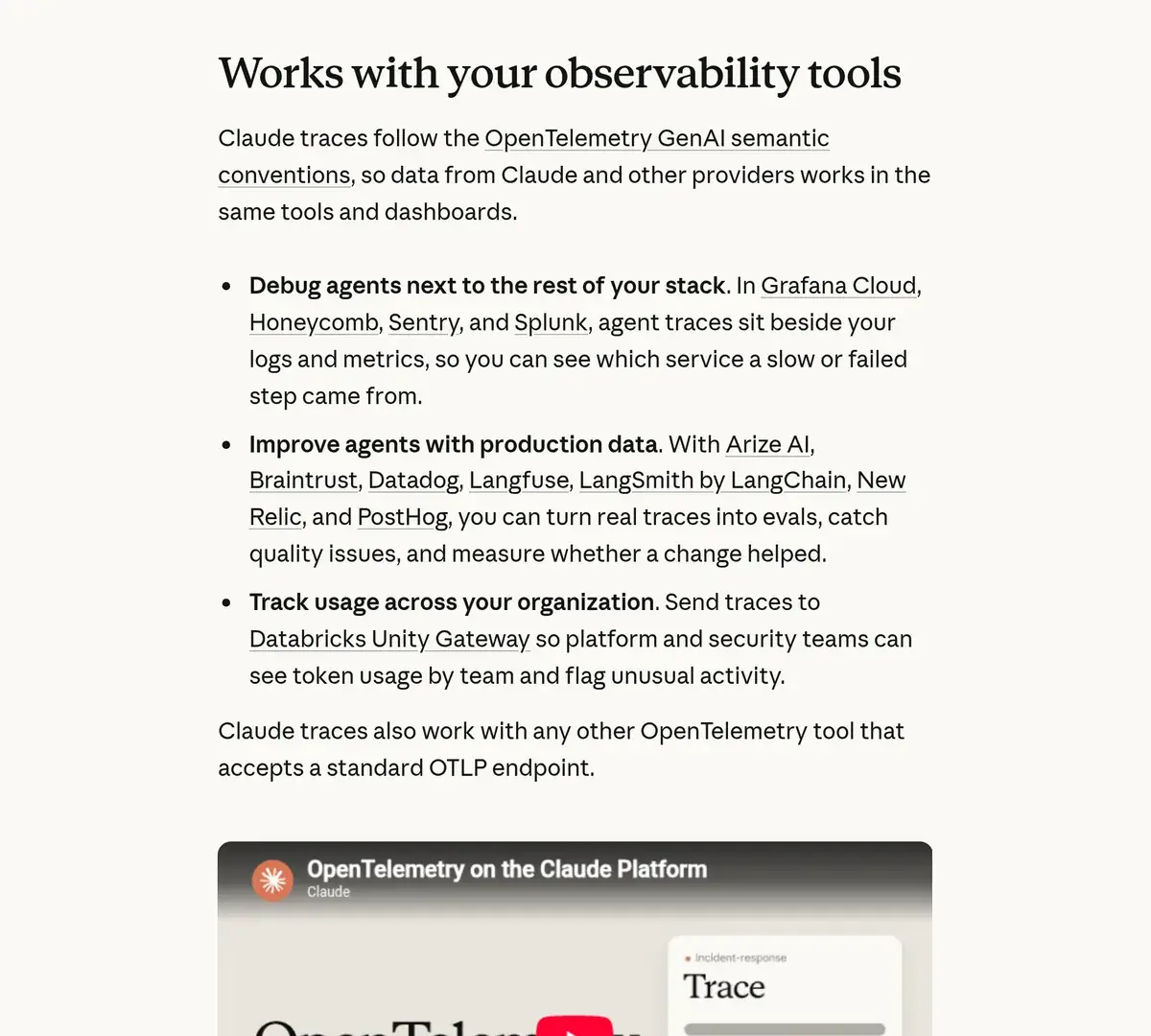
Claude traces are said to follow the OpenTelemetry GenAI semantic conventions, so spans from Claude and other providers can share tools and dashboards without a one-off schema project. The announcement groups backends by job rather than ranking them, and it adds a catch-all for any collector that speaks standard OTLP.
| Job | Tools named in the announcement | What Anthropic says they help with |
|---|---|---|
| Debug next to the stack | Grafana Cloud, Honeycomb, Sentry, Splunk | Place agent traces beside logs and metrics to find the slow or failed service |
| Improve with production data | Arize AI, Braintrust, Datadog, Langfuse, LangSmith by LangChain, New Relic, PostHog | Turn traces into evals, catch quality issues, and measure whether a change helped |
| Track org usage | Databricks Unity Gateway | See token usage by team and flag unusual activity |
| Any OTLP sink | Any OpenTelemetry tool with a standard OTLP endpoint | Catch-all path beyond the named list |
Our best AI agent observability tools guide and Langfuse alternatives comparison cover several of the same names. The Arize Phoenix vs Langfuse vs Helicone piece and LangSmith vs Langfuse vs Braintrust pricing breakdown help teams that already self-host or buy eval platforms.
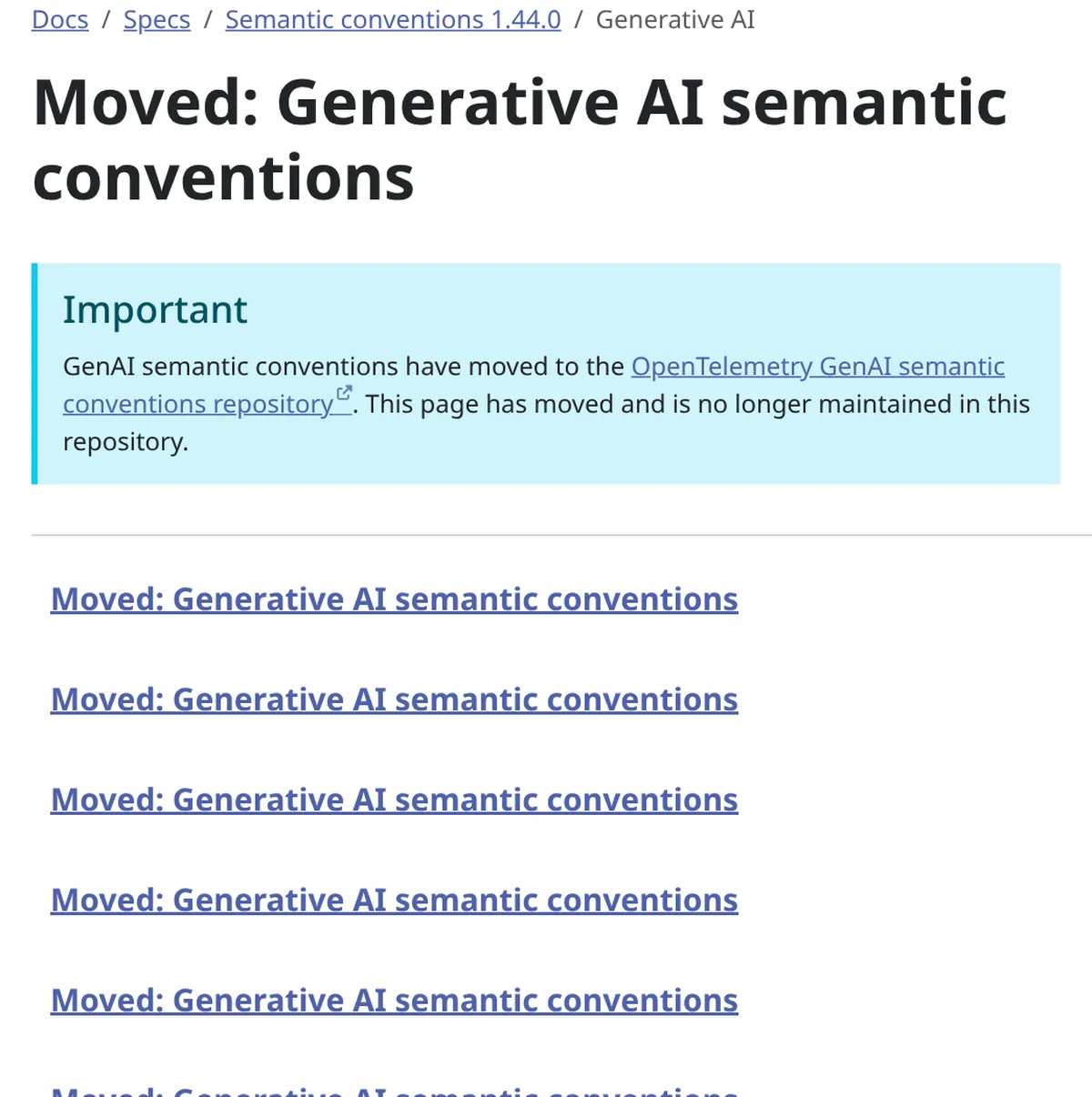
Standard attribute names matter because dashboards break when every vendor invents its own span keys. If Claude spans arrive with GenAI conventions, the same panels can mix Claude Managed Agents with other model providers without a second schema project.
Why Native Traces Matter for AgentOps Teams
Third-party wrappers can already log prompts and tool calls, but they sit outside the platform and often miss MCP server hops or Managed Agent orchestration steps. A first-party OTel export reduces that gap if the spans are complete and stable in beta.
What to verify on day one
Treat the beta as an instrumentation contract you test, not a finished observability program. Confirm that agent turns, model calls, tool use, and MCP server calls all appear, that latency and token fields populate, and that IDs let you join spans to your own request logs.
- Create or confirm a destination in the Claude Console for Managed Agents and Messages.
- Confirm Claude SDK exports fire without a second Console step, as the announcement describes.
- Sample a Managed Agent run that calls an MCP server and check that the MCP hop is present.
- Compare GenAI attributes against your existing dashboards built for Langfuse, Datadog, or Grafana.
- Keep widening agent permissions gated on readable traces, matching Anthropic’s stated trust model.
# Illustrative: point an OTLP exporter at your collector (SDK path varies by language)
# Confirm GenAI attributes and MCP spans after a Managed Agent run that uses tools.
export OTEL_EXPORTER_OTLP_ENDPOINT="https://otel.example.com:4318"
export OTEL_SERVICE_NAME="claude-managed-agent-prod"
# Then trigger a short agent run and query spans by trace id in your backend.
Teams comparing platforms can start from our AgentOps tools map, the open source LLM observability list, and the AI agent evaluation tools guide. Prior coverage of Claude Managed Agents dynamic workflows remains the product context for the agents these traces describe.
What Early Adopters Claimed in the Announcement
Anthropic published four customer quotes with the launch. They are marketing claims, not independent benchmarks from AgentStack, and we repeat only the numbers that appear in the quotes themselves so readers can separate vendor storytelling from measured AgentOps work in production.
| Company | Speaker | Claim in the announcement |
|---|---|---|
| Foxglove | Roman Shtylman, Co-Founder and CTO | Analyze agent interactions in PostHog beside product usage for robotics debugging agents |
| Ramp | David Traina, Senior Software Engineer | Reflect scores Langfuse traces and proposes fixes; some agents cut token usage by 10 to 20% and made sessions 30% faster |
| Sterling Labs | Hyon Lee, CTO | Langfuse as the pit wall for 24/7 market agents, with native OTel removing custom instrumentation |
| Unnamed books / finance context | Ankush Sharma, Head of Infrastructure | Grafana Cloud timeline with prompt version, tool calls, latency, and token spend for audit questions |
Ramp’s 10 to 20% token cut and 30% faster sessions are attributed to Reflect working on Langfuse traces, not to the new Claude export alone. The new export is presented as higher-fidelity fuel for that loop.
Limits, Beta Gaps, and What Is Still Unclear
The announcement does not publish a public docs URL that resolves without console access as of this writing. Linked documentation paths under platform.claude.com returned not-found pages when we checked on October 15, 2026, so setup detail beyond the Console destination note is still thin in public HTML.
Public beta also means attribute names, span shapes, and MCP call coverage can change. Anthropic does not spell out retention, sampling, redaction of prompt content, or how traces behave across Bedrock, Vertex, or other hosting paths in this article.
The piece does not price the feature separately. Teams should assume it follows existing Claude Platform billing for tokens and Managed Agents unless Console copy says otherwise.
What to Watch Next
Five follow-ups over the next few months will show whether this beta becomes the default instrumentation path for Claude agents or stays a Console toggle that only power users turn on, and whether MCP span detail is rich enough for production incident review.
- Docs: whether a stable public guide lands for Console destinations and SDK auto-export.
- MCP fidelity: whether MCP server calls include arguments, errors, and latency consistently.
- Hosting paths: whether Bedrock, Vertex, and Foundry customers get the same export story.
- Eval loops: whether Arize, Braintrust, Langfuse, and LangSmith publish Claude-specific GenAI parsers.
- GA timing: whether Anthropic graduates the beta with a retention and redaction policy.
Frequently Asked Questions
What did Anthropic announce for Claude Platform observability?
On October 14, 2026 Anthropic announced a public beta for OpenTelemetry traces from Claude Managed Agents, the Messages API, and Claude SDKs. Traces can include agent turns, model calls, tool use, and MCP server calls, with latency, tokens, and IDs, and they are meant to land in any OTLP-compatible tool.
How do you turn on Claude Platform OpenTelemetry traces?
For Managed Agents and the Messages API, the announcement says you add a destination in the Claude Console. Claude SDKs are described as exporting traces automatically. Claude Code and Cowork traces can share the same observability destination with platform-built agents, according to Anthropic.
Which observability tools work with Claude Platform traces?
Anthropic says traces follow OpenTelemetry GenAI semantic conventions and work with any standard OTLP endpoint. It names Grafana Cloud, Honeycomb, Sentry, and Splunk for stack debugging; Arize AI, Braintrust, Datadog, Langfuse, LangSmith, New Relic, and PostHog for evals; and Databricks Unity Gateway for organization usage views.
Why do MCP server calls in traces matter for AgentOps?
MCP server calls are where agents touch files, tickets, browsers, and internal APIs. Putting those hops on the same OpenTelemetry timeline as model calls lets teams see which tool step failed, how long it took, and whether permissions should widen. Anthropic explicitly lists MCP server calls among the events to review before granting more access.
The Bottom Line
Claude Platform now has a first-party OpenTelemetry path for Managed Agents, Messages, and SDKs, and Anthropic is selling it as the trust layer for agents that call tools and MCP servers. The beta is thin on public docs today, so day-one work is wiring a Console destination and verifying GenAI spans in the backend you already trust.
We will update this story when stable docs, GA timing, or hosting-path details land. Send corrections through our contact page.
Related coverage: agent observability, AgentOps, observability tools, Claude Managed Agents, and Anthropic distillation defenses.