

Last updated October 15, 2026. Catalog sizes, auth models, MCP endpoints, and prices were checked against each vendor’s docs, pricing pages, and changelogs on that date.
The best agent integration platforms in 2026 are Composio for catalog breadth, Arcade for per-user authorization, and Nango for teams that want open-source, code-owned tools. Pipedream Connect, Merge Agent Handler, StackOne, Paragon ActionKit, Unified.to, Zapier MCP, and Workato Enterprise MCP each win a narrower job, from embedded B2B integrations to governed tools for your own employees.
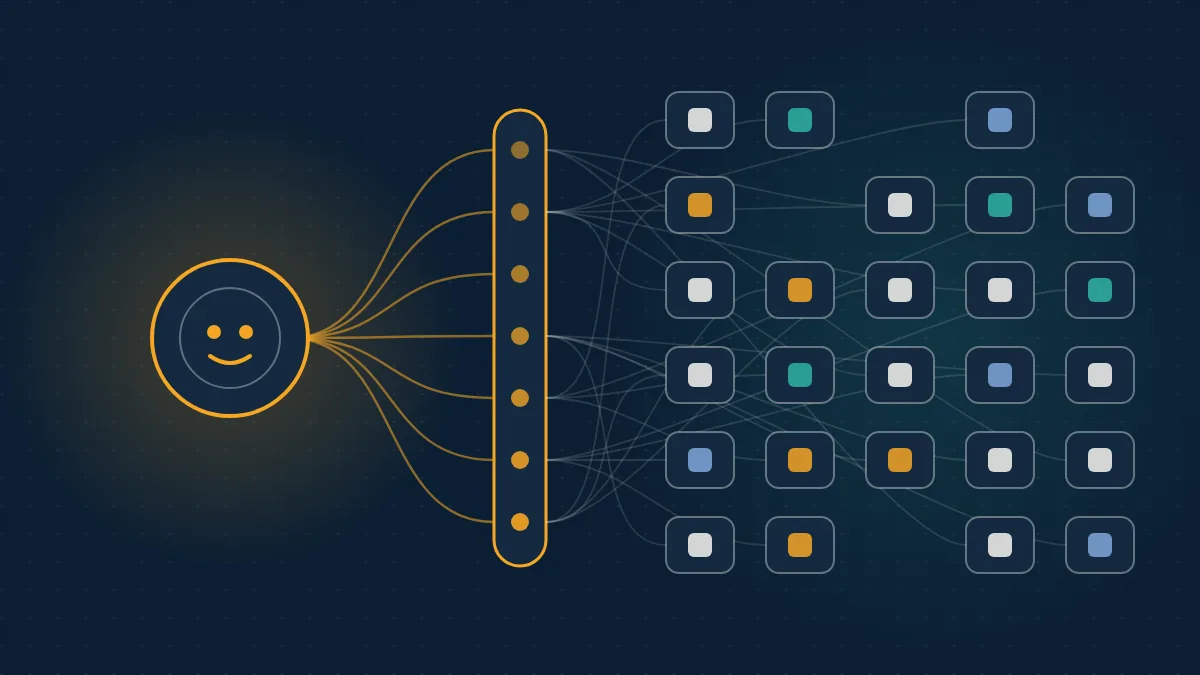
An agent integration platform is a managed layer that connects AI agents to SaaS apps such as Gmail, Salesforce, or Jira, handling OAuth, token refresh, tool schemas, and execution so the model can call real tools safely. This guide sits in the MCP and Agent Protocols hub under the MCP topic. Placement is unpaid, per our editorial standards and disclosure policy.
The choice matters more than catalog size suggests. Every platform here now speaks the Model Context Protocol (MCP), but they differ sharply on whose accounts the agent acts on, how tightly tools can be scoped, and what a single tool call costs, which ranges from $0.0003 to $0.01 on published rates.
TL;DR
- Best overall: Composio, with more than 1,600 toolkits, session-based tool discovery, and 100,000 free tool calls a month on its own-app Hobby tier.
- Per-user authorization: Arcade keeps OAuth tokens out of the model and checks the intersection of agent and user permissions on every call, with VPC and air-gapped deployment on Enterprise.
- Open source and code-owned: Nango runs TypeScript action functions, supports 1,000+ APIs and MCP servers, and exposes scoped, expiring agent sessions as MCP servers.
- Embedded B2B integrations: Merge Agent Handler (190+ connectors, inline data loss prevention), Paragon ActionKit (59 integrations, self-host option), StackOne (550+ connectors), and Unified.to (43,456 tools as of July 22, 2026).
- Your own employees: Zapier MCP reaches 9,000+ apps at 2 tasks per successful call, and Workato Enterprise MCP had 58 prebuilt servers by July 2026.
- Price spread: published overage rates run from $0.0003 per call on Composio to $0.01 on Arcade Team, so model your monthly call volume before you commit.
10 Best Agent Integration Platforms at a Glance
Pick an agent integration platform by whose accounts the agent uses, then compare catalog depth, MCP support, and the cost of one tool call. The table lists each platform’s own catalog claim and its entry pricing as of October 15, 2026. Vendors count toolkits, connectors, and actions differently, so treat the catalog column as a rough size signal.
| Platform | Best for | Catalog (vendor count) | MCP access | Entry pricing |
|---|---|---|---|---|
| Composio | Broad catalog for agent products | 1,600+ toolkits | Hosted session MCP URL | Free; Pro $29/mo |
| Arcade | Per-user auth and governance | 8,000+ tools | MCP runtime, MIT server framework | Free; Team $25/mo + usage |
| Nango | Open-source, code-owned tools | 1,000+ APIs and MCPs, 7k tools | Agent session MCP URL | Free; $50/mo pay as you go |
| Pipedream Connect | Large catalog with credit pricing | 3,000+ APIs, 10,000+ tools | Hosted MCP per app | Free in dev; Startup $99/mo |
| Merge Agent Handler | Governed B2B tool calls | 190+ connectors | Tool Pack MCP endpoint | Free 2,000 credits; Pro $1,000/mo |
| StackOne | Enterprise and HR depth | 550+ connectors, 34,000+ actions | MCP, A2A, SDK, REST | Free; Team $600/mo |
| Paragon ActionKit | Embedded integrations, self-host | 59 integrations | ActionKit MCP and REST | Free start; Pro via sales |
| Unified.to | Unified schemas plus raw tools | 43,456 tools, 575 integrations | Regional Streamable HTTP | Grow $750/mo |
| Zapier MCP | Personal and team assistants | 9,000+ apps, 40,000+ actions | One server per MCP client | Free 100 tasks; Pro $19.99/mo |
| Workato Enterprise MCP | Governed process tools for staff | 58 prebuilt servers | Managed MCP servers | Workato customers, quote based |
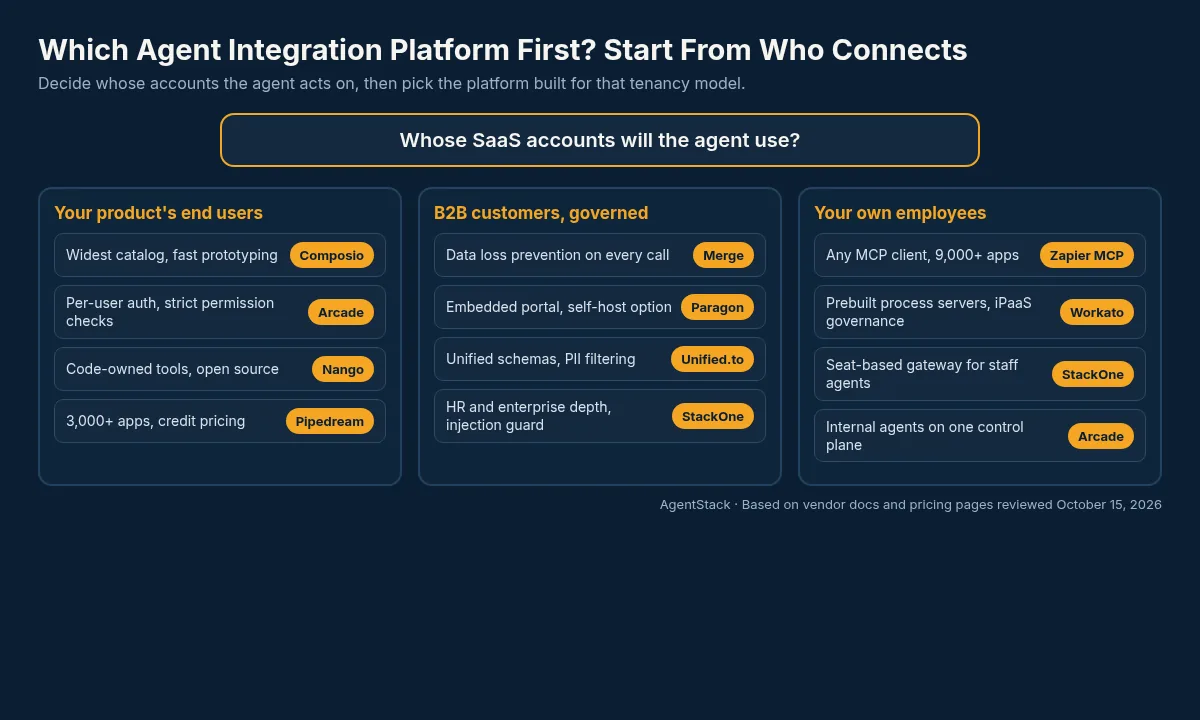
Verdict: Choose Composio or Pipedream when catalog breadth decides the build. Choose Arcade or Merge when a security review will ask how every call is authorized and logged. Choose Zapier MCP or Workato when the agents serve your own staff, because both run on accounts your company already governs.
How We Ranked These Agent Integration Platforms
We ranked platforms on how safely and cheaply they let an agent call a real SaaS tool on behalf of a real user, using only documented features. Each pick had to expose tools to agents over MCP or a tool-calling API, manage OAuth for end users, and publish docs we could capture on October 15, 2026.
- Authorization model: per-user OAuth, tokens kept away from the model, and a clear way to revoke access.
- Tool scoping: filters, packs, or sessions that limit which tools an agent can reach.
- Catalog depth: the number and quality of prebuilt tools, plus a path to custom tools.
- Governance: audit logs, data loss prevention, and prompt injection screening.
- Deployment: cloud, VPC, self-hosted, or on-premises options.
- Pricing clarity: a published free tier and a published per-call or per-credit rate.
We did not run paid benchmarks, so there are no star ratings. Catalog counts come from each vendor and use different units, and we flag vendor claims as claims. Ranking order reflects fit for the most common job: a product team giving its agent access to customers’ SaaS accounts.
1. Composio: Widest Catalog With Session-Based Discovery
Composio is the best overall agent integration platform for teams that need the widest SaaS catalog and a fast path from prototype to production. Its docs list 1,608 toolkits as of October 15, 2026, each a set of tools for one app such as GitHub, Gmail, or Slack, per the Composio toolkits catalog.
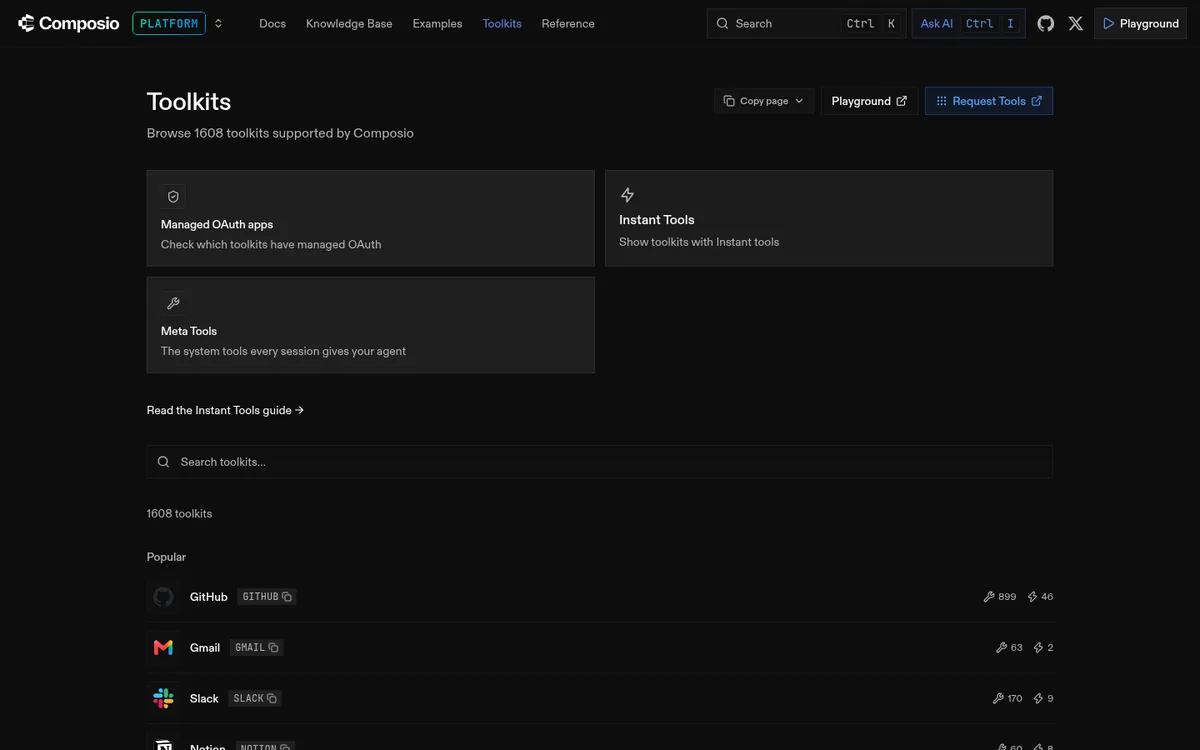
Sessions are the current integration model. A call such as composio.create(user_id) returns meta tools for discovery, authentication, and execution, so the agent finds tools as it needs them instead of loading every schema. The toolkit docs let you restrict a session to chosen toolkits, individual tools, or tags such as read-only, and the connected account’s own permissions still apply.
- Best for: AI product teams that want one SDK or MCP URL for hundreds of apps, with OpenAI, Anthropic, and Vercel AI SDK providers.
- Pricing (October 2026): Hobby is $0 with 100,000 own-app tool calls and 50,000 trigger events a month; Pro is $29 a month with a $29 usage credit and $0.0003 per extra tool call, per the Composio pricing page.
- Watch out for: Composio-managed shared OAuth apps cap at 20,000 of the free calls and cost $0.0005 per call after that, and Composio itself recommends bringing your own OAuth app as you scale.
2. Arcade: Per-User Authorization for Production Agents
Arcade is the strongest pick when security reviewers need every tool call to run with the requesting user credentials and no token in the model. Arcade brokers OAuth 2.0 and API keys, then injects them at runtime, so neither the client nor the large language model (LLM) sees them, per the Arcade authorized tool calling docs.
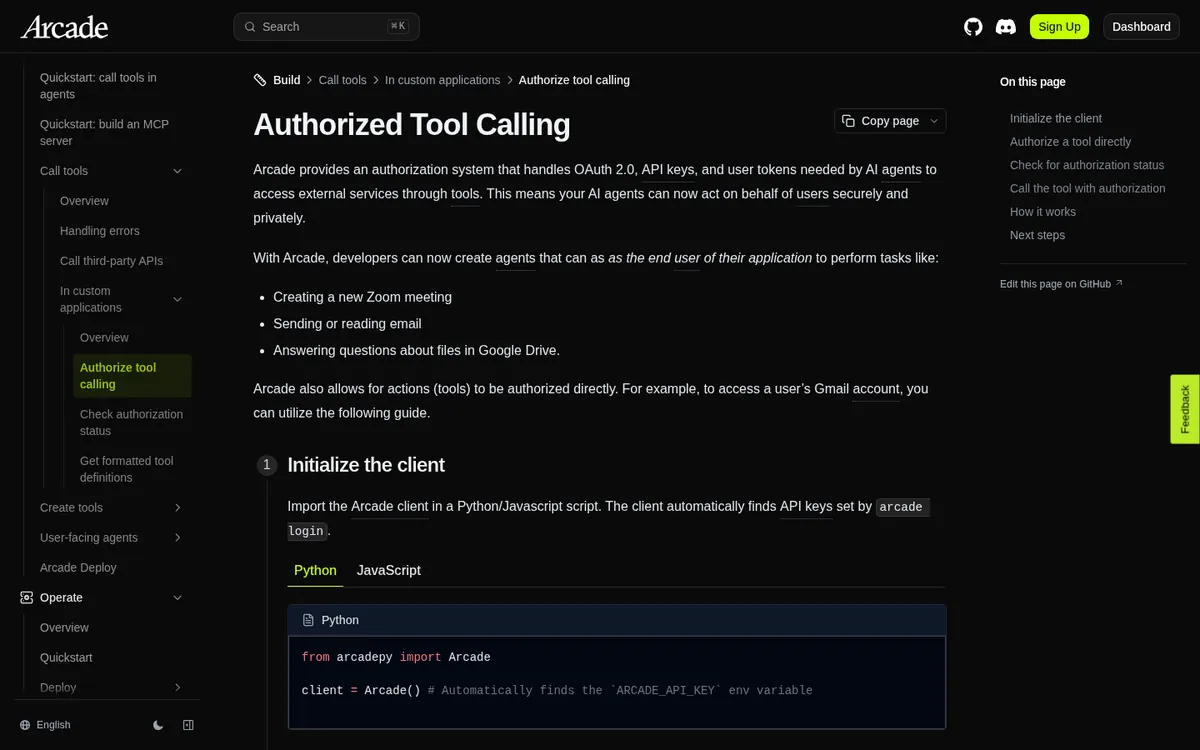
Arcade describes itself as an MCP runtime. Each request carries a project key and a user identity, and Arcade evaluates the intersection of agent and user permissions at execution time, per its runtime guide. The vendor reports a hosted catalog of more than 8,000 agent-optimized tools and integrations with Okta, Microsoft Entra ID, and SailPoint, per its tool calling explainer, and the arcade-mcp framework for custom servers is MIT-licensed.
- Best for: multi-user production agents in regulated companies, and teams that need VPC, on-premises, or air-gapped deployment.
- Pricing (October 2026): Free includes 2,000 tool calls and 2,000 auth events a month; Team is $25 a month plus $0.01 per tool call and $0.10 per auth event, per the Arcade pricing page.
- Watch out for: at $0.01 per call, Arcade Team costs about 33 times Composio’s published overage rate, and the first call to a tool needing OAuth stops for user consent before it can be re-run.
3. Nango: Open-Source, Code-Owned Agent Tools
Nango is the best agent integration platform for engineering teams that want to own tool logic as code and keep the option to self-host. It is open source under the Elastic License, runs integration logic as TypeScript functions on a managed runtime, and works with MCP and LangChain, per the Nango GitHub repository.
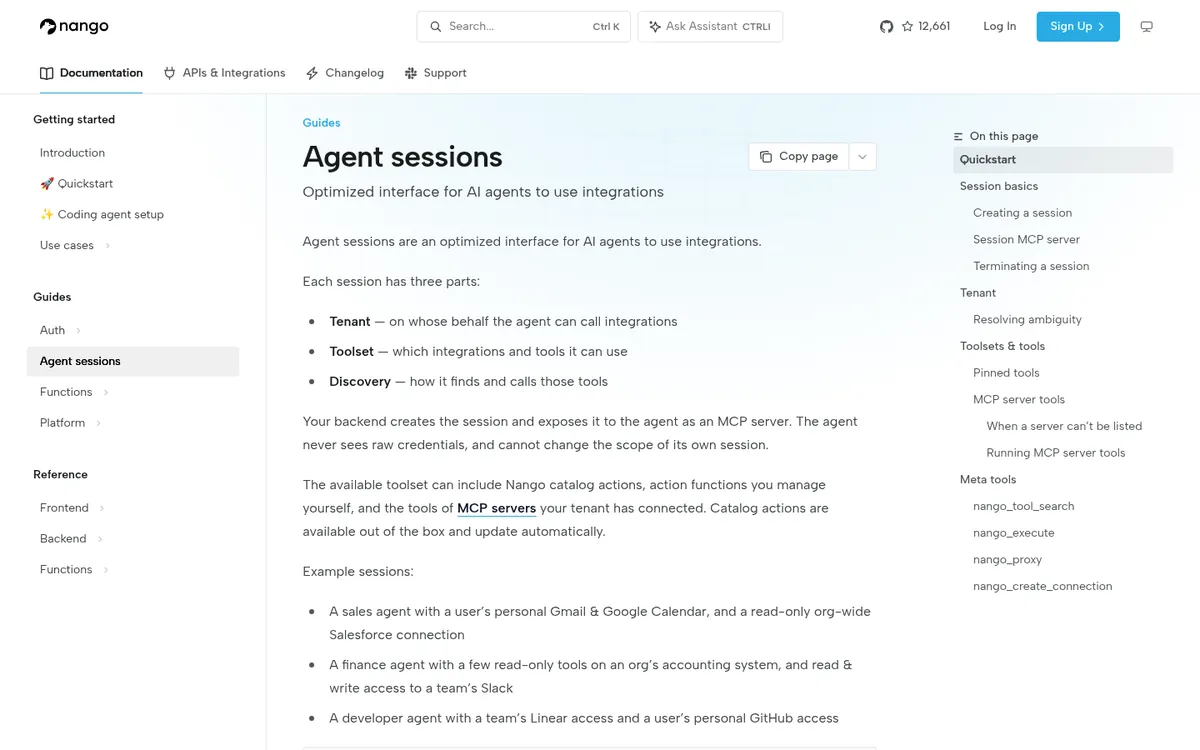
Agent sessions are the tool calling interface. Your backend creates a scoped, expiring session that pins connections and allowed tools, and each session exposes its own Streamable HTTP MCP server at an mcp_url, per the agent sessions docs. The older Connection MCP is deprecated, and a migration guide notes that sessions cannot be extended once they expire.
- Best for: product teams that want version-controlled tools, logs, retries, and rate-limit handling under their own review process.
- Pricing (October 2026): Free covers 10 connections, 10 compute hours, and 10 GB a month; pay as you go is $50 a month with $50 in credits, then $0.29 per connection and $0.72 per compute hour, per the Nango pricing page.
- Watch out for: the
nango_proxymeta tool bypasses allow and deny lists, so turn it off for agents that must stay inside a fixed toolset.
4. Pipedream Connect: 3,000+ APIs Behind One MCP Endpoint
Pipedream Connect gives agents managed OAuth and more than 10,000 prebuilt tools across 3,000+ APIs, the second-largest app catalog on this list after Zapier. Each app has its own MCP server, and developers call them on behalf of users through Pipedream Connect, per the Pipedream MCP docs.
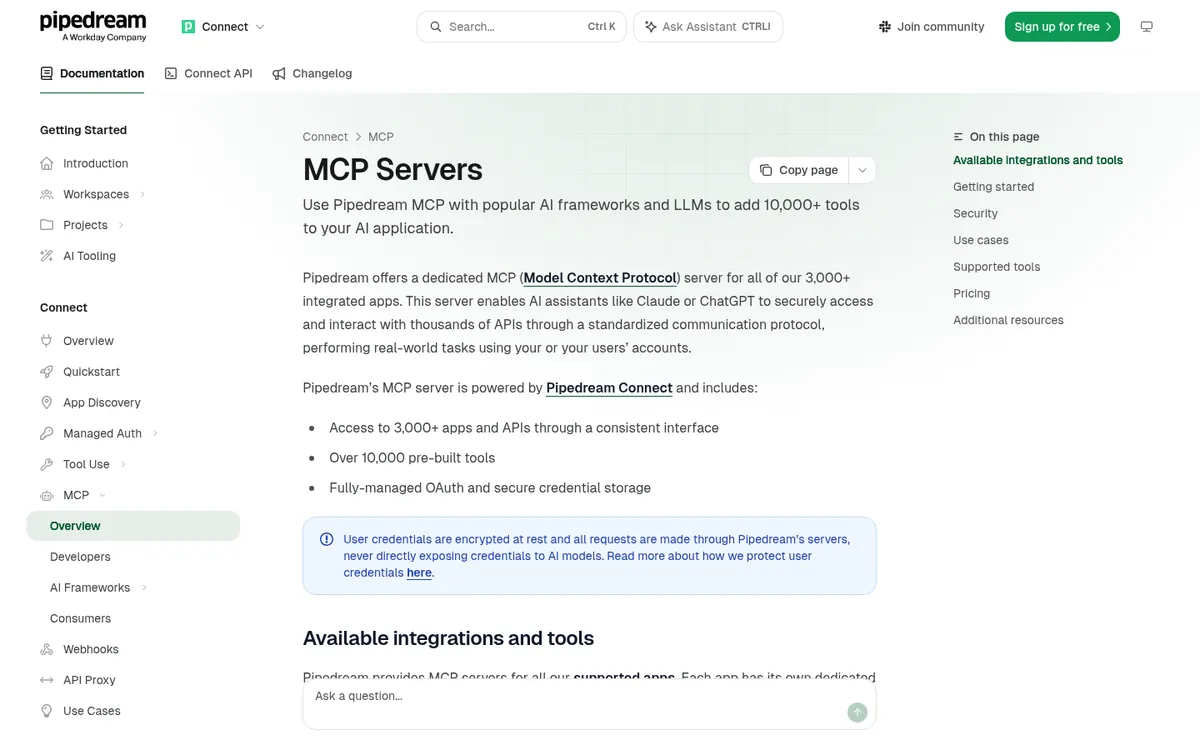
Agents connect to https://remote.mcp.pipedream.net/v3 with headers for project ID, environment, external user ID, and app slug, per the developer guide. You can also publish custom tools to a workspace and use them through the same server. Pipedream is now part of Workday, which positions it as the connectivity layer for Workday agents.
- Best for: teams that want a very large catalog with code steps in Node.js or Python when a prebuilt tool falls short.
- Pricing (October 2026): development is free; Startup is $99 a month billed annually or $150 monthly, with 100 external users and 10,000 credits included, then $2 per user and $0.012 per credit, per the Pipedream pricing page.
- Watch out for: credits are metered per 30 seconds of compute, and SSO, SCIM, and HIPAA require the custom Business plan.
5. Merge Agent Handler: Governed Tool Calls for B2B Products
Merge Agent Handler is the pick for B2B products whose agents touch customer CRMs, health records, or payment systems and need data loss prevention inline. It offers 190+ MCP-ready connectors as of September 2026, per-user authentication, Tool Packs that bound which tools an agent can reach, and an audit trail of every call, per the Merge Agent Handler docs.
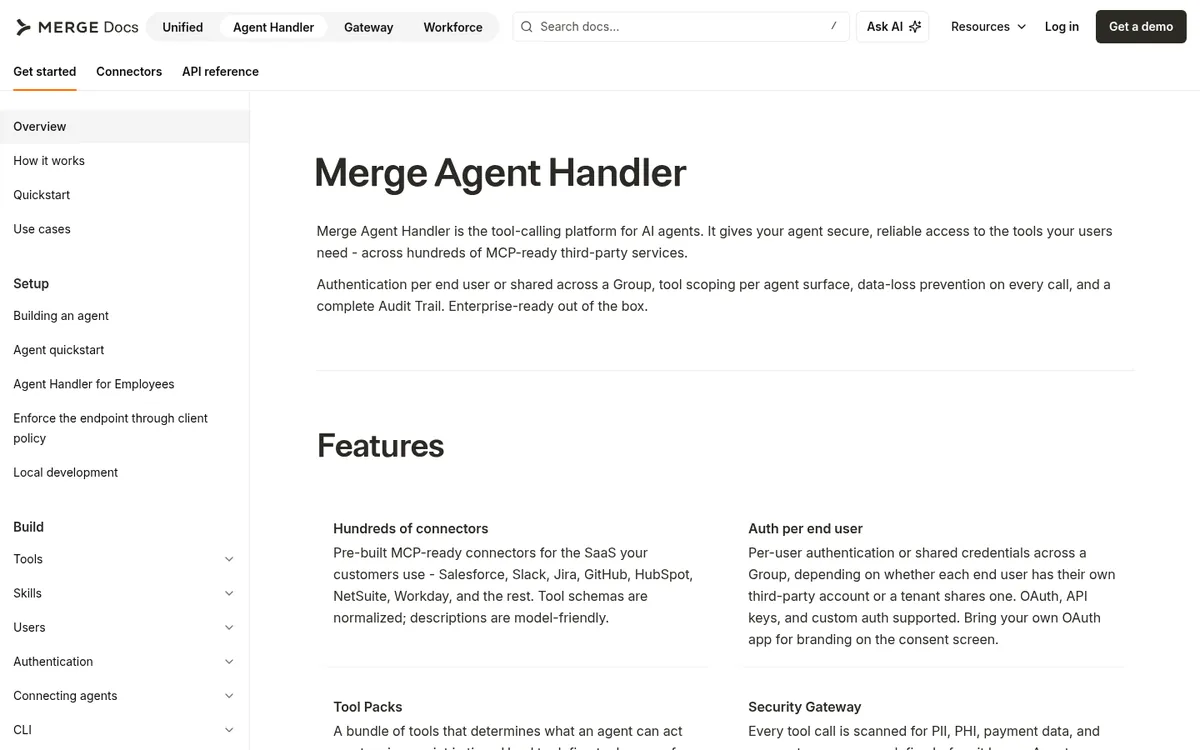
The Security Gateway scans every tools/call against entity rules for personal, financial, and health data, plus custom regex rules and plain-English guardrails, and can allow, redact, or block before arguments leave Merge. Teams already on the Merge Unified API reuse the same Link flow and credential store, so they avoid a second authentication system.
- Best for: SaaS vendors shipping agents to enterprise customers who will ask for SOC 2 Type II, ISO 27001, and HIPAA evidence.
- Pricing (October 2026): Free includes 2,000 credits a month with one credit per tool call; Pro is $1,000 a month for 25,000 credits, per the Merge Agent Handler pricing page.
- Watch out for: the jump from free to $1,000 a month is steep for early pilots, and custom internal connectors and SIEM log streaming are Enterprise features.
6. StackOne: Enterprise Connectors With Prompt Injection Defense
StackOne suits teams whose agents work across HR, recruiting, identity, and other enterprise systems, and who want prompt injection screening on every tool response. It claims 550+ connectors and 34,000+ actions, reachable through MCP, Agent2Agent (A2A), Python and TypeScript SDKs, or REST, per the StackOne homepage.
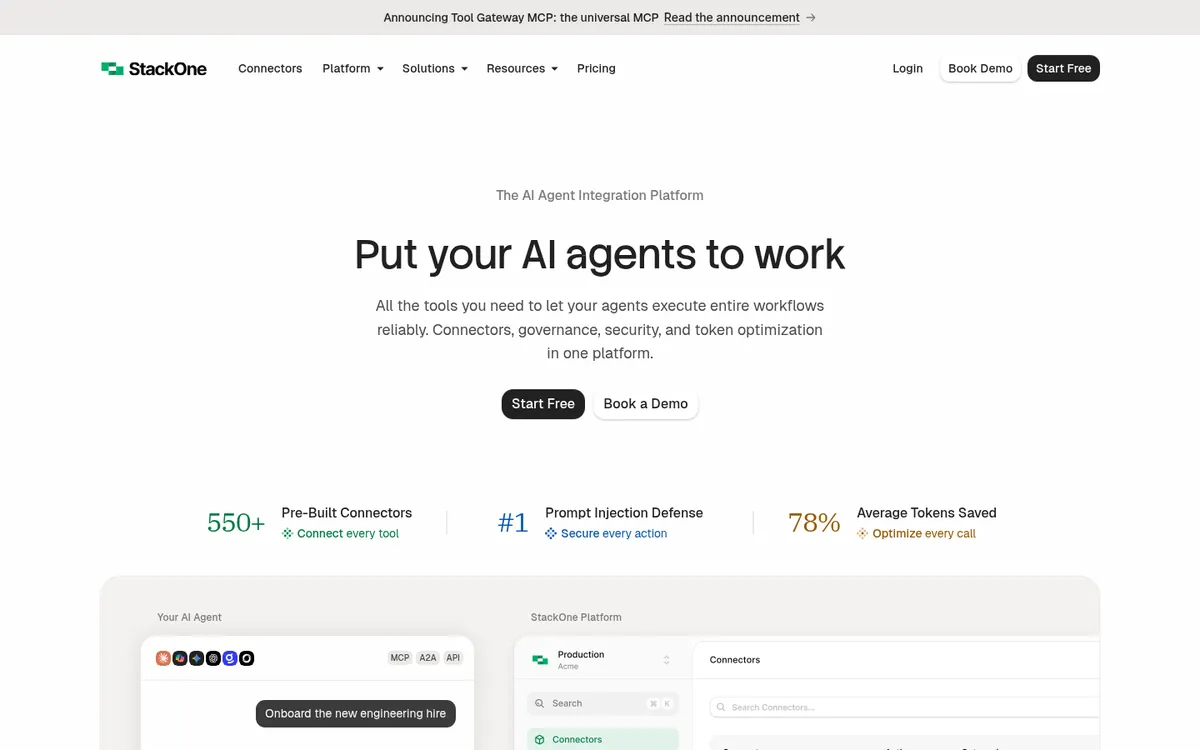
Defender Core, an open-source prompt injection scanner, runs on every plan, and StackOne says its guard catches 89% of malicious tool responses, a vendor figure we did not test. Pricing splits into Gateway plans for your own employees and OEM plans for embedding in a product, per the StackOne pricing page.
- Best for: companies connecting agents to Workday, Greenhouse, SharePoint, and similar systems, for staff or for customers.
- Pricing (October 2026): Gateway Starter is free with 1,000 credits per seat a month; Team is $600 a month with 5,000 credits per seat; OEM Core is free to start.
- Watch out for: Tool Policies, PII redaction, and SAML SSO start on Team, and Starter keeps action logs for only 1 day.
7. Paragon ActionKit: Embedded Integrations You Can Self-Host
Paragon ActionKit is the best fit for SaaS products that want one API and MCP server for agent actions, plus the option to run the whole platform in their own cloud. ActionKit returns JSON Schema tool definitions per user and executes them with that user’s credentials, per the ActionKit tool calling docs.
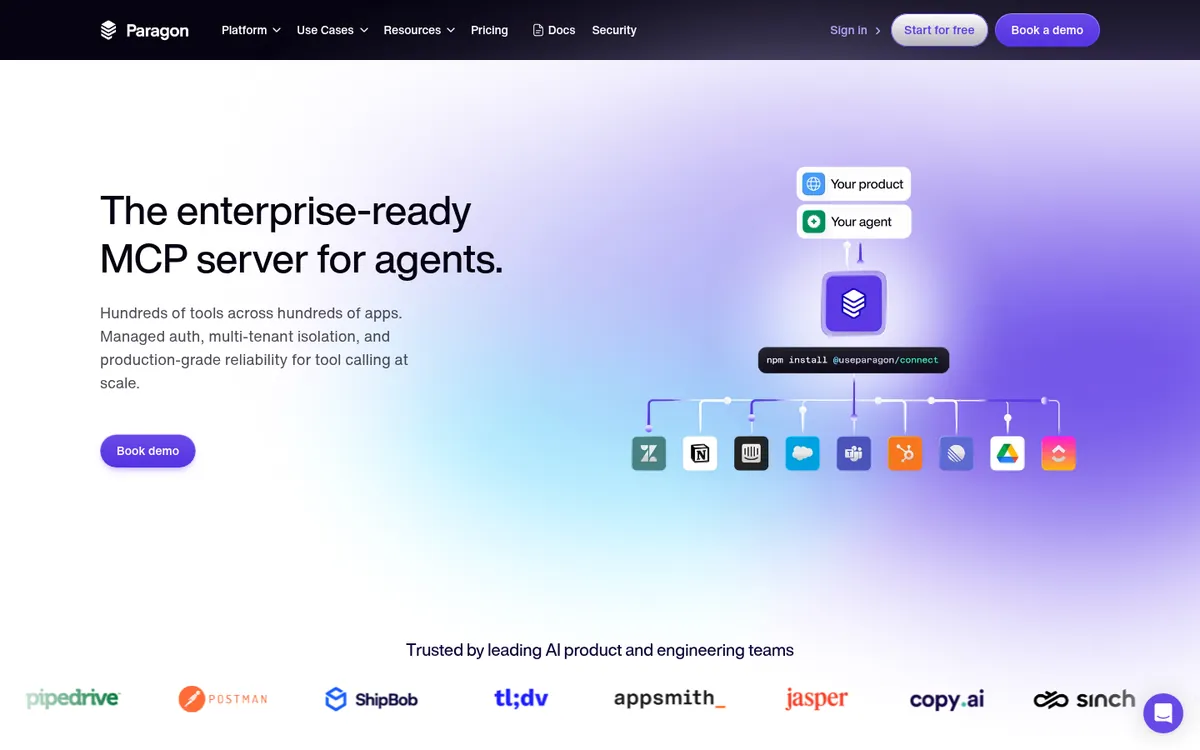
The supported integrations page lists 59 integrations as of October 15, 2026, including Salesforce, HubSpot, NetSuite, SAP S/4HANA, and ServiceNow. Paragon adds a white-labeled Connect Portal, webhook triggers, and self-hosting on AWS, GCP, or Azure, per its ActionKit MCP page.
- Best for: B2B SaaS teams that also need managed sync for retrieval-augmented generation (RAG) and embedded workflows from the same vendor.
- Pricing (October 2026): a free platform tier gets you started; Pro and Enterprise are priced through sales and scale with connected users, per the Paragon pricing page.
- Watch out for: the ActionKit catalog is far narrower than Composio or Pipedream, so check that your required apps are on the list before you sign.
8. Unified.to: Unified Schemas Plus 43,000 Raw Tools
Unified.to fits teams that want normalized data models across CRM, HR, and ticketing apps, with a very large MCP tool catalog behind them. Its MCP server carried 43,456 tools as of July 22, 2026, including 8,242 unified tools, across 575 integrations in 32 categories, per the Unified.to MCP v2 post.
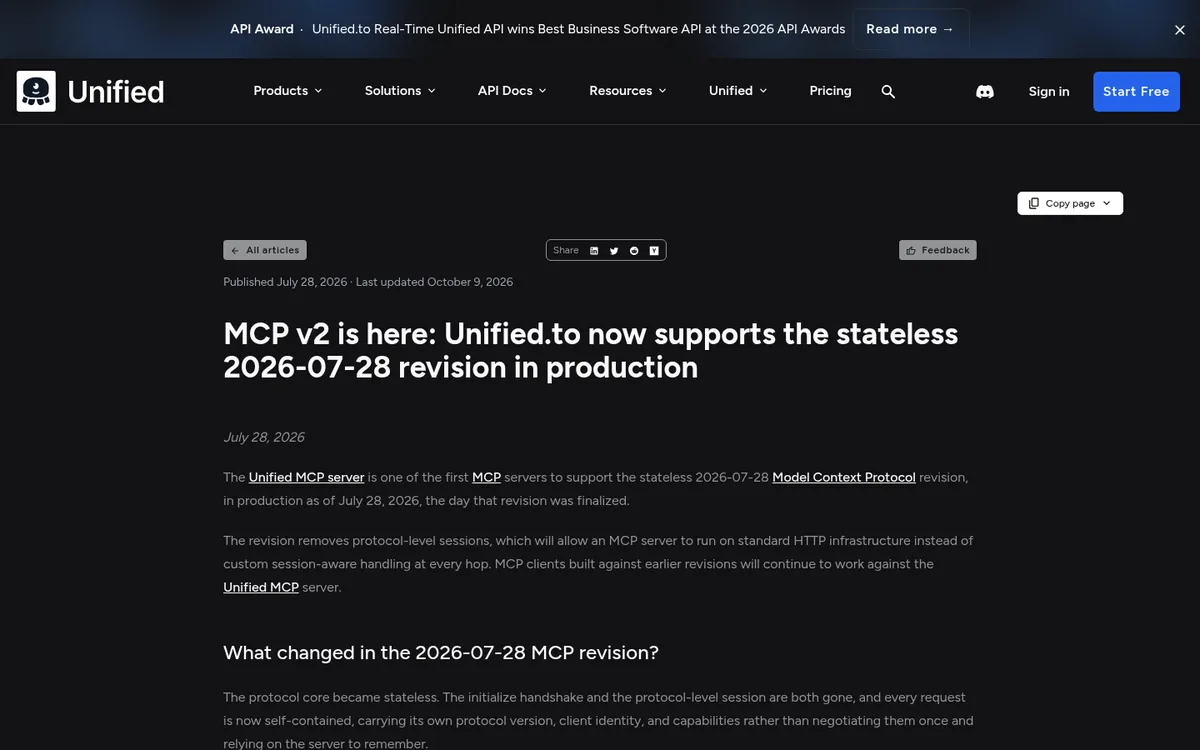
Unified.to adopted the stateless 2026-07-28 MCP revision in production on July 28, 2026, and serves US, EU, and AU regional endpoints. A hide_sensitive setting strips names, emails, and phone numbers from tool responses before they reach the model, and SSE was removed on September 23, 2026, so /sse now returns HTTP 410.
- Best for: product teams that need one schema across many vendors in a category and regional data residency.
- Pricing (October 2026): Grow is $750 a month with 750,000 API calls and unlimited connections, then $1.00 per 1,000 calls, with a 30-day free trial, per the Unified.to pricing page.
- Watch out for: a 43,000-tool catalog is too large for any model to load, so you must filter with
permissions,tools, ordefer_tools.
9. Zapier MCP: 9,000+ Apps for Assistants Your Team Uses
Zapier MCP is the quickest way to give an assistant such as Claude, ChatGPT, or Cursor actions across 9,000+ apps using connections your team already has in Zapier. It exposes 40,000+ actions, signs in with OAuth, and runs on Streamable HTTP only, per the Zapier MCP docs.
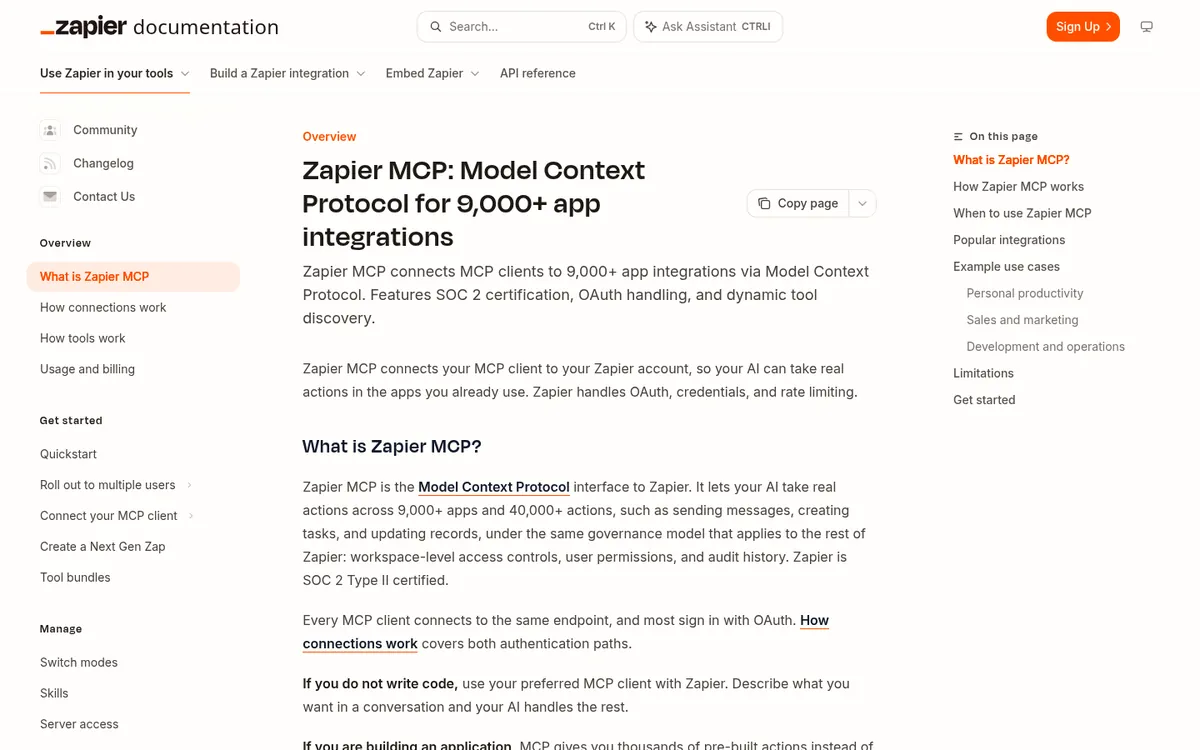
Each successful tool call uses 2 tasks from your Zapier plan, and failed calls are free, per the usage and billing docs. Each named MCP client gets one server, and sharing a server with teammates needs a Team or Enterprise plan. Enterprise adds app access controls and action restrictions, per the Zapier pricing page.
- Best for: operations and go-to-market teams that want assistants to act in the same apps their Zaps already use.
- Pricing (October 2026): Free includes 100 tasks a month, or about 50 tool calls; Professional starts at $19.99 a month billed annually for 750 tasks, or about 375 tool calls.
- Watch out for: tools run on the connections inside one Zapier account, which in our reading suits internal assistants better than per-customer product embedding.
10. Workato Enterprise MCP: Governed Process Servers for Staff
Workato Enterprise MCP suits enterprises already on Workato that want agents to run approved business processes, such as onboarding or vendor setup, under each user identity. Verified User Access makes agent actions inherit the signed-in user’s role-based access and audit trail, per the Workato Enterprise MCP page.
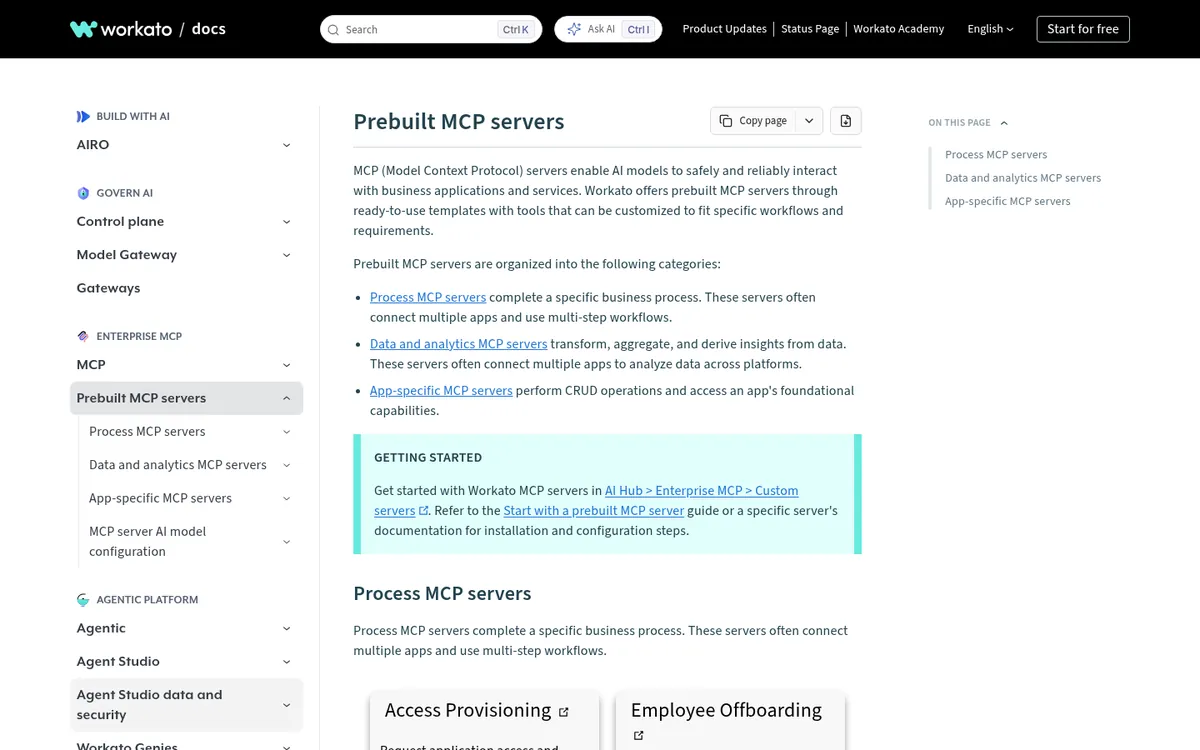
The prebuilt server catalog groups servers into process, data and analytics, and app-specific types, such as an Employee Offboarding server spanning Workday, Okta, Slack, and ServiceNow that previews revocations before executing. Workato reported 58 production-ready servers in a July 2026 update, and existing recipe functions can become MCP servers without code.
- Best for: IT, HR, and finance teams that want multi-step process tools with human confirmation, not raw API wrappers.
- Pricing (October 2026): available to Workato customers with Enterprise MCP; we found no public per-call price, so budget through sales.
- Watch out for: the catalog is small next to developer platforms, and the value depends on already running Workato recipes.
Governance and Deployment Compared
The safest agent integration rollout keeps tokens out of the model, scopes each session to a few tools, and logs every call against a named user. The table shows each documented control as of October 15, 2026. A cell marked not listed may still be available under contract.
| Platform | Tool scoping | Data or injection controls | Self-host or VPC |
|---|---|---|---|
| Composio | Toolkit, tool, and tag filters per session | Connected account permissions | Not listed on pricing page |
| Arcade | Agent and user permission intersection | Tokens isolated from LLM, audit logs | VPC, on-prem, air-gapped (Enterprise) |
| Nango | Pinned connections, allow and deny lists | Logs, OpenTelemetry export | Self-host free (limited) or Enterprise |
| Pipedream Connect | One MCP server per app | Credentials scoped per project | Not listed on pricing page |
| Merge Agent Handler | Tool Packs | Security Gateway DLP and guardrails | On-prem, mVPC (Enterprise) |
| StackOne | Action, field, and user permissions (Team) | Defender prompt injection scanning | On-prem or VPC add-on (Enterprise) |
| Paragon ActionKit | Per-user tools, integration filters | Per-tenant token encryption | Self-host on AWS, GCP, Azure |
| Unified.to | permissions, tools, defer_tools | hide_sensitive PII filter, regions | Private cloud or on-prem (Enterprise) |
| Zapier MCP | Tools chosen per server | Action restrictions (Enterprise) | Not listed |
| Workato Enterprise MCP | Curated tools per server | Verified User Access, audit logs | Not listed |
Verdict: Merge and StackOne do the most inspection of tool inputs and outputs. Arcade and Paragon offer the most deployment choice for regulated buyers. Composio and Pipedream give the most catalog per dollar but leave content screening to you.
Two documented patterns for user-scoped tool calls
Both snippets come from vendor quickstarts. The first opens a Composio session for one user, and the second asks Arcade to authorize a tool for a user before executing it.
# Composio: one session per end user (Python SDK)
from composio import Composio
composio = Composio()
session = composio.create(user_id="user_123")
tools = session.tools()  # meta tools for discovery, auth, execution

# Arcade: authorize, wait for consent, then execute
auth = client.tools.authorize(tool_name="Gmail.ListEmails", user_id=USER_ID)
if auth.status != "completed":
    print(auth.url)
    client.auth.wait_for_completion(auth.id)
client.tools.execute(tool_name="Gmail.ListEmails", input={}, user_id=USER_ID)
Security Risks to Check Before You Connect
Every agent integration platform widens what a model can do with real accounts, so the main risks are over-broad scopes, prompt injection in tool responses, and proxy tools that skip your allow list. Nango’s own docs warn that its proxy tool bypasses allow and deny rules, and Merge built its Security Gateway for this exact gap.
MCP tooling still ships bugs. Our coverage of the ToFu MCP fuzzing study found 253 verified bugs across 118 MCP servers, and broader agent risks sit in our Agent Security topic.
- Bring your own OAuth app: shared vendor OAuth apps are fine for demos, but your own app gives you branded consent and your own rate limits.
- Scope each session: one user, a few tools, and a short lifetime, as Nango sessions and Merge Tool Packs allow.
- Turn off raw proxies: disable any tool that lets the agent call arbitrary endpoints outside the approved list.
- Screen tool responses: emails, tickets, and docs can carry injected instructions, so use Defender, the Merge Security Gateway, or your own filter.
- Keep humans on writes: require confirmation for sends, deletions, and payments, the pattern Workato’s process servers follow.
What We Left Out and Why
- LLM gateways: gateways route model traffic, not SaaS tool calls, and are covered in our LLM gateways guide.
- MCP gateways and registries: they govern traffic to MCP servers you already run and do not supply the integrations themselves.
- Activepieces: its MIT-licensed MCP server mainly builds and manages flows, and running a single piece action costs 1 credit per call, per the Activepieces MCP docs. It is a strong open-source automation tool, but a narrower agent tool layer.
- Single-vendor MCP servers: a GitHub or Salesforce server covers one system, while every pick here covers many.
Our Recommendation for Tool Calling in 2026
Start with Composio for a broad prototype, then move to Arcade, Merge, or Nango when security review, data loss prevention, or code ownership becomes the constraint. Teams building for their own employees should trial Zapier MCP first and graduate to Workato or StackOne Gateway when they need central governance.
Run a two-week pilot with your 10 most-called tools, log cost per call, and test one prompt injection case before you commit. Pair the pilot with AI agent observability tools and the AgentOps tools map so you can see which tools the agent calls and why, and compare runtimes in AI agent frameworks.
Spotted a platform we missed or a price that changed? Send it through our contact page.
Related Guides
- MCP and Agent Protocols hub
- MCP topic
- Agent Security topic
- ToFu finds 253 bugs in 118 MCP servers
- Claude Managed Agents dynamic workflows
- AI agent frameworks compared
- Best LLM gateways for enterprise AI teams
- AgentOps hub
- AgentOps tools map
- Best AI agent observability tools
- Open source LLM observability
- AI agent evaluation tools
- Editorial standards · Disclosure · Contact
Frequently Asked Questions
What is an AI agent integration platform?
An AI agent integration platform is a managed service that connects agents to SaaS apps through tool calling or MCP. It handles OAuth consent, token storage and refresh, tool schemas, and execution, so developers do not build and maintain a separate integration for every app their agent needs to read or change.
Is an agent integration platform the same as an MCP gateway?
No, the two layers do different jobs. An agent integration platform supplies prebuilt tools and per-user authentication for apps like Gmail or Salesforce. An MCP gateway sits in front of MCP servers you already run and controls routing, access, and logging. Larger teams often run both, with the gateway governing traffic to the platform.
Which agent integration platform is cheapest per tool call?
On published rates in October 2026, Composio is cheapest at $0.0003 per tool call after 100,000 free own-app calls a month. Pipedream charges $0.012 per 30-second credit, Arcade Team charges $0.01 per call, and Zapier MCP uses 2 tasks per successful call from your plan allowance.
Can I self-host an agent integration platform?
Yes, several platforms support it. Nango is open source and can be self-hosted for free with a limited feature set, and Paragon supports self-hosting on AWS, GCP, or Azure. Arcade, Merge, StackOne, and Unified.to offer VPC or on-premises deployment on their enterprise plans, usually under a custom contract.
Do these platforms keep OAuth tokens away from the model?
The leading platforms do. Arcade injects tokens into the tool at runtime so neither the client nor the model sees them, and Nango sessions give the agent a session token instead of provider credentials. Avoid any setup that pastes raw API keys into prompts or tool arguments, because injected instructions can leak them.