
Last updated November 25, 2026. Lab used the official Python MCP SDK, mcp 2.3.0 (the newest release on PyPI on November 25, 2026), with an in-process client on protocol revisions 2026-07-28 and 2025-11-25.
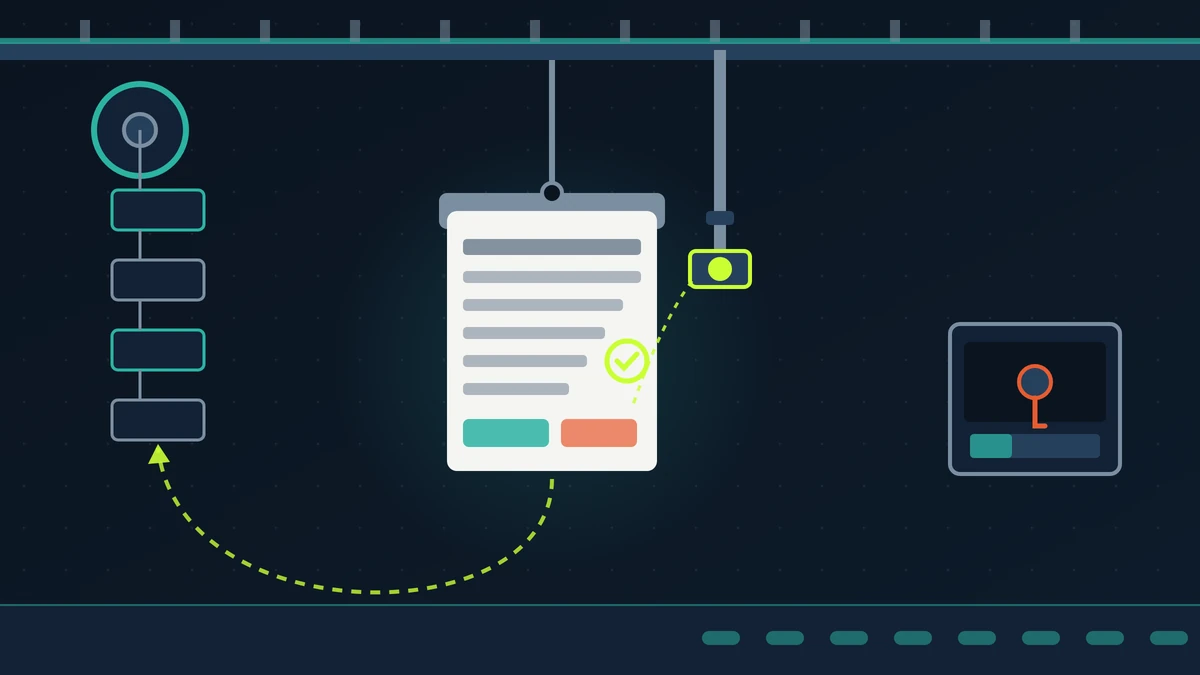
MCP elicitation lets a server pause a tool call and ask the user to confirm or fill in a form, and Anthropic made it generally available in Claude and Claude Code on November 24, 2026, together with MCP Tasks for long background jobs.
The approval is the server’s code, not Claude’s. In our lab with the official Python MCP SDK, the classic ctx.elicit() call failed on every run over the new stateless 2026-07-28 protocol, a hand-rolled retry handler approved a $49 charge with zero prompts when the client pre-filled the answer, and the SDK sent a form asking for an API key and a card CVV even though the spec forbids it. The SDK’s Resolve and Elicit pattern got every case right.
This builds on our best MCP servers guide, the Skills over MCP SDK test from October, and our MCP default approval report. No vendor paid for this page.
TL;DR
- Anthropic made MCP Tasks and Elicitation generally available in Claude and Claude Code on Nov 24, 2026, for Pro, Max and Ultra plans, with Team and Enterprise still rolling out. Skills over MCP entered public beta the same day.
- Tasks let a server answer a slow tool call with a task handle that Claude polls. Elicitation lets a server stop and ask the user through a form or a link.
- On a 2026-07-28 connection, the Python SDK’s ctx.elicit() failed in 9 of 9 runs with NoBackChannelError. The same tool worked on 2025-11-25.
- A hand-rolled multi-round handler accepted a client’s unsolicited “approve: true” and charged $49 with no prompt. The SDK’s Resolve pattern ignored the fake answer and rejected a forged requestState.
- The spec says servers MUST NOT ask for passwords, API keys or payment data in form mode. The SDK sent both an api_key form and a card number plus CVV form in 4 of 4 runs.
What Anthropic made generally available
Anthropic’s November 24 announcement made Tasks and Elicitation generally available in Claude and Claude Code for Pro, Max and Ultra plans, with Team and Enterprise organizations still rolling out. Skills over MCP moved to public beta, and File Uploads is listed as coming soon. The post timed the release to MCP’s second birthday.
Anthropic named early adopters for each feature. ZoomInfo runs account and contact research as Tasks. Supabase uses Elicitation to confirm costs before it creates a paid project and before destructive SQL, Railway asks before removing a service, and GitHub makes users type a repository’s name before an agent deletes it. Shopify, HubSpot and Atlassian ship skills over MCP.
The MCP blog adds scale numbers. The SDKs crossed 5 billion total downloads, more than 4.5 billion of them in the past year, from more than 2,500 contributors. Anthropic’s post puts monthly SDK downloads above 700 million and Claude connectors above 10,000.
| Feature | Status on Nov 24, 2026 | Plans | What it does |
|---|---|---|---|
| Tasks | Generally available | Pro, Max, Ultra; Team and Enterprise rolling out | Slow tool call returns a task handle; the client polls for the result |
| Elicitation | Generally available | Pro, Max, Ultra; Team and Enterprise rolling out | Server pauses a call to ask the user through a form or a URL |
| Skills over MCP | Public beta | On for Pro, Max, Ultra; Team after admin opt-in; Enterprise later | Server ships playbooks with its tools, loaded on demand |
| File Uploads | Coming soon | Pro, Max, Ultra, eligible Team and Enterprise | Claude passes files to a server outside the context window |
How MCP elicitation and Tasks work
Elicitation is a server asking the human a structured question in the middle of a tool call. The spec defines two modes. Form mode collects flat fields such as a string, number, boolean or enum. URL mode sends the user to a web page so sensitive data never passes through the client or the model.
The transport changed with the stateless 2026-07-28 revision. On 2025-11-25, the server sends an elicitation/create request back to the client while the tool call is still open. On 2026-07-28, the server returns an InputRequiredResult with its questions and a sealed requestState, and the client calls the tool again with the answers. Upstash’s write-up shows Claude Code doing exactly that retry.
Tasks are a separate extension, io.modelcontextprotocol/tasks. The Tasks spec lets a server answer tools/call with resultType “task”, a task ID, a TTL and a poll interval, and the client polls tasks/get. The server decides per call. A server must not return a task to a client that did not declare the extension, and must use error -32021 if it cannot serve that client.
We tested the approval paths in the Python SDK
We built a server with the official Python MCP SDK, mcp 2.3.0, and drove it with its in-process client on both protocol revisions. The main tool is a GitHub-style delete that asks the user to type “acme/api”. A scripted user answered accept, a typo, decline, cancel, a number instead of text, or had no elicitation support.
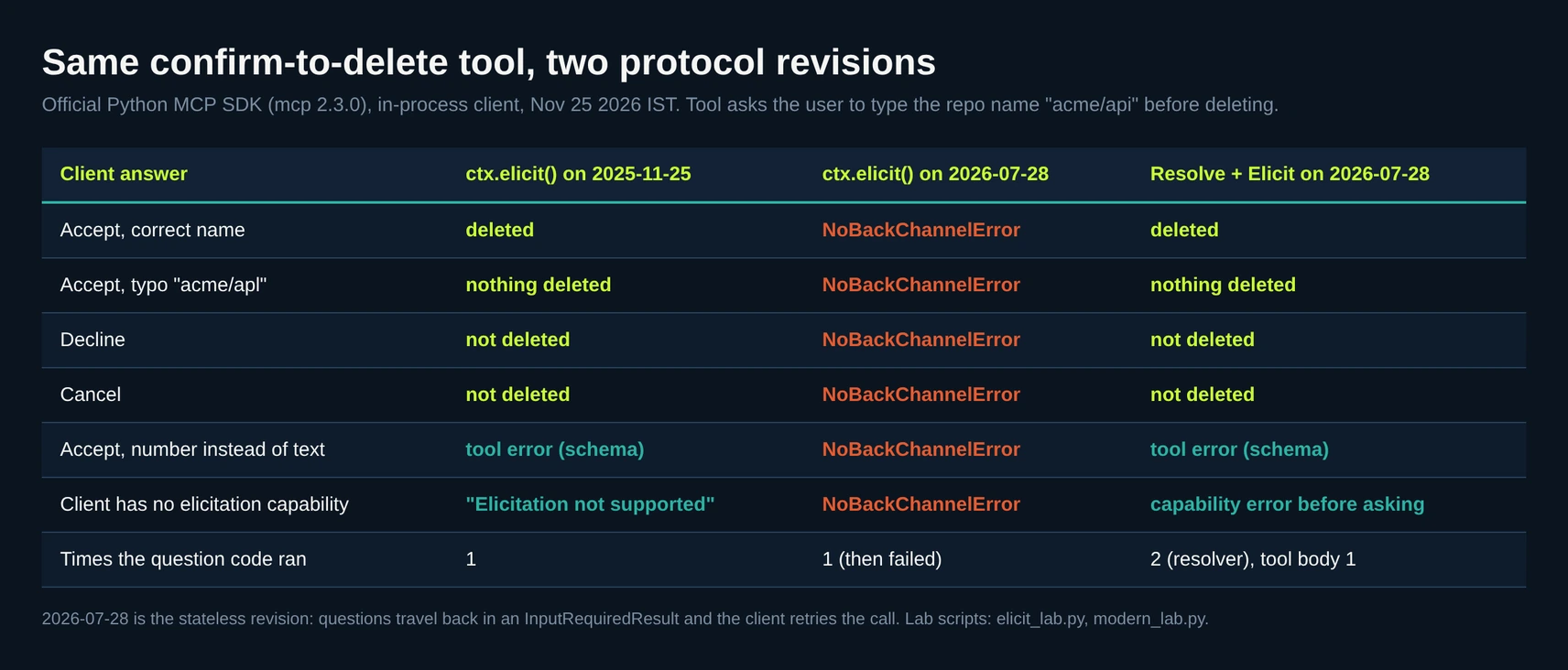
The first result matters most for anyone upgrading. A tool written with await ctx.elicit() worked on 2025-11-25 and failed in all 9 elicitation runs on 2026-07-28 with NoBackChannelError, because a stateless connection has no channel for the server to call the client mid-request. The two runs that never reached the question, a nested schema and a list field, failed earlier on schema checks.
The SDK’s dependency pattern fixed it. A parameter annotated with Resolve(ask_confirm), where the resolver returns Elicit(message, ConfirmName), produced the right outcome on both revisions: deleted on the correct name, nothing deleted on a typo, decline or cancel, and a schema error on the wrong type. On 2026-07-28 the resolver ran twice, once to ask and once on the retry, and the tool body ran once.
def ask_confirm(name: str) -> Elicit[ConfirmName]:
    return Elicit(f"Delete repository {name}? Type its name to confirm.", ConfirmName)

@srv.tool()
async def delete_repo(name: str,
    answer: Annotated[ElicitationResult[ConfirmName], Resolve(ask_confirm)]) -> str:
    if isinstance(answer, AcceptedElicitation) and answer.data.repo_name == name:
        return f"deleted {name}"
    return "not deleted"
Where the approval can be bypassed
A confirmation step is only as strong as the server code behind it. Our second tool creates a pending charge, returns an InputRequiredResult asking “Approve charge of $49?”, and reads ctx.input_responses on the retry. Then the client sent “approve: true” on the very first call, before any question existed.
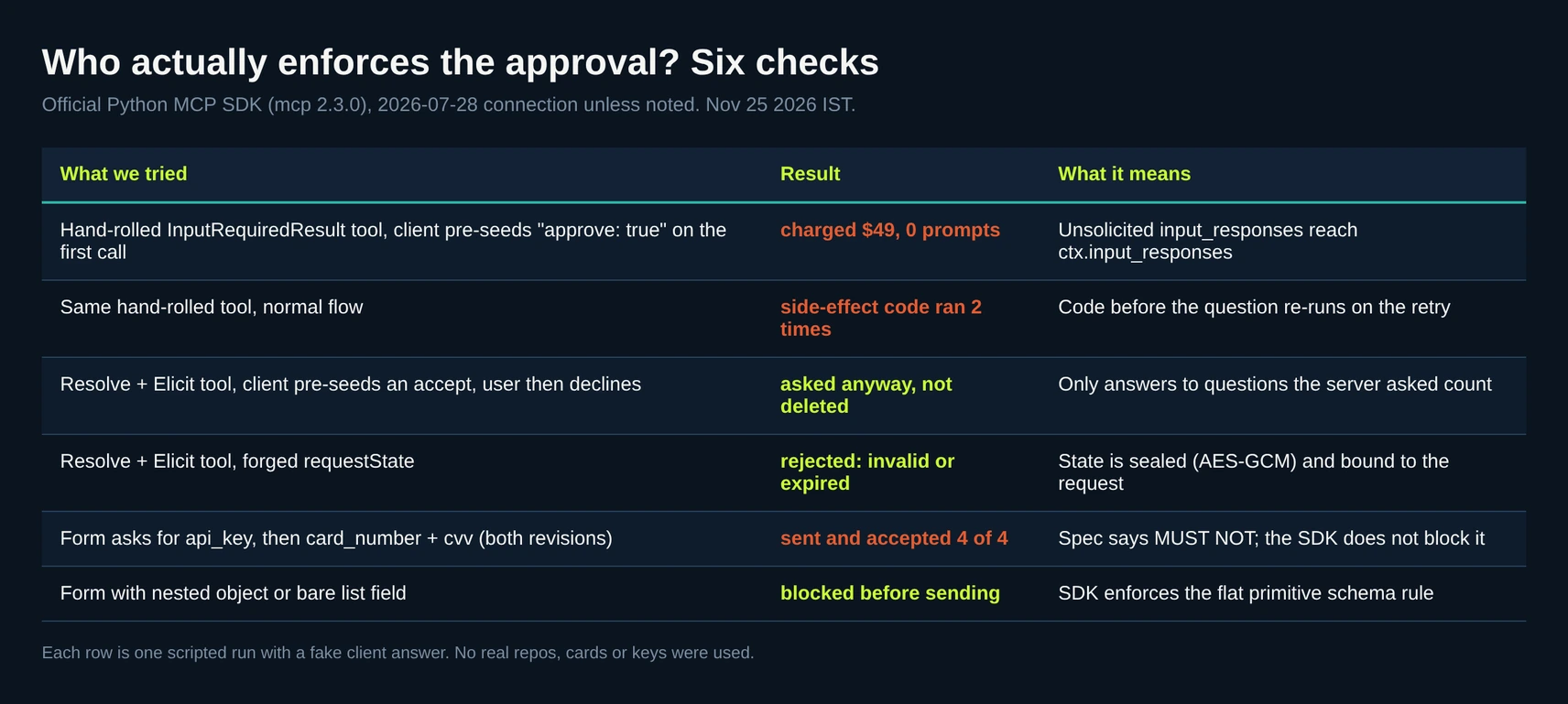
- Pre-seeded answer, hand-rolled handler: charged $49 with 0 prompts shown. The SDK passed the unsolicited answer through to ctx.input_responses.
- Normal flow, hand-rolled handler: the side-effect code ran 2 times for one charge, once per round.
- Pre-seeded answer, Resolve pattern: the server asked anyway, the user declined, and nothing was deleted.
- Forged requestState: rejected with “Invalid or expired requestState”. The SDK seals the state with AES-GCM and binds it to the request.
- Secrets in form mode: forms for api_key and for card_number plus cvv went out and came back in 4 of 4 runs across both revisions.
- Bad schemas: a nested object field and a bare list[str] field were blocked before sending, as the spec’s flat schema rule requires.
The pre-seeded case is the one to watch. Any MCP client, including a compromised or prompt-injected one, can attach answers to a first call, so a handler that trusts ctx.input_responses without checking that it asked the question gives a fake approval. The Resolve pattern only accepts answers to questions recorded in its sealed state.
What the Claude Code docs add
The Claude Code MCP docs spell out the limits. MCP tasks need Claude Code v2.1.304 or later, and v2.1.331 or later in the VS Code extension and desktop app sessions. A one-shot claude -p run does not get MCP tasks. A call needs a server that supports tasks on protocol 2026-07-28, so setting MCP_PROTOCOL_NEGOTIATION=legacy turns them off.
Headless runs cannot answer questions. In claude -p runs and Agent SDK sessions, Claude Code asks the server to cancel a task that opens an elicitation, without running your Elicitation hooks or the onElicitation callback. In an interactive terminal, a call waiting on an open dialog is not moved to the background, and you can press Esc to answer later from /tasks.
The Tasks spec carries its own security rules. Task IDs must be unguessable because servers may treat them as bearer tokens, every tasks/get must pass an authorization check, and there is no tasks/list, so one caller cannot enumerate another’s jobs. The spec states that a task is not a higher-trust channel for elicitation payloads.
What this means for teams running MCP servers
More Claude users will hit your elicitation and task paths this week, mostly on 2026-07-28 connections. Server authors who wrote approvals with the older call style should test on the new revision before assuming the confirmation still appears. Claude only shows the questions a server requests.
The guidance has limits. Our lab covers the Python SDK 2.3.0 only, with an in-process client, so it does not show how the TypeScript SDK, Claude Code’s own client or other hosts treat pre-seeded answers. We did not run Claude itself, which needs a paid plan and a reachable server. Read the results as server-side behavior, not as a test of Anthropic’s client.
What to do now
- Run your server’s approval tools on a 2026-07-28 connection. If they use ctx.elicit() or session.elicit_form(), move them to the Resolve and Elicit pattern or the equivalent in your SDK.
- Never treat ctx.input_responses as proof of consent unless your server asked that exact question in this call. Prefer the framework path that seals and binds requestState.
- Move side effects after the question. Code before an elicitation runs once per round on 2026-07-28.
- Use URL mode for API keys, passwords, OAuth and payment details. Add a lint or test that fails on form fields named like key, token, password, card or cvv.
- Plan for headless runs. claude -p and Agent SDK sessions cancel tasks that ask a question, so give unattended jobs a policy answer or a separate approval channel.
- For Tasks, generate high-entropy task IDs, check authorization on every tasks/get and tasks/cancel, and set a TTL you can live with.
Frequently Asked Questions
What is MCP elicitation?
MCP elicitation is a Model Context Protocol feature that lets a server pause a tool call and ask the user for input. Form mode shows a small form with flat fields such as text, numbers or choices. URL mode sends the user to a web page for OAuth, payments or API keys, so that data skips the client.
Are MCP Tasks and Elicitation available in Claude?
Yes. Anthropic made both generally available on November 24, 2026 in Claude and Claude Code for Pro, Max and Ultra plans, with Team and Enterprise organizations still rolling out. Claude Code needs v2.1.304 or later for MCP tasks, and v2.1.331 or later in the VS Code extension and desktop app sessions.
Why does ctx.elicit() fail on newer MCP connections?
The 2026-07-28 revision is stateless, so the server cannot send a request back to the client in the middle of a call. In our Python SDK 2.3.0 lab, ctx.elicit() raised NoBackChannelError on every 2026-07-28 run. The Resolve and Elicit pattern returns the question in an InputRequiredResult and worked on both revisions.
Can an MCP server ask for an API key in an elicitation form?
The spec says servers must not use form mode for passwords, API keys, access tokens or payment credentials, and must use URL mode instead. The Python SDK 2.3.0 does not enforce this rule. In our lab it sent and accepted an api_key form and a card number plus CVV form in 4 of 4 runs.
What happens to an MCP task that asks a question in a headless run?
In claude -p runs and Agent SDK sessions, Claude Code asks the server to cancel a task that opens an elicitation, according to the Claude Code docs. Your Elicitation hooks and the onElicitation callback do not run. Interactive terminal sessions show the question, and you can answer it later from /tasks.
Related Guides
- Best MCP servers
- Best MCP clients
- MCP server frameworks
- MCP testing tools
- MCP Python SDK session vulnerability
Sources
- Anthropic: MCP servers can now ship skills, run tasks, and more with Claude (Nov 24, 2026)
- MCP Blog: Two Years of MCP Builders (Nov 24, 2026)
- MCP specification: Elicitation
- MCP Tasks extension specification (2026-07-28)
- Claude Code docs: Connect Claude Code to tools via MCP
- The New Stack: As MCP turns two, Claude gets Skills over MCP (Nov 24, 2026)
- Upstash: MCP Tasks and Elicitations in Claude Code (Oct 23, 2026)
- PyPI: mcp (Python MCP SDK)