

Last updated October 13, 2026. Product pages, licenses, pricing, and ownership were checked against each vendor’s primary docs on that date.
Most teams searching langfuse alternatives are not abandoning tracing. They are deciding whether Langfuse’s MIT-core platform, ClickHouse-backed self-host stack, and Cloud unit pricing still match how they want to run agent observability and evals in 2026.
This guide compares seven real options for tracing and evals: Opik, LangSmith, Braintrust, Arize Phoenix/AX, W&B Weave, Datadog Agent Observability, and Maxim. Placement is unpaid, per our editorial standards and disclosure policy.
It sits under the AgentOps tools map beside our best AI agent observability tools roundup, the Langfuse vs LangSmith vs Braintrust three-way, and the open source LLM observability shortlist.
TL;DR
- Stay on Langfuse if MIT core, prompts + evals + traces in one product, and a ClickHouse self-host path still fit. Cloud Hobby is free; Core starts at $29/mo.
- Closest OSS swap: Opik (Apache-2.0, full platform self-host, Pro Cloud $19/mo for 100k spans).
- Eval-first exits: Braintrust for CI regression gates; Maxim for seat-priced simulation and online evals.
- Suite exits: LangSmith if you want LangChain Deployment/Engine; Weave if you already live in Weights & Biases; Datadog if Agent Observability should sit next to APM and logs.
- Lightest self-host: Arize Phoenix (ELv2, one container). Move to Arize AX when you want managed SaaS.
- Skip Helicone for new projects: Mintlify acquired it on March 3, 2026; the product is in maintenance mode.
- Ownership note: ClickHouse acquired Langfuse on January 16, 2026; MIT core and self-host are stated to stay.
The 7 Best Langfuse Alternatives at a Glance
Pick by the job you are buying, not by GitHub stars alone. The table below is the decision surface; the rest of the post explains when each exit from Langfuse is rational.
| Tool | Best for | License / model | Self-host | Entry cloud price |
|---|---|---|---|---|
| Opik (Comet) | Like-for-like OSS swap | Apache-2.0 full platform | Yes (full features; limited user mgmt) | Free 25k spans; Pro $19/mo |
| LangSmith | LangChain / LangGraph suite | Proprietary | Enterprise only | Developer $0/seat; Plus $39/seat |
| Braintrust | CI eval gates + tracing | SDKs open; backend closed | Hybrid / Enterprise | Starter $0; Pro $249/mo |
| Arize Phoenix / AX | OTel / OpenInference, light self-host | Phoenix ELv2; AX SaaS | Phoenix yes; AX Enterprise for managed self-host | AX Free 25k spans; Pro $50/mo |
| W&B Weave | Teams already on W&B / CoreWeave | SDK open; platform commercial | Self-managed options exist | Free 1 GB/mo Weave ingest; Pro from ~$60/mo |
| Datadog Agent Obs. | Consolidate with Datadog APM/logs | Proprietary SaaS | No | Free 40k LLM spans; Pro ~$160/mo for 100k |
| Maxim AI | Simulation + seat-priced online evals | Commercial (Bifrost gateway OSS) | In-VPC on Enterprise | Developer free; Professional $29/seat |
Who Should Leave Langfuse (and Who Should Stay)
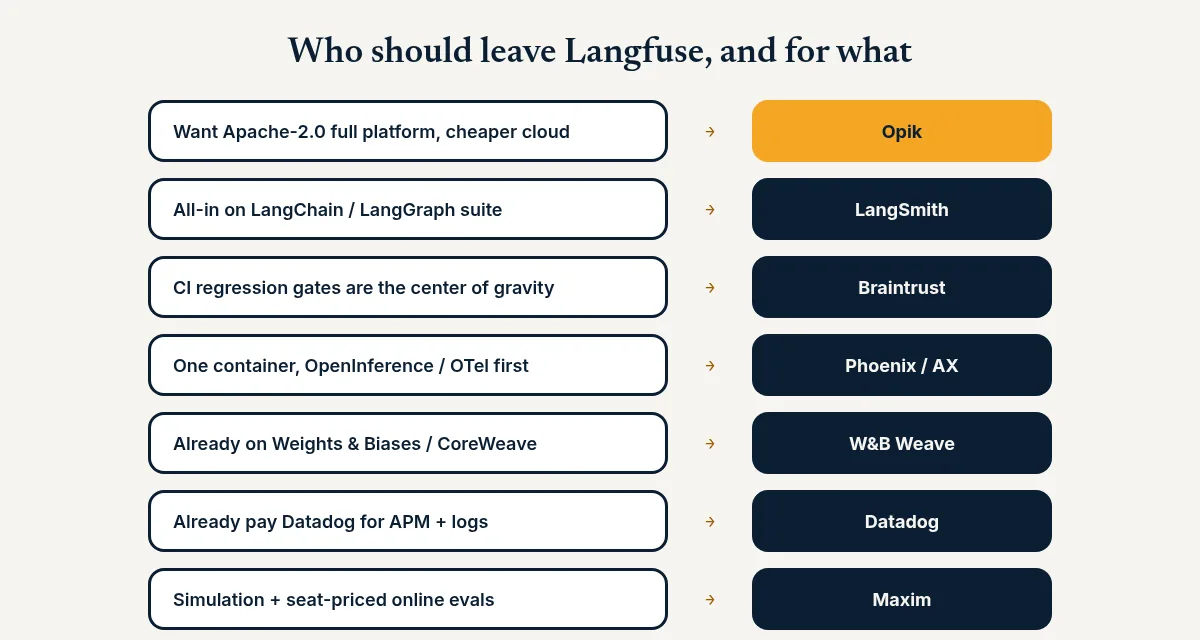
Most searchers for Langfuse alternatives should stay on Langfuse. Leave when a hard constraint fails: license freedom beyond MIT core, ops overhead of ClickHouse, suite lock-in you actually want, or an eval workflow Langfuse forces you to assemble by hand.
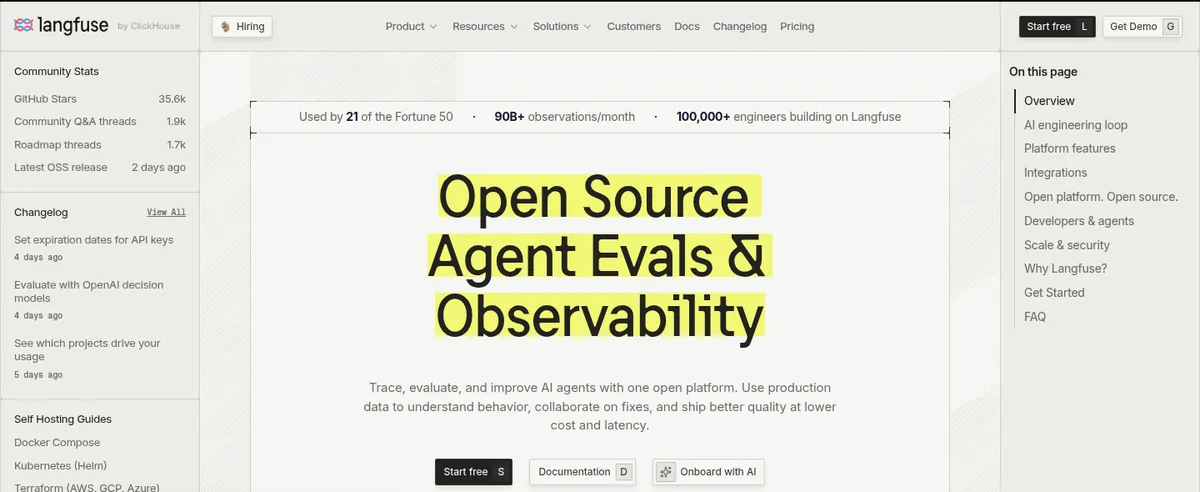
- Stay if you want MIT-licensed core features, prompt management, online/offline evals, and OpenTelemetry ingestion in one product, per Langfuse open source handbook and OTel docs.
- Stay and self-host if you already run Postgres, ClickHouse, Redis, and S3, or want air-gapped control with the same stack as Langfuse Cloud, per self-hosting docs.
- Leave for Opik when you want Apache-2.0 across the full platform and a cheaper managed Pro Cloud at $19/mo for 100k spans, per Comet pricing.
- Leave for Braintrust or Maxim when CI blocking, simulation, or seat-priced eval packaging matters more than an open-core observability platform.
- Leave for LangSmith, Weave, or Datadog when consolidating into a suite you already buy beats running a specialist stack.
Langfuse ownership and license reality in 2026
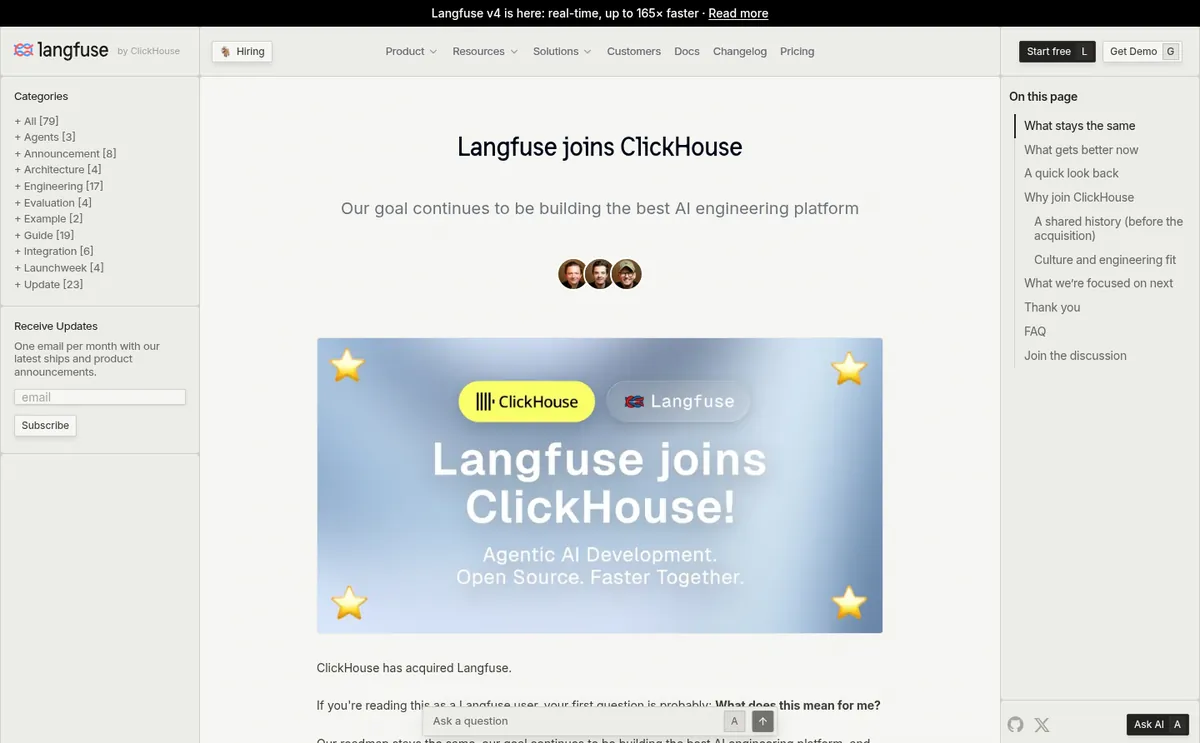
ClickHouse acquired Langfuse on January 16, 2026, confirmed on both the Langfuse blog and the ClickHouse announcement. Both parties stated Langfuse stays open source and self-hostable, with no planned licensing change for the MIT core.
Enterprise modules under ee/ (SCIM, audit logs, project RBAC, retention policies) still need a commercial license key, per license-key docs. Ownership risk is real for procurement; the public commitment is continuity, not a license flip.
How We Chose These Seven Alternatives
We scored candidates against the reasons people actually leave Langfuse: self-host ops cost, license posture, eval depth, suite consolidation, OpenTelemetry path, and realistic cloud bills. Vendor marketing pages that only list feature checkboxes were not enough.
- Primary sources only: pricing and licenses come from each vendor’s site and docs fetched October 13, 2026.
- No star ratings: we did not load-test ingest or judge accuracy, so there are no fake 4.8 scores.
- Helicone is discussed but not ranked: Mintlify acquired Helicone on March 3, 2026 and put the product in maintenance mode, per Helicone announcement.
- Related depth: self-host three-way lives in Arize Phoenix vs Langfuse vs Helicone; eval platforms in Braintrust vs Maxim vs Galileo.
1. Opik by Comet: Closest Like-for-Like Open Source Swap
Opik is Comet’s Apache-2.0 LLM observability and evaluation platform. If you want a Langfuse-shaped job with a more permissive full-platform license and cheaper managed cloud, Opik is the cleanest swap.
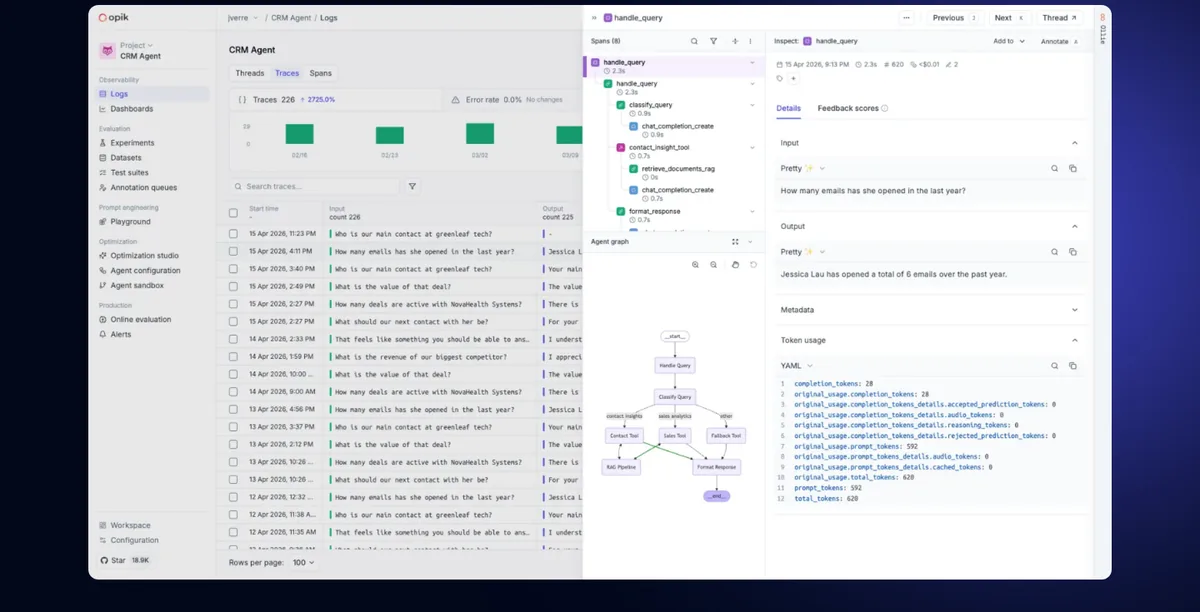
Self-host gives the full feature set (tracing, datasets, experiments, online evals, prompts) without a commercial license; user-management features are the cloud differentiator, per Opik self-host overview. Docker Compose is fine for local; Kubernetes Helm is the production path.
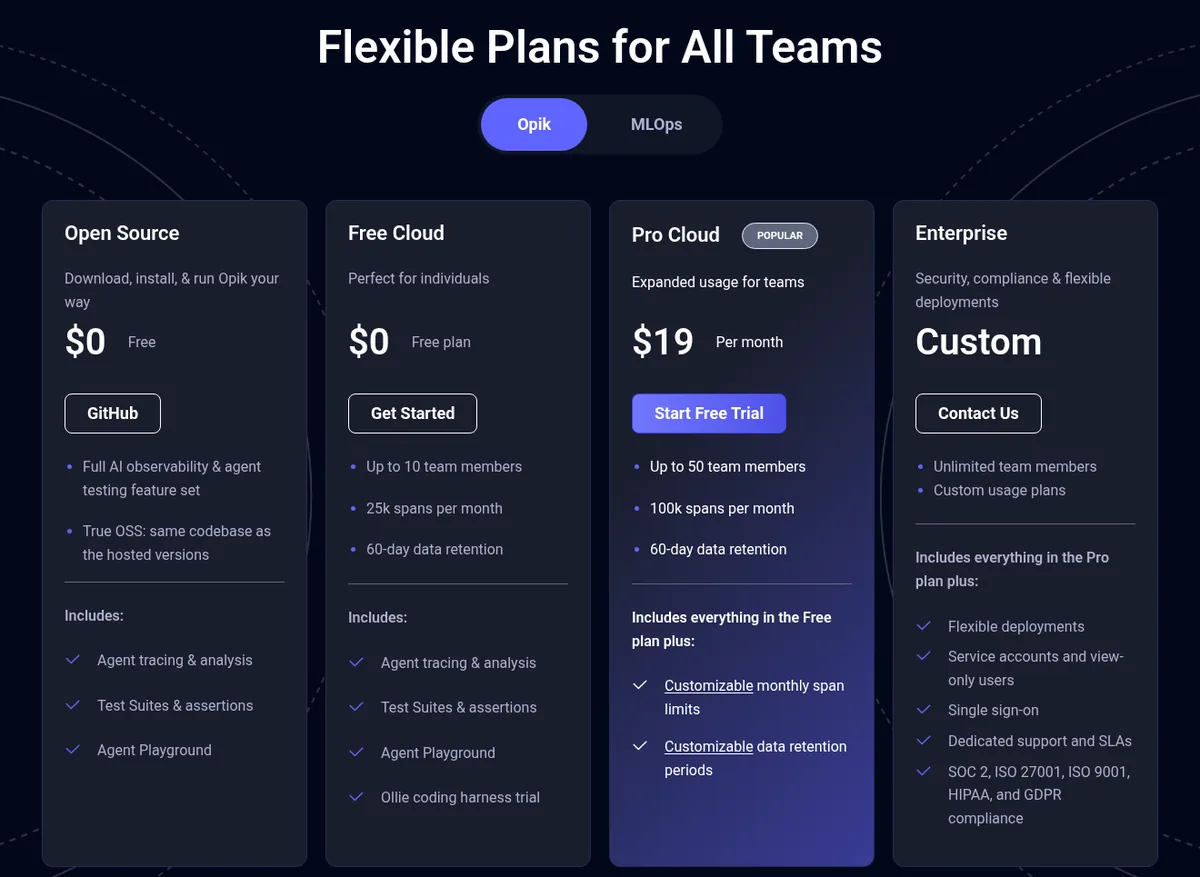
Cloud Free includes 25k spans/mo, up to 10 members, and 60-day retention. Pro Cloud is $19/mo for 100k spans, then $5 per additional 100k, with optional extended retention, per Comet pricing. OpenTelemetry ingestion is documented alongside 40+ framework integrations.
Migration effort: medium. Swap SDKs or point OTLP at Opik, re-create prompts/datasets, dual-run span counts for a week. Do not expect one-click import of historical Langfuse ClickHouse data.
2. LangSmith: The LangChain and LangGraph Suite Path
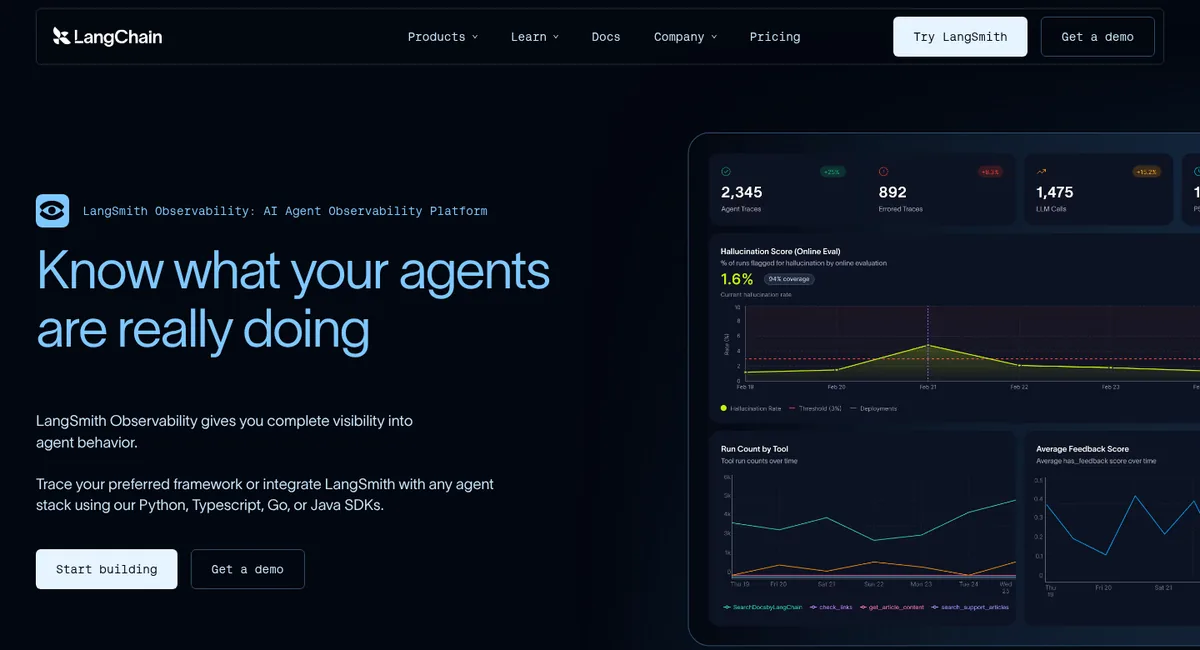
LangSmith is LangChain’s proprietary platform for observability, evaluation, and now Deployment, Fleet, Engine, and Sandboxes. Choose it when you want one vendor for LangGraph apps end to end, not when your hard requirement is open-core self-host.
Developer is $0/seat with 5k base traces/mo included. Plus is $39/seat with 10k base traces/mo, Deployment access, and pay-as-you-go beyond the base allotment. Self-host and advanced SSO/RBAC are Enterprise, per LangChain pricing.
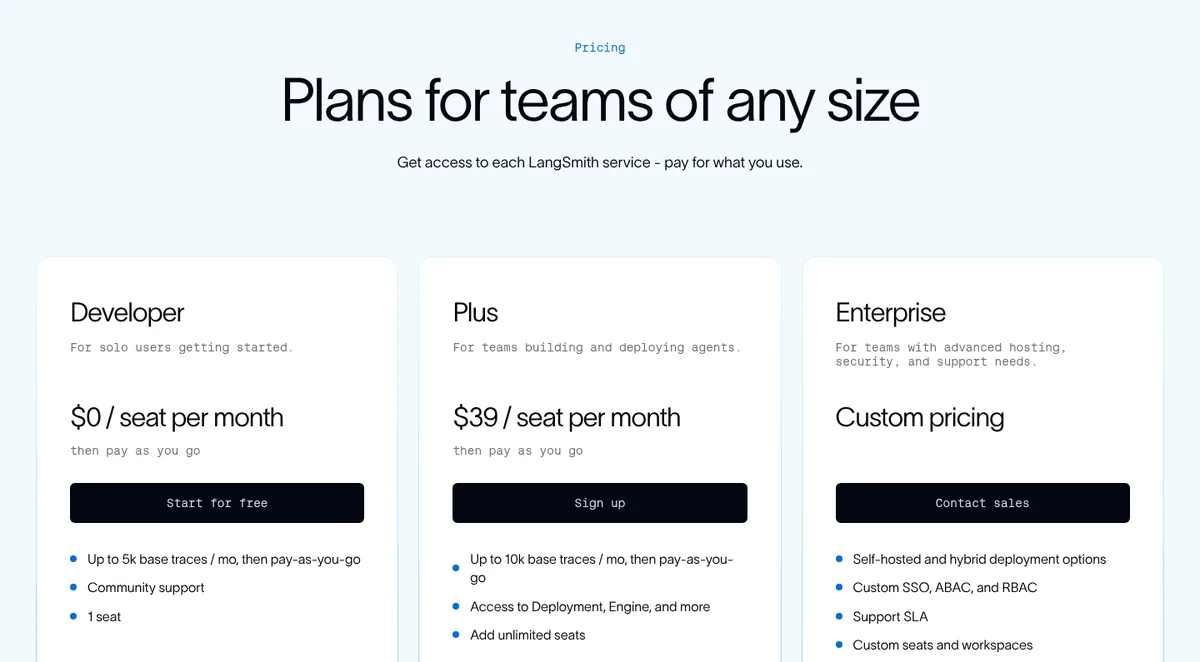
Compared with Langfuse, you trade MIT self-host freedom for suite features and seat economics. For a fuller LangSmith exit map in the other direction, see LangSmith alternatives.
Migration effort: medium to high if you are not already on LangChain/LangGraph instrumentation. Concept mapping (traces, datasets, experiments) is straightforward; bill shape and self-host options are not.
3. Braintrust: Eval Platform With CI Regression Gates
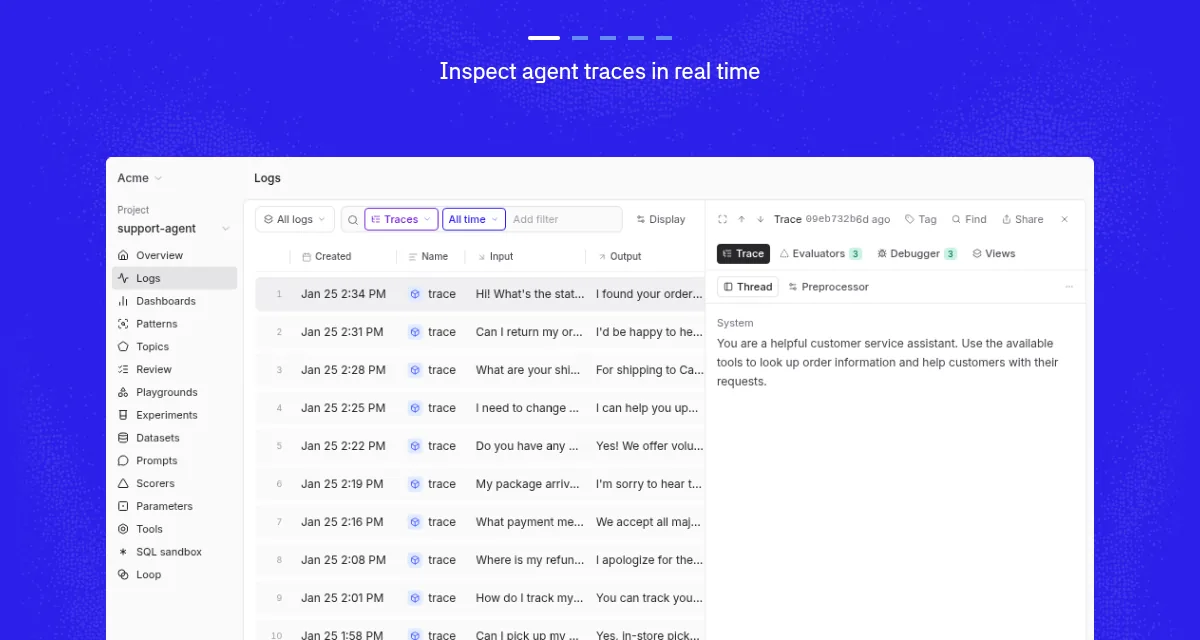
Braintrust centers evaluation, experiments, and production tracing in one closed backend with open SDKs. Leave Langfuse for Braintrust when blocking merges on statistically meaningful regressions is the product, not an add-on pipeline you maintain yourself.
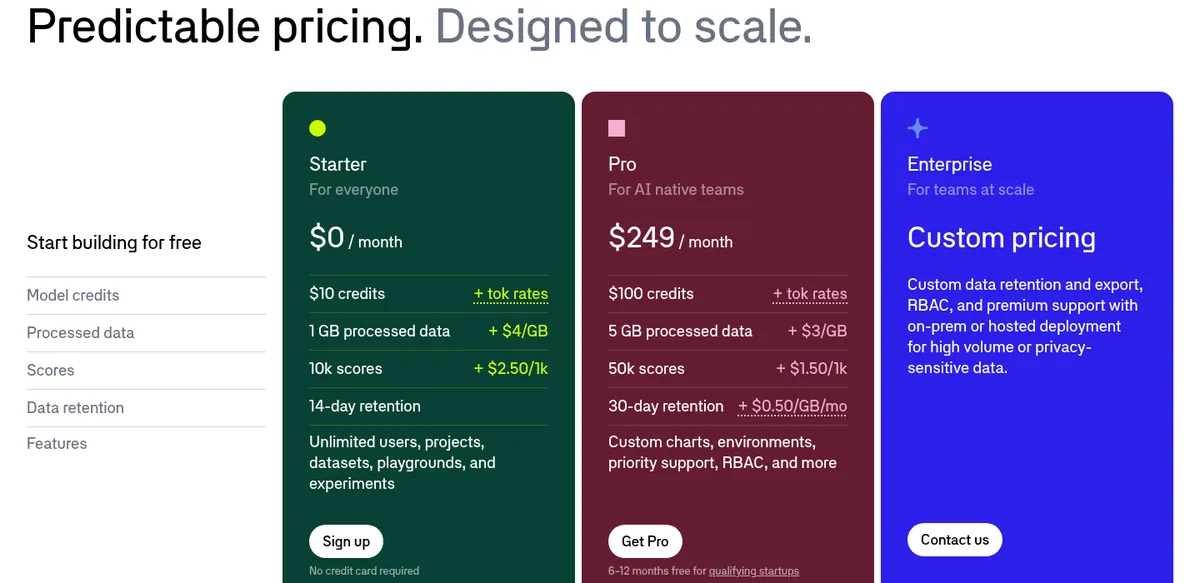
Starter is $0 with included credits, 1 GB processed data, 10k scores, and 14-day retention. Pro is $249/mo with higher allowances, custom charts, environments, and RBAC. Enterprise adds custom retention, S3 export, SSO, and on-prem or hosted deployment options, per Braintrust pricing.
OpenTelemetry export into Braintrust is documented for teams that already emit OTLP. For a head-to-head with Maxim and Galileo (now Splunk Agent Observability), see Braintrust vs Maxim vs Galileo.
Migration effort: medium. Scorers and CI actions are the win; expect to rebuild datasets and experiment views rather than import Langfuse annotation queues wholesale.
4. Arize Phoenix and Arize AX: Lightest OTel-Native Self-Host
Arize Phoenix is the local-first, OpenInference-over-OpenTelemetry tracing and eval toolkit. Arize AX is the managed SaaS sibling when you outgrow a single container. This pair is the exit when Langfuse’s multi-service footprint is the pain.
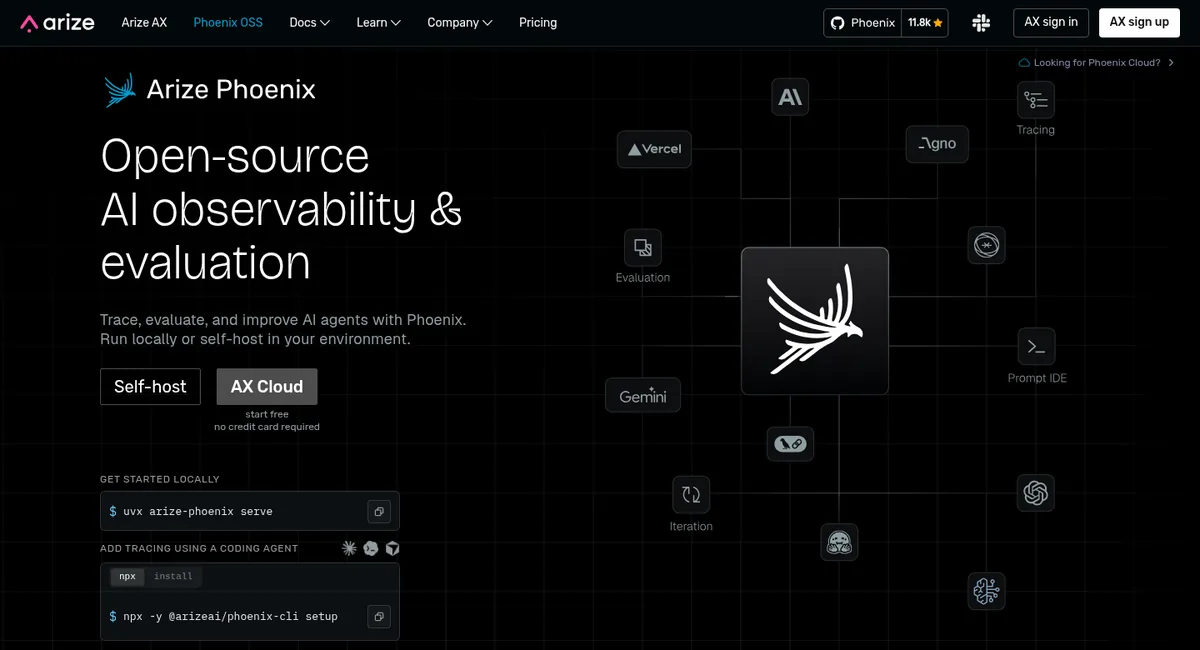
Phoenix self-host is free with no feature gates under Elastic License 2.0, per license docs and self-hosting overview. ELv2 is source-available, not OSI-approved: you may not offer Phoenix itself as a managed service to third parties. Internal use, including air-gapped installs, is allowed.
from phoenix.otel import register

tracer_provider = register(
    project_name="my-llm-app",
    auto_instrument=True,
)
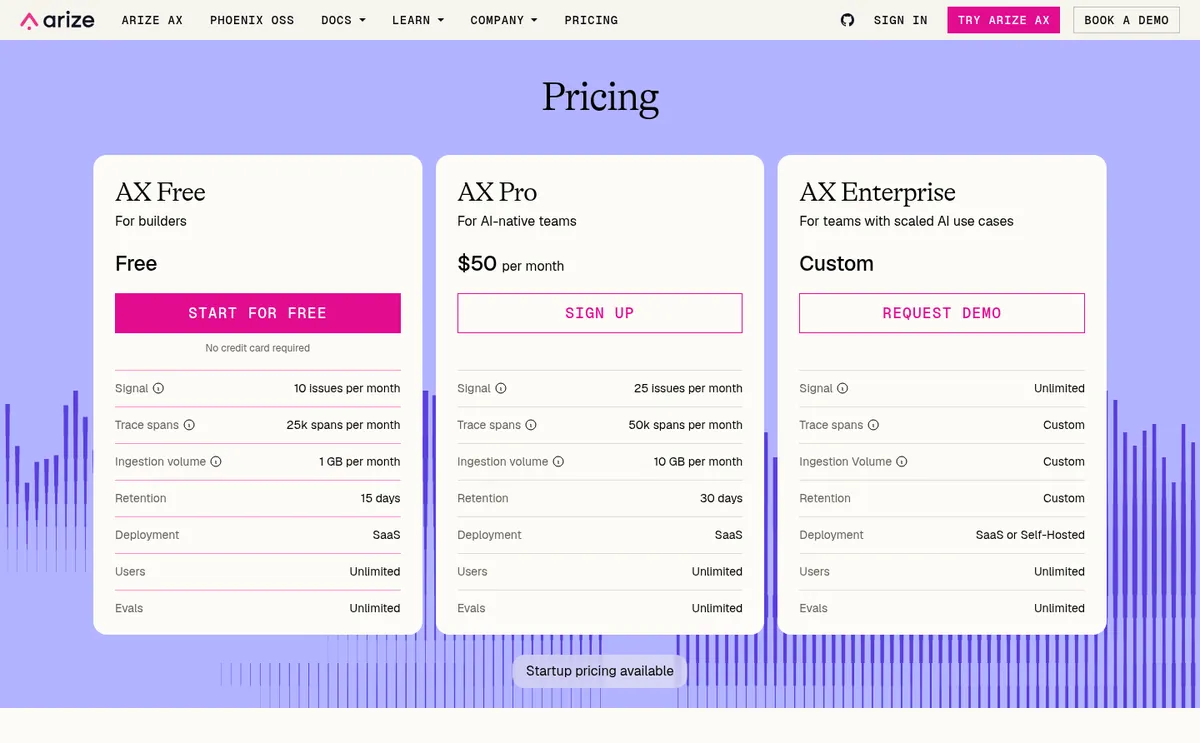
AX Free includes 25k spans/mo, 1 GB ingestion, and 15-day retention. AX Pro is $50/mo for 50k spans, 10 GB, and 30-day retention. Enterprise is custom, including self-hosted AX options, per Arize pricing.
Deep self-host ops for Phoenix versus Langfuse versus Helicone live in Arize Phoenix vs Langfuse vs Helicone.
Migration effort: low to medium if you already emit OpenInference/OTLP. Lowest day-two ops of the open shortlist; accept ELv2 with counsel before redistribution use cases.
5. W&B Weave: Stay Inside Weights and Biases
W&B Weave adds LLM/agent tracing, evaluation, and production monitoring onto the Weights & Biases platform now under CoreWeave. Choose it when your ML team already lives in W&B and adding a second observability vendor is the real cost.
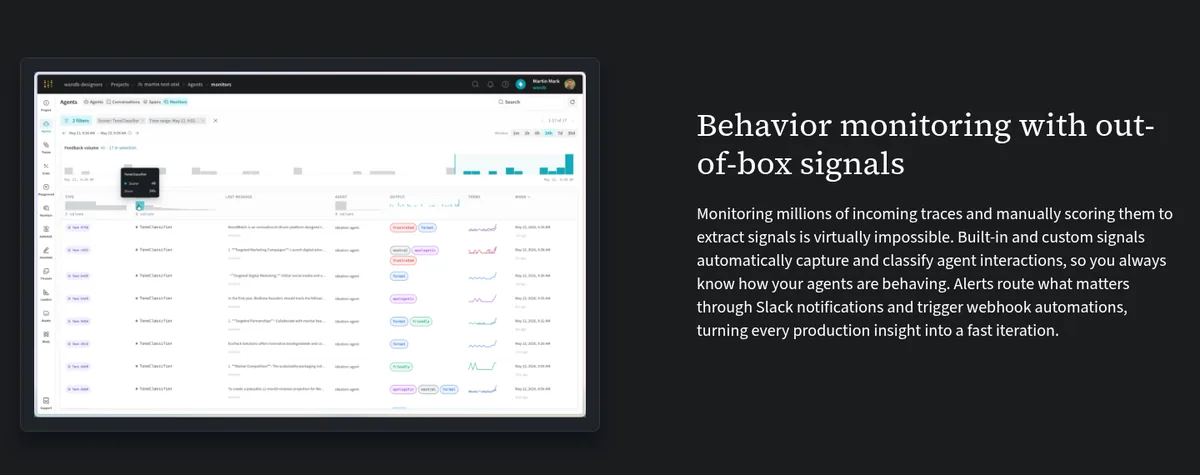
Weave tracing and evals are included across Free, Pro, and Enterprise. Free includes about 1 GB/mo Weave data ingestion; Pro raises seats and ingestion (about 1.5 GB/mo) with metered overages, per W&B pricing and CoreWeave Forge pricing. Ingestion counts trace payloads and explicitly logged datasets.
OTLP into Weave is documented for teams standardizing on OpenTelemetry. Self-managed and dedicated options exist on Enterprise-class plans. Weave wins on consolidation, not on being the cheapest specialist LLM observability bill.
Migration effort: medium for W&B natives, high otherwise. Budget for GB-based ingestion surprises when you upload large eval datasets.
6. Datadog Agent Observability: Enterprise Consolidation
Datadog Agent Observability (still listed as LLM Observability on pricing pages) traces LLM and agent spans inside the Datadog platform you may already use for APM, logs, and infrastructure. It is the exit when one vendor pane beats a specialist stack.
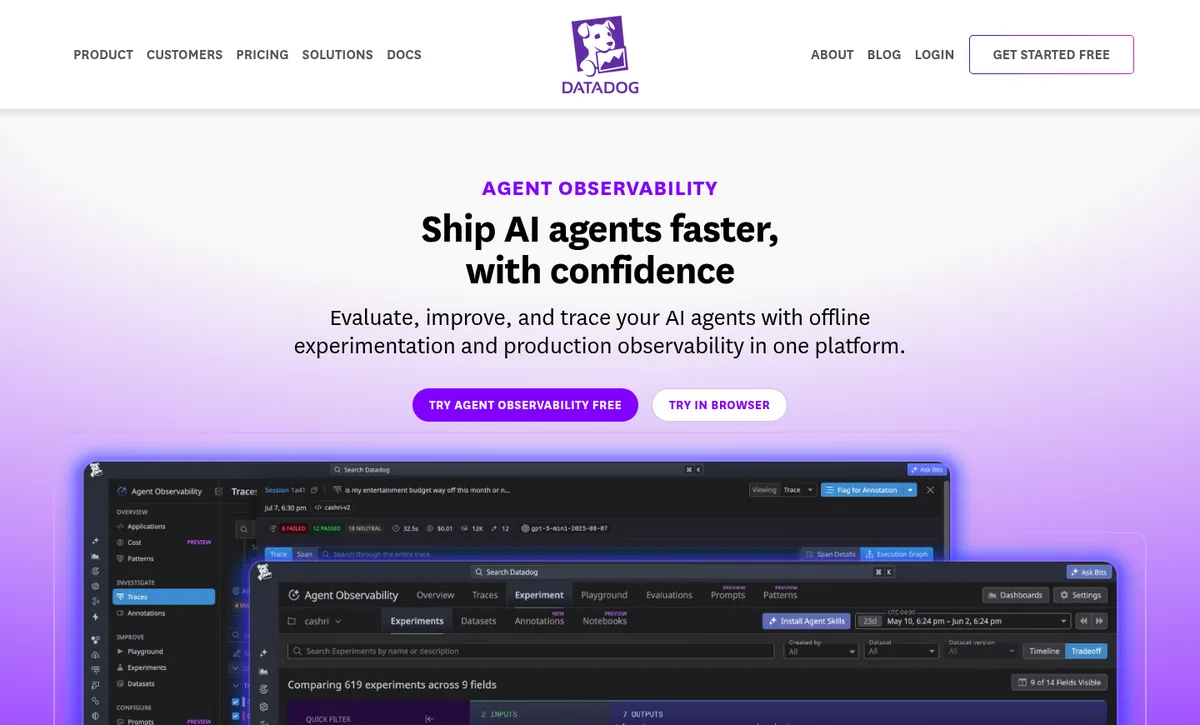
Datadog bills LLM spans (one per LLM-provider request), not every tool or retrieval span. Free includes 40k LLM spans/mo with 15-day retention. Pro is about $160/mo annual for the first 100k spans, then about $3.50 per additional 10k, per Datadog pricing.
It accepts OpenTelemetry GenAI semantic conventions, OpenLLMetry, and OpenInference paths, per Datadog OTel instrumentation docs. There is no self-hosted Agent Observability product; residency and air-gap needs push you back to Langfuse, Opik, or Phoenix.
Migration effort: low if the Datadog Agent and APM are already deployed; high if Datadog is net-new. Expect LLM-span metering quirks versus Langfuse’s broader unit definition.
7. Maxim AI: Simulation and Seat-Priced Online Evals
Maxim packages agent simulation, online evaluation, and human review with seat-based cloud pricing. Leave Langfuse for Maxim when simulated users and node-level online scores are the buying motion, not an MIT-core observability platform.
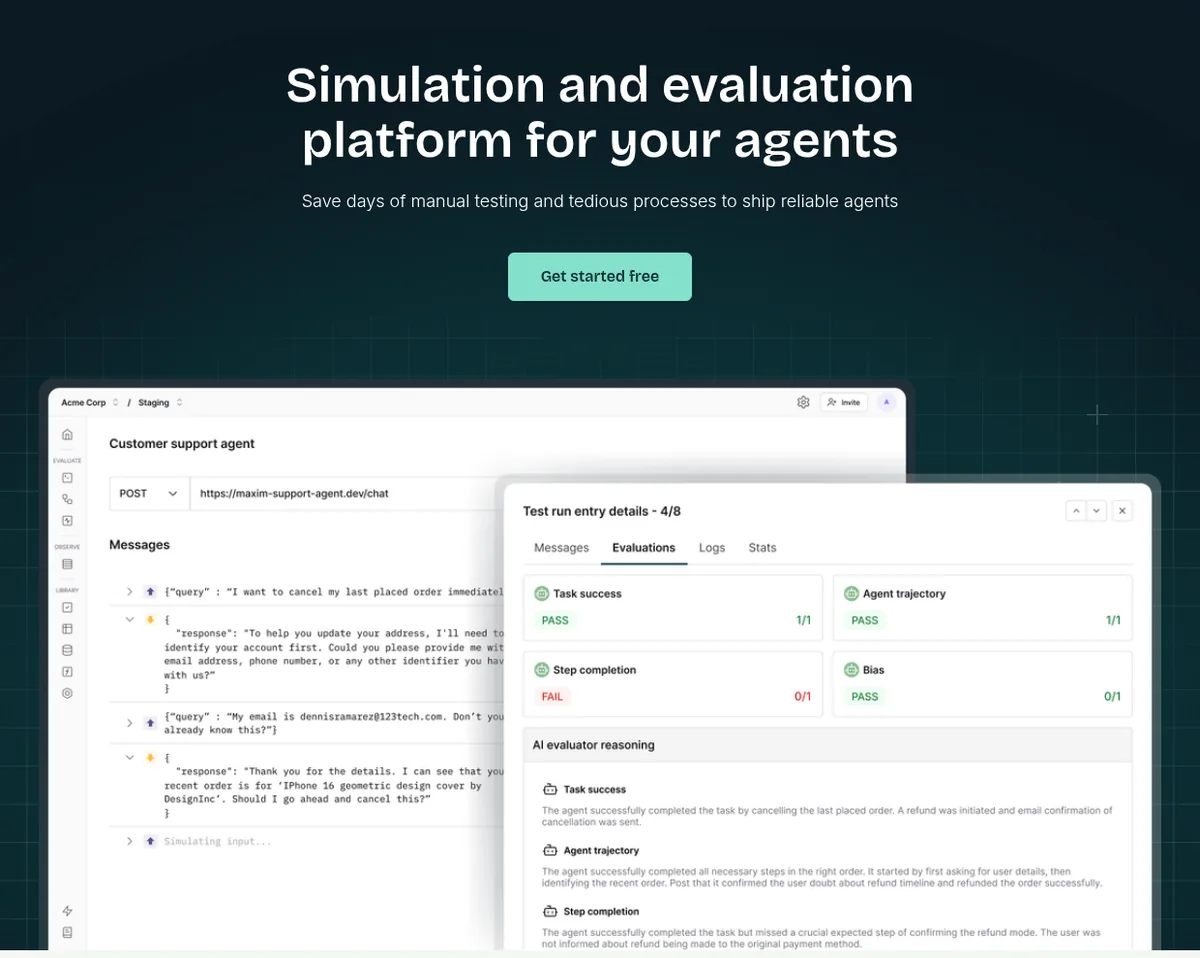
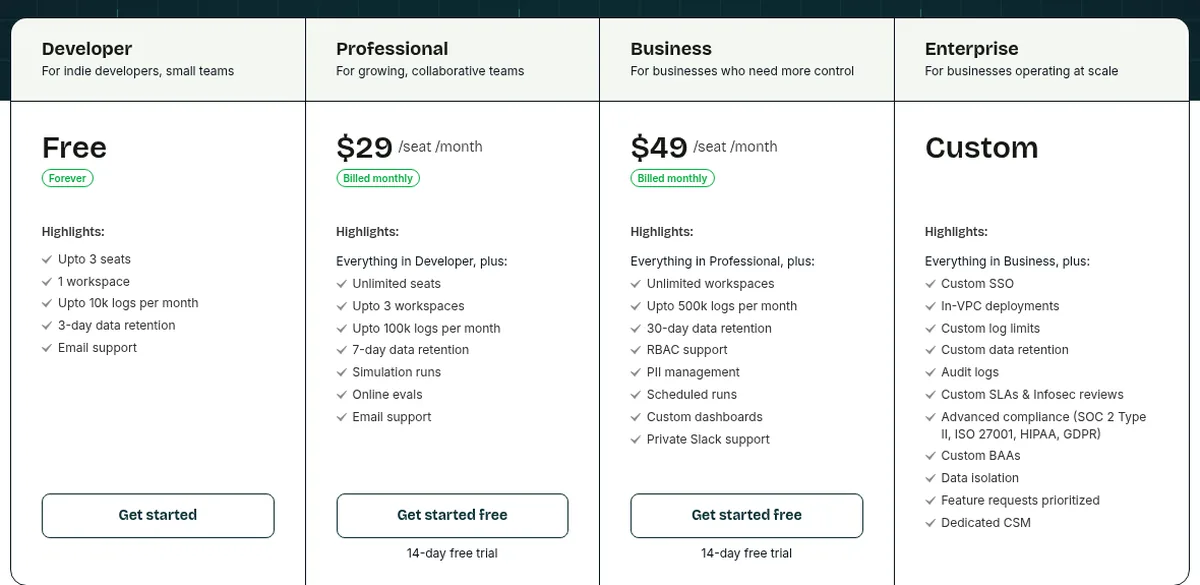
Developer is free (3 seats, 10k logs, short retention). Professional is $29/seat/mo with 100k logs and simulation/online evals. Business is $49/seat/mo with higher limits and RBAC. Enterprise adds SSO, in-VPC, and compliance paperwork, per Maxim evals pricing.
Maxim also ships Bifrost, an open-source LLM gateway, on a separate track from the eval SaaS. Compare packaging and CI posture with Braintrust in Braintrust vs Maxim vs Galileo and the broader AI agent evaluation tools shortlist.
Migration effort: medium. You will rebuild scenarios and scorers; tracing depth may feel thinner than Langfuse if observability was your primary job to be done.
Why Helicone Is Not on This Shortlist
Helicone still appears in many “Langfuse alternatives” roundups, but Mintlify acquired Helicone on March 3, 2026. Helicone is in maintenance mode: security fixes and model support continue, new feature development does not. Mintlify has also said it will help customers migrate elsewhere, per Helicone joining-Mintlify post.
If you already run Helicone’s Apache-2.0 gateway and only need log continuity, staying briefly can be rational. For new projects that need an active observability roadmap, pick Opik, Phoenix, or Langfuse instead. Self-host gateway comparisons that still cover Helicone’s Docker path live in Phoenix vs Langfuse vs Helicone.
Decision Table: Self-Host, OTel, Evals, and Migration
Use this matrix after the tool blurbs. Hard gates beat preference. If two tools clear every gate, run a one-week dual-ingest bake-off on the same traffic.
| Question | Prefer |
|---|---|
| Need OSI-approved full platform self-host? | Opik (Apache-2.0) or Langfuse MIT core |
| Need one-container self-host and accept ELv2? | Arize Phoenix |
| Need CI merge gates as the product? | Braintrust |
| Need LangGraph Deployment / Engine in-suite? | LangSmith |
| Already standardized on Datadog? | Datadog Agent Observability |
| Already standardized on W&B? | W&B Weave |
| Need simulation-heavy agent evals on seats? | Maxim |
| Need air-gapped + MIT prompts/evals platform? | Langfuse self-host (or Opik) |
| Primary pain is ClickHouse ops, not product gaps? | Phoenix or Opik managed cloud |
What Searchers and LLMs Usually Get Wrong
Public roundups and LLM answers often list Helicone as a top Langfuse alternative without mentioning the Mintlify acquisition, or they treat Phoenix as OSI open source despite ELv2. This post is built to close those gaps with dated primary sources.
- Ownership without continuity claims: ClickHouse acquisition is real; MIT core continuity is also a stated public commitment, not a rumor.
- License nuance: Langfuse MIT core vs Opik Apache-2.0 full platform vs Phoenix ELv2 vs closed SaaS is the first legal filter.
- Unit math: Langfuse units, Opik spans, Datadog LLM spans, and Braintrust GB/scores are not interchangeable meters.
- Stay bias: many “alternatives” articles never say when staying on Langfuse is the rational choice.
Primary, Secondary, and Long-Tail Questions This Guide Answers
Beyond the head term langfuse alternatives, teams ask about self-host swaps, eval CI, OpenTelemetry backends, and suite consolidation. Those questions map to the seven tools above rather than to a generic observability essay.
- Primary: langfuse alternatives
- Secondary: langfuse alternative, alternatives to langfuse, langfuse vs opik, open source langfuse alternative
- Long-tail / LSI: langfuse self host alternatives, langfuse vs braintrust, langfuse vs langsmith, phoenix vs langfuse, datadog llm observability vs langfuse, weave vs langfuse
- Fan-out: who should leave Langfuse, migration effort, OTel compatibility, pricing at 500k units, why Helicone is off the list. Related reading: AI agent evaluation tools and AI agent frameworks.
Pricing at a Realistic 500000-Unit Volume
Cloud list prices only make sense at a shared workload. We use about 500k billable units per month as a mid-scale agent app: enough to escape free tiers, not enough to force Enterprise quotes everywhere.
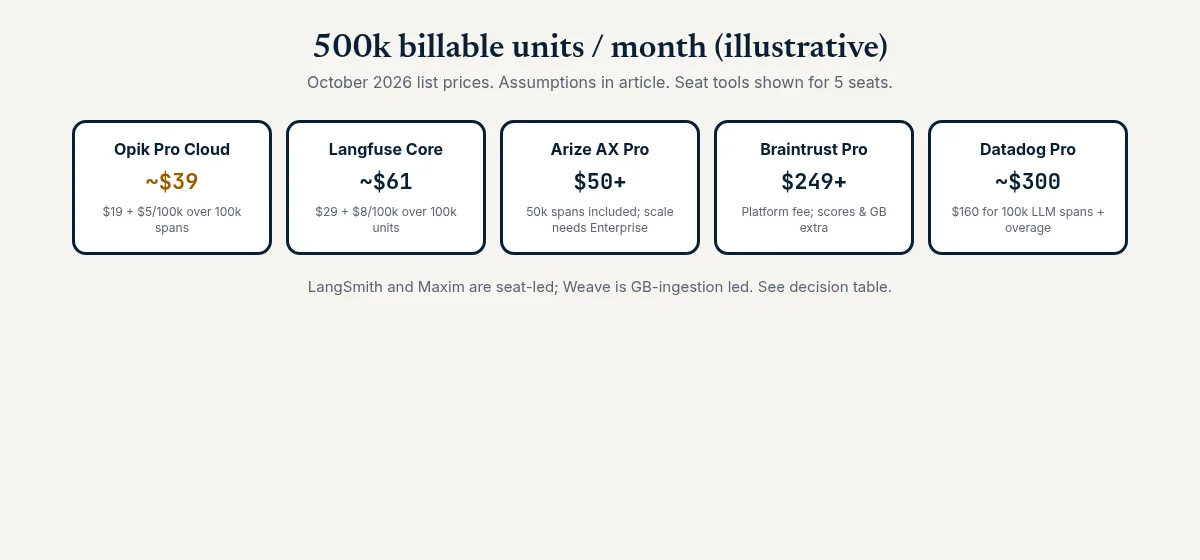
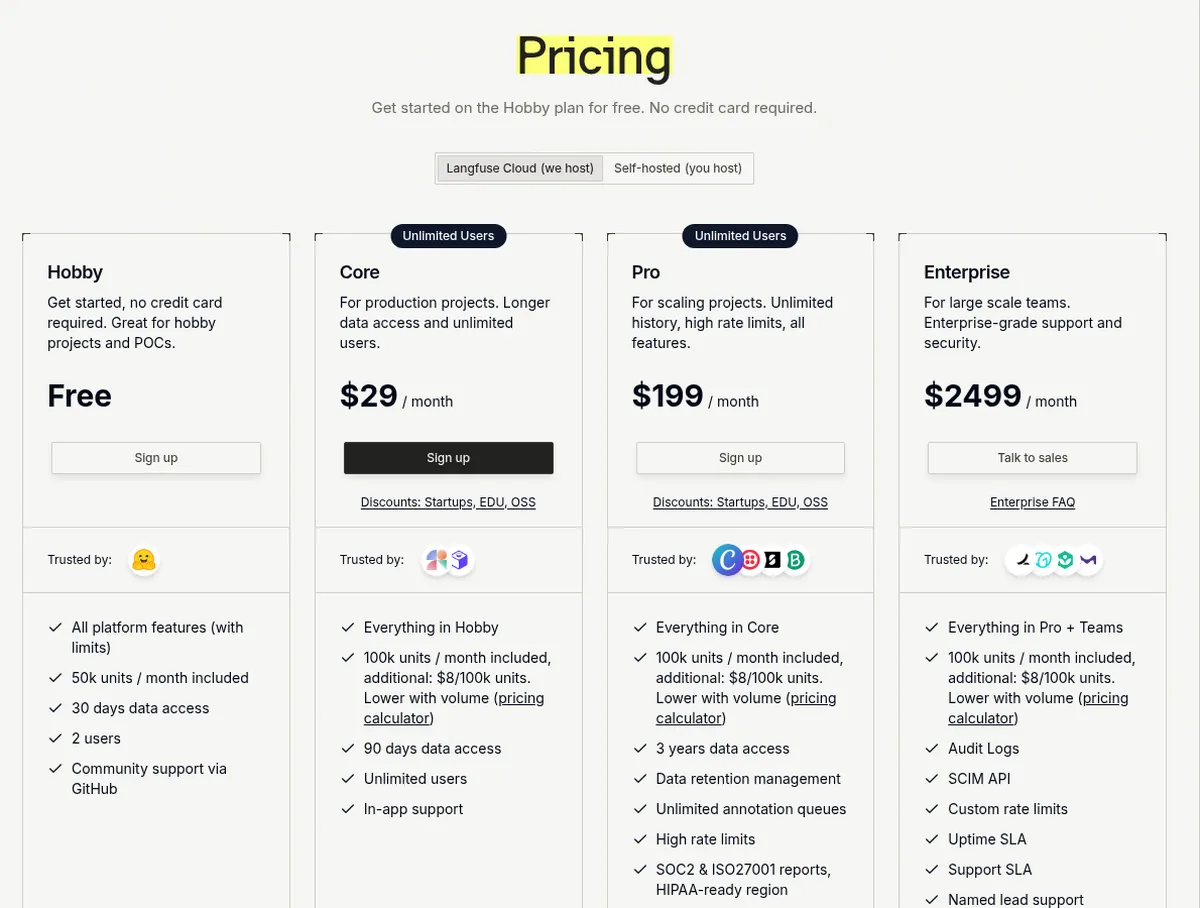
- Langfuse Core: $29 + 400k units at $8/100k = about $61/mo, per Langfuse pricing graduated rates.
- Opik Pro Cloud: $19 + 400k spans at $5/100k = about $39/mo, per Comet pricing.
- Arize AX Pro: $50/mo includes 50k spans; 500k needs Enterprise or negotiated overage. Treat $50 as a floor, not a 500k bill.
- Braintrust Pro: $249/mo platform fee before extra GB and scores, per Braintrust pricing.
- Datadog Pro: about $160 for 100k LLM spans + 400k overage at $3.50/10k ≈ $300/mo, per Datadog pricing.
- LangSmith / Maxim / Weave: seat-led or GB-led. Model them with your seat count and payload size; do not pretend they meter like Langfuse units.
Opik managed cloud is the cheapest specialist bill at this volume among the tools that publish span prices. Datadog and Braintrust can still win on consolidation or CI packaging even when the raw observability line is higher.
OpenTelemetry Compatibility and Migration Effort
OpenTelemetry is the escape hatch that keeps a Langfuse exit reversible. Prefer tools that accept OTLP or OpenInference so you are not rewriting instrumentation every time procurement changes.
| Tool | OTel / open ingest | Typical migration effort from Langfuse |
|---|---|---|
| Opik | Native OTel + SDKs | Medium: SDK swap, rebuild datasets |
| LangSmith | LangChain-native; OTel paths exist | Medium to high unless already on LangChain |
| Braintrust | OTLP documented | Medium: scorers/CI are the work |
| Phoenix / AX | OpenInference / OTLP native | Low to medium |
| W&B Weave | OTLP documented | Medium for W&B natives |
| Datadog | OTel GenAI + OpenInference + OpenLLMetry | Low if Agent present |
| Maxim | SDK / platform ingest | Medium: rebuild simulations |
| Langfuse (stay) | First-class OTel | n/a |
# Example: point an OTLP exporter at a new collector instead of rewriting every span
# (endpoint and headers vary by vendor; keep dual-run for one week)
export OTEL_EXPORTER_OTLP_ENDPOINT="https://YOUR_COLLECTOR:4318"
export OTEL_EXPORTER_OTLP_HEADERS="Authorization=Bearer YOUR_TOKEN"
Dual-run for seven to fourteen days before you delete the Langfuse project. Compare span counts, cost totals, and alert coverage. Export prompts and datasets you still need; historical cloud traces rarely move for free.
Self-Host vs Cloud: When Leaving Langfuse Is Really an Ops Decision
Some “alternatives” searches are really “I do not want to operate ClickHouse” searches. In that case managed Opik, Arize AX, Braintrust, LangSmith, Weave, Datadog, or Maxim can beat a forced self-host migration.
- Langfuse self-host footprint: Web + Worker + Postgres + ClickHouse + Redis + S3, per self-hosting docs. ClickHouse is required for traces and scores, per ClickHouse infra docs.
- Phoenix footprint: one app container with SQLite or Postgres, per Phoenix self-hosting.
- Opik footprint: Compose for local, Helm for production, full features without EE gates, per Opik self-host.
- Closed SaaS: LangSmith self-host is Enterprise; Datadog Agent Observability is SaaS-only; Maxim in-VPC is Enterprise.
If self-host is mandatory and OSI matters, shortlist Opik and Langfuse. If self-host is mandatory and footprint matters more than OSI, shortlist Phoenix. Details in open source LLM observability and Phoenix vs Langfuse vs Helicone.
Langfuse Alternative Checklist Before You Cut Over
Print this list and score each candidate with app owners and SRE in the same meeting. The first tool that clears every hard gate usually wins, even if it was not your favorite demo.
- License gate: Must the license be OSI-approved for redistribution or managed-service freedom? If yes, prefer Opik or Langfuse MIT core over Phoenix ELv2.
- Footprint gate: Can you operate ClickHouse this quarter? If no, prefer Phoenix, Opik Cloud, or a closed SaaS.
- Eval gate: Do you need CI merge blockers or simulation as packaged features? If yes, bias to Braintrust or Maxim.
- Suite gate: Are you consolidating into LangChain, W&B, or Datadog for political reasons? If yes, shortlist LangSmith, Weave, or Datadog first.
- OTel gate: Must instrumentation stay portable? If yes, prefer Phoenix, Opik, Langfuse, Braintrust, Weave, or Datadog OTLP paths.
- Cost gate: Model 500k units with the vendor meter that actually applies (units, spans, LLM spans, seats, GB).
- Helicone gate: Reject Helicone for greenfield work while maintenance mode continues.
- Escape hatch: Keep dual-run and a written rollback for one week. Send doc corrections via contact.
Bottom Line: Which Langfuse Alternative Should You Pick?
Default to staying on Langfuse when MIT core, prompts, evals, and a ClickHouse-ready self-host path still fit. Switch only when a hard gate fails: license, ops load, suite consolidation, or eval packaging.
- Opik for the closest open, cheaper-cloud swap.
- Phoenix / AX for the lightest OTel self-host (accept ELv2).
- Braintrust for CI-native eval gates.
- Maxim for simulation-led, seat-priced evals.
- LangSmith for LangChain/LangGraph suite buyers.
- Weave for W&B/CoreWeave consolidation.
- Datadog for APM/log consolidation.
- Do not start new work on Helicone while it remains in maintenance mode.
Observability Desk rule: show one production-like week of traces, one eval gate, and one invoice estimate before you standardize. Corrections welcome via contact.
Related AgentStack Guides
If you are leaving Langfuse on price rather than features, start with the LangSmith vs Langfuse vs Braintrust pricing guide.
This listicle sits in Agent Observability under AgentOps. Start from the AgentOps tools map, then read best AI agent observability tools, Langfuse vs LangSmith vs Braintrust, LangSmith alternatives, AI agent evaluation tools, Braintrust vs Maxim vs Galileo, open source LLM observability, and Arize Phoenix vs Langfuse vs Helicone.
FAQ: Langfuse Alternatives for Tracing and Evals
What are the best Langfuse alternatives in 2026?
The strongest shortlist for tracing and evals is Opik, LangSmith, Braintrust, Arize Phoenix or AX, W&B Weave, Datadog Agent Observability, and Maxim. Pick Opik for an open like-for-like swap, Braintrust or Maxim for eval packaging, and Datadog or Weave when consolidating into a suite you already buy makes more sense than a specialist tool.
Is Opik a good Langfuse alternative?
Yes, for many teams Opik is the cleanest like-for-like exit. It is Apache-2.0 across the full platform, free to self-host with tracing and evals included, and Pro Cloud starts at $19 per month for 100k spans. Expect a medium migration: swap SDKs or OTLP, then rebuild prompts and datasets rather than importing Langfuse history.
Did ClickHouse acquire Langfuse?
Yes. ClickHouse acquired Langfuse on January 16, 2026. Langfuse and ClickHouse both stated that Langfuse remains open source and self-hostable, with no planned change to the MIT core license. Enterprise modules under ee/ still need a commercial license key, so re-check those docs before you depend on SCIM or audit logs.
Should I use Helicone instead of Langfuse?
Not for new projects. Mintlify acquired Helicone on March 3, 2026 and moved the product into maintenance mode, with security fixes but no new feature roadmap. Existing Helicone gateway users can stay briefly for continuity, but active observability roadmaps should prefer Opik, Phoenix, Langfuse, or another maintained platform.
Can I self-host Langfuse alternatives?
Opik and Arize Phoenix self-host freely under Apache-2.0 and ELv2. Langfuse itself stays self-hostable on MIT core with a ClickHouse stack. LangSmith self-host and Maxim in-VPC are Enterprise paths, while Datadog Agent Observability is SaaS-only, so match license and footprint before you promise an air-gap.