


Last updated October 12, 2026. Prices, plan limits, deployment options, and ownership were checked against each vendor’s own pricing pages, documentation, and announcements on that date.
Braintrust vs Maxim vs Galileo is the three-way shortlist many enterprise teams reach once agent evals stop fitting in a notebook. Each platform scores agents, and each one is built around a different moment in the release cycle.
Braintrust gates releases on eval scores, Maxim simulates users before launch, and Galileo scores live traffic with small judge models. This comparison sets them side by side on eval features, CI gates, tracing overlap, integrations, pricing, hosting, and ownership.
It is part of our AgentOps tools map. For a wider shortlist of ten tools, see our AI agent evaluation tools guide. No vendor paid for placement or reviewed this page, per our editorial standards and disclosure policy.
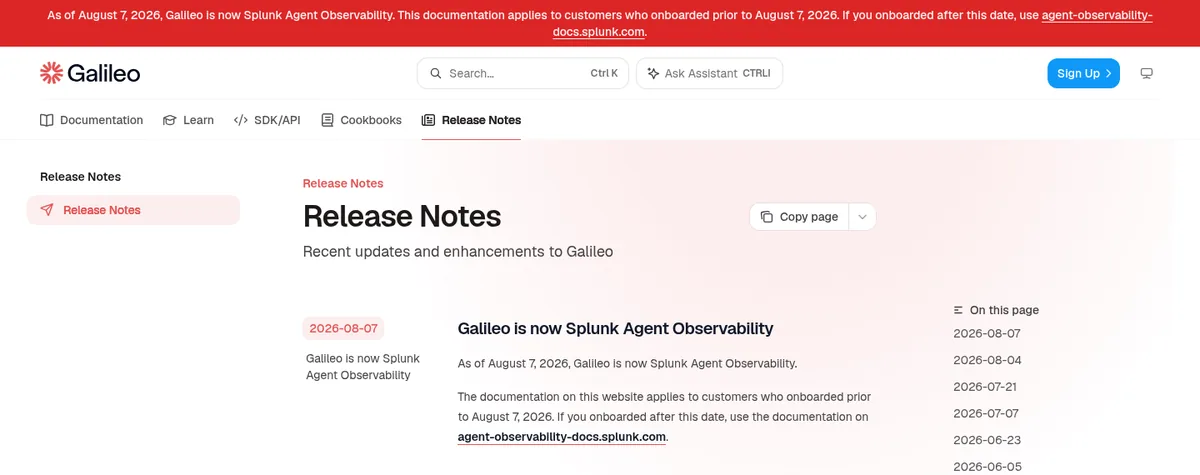
One change reshapes this comparison. Galileo became Splunk Agent Observability on August 7, 2026, after Cisco completed its acquisition, so most Galileo pricing you will find on other comparison pages is out of date.
TL;DR
- Braintrust is the release gate: experiments, scorers, and a GitHub Action that posts results on every pull request, with unlimited users from $0 to $249 per month.
- Maxim AI is the simulator: multi-turn chat and voice simulations across scenarios and personas, priced per seat from $29 per month.
- Galileo is now Splunk Agent Observability: preset agent evaluators and Luna small judge models, sold from $100 per month per 1.2 million spans a year, billed annually.
- Billing units differ: Braintrust meters gigabytes and scores, Maxim meters seats and logs, and Splunk meters spans and Luna tokens.
- On one worked example of 50,000 agent traces a month for a 10-person team, list prices came to about $264, $290 to $490, and $400 to $600 a month.
- None of the three is open source or free to self-host, so teams with that rule should look at Langfuse or Arize Phoenix.
Braintrust vs Maxim vs Galileo: The Short Answer
Pick Braintrust if eval scores decide what ships and many reviewers need access without seat fees. Pick Maxim if your agent holds multi-turn conversations, by chat or voice, and you want simulated users to break it before customers do. Pick Galileo if you already run Splunk and want to score every production request with low-cost judge models.
| Braintrust | Maxim AI | Galileo (Splunk Agent Observability) | |
|---|---|---|---|
| Center of gravity | Eval-first platform with tracing built around it | Simulation, evals, and observability in one product | Observability, evals, and runtime guardrails inside Splunk |
| Strongest feature | CI gates and experiment comparison | Multi-turn chat and voice simulation | Luna judge models and preset agent evaluators |
| Named agent evaluators | None built in; scorers read the full trace | Agent Trajectory, Tool Selection, Tool Call Accuracy | Nine, incl. Tool Selection Quality and Action Completion |
| CI mechanism | eval-action@v2 PR comment, bt eval CLI | maximhq/actions/test-runs@v1 | Experiments in pytest with threshold asserts |
| SDKs | TypeScript, Python, Go, Java, Ruby, C# | Python, JS/TS, Go, Java/JVM | Python |
| OpenTelemetry | Yes (exporter, Collector, span processor) | Yes (OTLP endpoint) | Yes (OTel and OpenInference) |
| Free tier | 1 GB, 10,000 scores, unlimited users | 3 seats, 10,000 logs, 3-day retention | Splunk Observability Cloud free edition |
| Paid entry | $249/month, unlimited users | $29/seat/month | From $100/month per 1.2M spans a year, billed annually |
| Self-hosting | BYOC or self-hosted data plane, Enterprise only | In-VPC, Enterprise only | On-premises deployment, by quote |
| Owner | Independent; $80M Series B in Feb 2026 | Independent (H3 Labs Inc); $3M seed in 2024 | Cisco (Splunk) since May 2026 |
What Changed in 2026: Galileo Is Now Splunk Agent Observability
Cisco announced its intent to acquire Galileo on April 9, 2026, and an update on the same post says the deal closed on May 22, 2026, per Cisco. On August 7, 2026, Galileo’s own release notes said the product is now Splunk Agent Observability. New customers since that date onboard through Splunk docs, per the Galileo release notes.
The galileo.ai site is still live and now carries a “now part of Cisco” badge, per galileo.ai. Its pricing link now redirects to the Splunk pricing page, so the old Free plan with 5,000 traces and the $100 Pro plan with 50,000 traces no longer appear on a vendor page we could find.
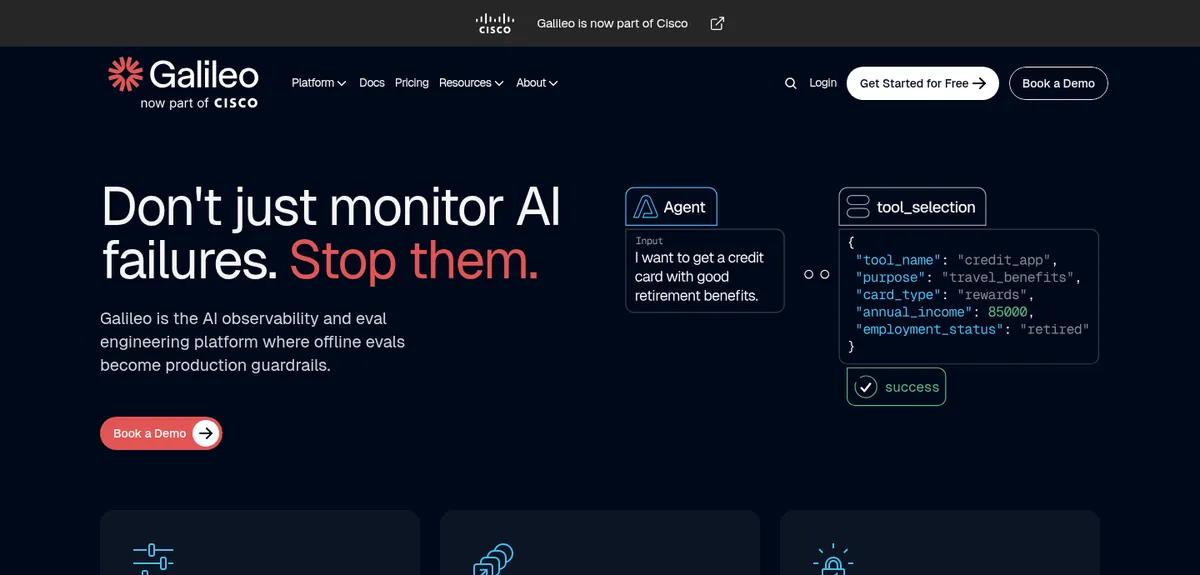
What this means for buyers: treat Galileo as a Splunk product from here on. Paid access, support, and new docs now run through Splunk, and the SaaS version lives inside Splunk Observability Cloud, per the Splunk Agent Observability SaaS docs.
We still use the name Galileo in this guide because that is what most buyers search for. Where a feature or price comes from a Splunk page, we say so.
How We Compared Braintrust, Maxim, and Galileo
For this Braintrust vs Maxim vs Galileo comparison, we read each vendor’s pricing page, product pages, and developer docs on October 12, 2026, and captured screenshots of the pages we cite. We compared them on six jobs an enterprise eval platform must do: datasets and experiments, judges and scorers, agent trajectory scoring, simulation, CI gates, and production scoring.
- Primary sources only: prices and limits come from vendor pricing pages, and features come from vendor docs. Funding comes from vendor announcements or named press coverage.
- No hands-on scores: we did not run paid accounts or benchmark judge accuracy, so this page has no star ratings.
- Estimates are labeled: the worked cost example uses list prices and our stated assumptions, and each assumption is listed below the table.
- Vendor claims are marked as claims: figures such as “96% lower cost” are the vendor’s own and were not tested by us.
Three Platforms, Three Centers of Gravity
The three products overlap on tracing, datasets, and LLM judges. They differ in where they start: Braintrust starts at the experiment, Maxim starts at the simulated conversation, and Galileo starts at the production request. That starting point shapes their pricing units and their best-fit teams.
Braintrust
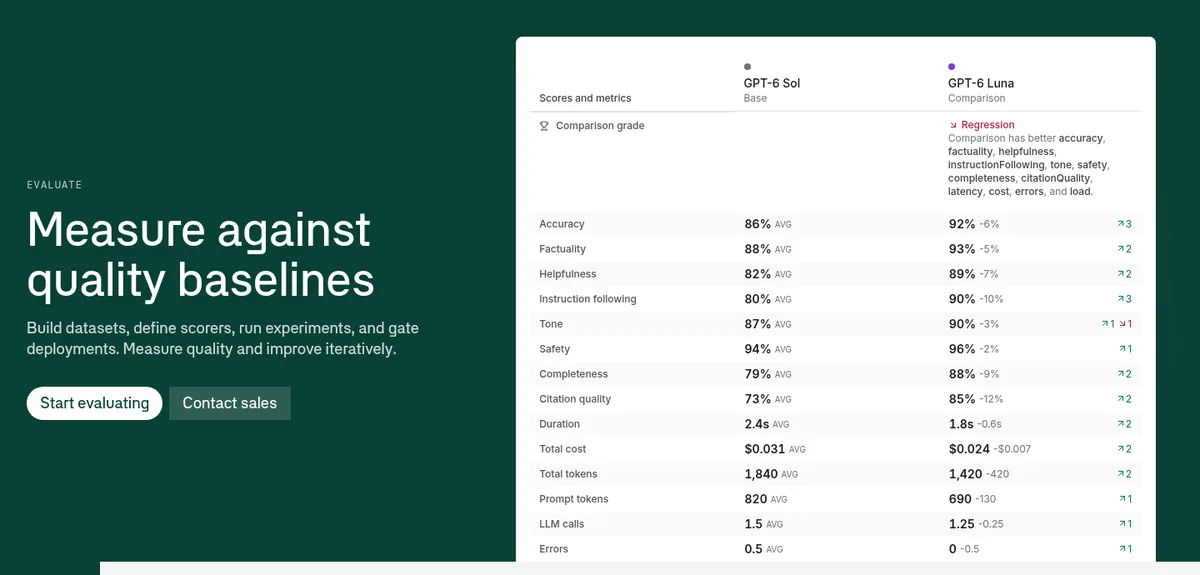
Braintrust describes itself as an observability platform for agents, and its roots are in evals, per braintrust.dev. Experiments compare runs case by case, scorers return a 0 to 1 score, and every scorer receives the input, output, expected value, metadata, and full trace, per its scorer docs.
Scorers come in three types: pre-built Autoevals, LLM-as-a-judge, and custom code. The autoevals library is MIT licensed. Loop, a built-in agent, can query logs, write scorers, and run experiments on a schedule, per the Loop docs.
Best for: teams that want a hard quality bar on every pull request and many reviewers in the tool. Unlimited users on every plan makes Braintrust the cheapest of the three for large review groups.
Maxim AI
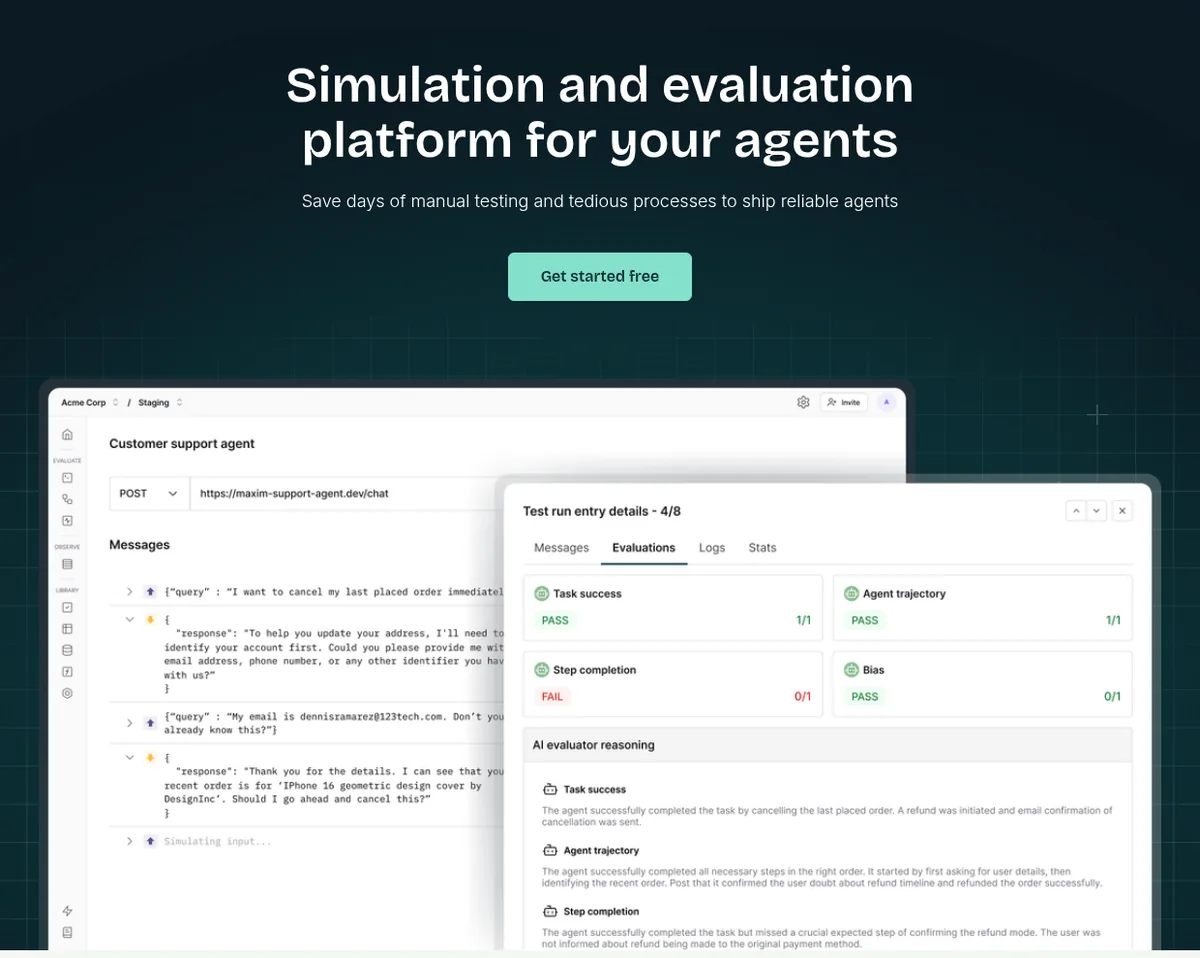
Maxim calls itself an end-to-end platform for simulation, evaluation, and observability of AI agents, per its homepage. Its headline feature is simulation: AI-generated users hold multi-turn conversations with your agent across scenarios and personas, per the simulation product page.
It also simulates voice agents, with voice evaluators such as interruption counts and word error rate, per its voice simulation docs. The company behind it, H3 Labs Inc, also builds Bifrost, an open-source LLM gateway under Apache 2.0 with 8,721 GitHub stars on October 12, 2026, per GitHub.
Best for: teams shipping support, sales, or voice agents where failures show up three or four turns into a conversation. Maxim is the only one of the three with simulated users as a first-class product.
Galileo
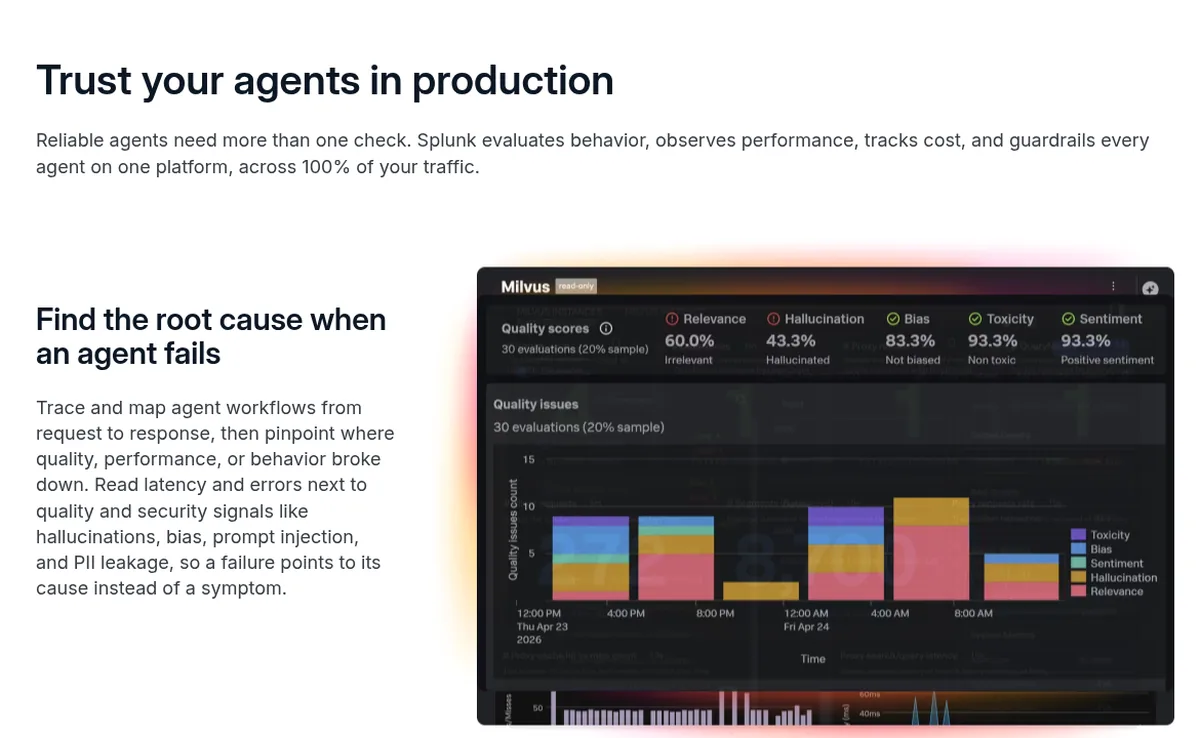
Splunk describes Agent Observability as one platform for evaluation, observability, token cost, and guardrails, per its product page. Its signature is Luna, a family of small language models trained to run evaluations. Splunk says Luna lets you score 100% of production traffic instead of a sample.
Luna-3 shipped for enterprise customers on October 9, 2026, and Splunk says it is 30 to 40% faster than Luna-2, per its release notes. Evaluator scores can also drive runtime guardrails through a feature called Agent Control, per the Agent Control docs.
Best for: large teams that already use Splunk and want eval scores, cost, and infrastructure signals on one timeline. Galileo is the only one of the three that turns eval scores into guardrails that block actions in production.
Agent Evals Compared: Datasets, Judges, Trajectories, and Simulation
All three handle datasets, experiments, LLM judges, code checks, and human review. The gaps open on agent-specific scoring. Galileo ships the most named agent evaluators, Maxim adds simulated users and deterministic tool-call matching, and Braintrust gives scorers the full trace so you write the agent logic yourself.
| Eval feature | Braintrust | Maxim AI | Galileo (Splunk) |
|---|---|---|---|
| Datasets and experiments | Yes, versioned datasets and experiment compare | Yes; dataset size capped by plan | Yes; experiment data kept 2 years on SaaS |
| LLM-as-a-judge | Yes | Yes, versioned custom evaluators | Yes, plus Autotune from feedback |
| Code-based scorers | Yes | Yes (programmatic and API evaluators) | Yes on-premises; not on SaaS |
| Small judge models | No | No | Luna (limited preset set on SaaS) |
| Trajectory scoring | Custom scorers over the trace | Agent Trajectory (session, pass or fail) | Agent Flow, Action Advancement, Agent Efficiency |
| Tool-call scoring | Custom scorers | Tool Selection, Tool Call Accuracy | Tool Selection Quality, Tool Error |
| Simulated users | No | Chat and voice | No |
| Human review | Review mode and queues; 1 score per project on Starter | Human annotation, plus Maxim-managed raters on Enterprise | Annotation queues |
| Online scoring | Automation rules on production logs | Session, trace, and node levels | Agent Stream evaluators with sampling |
Datasets and experiments
Braintrust datasets are versioned and feed straight into experiments, which you can compare against a baseline to see which cases regressed. Maxim limits dataset size by plan: 100 entries per dataset on Developer, 1,000 on Professional, and 10,000 on Business, per its pricing table. A 2,000-case regression suite does not fit in one Maxim Professional dataset.
Galileo, on Splunk SaaS, keeps experiment data for 2 years and trace data for 30 days by default, with 60, 90, or 180 days on request, per the SaaS docs.
LLM judges and custom scorers
Braintrust and Maxim both let you write judges in natural language and checks in code. Galileo adds Autotune, which turns reviewer feedback into few-shot examples inside a judge prompt, per its Autotune docs. The older Galileo release notes said this raised metric accuracy by 20 to 30%, a vendor figure we did not test.
One Splunk SaaS limit matters here. Custom code-based evaluators, Luna fine-tuning, and the AI Assistant are on-premises only, and SaaS supports only five preset Luna evaluators: Prompt Injection, Toxicity, Sexism, PII, and Context Adherence, per the feature table.
Trajectory and tool-call scoring
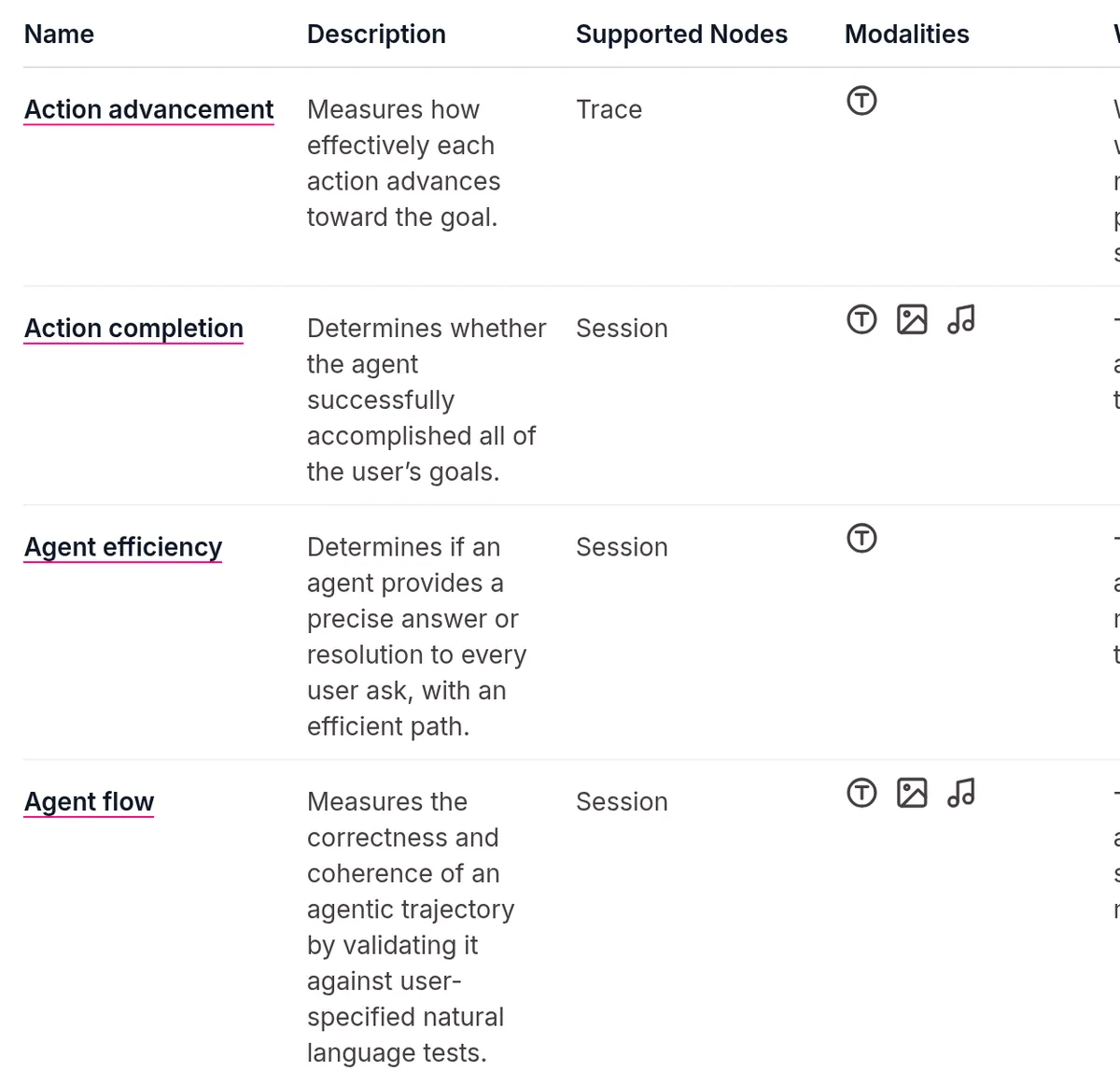
Galileo lists nine agentic evaluators, including Action Completion at the session level, Tool Selection Quality on LLM spans, and Tool Error on tool spans, per its agentic evaluators docs. Agent Flow checks a trajectory against natural-language tests you write, such as “must verify identity before refunding.”
Maxim’s Agent Trajectory evaluator returns 1 when a session completed all required steps and 0 when it missed some, per its docs. Its Tool Call Accuracy evaluator compares actual and expected tool calls with inAnyOrder and anyOne matching, with no LLM in the loop, per the Tool Call Accuracy docs.
Braintrust has no named trajectory metric. Its scorers receive the whole trace, so you can write a code scorer that checks tool order and arguments. Braintrust trades ready-made agent metrics for full control over how a trajectory is graded.
Simulation before launch
Maxim simulates multi-turn chats from a scenario, a persona, and an agent description, per its simulation docs. Simulation runs and online evals start on the Professional plan, per Maxim pricing.
Braintrust and Galileo do not offer simulated users. Braintrust’s closest feature is remote evals, which run your own agent code in a sandbox from a playground, per its remote evals docs.
Human review
Braintrust supports review mode, multiple reviewers per span, and assigned review queues, per its human review docs. The Starter plan allows one human review score per project. Maxim supports team and external raters on logs, per its annotation docs, and Galileo made annotation queues generally available on August 4, 2026.
Online Scoring and the Observability Overlap
All three trace agents and score production traffic, so you may not need a separate tracing tool. Braintrust runs scorers as background automation rules on logs, Maxim scores sessions, traces, and single nodes, and Galileo attaches evaluators to Agent Streams with sampling. For tracing depth, compare them with our AI agent observability tools guide.
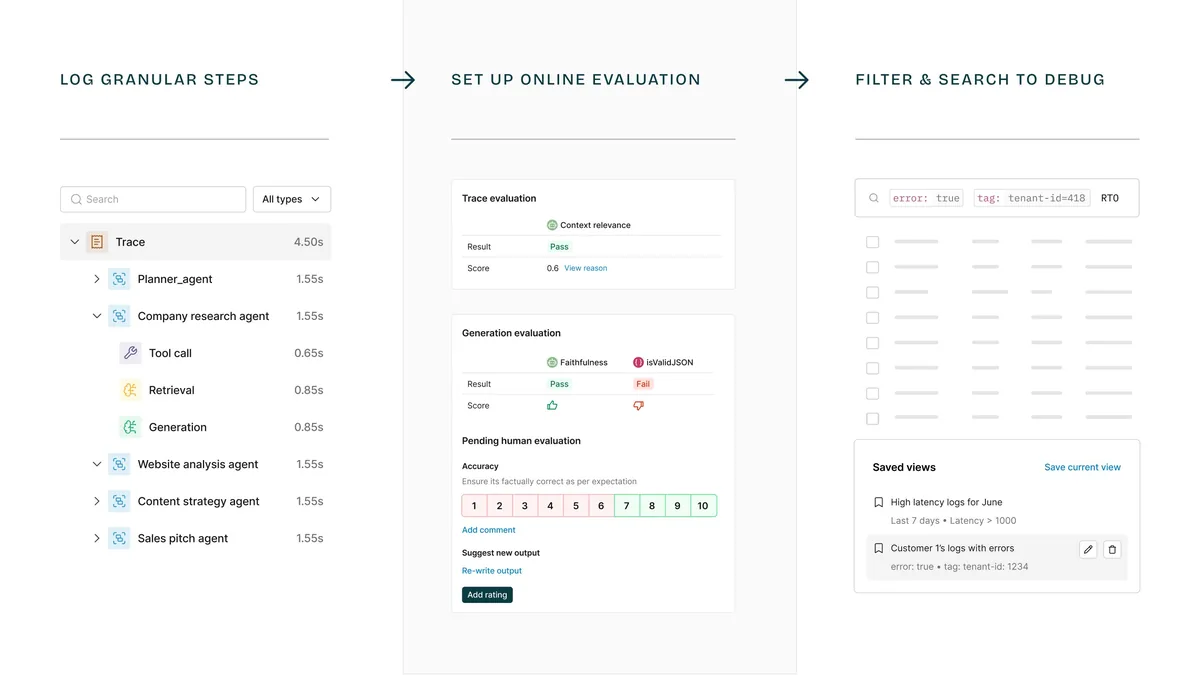
- Braintrust: online scores run asynchronously and add no latency to your app, and each score is stored as a span in the trace, per its online scoring docs.
- Maxim: online evals work at session, trace, and span level, with Slack and PagerDuty alerts, per its online evaluation docs.
- Galileo: Splunk correlates eval scores with latency, errors, GPU use, and token cost on one timeline, per the product page. That link to infrastructure data is the main reason to buy it inside Splunk.
If you already pay for Splunk Observability Cloud, Galileo gives you agent quality next to the infrastructure data you already watch. If you do not, the Splunk dependency becomes a cost of its own.
CI/CD Gates Compared, With Code
All three can fail a build when eval scores drop, but the mechanism differs. Braintrust ships a GitHub Action that comments on pull requests and a CLI for other CI systems. Maxim ships a GitHub Action that runs a test run against a stored workflow. Galileo runs experiments inside your unit tests, where you assert on average scores.
Braintrust uses braintrustdata/eval-action@v2 with a runtime of node, python, or go, and it posts a results comment on the pull request, per its CI docs. Other CI systems call bt eval, and a custom Reporter decides what counts as a failure.
# .github/workflows/evals.yml  (adapted from Braintrust's CI docs)
on:
  pull_request:
    branches: [main]
permissions:
  pull-requests: write
  contents: read
jobs:
  evaluate:
    runs-on: ubuntu-latest
    steps:
      - uses: actions/checkout@v4
      - run: pip install -r requirements.txt
      - uses: braintrustdata/eval-action@v2
        with:
          api_key: ${{ secrets.BRAINTRUST_API_KEY }}
          runtime: python
Maxim uses maximhq/actions/test-runs@v1 with a workspace, dataset, and workflow ID, and it returns failed indices and a report link, per its CI docs and the actions repository. It tests an agent that Maxim calls over HTTP, so your agent needs a reachable endpoint.
# .github/workflows/maxim.yml  (adapted from Maxim's CI docs)
      - uses: maximhq/actions/test-runs@v1
        with:
          api_key: ${{ secrets.MAXIM_API_KEY }}
          workspace_id: ${{ vars.WORKSPACE_ID }}
          dataset_id: ${{ vars.DATASET_ID }}
          workflow_id: ${{ vars.WORKFLOW_ID }}
          test_run_name: "PR ${{ github.sha }}"
          evaluators: "clarity, faithfulness"
Galileo runs an experiment inside a pytest test, then asserts on an evaluator’s average once it is computed, per the Splunk unit test docs. The SDK package is now splunk_ao.
# test_agent_evals.py  (adapted from Splunk Agent Observability docs)
import time
from splunk_ao.experiments import run_experiment, get_experiment
from splunk_ao.schema.metrics import SplunkAOEvaluators

def test_tool_selection():
    resp = run_experiment(experiment_name="pr-check", dataset_name="regression-set",
                          function=run_agent, metrics=[SplunkAOEvaluators.correctness])
    exp = get_experiment(experiment_name=resp["experiment"].name)
    while exp.get_metric_aggregate(SplunkAOEvaluators.correctness) is None:
        time.sleep(5)
        exp = get_experiment(experiment_name=resp["experiment"].name)
    assert exp.get_metric_aggregate(SplunkAOEvaluators.correctness).avg >= 0.9
We adapted these snippets from vendor docs and did not run them against paid accounts. Pin action versions and test them in a branch before you make any of them a required check.
Rule of thumb: gate merges on deterministic checks such as tool-call matching, and track LLM-judge averages as trends. Judge averages drift a few points between runs, so a hard 0.9 threshold on a judge score will flake until you calibrate it against human labels.
Integrations and SDKs: LangGraph, OpenTelemetry, and More
All three accept OpenTelemetry traces and support LangChain and LangGraph, so framework choice rarely decides this comparison. SDK breadth does: Braintrust supports six languages, Maxim supports four, and Splunk Agent Observability documents a Python SDK. Teams with Go, Java, or .NET agents should weigh that early.
| Integration | Braintrust | Maxim AI | Galileo (Splunk) |
|---|---|---|---|
| LangChain and LangGraph | LangGraph integration | LangChain and LangGraph listed; JS LangChain package | Callback handler and middleware |
| OpenTelemetry | Exporter, Collector, span processor | OTLP endpoint (GenAI, OpenInference, AI SDK conventions) | OTel and OpenInference |
| Other agent frameworks | OpenAI Agents SDK, CrewAI, Google ADK, Mastra, Pydantic AI, Strands, and more | OpenAI Agents, CrewAI, Agno, LiveKit, LiteLLM | CrewAI, Google ADK, Microsoft Agent Framework, Pydantic AI, Strands, A2A |
| SDK languages | TS, Python, Go, Java, Ruby, C# (Rust alpha) | Python, JS/TS, Go, Java/JVM | Python |
| Test runners | Pytest, Vitest, Node test runner | SDK test runs | Unit tests via experiments |
| MCP server for your eval data | Yes | Not found; MCP tools work in prompt tests | Yes |
Building on LangGraph? Our AI agent frameworks comparison covers how each framework emits traces. If LangSmith is already in your stack, our LangSmith alternatives guide explains what you give up by switching.
Pricing Compared, With a Worked Example
Braintrust bills processed gigabytes and scores with unlimited users. Maxim bills seats and caps logs per plan. Splunk bills Galileo by spans and Luna tokens on an annual contract. The cheapest platform flips with team size: seats push Maxim up, scores push Braintrust up, and span volume pushes Galileo up.
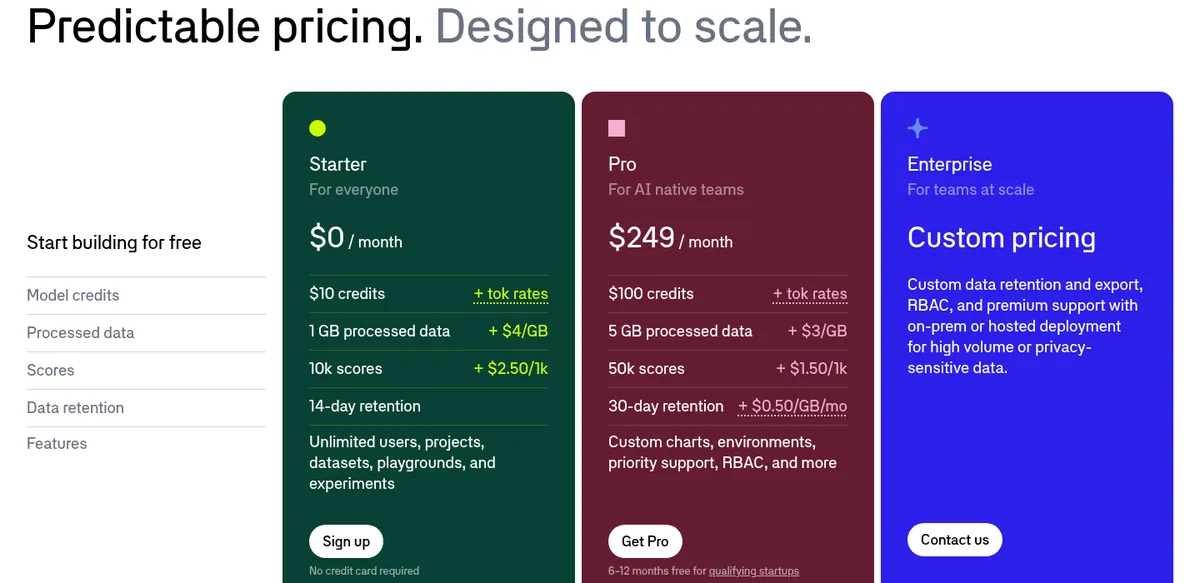
- Braintrust Starter, $0: 1 GB processed data then $4/GB, 10,000 scores then $2.50 per 1,000, 14-day retention, unlimited users, per Braintrust pricing.
- Braintrust Pro, $249/month: 5 GB then $3/GB, 50,000 scores then $1.50 per 1,000, 30-day retention, custom charts, environments, and RBAC. Qualifying startups can get 6 to 12 months free.
- Braintrust Enterprise: custom pricing, SAML SSO, BAA, and BYOC or self-hosted deployment. Processed data counts at ingestion, so deleting logs does not lower that month’s bill, per the billing FAQ.
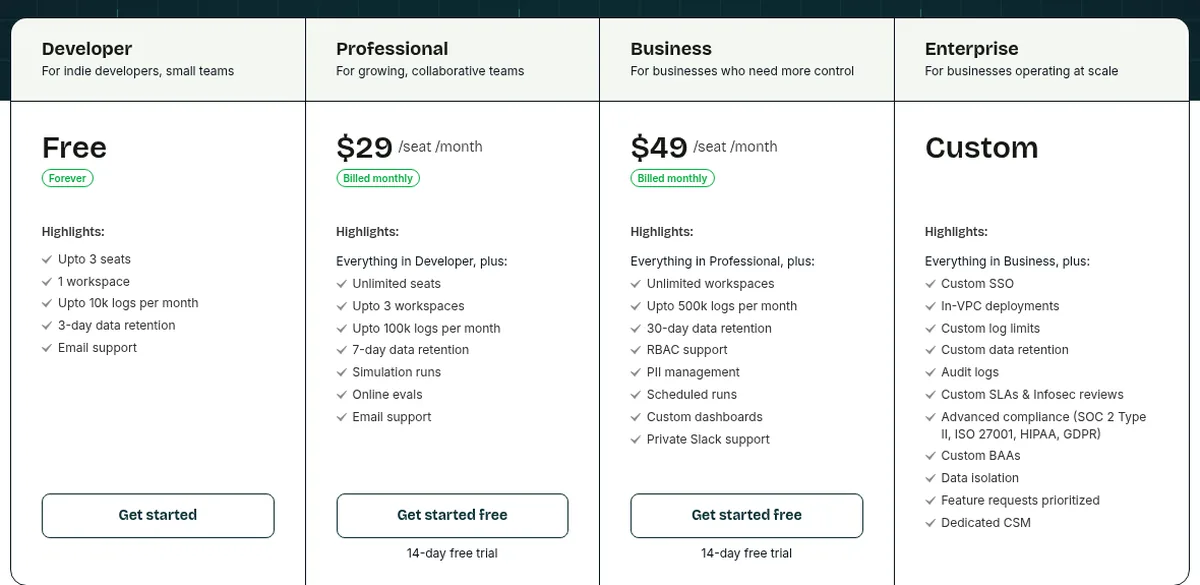
- Maxim Developer, free: up to 3 seats, 10,000 logs a month, 3-day retention, no overages, per Maxim pricing.
- Maxim Professional, $29/seat/month: 100,000 logs, 7-day retention, simulation runs, and online evals, then $1 per 10,000 extra logs.
- Maxim Business, $49/seat/month: 500,000 logs, 30-day retention, RBAC, PII management, and scheduled runs. Enterprise adds SSO, in-VPC deployment, and custom retention.
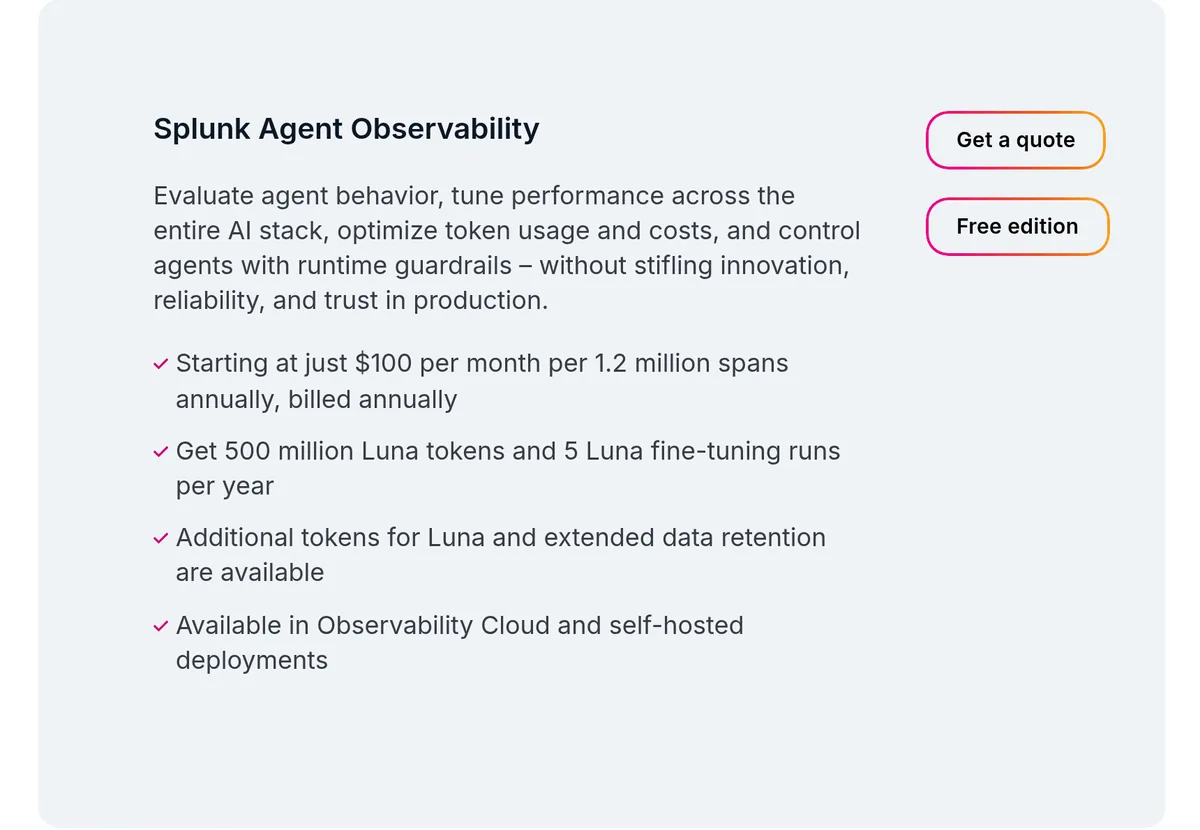
- Splunk Agent Observability: starting at $100 per month per 1.2 million spans annually, billed annually, with 500 million Luna tokens and 5 Luna fine-tuning runs per year, per Splunk pricing. We read this as $1,200 a year for each block of 1.2 million spans, or about 100,000 spans a month.
- Free edition: Splunk Observability Cloud is free for up to 15 hosts with all features, and Splunk says that includes agent tracing and evals, per its free edition announcement. We found no published span cap for agent data on the free edition.
- Billing units: agentic spans ingested and analyzed, plus Luna tokens used, per the billing docs.
Worked example: 50,000 agent traces a month
Here is one mid-sized workload priced at list rates. A 10-person team runs an agent that produces 50,000 production traces a month, each with about 8 spans and 25 KB of data. It scores 20% of production traces with 2 judges and runs a 2,000-case regression suite 10 times a month with 2 scorers.
| Cost line | Braintrust Pro | Maxim Business (10 seats) | Galileo on Splunk (estimate) |
|---|---|---|---|
| Platform or seats | $249 | $490 | Billed annually by span block |
| Usage in the example | 1.75 GB, 60,000 scores | 50,000 logs | 400,000 to 560,000 spans |
| Overage | 10,000 scores = $15 | $0 (500,000 logs included) | 4 to 6 blocks of 1.2M spans a year |
| Monthly total at list price | $264 | $490 ($290 on Professional) | $400 to $600 |
| Judge model tokens | Extra beyond model credits | Not priced on the page | Luna tokens included; LLM judges need your own model key |
- Braintrust: 1.25 GB of production traces plus 0.5 GB of experiment rows fits in Pro’s 5 GB. Scores are 20,000 online plus 40,000 offline, which is 10,000 over the 50,000 included. On Starter the same workload costs about $128, with 14-day retention and one human review score per project.
- Maxim: we assumed one production trace equals one log and that CI test runs do not count as logs, since the pricing page does not define a log. Professional costs $290 but caps each dataset at 1,000 entries and keeps logs for 7 days, so the suite must be split across two datasets.
- Galileo: production alone is 400,000 spans a month, or 4.8 million a year, which is 4 blocks. Counting experiment spans adds 160,000 a month and takes it to 6 blocks. We assumed the starting price scales in whole blocks; Splunk prices by quote and says SaaS access goes through your Splunk team, so treat this as a sanity check and confirm whether you also need a paid Observability Cloud plan.
Where the math flips: at 30 seats, Maxim Business costs $1,470 a month while Braintrust Pro stays at $264 for the same traffic. At a few million spans a month, the span blocks make Galileo the largest bill, and Luna’s included tokens matter only if you score with Luna rather than a frontier judge.
Pricing for LangSmith and Langfuse sits outside this page. Our Langfuse vs LangSmith vs Braintrust comparison prices those two against Braintrust on a similar workload.
Self-Hosting, Security, and Compliance
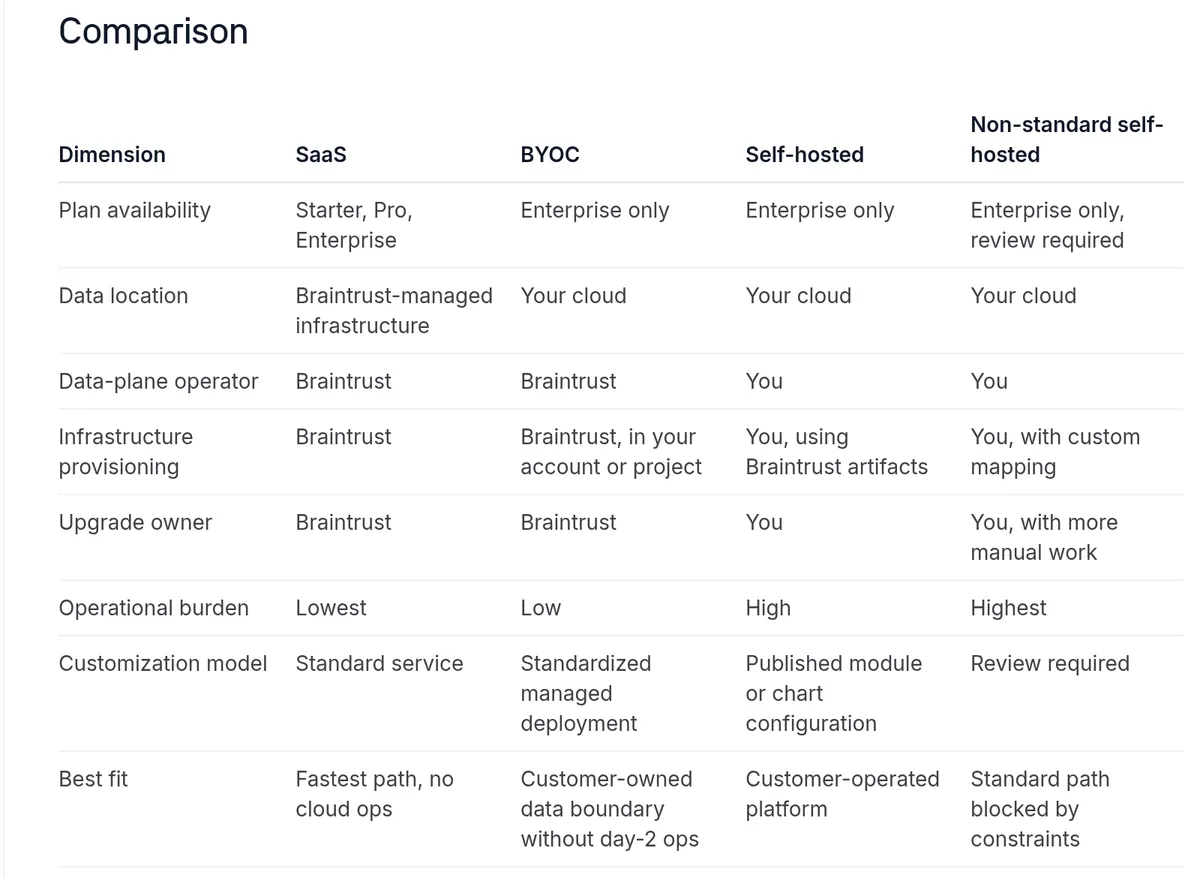
None of the three is free to self-host. Braintrust and Maxim reserve customer-cloud deployments for Enterprise plans, and Splunk offers Galileo as a customer-managed on-premises deployment by quote. All three publish security claims on their own pages, listed below as the vendors state them.
| Braintrust | Maxim AI | Galileo (Splunk) | |
|---|---|---|---|
| Hosted SaaS | All plans | All plans | Inside Splunk Observability Cloud |
| Your cloud | BYOC (Braintrust operates) or self-hosted data plane, Enterprise | Zero Touch (full VPC) or Data Plane (VPC peering), Enterprise | On-premises, customer-managed |
| Control plane | Always run by Braintrust | In your VPC with Zero Touch | Yours with on-premises |
| Compliance listed | SOC 2 Type II, GDPR, HIPAA (BAA on Enterprise) | SOC 2 Type II, ISO 27001, HIPAA, GDPR (Enterprise) | Not listed on the Agent Observability pages we checked |
| SSO | SAML SSO on Enterprise | Google OAuth; SAML SSO on Enterprise | SSO integration documented |
Maxim Zero Touch is the only option of the three that puts both the control plane and the data plane in your VPC on a vendor-managed install. Braintrust always runs the control plane itself, even when your data stays in your cloud, per its deployment docs. Maxim lists both models in its self-hosting docs and its trust center.
Splunk SaaS keeps trace data 30 days by default, which is short for audit work. If eval data cannot leave your network and you have no Enterprise budget, our AI agent evaluation tools guide covers open-source options such as Langfuse and Arize Phoenix.
Ownership and Roadmap Risk
Ownership tells you who sets the roadmap after you sign. Braintrust is a well-funded independent, Maxim is a small independent with a seed round on record, and Galileo now belongs to Cisco and ships as a Splunk product. Each carries a different risk for a multi-year contract.
- Braintrust: raised an $80 million Series B led by ICONIQ, with Andreessen Horowitz and Greylock returning, per its announcement. SiliconANGLE reported the round valued the company at $800 million, per SiliconANGLE.
- Maxim AI: raised $3 million led by Elevation Capital at its general availability launch in June 2024, per its announcement. We found no later round announced by the company.
- Galileo: acquired by Cisco, closed May 22, 2026, and folded into Splunk’s observability portfolio, per Cisco. Galileo docs remain for customers who onboarded before August 7, 2026.
The Galileo risk is roadmap direction, and the Maxim risk is scale. Splunk’s SaaS version already lacks several on-premises features, and Maxim’s funding on record is far smaller than Braintrust’s. Ask both for a written roadmap and data export terms before you sign.
Head-to-Head: Each Pair Compared
Most teams end up choosing between two of the three. These short verdicts cover each pair on the deciding factor, followed by what the other tool still does better. Use them when the third option is already ruled out by budget, hosting, or the shape of your agent.
Braintrust vs Maxim
Choose Braintrust when releases are gated on scores and your reviewer group is large, since users are unlimited. Choose Maxim when the agent is conversational and you need simulated users, chat or voice, before launch. Maxim Professional is cheaper for teams of eight or fewer, and Braintrust Pro is cheaper from nine seats up, before usage.
Braintrust vs Galileo
Choose Braintrust when you want scoring logic in your own code and a pull request comment on every change. Choose Galileo when you run Splunk, need guardrails that act in production, and want low-cost Luna scoring on all traffic. Braintrust supports more SDK languages, and Galileo ships more ready-made agent evaluators.
Maxim vs Galileo
Choose Maxim for pre-launch simulation and a self-serve, per-seat price you can buy today. Choose Galileo for production-scale scoring and guardrails inside an existing Splunk contract. Both ship named trajectory and tool-selection evaluators, so the choice comes down to testing before launch or protecting after it.
What None of the Three Does Well
Every comparison page lists strengths, so here are the gaps we found in the docs. None of the three is open source, none publishes independent judge-accuracy benchmarks, and none prices LLM-judge tokens in a way you can forecast from the pricing page alone. Plan for those before you commit.
- No open-source core: Braintrust’s autoevals and Maxim’s Bifrost are open source, but the eval platforms are not.
- Judge cost is outside the sticker price: Braintrust bills built-in model use against credits, Maxim does not price judge tokens on its page, and Galileo’s Luna pool covers Luna only.
- Short default retention: 14 days on Braintrust Starter, 3 to 7 days on Maxim’s lower plans, and 30 days on Splunk SaaS traces.
- Vendor-reported accuracy: Galileo’s “96% lower cost” for Luna and Autotune’s “20 to 30%” gains come from the vendor, and we found no independent test.
- Migration cost: scorers and datasets do not move cleanly between the three, so export your test cases to JSONL from day one. Our evals and testing coverage tracks portable formats.
Which One Should You Choose?
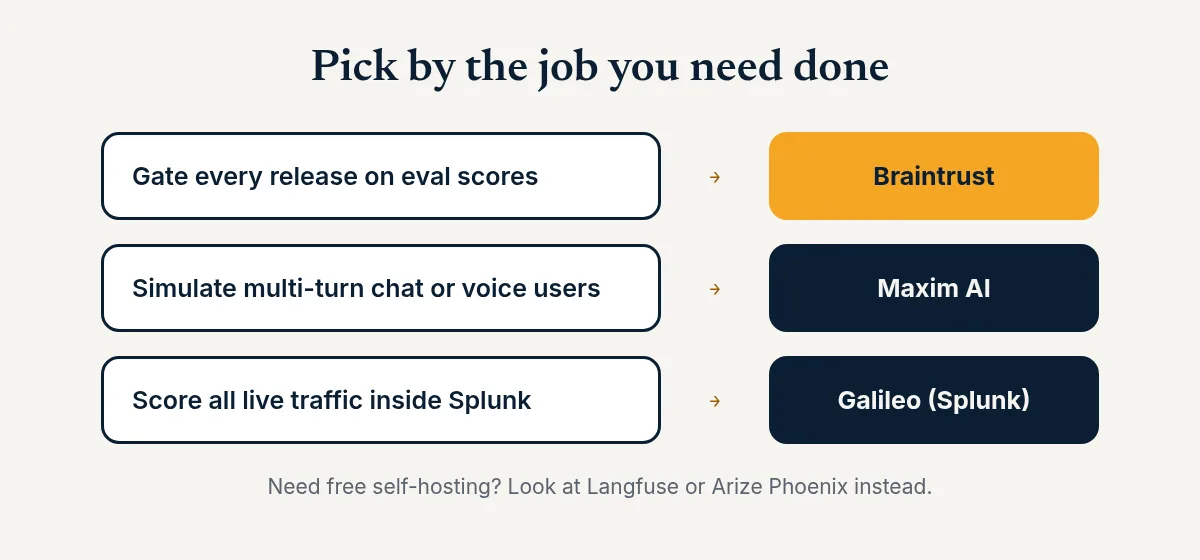
Start with the job that hurts most today. If bad releases slip through, pick Braintrust and wire its action into pull requests. If conversations fail several turns in, pick Maxim and simulate them. If production quality is invisible inside an existing Splunk estate, pick Galileo and score live traffic with Luna.
Choose Braintrust if
- Eval scores must block merges, and you want a pull request comment on every change.
- Many engineers, PMs, and reviewers need access without per-seat fees.
- Your agents run in Go, Java, Ruby, or C# as well as Python or TypeScript.
Choose Maxim AI if
- Your agent holds multi-turn chats or voice calls, and failures appear late in the conversation.
- You want a self-serve plan under $300 a month for a small team.
- You need the control plane and data plane inside your VPC on Enterprise.
Choose Galileo if
- You already run Splunk Observability Cloud or plan an on-premises Splunk deployment.
- You want to score every production request and turn scores into runtime guardrails.
- You prefer preset agent evaluators over writing your own scorers.
Disqualifiers: skip all three if you need free self-hosting, skip Maxim if your agent never holds a conversation, skip Galileo if you have no Splunk plans and need monthly billing, and skip Braintrust Starter if you need more than one human review score per project.
Frequently Asked Questions About Braintrust, Maxim, and Galileo
Is Galileo AI still available in 2026?
Yes, but as a Splunk product. Cisco completed its Galileo acquisition on May 22, 2026, and on August 7, 2026 Galileo became Splunk Agent Observability. Existing customers keep the Galileo docs, while new customers onboard through Splunk, with SaaS inside Splunk Observability Cloud or a customer-managed on-premises deployment.
Which is cheaper, Braintrust or Maxim?
Team size decides it. Maxim Professional costs $29 per seat, so 5 seats cost $145 a month, below Braintrust Pro at $249. Braintrust has unlimited users, so from nine seats up it is usually cheaper. Braintrust bills scores and gigabytes, and Maxim bills seats and logs.
Does Braintrust support agent simulation like Maxim?
No. Braintrust has no simulated users. Its closest feature is remote evals, which run your own agent code in a sandbox from a playground. Maxim generates AI users that hold multi-turn chat or voice conversations across scenarios and personas, and then scores task success and trajectory.
What does Galileo cost now that it is part of Splunk?
Splunk lists Agent Observability starting at $100 per month per 1.2 million spans annually, billed annually, with 500 million Luna tokens and five Luna fine-tuning runs per year. A free edition of Splunk Observability Cloud covers up to 15 hosts. The older $100 Galileo Pro plan no longer appears.
Can I self-host Braintrust, Maxim, or Galileo?
Only on paid contracts. Braintrust offers BYOC and a self-hosted data plane on Enterprise, with Braintrust running the control plane, and Maxim offers full in-VPC Zero Touch or a Data Plane deployment on Enterprise. Splunk sells Galileo as a customer-managed on-premises deployment. None of the three is open source.
The Bottom Line: Pick the Moment You Want to Catch Failures
Braintrust catches failures at the pull request, Maxim catches them in a simulated conversation, and Galileo catches them in production. Choose the moment that costs you most today, then check the billing unit against your traffic, because seats, scores, and spans scale very differently.
We recheck these prices quarterly, and vendors can send corrections through our contact page. For the tracing side of the same stack, read our guide to the best AI agent observability tools.
Related guides: the AgentOps tools map, 10 best AI agent evaluation tools, Langfuse vs LangSmith vs Braintrust, LangSmith alternatives, AI agent frameworks, AgentOps: observability, evals, and monitoring, agent evals and testing, and agent observability.