

Last updated October 11, 2026. Prices, plan limits, licenses, and hosting options were checked against each vendor’s own pricing pages and documentation on that date.
Three names come up on almost every agent observability shortlist in 2026, and each one wins a different kind of team.
Langfuse vs LangSmith vs Braintrust comes down to one question: do you need an open platform, a LangChain-native suite, or an eval engine? This comparison puts the three side by side on tracing, evals, prompts, alerts, pricing, hosting, and ownership.
It is part of our AgentOps tools map and our agent observability coverage. No vendor paid for placement or reviewed this page, per our editorial standards and disclosure policy.
All three trace agents, run evals, and accept OpenTelemetry, so the real differences sit in pricing units, hosting rights, and workflow focus. If you want a wider shortlist first, see our 12 best AI agent observability tools.
TL;DR
- Langfuse is the open platform: MIT licensed, free to self-host, and $29 per month on Cloud with unlimited users.
- LangSmith is the LangChain suite: the deepest LangGraph tracing, plus deployment, at $39 per seat per month.
- Braintrust is the eval engine: scores, experiments, and quality alerts at the center, with unlimited users from $0 to $249 per month.
- Pricing units differ: Langfuse bills traces, spans, and scores as units, LangSmith bills traces and seats, and Braintrust bills gigabytes and scores.
- On one worked example of 50,000 agent runs a month, the bills came to about $105, $408, and $249.
- Self-hosting is free only with Langfuse, since LangSmith and Braintrust reserve it for Enterprise contracts.
Langfuse vs LangSmith vs Braintrust: The Short Answer
Pick Langfuse if you want open-source tracing and evals you can self-host or buy cheaply. Pick LangSmith if your agents run on LangChain or LangGraph and you want one vendor through deployment. Pick Braintrust if eval scores decide what ships and you want quality alerts, experiments, and playgrounds in one place.
| Langfuse | LangSmith | Braintrust | |
|---|---|---|---|
| Center of gravity | Open LLM engineering platform | LangChain’s agent engineering suite | Evaluation-first platform |
| License | MIT core, enterprise features in ee folders | Proprietary platform, MIT SDK | Proprietary platform, open-source SDKs |
| Free self-hosting | Yes | No (Enterprise only) | No (Enterprise only) |
| Free tier | 50,000 units, 2 users | 5,000 base traces, 1 seat | 1 GB, 10,000 scores, unlimited users |
| Paid entry | $29/month, unlimited users | $39/seat/month | $249/month, unlimited users |
| Billing unit | Traces + observations + scores | Seats + traces | Processed GB + scores |
| Data access on entry paid plan | 90 days | 14 days base, 180 days extended | 30 days, up to 180 for a fee |
| OpenTelemetry | OTLP endpoint | OTLP endpoint | OTLP exporter or span processor |
| Owner | ClickHouse (since January 2026) | LangChain | Braintrust Data, Inc. |
Key takeaway: the cheapest tool depends on your team size and trace shape. Seat pricing punishes large teams, unit pricing punishes span-heavy agents, and gigabyte pricing punishes verbose payloads.
How We Compared Langfuse, LangSmith, and Braintrust
We reviewed each vendor’s pricing page, product documentation, license files, and SDK repositories on October 11, 2026, and scored the three on the jobs an agent team does every week. We did not run hands-on benchmarks for this edition, so treat vendor performance claims as claims until you test them.
- Tracing: SDKs, OpenTelemetry ingestion, and agent views.
- Evals: datasets, experiments, LLM-as-judge, human review, and online scoring.
- Prompts and alerts: versioning, playgrounds, and what an alert can fire on.
- Pricing: list prices, billing units, and one worked cost example.
- Hosting and compliance: self-hosting rights, data regions, and audit reports.
- Ownership: who owns each product and how it is funded.
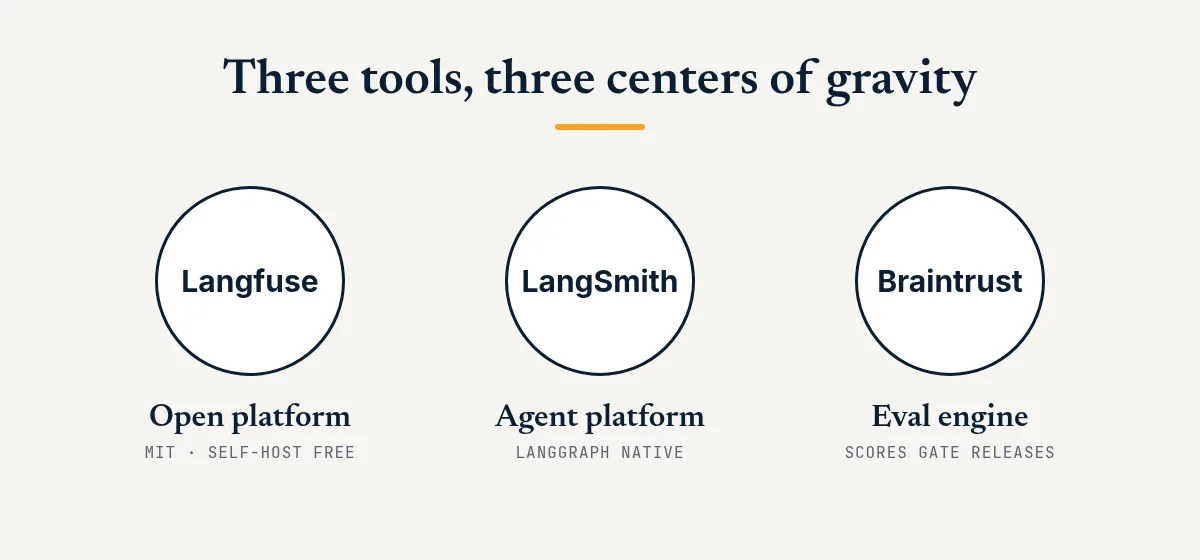
Three Tools, Three Centers of Gravity
Langfuse, LangSmith, and Braintrust overlap on most core features, but each one was built around a different first job. Langfuse started as open tracing, LangSmith as the debugger for LangChain apps, and Braintrust as an eval workbench, and those roots still shape pricing, defaults, and the screens teams use daily.
Langfuse
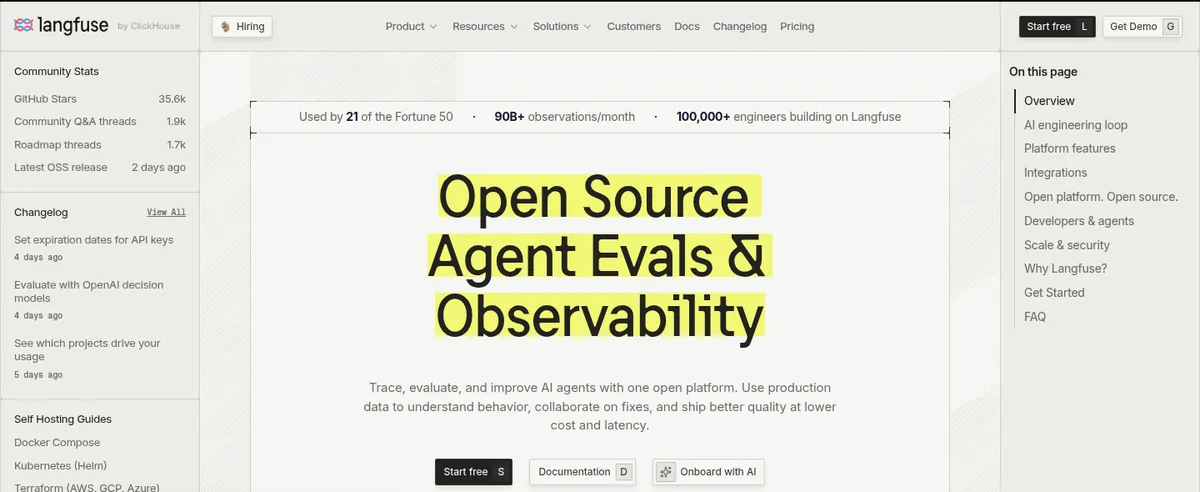
Verdict: Langfuse is the best fit for teams that want open-source tracing, evals, and prompt management with no per-seat fees.
Langfuse is an open-source LLM engineering platform whose core is MIT licensed, with enterprise features kept in separate folders, per its license file. ClickHouse acquired Langfuse in January 2026, and the repository had about 35,600 GitHub stars in October 2026.
Self-hosting runs the same stack as Langfuse Cloud: web and worker containers, Postgres, ClickHouse, Redis or Valkey, and S3-compatible storage.
Key features
- Agent traces and graphs, session and user tracking, and token and cost tracking.
- Datasets, experiments from the SDK or UI, LLM-as-judge evaluators, and annotation queues.
- Prompt versioning, release labels, caching, a playground, and alerts to Slack, webhooks, or GitHub Actions.
Pricing
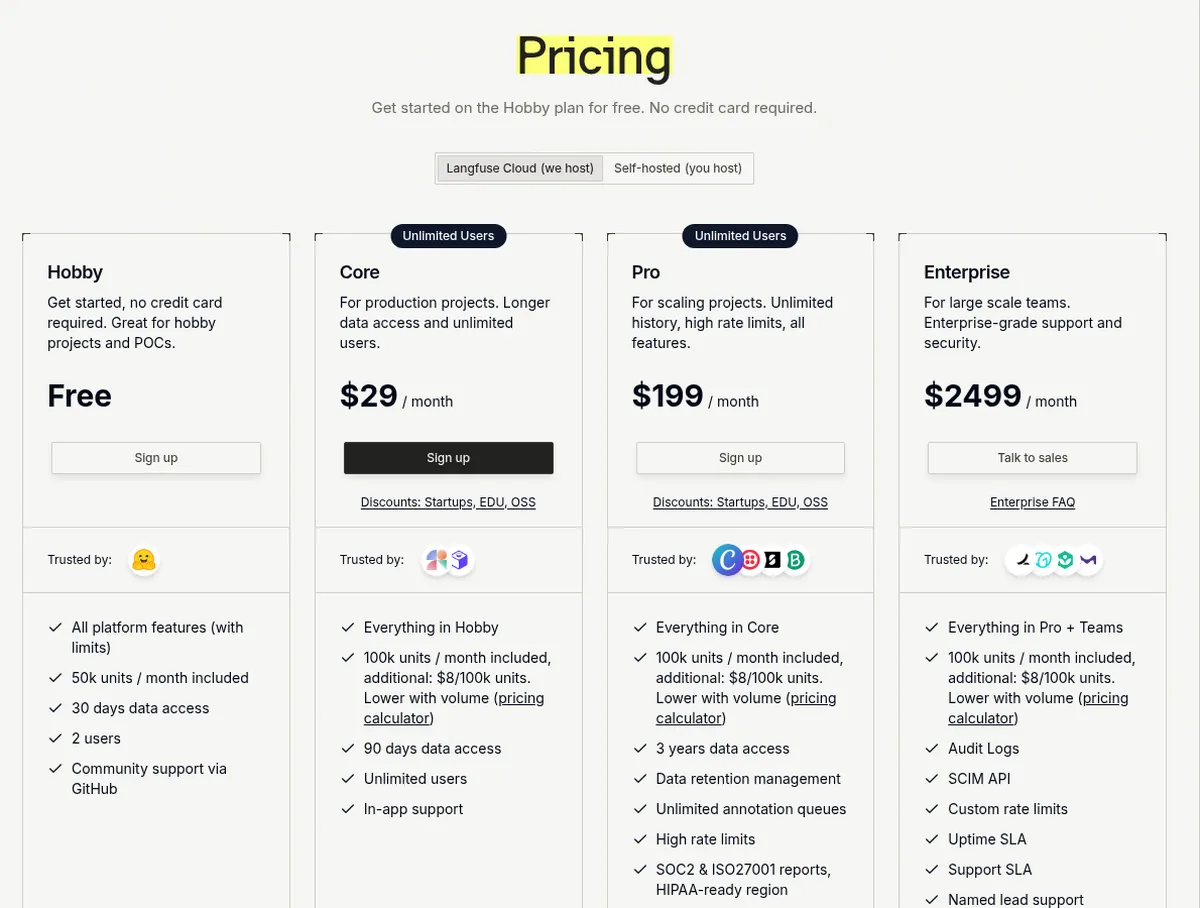
- Hobby is free with 50,000 units per month, 2 users, and 30 days of data access.
- Core costs $29 per month for 100,000 units, then $8 per 100,000, with unlimited users and 90 days of data access.
- Pro costs $199 per month with 3 years of data access, and Enterprise starts at $2,499 per month.
Prices come from Langfuse pricing. The OSS self-host is free under MIT, and a license key unlocks extras such as project-level RBAC, audit logs, and data retention policies.
Looking beyond this three-way set, we ranked eight open source LLM observability tools you can self-host, including Opik, Phoenix, Helicone, and LangWatch.
Pros and cons
Pros
- Free self-hosting with every core feature and no usage caps.
- Unlimited users from the $29 Core plan.
Cons
- Every trace, span, and score counts as a billable unit on Cloud.
- Running ClickHouse in production takes real operations work.
LangSmith
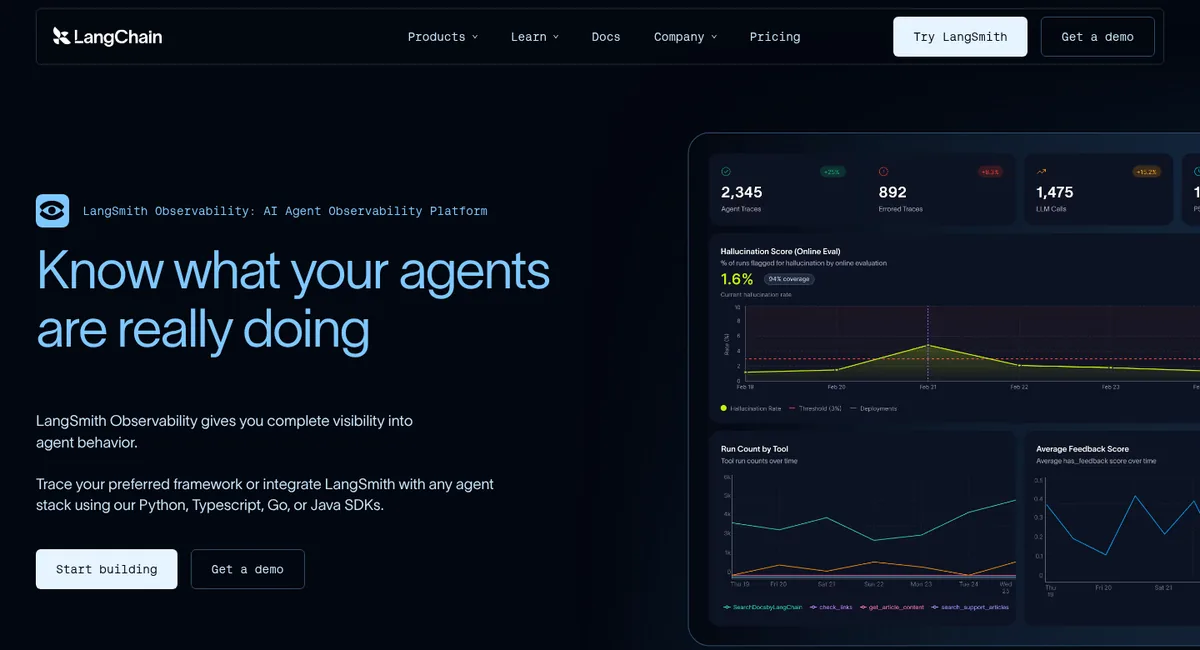
Verdict: LangSmith is the best fit for teams building on LangChain or LangGraph that want tracing, evals, and deployment from one vendor.
LangSmith is LangChain’s commercial platform for agent observability, evaluation, and deployment. It works with or without LangChain, through Python, TypeScript, Go, and Java SDKs and an OpenTelemetry endpoint.
LangChain raised $125 million at a $1.25 billion valuation in October 2025 to expand LangSmith into a full agent engineering platform.
Key features
- Agent traces with trajectory and tool views, plus monitoring dashboards.
- Offline and online evals with human review, code rules, LLM-as-judge, and pairwise comparison.
- Engine, which clusters agent failures and proposes fixes and evals, on paid plans.
Pricing
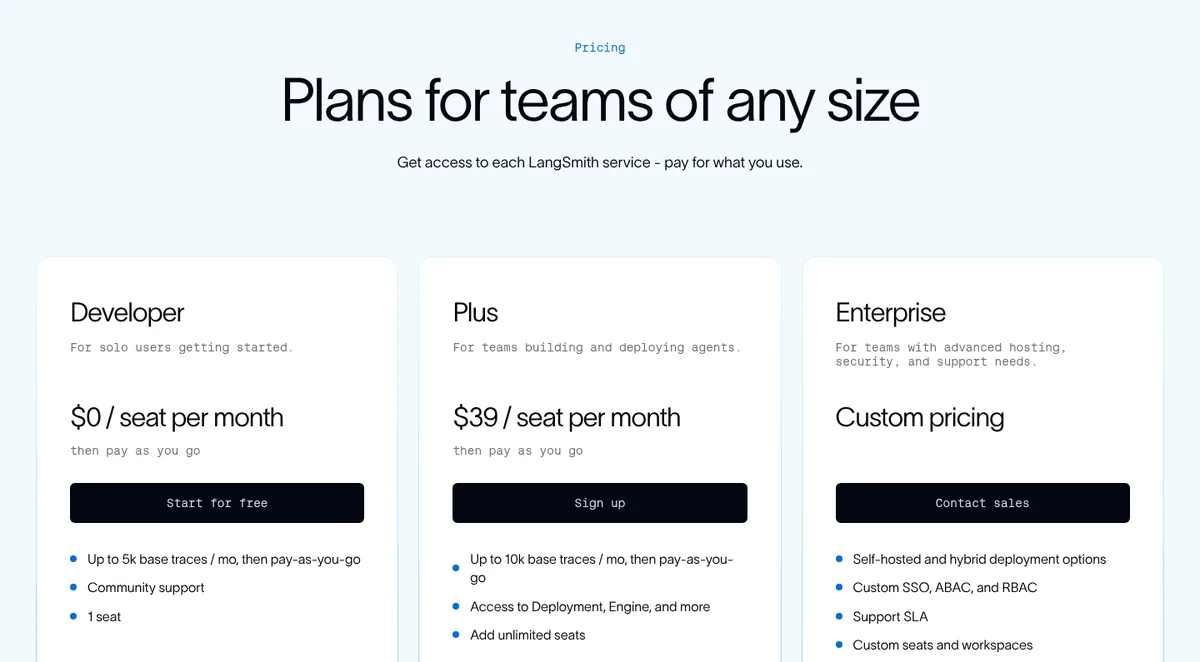
- Developer is free for 1 seat and 5,000 base traces per month.
- Plus costs $39 per seat per month with 10,000 base traces, then $0.005 per base trace.
- Enterprise is custom priced and adds hybrid and self-hosted deployment, custom SSO, and RBAC.
Prices come from LangSmith pricing. Upgrading a trace from 14-day to 180-day retention adds 0.0025 LSU, and one LSU equals $1.
Pros and cons
Pros
- The deepest LangGraph-aware tracing and debugging available.
- Deployment, sandboxes, and an LLM gateway sit in the same account.
Cons
- Every invited user is a billable seat.
- Self-hosting requires an Enterprise contract.
Braintrust
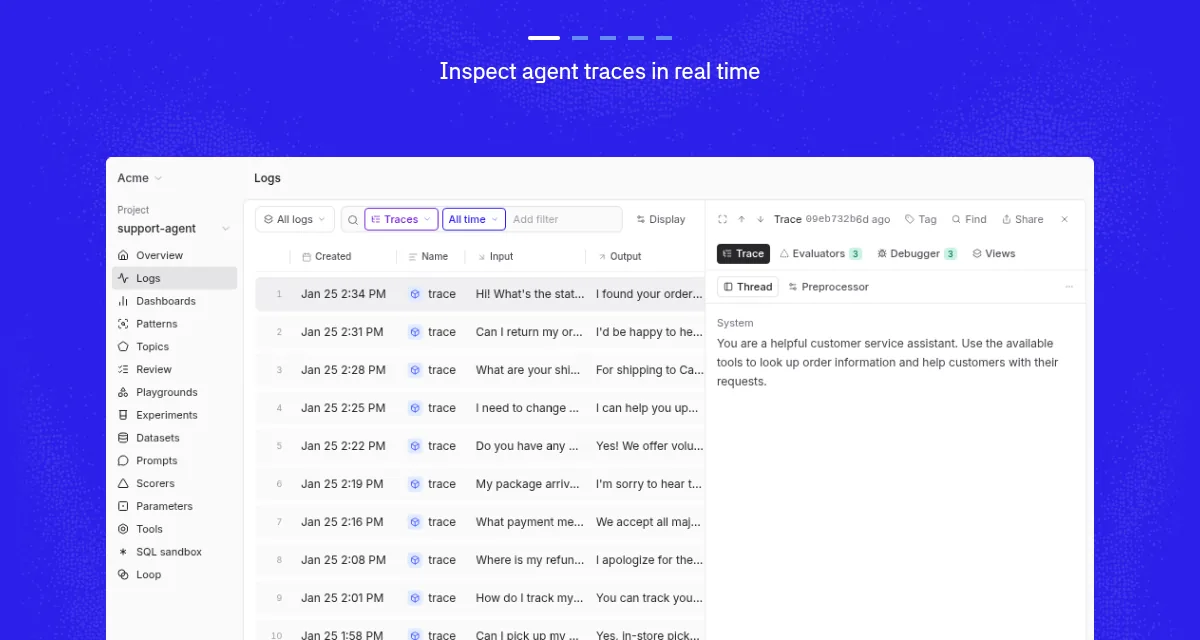
Verdict: Braintrust is the best fit for product teams where eval scores decide releases and many people review AI output.
Braintrust is a proprietary evaluation and observability platform built around datasets, experiments, scorers, and playgrounds. Its SDKs for Python, TypeScript, Go, Java, and Ruby are open source, and its autoevals scorer library is MIT licensed.
Braintrust raised an $80 million Series B led by ICONIQ in February 2026, which press reports put at an $800 million valuation.
Key features
- Online scoring of production traces with sampling and filters.
- Alerts written as SQL conditions on scores, such as factuality below 0.8.
- Loop, a built-in agent that runs evals, writes test cases, and iterates on prompts.
Pricing
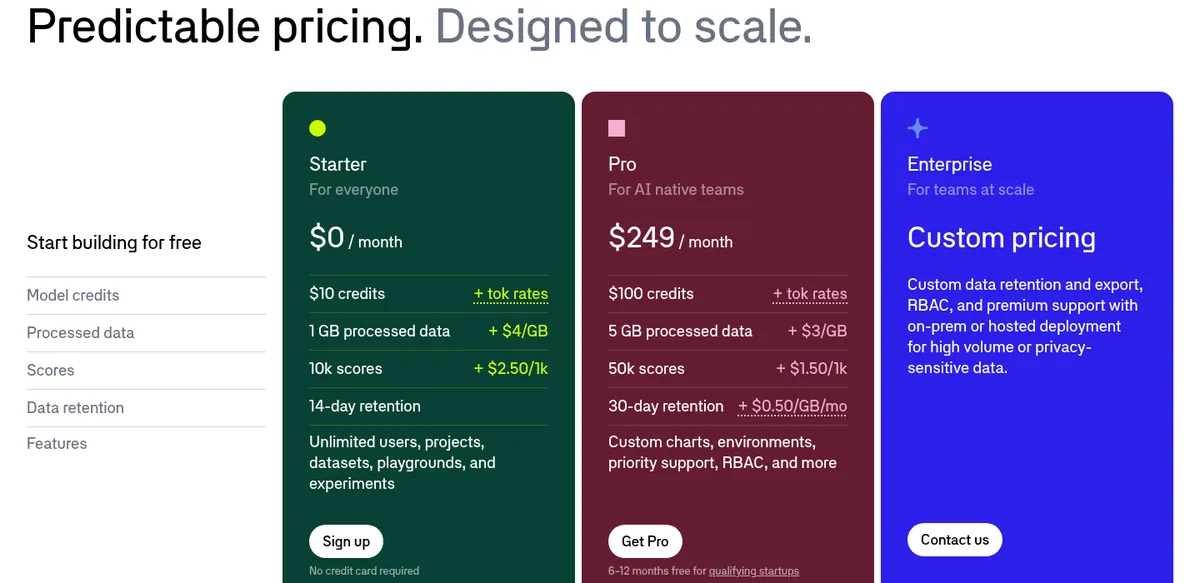
- Starter is free with $10 in model credits, 1 GB of processed data, 10,000 scores, and 14-day retention.
- Pro costs $249 per month with $100 in credits, 5 GB, 50,000 scores, and 30-day retention.
- Overage runs $3 per GB and $1.50 per 1,000 scores on Pro, and Enterprise is custom priced.
Prices come from Braintrust pricing. Pro is free for 6 to 12 months for qualifying startups, according to the same page.
Pros and cons
Pros
- Unlimited users on every plan, including the free one.
- Quality alerts fire directly on eval scores.
Cons
- Billing on gigabytes plus scores takes modeling to forecast.
- Self-hosting and SAML SSO are Enterprise only.
Tracing Compared: SDKs, OpenTelemetry, and Agent Views
All three tools capture nested agent traces with model calls, tool calls, tokens, latency, and cost, and all three accept OpenTelemetry spans. LangSmith adds the richest LangGraph views, Langfuse offers the broadest open ingestion, and Braintrust ties every trace directly to scoring and datasets. LangSmith is the native tracer for LangGraph, one of the 12 AI agent frameworks we compare.
| Tracing feature | Langfuse | LangSmith | Braintrust |
|---|---|---|---|
| Native SDKs | Python, JavaScript | Python, TypeScript, Go, Java | Python, TypeScript, Go, Java, Ruby |
| OpenTelemetry ingestion | OTLP endpoint at /api/public/otel | OTLP endpoint, maps GenAI, OpenInference, and Traceloop attributes | OTLP exporter, Collector, or span processor |
| Agent views | Traces, agent graphs, sessions | Trajectories, threads, LangSmith Studio | Trace trees, custom trace views |
| Cost tracking | Token and cost per trace | Cost per trace and project | Estimated cost per trace |
| Gateway | Logs proxy traffic via LiteLLM | LangSmith LLM Gateway | Braintrust Gateway (public preview) |
Instrumenting a function looks nearly identical in all three Python SDKs. Each snippet below comes from the vendor’s own docs.
# Langfuse
from langfuse import observe

@observe()
def run_agent(question):
    ...

# LangSmith
from langsmith import traceable

@traceable
def run_agent(question):
    ...

# Braintrust
from braintrust import init_logger, traced

logger = init_logger(project="My Project")

@traced
def run_agent(question):
    ...
Sources: Langfuse instrumentation, LangSmith custom instrumentation, and Braintrust custom tracing. If you instrument with OpenTelemetry instead, you can switch among the three without touching application code.
The Braintrust Gateway is free in public preview, and Braintrust states that it carries no SLA. Teams that need a production gateway today should compare options in our AI gateways coverage.
Evals Compared: Datasets, Judges, and Production Scoring
Each tool runs offline experiments on datasets and online evaluators on live traces, with LLM-as-judge and human review. Braintrust makes evals the main screen and alerts on scores, LangSmith adds automated failure clustering through Engine, and Langfuse gives the most eval capacity per dollar. For seven more options, including DeepEval, Phoenix, and promptfoo, see our 10 best AI agent evaluation tools.
| Eval feature | Langfuse | LangSmith | Braintrust |
|---|---|---|---|
| Datasets and experiments | SDK and UI | SDK, UI, and Studio | SDK, UI, and playgrounds |
| Scorers | LLM-as-judge, custom code, user feedback | LLM-as-judge, code rules, pairwise, human | LLM-as-judge, autoevals, custom code |
| Online evals | Yes, on live traces | Yes, on live traffic | Yes, with sampling and filters |
| Human review | Annotation queues (1 on Hobby, 3 on Core) | Annotation queues | Human review scores (1 per project on Starter) |
| Automation | Langfuse Assistant | Engine and Tuned Evaluators (beta) | Loop agent |
| How scores are billed | 1 unit per score | Scored traces upgrade to extended retention | Per 1,000 scores after the allowance |
Scoring cost behaves differently in each tool. LangSmith online evaluators upgrade the traces they score to 180-day retention by default, according to its administration docs, though you can opt out per evaluator. Braintrust bills each score after the free allowance, and Langfuse counts each score as one unit.
Model calls made by LLM-as-judge evaluators cost extra in every tool, either on your own API key or from included credits. For a wider view of eval platforms, see our evals and testing coverage.
Prompts, Playgrounds, and Alerts Compared
All three tools version prompts, offer a playground, and alert on both operational metrics and quality scores. The difference is alert style: Langfuse sets thresholds with warning levels, LangSmith scopes alerts to one project and routes them to PagerDuty, and Braintrust writes alert conditions as SQL filters over logs.
| Feature | Langfuse | LangSmith | Braintrust |
|---|---|---|---|
| Prompt management | Versioning, release labels, composability, caching | Prompt Hub with commit tags | Versioned prompts tagged by environment |
| Playground | Yes, with prompt experiments | Yes | Yes, runs full evals side by side |
| Alert targets | Observation metrics and numeric, categorical, or boolean scores | Latency, errors, cost, feedback scores | SQL conditions on logs, scores, and metrics |
| Alert channels | Slack, webhooks, GitHub Actions | Webhooks, PagerDuty | Slack, webhooks |
| Alert types or limits | 2, 20, 50, or 100 by Cloud plan; no limit self-hosted on v4 | Scoped to one tracing project or agent environment | Log, time window, and environment alerts |
An alert on quality only works once you define the score behind it. Set up one LLM judge or code check per failure mode first, then alert on its average or pass rate. Braintrust can also alert when a prompt or dataset changes environment, which helps audit releases.
Pricing Compared, With a Worked Example
Langfuse starts at $29 per month with unlimited users, LangSmith at $39 per seat per month, and Braintrust at $249 per month with unlimited users. Each one meters a different unit, so the right comparison is a bill for your own workload, which we model below with public list prices.
| Pricing item | Langfuse Cloud | LangSmith | Braintrust |
|---|---|---|---|
| Free plan | 50,000 units, 2 users, 30 days | 5,000 base traces, 1 seat, 14 days | 1 GB, 10,000 scores, unlimited users, 14 days |
| Entry paid plan | Core $29/month | Plus $39/seat/month | Pro $249/month |
| Included on entry plan | 100,000 units | 10,000 base traces | 5 GB, 50,000 scores, $100 credits |
| Overage | $8 per 100,000 units | $0.005 per base trace | $3 per GB, $1.50 per 1,000 scores |
| Longer retention | Pro $199/month, 3 years | $0.0025 per extended upgrade, 180 days | $0.50 per GB-month, up to 180 days |
| Startup offer | Discounts for startups, EDU, OSS | Up to $10,000 in credits | Pro free 6 to 12 months if eligible |
Worked example: 50,000 agent runs a month
Our scenario is a team of 5 engineers running 50,000 agent runs a month, with 20 spans per run and an LLM judge scoring 10 percent of runs. For Braintrust, we assume about 20 KB of processed data per run, which is our estimate and not a vendor figure.
| Cost line | Langfuse Core | LangSmith Plus | Braintrust Pro |
|---|---|---|---|
| Platform or seats | $29 | $195 (5 x $39) | $249 |
| Usage | 955,000 extra units = $76.40 | 40,000 extra traces = $200 | 1 GB, inside the 5 GB allowance = $0 |
| Scoring | 5,000 scores, included in units above | 5,000 extended upgrades = $12.50 | 5,000 scores, inside the allowance = $0 |
| Estimated monthly total | About $105 | About $408 | About $249 |
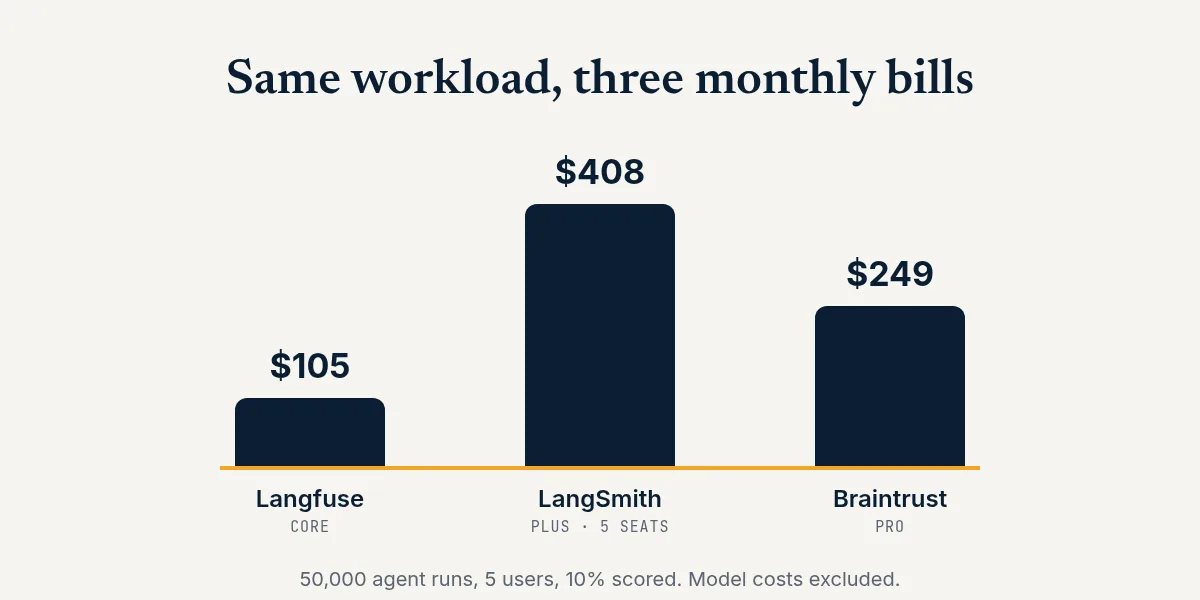
The ranking flips as the inputs change. One seat on LangSmith drops its bill to about $252, while doubling spans per run nearly doubles the Langfuse usage line. On Braintrust Starter, the same workload could cost $0, at the price of 14-day retention and one human review score per project.
Before you sign: run one week of real traffic through each free tier and read the usage page. Langfuse documents how to count units in its billable units guide.
Self-Hosting, Data Residency, and Compliance
Langfuse is the only one of the three you can self-host for free, under an MIT license with no usage caps. LangSmith and Braintrust offer self-hosted or hybrid deployment only on Enterprise contracts, though all three list SOC 2 Type II and offer HIPAA paths on higher tiers.
| Hosting and security | Langfuse | LangSmith | Braintrust |
|---|---|---|---|
| Cloud regions | US, EU, Japan, plus a HIPAA region on Pro | US or EU | Not stated on the pricing page |
| Self-hosting | Free OSS, or Enterprise bundled with ClickHouse | Enterprise: self-hosted, hybrid, or BYOC | Enterprise: your data plane, Braintrust control plane |
| SSO | Google, Azure AD, GitHub; Enterprise SSO via the $300/month Teams add-on on Pro | Google, GitHub; custom SSO on Enterprise | OAuth and MFA; SAML SSO on Enterprise |
| Compliance | SOC 2 Type II and ISO 27001 reports on Pro | SOC 2 Type 2, HIPAA, GDPR | SOC 2 Type II; BAA on Enterprise |
| Training on your data | Not addressed on the pricing page | No, per the pricing FAQ | Not addressed on the pricing page |
Braintrust’s self-hosted model keeps traces, datasets, and prompts in your cloud account, while Braintrust runs the UI, authentication, and metadata. That split suits teams that need data residency but do not want to operate the whole platform.
Ownership and Roadmap Risk
All three tools are backed by well-funded owners in 2026, so the risk is direction more than survival. Langfuse now sits inside ClickHouse, LangSmith is the commercial core of LangChain, and Braintrust is an independent startup that raised $80 million in February 2026.
- Langfuse: ClickHouse acquired it on January 16, 2026, and the MIT license and self-hosting continue. Enterprise self-hosting is now sold alongside ClickHouse Cloud, BYOC, or ClickHouse Private.
- LangSmith: LangChain’s October 2025 Series B funded the expansion into deployment, Engine, and a no-code agent builder. Expect more bundled products and more separately metered lines.
- Braintrust: the Series B announcement lists ICONIQ as lead, with Andreessen Horowitz and Greylock returning. It remains independent and closed source.
Keep an exit path whichever tool you pick. OpenTelemetry instrumentation and exported datasets make a later move far cheaper. Our AgentOps tools map tracks ownership changes across the wider market.
Head-to-Head: Each Pair Compared
Most buyers end up choosing between two of the three, so here is how each pair splits. In every pair, the deciding factor is usually hosting rights, team size, or whether evals or traces are the daily screen, more than any single feature.
Langfuse vs LangSmith
Langfuse and LangSmith are the closest match on features, with traces, datasets, online evals, prompts, and alerts in both. Langfuse is MIT licensed and free to self-host, while LangSmith is proprietary and reserves self-hosting for Enterprise.
Pricing splits on seats. Langfuse charges no seat fee from Core upward, while every LangSmith user costs $39 per month on Plus. LangSmith pulls ahead for LangGraph teams that want Studio, managed deployment, and Engine in the same account.
Verdict: choose Langfuse for neutrality and cost at team scale, and LangSmith for LangGraph depth with a small team.
Langfuse vs Braintrust
Both tools give unlimited users on paid plans, but they meter different things. Langfuse counts every trace, span, and score, while Braintrust counts processed gigabytes and scores, so span-heavy agents favor Braintrust and verbose payloads favor Langfuse.
Braintrust puts evals at the center, with score-based alerts, playgrounds that run full evals, and the Loop agent. Langfuse offers comparable eval building blocks at a lower entry price of $29 per month against $249, plus a free self-host option.
Verdict: choose Langfuse when budget or self-hosting leads, and Braintrust when product and engineering share one eval workflow.
LangSmith vs Braintrust
LangSmith and Braintrust are both proprietary platforms with Enterprise-only self-hosting, so the split is workflow and pricing model. LangSmith fits engineers who build and deploy on LangChain, and Braintrust fits teams where product managers and engineers review outputs and gate releases together.
Seat pricing makes LangSmith cheaper for one or two users and Braintrust cheaper for large review teams. At 7 Plus seats, LangSmith seat fees alone pass the $249 Braintrust Pro platform fee, before any trace usage.
Verdict: choose LangSmith for LangGraph agents and small teams, and Braintrust for cross-functional eval programs.
Which One Should You Choose?
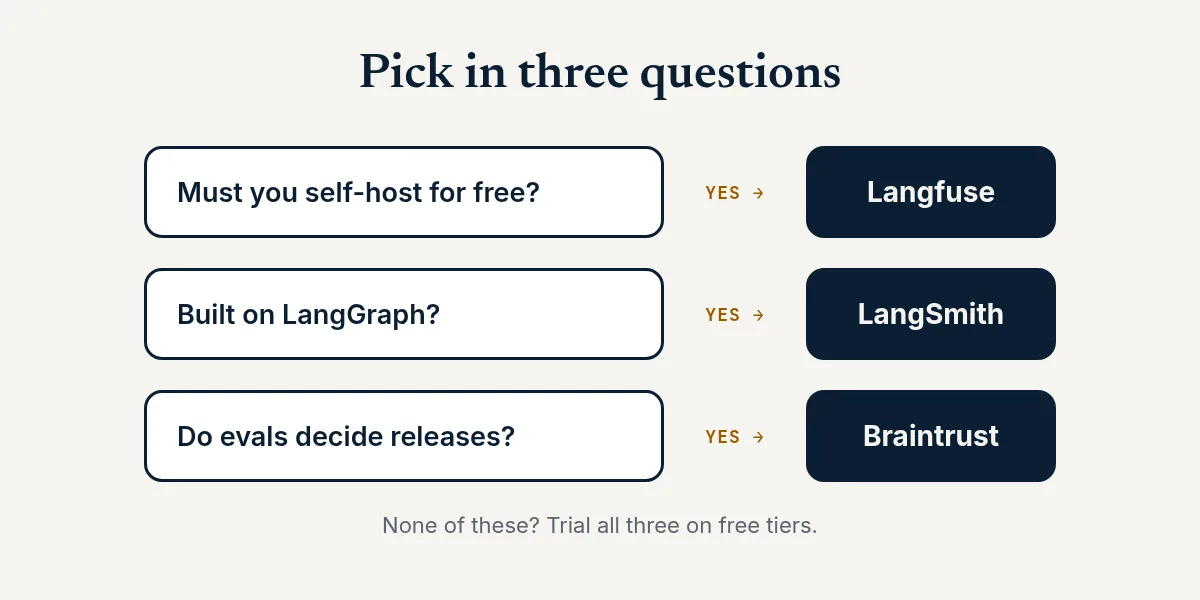
Choose by your hardest constraint first: free self-hosting points to Langfuse, a LangGraph codebase points to LangSmith, and eval-gated releases point to Braintrust. If none of those applies, trial all three on their free tiers with a week of real traffic and compare usage pages.
Choose Langfuse if
- You need to self-host for data residency without an Enterprise contract.
- Your team is large, and per-seat fees would dominate the bill.
- You run several agent frameworks and want one neutral backend.
Choose LangSmith if
- Your agents run on LangGraph, and you want Studio, deployment, and tracing together.
- A small team keeps the seat count low.
- You want automated failure clustering through Engine.
Not convinced LangSmith fits? We compared 8 LangSmith alternatives, including Opik, Phoenix, and MLflow, on the same workload.
Choose Braintrust if
- Releases are blocked on eval regressions, and product managers review outputs.
- You want alerts that fire on quality scores.
- Many reviewers need access, since users are unlimited on every plan.
Disqualifiers: skip LangSmith if you need free self-hosting, skip Braintrust if you need a predictable bill for very verbose traces, and skip self-hosted Langfuse if no one on the team can run ClickHouse in production.
For a wider shortlist beyond LangSmith and Braintrust, read Langfuse alternatives.
For a seat and unit cost breakdown across the same three platforms, read LangSmith vs Langfuse vs Braintrust pricing.
Frequently Asked Questions About Langfuse, LangSmith, and Braintrust
Is Langfuse better than LangSmith?
Langfuse is better for teams that want free self-hosting, unlimited users, and framework-neutral tracing. LangSmith is better for agents built on LangChain or LangGraph, where its trajectory views, Studio, and deployment save setup time. Feature coverage is similar, so pricing model and hosting rights usually decide the choice.
Is Braintrust open source?
No, the Braintrust platform is proprietary, but its SDKs for Python, TypeScript, Go, Java, and Ruby are open source on GitHub. Its autoevals scorer library is MIT licensed. Self-hosting the data plane in your own cloud is available only on the Enterprise plan, with Braintrust running the control plane.
Can LangSmith be used without LangChain?
Yes, LangSmith traces any application through its Python, TypeScript, Go, and Java SDKs, a traceable decorator, or an OpenTelemetry endpoint. LangChain says LangSmith is neutral to the framework. Its deepest views still target LangGraph, so non-LangChain teams get less advantage from it than LangGraph teams.
Which is cheapest: Langfuse, LangSmith, or Braintrust?
Langfuse was cheapest in our worked example of 50,000 agent runs a month at about $105, against about $249 for Braintrust Pro and $408 for LangSmith Plus with 5 seats. Results change with seat count, spans per run, and payload size, so model your own workload before deciding.
Can I migrate between Langfuse, LangSmith, and Braintrust?
Yes, and OpenTelemetry makes it easier, since all three accept OTLP traces. Instrument with OpenTelemetry, run two tools side by side during the switch, and export datasets and prompts before you cancel. Historical traces generally stay in the old tool, so plan retention around the move.
The Bottom Line: Match the Tool to Your Constraint
Langfuse wins on openness and price, LangSmith on LangGraph depth, and Braintrust on eval-driven workflow. All three are mature enough for production agents in 2026, so let hosting needs, team size, and how you ship decide. Instrument with OpenTelemetry, and the choice stays reversible.
We recheck these prices quarterly, and vendors can send corrections through our contact page. For nine more options, read our guide to the best AI agent observability tools.
Related guides: the AgentOps tools map, agent observability, agent evals and testing, Braintrust vs Maxim vs Galileo, 8 Best Open Source LLM Observability Tools You Can Self-Host in 2026, 8 Best LangSmith Alternatives in 2026, Including Open Source, and AI gateways.
For an open-source three-way focused on self-host ops (Phoenix and Helicone included), see Arize Phoenix vs Langfuse vs Helicone.