


Last updated October 25, 2026. We checked all three pricing pages and the billing docs that day, then ran the same three step agent on each local dev server 300 times and crashed it mid tool call 25 times.
Temporal vs Inngest vs Restate is a choice between three ways to make an AI agent survive a crash: workflow history, event driven steps, and a durable journal. All three record each model and tool call, so a restarted agent resumes where it stopped and skips work it already paid for. They differ on billing, recovery speed, and licensing.
This guide belongs to our agent frameworks hub. Our guide to the 12 best AI agent frameworks covers the libraries that decide what an agent does, and this page covers the engine that keeps it running when a pod dies, a deploy rolls out, or a provider times out.
We priced four agent workloads from each vendor’s public rates and ran one plan, tool, and write agent on all three engines with a scripted model and logged every call. No vendor paid for placement or reviewed this page, per our editorial standards and disclosure policy.
TL;DR
- Restate recovered fastest in our crash test. It retried the interrupted tool call within 0.3 seconds of restart and finished in a median 5.9 seconds, against 8.6 for tuned Temporal and 35.0 for Inngest.
- Temporal Cloud is cheapest at low volume. It has no base fee, so 10,000 agent runs of 10 steps cost about $6 a month at $50 per million actions plus the 10% support fee.
- Restate Cloud is cheapest at high volume. Starter costs $75 a month for 5 million actions, then $25 per million, so 1 million runs cost $250 against $449 on Inngest and $605 on Temporal.
- Inngest bills per step and pauses on Free. Each run uses steps plus 1 executions, and the free plan stops at 50,000 a month instead of charging overage.
- All three skipped completed work. In 25 crashes, no engine repeated a finished model call, and each reran only the interrupted tool call.
- Licenses differ. Temporal is MIT, Inngest’s server is SSPL with delayed Apache 2.0, and Restate is BSL 1.1 that turns into Apache 2.0 after 4 years.
Temporal vs Inngest vs Restate at a Glance
The three engines solve the same problem with different shapes. Temporal runs your agent as a workflow on long lived workers, Inngest calls your functions over HTTP when events arrive, and Restate sits in front of your services as a proxy that journals every step. The table compares what you buy.
| Temporal | Inngest | Restate | |
|---|---|---|---|
| Model | Workflows and Activities on workers you run | Event triggered functions with step.run | Services and handlers behind a journaling proxy |
| Free cloud tier | $150 credits for 90 days | 50,000 executions a month | 100,000 actions a month |
| Paid entry point | Pay as you go, $50 per million actions | Pro, $99 a month for 1 million executions | Starter, $75 a month for 5 million actions |
| Billing unit | Action: start, activity, timer, signal, heartbeat | Execution: 1 per run plus 1 per step | Action: 2 per call plus 1 per step, RPC, sleep, or state access |
| Crash recovery in our test | 8.6 s tuned, 14.6 to 17.6 s default | 35.0 s median with default backoff | 5.9 s median |
| Self hosted server | MIT, several services plus a database | SSPL, single binary with SQLite or Postgres and Redis | BSL 1.1, single binary with embedded storage |
| Agent SDK integrations | OpenAI Agents SDK, Google ADK, LangGraph | AgentKit for TypeScript | OpenAI Agents SDK, Vercel AI SDK, Pydantic AI, Google ADK |
| GitHub stars | 24.0k | 6.0k | 4.6k |
Verdict: Pick Temporal for long running, multi team agent systems where maturity and an MIT server matter most. Pick Inngest for TypeScript or serverless teams that want events and steps without running workers. Pick Restate when recovery speed and cost at high volume lead your list.
What Durable Execution Means for an AI Agent
Durable execution records the result of every step, so when a process dies, a new process replays the record and continues from the last finished step. For an agent, that means a crash after an expensive model call does not pay for the same call twice. It also lets agents wait hours for approval without holding a server open.
- Checkpoints per step: each model call, tool call, or sleep becomes a recorded step with its own retries.
- Replay on restart: finished steps return their saved result, and only the interrupted step runs again.
- Long waits: timers, signals, and awakeables pause a run for days at little cost, which suits human approval in the loop.
- Different from hosting: runtimes such as the one in our AWS agent runtime report host the agent, while these engines decide what happens when it fails.
Temporal: The Most Proven Engine for Long Agent Workflows
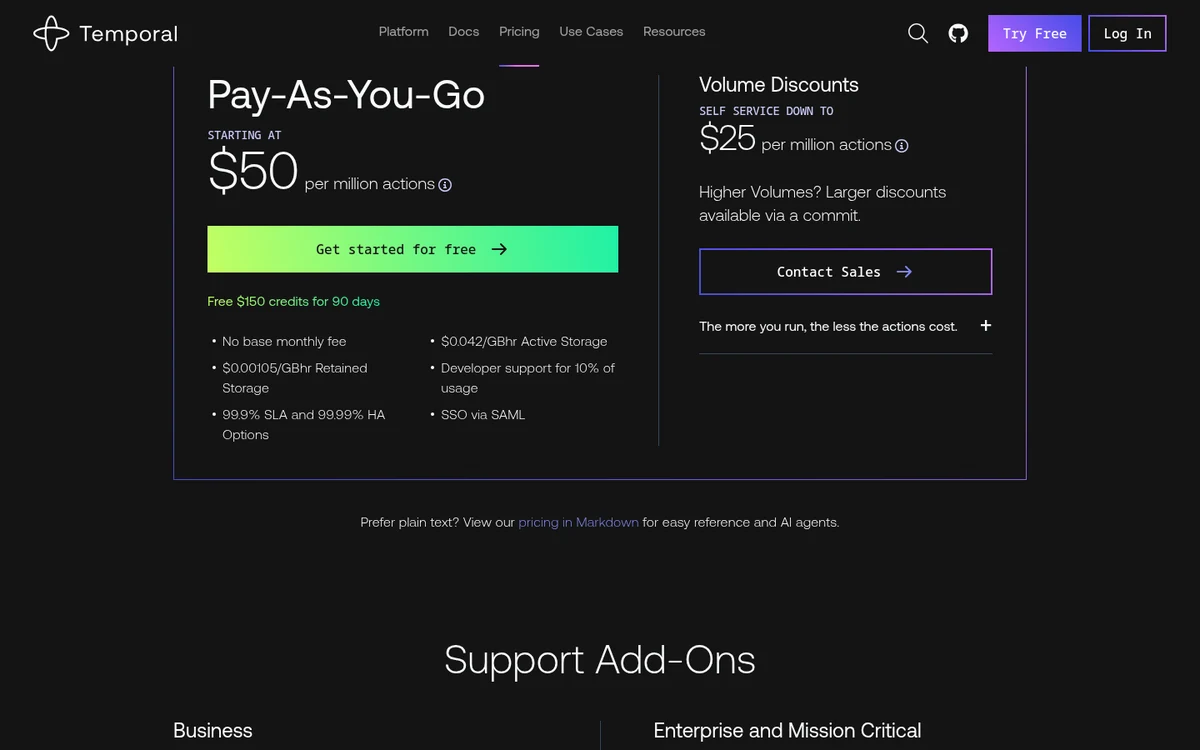
Temporal runs your agent loop as a Workflow and every model or tool call as an Activity on workers you deploy. Temporal Cloud has no base fee: you pay $50 per million actions plus a Developer support fee of 10% of usage, and new accounts get $150 in credits. The Temporal pricing page lists self service volume prices down to $25 per million.
- Developer plan: $50 per million actions at every volume, $0.042 per GB hour active storage, and $0.00105 retained, per the Temporal Cloud pricing docs.
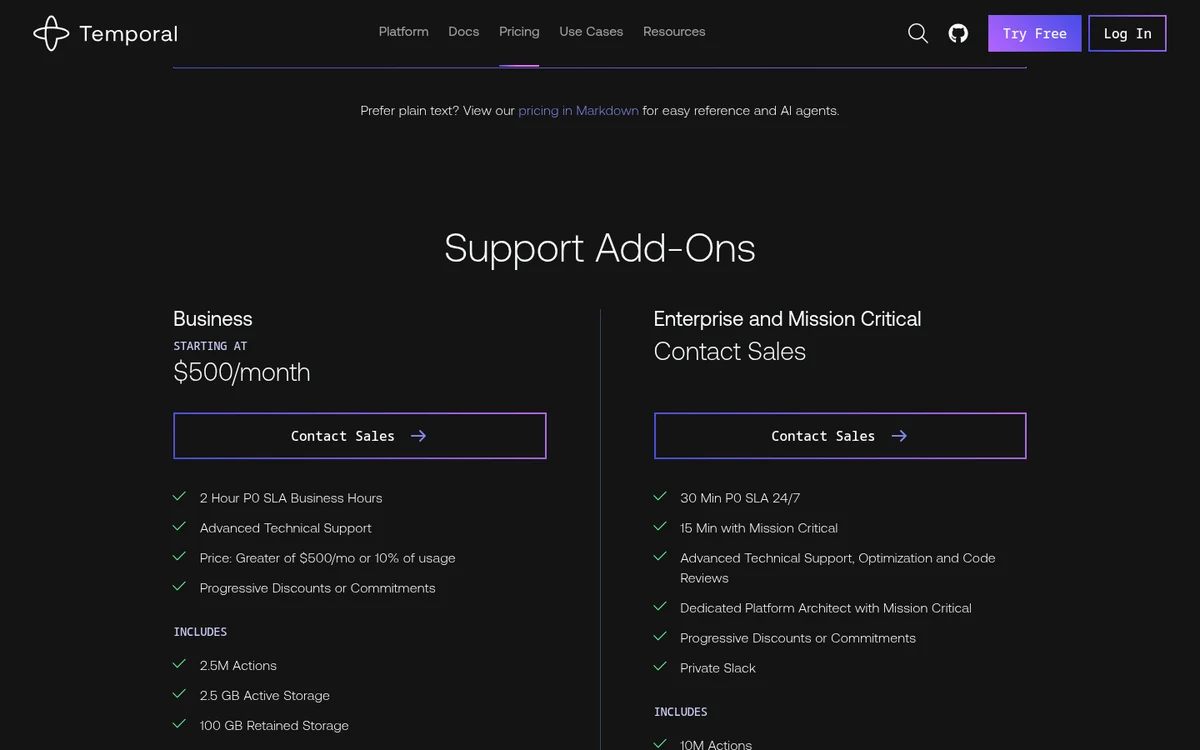
- Business plan: the greater of $500 a month or 10% of usage, with 2.5 million actions included and tiered rates from $50 down to $25 per million.
- Enterprise and Mission Critical: annual contracts with 10 million actions included, a 30 minute P0 response, and private Slack.
- SLA: 99.9%, or 99.99% with high availability namespaces.
An action is any billable call between your app and Temporal Cloud. The actions docs count a workflow start, each activity start or retry, timers, signals, queries, updates, and heartbeats that reach the server, while replay costs nothing. A 10 step agent run bills 11 actions, plus 1 more for every retry or heartbeat that reaches the server.
Temporal ships agent integrations for Python. The OpenAI Agents SDK integration runs the agent loop inside the workflow and model calls as activities, and the docs list Google ADK, LangGraph, and MCP guides beside it. The MIT licensed server has 24.0k GitHub stars, with v1.32.1 released October 8.
- Best for: Platform teams running long, multi step agents across languages who want the most mature engine and an MIT server.
- Pricing (October 2026): No base fee, $50 per million actions plus 10% support on Developer, $150 in starting credits, and Business from $500 a month, per the pricing page.
- Watch out for: Default timeouts. A crashed activity without a heartbeat waits for its full start to close timeout before it retries.
Inngest: Event Driven Steps for TypeScript and Serverless Teams
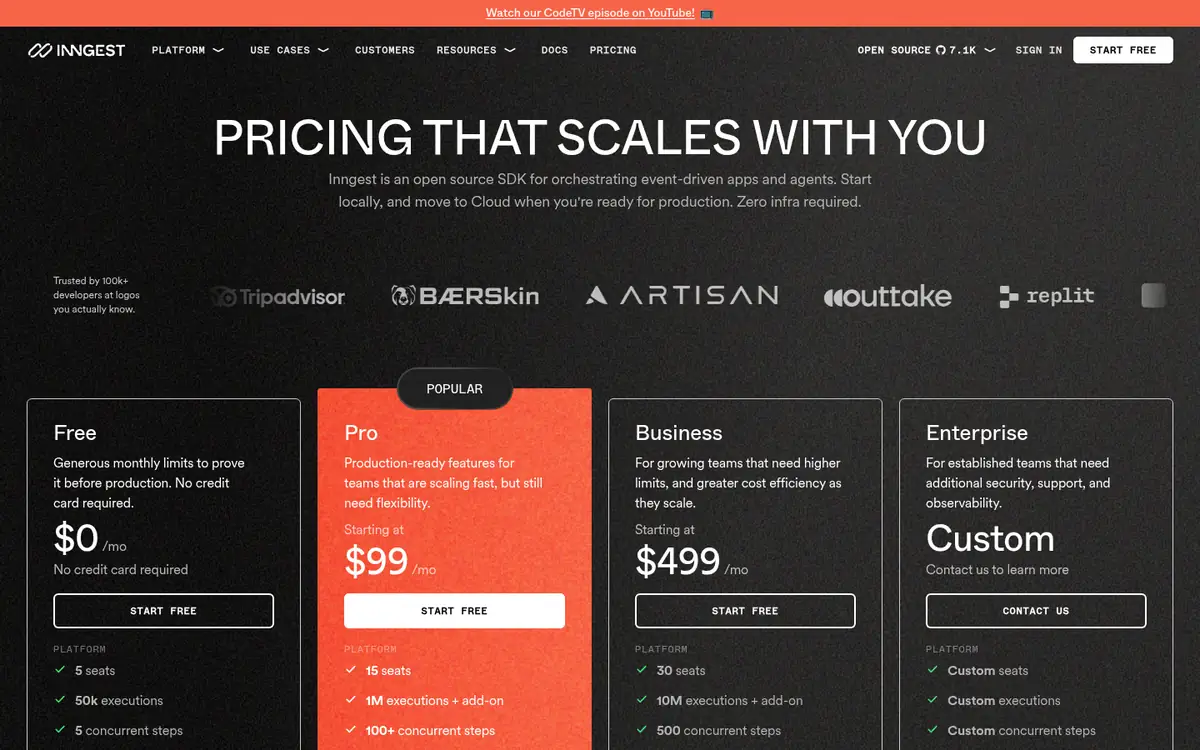
Inngest triggers functions from events and calls your app over HTTP, so agents can run on serverless platforms without long lived workers. Inngest counts one execution per run plus one per step, so a 10 step agent run uses 11 executions. The Inngest pricing page spells out that formula in its calculator.
- Free, $0: 5 seats, 50,000 executions, 5 concurrent steps, and 24 hour trace history. Runs pause at the quota.
- Pro, from $99 a month: 15 seats, 1 million executions, 100 concurrent steps, 7 day traces, and 90 day maximum run length.
- Business, from $499 a month: 30 seats, 10 million executions, 500 concurrent steps, 14 day traces, and 366 day runs.
- Overage: $50 per million from 1 to 5 million, $25 to 15 million, $20 to 50 million, and $15 to 100 million, per the pricing calculator.
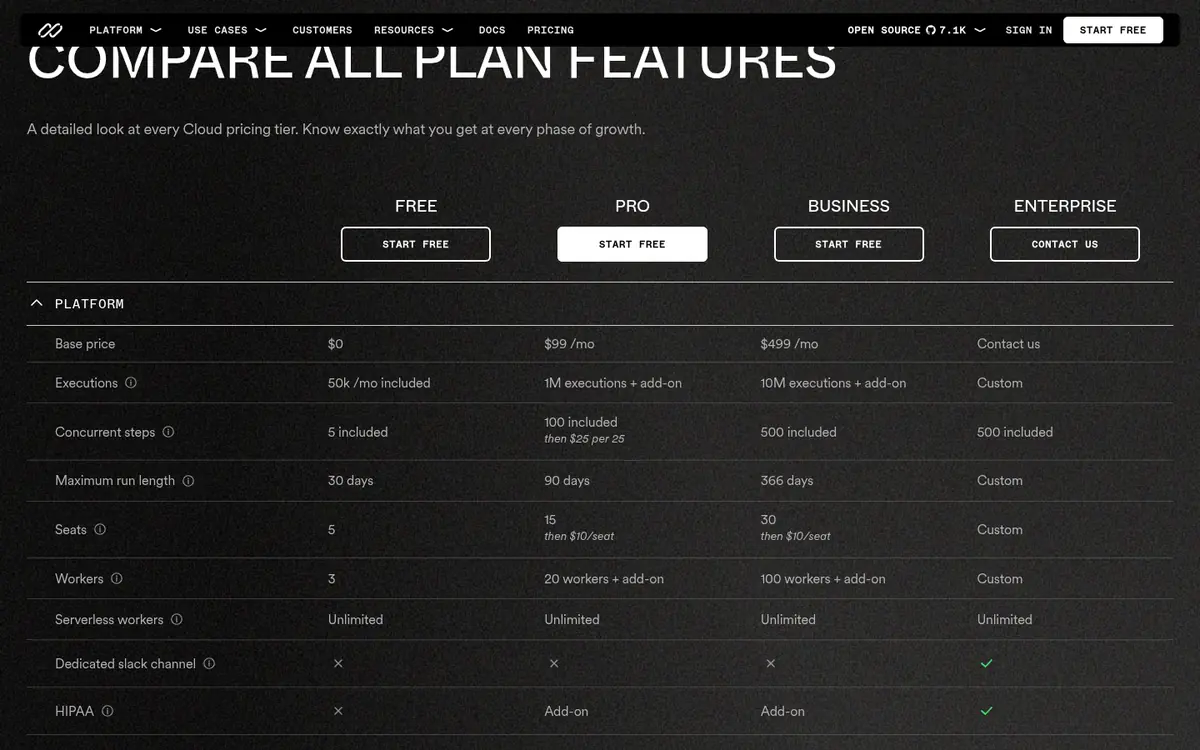
Concurrency is the limit most agent teams hit first. Pro includes 100 concurrent steps, then charges $25 per 25 more, and advanced observability with Datadog costs $300 on top. Sandboxes for code execution bill $0.0396 per vCPU hour and $0.0108 per GB hour.
Inngest’s agent framework is AgentKit, a TypeScript library for agents, tools, and networks that runs on the same engine, and the Python SDK wraps any call in step.run. The server has 6.0k GitHub stars and reached v1.49.0 on October 23, with SDKs under Apache 2.0.
- Best for: TypeScript and serverless teams that want events, steps, and flow control without operating workers.
- Pricing (October 2026): Free with 50,000 executions, Pro from $99 a month with 1 million, and Business from $499 with 10 million, then $50 down to $15 per million, per the pricing page.
- Watch out for: Retry backoff. In our test, a crashed step waited 15 to 37 seconds for its next attempt.
Restate: A Single Binary With the Lowest Overhead in Our Test
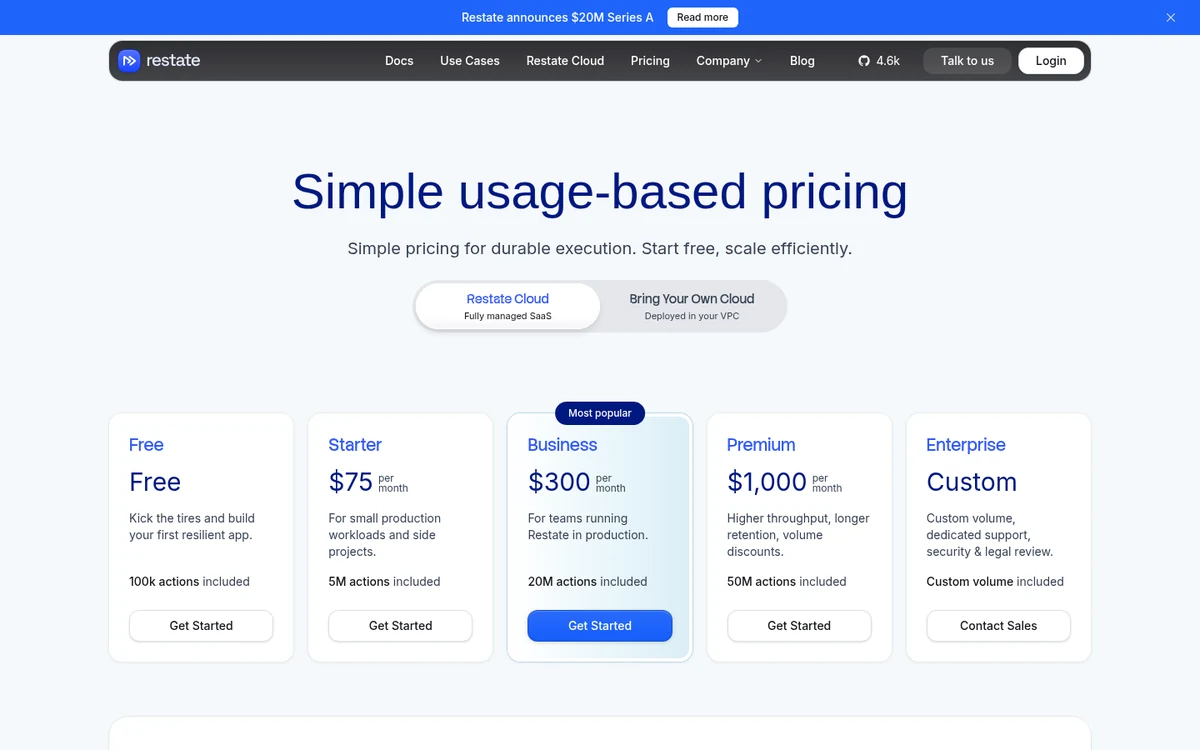
Restate is a server that sits in front of your services, journals every step, and pushes invocations to your handlers. Restate Cloud Starter costs $75 a month for 5 million actions, then $25 per million, which makes it the cheapest of the three at agent scale. The Restate pricing page lists five plans.
- Free, $0: 100,000 actions a month, 10 actions per second, and 1 day of history.
- Starter, $75 a month: 5 million actions, $25 per extra million, 50 actions per second, and 3 day history.
- Business, $300 a month: 20 million actions, $25 per extra million, 200 per second, and 7 day history.
- Premium, $1,000 a month: 50 million actions, $15 per extra million, 500 per second, and 30 day history.
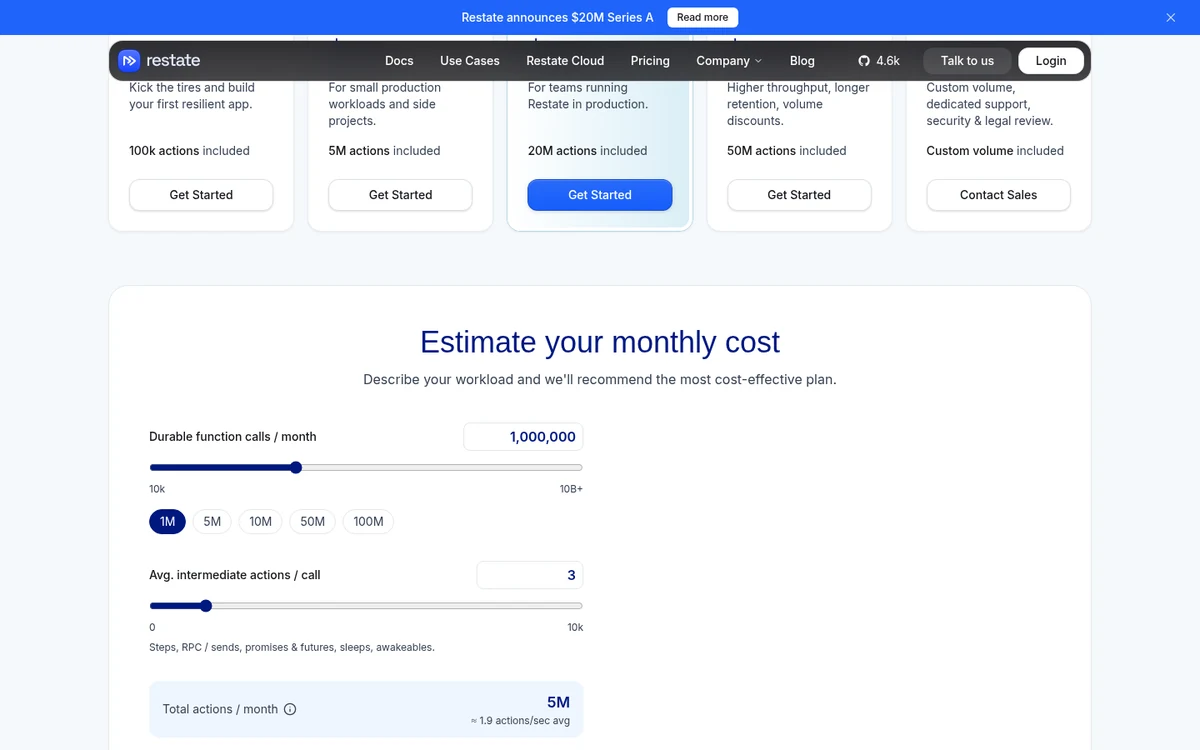
Restate counts 2 actions per call, for invocation and completion, plus 1 for each step, RPC, sleep, promise, or state access. Payloads count one action per started 64 KiB, so an agent that journals long model responses can bill several actions per step. A 10 step run with small payloads bills 12 actions.
The Restate AI docs cover integrations with the Vercel AI SDK, OpenAI Agents SDK, Google ADK, Pydantic AI, LangChain, and LiteLLM. The server has 4.6k GitHub stars, v1.8.1 shipped October 21, and the company announced a $20M Series A. Restate BYOC runs in your own AWS or GCP account with capacity based pricing.
- Best for: Teams that want the fastest recovery, a single binary to self host, and the lowest bill past a few million actions.
- Pricing (October 2026): Free with 100,000 actions, Starter $75 a month with 5 million, Business $300 with 20 million, and Premium $1,000 with 50 million, per the pricing page.
- Watch out for: Payload size and history retention. Starter keeps only 3 days of history, and large model outputs raise the action count.
How Each Platform Bills One Agent Run
All three charge per durable step, but they count the run itself differently. Use your real step count, including retries and sleeps, to compare them. The table shows the units for an agent run with 10 model and tool calls, small payloads, and no failures.
| Billing detail | Temporal Cloud | Inngest | Restate Cloud |
|---|---|---|---|
| Units for a 10 step run | 11 actions | 11 executions | 12 actions |
| Run overhead | 1 action to start | 1 execution per run | 2 actions per call |
| Retries | 1 action per activity retry | Counted as step executions | Counted as journal actions |
| Heartbeats and timers | Each billed as an action | Sleeps count as steps | Sleeps count as actions |
| Payload size | Not metered per action | Not metered per execution | 1 action per started 64 KiB |
| Extra fees | 10% support fee, storage per GB hour | Seats, concurrency, observability add on | Storage over plan, add ons |
Verdict: The three units are close enough per run that plan structure decides the bill. Temporal wins when volume is small and spiky because it has no base fee, and Restate wins past about 1.4 million actions a month, where Temporal’s metered bill overtakes the $75 Starter fee.
Monthly Cost at Four Agent Workloads
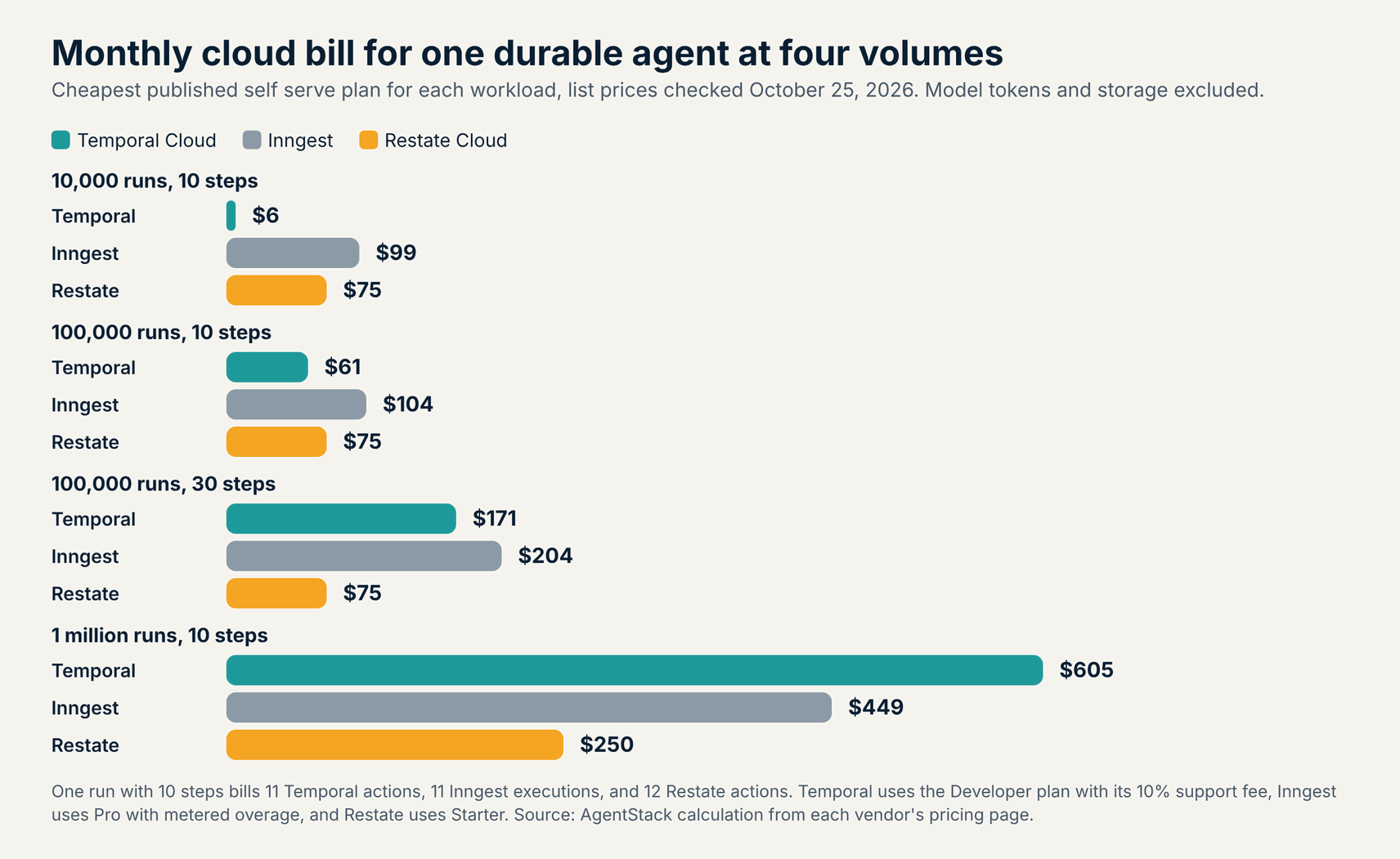
We priced four workloads on each vendor’s cheapest self serve plan, using public list prices on October 25, 2026. Temporal was cheapest for both 10 step workloads up to 100,000 runs, and Restate Starter was cheapest once runs grew longer or passed 1 million. Model tokens and storage are excluded because your provider and retention settings set them.
| Workload per month | Temporal Cloud | Inngest | Restate Cloud |
|---|---|---|---|
| 10,000 runs, 10 steps | $6.05 (110,000 actions) | $99 on Pro (Free caps at 50,000) | $75 on Starter (Free caps at 100,000) |
| 100,000 runs, 10 steps | $60.50 | $104 on Pro | $75 on Starter |
| 100,000 runs, 30 steps | $170.50 | $204 on Pro | $75 on Starter |
| 1 million runs, 10 steps | $605 on Developer, $907.50 on Business | $449 on Pro, $524 on Business | $250 on Starter, $300 on Business |
Verdict: Temporal is the cheapest managed option for pilots and short agents under about 1.4 million actions a month. Restate is cheapest above that line, and Inngest lands between the two at high volume while charging the most at small volume.
Self hosting moves the math. Temporal and Restate are free to run on your own servers within their licenses, and Inngest documents a single binary you can host. Add tracing to the budget with our LLM cost monitoring tools guide, since none of these engines tracks token spend.
Our Hands-On Test: Crashing an Agent Mid Tool Call
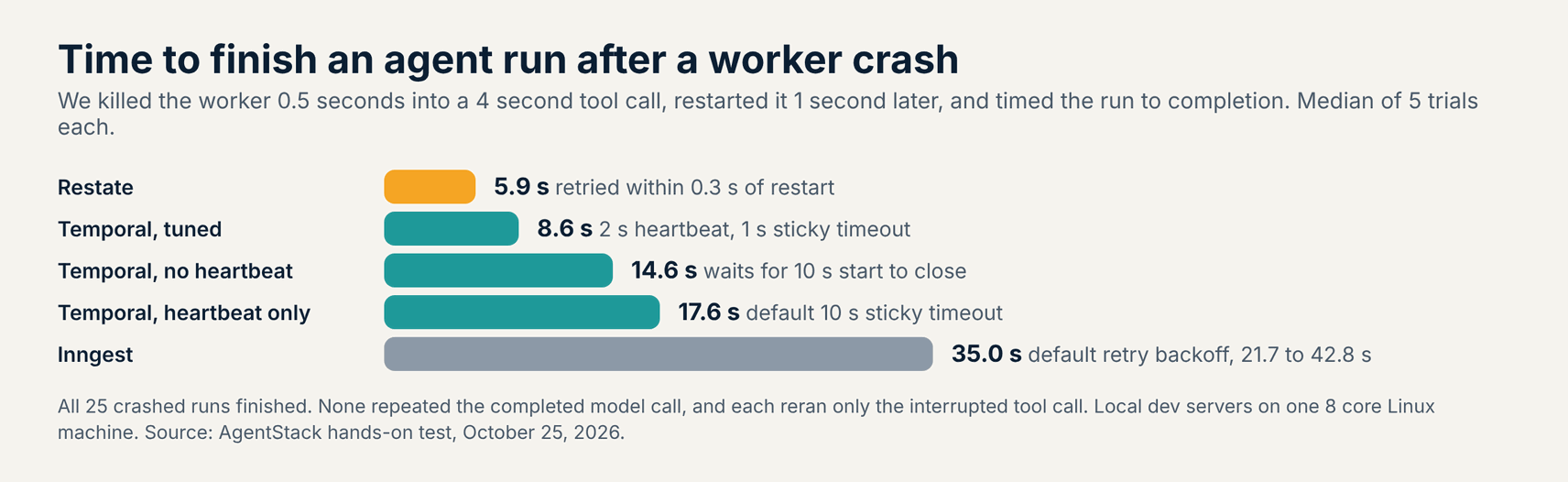
We built one agent three times: plan, call a tool, then write an answer. We killed the worker half a second into a 4 second tool call, restarted it 1 second later, and timed how long each engine took to finish the run. Every model and tool call hit a local logging server, so we could count repeats.
- Setup: Temporal CLI 1.9.1 with Server 1.32.0, Inngest dev server 1.49.0, and Restate server 1.8.1, with the Python SDKs temporalio 1.34.0, inngest 0.5.19, and restate-sdk 1.1.0 on one 8 core Linux machine.
- Model: a scripted local model that answers in 50 ms, so engine overhead stays visible.
- Crash: kill -9 on the worker process, the harshest failure, with no chance to clean up.
- Trials: 5 per configuration, 25 crashes in total, plus 300 clean runs for timing.
| Engine and setting | Median time to finish | Retry started after restart | Model calls repeated |
|---|---|---|---|
| Restate, defaults | 5.9 s | 0.1 to 0.3 s | 0 of 5 |
| Temporal, 2 s heartbeat, 1 s sticky timeout | 8.6 s | 1.6 to 1.8 s | 0 of 5 |
| Temporal, no heartbeat timeout | 14.6 s | 8.7 s | 0 of 5 |
| Temporal, 2 s heartbeat only | 17.6 s | 1.6 to 1.7 s | 0 of 5 |
| Inngest, default retries | 35.0 s (21.7 to 42.8 s) | 15.5 to 36.8 s | 0 of 5 |
Verdict: Restate recovers fastest with no tuning. Temporal gets close once you set a heartbeat timeout and a short sticky queue timeout, and Inngest recovers reliably but on a backoff schedule measured in tens of seconds.
The Temporal numbers show why settings matter. Without a heartbeat timeout, the server waits out the full 10 second start to close timeout. With a 2 second heartbeat, the tool retried fast, but the next step then sat on the dead worker for 10 seconds, the Python SDK default sticky queue timeout. Lowering it to 1 second fixed that.
# Temporal Python: faster recovery for agent tool calls
await workflow.execute_activity(
    call_tool, args,
    start_to_close_timeout=timedelta(seconds=60),
    heartbeat_timeout=timedelta(seconds=2),  # detect a dead worker fast
)
worker = Worker(
    client, task_queue="agent", workflows=[AgentWF], activities=[call_tool],
    sticky_queue_schedule_to_start_timeout=timedelta(seconds=1),
)
Inngest documents backoff with jitter and 4 retries by default on its retries page, which explains the 15 to 37 second spread. The dev server offers a --retry-interval flag for local testing, and production backoff stays automatic.
Run Time and Memory on Local Dev Servers
We also ran 100 clean runs per engine with 100 ms of scripted model time per run. Restate finished a three step run in a median 140 ms, Temporal in 250 ms, and Inngest in 590 ms, and all 300 runs completed with exactly one call per step. Dev servers favor simplicity, so treat these as engine overhead.
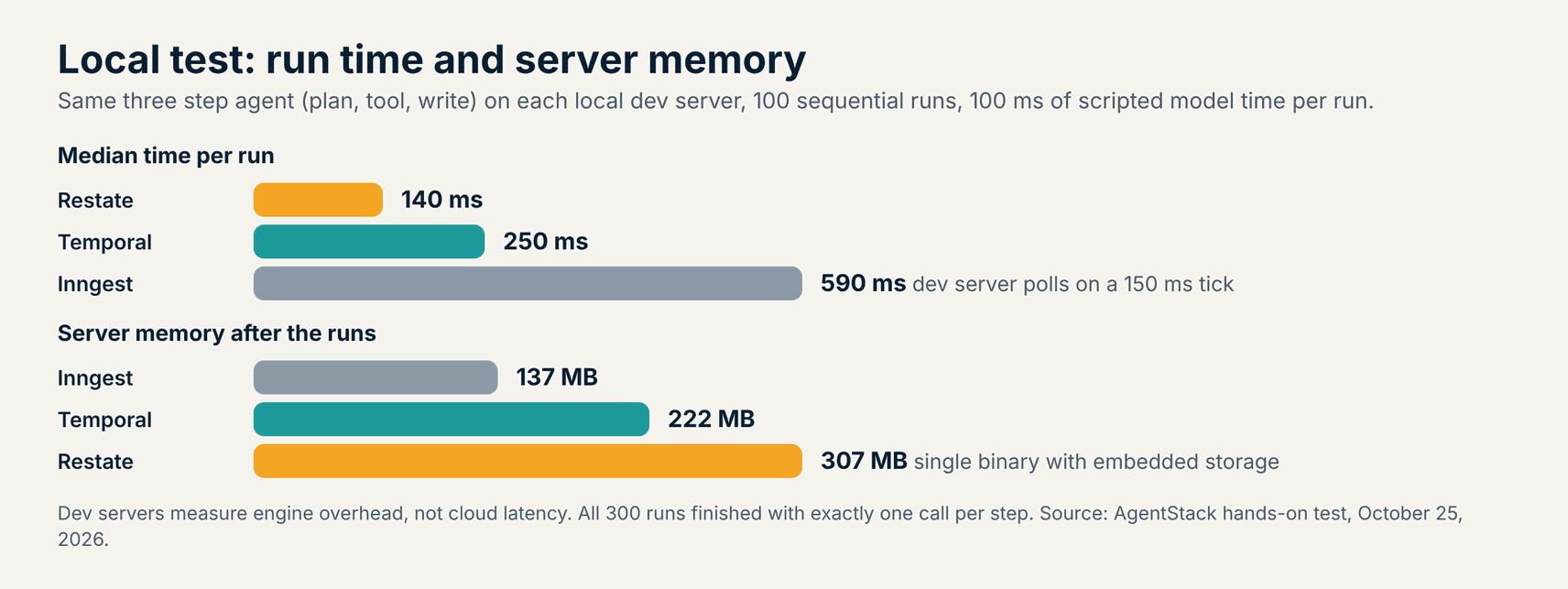
- Inngest: the dev server polls its queue every 150 ms by default, which adds most of its overhead. It used the least memory at 137 MB.
- Temporal: each run wrote 23 history events for 3 activities, about 2.9 KB, and the dev server grew from 157 MB to 222 MB.
- Restate: each run journaled 8 entries, and the server idled at 275 MB with its embedded storage.
- Startup: all three servers opened their ports in under 0.25 seconds.
Licenses and Self-Hosting
Self hosting is where the three differ most. Temporal’s server is MIT and free for any use, while Inngest and Restate use source available licenses that restrict offering their engine as a hosted service to others. For internal agents, all three can run on your own infrastructure at no license cost.
| Temporal | Inngest | Restate | |
|---|---|---|---|
| Server license | MIT | SSPL, Apache 2.0 after 3 years | BSL 1.1, Apache 2.0 after 4 years |
| Main restriction | None | SSPL terms if offered as a service | No public Restate platform service |
| SDK license | MIT | Apache 2.0 | MIT |
| What you operate | Frontend, history, matching, and worker services plus Postgres, MySQL, or Cassandra | One binary with SQLite, or Postgres and Redis | One binary with embedded storage, clustered for high availability |
Verdict: Choose Temporal when legal review needs a permissive license with no conditions. Choose Restate or Inngest for internal agents where a single binary saves operations time, and read the license if you plan to resell workflow hosting.
Which Durable Execution Engine Should You Pick?
Start from who runs the agents and how often they fail in expensive places. The four profiles below cover most agent teams, and each one points to the engine that fits with the least tuning. Revisit the choice once monthly volume passes a few million steps.
Platform teams with long, multi step agents
- Choose Temporal for its history, replay testing, and support for 8 languages.
- Set heartbeat and sticky queue timeouts on day one, as shown above.
TypeScript and serverless product teams
- Choose Inngest and keep agents on Vercel, Cloudflare, or Lambda without workers.
- Budget for Pro at $99 a month once you pass 50,000 executions, since Free pauses.
High volume or latency sensitive agents
- Choose Restate for the fastest recovery in our test and $25 per million actions past 5 million.
- Keep journaled payloads small, because each started 64 KiB counts as an action.
Teams already using an agent framework
- Match the integration: OpenAI Agents SDK runs on Temporal and Restate, and AgentKit is native to Inngest.
- Pair any engine with agent observability and agent testing tools so failed steps are visible.
Frequently Asked Questions
What is the difference between Temporal, Inngest, and Restate?
All three are durable execution engines that save each step of an agent run and resume after a crash. Temporal runs workflows on workers you operate, Inngest calls your functions over HTTP when events arrive, and Restate is a single server that journals steps as a proxy in front of your services.
Which is cheapest for AI agents?
It turns on volume. Temporal Cloud has no base fee, so 10,000 runs of 10 steps cost about $6 a month and 100,000 runs cost $60.50. Past about 1.4 million actions, Restate Cloud is cheaper: 1 million runs cost $250 on Restate, $449 on Inngest, and $605 on Temporal.
Do these engines repeat LLM calls after a crash?
No, not for completed steps. In our 25 kill tests, none of the three repeated a finished model call. Each saved the result of the plan step and reran only the tool call that was interrupted, so you pay again only for the step that was in flight when the worker died.
Is Temporal better than Inngest for agents?
Temporal suits long running agents on workers you manage, with mature history, replay tests, and an MIT server. Inngest suits TypeScript and serverless teams that want events and steps without workers. In our test, a tuned Temporal worker recovered from a crash in 8.6 seconds, while Inngest took a median 35 seconds.
Can I self host Temporal, Inngest, or Restate for free?
Yes, for your own internal agents. Temporal is MIT licensed, Inngest’s server uses SSPL with delayed Apache 2.0, and Restate uses BSL 1.1, which forbids offering a public Restate platform service. Inngest and Restate ship as single binaries, while Temporal needs several services and a database.
Related Guides
Durable execution matters most for long agent loops. Our overview of agent workflow and loop patterns helps you see which designs run long enough to need a durable runtime.
For related coverage, see our multi-agent frameworks test, LangGraph alternatives ranking, open source AI agent frameworks you can self-host, TypeScript AI agent frameworks guide, AI agent memory frameworks comparison, LangGraph Platform vs CrewAI AMP pricing breakdown and best MCP servers guide.
Read the agent frameworks hub, 12 best AI agent frameworks, AWS agent runtime report, Claude Managed Agents workflows, Cloudflare vs Vercel vs AgentCore, MCP hosting platforms, AgentOps hub, AgentOps tools, open source LLM observability, LLM gateways, agent integration platforms, and AI agent governance.
The Bottom Line
Pick Temporal for maturity and an MIT server, Inngest for serverless TypeScript agents, and Restate for the fastest recovery and lowest bill at scale. All three stopped our crashed agents from paying twice for finished model calls. The real differences are recovery time, the plan that fits your volume, and license terms.
Prices and defaults change often, so rerun the cost math with your own step counts before you commit. We will update this page as vendors change their plans, and you can send corrections through our contact page.