
Last updated October 15, 2026. Tracing, evals, OpenTelemetry, and pricing claims were checked against each vendor’s primary product, docs, and pricing pages on that date.
Datadog vs Dynatrace vs New Relic is the shortlist enterprise buyers reach once they already run an application performance monitoring (APM) stack and need to know whether that same platform covers AI agents. All three now ship agent and large language model (LLM) observability. They diverge on how deep the agent engineering loop goes, how OpenTelemetry fits, and how the bill is shaped.
This post is for platform, SRE, and AI engineering teams comparing big-budget APM vendors for agent monitoring, not for teams choosing a specialist tracer first. Placement is unpaid, per our editorial standards and disclosure policy.
It sits under the AgentOps tools map and the agent observability topic, next to our best AI agent observability tools roundup, Langfuse vs LangSmith vs Braintrust comparison, and open source LLM observability shortlist. We compare agent and LLM tracing depth, evals and quality signals, APM correlation, OpenTelemetry, alerts, hosting and region posture, pricing shape, agent-specific features, and setup effort.
TL;DR
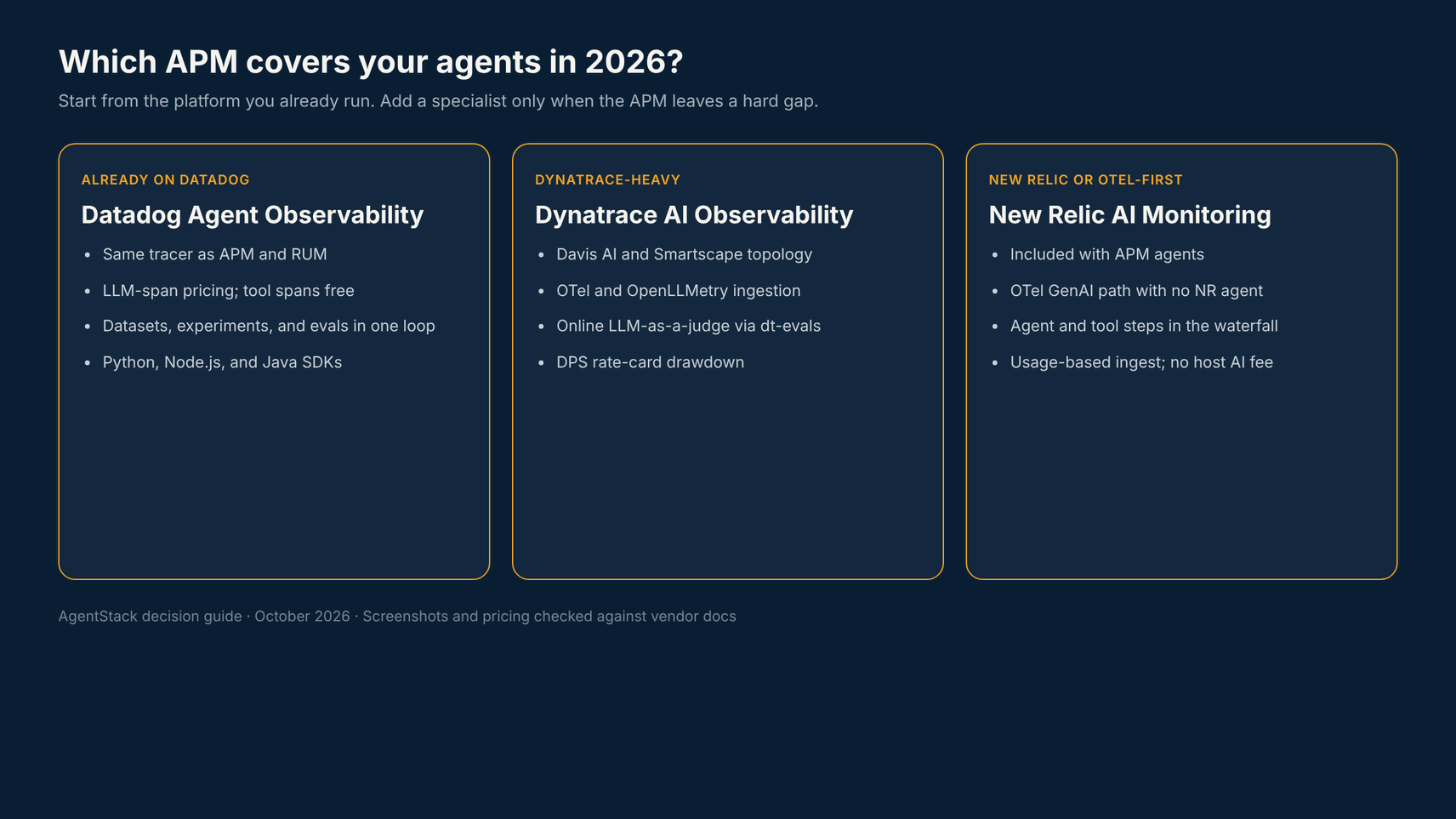
- Datadog wins when you already live in Datadog: Agent Observability bills only LLM spans (tool, workflow, agent, embedding, and retrieval spans are free), Free includes 40k LLM spans/mo, Pro starts at $160/mo for 100k, and datasets, experiments, and evals share one loop.
- Dynatrace wins for Dynatrace-heavy estates: the AI Observability app is generally available, Davis AI adds anomaly and cost forecasting, Smartscape-grade topology is the roadmap, and consumption draws down a Dynatrace Platform Subscription (DPS) with Grail metrics, traces, and logs.
- New Relic wins for New Relic or OpenTelemetry-first teams: AI Monitoring rides on APM agents, OTel GenAI support reached GA on August 31, 2026 with no New Relic agent required on that path, and there is no separate per-host AI monitoring fee.
- Persona filter: stay on the APM you already staff unless a hard gap (offline eval loop, residency, or OTel-only ingest) forces a specialist.
- Blind spots: Datadog adds an LLM-span SKU with 15-day default retention; Dynatrace is a platform commit with Traces-Query cost on some dashboards; New Relic is thinner on native offline datasets and experiments than Datadog Agent Observability.
- Specialist escape hatch: if you need self-host OSS tracing or a dedicated eval platform, still shortlist Langfuse, LangSmith, or Braintrust beside these three.
Datadog vs Dynatrace vs New Relic: The Short Answer
Pick Datadog when the same tracer must connect agent steps to APM, real user monitoring (RUM), and infrastructure, and you want experiments and evals inside that loop. Pick Dynatrace when Davis AI, Grail, and topology-driven root cause already define how your SRE team works. Pick New Relic when you want AI spans inside existing APM waterfalls, or you will export GenAI OpenTelemetry spans without installing another proprietary agent.
| Datadog | Dynatrace | New Relic | |
|---|---|---|---|
| Center of gravity | Agent Observability + LLM Observability on the Datadog platform | AI Observability app on Grail + Davis AI | AI Monitoring on APM (plus OTel GenAI path) |
| Agent / LLM tracing | End-to-end agent traces, tool decisions, handoffs | Prompt-to-response traces; agents topology; MCP visibility | LLM, tool, and agent steps in the APM waterfall |
| Evals / quality | Offline + online evals, datasets, experiments, annotation | Online LLM-as-a-judge (dt-evals); score drift | User feedback correlation; thinner native offline loop |
| APM correlation | Same tracer as APM / infra / RUM | Full-stack Grail + Smartscape | Native APM correlation; OTel joins the same service view |
| OpenTelemetry | OTel / HTTP API supported alongside SDKs | Primary path via OTel + OpenLLMetry / OpenInference | OTel GenAI GA (Aug 31, 2026); no NR agent required |
| Pricing shape | LLM spans only; Free 40k; Pro $160/100k | DPS rate-card drawdown (Grail metrics/traces/logs) | Included with APM; usage-based ingest + users |
| Default retention | 15-day traces/spans (add-ons 30/60/90) | Platform / Grail retention per DPS config | Per account data retention rules |
| Setup effort | Minutes with ddtrace + env flags for common stacks | Platform enablement + OTel / integrations | Flip AI monitoring on APM, or point OTLP at New Relic |
| Verdict | Best if already on Datadog | Best if already on Dynatrace | Best if on New Relic or OTel-first |
How We Compared These Three APM Suites
We read each vendor’s agent or AI observability product page, primary docs, and pricing materials on October 15, 2026, and captured the pages we cite. The lens is operational for buyers who already pay for APM: does the platform cover multi-step agents, how do you pay, and where does a specialist still win.
- Primary sources only: claims come from Datadog Agent Observability, Dynatrace AI Observability docs, New Relic AI monitoring, and the linked pricing pages.
- No paid bake-off: we did not load-test p99 overhead or judge model quality, so there are no star ratings.
- Estimates are labeled: any fee examples use published list prices and stated allowances.
- Related reading: for specialist tracers see Langfuse vs LangSmith vs Braintrust, Arize Phoenix vs Langfuse vs Helicone, and AI agent evaluation tools.
Agent and LLM Tracing Depth
Tracing depth is the first filter: can you see tool calls, handoffs, and multi-step agent runs next to ordinary service spans? All three advertise that story. The packaging and instrumentation path still differ.
Datadog: Agent Observability on the shared tracer
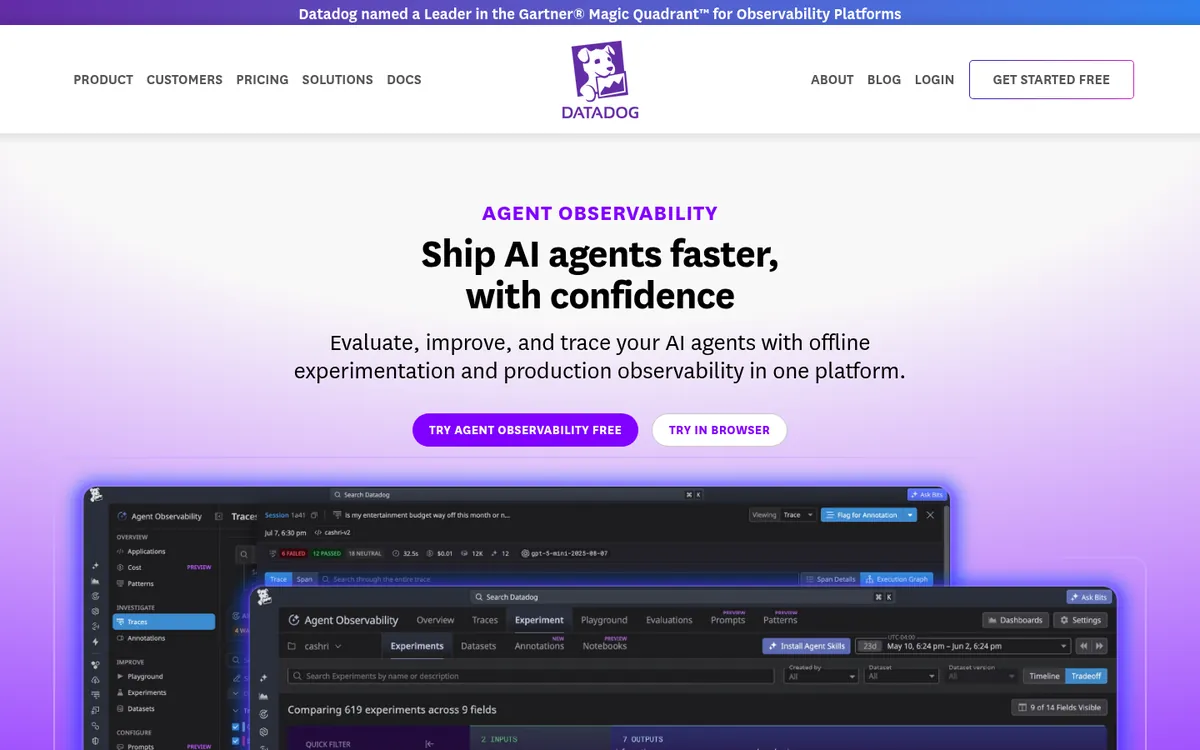
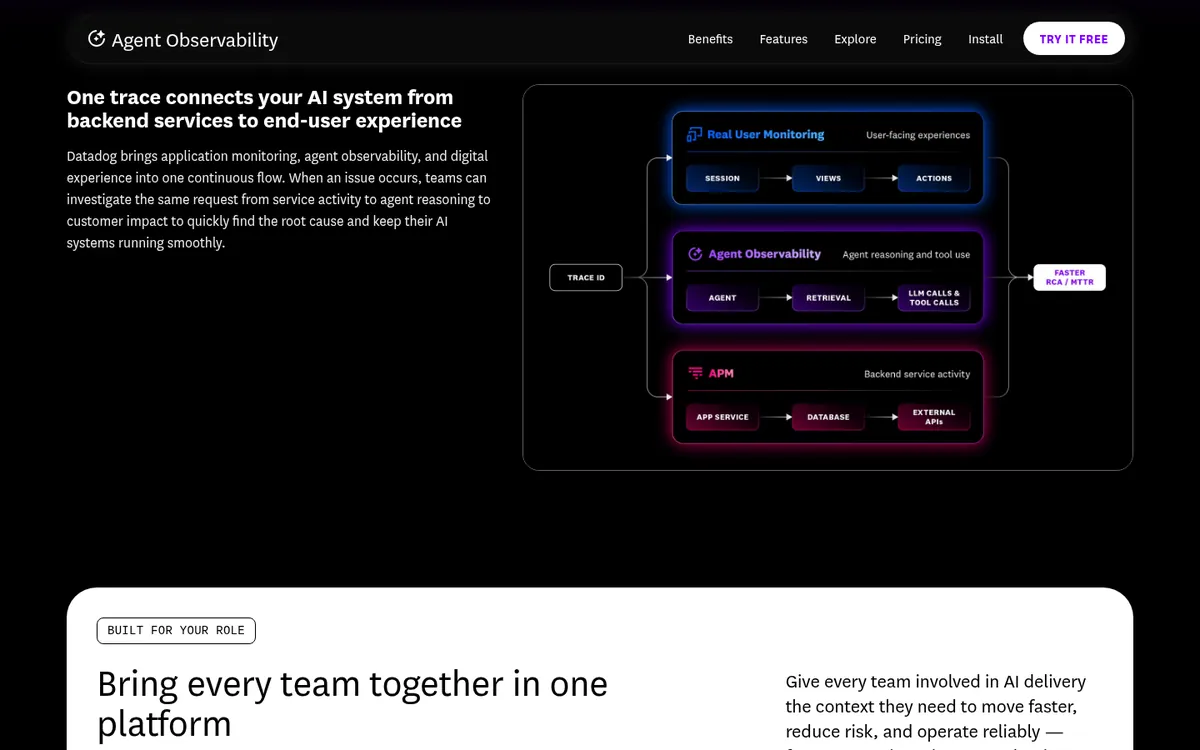
Datadog positions Agent Observability as end-to-end tracing for agentic apps, including error rate, latency, cost, tool decisions, and handoffs, with SDKs for Python, Node.js, and Java plus OpenTelemetry and HTTP API options, per Agent Monitoring docs and instrumentation docs. Auto-instrumentation covers popular providers and frameworks; custom spans and evaluations attach to the same traces.
Documented agent frameworks include OpenAI Agents SDK, LangGraph, and CrewAI on the agent monitoring path, with broader model and framework coverage listed on the product page. The practical win is one tracer from prototype through production, correlated with APM and RUM.
Dynatrace: AI Observability app and agent topology
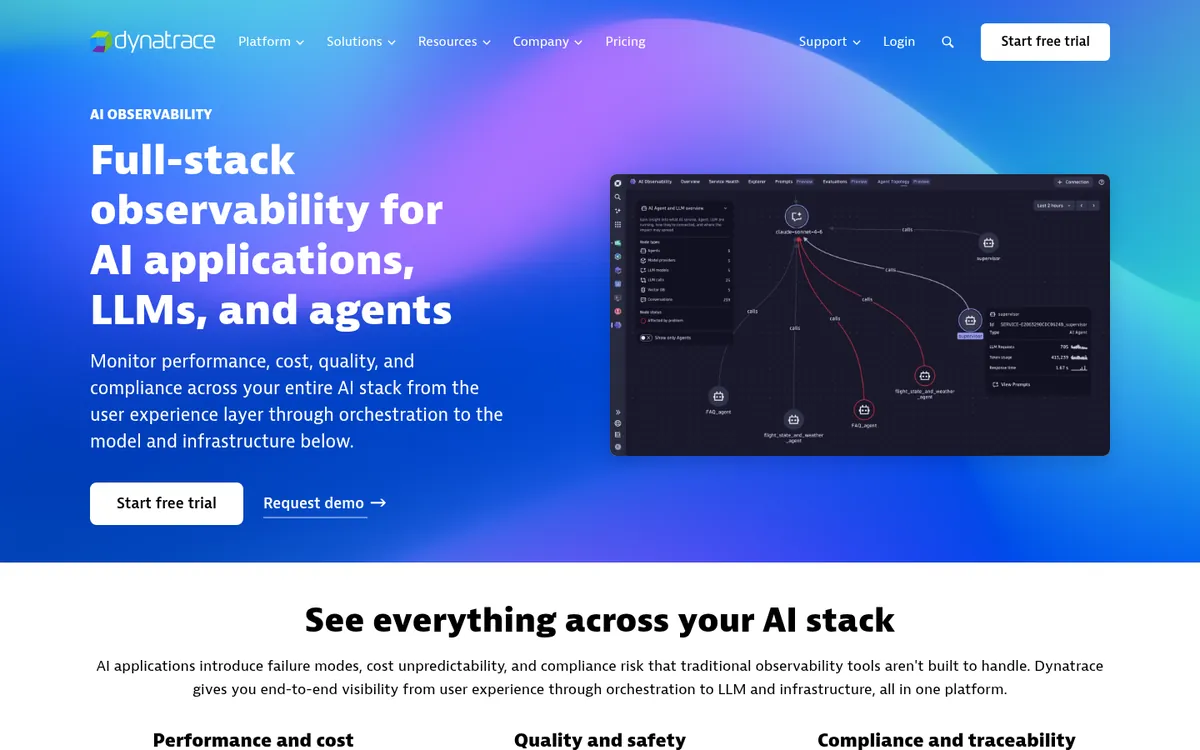
Dynatrace’s AI Observability app reached general availability with agentic framework support announced January 28, 2026, unifying OpenTelemetry and OpenLLMetry telemetry across agents, models, tools, and protocols, per the GA blog and AI Observability docs. Supported workloads include OpenAI Agents SDK, LangChain and LangGraph, CrewAI, Amazon Bedrock AgentCore, Strands, Google ADK, and Model Context Protocol (MCP) visibility.
The app surfaces Overview, Explorer, Prompts, Agents topology, and Evaluations tabs. Traces enrich with GenAI fields and deep-link into Distributed Tracing. Dynatrace’s next focus is an Agentic Topology View with Smartscape-grade visualization of agent execution flows.
New Relic: AI Monitoring inside the APM waterfall
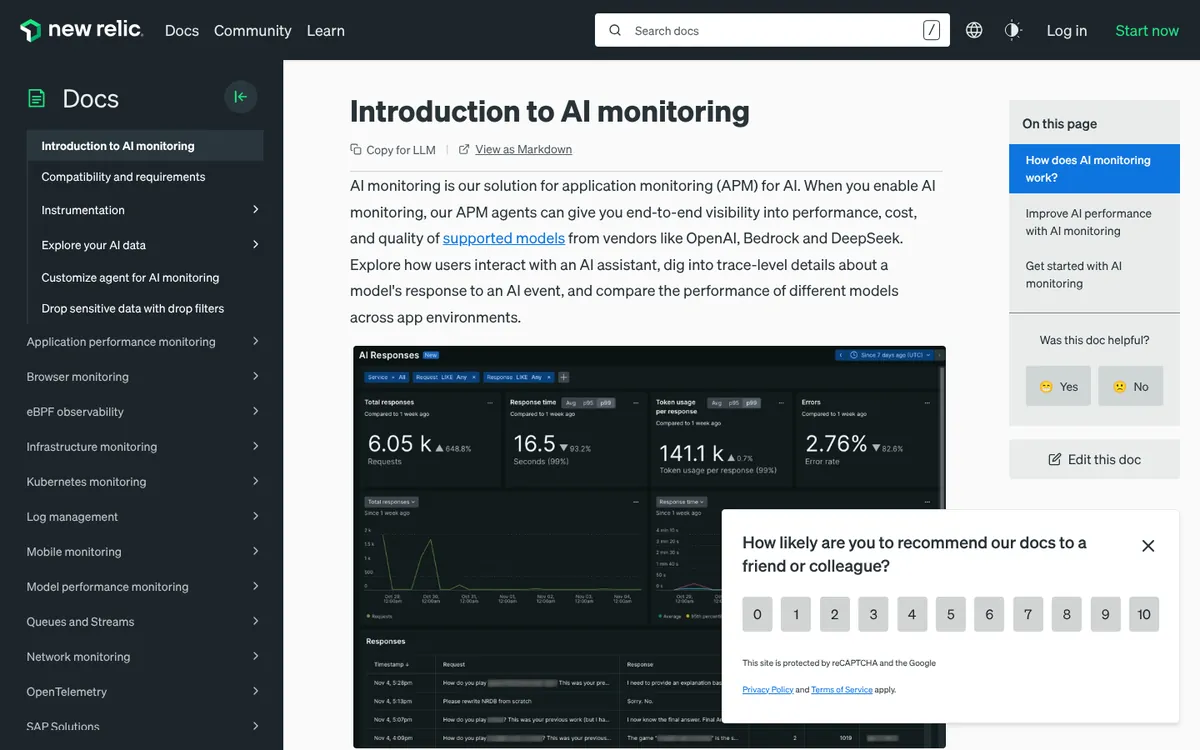
New Relic AI Monitoring treats AI as an APM layer: once AI monitoring is active on an APM agent, it captures prompt, completion, and token data for supported models and vector stores, and correlates end-user feedback, per the intro docs. For agentic workflows, New Relic documents end-to-end capture of agent invocations, tool calls, and handoffs in the trace waterfall, including frameworks such as LangGraph, Strands, and AutoGen on the agent views path (monitor AI agents).
If you already emit OpenTelemetry GenAI spans, you can skip the New Relic agent entirely on that path. LLM calls, tool calls, and agent steps appear inside the same distributed traces your services already send.
Evals and Quality Signals
Quality is where APM suites either become an agent engineering platform or stay an operations console. Datadog packages the tightest closed loop of the three. Dynatrace adds production LLM-as-a-judge. New Relic leans on feedback and production signals more than a full offline experiment studio.
- Datadog: versioned datasets from production traces, experiments across prompts and models, built-in and custom evaluators, human annotation, and production monitors in one product. Evals have no separate product fee; LLM calls inside evals count as LLM spans (Agent Observability).
- Dynatrace: online LLM-as-a-judge evaluations against production traces via the open-source
dt-evalsCLI, with scores written back as business events linked to the source trace. Built-in judges cover toxicity, hallucination, faithfulness, PII leakage, prompt injection, and more, plus statistical drift detection (docs). - New Relic: response tables, model comparison across environments, and user feedback correlation. There is less published packaging for golden datasets and offline experiment runs comparable to Datadog Agent Observability.
If offline eval rigor is the buying criterion and you are not already standardized on Datadog, keep AI agent evaluation tools and Braintrust vs Maxim vs Galileo on the shortlist.
APM Correlation and Alerts
The reason to buy an APM suite for agents is correlation: one incident view from the slow tool call to the starved dependency. All three can alert on latency, errors, and cost-like metrics. The incident workflow follows whatever your SRE team already runs.
- Datadog: correlate LLM spans with APM services, infrastructure, and RUM sessions; monitors for latency, cost, and quality; Sensitive Data Scanner included and scaled with LLM usage on the Agent Observability plans.
- Dynatrace: Davis AI anomaly detection and cost forecasting; Problems and root-cause analysis across the full stack; guardrail outcomes from providers visualized when reported.
- New Relic: AI responses and traces live beside classic APM; drop filters for sensitive data; standard New Relic alerting and dashboards apply to AI signals.
OpenTelemetry Posture
OpenTelemetry is the escape hatch for polyglot stacks and for teams that refuse a second proprietary tracer. Dynatrace and New Relic lean hardest on OTel GenAI conventions. Datadog still offers OTel and HTTP intake beside first-party SDKs.
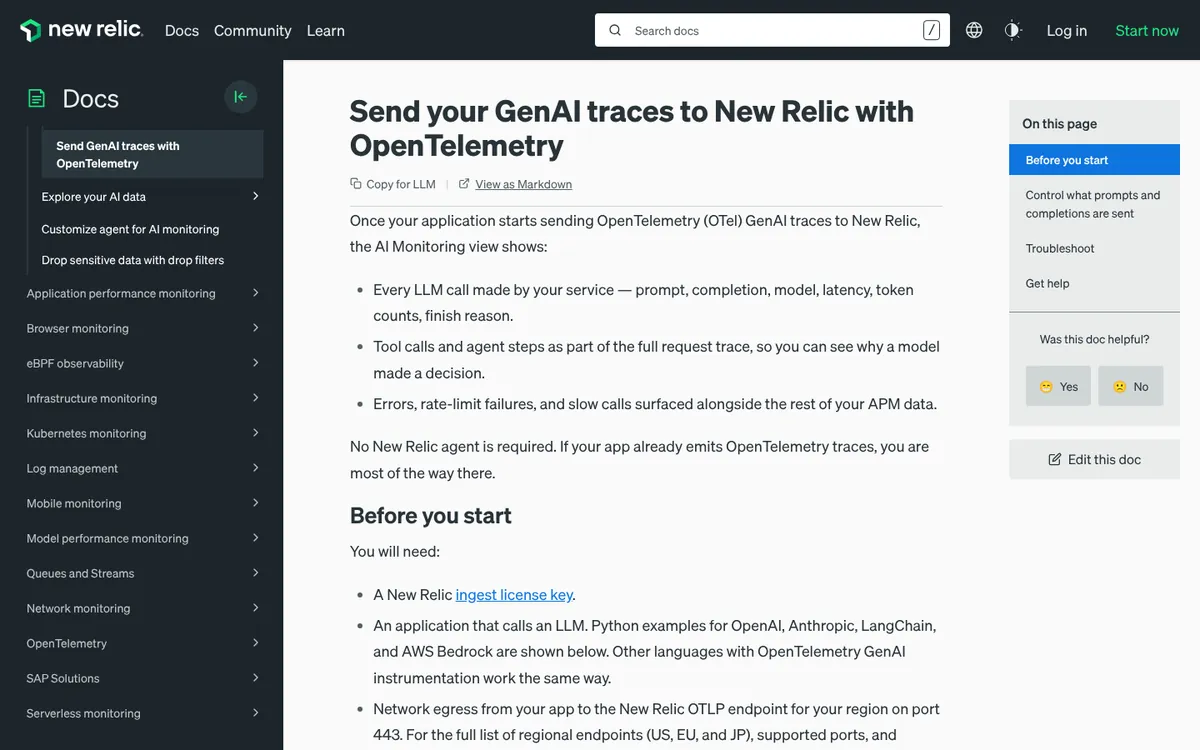
- New Relic: OpenTelemetry support for AI Monitoring reached GA on August 31, 2026. Set OTLP endpoint and license key, add GenAI instrumentation, and spans populate AI Monitoring without a New Relic agent. Prompt and completion content capture is off by default (OTel AI monitoring, GA note).
- Dynatrace: documents OpenTelemetry with GenAI semantic conventions, OpenInference, and OpenLLMetry as the unifying ingest model for agentic frameworks (docs, GA blog).
- Datadog: first-party Python, Node.js, and Java SDKs are the happy path; OpenTelemetry and the HTTP Spans and Evaluations APIs cover custom languages and frameworks (instrumentation).
# New Relic OTel GenAI path (conceptual)
export OTEL_EXPORTER_OTLP_ENDPOINT="https://otlp.nr-data.net:4317"
export OTEL_EXPORTER_OTLP_HEADERS="api-key=$NEW_RELIC_LICENSE_KEY"
export OTEL_SERVICE_NAME="my-agent-service"
# Add GenAI instrumentation for your framework, then send traffic.
# Leave content capture off unless compliance review approves it.
Pricing Shapes: Spans, DPS, and APM Ingest
Gateway and specialist tools often meter spans or seats. These three meter in the language of their broader platforms. Model that honestly before you assume “we already pay for APM, so agents are free.”
Datadog: bill only LLM spans
Free includes up to 40k LLM spans per month with 15-day retention. Pro starts at $160 per month for 100k LLM spans. Additional usage is billed per 10k LLM spans (list examples on the pricing comparison run about $3.50 annual, $4.20 month-to-month, and $5 on-demand for 15-day retention), per Agent Observability pricing and the pricing list.
An LLM span is one call to an LLM provider. Tool, workflow, agent, embedding, and retrieval spans are free. Retention add-ons extend traces to 30, 60, or 90 days. Evaluations do not carry a separate product fee; LLM calls made during evals still count as LLM spans.
Dynatrace: DPS rate-card drawdown
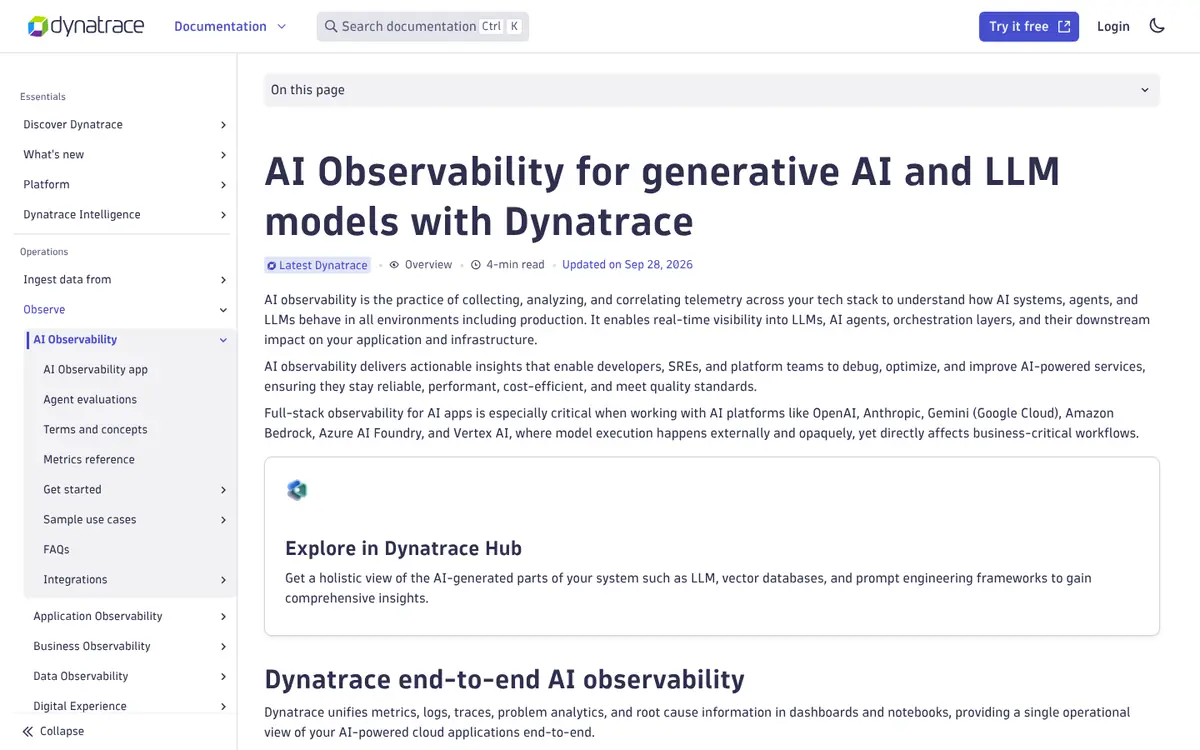
AI Observability requires a Dynatrace Platform Subscription with Metrics, Traces, and Logs powered by Grail, plus listed permissions, per the AI Observability app docs. DPS is an annual platform commitment consumed at rate-card prices; seats are unlimited on the platform model Dynatrace markets (DPS overview).
Agentic AppEngine capabilities on the public rate card include AI Units at $0.10 per AI unit for Dynatrace’s own agentic operations, which is separate from metering your application’s GenAI spans under Grail trace and metric capabilities (rate card). Some ready-made AI Observability dashboards consume Traces-Query when they run span queries, even before data is fully configured, so restrict exploratory dashboards and prefer metrics tiles where possible.
New Relic: included with APM, usage-based platform
New Relic documents AI Monitoring as part of instrumenting AI apps with APM agents; there is no separate per-host AI monitoring SKU on the public pricing page. You pay the platform model: 100 GB ingest free per month, then list prices starting around $0.40/GB for original data, plus full platform users, per New Relic pricing.
Advanced Compute (priced in Compute Capacity Units) unlocks Intelligent Observability features such as Transaction 360 and New Relic AI. Standard AI Monitoring does not require Advanced Compute on the documentation we checked. Confirm with your account team if AI Monitoring must be switched on for the account.
| Question | Datadog | Dynatrace | New Relic |
|---|---|---|---|
| What you primarily meter | LLM spans | DPS commit (Grail metrics/traces/logs + related) | Data ingest + full platform users |
| Agents “free” on APM? | No: separate Agent Observability SKU | No: draws Grail / platform capacity | Mostly: included with APM; ingest still grows |
| Entry published number | Free 40k spans; Pro $160/100k | Annual DPS commit (custom) | 100 GB ingest free; user tiers |
| Eval product fee | None (LLM calls still count) | dt-evals + underlying query/LLM usage | N/A as separate SKU |
| Watch-out | 15-day default retention | Traces-Query on span dashboards | Offline eval loop thinner; confirm account enablement |
| Verdict | Forecast from LLM call volume | Forecast from DPS + Grail query | Forecast from ingest + seats |
Hosting, Regions, and Compliance Controls
All three are primarily SaaS control planes. Residency, gov clouds, and prompt storage policies decide whether you can turn content capture on.
- Datadog: multi-region SaaS; Agent Observability is called out as unsupported on some Datadog gov sites in the docs. Sensitive Data Scanner is included with Agent Observability plans.
- Dynatrace: enterprise SaaS and controlled environments under DPS; emphasizes audit-ready lineage from prompt to response and provider-reported guardrail outcomes.
- New Relic: regional OTLP endpoints (US, EU, JP documented). Content capture for OTel GenAI is off by default; drop filters can strip sensitive attributes before ingest (OTel docs).
Setup Effort and Agent-Specific Features
Time-to-first-trace matters when an AI team is blocking on tooling. Datadog and New Relic optimize for “flip a flag on the stack you have.” Dynatrace optimizes for “your platform already sees everything once OTel is flowing.”
- Datadog setup: install
ddtrace(or Node/Java equivalents), setDD_LLMOBS_ENABLED, site, API key, and ML app name, then run under the tracer (setup examples). - Dynatrace setup: turn on AI Observability capabilities and permissions, instrument with OTel/OpenLLMetry or supported integrations, then use the AI Observability app tabs for prompts, topology, and evaluations (app docs).
- New Relic setup: update APM agents and turn on AI monitoring, or export OTel GenAI spans to the regional OTLP endpoint with an ingest license key (intro, OTel).
Agent-specific features to score in a proof of concept: tool-call spans, multi-agent handoffs, MCP or tool-server visibility, prompt content controls, cost by model, and whether eval scores attach back to the failing trace.
Who Should Pick Datadog, Dynatrace, or New Relic
Match the platform to the estate you already operate. Switching APM to chase an agent feature is almost never the first move.
- Choose Datadog when you already standardize on Datadog APM and want datasets, experiments, and production agent tracing without a second vendor. Budget LLM spans and retention add-ons explicitly.
- Choose Dynatrace when Davis AI, Grail, and topology-driven operations are how incidents get resolved, and you will ingest agent telemetry through OTel. Model DPS and Traces-Query carefully.
- Choose New Relic when you run New Relic APM today, or you want an OTel-only GenAI path into AI Monitoring without another agent binary.
- Choose a specialist instead when you need self-host OSS (see open source LLM observability and Langfuse alternatives) or a dedicated eval studio that your APM does not match.
Observability Desk rule: prove one failing multi-tool agent trace, one cost alert, and one eval score linked to that trace before you standardize. If the APM cannot show that loop in a week, shortlist a specialist beside it.
Decision Checklist
Print this list and score each option with platform engineering and AI engineering in the room. The first option that clears every hard gate usually wins.
- Estate gate: Which APM already has agents, dashboards, and on-call muscle memory? Bias to that vendor unless a hard gap appears.
- Tracing gate: Can we see tool calls and handoffs for our exact frameworks (LangGraph, CrewAI, Bedrock Agents, MCP, and so on)?
- Eval gate: Do we need offline datasets and experiments, online LLM-as-a-judge, or only production feedback?
- OTel gate: Must ingest be OpenTelemetry-only? Prefer New Relic or Dynatrace paths; confirm Datadog OTel coverage for your language.
- Fee gate: Can finance forecast LLM-span volume (Datadog), DPS drawdown (Dynatrace), or ingest growth (New Relic)?
- Escape hatch: Keep a specialist tracer dual-run for one week and a written rollback. Corrections: contact us.
Related AgentStack Guides
Teams already paying for an APM platform should also read our LLM cost monitoring tools comparison, which looks at Datadog Agent Observability next to dedicated token spend tools such as Langfuse, LiteLLM, and Vantage.
This comparison sits in the agent observability topic under AgentOps. Start from the AgentOps tools map, then drill into best AI agent observability tools, Langfuse vs LangSmith vs Braintrust, Arize Phoenix vs Langfuse vs Helicone, open source LLM observability, or AI agent evaluation tools. Questions or corrections: contact us.
FAQ: Datadog vs Dynatrace vs New Relic
Does Datadog LLM Observability replace a specialist like Langfuse?
It can for teams already standardized on Datadog that want tracing, datasets, experiments, and production monitors in one place. Specialist tools still win for self-host OSS, some eval workflows, or when you refuse another Datadog SKU. Run one multi-tool agent failure through both before you rip anything out.
Is Dynatrace AI Observability generally available in 2026?
Yes. Dynatrace announced general availability of the AI Observability app with broader agentic framework support on January 28, 2026. Docs updated through September 2026 describe Grail-backed metrics, traces, and logs requirements, online evaluations with dt-evals, and Agents topology views for production debugging.
Is New Relic AI Monitoring a separate paid product?
New Relic documents AI Monitoring as available on APM agents, without a separate per-host AI monitoring fee on the public pricing page. You still pay platform ingest and user pricing as AI traffic grows. OpenTelemetry GenAI ingest also uses your ingest license key and regional OTLP endpoint.
Which is best if we are OpenTelemetry-first?
New Relic and Dynatrace are the cleaner OTel-first stories in this trio. New Relic made OTel GenAI support for AI Monitoring generally available on August 31, 2026 without requiring a New Relic agent. Dynatrace centers OTel and OpenLLMetry for agentic frameworks. Datadog supports OTel but leads with first-party SDKs.
Datadog vs Dynatrace vs New Relic: which should we try first?
Start with the APM you already run. Prove tool-call traces, a cost or latency alert, and one quality signal on that platform within a week. Only then trial a second APM or a specialist such as Langfuse or LangSmith for gaps the incumbent cannot close.